



Pictory: New York City
Pictory has a slideshow up of New York City photos. Design by Nicholas Felton, photos curated by Josh Haner of the New York Times Lens blog.

This site is made possible by member support. 💞
Big thanks to Arcustech for hosting the site and offering amazing tech support.
When you buy through links on kottke.org, I may earn an affiliate commission. Thanks for supporting the site!
kottke.org. home of fine hypertext products since 1998.
Beloved by 86.47% of the web.
Pictory has a slideshow up of New York City photos. Design by Nicholas Felton, photos curated by Josh Haner of the New York Times Lens blog.
In an attempt to eliminate Manhattan’s travel inefficiencies and encourage more use of public transportation, Charles Komanoff spent three years creating an Excel spreadsheet (you can download it here) that details “the economic and environmental impact of every single car, bus, truck, taxi, train, subway, bicycle, and pedestrian moving around New York City”. Based on that research, he’s come up with a plan for changing how transportation is paid for in Manhattan below 60th St. (the CBD or central business district).
It would charge $3 to cars entering the CBD on weekday nights, $6 for most of the day, and $9 during rush hour. The subway fare also varies, but is always less than the $2.25 it is today: $1 at night, rising to $1.50 as day breaks, and peaking at $2 during weekday rush hours. Buses are always free, because the time saved when passengers aren’t fumbling for change more than makes up for the lost fare revenue. Komanoff’s plan also imposes a 33 percent surcharge on every taxi ride, 10 percent of which would go to the cab driver and the rest to the city.
Komanoff’s plan is vastly more sophisticated than a simple bridge toll. Instead of merely punishing drivers, he has built a delicate system of incentives and revenue streams. Just as a musical fugue weaves several melodic lines into a complex yet harmonious whole, Komanoff’s policy assembles all the various modes of transportation into a coherent, integrated traffic system.
Next month, the MTA will release a new subway map. The NY Times has a look at the new map.
The new subway map makes Manhattan even bigger, reduces Staten Island and continues to buck the trend of the angular maps once used here and still preferred in many other major cities. Detailed information on bus connections that was added in 1998 has been considerably shortened.
Manhattan will be shown on the map as nearly twice as wide as in real life. Cut back on the chili-cheese fries, my friend!
A Times Square tshirt vendor alerted police to an oddly parked truck near his stand. A bomb squad found a crudely built bomb inside the truck.
When asked if he was proud of his actions, he said: “Of course, man. I’m a veteran. What do you think?” The vendor said that he had served during the Vietnam War and had been selling wares on the street for about 20 years. “I don’t have too much of a choice, nobody’s giving me a job,” he said.
The Bloomberg administration is considering splitting 34th Street into three parts: an westbound-only section from the Hudson to 6th Ave, an eastbound-only section from 5th Ave to the East River, and a pedestrian-only section from 5th to 6th Aves.
Buses would still operate in both directions, and through the pedestrian plaza as well, but in dedicated lanes separated from passenger cars by a concrete barrier. […] A city study showed that only one in 10 people travel along 34th Street by car, including taxis; the rest walk or use mass transit. Faster buses would benefit “the majority of the people who are actually using the street”.
Wow!
Eddie Feibusch opened his Manhattan zipper store on December 7, 1941 and is still plying his trade there, even after most of his competition has decamped for cheaper overseas locations.
How great are zippers? Don’t even get Mr. Feibusch started. They are watertight for deep-sea divers, airtight for NASA. “Nothing replaces a zipper,” he said. Buttons? He made a face. “A button is unpleasant,” he said.
Feibusch will even sell you a 30-foot-long zipper for $100…to wrap your hot-air balloon up. (via girlhacker)
Doree Shafrir wrote this week’s New York magazine cover story on the NYC tech/media start-up scene. It’s the first one I’ve read in awhile in which Tumblr’s not the centerfold. Foursquare is the new hotness I guess.
Culled primarily from the Charles W. Cushman collection, a selection of color photographs of NYC taken in the 40s, 50s, and 60s: Downtown 1941, Downtown 1960, Lower East Side, and Miscellaneous. Here’s a shot of Canal St in 1942 (with cobblestones!):
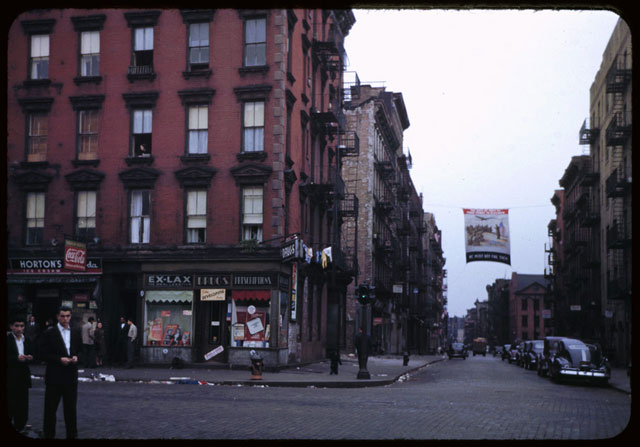
Does anyone know which corner this is? (Here’s another view.) I poked around on Google Maps for a bit trying to find it, but I fear that building is long gone…Canal St, particularly the western part, is much changed since the 1940s.
Everett Fahy, the former head of the European painting department at the Met, believes that one of the museum’s paintings by Francesco Granacci is actually by Michelangelo.
I believe Michelangelo painted it in 1506, two years before he started on the Sistine ceiling. It was already in my brain in 1971, the year after it was bought. When the Metropolitan showed it in 1971, I wrote for an exhibition called ‘Masterpieces of Fifty Centuries’ that the second panel recalled the figures in the Sistine Chapel. As years went by, it firmed up. I had long believed it to be by Michelangelo, but exactly when I don’t know. There wasn’t a moment when I suddenly said, ‘This is absolutely by Michelangelo.’ It was a gradual recognition.
One the clues Fahy used to make his determination involves the rocks in the painting; they resemble the quarry at which Michelangelo spent several months in 1497. The painting can be viewed larger on the Met’s website.
Accompanied by a New Yorker writer, Christopher Walken visits Astoria, Queens, the neighborhood he grew up in.
“Hello, my name is Chris Walken,” he said. “This is very nice of you. When I was little, I used to have my diaper changed on the kitchen table here.” He stayed in the kitchen, a polite house guest. After a minute, he said, “Well, this was very interesting. God bless and good luck!” (“This sounds silly,” he said later, “but the first thing that I can remember I was on my back, on that kitchen table, and the window facing the street was open. I remember this marvellous warm breeze coming in, so it was around June, and I was a couple of months old. And I turned my head and right next to me was a white plate with scrambled eggs on it. I can still see it.”)
(via clusterflock)
Pixelized video game characters lay waste to NYC.
Give it a few seconds to get going…things get good right around Tetris time.
Nice timelapse map view of taxi traffic across Manhattan.
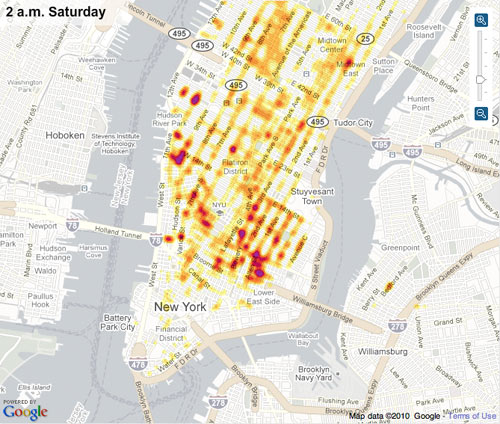
I’ve often wondered what an NYC version of Stamen’s Cabspotting project would look like.
If the population density of the United States was equal to that of Brooklyn, the entire US population would fit into New Hampshire.
The state would be ruined, though (imagine a Brooklyn-like sprawl of that size), but the rest of the country would be green and pleasantly devoid of people!
If you used Manhattan’s population density, Dense US would shrink to more than half that size, roughly the area of Teton County in Wyoming. Manila, the capital of the Philippines, has the highest population density of any city in the world (111,000 people per square mile)…if the US was that dense, the population would fit into any number of tiny Alaskan islands you’ve never heard of or a square 52 miles on a side.
NYC’s Board of Health has lifted the ban on keeping bees in the city.
The unanimous vote amends the health code to allow residents to keep hives of Apis mellifera, the common, nonaggressive honeybee. Beekeepers will be required to register with the Department of Health and Mental Hygiene and to adhere to appropriate practices. That means they must be able to control bee swarms and ensure that the hives do not interfere with pedestrians or neighbors.
Ten dollars says my wife utters the following words to me tonight: “we should raise some bees on the roof!”
Socials & More