Entries for August 2014

Oh man, this is great. A Spacecraft For All is an interactive video about the ISEE-3 Reboot Project, in which a group of scientists working out of an old McDonald’s crowdfunded an effort to communicate with a nearly forgotten satellite launched by NASA in 1978 to observe the Sun and chase a comet. After the intro, click on “See the Journey”…it’s well worth your time if you’re at all interested in space or science.
For instance, did you know there exists several points between the Earth and the Sun at which a satellite can orbit around, enabling spacecraft to stay more or less in the same spot for observation purposes? So cool!
New mixtape from The Hood Internet, the eighth in a hopefully infinite series. You know what to do.
The latest word on Homo floresiensis, the potential new species of hobbit-like humans discovered ten years ago in Indonesia, concerns a pair of papers which argue the single specimen found is actually a regular human with Down syndrome.
Now, the debate has reignited with two new papers published this week by a team of researchers from Penn State and other institutions. In one of those papers, they argue that the Flores skull is not a new species, but instead represents an ancient person with Down syndrome.
The researchers also point out, in the second paper, that the original report on the bones seemed to have exaggerated the skull’s diminutive size. Cranial measurements and features, along with shorter thigh bones, the team found, all correspond with modern manifestations of Down syndrome. “The difference is significant, and the revised figure falls in the range predicted for a modern human with Down syndrome from the same geographic region,” they say in a statement.
(via @daveg)
From Cameron Drake, a collection of animated GIFs of human x-rays, featuring the hand, elbow, shoulder, knee, and ankle. Imagine this, except in motion:

Here’s how Drake made them. (via bb)
Microsoft has developed software to transform shaky time lapse videos into impressively smooth hyperlapse movies. Take a look at a couple of examples.
Read more about the project on the Microsoft Research site.
[We’re all adults here (or reasonably mature humans anyway) so I rarely feel the need to warn you about what you might be getting yourself into, link-wise, but this article is REALLY disturbing in spots. If you have young children especially, you might want to take a pass on this. -jason]
From Luke Malone on Medium, a story about a support group of pedophiles who haven’t and don’t want to act on those impulses, You’re 16. You’re a Pedophile. You Don’t Want to Hurt Anyone. What Do You Do Now?
Anecdotal evidence suggests that most pedophiles first notice an attraction toward children when they themselves are between 11 and 16, mirroring that of any other sexual awakening. It can be a confusing time for any of us, but imagine realizing that you’re attracted to little kids. How do these young men and women negotiate that with no viable role models or support network? There is no It Gets Better for pedophiles. Are they all fated to end up as child molesters? Or is it possible for them to live a life without hurting children at all?
You may have heard a version of Malone’s story on This American Life earlier this year. Over at The Awl, Choire Sicha talked with Malone about his reporting of the story and how it came about.
People would eventually find out what I was working on, and the questions would come thick and fast: How did you find them? How can you stomach it? Why are you defending pedophiles? It was really telling about a person if they asked that last one. I get it, pedophiles get a bad rap and in many cases rightly so. But I found myself trying to convince people that there are plenty who don’t want to act and really want help not acting on their attractions. Which, side bar, would be a big ask of anyone. Imagine if you were told at 16 that you could never have sex in a way that was appealing to you, Okay, thanks, bye! There’s obviously a reason for that, but it makes no sense not to help them out. Anyway, most of my friends got it but a few were like, “Okay, but at the end of the day you have to put the kids first.” I would reply that talk of preventive therapy was putting both teenage pedophiles, who are essentially kids themselves by the way, and their potential victims first. It’s win win. But they’d think about it for a minute and reply, “Yeah, I get it, but we have to put the children first.” It was all very Helen Lovejoy.
According to testing by the folks at America’s Test Kitchen, you should not be thawing out your frozen steaks before you cook them. Mind. Blown. Into. Tiny. Pieces. Sweep. Me. Up. Pls.
Conventional wisdom holds that frozen steaks should be thawed before cooking, but we wondered if steaks could be cooked straight from the freezer. Cook’s Illustrated Senior Editor Dan Souza explains our cooking experiments.
They also apparently more-or-less deep fry their steak? Is that a thing that we should be doing? (via digg)
This morning’s jam is by Jungle.
Many videos and photo projects promise a glimpse of life inside North Korea “as you’ve never seen it”, but I believe this video by JT Singh and Rob Whitworth actually delivers the goods. It’s one of those 3-minute time lapse portraits of a city that are in vogue, with the North Korean capital Pyongyang as its subject.
Time lapse videos are interesting because they show movement over long periods of time. The Western conception of North Korea is of a place frozen in time, so the time lapse view is highly instructive. (thx, jeff)
Update: Sam Potts, who travelled to Pyongyang and North Korea in 2012 and took these photos, finds this “deeply fake as filmmaking”. From his Twitter acct:
Re the time lapse of Pyongyang video, it feels deeply fake as filmmaking, to me. Thus I mistrust it as a document of what real PY is like. You don’t see any of the details to that reveal, even in PY, how very poor a country it is. Some of those buses didn’t have tail lights. They had blocks of wood painted red to look like tail lights. And the library computers are incredibly poor quality.
Gizmodo’s Alissa Walker also noted the propaganda-ish nature of the video. At the very least, the video is a dual reminder of the limitations of time lapse video in showing the whole story and of how manipulative attractively packaged media can be.
In the latest installment of his excellent series Ask A Native New Yorker, Jake Dobkin tackles the question of how to react to those people holding clipboards asking if you have a minute for the environment or gay rights or whatever. The short answer is ignore them with “EXTREME PREJUDICE”.
This is because Clipboard People are grifters, who, in the name of various causes (Gay Rights, the Environment), have only a single aim: to get your credit card number authorized for recurring payments to a “charity.” In fact, the majority of that money does not go to the charity, but goes to pay the salary of the Clipboarder, and the evil canvas organizations that employ them. Even worse, the Clipboarders are themselves exploited-often young idealists from less vicious places, they are brought to New York on the promise of helping a charity they believe in, only to find out they’ve been dragooned into a commission-based predatory marketing scheme.
Well, good because that’s what I’ve been doing (for other reasons). Instead, give to an efficient charity listed on Charity Navigator.
To celebrate the 20th anniversary of the first Microsoft home page, the company has recreated that old page here. More here, including screenshots of subsequent designs.
In terms of “Web design,” the notion, much less the phrase, didn’t really exist.
“There wasn’t much for authoring tools,” Ingalls says. “There was this thing called HTML that almost nobody knew.” Information that was submitted for the new Microsoft.com website often came to Ingalls via 3-1/2-inch floppy disks.
“Steve Heaney and I put together PERL scripts that handled a lot of these daily publishing duties for us,” he says. “For a while, we ran the site like a newspaper, where we published content twice a day. And if you missed the cutoff for the publishing deadline, you didn’t get it published until the next running of the presses, or however you want to term it.”
Interestingly, Microsoft doesn’t seem to know exactly when the page first went live:
Based on the findings, it appears the website was launched during the time between HTML/1.0 (June 1993) and HTML/2.0 (Dec 1994).
I made a brief search of the NCSA What’s New Archive, where a web site for Microsoft should have been noted, and found nothing between June 1993 and September 1994. This piece written in 1999 about the beginnings of Microsoft’s site says the page launched in April 1994. I searched some early Usenet groups to no avail. Anyone have a more accurate date? (via waxy)
A wonderful interview with Werner Herzog on soccer, his wonderful fatherless upbringing, the nature of reality, and, of course, Mel Brooks.
I told Mel, “Mel, you know what, I have seen an extraordinary film. Something you must see. You must see. It’s only at midnight screenings at the Nuart Theater. And it’s a film by — I don’t know his name, I think it’s Lynch. And he made a film Eraserhead and you must see the film.” And Mel keeps grinning and grinning and lets me talk about the movie and he says, “Yes, his name is really David Lynch, do you like to meet him?” I said, “In principle, yes.” He says, “Come with me,” and two doors down the corridor is David Lynch in pre-production on The Elephant Man! Which Mel Brooks produced! And the bastard sits there and lets me talk and talk and talk and grins and chuckles. And I had no idea [and kept thinking], Why does he chuckle all the time when I talk about the film? But that was how I love Mel Brooks.
When Stewart Butterfield’s first game company wasn’t going all that well, he and his team decided to focus on one of the game’s features that enabled players to share images. Before long, Flickr had taken over the web, and in some ways, launched a new era of social media. So Stewart went back to his original passion. And his next game flopped. So he focused on an internal communication tool his team had built to better work on the game. That became a new product called Slack. And Slack could be huge. In Wired, Mat Honan does an excellent job tracing the career of Stewart Butterfield, and in doing so, paints a very accurate portrait of the evolution of the start-up world: The most fascinating profile you’ll ever read about a guy and his boring startup.
Using Motorola, Nokia, and Nintendo as examples, Tero Kuittinen explains how dominant tech companies are lulled into “a comfy trip to the grave” by huge but ultimately short-lived successes before new paradigms take over.
For years, Nintendo has believed it could reject smartphone and tablet apps, yet still flourish. The reason for this delusion is familiar — it’s the toxic Last Blockbuster Syndrome that doomed the consumer electronics divisions of Motorola in 2004 and Nokia in 2007. Often at the start of a massive trend shift in consumer electronics, dominant dinosaurs get one massive hit built on a nearly obsolete paradigm, and that allows them to be lulled into a comfy trip to the grave.
The best example from the past few years is when Motorola, Nokia, and RIM were flying high with their phone products when the iPhone came along and changed the game.
A harrowing piece by novelist Helen DeWitt about being stalked by her neighbor.
E turned up next morning at six because his fire had gone out. I said I had to go for my walk. He went home. When I got back I found a pane of glass on the dresser; there was a gap in its normal home in the side door. E: ‘I was cold and you weren’t there. But yeah, yeah, I know that was wrong. Don’t worry, I’ll fix it.’
This was clearly something I could report to the police. It seemed harsh to lock someone up for social cluelessness, but I was spooked. I packed my bags and left for a motel within the hour. Then I found a room on Craigslist that was available until the end of January. I was desperate to finish a book.
E’s landlord: ‘You’re a very attractive woman. He can’t help himself. I’m sorry you can’t live on your property.’
It’s a big leap from ‘you know I love her’ to baseball bat by the bed. I read the Vermont law on trespass on 28 December 2012 and it appeared to confirm my sense of the social norm. Entering a property when forbidden to do so, or remaining on a property after being asked to leave, carries a maximum sentence of three months and/or a $500 fine. It’s not a heavy sentence, but the law is beautifully genderblind: I have the same right to occupy my property undisturbed as my uncle the ex-marine. I believed I could exercise this right and attempted to do so. This was the first step on the slippery slope to the baseball bat.
Yobi3D is a search engine for finding 3D objects. Here’s a search for “horses”:

This is pretty neat…all the objects are zoomable and rotatable in the browser. (via prosthetic knowledge)
From the gaming laboratory at CERN (??!), Particle Clicker is like Cookie Clicker but about particle physics. As in, you actually learn about particle physics while you’re playing.
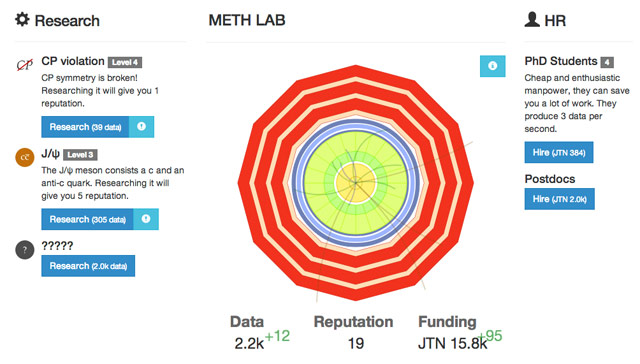
I am addicted to these damn things. Send help. (via waxy)
From James Marsh, the director of the excellent Man on Wire, a biopic of physicist Stephen Hawking and his first wife, Jane. Here’s the first trailer:
The film is based on a book by Jane Hawking, Travelling to Infinity: My Life with Stephen.
In this compelling memoir, his first wife, Jane Hawking, relates the inside story of their extraordinary marriage. As Stephen’s academic renown soared, his body was collapsing under the assaults of motor neurone disease. Jane’s candid account of trying to balance his 24-hour care with the needs of their growing family reveals the inner-strength of the author, while the self-evident character and achievements of her husband make for an incredible tale presented with unflinching honesty.
As promising as this looks, the Kanye in me needs to remind you that Errol Morris’ A Brief History of Time is the best film about Stephen Hawking of all time. OF ALL TIME.
Michael Jordan and Kobe Bryant played against each other in only eight NBA games, but none of the games took place with both players in their prime. Their first few meetings, dominated by Jordan, happened during Kobe’s first and second NBA seasons, when he was an impulsive and unpolished teen. Their final meetings, dominated by Bryant, found an out-of-retirement Jordan on the hapless Washington Wizards, pushing 40 years old.
But more than any other two marquee players in NBA, Jordan and Kobe have played with very similar styles. Like almost identically similar, as this video clearly shows:
The first 15 seconds of the video is a fantastic piece of editing, stitching together similar moves made by each player into seamless single plays. And dang…even the tongue wagging thing is the same. How many hours of Jordan highlight reels did Kobe watch growing up? And practicing moves in the gym?
As an aside, and I can’t believe I’m saying such a ridiculous thing in public, but I can do a pretty good MJ turnaround fadeaway. I mean, for a 6-foot-tall 40-year-old white guy who doesn’t get a lot of exercise and has never had much of a vertical leap. I learned it from watching Jordan highlights on SportsCenter and practicing it for hundreds of hours in my driveway against my taller next-door neighbor. I played basketball twice in the past month for the first time in years. Any skills I may have once had are almost completely gone…so many airballs and I couldn’t even make a free throw for crying out loud. Except for that turnaround. That muscle memory is still intact; the shots were falling and the whole thing felt really smooth and natural. I think I’ll still be shooting that shot effectively into my 70s. (via devour)
Today I learned that iconic designer Milton Glaser co-wrote a column for New York magazine (which he co-founded) about where to find cheap-but-good food in NYC. It was called The Underground Gourmet. Here’s a typical column from the October 27, 1975 issue, reviewing a ramen joint in Midtown called Sapporo that is miraculously still around:
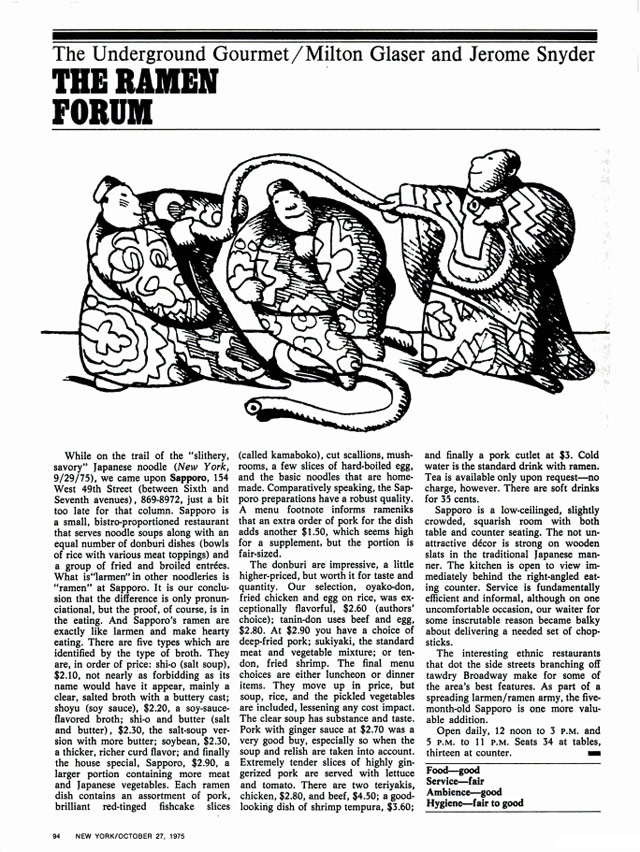
Glaser and his co-authior Jerome Snyder eventually packaged the column into a series of books, some of which you can find on Amazon…I bought a copy this morning.
I found out about Glaser’s food enthusiasm from this interview in Eye magazine about The Underground Gourmet and his long collaboration with restaurateur Joe Baum of the Rainbow Room and Windows on the World.
We just walked the streets … When friends of ours knew we were doing it we got recommendations.
There were parts of the city where we knew we could find good places … particularly in the ethnic parts. We knew if we went to Chinatown we would find something if we looked long enough, or Korea Town, or sections of Little Italy.
More then than now, the city was more locally ethnic before the millionaires came in and bought up every inch of space. So you could find local ethnic places all over the city. And people were dying to discover that. And it was terrific to be able to find a place where you could have lunch for four dollars.
In 2010, Josh Perilo wrote an appreciation of The Underground Gourmet in which he noted only six of the restaurants reviewed in the 1967 edition had survived:
Being obsessed with the food and history of New York (particularly Manhattan), this was like finding a culinary time capsule. I immediately dove in. What I found was shocking, both in the similarities between then and now, and in the differences.
The most obvious change was the immense amount of restaurants that no longer existed. These were not landmarked establishments, by and large. Most of them were hole-in-the wall luncheonettes, inexpensive Chinese restaurants and greasy spoons. But the sheer number of losses was stunning. Of the 101 restaurants profiled, only six survive today: Katz’s Delicatessen, Manganaro’s, Yonah Schimmel’s Knishes Bakery, The Puglia and La Taza de Oro. About half of the establishments were housed in buildings that no longer exist, especially in the Midtown area. The proliferation of “lunch counters” also illustrated the evolution of this city’s eating habits. For every kosher “dairy lunch” joint that went down, it seems as though a Jamba Juice or Pink Berry has taken its place.
Man, it’s hard not get sucked into reading about all these old places…looking forward to getting my copy of the book in a week or two.
Update: Glaser’s co-author Jerome Snyder was also a designer…and no slouch either.
For the NY Times, Nick Bilton writes about uBeam, Meredith Perry’s startup that is working on wireless electricity. Sounds like the company is on track to deliver a product in a couple of years.
Ms. Perry’s company, uBeam, announced on Wednesday that it took an early prototype concept of this technology, first developed for Ms. Perry’s college innovation competition, and turned it into a fully functional prototype that the company now plans to build for consumers.
“This is the only wireless power system that allows you to be on your phone and moving around a room freely while your device is charging,” Ms. Perry said in an interview. “It allows for a Wi-Fi-like experience of charging; with everything else you have to be in close range of a transmitter.”
That is some future shit right there. (via @tcarmody)

Photographer David Slater wants Wikipedia to remove his photograph of a monkey taking a photo of itself but Wikipedia has refused, saying that as the monkey was the photographer, Slater has no right to the copyright to the photo.
The Gloucestershire-based photographer now claims that the decision is jeopardising his income as anyone can take the image and publish it for free, without having to pay him a royalty. He complained to Wikimedia that he owned the copyright of the image, but a recent transparency report from the group, which details all the removal requests it has received, reveals that editors decided that the monkey itself actually owned the copyright because it was the one that pressed the shutter button.
But shouldn’t Wikipedia take it down anyway because they don’t have the monkey’s permission to release the photo into the public domain? (I mean, probably not…monkeys don’t have any rights under the law, yes?) (via @capndesign)
Update: A previous version of this post stated that Wikipedia said that the monkey held the copyright. They said no such thing…that was my poor paraphrase. In the US at least, monkeys obviously can’t hold copyrights. From the Compendium II of Copyright Office Practices, section 202.02(b) states:
The term “authorship” implies that, for a work to be copyrightable, it must owe its origin to a human being. Materials produced solely by nature, by plants, or by animals are not copyrightable.
Interesting phrase, “owe its origin to”…perhaps Slater has a point. (via @stvnrlly)
Update: According to a recent 1000+ page document produced by the US Copyright Office, a photograph taken by a monkey is “unprotected intellectual property”.
The US Copyright Office, in a 1,222-page report discussing federal copyright law, said that a “photograph taken by a monkey” is unprotected intellectual property.
“The Office will not register works produced by nature, animals, or plants. Likewise, the Office cannot register a work purportedly created by divine or supernatural beings, although the Office may register a work where the application or the deposit copy state that the work was inspired by a divine spirit,” said the draft report, “Compendium of US Copyright Office Practices, Third Edition.”
Update: PETA has filed a lawsuit on behalf of the monkey photographer, seeking to award the copyright and any sales proceeds to the monkey. Alt headline: PETA Thinks Famous Monkey Photographer Is Too Stupid To Manage Own Money.



These sculptures by Gerry Judah for the Goodwood Festival of Speed are amazing. Here’s how they made the Mercedes arch for this year’s festival. (via ministry of type)
Peter Sims writes about an under-appreciated aspect of Steve Jobs’ success: he “was a superb collaborator with the people who he respected and trusted”.
[Ed] Catmull, now president of both Pixar as well as Walt Disney Animation (a position Catmull has held since Disney acquired Pixar for $7.4 billion in 2006), was Jobs’ longest-running colleague, a working relationship that spanned 26 years. Catmull dedicates a chapter of his superb recent book Creativity, Inc. to what it was like to work with Jobs. Catmull, who has the least overt ego of any senior executive I’ve ever met, saw Jobs mature enormously over time, especially in the development of personal empathy and humility.
In fact, Catmull, sees Jobs’ life as having taken a classic Hero’s Journey arc.
From his widely-reported immature and often arrogant youth, Jobs by all accounts appeared to develop into a far more empathetic human being and wise leader. But that personal transformation would not have happened without what leadership scholar Warren Bennis described as “crucibles” — those personal crises and setback experiences that shape us much like “medieval alchemists used in their attempts to turn base metals into gold” — and, that allow for personal and leadership metamorphosis.
The “far more” qualifier in front of “empathetic” is necessary when speaking of Jobs’ transformation. I think what he developed could probably be referred to as a ruthless empathy, employed much like another other tool in the service of building great companies and making great products.
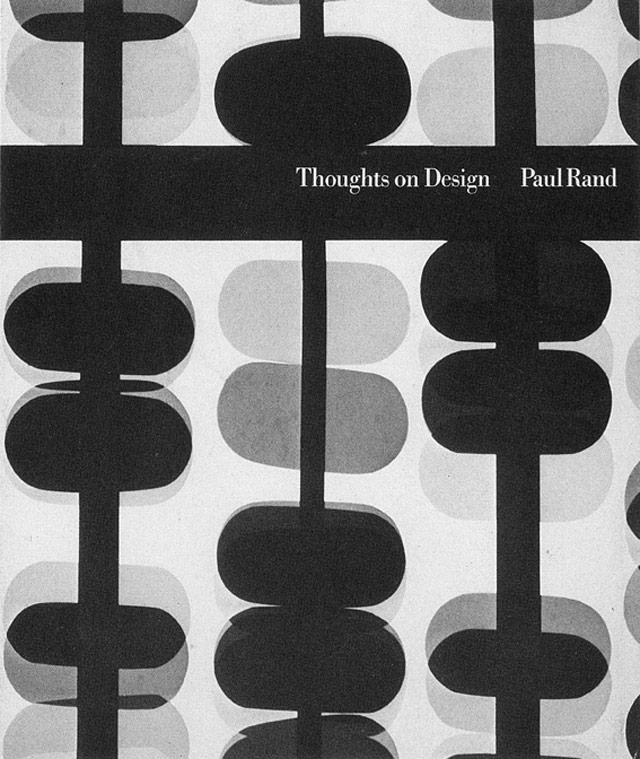
Legendary designer Paul Rand’s Thoughts on Design is back in print for the first time since the 1970s. The new version, which will be out on Aug 19, is available for preorder and comes with a foreword by Michael Bierut.
One of the seminal texts of graphic design, Paul Rand’s Thoughts on Design is now available for the first time since the 1970s. Writing at the height of his career, Rand articulated in his slender volume the pioneering vision that all design should seamlessly integrate form and function. This facsimile edition preserves Rand’s original 1947 essay with the adjustments he made to its text and imagery for a revised printing in 1970, and adds only an informative and inspiring new foreword by design luminary Michael Bierut. As relevant today as it was when first published, this classic treatise is an indispensable addition to the library of every designer.
Sight and Sound polled 340 critics and filmmakers in search of the world’s best documentary films. Here are their top 50. From the list, the top five:
A Man with a Movie Camera
Shoah
Sans soleil
Night and Fog
The Thin Blue Line
Unless you went to film school or are a big film nerd, you probably haven’t seen (or even heard of) the top choice, A Man with a Movie Camera. Roger Ebert reviewed the film several years ago as part of his Great Movies Collection.
Born in 1896 and coming of age during the Russian Revolution, Vertov considered himself a radical artist in a decade where modernism and surrealism were gaining stature in all the arts. He began by editing official newsreels, which he assembled into montages that must have appeared rather surprising to some audiences, and then started making his own films. He would invent an entirely new style. Perhaps he did. “It stands as a stinging indictment of almost every film made between its release in 1929 and the appearance of Godard’s ‘Breathless’ 30 years later,” the critic Neil Young wrote, “and Vertov’s dazzling picture seems, today, arguably the fresher of the two.” Godard is said to have introduced the “jump cut,” but Vertov’s film is entirely jump cuts.
If you’re curious, the film is available on YouTube in its entirety:
(via open culture)
Christopher Nolan + Matthew McConaughey + space + doomed Earth. Oh man, this is looking like it might actually be great. Or completely suck.
Please don’t suck, please don’t suck, please don’t suck, please don’t suck, please don’t suck, please don’t suck, please don’t s (via @aaroncoleman0)
Halt and Catch Fire just ended its first season last night and while the show wasn’t perfect, I loved almost every single minute of it. (In Time, James Poniewozik writes about why the series was so interesting.) Even haters of the show can agree that one of the best aspects of the 80s period drama is the music. There are several playlists of the music on Rdio…this seems to be the best one.
Each main character from the show also has their own playlist. Joe MacMillan: Brian Eno, Eurythmics, and The Cars. Cameron Howe: Blondie, The Clash, and The Slits. Gordon Clark: Creedence, Eric Clapton, and Dire Straits. Donna Clark: Mozart, Joni Mitchell, and Billy Joel.
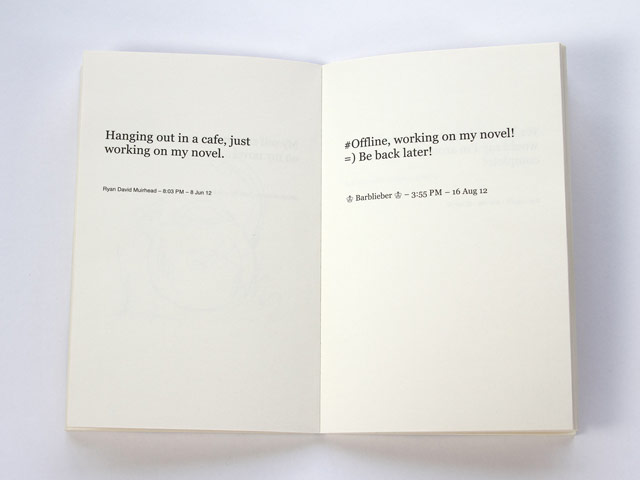
From artist Cory Arcangel, Working On My Novel is a book comprised of tweets from people who posted they were working on their novels.
What does it feel like to try and create something new? How is it possible to find a space for the demands of writing a novel in a world of instant communication? Working on My Novel is about the act of creation and the gap between the different ways we express ourselves today. Exploring the extremes of making art, from satisfaction and even euphoria to those days or nights when nothing will come, it’s the story of what it means to be a creative person, and why we keep on trying.
Arcangel also ran a blog that reposted “I’m sorry I haven’t posted” posts from other blogs.

The Digital Atlas of the Roman Empire lets you explore ancient Rome in a Google Maps interface. (via @pbump)
Update: From Vox, 40 Maps That Explain the Roman Empire.
Two thousand years ago, on August 19, 14 AD, Caesar Augustus died. He was Rome’s first emperor, having won a civil war more than 40 years earlier that transformed the dysfunctional Roman Republic into an empire. Under Augustus and his successors, the empire experienced 200 years of relative peace and prosperity. Here are 40 maps that explain the Roman Empire — its rise and fall, its culture and economy, and how it laid the foundations of the modern world.
Physicist Andy Howell recently gave a talk about the science of Star Wars and wrote up a summary of it for Ain’t It Cool News. Topics covered include binary star systems, droids, the Death Star, and lightsabers:
Of course, we still don’t know how to make a lightsaber. One big problem is confining plasma (if that is even what it is), into some tube. But a bigger problem is the amount of energy required. We can actually calculate this from clues in the movies!
In Episode I, Qui-Gon jabs his lightsaber into a door, and melts part of it. That’s just basic physics! To melt something, you have to raise its temperature to the melting point, and you can calculate how much energy that takes using the specific heat capacity of a material.
(thx, greg)
Alarming reports out of Japan are saying that super-animation studio Studio Ghibli is closing!
Just moments ago, Toshio Suzuki, Studio Ghibli producer, announced on the TV show of the MBS Jounetsu Tairiku chain effectively as announced as sources close to the studio, Studio Ghibli will close and production studio anime, leaving himself only as a company that will manage its trademarks. As stated in the program’s producer, “the production department of anime will be dismantled,” which coincides with the data that we gave in our previous post on this decision had been taken from spring after the poor reception at the box office of Kaguya-hime no Monogatari.
Luckily those reports appear to be overblown and poorly translated. As Kotaku explains, Suzuki’s comments were much more speculative in nature:
Suzuki’s wording makes it sound like the studio is considering reorganization and regrouping. It could mean that Studio Ghibli decides it won’t make anime films anymore. Though it could mean they do keep making anime films. It could mean a lot of things!
Realize that, at the time of writing, no major Japanese newspaper is running this story. Nor did any morning TV shows. Had Studio Ghibli — a national treasure — definitively ceased production of films, it would be headline news around the country, as it would be important in both the entertainment and business worlds.
(via @tcarmody)
Erik Malinowski takes a baseball commercial that used to air late nights on ESPN in the ’90s and ’00s, and uses it to trace the effect of technology on sports.
“He was the first guy I ever knew who used video as a training device in baseball,” says Shawn Pender, a former minor-league player who would appear in several of Emanski’s instructional videos. “There just wasn’t anyone else who was doing what he did.”
It’s also something of a detective story, since its subject Tom Emanski has virtually fallen off the face of the earth:
Fred McGriff is surely correct that nearly two decades of video sales — first through TV and radio and now solely through the internet — made Emanski a very wealthy man, but this perception has led to some rather outlandish internet rumors.
According to one, the Internal Revenue Service investigated Emanski in 2003 for unpaid taxes and, in doing so, somehow disclosed his estimated net worth at around $75 million. There’s no public record of such an investigation ever having taken place or been disclosed, and an IRS spokesman for the Florida office would say only that the agency is “not permitted to discuss a particular or specific taxpayer’s tax matter or their taxes based on federal disclosure regulations and federal law.”
Douglas Wolk isn’t happy with the long-awaited James Brown biopic Get On Up:
Treating Brown’s personality as the interesting thing about him means that Taylor doesn’t end up saying much about Brown’s music, the fascinating way it was made, or the colossal effect it had on the culture around it. As far as Get On Up is concerned, James Brown was an unstoppable personality more than he was a musician; the film suffers from “the Great Man theory of funk.”
Brown’s songs… were collaborative and process-based, more than any other pop star’s work: Both on record and on stage, Brown directed and instructed the band, restructuring arrangements on the fly… In Get On Up, though, there’s no sense that anyone else’s voice mattered to him. Brown’s right-hand man and backup singer Bobby Byrd (played as a hapless second banana by True Blood’s Nelsan Ellis) morosely explains that James is a genius whose coattails he’s lucky enough to ride, and that he himself wasn’t meant to be a frontman. The Byrd who had a decadelong string of R&B hits with Brown backing him up—the best-remembered is “I Know You Got Soul”—might have disagreed.
Here two bad cultural fallacies come together: treating artists like self-contained auteurs and thinking every movie has to be an origin story. In the best stories, like in reality, everything and everyone is in medias res.
Hi, everybody! Tim Carmody here, guest-hosting for Jason this week.
On Monday, I tried to list some reasons why OKCupid’s self-acknowledged experiments on its users didn’t seem to be stirring up the same outrage that Facebook’s had. Here at the end of the week, I think I was largely right: fewer people are upset, the anger is more tempered, and that has a lot to do with the reasons I gave. But one reaction I didn’t expect is that some people took it as saying that I wasn’t upset by what OKCupid did, or that people shouldn’t be as upset by it.
What OKCupid did has actually made me madder and madder as the week’s gone on, but for reasons that are different from other people’s. I think this is pretty important, so I’m going to try to explain why.
Let’s start with the Facebook “social contagion” study. Most Facebook critics focused on the people who were the subjects of the study, for good reasons. Did these users give consent? Can terms of service count as consent for an academic study? Should they have been informed of the study afterwards? Is Facebook responsible for any harm these users might have suffered? Is an increase or decrease in engagement really a sign that users’ emotions were affected? How else has Facebook attempted to influence its users, or might try in the future? These are all good questions.
But what if you flip it around? What if you weren’t one of the subjects whose moods Facebook was trying to study, but one of their friends or family? What if you were one of the people whose posts were filtered because your keywords were too happy, too angry, or too sad?
I think there’s no way to know whether the Facebook study may have harmed people who weren’t being studied. And even though the TOS basically says that users give Facebook permission to do whatever they want not only with the users’ data, but all of their friends’ too, you can’t call that consent with a straight face. (This is just another reason that software terms of service are a rotten legal and ethical basis for research. They just weren’t built for that reason, or to solve any of those problems.)
So Facebook didn’t just mess around with some of its users’ feeds, hoping to see if it might mess around with their feelings. It used some of its users’ posts in order to do it. Arguably, it made them complicit.
To be clear, filtering posts, giving preference to some and not others, is how Facebook’s newsfeed algorithm always works. Facebook users have been complaining about this for a long time, especially brands and news organizations and other companies who’ve built up their subscriber counts and complain that hardly anybody ever sees their posts unless they pay off Facebook’s ad department. And Facebook makes no guarantees, anywhere, that they’re going to deliver every message to every user who’s subscribed to it. Readers miss posts all the time, usually just because they’re just not looking at the screen or reading everything they could see. Facebook isn’t certified mail. It’s not even email. All this is known.
However.
We all buy in to Facebook (and Twitter, and OKCupid, and every other social media network), giving them a huge amount of personal data, free content, and discretion on how they show it to us, with the understanding that all of this will largely be driven by choices that we make. We build our own profiles, we select our favorite pictures, we make our own friends, we friend whatever brands we like, we pick the users we want to block or mute or select for special attention, and we write our own stories.
Even the filtering algorithms, we’re both told and led to assume, are the product of our choices. Either we make these choices explicitly (mute this user, don’t show me this again, more results like these) or implicitly (we liked the last five baby pictures, so Facebook shows us more baby pictures; we looked at sites X, Y, and Z, so we see Amazon ads for people who looked at X, Y, and Z.) It’s not arbitrary; it’s personalized. And it’s personalized for our benefit, to reflect the choices that we and the people we trust have made.
This is what makes the user-created social web great. It’s the value it adds over traditional news media, traditional classified ads, traditional shopping, everything.
We keep copyright on everything we write and every image we post, giving these services a broad license to use it. And whenever the terms of service seem to be saying that these companies have the right to do things we would never want them to do, we’re told that these are just the legal terms that the companies need in order to offer the ordinary, everyday service that we’ve asked them to do for us.
This is why it really stings whenever somebody turns around and says, “well actually, the terms you’ve signed give us permission to do whatever we want. Not just the thing you were afraid of, but a huge range of things you never thought of.” You can’t on one hand tell us to pay no attention when you change these things on us, and with the other insist that this is what we’ve really wanted to do all along. I mean, fuck me over, but don’t tell me that I really wanted you to fuck me over all along.
Because ultimately, the reason you needed me to agree in the first place isn’t just because I’m using your software, but because you’re using my stuff. And the reason I’m letting you use my stuff, and spending all this time working on it, is so that you can show it to people.
I’m not just a user of your service, somebody who reads the things that you show it to me: I’m one of the reasons you have anything that you can show to anyone at all.
Now let’s go back to the OKCupid experiment. Facebook didn’t show some of its users posts that their friends wrote. But at least it was a binary thing: either your post was shown, just as you wrote it, or it wasn’t. OKCupid actually changed the information it displayed to users.
You can pick nits and say OKC didn’t change it, but rather, just selectively repressed parts of it, deleting photos on some profiles and text on others. But if you’ve ever created a profile on any web site, you know that it’s presented as being a whole ensemble, the equivalent of a home page. The photos, the background, the description, the questions you answer: taken altogether, that’s your representation of yourself to everyone else who may be interested. It’s the entire reason why you are there.
Now imagine you’re an OKCupid user, and you strike up a conversation with someone or someone strikes up a conversation with you. You assume that the other person has all of your information available to them if they’re willing to look at it. That’s the basis of every conversation you have on that site. Except they don’t. The profile that OKCupid has implicitly promised they’ll show to everyone who looks at it has been changed. The other person either doesn’t know what you look like (and assumes you can’t be bothered to post a photo) or doesn’t know anything else about you (and assumes you can’t be bothered to write anything about yourself.) Both of you have been deceived, so the site can see what happens.
This is why I question the conclusion that OKC users who were only shown profiles with pictures are shallow, because their conversations were almost as long as the ones who were shown full profiles. This is how I imagine those conversations going:
Rosencrantz: So what do you do?
Guildenstern: Um I work in marketing?
Rosencrantz: That’s great! Where did you go to school?
Guildenstern: I went to UVA
Guildenstern: Wait a minute are you some kind of bot?
Rosencrantz: What makes you say that?
Guildenstern: You keep asking me questions that are in my profile, did you even read it
Rosencrantz: I’m looking at it right now, why didn’t you answer any of the questions
Guildenstern: lol I guess you can’t read nice pic though goodbye
That’s a high-value interaction by the OKC researchers’ standards, by the way.
This is also why I don’t have much patience with the idea that “The worst thing could have happened [with the OkCupid testing] is people send a few more messages, and maybe you went on a date you didn’t like.” (Rey Junco told this to ReadWrite to explain why he thought Facebook’s study was worse than OKCupid’s, but you see versions of this all over.)
First, going on “a date you didn’t like” isn’t a frivolous thing. It definitely incurs more material costs than not seeing a Facebook status. And bad (or good) messages or a bad or good date can definitely have a bigger emotional impact as well.
More importantly, though, don’t make this just a question about dates or feelings, about what somebody did or didn’t read and what its effect on them was. I don’t care if you think someone making a dating profile is a frivolous thing. Somebody made that. They thought the company hosting it could be trusted to present it honestly. They were wrong.
So this is the problem I see not just with Facebook and OKCupid’s experiments, but with most of the arguments about them. They’re all too quick to accept that users of these sites are readers who’ve agreed to let these sites show them things. They don’t recognize or respect that the users are also the ones who’ve made almost everything that those sites show. They only treat you as a customer, never a client.
And in this respect, OKCupid’s Christian Rudder and the brigade of “and this surprises you?” cynics are right: this is what everybody does. This is the way the internet works now. (Too much of it, anyway.) It doesn’t matter whether your site is performing interventions on you or not, let alone publishing them. Too many of them have accepted this framework.
Still, for as long as the web does work this way, we are never only these companies’ “products,” but their producers, too. And to the extent that these companies show they aren’t willing to live up to the basic agreement that we make these things and give them to you so you will show them to other people — the engine that makes this whole world wide web business go — I’m not going to have anything to do with them any more. What’s more, I’ll get mad enough to find a place that will show the things I write to other people and tell them they shouldn’t accept it either. Because, ultimately, you ought to be ashamed to treat people and the things they make this way.
It’s not A/B testing. It’s just being an asshole.
Update: OKCupid’s Christian Rudder (author of the “We Experiment On Human Beings” post) gave an interview to Alex Goldman and PJ Vogt for On the Media’s TLDR podcast.
Rudder says some of the negative response “is my own fault, because, y’know, the blog post is sensationally written, for sure.” But he doesn’t back off of that tone one bit. In fact, he doubles down.
Alex Goldman: Have you thought about bringing in, say, like an ethicist to, to vet your experiments?
Christian Rudder, founder of OkCupid: To wring his hands all day for a hundred thousand dollars a year?… This is the only way to find this stuff out. If you guys have an alternative to the scientific method, I’m all ears.
I think he maybe should have just written the blog post and left it alone.
Update: University of Maryland Professor of Law James Grimmelmann say that not only were OKCupid’s and Facebook’s studies unethical, but they were illegal.
Most of the resulting discussion has treated this as a story about ethics. Which it is — and the lapses of ethical judgment shown by Facebook and OkCupid are scandalous. But the ethics are only half of the story. What Facebook and OkCupid did wasn’t just unethical. It was illegal. A common assumption is that even if research laws ought to apply to private companies, they don’t. But that assumption is false. Facebook and OkCupid are bound by research laws, and those research laws quite clearly prohibit what they did.
For August, the writers at HiLobrow will have a month of appreciations of fonts and typefaces, lovingly titled “Kern Your Enthusiasm.” Matthew Battles kicks things off with the legendary Aldine Italic developed for Venetian publisher Aldus Manutius, a new set of metal letters that helped jumpstart a little thing we call the Renaissance.
When Aldus put the first version of a typeface we call italic to use in 1501, the printing press had been proliferating in Europe for half a century. In other words, it was about as old as the computer is now. It was a time of immense invention and swiftly spun variety in the printed book, and a time of new mobility and independence of thought and activity among certain classes of people as well — and the combination of new ways and new tools meant new kinds of books. Crucially, the book was getting smaller, small enough to act not only as a desktop, but as a mobile device.
Previous HiLobrow series include “Kirb Your Enthusiasm” (on Jack Kirby), “Kirk Your Enthusiasm” (on Star Trek’s Captain Kirk) and “Herc Your Enthusiasm” (on old school hip-hop, where I contributed a short thing on Afrika Bambaataa.)
Thesis: the quality of every movie starring Samuel L. Jackson varies directly with the number of times he says “motherfucker.” I feel like somebody at 538 should get on this.
Whenever I think about how Sam Jackson says “motherfucker,” I can’t get this Supremes song out of my head.
Whenever you’re near, I hear a symphony
Play sweet and tenderly
Every time your lips meet mine, now, baby, baby, baby
You bring much joy within
Don’t let this feeling end
Let it go on and on and on, now, baby, baby, baby
Those tears that fill my eyes
I cry not for myself
But for those who’ve never felt the joy we felt (baby)
(via @igorbobic by way of @daveweigel)
Update: In mid-2013, Filmdrunk calculated that since joining Twitter, Samuel L. Jackson has spelled “motherfucker” no fewer than 151 different ways.

Yesterday, I was looking for a GIF of two people missing a high-five (as one does) and the top hits I got back were all of New England Patriots quarterback Tom Brady.
I thought, “the three-time Super Bowl winner and one of his wide receivers trying to high-five and missing each other’s hands? That’s pretty funny!” Oh no. What is funnier still is Brady trying to high-five one or more of his teammates and the other players totally ignoring him. What’s even funnier than that? This has happened over and over again.
Against the Ravens:

Against the Saints:

And against the Steelers. (These are all just from last season, and all Patriots wins, by the way):

Nobody likes a pity five.
NFL Films even made a “Give Brady a high-five” video, which led to this spoof PSA:
If Glenn Burke and the 1977 Dodgers show us the original spirit of the high-five, Tom Brady and the 2013 Patriots show us that the high-five evangelist’s work is never done.
(via Boston.com and SB Nation)
Meg Jayanth was asked to adapt Around the World in Eighty Days into a steampunk-y iOS adventure game. The only problem? She hated the book’s character Aouda, the English-imperialist-fantasy of an Indian princess who falls in love with Phineas Fogg. But what if “the damsel-in-distress is actually a sabre-wielding revolutionary leader, where she is not only not in need of rescuing, but in fact, sees herself as rescuer?”
This begs a larger question: is it possible to write a game in which your protagonist isn’t the hero? Or maybe, less provocatively: can you write a game in which your protagonist isn’t the only hero? …
[“80 Days” is] a world where the protagonist’s story of racing around the world isn’t necessarily the most important, or the most interesting one available to the player.
(via @robinsloan and @aaronissocial)
Newer posts






Socials & More