Entries for June 2014
An instant classic John Gruber post about the sort of company Apple is right now and how it compares in that regard to its four main competitors: Google, Samsung, Microsoft, and Amazon. The post is also about how Apple is now firmly a Tim Cook joint, and the company is better for it.
When Cook succeeded Jobs, the question we all asked was more or less binary: Would Apple decline without Steve Jobs? What seems to have gone largely unconsidered is whether Apple would thrive with Cook at the helm, achieving things the company wasn’t able to do under the leadership of the autocratic and mercurial Jobs.
Jobs was a great CEO for leading Apple to become big. But Cook is a great CEO for leading Apple now that it is big, to allow the company to take advantage of its size and success. Matt Drance said it, and so will I: What we saw last week at WWDC 2014 would not have happened under Steve Jobs.
This is not to say Apple is better off without Steve Jobs. But I do think it’s becoming clear that the company, today, might be better off with Tim Cook as CEO. If Jobs were still with us, his ideal role today might be that of an eminence grise, muse and partner to Jony Ive in the design of new products, and of course public presenter extraordinaire. Chairman of the board, with Cook as CEO, running the company much as he actually is today.
This bit on the commoditization of hardware, and Apple’s spectacularly successful fight against it, got me thinking about current events. Here’s Gruber again:
Apple’s device-centric approach provides them with control. There’s a long-standing and perhaps everlasting belief in the computer industry that hardware is destined for commoditization. At their cores, Microsoft and Google were founded on that belief - and they succeeded handsomely. Microsoft’s Windows empire was built atop commodity PC hardware. Google’s search empire was built atop web browsers running on any and all computers. (Google also made a huge bet on commodity hardware for their incredible back-end infrastructure. Google’s infrastructure is both massive and massively redundant - thousands and thousands of cheap hardware servers running custom software designed such that failure of individual machines is completely expected.)
This is probably the central axiom of the Church of Market Share - if hardware is destined for commoditization, then the only thing that matters is maximizing the share of devices running your OS (Microsoft) or using your online services (Google).
The entirety of Apple’s post-NeXT reunification success has been in defiance of that belief - that commoditization is inevitable, but won’t necessarily consume the entire market. It started with the iMac, and the notion that the design of computer hardware mattered. It carried through to the iPod, which faced predictions of imminent decline in the face of commodity music players all the way until it was cannibalized by the iPhone.
And here’s David Galbraith tweeting about the seemingly unrelated training that London taxi drivers receive, a comment no doubt spurred by the European taxi strikes last week, protesting Uber’s move into Europe:
Didn’t realize London taxi drivers still have to spend years learning routes. That’s just asking to be disrupted http://en.wikipedia.org/wiki/Taxicabs_of_the_United_Kingdom#The_Knowledge
Here’s the relevant bit from Wikipedia about The Knowledge:
It is the world’s most demanding training course for taxicab drivers, and applicants will usually need at least twelve ‘appearances’ (attempts at the final test), after preparation averaging 34 months, to pass the examination.
Uber, in this scenario, is attempting to be Microsoft in the 1980s and early 90s. They’re implementing their software layer (the Uber service) on commodity hardware, which includes not only iPhones & Android phones, mass-produced cars of any type, and GPS systems but also, and crucially, the drivers themselves. Uber is betting that a bunch of off-the-shelf hardware, “ordinary” drivers, and their self-service easy-pay dispatch system will provide similar (or even better) results than a fleet of taxi drivers each with three years of training and years of experience. It is unclear to me what the taxi drivers can do in this situation to emulate the Apple of 1997 in making that commoditization irrelevant to their business prospects. Although when it comes to London in particular, Uber may have miscalculated: in a recent comparison at rush hour, an Uber cab took almost three times as long and was 64% more expensive than a black cab.
Paul Ford writes about the connection between kitty litter and internet culture. In short, kitty litter led to house cats which led to cat memes.
Certainly Ed Lowe in 1947 could never have predicted the memes and clickbait that would follow, but he figured out a fundamental rule that applies today as well as it did back then. If you want to change the world, fill a bag with dirt and give it a name. The world will come running.
Last year, Kevin Slavin argued that the protozoan parasite Toxoplasma gondii is engineering people to create online cat memes. Well, which is it fellas? Is kitty litter responsible for Nyan Cat or is Toxoplasma gondii to blame?
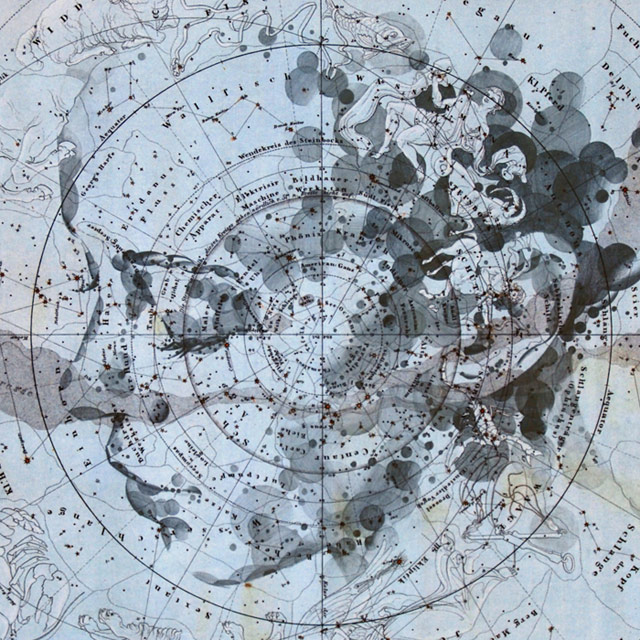
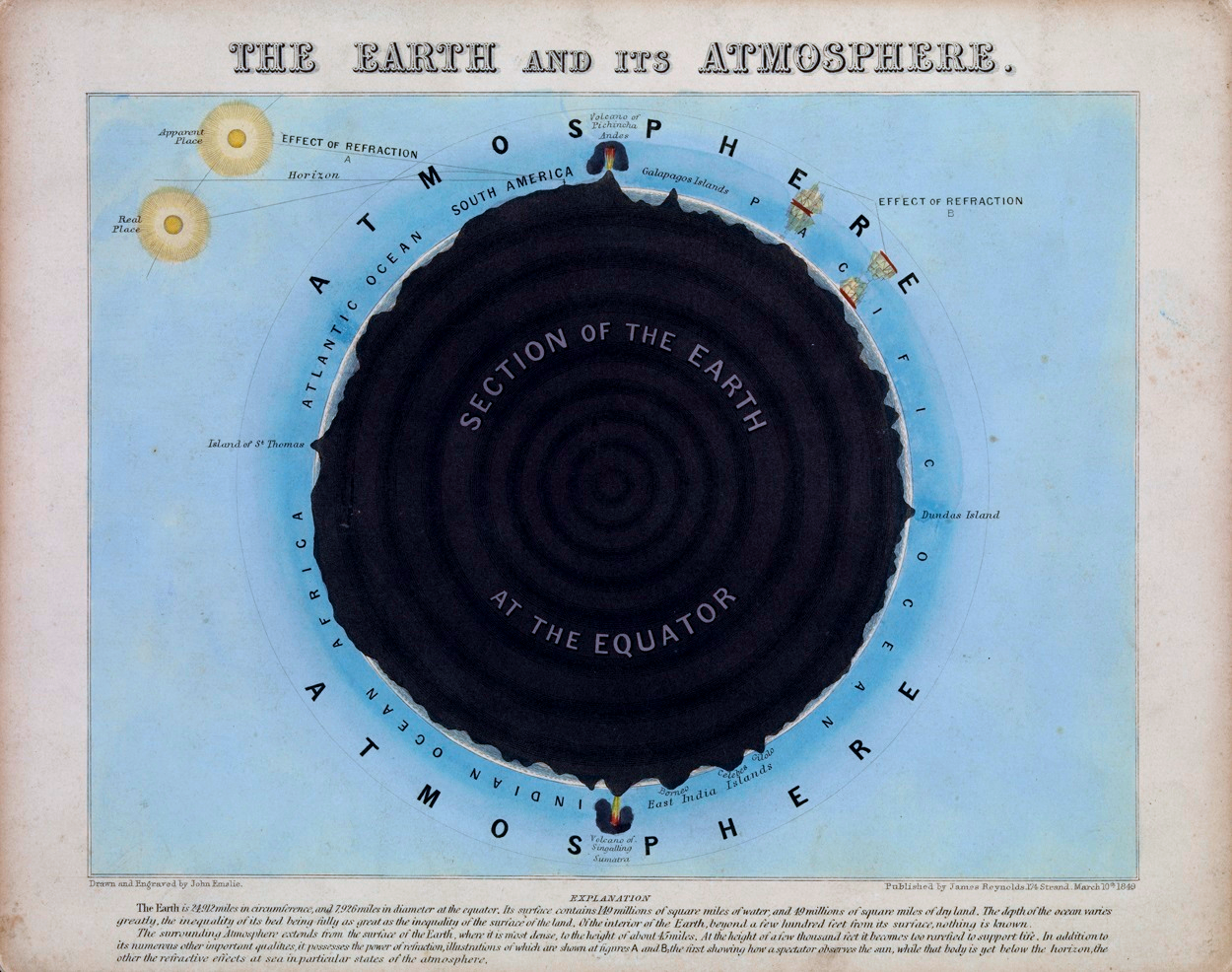
These maps, diagrams, and charts by John Philipps Emslie done in the mid-to-late 1800s are gorgeous.
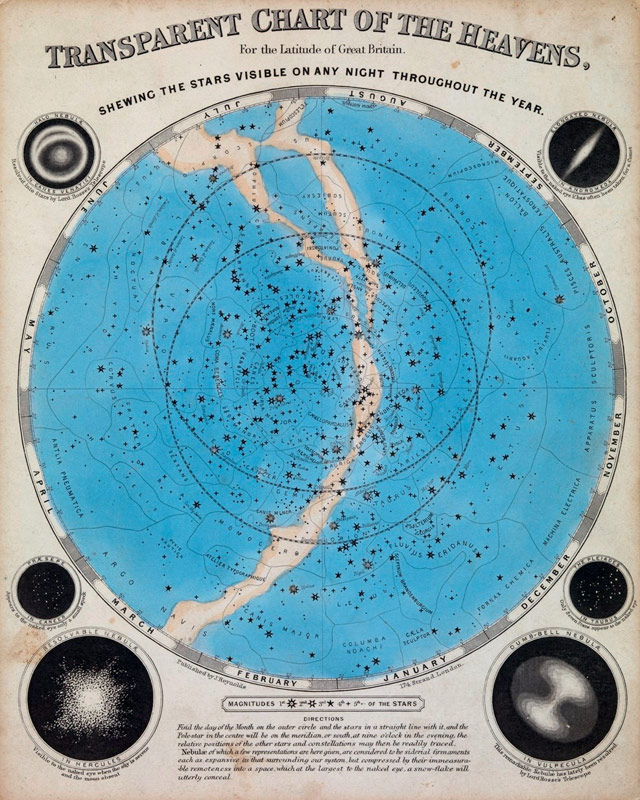
Intrigued, I went searching for more examples. I loved this one just for pure compositional beauty:
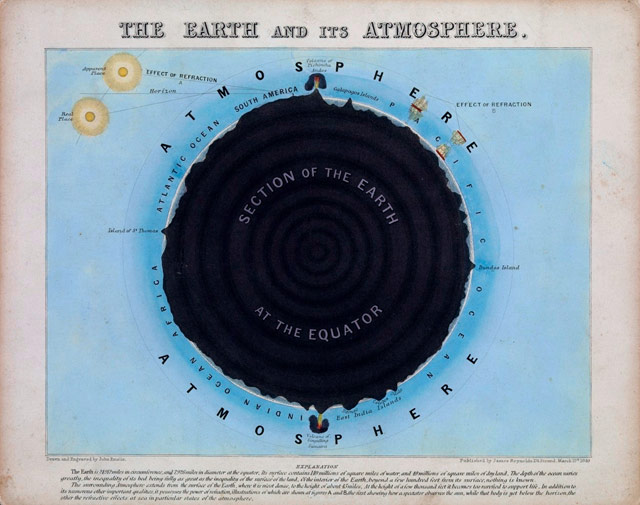
And this lithograph from 1850 showing various machines of the time:

(thx, greg)
The NY Times has an interactive look at the balls used in the World Cup from 1930 onward. Here’s the ball from 1930:

Look at those laces! Just like the ol’ American handegg.
I’ve seen the waterfalls and the hot springs and the rocky desolation, but I didn’t know that Iceland was also this:



I mean, come on. Photos by Max Rive, Menno Schaefer, and Johnathan Esper. Many more here. (via mr)
Journalist Miles O’Brien lost his left arm in February. He wrote about the experience and what he’s learned from it so far for New York magazine.
But here are two things you need to know about life after an arm amputation: First, your center of gravity changes dramatically when you are suddenly eight pounds lighter on one side of your body. Second, while my arm may be missing physically, it is there, just as it always has been, in my mind’s eye. I can feel every digit. I can even feel the watch that was always strapped to my left wrist. When I tripped, I reached reflexively to break my very real fall with my completely imaginary left hand. My fall was instead broken by my nose, and my nose was broken by my fall.
Lying on that sidewalk, moaning in pain, I reached the end of Denial River and flowed into the Sea of Doubt. It finally dawned on me in that instant that I was, indeed, handicapped. That may not be the term of choice these days — “differently abled” or “physically challenged” may be de rigueur — but as I touched my bloody face, feeling embedded chips of concrete in the wounds, “handicapped” sure seemed to fit.
The woman I was passing on the sidewalk when I fell took one look at me and cried out in panic to her husband: “My God, what’s happened to his arm?” “It’s gone,” I said. “But don’t worry, that didn’t happen today.”
O’Brien also mentions he’s tried mirror therapy pioneered by V.S. Ramachandran, which I’ve written about previously.
Here’s Louis C.K. at 20 years old doing a stand-up routine in Boston in 1987.
Thankfully, he got better. A lot better. Even 3-4 years later he was better…and wait, is that Phil Hartman in the audience at ~2:45?! (via open culture)
Dang, Tesla just announced they’re letting anyone use their patented technology. CEO Elon Musk:
Yesterday, there was a wall of Tesla patents in the lobby of our Palo Alto headquarters. That is no longer the case. They have been removed, in the spirit of the open source movement, for the advancement of electric vehicle technology.
Tesla Motors was created to accelerate the advent of sustainable transport. If we clear a path to the creation of compelling electric vehicles, but then lay intellectual property landmines behind us to inhibit others, we are acting in a manner contrary to that goal. Tesla will not initiate patent lawsuits against anyone who, in good faith, wants to use our technology.
Damn good move for a damn good reason. It’s impressive to watch this company in action.
Update: I read that last line quoted above again and perhaps “abandoned” is too strong a word. Glenn Fleishman notes on Twitter:
They did not abandon their patents. They aren’t apparently even licensing them. They are stating they won’t sue except defensively. The devil is in the details. Twitter released a complete framework of their policy when they announced the same thing.
Hopefully Musk and co. will clarify what they mean by “in good faith”.
Today at 3pm, I’m going to pick up my 6-year-old son and his friends at school and bring them back to my place for his early birthday party. We’re going to watch The Lego Movie, eat popcorn, scarf pizza, and demolish a bunch of mini cupcakes. Everyone is excited.
Today at 3pm, Eric Meyer and his family will be holding a funeral service for his 6-year-old daughter. Rebecca Meyer died on Saturday on her 6th birthday after a months-long battle against cancer. I have been following along as Eric has written beautifully and powerfully about his daughter’s illness and the family’s search for treatments. Each new piece of bad news was tough to read, and her death devastated me.
Sometimes parents tend to get caught up in the minutia of parenthood: the logistics of getting from one place to another without losing your shit, the weary deflection of the 34th “why?” question of the afternoon, and all the rest. At least, I know I do. You forget to lift your head up to appreciate what you have. Author Elizabeth Stone once wrote that having kids was deciding to “have your heart go walking around outside your body”. Steve Jobs put it similarly: your children are “your heart running around outside your body”. That’s the truest sentiment I’ve ever read about parenting; it feels exactly like that to me. Reading Eric’s writing about Rebecca, a girl so close in age to both my kids, has affected me greatly. That could be me. My kids suffering. My heart, broken and dying. Imagining one of them…I can’t even do it, the tears come hard and fast, washing away any such thoughts.
Those dark sad thoughts of mine have to be but a tiny fraction of what Eric and his family are feeling right now and in the months to come. Their heart is gone forever. Eric, I will be thinking about you and your family this afternoon even as we celebrate our happy event, while appreciating what I have more than ever. Rest in peace, Rebecca.
Note: In memory of Rebecca, the text of this post is purple, her favorite color.
A group led by Dr. Robert Costanza has calculated the value of the world’s ecosystems…the group’s most recent estimate puts the yearly value at $142.7 trillion.
“I think this is a very important piece of science,” said Douglas J. McCauley of the University of California, Santa Barbara. That’s particularly high praise coming from Dr. McCauley, who has been a scathing critic of Dr. Costanza’s attempt to put price tags on ecosystem services.
“This paper reads to me like an annual financial report for Planet Earth,” Dr. McCauley said. “We learn whether the dollar value of Earth’s major assets have gone up or down.”
The group last calculated this value back in 1997 and it rose sharply over the past 17 years, even as those natural habitats are disappearing. This line from the article stunned me:
Dr. Costanza and his colleagues estimate that the world’s reefs shrank from 240,000 square miles in 1997 to 108,000 in 2011.
Coral reefs shrank by more than half over the past 17 years…I had no idea the reef situation was that bad. Jesus.
The IPPAWARDS has been judging an iPhone photography competition since 2007 and they recently announced the winners of their 2014 competition.
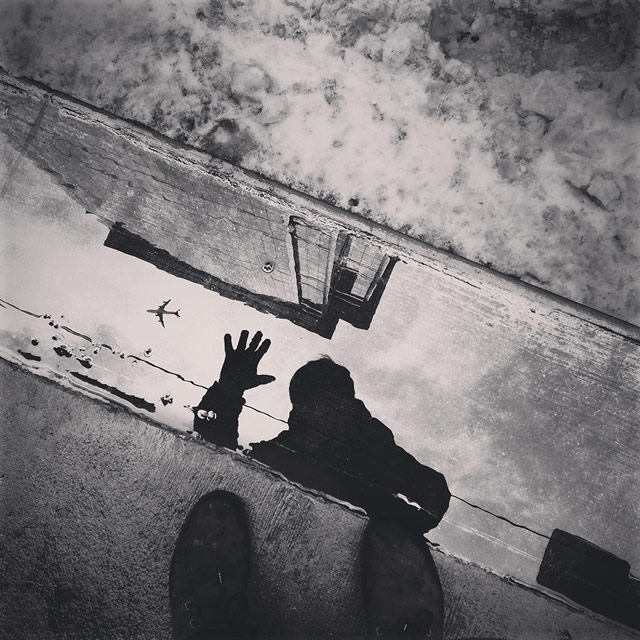

Impressive stuff. I’ve been saying recently that the iPhone 5s is the best camera in the world. Looking back on the 2008 winners, it becomes apparent how much more comfortable photographers have become wielding this increasingly powerful device. (via the verge)
The Pew Research Center has data and visualizations showing how much more polarized Americans have become about their politics over the past 20 years.
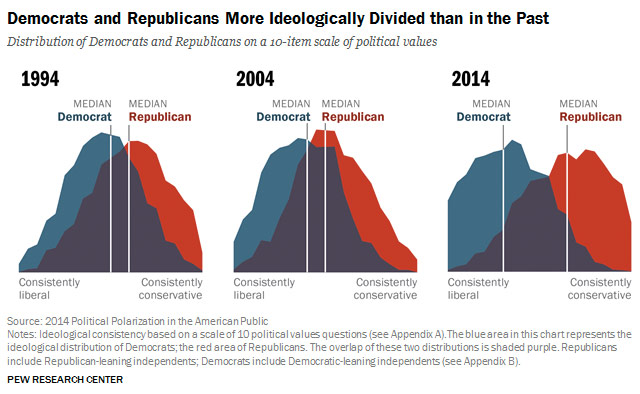
In 1994, the overlap was much greater than it is today. Twenty years ago, the median Democrat was to the left of 64% of Republicans, while the median Republican was to the right of 70% of Democrats. Put differently, in 1994 23% of Republicans were more liberal than the median Democrat; while 17% of Democrats were more conservative than the median Republican. Today, those numbers are just 4% and 5%, respectively.
Even more pronounced is the shift by the Republican members of Congress toward the right.
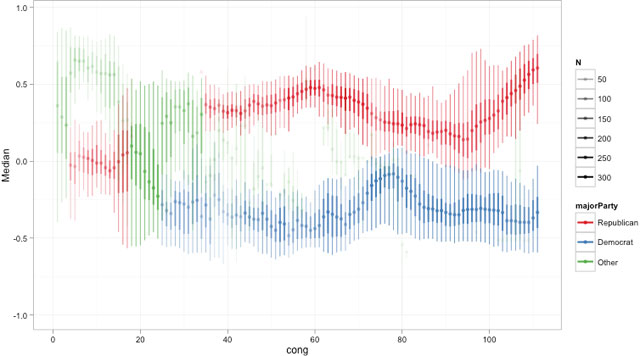
(via @mulegirl)
We’ve been listening to this quite a bit at home lately: Motown: The Complete No. 1’s.
That’s more than twelve hours of music, from The Miracles to Erykah Badu. Some of it, particularly from the 80s, is not so great, but as you listen, you’re of course reminded of how great Stevie Wonder is. Rdio has more than 40 additional hours of Stevie for your listening pleasure. More than 30 hours of the Jackson 5. Hundreds more hours of The Supremes, Marvin Gaye, The Temptations, Commodores, Diana Ross, and on and on. And that’s just riffing off of one album in one genre. Freely choosing from an infinite buffet of choices is a completely different way of listening to music than any of us grew up with (unless you had tons of money or worked in a record store). For me, it’s been an incredible way to take advantage of Tyler Cowen’s observation that there’s way more good unheard stuff in the back catalog than there is new music…e.g. if you haven’t heard John Coltrane’s The Complete 1961 Village Vanguard Recordings, it’s likely to be better than most new music you’ll hear this year.
Felix Salmon, who used to blog for Reuters but now works for a new cable TV network, interviews Jonah Peretti of Buzzfeed, a site best known for its lists and snackable meme content, for a site called Matter which is in turn published by Medium. Medium tells us the interview will take 91 minutes to read. Also, I am writing this from the Buzzfeed office and Jonah is a friend of mine.
Jonah is not your typical media mogul, however. He’s smarter than most, and more accessible, and also much happier than many to share his thoughts. Which is why I asked Jonah if he’d be interested in talking to me over an extended period. To my delight, he said yes, and we ended up having four interviews spanning more than six hours.
The resulting Q&A is long, for which I make no apologies. You’ll learn a lot about Jonah Peretti and how he thinks - but you’ll also learn a great deal about the modern media world, the way the Internet has evolved, and the way that Jonah has evolved with it.
If you want to learn the secret of how Jonah managed to build two of the world’s most important online media properties, you’ll find that here, too. Which brings me to another way in which Jonah differs from most other moguls. If you succeed in building something similarly successful as a result, he will be cheering you all the way.
I am looking forward to someone publishing the highlights of this. (via @choire)
Update: Here’s an attempt at some crib notes. (via @tgeorgakopoulos)
Great short film about how ILM’s groundbreaking visual effects came to be used in Jurassic Park.
When Spielberg originally conceived the movie, he was going to use stop-motion dinosaurs. ILM was tasked with providing motion blur to make them look more realistic. But in their spare time, a few engineers made a fully digital T. Rex skeleton and when the producers saw it, they flipped out and scrapped the stop-motion entirely. Fun story.
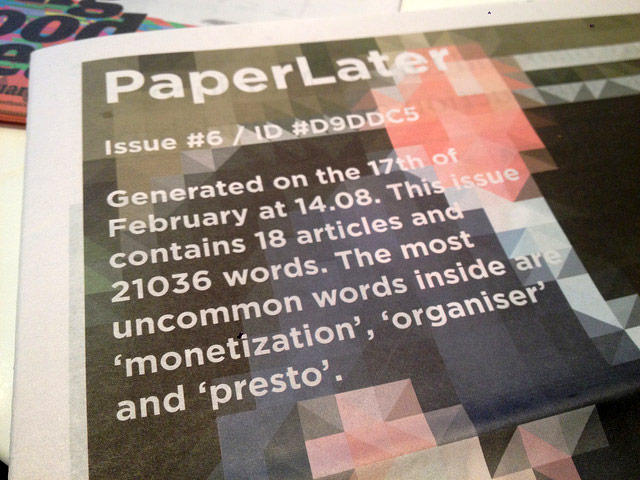
PaperLater is a new service by Newspaper Club. You bookmark articles you want to read and they print it up as a newspaper. Basically a print version of Instapaper.
Rex Sorgatz on how rare media doesn’t really exist anymore.
With access to infinite bytes of media, describing a digital object as “rare” sticks out like a lumbering anachronism. YouTube - the official home of lumbering anachronisms - excels at these extraordinarily contradictory moments. Here, for instance, are the Beatles, performing a “VERY RARE” rendition of “Happy Birthday”. That sonic obscurity has been heard 2.3 million times. And here is a “Rare Acoustic” version of Slash performing “Sweet Child O’ Mine”. Over 26 million have devoured this esoteric Axl-less morsel.
One way or another, Bitcoin is going to be huge. It could be the as big as the Internet, it could transform into something else, or it could be one of tech’s biggest busts. Meanwhile, many of us are still wondering exactly what it is (it’s both a currency and means of transporting that currency). GQ’s Marshall Sella decided to score some of this newfangled dough and “blow it on all the pleasures that Bitcoin can buy.” Sex, Drugs, and Toasters: My Life on Bitcoin.
Within two months, I’d be visiting Charlie Shrem at his parents’ place, where he was wearing an ankle monitor and living under house arrest.
(That sounds like the beginning of every great startup story.)
Kwe’Shaun Parker is a 6’2” high-school sophomore and recently threw down one of the sickest dunks of the year:
Dang! I mean, DANG! Here’s Parker last year as a freshman doing some equally amazing stuff:
(via @cory_arcangel)
After thumbing through a copy at my local bar the other night, I’ve had my eye on Jeffrey Morgenthaler’s new book, The Bar Book: Elements of Cocktail Technique.
Written by renowned bartender and cocktail blogger Jeffrey Morgenthaler, The Bar Book is the only technique-driven cocktail handbook out there. This indispensable guide breaks down bartending into essential techniques, and then applies them to building the best drinks. More than 60 recipes illustrate the concepts explored in the text, ranging from juicing, garnishing, carbonating, stirring, and shaking to choosing the correct ice for proper chilling and dilution of a drink. With how-to photography to provide inspiration and guidance, this book breaks new ground for the home cocktail enthusiast.
I’ve been beefing up my home bar over the past few weeks and hopefully this book will help me along in the technique department. Nothing in there about catching glasses behind your back, but no book is perfect, I guess. (thx, gabe)
From Grantland’s Mike Goodman, a guide to nerding out about soccer, using the language already spoken by American sports nerds.
What exactly is a good shot in soccer? The nascent field of soccer analytics is hard at work trying to figure that out. It won’t surprise anybody to learn that closer is better, and using your feet is much, much better than using your head. So, much like getting into the lane is of paramount importance in basketball, getting the ball at your feet in front of the goal is just about the best thing you can do in soccer. Getting to the byline (baseline) in the corner of the penalty areas (like where Maicon was in the above video) is a hot destination. That’s where you can cut the ball back for a teammate to have one of those coveted close shots. Hey, look at that - it’s like basketball again: Get to the goal or get to the corners.
I saw the trailer for the new Planet of the Apes movie last night and it looks amazing, but that’s not what I came to talk about. A recent paper shows that chimps do better in some strategy games than humans.
Chimps play the cat and mouse game very well. First, the chimps converge on the Nash Equilibrium strategies. In one set of games the Nash equilibrium strategies had randomization frequencies of .5, .75 and .8 and the chimps played .5, .73 and .79. Second, when payoffs change the chimps adapt their strategies very quickly simply by observation of outcomes.
Camerer et al. also tested humans in similar games and they found that humans often deviate from NE play and they adjust their strategies more slowly when payoffs change, i.e. they learn more slowly! The only thing that Camerer didn’t do was to play humans against chimps in the same game. That would have been awesome!
But that’s nothing compared to this video of a chimp remembering the placement of nine numbers on a screen after seeing them for less than a quarter of a second:
That’s a literal jaw-dropper there.
Anthony Richardson is back, offering his British commentary on American sports. This time it’s hockey:
Mary Poppins, look how small the goals are, the size of a matchbox guarded by an overzealous beekeeper.
See also Bad British NFL commentary and Bad British baseball commentary.

For three years, Nick Kokonas’s trio of eating/drinking establishments in Chicago (Next, Alinea, and Aviary) has been using a ticketed reservation system. In this epic piece, Kokonas details why they started using tickets and what the effect has been (emphasis mine):
Our ticket implementation strategy at Alinea was to create a “higher-touch” system than we had previously used at Next. Every customer buying a ticket at Alinea must include a cell phone number where we can reach them. About a week before they dine with us we call every customer to thank them for buying a ticket to Alinea, ask if they have any dietary restrictions or special needs, and generally get a feel for their expectations and whether it is a special occasion. We can, in fact, spend more time (not less) with every single one of our customers because we are only speaking with the customers we know are coming to dine with us. Previously, we answered thousands of calls from people we had to say ‘no’ to. Now we can take far more time to say ‘yes’.
The results on Alinea’s business are staggering. Bottom line EBITDA profits are up 38% from previous average years. No shows of full tables are almost non-existent and while partial no-shows still occur they are only a handful of people per week at most. That allows us to run at a far greater capacity with less food waste and more revenue.
Will be interesting to see if more restaurants adopt this model…I bet a bunch of restaurateurs’ eyes lit up at the 38% increase in profit. But not every restaurant is Alinea and not every restaurateur is a clever former derivatives trader.
A supercomputer running a program simulating a 13-year-old boy named Eugene has passed the Turing Test at an event held at London’s Royal Society.
The Turing Test is based on 20th century mathematician and code-breaker Turing’s 1950 famous question and answer game, ‘Can Machines Think?’. The experiment investigates whether people can detect if they are talking to machines or humans. The event is particularly poignant as it took place on the 60th anniversary of Turing’s death, nearly six months after he was given a posthumous royal pardon.
If a computer is mistaken for a human more than 30% of the time during a series of five minute keyboard conversations it passes the test. No computer has ever achieved this, until now. Eugene managed to convince 33% of the human judges that it was human.
I’m sure there will be some debate as members of the AI and computing communities weigh in over the next few days, but at first blush, it seems like a significant result. The very first Long Bet concerned the Turing Test, with Mitch Kapor stating:
By 2029 no computer — or “machine intelligence” — will have passed the Turing Test.
and Ray Kurzweil opposing. The stakes are $20,000, but the terms are quite detailed, so who knows if Kurzweil has won.
Update: Kelly Oakes of Buzzfeed dumps some cold water on this result.
Of course the Turing Test hasn’t been passed. I think its a great shame it has been reported that way, because it reduces the worth of serious AI research. We are still a very long way from achieving human-level AI, and it trivialises Turing’s thought experiment (which is fraught with problems anyway) to suggest otherwise.
Calvin and Hobbes artist/professional recluse Bill Watterson quietly collaborated with Pearls Before Swine’s Stephan Pastis to write and draw a short sequence of comics that appeared in newspapers this week.
Let me tell you. Just getting an email from Bill Watterson is one of the most mind-blowing, surreal experiences I have ever had. Bill Watterson really exists? And he sends email? And he’s communicating with me?
But he was. And he had a great sense of humor about the strip I had done, and was very funny, and oh yeah….
…He had a comic strip idea he wanted to run by me.
Now if you had asked me the odds of Bill Watterson ever saying that line to me, I’d say it had about the same likelihood as Jimi Hendrix telling me he had a new guitar riff. And yes, I’m aware Hendrix is dead.
So I wrote back to Bill.
“Dear Bill,
I will do whatever you want, including setting my hair on fire.”
All Watterson asked was that the original artwork be auctioned off for charity, and that Pastis not reveal the trick until it was complete.
Pastis did tip his hand a little on Twitter — how could he not? — writing that “this week’s Pearls strips will contain a mind-blowing surprise,” which led some people to take a good look at the artwork (and the lettering — it’s the lettering that gives it away) and put two and two together.
In an interview, Watterson tells the Washington Post’s Michael Cavna that the motivating impulse for his temporary return was to raise money for a charity founded by Post cartoonist (and close Watterson friend) Richard Thompson:
Thompson, a longtime Washington Post artist who lives in Arlington, Va., ended his Reuben Award-winning syndicated strip “Cul de Sac” in 2012 as he underwent therapy and surgery to treat his Parkinson’s; Watterson is an enormous fan of Thompson’s, and the two now have a dual exhibit at Ohio State University’s Billy Ireland Cartoon Library & Museum in Columbus.
“I thought maybe Stephan and I could do this goofy collaboration and then use the result to raise some money for Parkinson’s research in honor of Richard Thompson,” Watterson tells me. “It just seemed like a perfect convergence.”
The conceit of this week in Pearls Before Swine is that the cartoonist protagonist meets his neighbor Libby, who takes over drawing his comic. (Libby is in second grade, roughly the same age as Calvin, and her name is a play on “Bill.”)
My favorite of the strips is easily Thursday’s, where a talking-head pig and mouse are interrupted by a beautifully-drawn Martian robot attack.
“I could do better if I had more space,” Libby gripes — a nod to Watterson’s famous insistence on only syndicating the Sunday strip of Calvin and Hobbes if it could be printed in full.
But the whole week is worth reading. Start with Monday’s and keep clicking right until you run out of Libby. And let us never cease from exploration, but at the end of all our exploring arrive where we started and know the place for the first time.
(Thanks to Bill Wasik, Susie Cagle, and TS Eliot)
Louis C.K. sat down with Jonah Weiner for an extended interview where he discusses learning how to fix cars, tell jokes, fry chicken, and more. (Seriously, Medium is milking that whole time spent reading thing now.) He also gives some clues as to what he seems to be up to in the current season of Louie:
JW: You’ve talked about how you’ve had to explain moral lessons to your daughters, but do it in a catchy way. It’s almost as though you’re writing material for them. What’s the place of morality and ethics in your comedy?
I think those are questions people live with all the time, and I think there’s a lazy not answering of them now, everyone sheepishly goes, “Oh, I’m just not doing it, I’m not doing the right thing.” There are people that really live by doing the right thing, but I don’t know what that is, I’m really curious about that. I’m really curious about what people think they’re doing when they’re doing something evil, casually. I think it’s really interesting, that we benefit from suffering so much, and we excuse ourselves from it. I think that’s really interesting, I think it’s a profound human question…
I think it’s really interesting to test what people think is right or wrong, and I can do that in both directions, so sometimes it’s in defense of the common person against the rich that think they’re entitled to this shit, but also the idea that everybody has to get handouts and do whatever they want so that there’s not supposed to be any struggle in life is also a lot of horseshit. Everything that people say is testable.
At the LA Review of Books, Lili Loofbourow has a good essay about Louie’s abrupt shifts in perspective, in the context of its recent rape-y episodes. There’s Louie the dad, who garners sympathy and acts as a cover/hedge/foil to Louie’s darker impulses. There’s standup Louie, who acts as a commentary and counterpoint to dramedy Louie… except when he doesn’t, and the two characters blur and flip.
Louie is — despite its dick-joke dressing — a profoundly ethical show… Louie is sketching out the psychology of an abuser by making us recognize abuse in someone we love. Someone thoughtful and shy, raising daughters of his own, doing his best. Someone totally cognizant of the issues that make him susceptible to the misogyny monster. Someone who thinks hard about women and men and still gets it badly wrong.
I had to stop watching Louie after Season 1. I raced greedily through those episodes, enjoying the dumb jokes and the sophisticated storytelling, and telling my friends, “this is like looking at my life in ten years.” Then my wife and I separated and that joke wasn’t funny any more, if it ever was. The things in Louie that are supposed to indicate the cracks in the fourth wall — the African-American ex-wife and the seemingly white children — are actually true in my life. His character is more like me than his creator is (except Louie has more money). No haha, you’re both redheads with beards. It’s an honest-to-goodness uncanny valley. I had to walk away.
At the same time, I feel like I understand Louis C.K., the comedian/filmmaker, better now than I did three years ago. If you read that interview, you see someone who’s more successful now than he’s ever been, who knows he’s good at what he does, but who’s never been certain that anyone’s ever loved him or if he’s ever been worthy of love.
Now America loves Louis C.K. and hangs on his every word: on gadgets, on tests in school, on what’s worth caring about. How can he not want to test those limits? How can he not want to punish his audience for caring about a character based on him that he doesn’t even like very much?
A short profile of writer/editor Roger Angell, still coming in to work most days at The New Yorker at age 93:
Angell saw Babe Ruth in his prime, but he never writes sentimentally about baseball, a sport that has inspired many sports-writers to produce reams of awful, faux-poetic prose. His habit of telling it straight is what makes his nine books hold up and keeps him relevant today. “I don’t go for nostalgia,” he says. “I try not to. It’s so easy to sentimentalize the good old days, but I don’t ever do that. I’m aware that things have changed, but I try not to go there. It’s very easy, and you get sort of a mental diabetes. All that goo. I am a foe of goo, maybe too much so.”
Angell’s extended essay “This Old Man” offers an extended dose of that lucidity.
Here in my tenth decade, I can testify that the downside of great age is the room it provides for rotten news. Living long means enough already. When Harry [Angell’s fox terrier] died, Carol and I couldn’t stop weeping; we sat in the bathroom with his retrieved body on a mat between us, the light-brown patches on his back and the near-black of his ears still darkened by the rain, and passed a Kleenex box back and forth between us. Not all the tears were for him. Two months earlier, a beautiful daughter of mine, my oldest child, had ended her life, and the oceanic force and mystery of that event had not left full space for tears. Now we could cry without reserve, weep together for Harry and Callie and ourselves. Harry cut us loose.
Anyone who’s been writing for a long time has tools they like and come to depend on; one of Angell’s is a discontinued Mead three-subject notebook:
The best notebook in the world. David Remnick and I talk about how you can’t get anything to replace the Mead notebook, which is unavailable now. They take ink perfectly. There is a great flow. All the other notebooks are coated with something so your pen slides along.
“In recent years, when he goes on reporting trips,” Angell’s interviewer notes, “he has resorted to making use of old Mead notebooks that still have blank pages.”
Today is National Donut/Doughnut Day, apparently a relatively venerable holiday with roots in a Depression-era Salvation Army giveaway. But just how do you spell that “edible, torus-shaped piece of dough which is deep-fried and sweetened”?
The Official Dictionary Spelling of the word in question—if you’re into that sort of thing—is “doughnut.” The expedited, simplified, Americanized spelling of “donut,” as Grammarist tells us, has been around since at least the late 19th century. It didn’t catch on, though, until late in the 20th century.
Why? That’s when Massachusetts-based chain Dunkin’ Donuts first started taking off — so thank (or blame) Dunkin’ for the popularity of the “Donut” spelling.
Historically, I’ve bowed to usage on this one and spelled it “donut” (just like I use “catalog” and other Americanized spellings that are more than a century old). But Dick Wisdom has an informal survey that shows that even professional publications are torn on which spelling to prefer. Even that quintessentially British, infinitely rule-observing Reuters has been known to publish either spelling.
As a professional journalist, I’ve learned to follow the style guide and keep my private grumblings about grammar and usage confined to Twitter, email, IRC, and viva voce conversation. So for clarity, I asked: what does Jason do? (I did the same thing yesterday to decide whether or not to put “Lego” in all-caps.)
For kottke.org, Jason overwhelmingly prefers “donut.” The vast majority of “doughnut” spellings found on the site are direct quotes (which kottke.org normally does not adapt to match house style). There are some really fun posts about donuts, too, including 2003’s “A Fun Thing I’ll Do Again”:
I have tasted a donut so hot and delicious that I burned my fingers eating it but did not stop to put it down. I have eaten foie gras creme brulee and heard tale of a foie gras donut.
Still, even here, we see a stray native spelling of “doughnut”:
This video is too long and come frontloaded with too much explanation, but like a jelly doughnut, there’s some goodness in the middle
So here, like at Reuters, Wired, Gawker, and the BBC, the lesson seems to be to do what you feel.
PS: How cool is the word “torus”? Finally, a way to describe a donut’s shape without saying “donut-shaped”!
(Links via @phillydesign, @bydanielvictor)
For the World Cup, the managers of Mexico, Bosnia-Herzogovina, Spain, Germany, and Chile have all banned players from having sex for the duration of the tournament. France and Brazil’s players have to slow down, too:
Usually normal sex is done in balanced way, but there are certain forms, certain ways and others who do acrobatics. We will put limits and survey the players.
— Brazil manager Luiz Felipe Scolari
Intriguing but creepy! (What does “survey” mean?)
Athletics and abstinence have gone together for seemingly forever, but scientific studies suggest that sex as such doesn’t impair athletic performance.
The bigger worry might be the cultural connection between sex and sports, particularly soccer in Brazil: Adidas withdrew two purportedly World Cup-themed T-shirts with the slogans “Looking To Score” (with a woman in a bikini and a soccer ball for the O in “Score”) and “I <3 Brazil” (with the heart drawn to resemble a woman’s rear end in a bikini). That’s not creepy, that’s being a creep.
There’s a weird dehumanization that happens in sports and sports fandom. Athletes get reduced to their performance, which is usually understood in abstract terms: statistics, salaries, wins and losses. Everything around the game, from families to fans to the ordinary women and men whose lives intersect with the players, is measured in terms of how it affects competition. This in turn justifies all kinds of intrusions into people’s lives, whether from coaches or fans or media, but never for its own sake.
It’s almost as if when you start to think about sex as an act with ethical dimensions, it disrupts (in a good way) the shallow ways we usually consider people’s bodies for the purposes of both work and commerce. When nobody is disposable, it throws the whole system off. That’s a kind of acrobatics that sports just can’t seem to handle.
(“Normal Sex, No Acrobatics” via @webbmedia)
The NBA Finals have started, with the San Antonio Spurs winning Game 1 over the Miami Heat after an air-conditioning fail and a wicked leg cramp took down LeBron James. (That kind of thing can happen when you play in four straight finals and an Olympics at a marathon pace.)
Meanwhile, the Spurs’ superstar Tim Duncan turned 38 during the first round of the playoffs and keeps playing at a level we haven’t seen since Kareem. He swims in the off-season, his coach rests him whenever he can, and the only muscles he seems to risk straining are when his eyes bug out every time he’s called for a foul.

It helps that Duncan’s style of play all the way since college has been preshrunk to fit an old man’s, um, let’s say, less explosive brand of athleticism. Many have even called Duncan and the Spurs “boring.” I say, maybe you just don’t know what to look for.
This isn’t a curmudgeonly rant about old-school basketball, appreciating a bank shot or the extra pass. This is about the state-of-the-art new hotness. The NBA has gotten creepily specific about crazy minutiae — floor spacing, help defense, shot selection — and both the Spurs and the Heat are the best in the world at these things. When you watch these teams, you are watching precision machines: not just the athletes and their bodies, but how all their bodies work together.
And at least one of these details — screens, or picks, i.e. Tim Duncan’s specialty — can be decently explained in terms that open up your appreciation of the game and don’t make you sound like a pedantic dick. (Also, GIFs.)
I always hear that NBA players just don’t know how to set a solid screen anymore. A lack of old-school fundamentals, they say. Damn that AAU basketball!
In reality, the nature of setting screens has changed along with the style of NBA offenses. The full-body, bone-crushing pick that frees up a jump shooter isn’t always as important as forcing the screener’s defender to make a decision that will make the other players on the defensive string also make a decision. Who helps? Who helps the helper? Do I come off that corner shooter to deal with the ball handler or roll man? It always comes back to making the defense make a decision.
To boil it down, the key part of any screen — besides, you know, putting your body in another guy’s way — is picking the angle of the screen. Get the angle right, and the other guy has to go around you the way you want him to. There are only so many angles, so there are only so many kinds of screens. They have names. And once you know what to look for, you see them everywhere on the basketball court, and the game becomes a beautiful thing.
(This is my kind of news “explainer.” Charts are great, when the data they have is good. So is history. But give me vocabulary. Help me see things better.)
A proposal by geochemist Ellen Kooijman for a minifigure set of female scientists has won Lego’s Winter 2014 Review. The set, called “Research Institute,” is on track to be released by Lego Ideas in August 2014, more than two years after a campaign that took off with huge support from the internet.
Kooijman designed twelve figures in total, plus accessories. Lego will tweak the final designs and hasn’t announced the specific characters or total number that will be included. Kooijman’s proposed set includes an astronomer, a paleontologist, and a chemist:
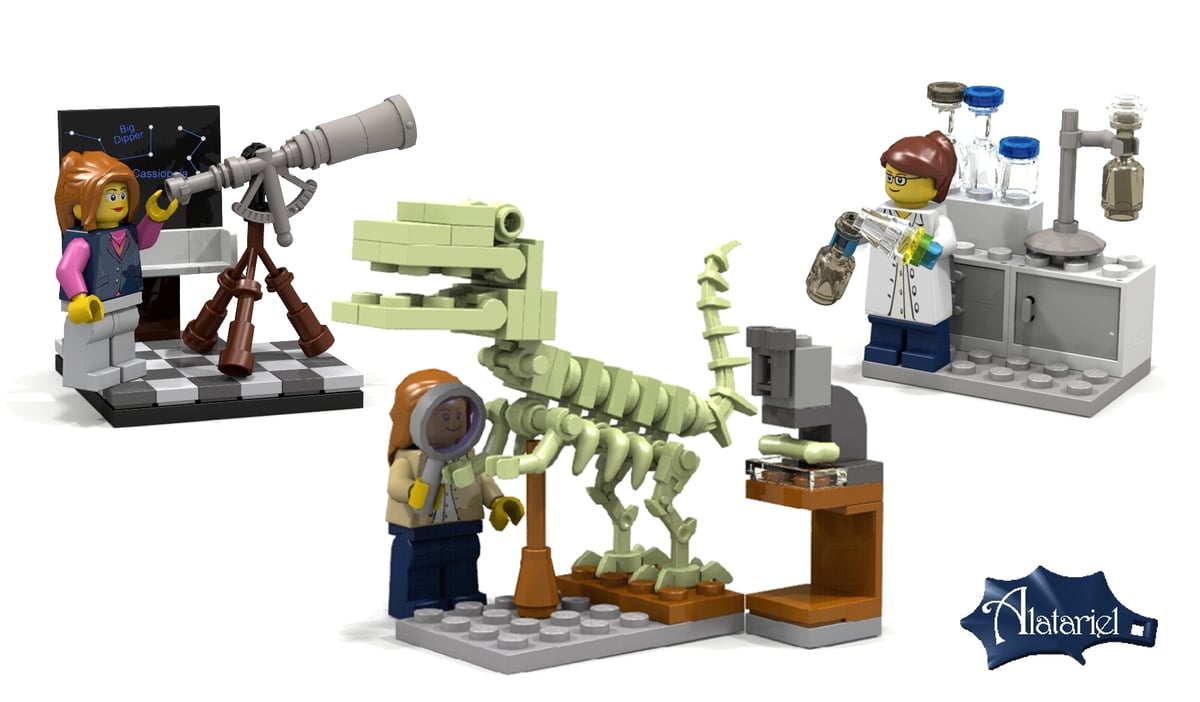
Me, I’m a fan of the robotics engineer (pictured below, right, with a falconer and geologist):

Lego already has one female scientist minifigure, released just last fall (after Koojiman’s original proposal). She’s a chemist/theoretician, with the typical glasses (safety glasses! according to materials scientist Deb Chachra), pocket protector, and laboratory flasks. But scientists have all kinds of tools and look all sorts of different ways, even broader than Kooijman’s all-yellow/caucasian team with generic Lego hair. (“Ideally, Lego would use some ‘rare’ face and hair designs if they were to produce a set,” she writes.)
Besides, go back and look at the composition of some of Lego’s other sets to see if it could use more than one female scientist. Minifigure Series 1 had sixteen characters, with the two women being “Cheerleader” and “Nurse.” The “Scientist” just came out in Series 11, along with “Grandma,” [ok fine] “Pretzel Girl,” [really?] “Diner Waitress,” [ugh!] and the admittedly awesome “Lady Robot,” who loves to party. “Some day she might decide she’s ready to stop partying…but not yet!” Go ahead, be gone with it, Lady Robot.
Update: The retail version of the Lego Research Institute has arrived! It’s Kooijman’s original trio of paleontologist, astronomer, and chemist, with tweaked designs and accessories. Here’s a picture:
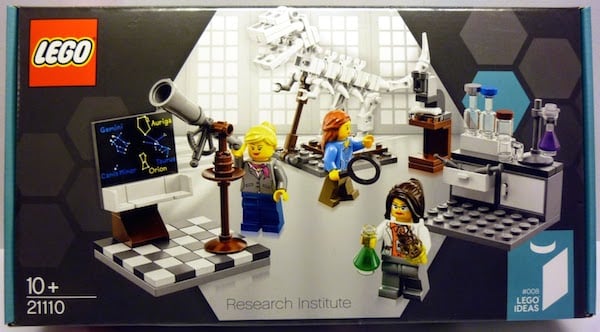
(Thanks, @debcha)
The Guardian has an interview with Adam Parrish, creator of @everyword, an automated Twitter account that’s been listing a dictionary’s worth of English words in sequence since 2007. @everyword recently reached the Zs and will complete and close tomorrow, June 6.
Words aren’t just things that we write and use in our speech. They are also things we think about individually. Like sex, weed, swag - when they’re not in a sentence, we can also think about them individually. Everyword raises that question of thinking about a word just from that perspective, as a social object.
On the other hand, because @everyword is inside an individual person’s Twitter stream, the words take on the context of whatever else is in the stream at the time. There’s the possibility of weird serendipitous interactions between a word in your stream and some other tweets. The word “super” might be tweeted, and then you read a tweet about a school superintendent or Superman movie.
Any Twitter account that gets you thinking about both the Platonist and the Dadaist dimensions of language at the same time is my kind of fun. And that’s a sort of fun that I associate with the Golden Age of Twitter, given its commingling of high and low, news and musings, humans and bots. That too is coming to a close:
In its early days, because of ven-cap funding, Twitter wasn’t thinking about monetization. They were just really encouraging developers to work with it and do interesting things. There was no concept of ads or promoted tweets. Now things are different. They’ve changed the API and some of the things that were easy to do are now difficult.
The flipside is, more people use it. As an artist, it’s disappointing that the medium has been converted into this very commercial, focused platform, but on the other hand I get to have a huge audience for an experimental writing project. It’s a huge privilege and I definitely have Twitter to thank for that.
It’s all cause for low-grade melancholy and a touch of anxiety. As Suzanne Fischer wryly tweets: “If the dictionary is finite, what else might be ending?”
This summer in London, Secret Cinema will build a replica of the fictional Hill Valley town seen in Back to the Future:
Fabien Riggall, founder of Secret Cinema which has presented more than 40 immersive cinema screening events, said: “We shall play heavily on the innocent dream-like world of 1955 and the nostalgic pre-mobile phone world of 1985. We want the audiences to forget their current world and take an adventure.”
The recreation will include a DeLorean “time machine” to shuttle audience members between 1985 and 1955 sections of the town, and an “Enchantment Under the Sea” afterparty. Tickets cost £53.50, or about $90 US.
It’s fascinating to watch the Back to the Future movies now not for their nostalgic depiction of the 1950s or jokey guesses at life in 2015, all hoverboards and flying cars, but as a vital document of the 1980s. After all, next year, we’ll be as far removed from 1985 as the filmmakers were from 1955. The first film especially fixes that time’s preoccupations and possibilities in amber.
(Via Paleofuture/Gizmodo.)
National treasure John Waters, who wrote a book about hitchhiking from Baltimore to San Francisco at the age of 66, recently tried to catch a ride with a reporter from Greenwich Village to the Frick Collection at 70th St and Fifth Avenue.
The only place in the country Waters has never yet succeeded hitching is Manhattan, which is why he’s intent on trying again today. “I used to stand in front of the Holland Tunnel tollbooth in the ’60s, and no one would ever pick me up,” he says. Before he embarked cross-country, Waters wrote the first two sections of Carsick—one envisioning good rides, the other bad rides. In both cases, the fiction is far more eventful than the true-life bits. On the real trip, there were no sexual encounters, twisted or otherwise. “It’s very different hitchhiking when you’re 16 and when you’re 66,” says Waters. “I didn’t have any rabid gerontophiliacs pick me up.” He imagines what could go most wrong on our trip uptown. “The worst case scenario would be someone that didn’t speak the language, so we couldn’t really tell what they were doing,” Waters says. “But immediately the locks go down. And it smells. We ride one block, and they turn around and blow both our heads off.”
Why the Frick? “When Pink Flamingos first came out,” Waters says, “whoever ran the Frick wrote me a note about how much they liked it. My mother was really impressed.” Man, now I just want to hang out with John Waters and have him tell me stories.
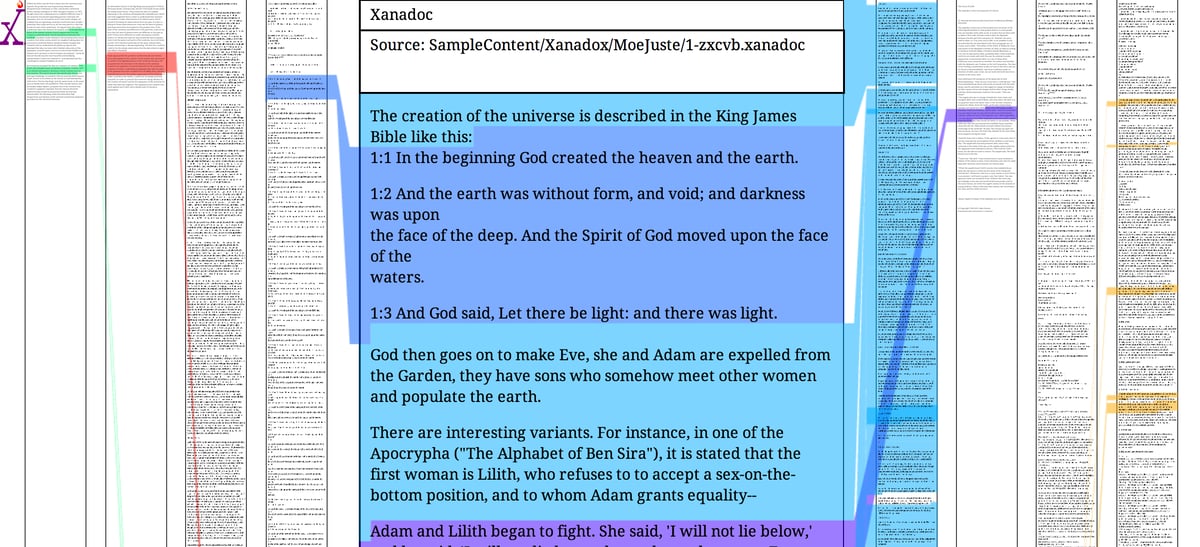
Ted Nelson coined the term “hypertext” in 1963 to describe a computing interface project he’d been working on called Xanadu. Xanadu, Nelson wrote some ten years ago, “is often misunderstood as an attempt to create the World Wide Web”:
It has always been much more ambitious, proposing an entire form of literature where links do not break as versions change; where documents may be closely compared side by side and closely annotated; where it is possible to see the origins of every quotation; and in which there is a valid copyright system— a literary, legal and business arrangement— for frictionless, non-negotiated quotation at any time and in any amount. The Web trivialized this original Xanadu model, vastly but incorrectly simplifying these problems to a world of fragile ever-breaking one-way links, with no recognition of change or copyright, and no support for multiple versions or principled re-use. Fonts and glitz, rather than content connective structure, prevail.
Nelson’s idea was to preserve a hypertext’s source documents along with the new composite, making the links between them visible and navigation between them as easy as possible: no file hierarchy, but documents maintained and comparable in parallel, for commentary, annotation, or recombination. It aims to be post-paper, instead (like Vannevar Bush’s hypothetical memex machine) directly imitating associative patterns of thought.
Instead of deleting content from one place and plugging it into another (today’s distorted meanings of the venerable terms “cut” and “paste”), the author should be able to pull screen contents from old versions into new, seeing all points of origin and also seeing what contents have not yet been used.
Xanadu never shipped a working product (“perhaps due to our net negative funding”), but Nelson wrote many articles and two books (Dream Machines and Literary Machines) that influenced the development of the personal computer and the world wide web, as well as every other idiosyncratic hypermedia model that’s come along since.
Finally on April 24 of this year, Nelson slipped a “one more thing” into an event at Chapman University: OpenXanadu, a working model of the document type and interface, programmed by Nicholas Levin and running in a web browser.
It’s a little awkward (“don’t touch the mouse!” the instructions yelp), but it’s all there, it’s pretty cool, and more than fifty years later, it’s still cracking fire about what computer work could look like.
We foresaw in 1960 that all document work would migrate
to the interactive computer screen, so we could write in new ways—
- paper enforces sequence— we could escape that!
- paper documents can’t be connected— we could escape that!
- this means a different form of writing
- this means a different form of publishing
- this means a different document format,
to send people and to archive.
We screwed up in the 1980s,
and missed our chance to be world wide hypertext
(the Web got that niche).
However, we can still compete with PDF,
which simulates paper,
by showing text connections.
PDFs better recognize.
(via @ftrain)
Alex Wright previously wrote about Paul Otlet (and many other things) in his 2007 book Glut (my post about the book is here). Otlet imagined something like personal computing and the internet back in the 1930s.
Here, the workspace is no longer cluttered with any books. In their place, a screen and a telephone within reach. Over there, in an immense edifice, are all the books and information. From there, the page to be read, in order to know the answer to the question asked by telephone, is made to appear on the screen. The screen could be divided in half, by four, or even ten if multiple texts and documents had to be consulted simultaneously. There would be a loudspeaker if the image had to be complemented by oral data and this improvement could continue to the automating the call for onscreen data. Cinema, phonographs, radio, television: these instruments, taken as substitutes for the book, will in fact become the new book, the most powerful works for the diffusion of human thought. This will be the radiated library and the televised book.
Wright is back with a new book called Cataloging the World in which Otlet takes center stage.
In Cataloging the World, Alex Wright introduces us to a figure who stands out in the long line of thinkers and idealists who devoted themselves to the task. Beginning in the late nineteenth century, Paul Otlet, a librarian by training, worked at expanding the potential of the catalog card, the world’s first information chip. From there followed universal libraries and museums, connecting his native Belgium to the world by means of a vast intellectual enterprise that attempted to organize and code everything ever published. Forty years before the first personal computer and fifty years before the first browser, Otlet envisioned a network of “electric telescopes” that would allow people everywhere to search through books, newspapers, photographs, and recordings, all linked together in what he termed, in 1934, a reseau mondial—essentially, a worldwide web.
While the story covers both sides of the dispute with detail and pathos, the most affecting bits treat how H & FJ worked together and the tiny details of the letters they made and loved:
At his computer, he drew an uppercase H, O, and D, because they contained flat and round elements that would determine how other letters looked. When he moved on to the G, the R, and the S, he started to deviate from the mathematical grid, hoping to give the font a subliminal playfulness. As he filled out the alphabet, the letters revealed a promising flexibility; if Frere-Jones set text in caps and spread the spacing out, the words felt authoritarian, imposing, and if he set them in lowercase and pulled the spacing in, they felt fresh and young. He tried to think of a name for the font that would showcase some of the more distinctive letters: the stark, powerful G; the circular o; the strange-tasting a. For a name, he thought about Goats, and Gomorrah. He finally settled on Gotham.
If the deep dive into the beauty and business of lettermaking doesn’t grab you, the essay’s packed with other-cultural analogies. My favorite is probably this: “According to a designer who used to work with Frere-Jones, his eye is so sharp that he can look at a printout of a letterform and tell if it’s one pixel off, the same way Ted Williams was said to be able to hold a baseball bat and tell if it was a half-ounce too heavy.”
Disclosure: Jason Fagone is my friend. Kottke.org uses Whitney Screensmart, a version of one of the fonts discussed in the article. Also one time Jonathan Hoefler got really mad at me because of a story I wrote about iPad magazines. The font people don’t play.
Update: If you want to know just how much the font people don’t play, I immediately was contacted by a friend to change “typographer” to “type designer.” I’ve spent years writing about this, and if I ever manage to get all of the terms right, the universe will collapse on itself.
Adam Phillips is a writer and psychoanalyst, working on (among other things) a digressive, deflationary biography of Freud. He recently gave an “Art of Nonfiction” interview to The Paris Review which is one of those great Paris Review interviews about writing and life and approaching the universe.
PHILLIPS: Analysis should do two things that are linked together. It should be about the recovery of appetite, and the need not to know yourself. And these two things—
INTERVIEWER: The need not to know yourself?
PHILLIPS: The need not to know yourself. Symptoms are forms of self-knowledge. When you think, I’m agoraphobic, I’m a shy person, whatever it may be, these are forms of self-knowledge. What psychoanalysis, at its best, does is cure you of your self-knowledge. And of your wish to know yourself in that coherent, narrative way…
I was a child psychotherapist for most of my professional life. One of the things that is interesting about children is how much appetite they have. How much appetite they have—but also how conflicted they can be about their appetites. Anybody who’s got young children, or has had them, or was once a young child, will remember that children are incredibly picky about their food. They can go through periods where they will only have an orange peeled in a certain way. Or milk in a certain cup.
INTERVIEWER: And what does that mean?
PHILLIPS: Well, it means different things for different children. One of the things it means is there’s something very frightening about one’s appetite. So that one is trying to contain a voraciousness in a very specific, limiting, narrowed way. It’s as though, were the child not to have the milk in that cup, it would be a catastrophe. And the child is right. It would be a catastrophe, because that specific way, that habit, contains what is felt to be a very fearful appetite. An appetite is fearful because it connects you with the world in very unpredictable ways. Winnicott says somewhere that health is much more difficult to deal with than disease. And he’s right, I think, in the sense that everybody is dealing with how much of their own aliveness they can bear and how much they need to anesthetize themselves.
We all have self-cures for strong feeling. Then the self-cure becomes a problem, in the obvious sense that the problem of the alcoholic is not alcohol but sobriety. Drinking becomes a problem, but actually the problem is what’s being cured by the alcohol. By the time we’re adults, we’ve all become alcoholics. That’s to say, we’ve all evolved ways of deadening certain feelings and thoughts. One of the reasons we admire or like art, if we do, is that it reopens us in some sense—as Kafka wrote in a letter, art breaks the sea that’s frozen inside us. It reminds us of sensitivities that we might have lost at some cost.
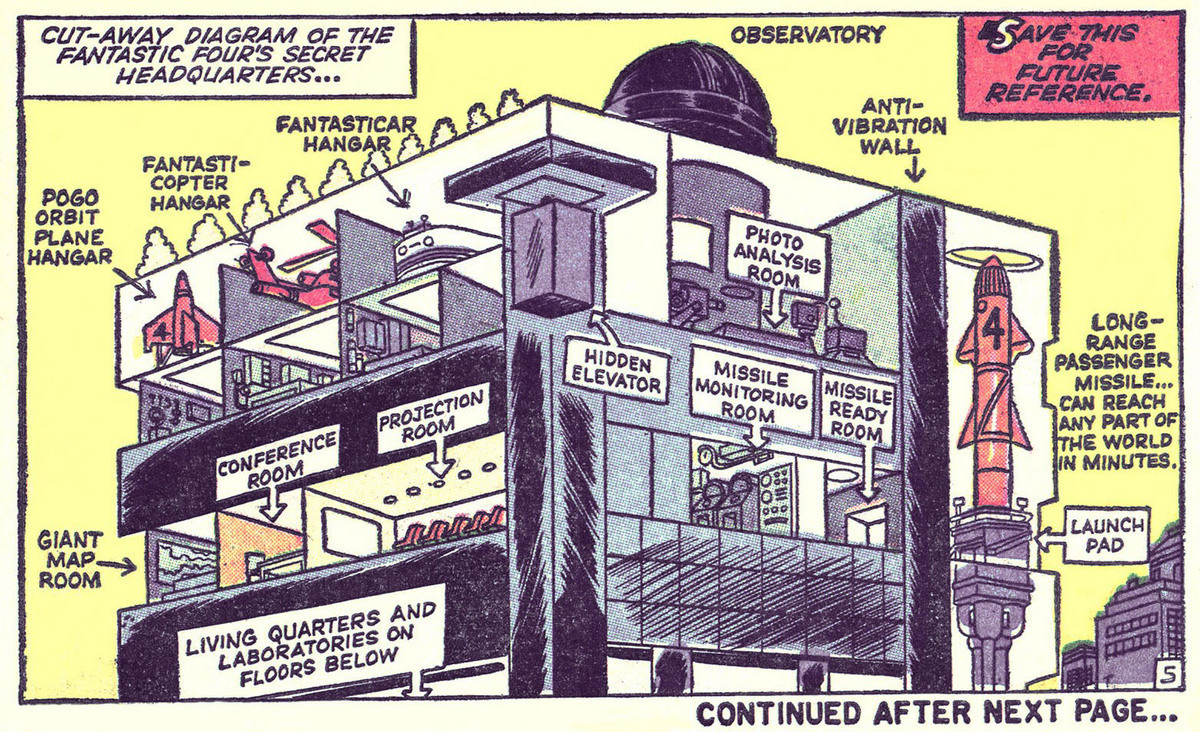
Comic Book Cartography is a now-dormant blog devoted to maps, charts, diagrams, and other visual explainers of (mostly) fictional worlds found (mostly) in old comic books.
These maps are beautiful, but they’re also packed with definitive detail. I love the stern “SAVE THIS FOR FUTURE REFERENCE” on the first-ever cutaway of the Fantastic Four’s Baxter Building, from issue #3. Two issues ago, you’ve got the FF someplace called “Central City,” and The Thing looking like a poop with arms and a mouth, but already, there’s a fixed architecture for midtown Manhattan offices packed with reference ideas for future storylines. A man, a plan, Jack Kirby.
In these flattened worlds for tiny obsessives, you’ve got your narrative and your database all in one: not just maps, but routes, connections, circuits, ideas, topologies. Really, it’s dataviz, only since comics don’t have, you know, large data sets for running regressions, it’s a lot of tiny illustrations with copious labeling. Still, the future of the modern impulse to an “all in one chart” aesthetic probably starts here as much as anywhere. (Via @justinNXT.)
Update: There’s an active “Comic Cartography” Tumblr that includes more contemporary examples. Also, John Hilgart, the proprietor of Comic Book Cartography, runs an active blog on images from classic comic books called 4CP (for four-color process, naturally). (Thanks, Hampton)
A short film by Douglas Gautrand about how his mom came to own a motorcycle. It all starts with his grandfathers…
According to a new study, hurricanes with female names kill more people because Americans are less fearful of storms named after women:
The stereotypes that underlie these judgments are subtle and not necessarily hostile toward women — they may involve viewing women as warmer and less aggressive than men.
Then again, maybe this study blows… (If your first name is Hurricane, I don’t even care what your last name is.)
Other aspects of the team’s analysis didn’t make sense to Lazo. For example, they included indirect deaths in their fatality counts, which includes people who, say, are killed by fallen electrical lines in the clean-up after a storm. “How would gender name influence that sort of fatality?” he asks. He also notes that the damage a hurricane inflicts depends on things like how buildings are constructed, and other actions that we take long before a hurricane is named, or even before it forms.
You only get a single move in One-Tap Quest, so you had better make it a good one. This game has no right to be fun, but somehow it is. My top score so far is 15,800…the best score I’ve seen is 21,400. (via @mrgan)
Today I’m launching something new on kottke.org. It’s been gestating for a long time, so I’m excited to finally get it out here. It’s called Boost and it’s an opportunity to promote individual Kickstarter campaigns on kottke.org through sponsored posts.
A week to go and a little short of your goal? Looking to add some of kottke.org’s fun and clever bunch of readers to your project’s emerging backer community? Reaching for that second stretch goal to provide even more value to your backers? Get your Kickstarter project in front of kottke.org’s readers with a Boost for Kickstarter.
The sponsored posts will obviously be clearly marked on the site (and in RSS, on Twitter, etc.) and only one project will be featured each week. And for Kickstarter project creators thinking about buying a Boost, here’s an interesting little wrinkle: if your campaign doesn’t meet its goal, you don’t pay anything for your Boost, just like with Kickstarter. So if you’re currently running a KS campaign or have one planned for the future, check out the Boost page and get in touch.
The first Boost will run on the site (and in RSS, Twitter, Facebook, & Tumblr) a little later today and is for a project called Monikers. I contributed slightly to the project and am a backer myself, and I would like to thank Alex for letting me use Monikers as a guinea pig for this new service.
Note: As much as I love their service, neither kottke.org nor the Boost service is endorsed by or affiliated with Kickstarter.

Apple recently announced their annual design awards for 2014. Some nice work there.
James Somers says that we’re probably using the wrong dictionary and that most modern dictionaries are “where all the words live and the writing’s no good”.
The New Oxford American dictionary, by the way, is not like singularly bad. Google’s dictionary, the modern Merriam-Webster, the dictionary at dictionary.com: they’re all like this. They’re all a chore to read. There’s no play, no delight in the language. The definitions are these desiccated little husks of technocratic meaningese, as if a word were no more than its coordinates in semantic space.
As a counterpoint, Somers offers John McPhee’s secret weapon, Webster’s Revised Unabridged Dictionary, the bulk of which was the work of one man and was last revised in 1913.
Take a simple word, like “flash.” In all the dictionaries I’ve ever known, I would have never looked up that word. I’d’ve had no reason to — I already knew what it meant. But go look up “flash” in Webster’s (the edition I’m using is the 1913). The first thing you’ll notice is that the example sentences don’t sound like they came out of a DMV training manual (“the lights started flashing”) — they come from Milton and Shakespeare and Tennyson (“A thought flashed through me, which I clothed in act”).
You’ll find a sense of the word that is somehow more evocative than any you’ve seen. “2. To convey as by a flash… as, to flash a message along the wires; to flash conviction on the mind.” In the juxtaposition of those two examples — a message transmitted by wires; a feeling that comes suddenly to mind — is a beautiful analogy, worth dwelling on, and savoring. Listen to that phrase: “to flash conviction on the mind.” This is in a dictionary, for God’s sake.
And, toward the bottom of the entry, as McPhee promised, is a usage note, explaining the fine differences in meaning between words in the penumbra of “flash”:
“… Flashing differs from exploding or disploding in not being accompanied with a loud report. To glisten, or glister, is to shine with a soft and fitful luster, as eyes suffused with tears, or flowers wet with dew.”
Did you see that last clause? “To shine with a soft and fitful luster, as eyes suffused with tears, or flowers wet with dew.” I’m not sure why you won’t find writing like that in dictionaries these days, but you won’t. Here is the modern equivalent of that sentence in the latest edition of the Merriam-Webster: “glisten applies to the soft sparkle from a wet or oily surface .”
Who decided that the American public couldn’t handle “a soft and fitful luster”? I can’t help but think something has been lost. “A soft sparkle from a wet or oily surface” doesn’t just sound worse, it actually describes the phenomenon with less precision. In particular it misses the shimmeriness, the micro movement and action, “the fitful luster,” of, for example, an eye full of tears — which is by the way far more intense and interesting an image than “a wet sidewalk.”
It’s as if someone decided that dictionaries these days had to sound like they were written by a Xerox machine, not a person, certainly not a person with a poet’s ear, a man capable of high and mighty English, who set out to write the secular American equivalent of the King James Bible and pulled it off.
Don’t miss the end of the piece, where Somers shows how to replace the tin-eared dictionaries on your Mac, iPhone, and Kindle with the Webster’s 1913. (via @satishev)
Update: In the same vein, Kevin Kelly recommends using The Synonym Finder as a thesaurus.
Just look up a word, any word, and it proceeds to overwhelm you with alternative choices (a total of 1.5 million synonyms are presented in 1,361 pages), including short phrases and only mildly related words. Rather than being a problem of imprecision, the Finder’s broad inclusiveness prods your imagination and prompts your recall.
This article by Anne Helen Petersen about how Angelina Jolie has expertly controlled her PR through several potential rough patches is way more interesting than it has any right to be.
This photo, for example, is a semiotic gold mine: Shiloh, often nicknamed “The Chosen One,” a glimmering beacon of whiteness, flanked by her racially marked siblings, one of whom seems to be protecting her from possible harm. All three are framed by their doting parents, tied to their children via skin color, head/neck scarf, hair highlighting, and physical touch. They’re a “Party of Five,” as the title of the accompanying article puts it, but they’re a distinctly global one: The photos were all shot in Cambodia, and when asked how her children manage all the traveling, Jolie says, “We’ve tried to make them very adaptable, so when we go to a country like India or certain parts of Namibia, they’re happy to play with sticks and rocks outside — they’re happy to blend.”
Taken together, these images, and the stories that accompanied them, were speaking about their relationship, even if the pair themselves weren’t offering comment. And what they were saying was that this wasn’t a story about sex or scandal; rather, it was one of family, humanitarianism, and global citizenship. Within this framework, any publication that chose to focus on sexual intrigue was effectively neglecting the most in need.
It is sad to see Gwyneth Paltrow promoting pseduoscience hucksters like Masaru Emoto in her very popular Goop newsletter. It begins:
I am fascinated by the growing science behind the energy of consciousness and its effects on matter. I have long had Dr. Emoto’s coffee table book on how negativity changes the structure of water, how the molecules behave differently depending on the words or music being expressed around it.
And later on in the letter, Dr. Habib Sadeghi continues:
Japanese scientist, Masaru Emoto performed some of the most fascinating experiments on the effect that words have on energy in the 1990’s. When frozen, water that’s free from all impurities will form beautiful ice crystals that look exactly like snowflakes under a microscope. Water that’s polluted, or has additives like fluoride, will freeze without forming crystals. In his experiments, Emoto poured pure water into vials labeled with negative phrases like “I hate you” or “fear.” After 24 hours, the water was frozen, and no longer crystallized under the microscope: It yielded gray, misshapen clumps instead of beautiful lace-like crystals. In contrast, Emoto placed labels that said things like “I Love You,” or “Peace” on vials of polluted water, and after 24 hours, they produced gleaming, perfectly hexagonal crystals. Emoto’s experiments proved that energy generated by positive or negative words can actually change the physical structure of an object.
Riiiight. Paltrow should stick to recipes, fashion, and workouts and leave the science to people who actually understand it lest she wander into Jenny McCarthy territory. There’s nothing wrong with asserting that thinking positively will improve your life, but connecting it with quantum physics and the like, without rigorous scientific proof, is dangerous and stupid.
When he was around 32 years old, Leonardo da Vinci applied to the Duke of Milan, Ludovico Sforza, for a job. The duke was in need of military expertise and Leonardo’s 10-point CV emphasized his military engineering skills:
3. Also, if one cannot, when besieging a terrain, proceed by bombardment either because of the height of the glacis or the strength of its situation and location, I have methods for destroying every fortress or other stranglehold unless it has been founded upon a rock or so forth.
4. I have also types of cannon, most convenient and easily portable, with which to hurl small stones almost like a hail-storm; and the smoke from the cannon will instil a great fear in the enemy on account of the grave damage and confusion.
And I love what is almost an aside at the end of the list:
Also I can execute sculpture in marble, bronze and clay. Likewise in painting, I can do everything possible as well as any other, whosoever he may be.
Oh yeah, P.S., by the way, not that it matters, I am also the greatest living artist in the world, no big deal. Yr pal, Leo. (via farnam street and the letters of note book)
Newer posts





Socials & More