In his new series for Slate about creative partnerships, Joshua Shenk explores one of the most fruitful creative collaborations in history: that of John Lennon and Paul McCartney. Part three, about the break-up the Beatles, comes to a conclusion that’s different than some of the theories you may have heard previously.
Yet, looking for concrete divisions in their labor, though not irrelevant, can certainly seem myopic. It feels, from Davies’ account, as though the two men were bound by a thousand invisible strings.
Davies looked on at the partners before Yoko, before The White Album — “the tension album” Paul said. But tension had always been key to their work. The strings connecting them hardly dissolved, even in the times when the collaboration was adversarial, the kind of exchange that Andre Agassi described when he said that, if he hadn’t faced Pete Sampras, he’d have a better record, “but I’d be less.” Picking up on that incisive line, Michael Kimmelman wrote in his review of Agassi’s book Open that “rivalry … [is] the heart of sports, and, for athletes, no matter how bitter or fierce, something strangely akin to love: two vulnerable protagonists for a time lifted up not despite their differences but because of them.”
And:
This is nasty stuff. But the opposite of intimacy isn’t conflict. It’s indifference. The relationship between Paul and John had always been a tug of war — and that hardly stopped when they ceased to collaborate directly. Asked what he thought Paul would make of his first solo album, Lennon said, “I think it’ll probably scare him into doing something decent, and then he’ll scare me into doing something decent, like that.”
I’ve said it before: love and hate are the same emotion. (via @tcarmody)
THE THEME OF THIS PARTICULAR PROGRAM is “JOCKS vs. NERDS,” the culture war of our time, and a subject that you know I have been thinking about for some time now, and also talking about with the PRESIDENT OF THE UNITED STATES.
IN THIS CASE, the “NERD” shall be played by me, John Hodgman, and the “JOCK” shall be played by the New York Jet, NICK MANGOLD, as I confront all of my deepest fears (humiliation/being punched/Nick Mangold) and attempted to learn from him the virtues of jock culture and the rules of football.
And YOU are invited: September 28th in NYC. Tickets are free and they have an unlimited supply because they are filming it in some sort of massive rocket ship hanger. All you Little Hobos (that’s what Hodgman calls all his fans) click through for details on how to get your tickets.
The other night, however, a very amazing thing happened. I downloaded an app called Color ID. It uses the iPhone’s camera, and speaks names of colors. It must use a table, because each color has an identifier made up of 6 hexadecimal digits. This puts the total at 16777216 colors, and I believe it. Some of them have very surreal names, such as Atomic Orange, Cosmic, Hippie Green, Opium, and Black-White. These names in combination with what feels like a rise in serotonin levels makes for a very psychedelic experience.
I have never experienced this before in my life. I can see some light and color, but just in blurs, and objects don’t really have a color, just light sources. When I first tried it at three o’clock in the morning, I couldn’t figure out why it just reported black. After realizing that the screen curtain also disables the camera, I turned it off, but it still have very dark colors. Then I remembered that you actually need light to see, and it probably couldn’t see much at night. I thought about light sources, and my interview I did for Get Lamp. First, I saw one of my beautiful salt lamps in its various shades of orange, another with its pink and rose colors, and the third kind in glowing pink and red.. I felt stunned.
Of course, it’s a bit more complicated than that, but here’s an overview of what we did. Using the properties of previously discovered exoplanets, we developed a simple metric of habitability for each planet that uses its mass and temperature to rate it on a scale of 0 to 1, where 1 is Earth-like, and 0 is so very not Earth-like. Plotting these values over time and taking the upper envelope yields a nice march towards habitability.
The authors don’t address this directly in their paper, but I wondered what the Moore’s Law for planetary discovery might be — e.g. every X years (or months?), the habitability of the most habitable planet discovered doubles. So I emailed Sam Arbesman and he said that his quick back of the envelope calculation would be “half a month or so”…which is an astounding pace.
If you’ve got a Mac, the “droid” sound that Android phones make — yep, the one from the commercials — can be produced in the following manner:
1. Open Terminal.app
2. Type say -v “Cellos” “droid” at the prompt
3. Experiment: say -v “Cellos” “droid. sucks.”
4. Or say -v “Cellos” “droid want to be iphone when droid grow up”
5. And finally, say “i am trying to unlock the mysteries of the universe, like how the big bang happened and where all the lost socks go after being in the dryer that really makes me mad”
A little Friday fun: Clock Blocks. It took me a bit to figure out how to play, but basically you clear a grid of clocks by shooting from clock to clock at the angle of each clock’s rapidly spinning second hand. Ok, maybe not so basically, but you’ll get the gist after playing for a few seconds. There is also an iPhone version.
The debate is essentially over and the final word is in: vaccines do not cause autism. The results of a rigorous study conducted over several years were just announced and they confirmed the results of several past studies.
Basically, the final two groups that were studied consisted of 256 children with ASD [autism spectrum disorders] and 752 matched controls. One very interesting aspect that looks as though it were almost certainly placed into the experimental design based on concerns of anti-vaccine advocates like Sallie Bernard is a group of children who underwent regression. Basically, the study examined whether there was a correlation between ASD and TCV [thimerosal-containing vaccines, i.e. mercury-containing vaccines] exposure. It also examined two subsets of ASD, autistic disorder (AD) and ASD with regression, looking for any indication whether TCVs were associated with any of them. Regression was defined as:
“the subset of case-children with ASD who reported loss of previously acquired language skills after acquisition.”
Also, when adding up total thimerosal exposure, the investigators also included any thimerosal exposure that might have come prenatally from maternal receipt of flu vaccines during pregnancy, as well as immunoglobulins, tetanus toxoids, and diphtheria-tetanus. In other words, investigators tried to factor in all the various ideas for how TCVs might contribute to autism when designing this study.
So what did the investigators find? I think you probably know the answer to that question. They found nothing. Nada. Zip. There wasn’t even a hint of a correlation between TCV exposure and either ASD, AD, or ASD with regression:
“There were no findings of increased risk for any of the 3 ASD outcomes. The adjusted odds ratios (95% confidence intervals) for ASD associated with a 2-SD increase in ethylmercury exposure were 1.12 (0.83-1.51) for prenatal exposure, 0.88 (0.62-1.26) for exposure from birth to 1 month, 0.60 (0.36-0.99) for exposure from birth to 7 months, and 0.60 (0.32- 0.97) for exposure from birth to 20 months.”
The last result is a bit of an anomaly in that it implies that exposure to TCVs from birth to 1 month and birth to 7 months actually protects against ASD. The authors quite rightly comment on this result thusly:
“In the covariate adjusted models, we found that an increase in ethylmercury exposure in 2 of the 4 exposure time periods evaluated was associated with decreased risk of each of the 3 ASD outcomes. We are not aware of a biological mechanism that would lead to this result.”
So get your kids (and yourselves) vaccinated and save them & their playmates from this whooping cough bullshit, which is actually killing actual kids and not, you know, magically infecting them with autism. Vaccination is one of the greatest human discoveries ever — yes, Kanye, OF ALL TIME — has saved countless lives, and has made countless more lives significantly better. So: Buck. Up.
Roger Ebert recently sat down with Errol Morris to talk about his new movie, Tabloid, and a bunch of other stuff. The interview is presented as a series of eight YouTube videos. In this one, he talks about how he got started writing his blog for The NY Times and how that helped him get over his 30-year struggle with writer’s block:
He’s working on a seventeen-part article about a murder case for the blog. Seventeen parts!
In The Grand Design we explain why, according to quantum theory, the cosmos does not have just a single existence, or history, but rather that every possible history of the universe exists simultaneously. We question the conventional concept of reality, posing instead a “model-dependent” theory of reality. We discuss how the laws of our particular universe are extraordinarily finely tuned so as to allow for our existence, and show why quantum theory predicts the multiverse—the idea that ours is just one of many universes that appeared spontaneously out of nothing, each with different laws of nature. And we assess M-Theory, an explanation of the laws governing the multiverse, and the only viable candidate for a complete “theory of everything.”
Dark Patterns are UI techniques designed to trick users into doing things they otherwise wouldn’t have done.
Normally when you think of “bad design”, you think of laziness or mistakes. These are known as design anti-patterns. Dark Patterns are different — they are not mistakes, they are carefully crafted with a solid understanding of human psychology, and they do not have the user’s interests in mind.
For instance, Privacy Zuckering is a dark pattern implemented by Facebook to get users to share more about themselves than they would like to. (thx, @tnorthcutt)
Over at Serious Eats, Kenji Lopez-Alt assures us that while you can’t make restaurant-quality Neapolitan pizza at home, you can come damn close. Best thing is, his technique doesn’t involve lining your oven with bricks and is actually as easy as making regular pizza at home.
After cooking for around a minute and a half, the bottom crust achieved the perfect degree of char-even better than what I was getting on the stone. Interestingly enough, the pan was actually cooler than the stone I was using, maxing out at around 450 degrees. So how does a 450 degree pan brown better and faster than a 550 degree stone? It’s a matter of heat capacity and density.
The heat capacity of a material is directly related to the amount of energy that a given mass of material holds at a given temperature. Even though stone has almost twice the heat capacity than steel (.2 kcal/kg C vs. .1 kcal/kg C), it loses in two ways: it is far less dense than steel, and it has a much lower rate of heat conduction than steel. The pizza cooking in a skillet is not just getting energy from the pan-it’s getting energy from the burner below the pan as it gets rapidly conducted through the metal.
It’s a clear demonstration of how when cooking foods, what matters it the amount of energy transferred, not just the temperature you cook at. The two are often directly related, but not always.
I have said it before but will repeat: I love Kenji’s nerdiness about the science combined with the ability to come up with the solution that’s easiest for non-nerds to appreciate and implement. It is a rare and wonderful thing to observe.
Errol Morris and Werner Herzog both had films premiere at the Toronto Film Festival. To mark the occasion, they sat down and had a conversation with each other.
Fiore did a similar project with pinball machines…instead of photos, the ball was covered in paint and left trails on vellum. Reminds me of some of the other time merge media I collected awhile back. (via @brainpicker)
The new show will appear on PBS and feature Elvis Mitchell & Christy Lemire as the main hosts.
“I believe that by returning to its public roots, our new show will win better and more consistent time slots in more markets,” added Ebert. “American television is swamped by mindless gossip about celebrities, and I’m happy this show will continue to tell viewers honestly if the critics think a new movie is worth seeing.”
The Austen Fiction Manuscripts Project is scanning Jane Austen’s original manuscripts and putting them online for scholars to study and for us norms to gawk at.
Want to see the state of the art in web design using web fonts and Typekit? Check out Lost World’s Fairs. It’s all good, but Frank Chimero really knocked it out of the park with the 1962 Atlantis World’s Fair. With HTML5 and web fonts, experimentation with web design seems open and fun again; reminds me of the 90s a bit.
Some years ago, Joaquin Phoenix was in a car accident. Werner Herzog happened to be driving right behind him, stopped, and pulled him from the wreakage. Herzog tells the story:
Funny how you never see Superman and Werner Herzog together. I wonder… (via buzzfeed)
Of all the stories I’ve heard about the recent financial crisis — the high-risk mortgage loans, the CDOs, the credit default swaps, the Icelandic crisis — the story of the collapse of the Greek economy by Michael Lewis in the October issue of Vanity Fair is the craziest. And it’s the only one involving monks.
The tsunami of cheap credit that rolled across the planet between 2002 and 2007 has just now created a new opportunity for travel: financial-disaster tourism. The credit wasn’t just money, it was temptation. It offered entire societies the chance to reveal aspects of their characters they could not normally afford to indulge. Entire countries were told, “The lights are out, you can do whatever you want to do and no one will ever know.” What they wanted to do with money in the dark varied. Americans wanted to own homes far larger than they could afford, and to allow the strong to exploit the weak. Icelanders wanted to stop fishing and become investment bankers, and to allow their alpha males to reveal a theretofore suppressed megalomania. The Germans wanted to be even more German; the Irish wanted to stop being Irish. All these different societies were touched by the same event, but each responded to it in its own peculiar way.
As it turned out, what the Greeks wanted to do, once the lights went out and they were alone in the dark with a pile of borrowed money, was turn their government into a pinata stuffed with fantastic sums and give as many citizens as possible a whack at it. In just the past decade the wage bill of the Greek public sector has doubled, in real terms-and that number doesn’t take into account the bribes collected by public officials. The average government job pays almost three times the average private-sector job. The national railroad has annual revenues of 100 million euros against an annual wage bill of 400 million, plus 300 million euros in other expenses. The average state railroad employee earns 65,000 euros a year. Twenty years ago a successful businessman turned minister of finance named Stefanos Manos pointed out that it would be cheaper to put all Greece’s rail passengers into taxicabs: it’s still true. “We have a railroad company which is bankrupt beyond comprehension,” Manos put it to me. “And yet there isn’t a single private company in Greece with that kind of average pay.” The Greek public-school system is the site of breathtaking inefficiency: one of the lowest-ranked systems in Europe, it nonetheless employs four times as many teachers per pupil as the highest-ranked, Finland’s. Greeks who send their children to public schools simply assume that they will need to hire private tutors to make sure they actually learn something. There are three government-owned defense companies: together they have billions of euros in debts, and mounting losses. The retirement age for Greek jobs classified as “arduous” is as early as 55 for men and 50 for women. As this is also the moment when the state begins to shovel out generous pensions, more than 600 Greek professions somehow managed to get themselves classified as arduous: hairdressers, radio announcers, waiters, musicians, and on and on and on. The Greek public health-care system spends far more on supplies than the European average-and it is not uncommon, several Greeks tell me, to see nurses and doctors leaving the job with their arms filled with paper towels and diapers and whatever else they can plunder from the supply closets.
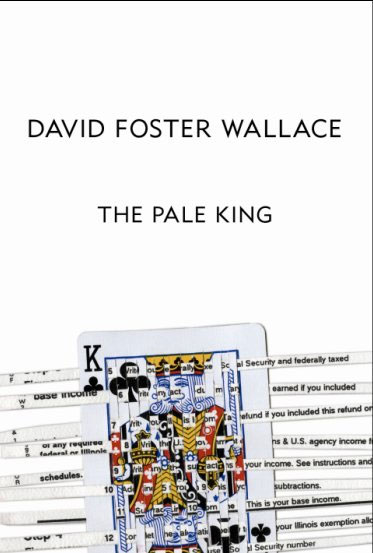
Set at an IRS tax-return-processing center in Illinois in the mid-1980s, The Pale King is the story of a crew of entry-level processors and their attempts to do their job in the face of soul-crushing tedium. “The Pale King may be the first novel to make accountants and IRS agents into heroes,” says Bonnie Nadell, Wallace’s longtime agent and literary executor. Michael Pietsch, Little, Brown’s publisher and The Pale King’s editor, says, “Wallace takes agonizing daily events like standing in lines, traffic jams, and horrific bus rides — things we all hate — and turns them into moments of laughter and understanding. Although David did not finish the novel, it is a surprisingly whole and satisfying reading experience that showcases his extraordinary imaginative talents and his mixing of comedy and deep sadness in scenes from daily life.”
The cover was designed by Karen Green, Wallace’s widow.
This compilation of people dodging out of the way of cars, trains, etc. is a bit American’s Funniest Videos1, but my heart is still pounding…I couldn’t even watch the whole thing.
The Canon 7D and 5D Mark II can shoot HD video at 60 fps. But with an After Effects plug-in called Twixtor, you can slow the action down to 1000 fps, no expensive camera equipment required. Here’s a sample:
Obviously if you’re shooting footage of bullets going through playing cards, this isn’t going to work for you, but the results look great for slower moving objects like BMX bikes.
Health Month is a game designed to help you improve your health.
There are about 50 different kinds of rules. Half of them are rules about what to avoid - things like alcohol, white flour, artificial sweeteners, and illegal drugs. And half of them are rules about what you do more of - things like exercise, sleep, greens, and multivitamins. Choose however many you like, and ignore the rest (you can always add more next month, right?). After choosing your rules, you have the option of making a promise to yourself about how to reward yourself if you stay in the game all month, or to build in consequences if you don’t make it. It’s all about self-accountability, in public. It works.
Now, we are always in the center of the map, and it’s a very powerful place to be.
Now you are the starting point. Now the digital world follows you, not the other way around.
In the political world, the rough analog to this digital media future is democracy. But as we’ve seen, the seeming transfer of control from lawmakers to the people is just that: seeming. To a large degree, the big media and technology companies — particularly the de facto monopolies like the mobile carriers, cable companies, etc. — still control the consumer experience. The future will be personalized, but don’t think you’ll get everything you want when you want it.
If you are at first lonely, be patient. If you’ve not been alone much, or if when you were, you weren’t okay with it, then just wait. You’ll find it’s fine to be alone once you’re embracing it.
We could start with the acceptable places, the bathroom, the coffee shop, the library. Where you can stall and read the paper, where you can get your caffeine fix and sit and stay there. Where you can browse the stacks and smell the books. You’re not supposed to talk much anyway so it’s safe there.
The new, patented system abandons the power-hungry compressor-driven refrigeration process used in many domestic (and virtually all commercial) air conditioners in favor of a couple of high-efficiency pumps and fans. But it also uses water for evaporative cooling — a concept familiar to many people living in the arid West who have roof-mounted “swamp coolers.” Swamp coolers work well when the outside air is dry, as evaporating water carries away heat, cooling and moistening the air that is re-circulated into the house.
What we’ve made of it all is an 88-page souvenir of a moment in time when a non-life-threatening crisis hit the world, one for which nobody was to blame, and nobody knew how long it would last. People scrambled to find alternative routes home, any way, any how, or tried to make the best of wherever fate had placed them. It was a moment of unplanned disruption, never to be repeated in quite the same way. The perfect subject for a magazine, in fact.
The New Yorker has a trio of interesting articles in their most recent issue for the discerning web/technology lady or gentlemen. First is a lengthy profile of Mark Zuckerberg, the quite private CEO of Facebook who doesn’t believe in privacy.
Zuckerberg may seem like an over-sharer in the age of over-sharing. But that’s kind of the point. Zuckerberg’s business model depends on our shifting notions of privacy, revelation, and sheer self-display. The more that people are willing to put online, the more money his site can make from advertisers. Happily for him, and the prospects of his eventual fortune, his business interests align perfectly with his personal philosophy. In the bio section of his page, Zuckerberg writes simply, “I’m trying to make the world a more open place.”
Tavi has an eye for frumpy, “Grey Gardens”-inspired clothes and for arch accessories, and her taste in designers runs toward the cerebral. From the beginning, her blog had an element of mystery: is it for real? And how did a thirteen-year-old suburban kid develop such a singular look? Her readership quickly grew to fifty thousand daily viewers and won the ear of major designers.
And C, John Seabrook has a profile of James Dyson (sub. required), he of the unusual vacuum cleaners, unusual hand dryers, and the unusual air-circulating fan.
In the fall of 2002, the British inventor James Dyson entered the U.S. market with an upright vacuum cleaner, the Dyson DC07. Dyson was the product’s designer, engineer, manufacturer, and pitchman. The price was three hundred and ninety-nine dollars. Not only did the Dyson cost much more than most machines sold at retail but it was made almost entirely out of plastic. In the most perverse design decision of all, Dyson let you see the dirt as you collected it, in a clear plastic bin in the machine’s midsection.
The idea was mine, and all the long form writing, talks, and speeches were me. But a lot of tweets — a lot of my favorite tweets — weren’t mine. I edited and maybe tweaked some of them, but there’s no way I would have been able to come up with the quality or volume of jokes without a good team. We had about 15 people, and those writers deserve a lot of the credit. Some contributed every day. My dad did one, even. I sent him a message and told him about it, and I was like, “fuck, I’m not sure what he’ll think.” But he responded immediately with a joke.
I don’t know whether she still looks this fit or not, but Dara Torres is going to try to make the US swim team for the 2012 Olympics. At 41 in Beijing, she won three silver medals; she’ll be 45 when London rolls around.
From the Guardian, a review of a book called Meat: A Benign Extravagance by Simon Fairlie. In it, Fairlie argues that meat production isn’t actually that inefficient when done properly and veganism as an ethical response leaves something to be desired.
But these idiocies, Fairlie shows, are not arguments against all meat eating, but arguments against the current farming model. He demonstrates that we’ve been using the wrong comparison to judge the efficiency of meat production. Instead of citing a simple conversion rate of feed into meat, we should be comparing the amount of land required to grow meat with the land needed to grow plant products of the same nutritional value to humans. The results are radically different.
If pigs are fed on residues and waste, and cattle on straw, stovers and grass from fallows and rangelands — food for which humans don’t compete — meat becomes a very efficient means of food production. Even though it is tilted by the profligate use of grain in rich countries, the global average conversion ratio of useful plant food to useful meat is not the 5:1 or 10:1 cited by almost everyone, but less than 2:1. If we stopped feeding edible grain to animals, we could still produce around half the current global meat supply with no loss to human nutrition: in fact it’s a significant net gain.
This profile of Billy Mitchell and other classic video game record holders starts off as most do, with descriptions of Mitchell’s hair, the dizzying scores, the rivalries, and Mitchell’s perfect game of Pac-Man:
Another player named Rick Fothergill had almost beaten Billy to the mark, but he fell short by nine dots, or 90 points. Fothergill is Canadian, and his challenge made Billy redouble his efforts, because Billy thinks of his Pac-Man prowess as a patriotic symbol, a matter of national pride not unlike like the space race. Billy was so determined to beat Canada that he forgot to eat for several days. He had set out on his quest July 1 — Canada Day — and eventually executed 30,000 precisely calculated turns for a perfect run just in time to celebrate America’s own Day of Independence on July 4. “It’s like Neil Armstrong walking on the moon,” he told reporters afterward. “No matter how many people accomplish the feat, it will always be Armstrong who will be remembered for doing it first. And, best of all, it was an American.” To emphasize the point, Billy began using a new set of high-score initials: USA.
But then, it starts to get deep. This is a great piece and not just for gamers. (thx, @asimone)
It was after 5 P.M., so I ducked in for a drink a few doors down at the Whiskey Trader bar, where the weekend was noisily under way. Downstairs, by the rest rooms, was a door with a sign warning “Siren Will Sound.” But siren didn’t sound. In the adjacent basement were a mop and a bucket, odds and dead ends-and a stairwell, leading up. On the landing I eased open a fire door… into a gleaming lobby off Fifty-sixth. Ha!
Updike only made it to Rockefeller Center. You may remember a similar effort from last year. Who will take up Friend’s mantle and stretch this down to 14th Street? And would Broadway be allowed? (I think not.)
You give it a year and YouTube Time Machine will show you videos of events from that year. For instance: 1894, 1943, and 1991. A super idea. (thx, alice)
Bob Burnquist pulled a fakie-to-fakie 900 on a Mega Ramp the other day. For those of you who speak only English, I consulted my skateboarding-to-English dictionary and that means he rode into the ramp backwards on his skateboard, rotated two-and-a-half times, rode out backwards, and did it all on one of those massive ramps. Or, you could just watch. As you may recall, 900s on a skateboard ain’t easy. (thx, matt)
Jeffrey Goldberg visited with Fidel Castro recently and has two posts on his Atlantic blog about his meetings with the former Cuban head of state: part one and part two.
After this first meeting, I asked Julia to explain the meaning of Castro’s invitation to me, and of his message to Ahmadinejad. “Fidel is at an early stage of reinventing himself as a senior statesman, not as head of state, on the domestic stage, but primarily on the international stage, which has always been a priority for him,” she said. “Matters of war, peace and international security are a central focus: Nuclear proliferation climate change, these are the major issues for him, and he’s really just getting started, using any potential media platform to communicate his views. He has time on his hands now that he didn’t expect to have. And he’s revisiting history, and revisiting his own history.”
This is substantial reporting but I’ll admit my favorite line was:
I’ve never seen someone enjoy a dolphin show as much as Fidel Castro enjoyed the dolphin show.
Because of Goldberg’s reportage on Castro’s remarks regarding anti-Semitism, Venezuelan President Hugo Chavez (and strong critic of Israel) announced yesterday that he would meet with Venezuela’s Jewish leaders. Someone get Errol Morris down to Cuba to make a sequel to his film about Robert McNamara. The Fog of Cold War perhaps? (via @kbanderson)
Back in July, Ben Terrett wrote a post about how many instances of the word “helvetica” set in unkerned 100 pt Helvetica it would take to go from the Earth to the Moon:
The distance to the moon is 385,000,000,000 mm. The size of an unkerned piece of normal cut Helvetica at 100pt is 136.23 mm. Therefore it would take 2,826,206,643.42 helveticas to get to the moon.
But let’s say you wanted to stretch one “helvetica” over the same distance…at what point size would you need to set it? The answer is 282.6 billion points. At that size, the “h” would be 44,600 miles tall, roughly 5.6 times as tall as the Earth. Here’s what that would look like:
The Earth is on the left and that little speck on the right side is the Moon. Here’s a close-up of the Earth and the “h”:
And if you wanted to put it yet another way, the Earth is set in 50.2 billion point type — Helvetically speaking — while the Moon is set in 13.7 billion point type. (thx, @brainpicker)
As part of a two-person team, the incumbent of this position is responsible for the design and timely updating of NYCT’s printed and online map products, including the extensive service schedule panels on the reverse side of all “pocket” bus maps; researching and responding to map design and information issues; identifying, researching, recommending, and adapting evolving map drawing and production technologies; adapting Transit’s map products to the agency website and providing modified products for third party publications; advising on or producing custom maps for major agency initiatives and proposals; advising and assisting on other product design, graphics technology procurements and related staff training for all graphics services in Marketing and Service Information.
This has to be some kottke.org reader’s dream job…go get it!
However, the temple for waisted male self-esteem is Old Navy, where I easily slid into a size 34 pair of the brand’s Dress Pant. Where no other 34s had been hospitable, Old Navy’s fit snugly. The final measurement? Five inches larger than the label. You can eat all the slow-churn ice cream and brats you want, and still consider yourself slender in these.
The vanity sizing situation with women’s clothes is even more variable. (via @linklog)
Note: If you are a member and tried to log in, it didn't work, and now you're stuck in a neverending login loop of death, try disabling any ad blockers or extensions. Or try logging out and then back in. Still having trouble? Email me!










Socials & More