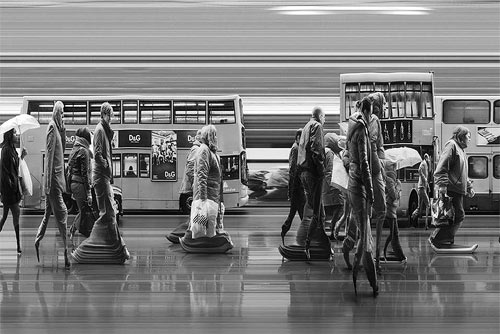
Photographer Adam Magyar uses scanner cameras to take these huge panoramic photos which are a little difficult to explain.
Adam uses the same technologies as the finish line cameras at the Olympic Games, which take thousands of images a second and records through a 1 pixel wide slit. The time and space slices are then placed next to one another to generate an image without perspective. This method is capable of recording movement only, with static objects and buildings appearing as stripes and lines.
The cheese was a going-away present for Burson’s paternal great-grandfather Charles Wainman (nee Yehezkel), upon his emigration from Lithuania, around 1893, to Johannesburg. For reasons lost to history, he never ate the cheese but kept it in a trunk that travelled with him while he worked as a trader among the Zulus, and then when he fought, on the Dutch side, in the Boer Wars.
He has financed the businesses of numerous cohorts, merely out of affection. “He’s one of the most generous people I know,” says another associate. “Also one of the flakiest.”
The movie had been controversial. The president of the festival jury, Tennessee Williams, already had vowed that it would win a prize only over his dead body (it won the Grand Prix; Williams lived). The key people at the press conference were Martin Scorsese, the film’s director, and Paul Schrader, who wrote it. The French critics were lobbing complex philosophical questions at them in French, and then the English-language translators were wading in, and everyone was getting nicely confused.
Someone finally condescended to ask a question of the little girl down at the end of the table - the one, you might assume, who’d been brought along to France as a treat, along with all the ice cream she could eat. The translator grabbed for the microphone, but Jodie Foster waved him off and answered the question herself, in perfect French. There was an astonished round of applause: At last, an American who spoke French! And less than 5 feet tall!
Why are long free kicks suprisingly effective in soccer matches? Science explains!
For a well-struck soccer ball, the researchers estimate, one might expect a gentle arc followed by a sharp hook at about 50 meters — in rough agreement with the distance of Roberto Carlos’s free kick. In other words, if a soccer player has the strength to drive a ball halfway down the field with plenty of velocity and spin, he or she can expect to benefit from an unexpected curve late in the ball’s trajectory.
But really, this is just an excuse to show you Roberto Carlos’ amazing free kick against France in 1997:
Pure awesometown. But it might not be even be better than this one:
Bikes can and should behave much more like cars than pedestrians. They should ride on the road, not the sidewalk. They should stop at lights, and pedestrians should be able to trust them to do so. They should use lights at night. And — of course, duh — they should ride in the right direction on one-way streets. None of this is a question of being polite; it’s the law. But in stark contrast to motorists, nearly all of whom follow nearly all the rules, most cyclists seem to treat the rules of the road as strictly optional. They’re still in the human-powered mindset of pedestrians, who feel pretty much completely unconstrained by rules.
The result is decidedly suboptimal for all concerned, but mostly for the bicyclists themselves. New York needs to make a collective quantum leap, from treating bicyclists like pedestrians to treating bicyclists like motorists. And unless and until it does, bike relations will continue to be marked by hostility and mistrust.
This car/pedestrian duality in the manner in which bicyclists behave is also why the City’s Summer Streets initiative is becoming almost unusable by pedestrians. We tried walking on the last Summer Streets weekend, but the cyclists were going way too fast, were routinely weaving in and out of pedestrians, pretty much refused to stay in their lanes, and there were just too many for the width of the street. We bailed out after several blocks. There will likely be even more bikes next year because the word’s getting out: it’s just too dangerous for walking.
Newton said the speed of gravity is infinite but according to Einstein (and some nifty interstellar measurements), it most certainly is not.
But in general relativity, things are much more intricate, and incredibly interesting. First off, it isn’t mass, per se, that causes gravity. Rather, all forms of energy (including mass) affect the curvature of space. So for the Sun and the Earth, the incredibly large mass of the Sun dominates the curvature of space, and the Earth travels in an orbit along that curved space.
If you simply took the Sun away, space would go back to being flat, but it wouldn’t do so right away at every point. In fact, just like the surface of a pond when you drop something into it, it snaps back to being flat, and the disturbances send ripples outward!
His total take home amounted to five times the earnings of the highest paid provincial governors over a similar period — enough to provide grain for the entire city of Rome for one year, or to pay all the ordinary soldiers of the Roman Army at the height of its imperial reach for a fifth of a year. By today’s standards that last figure, assuming the apt comparison is what it takes to pay the wages of the American armed forces for the same period, would cash out to about $15 billion.
Warning: once you make edamame2003’s version, you may never be able to go back to commercial sriracha again. The vibrant color and piquancy of the fresh fresno peppers, combined with plenty of garlic and a boost of vinegar, make for a zippy, versatile condiment that would be great with anything from banh mi to scrambled eggs.
Don’t feel guilty. Modern parents are made to feel as if they are depriving their children of “the best” if they don’t sign them up for every lesson, take them to every movie, or buy them every brain-enhancing toy. Advertising companies are paying billions of dollars to make you think this. It is not reality… it is a fictional version of reality they are selling. Let it go. Don’t “buy” into it. You are not depriving your children; you are enhancing their mental and emotional development by letting the real world around them captivate and interest them. Do you think the Smiths’ kids are really better off because they spend all their free time in front of a television or playing with a DSI?
One of the first things that Steve Jobs did after taking over as Apple’s interim CEO in 1997 is to get Apple back on track with their branding. In this short presentation from ‘97, Jobs talks about branding & Apple’s core values and introduces the Think Different campaign.
What’s interesting is how the iPad and iPhone advertisements focus almost entirely on the product. Apple no longer has to imply that their products are the best by showing you pictures of Albert Einstein and Amelia Earhart…they just show you the products and you know. But I don’t see Jobs doing a “fake it ‘til you make it” branding presentation anytime soon. :)
Life in Manhattan is like living inside a gigantic Twitter stream. What you get to know about people you don’t know simply by accidental adjacency is astonishing.
Pseudovariety — “the illusion of diversity, concealing a lack of real choice” — is when you go to the store and see an entire aisle filled with hundreds of different kinds of soda but most of those soda varieties are owned by three companies. Click through to see a neat visualization of soft drink brands and their market shares and owners.
This feat may sound impossible, but for Game Informer reader and hardcore Modern Warfare 2 player Glen McCracken, it’s only a matter of time. In two hours of playing, Glen has reached rank 5 without taking a life. Using pacifist means to earn points, Glen estimates it will take him roughly two months to be the first player to reach rank 70 with zero kills.
Here’s what the communication between a web browser and YouTube looks like when the browser requests a video, slowed down 12X so you can actually see what happens.
Professionally. From the tail-end of a recent interview with the sprinter:
Ultimately, he says, he’d love to make a go of playing football professionally. He’s being deadly serious. One of the perks of being Usain Bolt is that sporting stars love to meet him, so whenever he’s travelling and there’s time, he tries to train with a top football team. Last year it was Manchester United, a few days ago it was Bayern Munich. He’s still carrying a copy of the French sporting newspaper L’Equipe, which features a spread on his football skills and praise from Bayern manager Louis van Gaal. He shows me a photo of himself with his arm wrapped round the dwarfed 6ft German forward Miroslav Klose. “If I keep myself in shape, I can definitely play football at a high level,” he says.
“With his physical skills, I reckon he could play in the Premier League,” Simms says.
Professional American football would be even more of a no brainer…Randy Moss with Darrell Green speed++.
About eleven o’clock two nights later Fraser Lucey has a blue box in the palm of his left hand and a phone in the palm of his right. He is standing inside a phone booth next to an isolated shut-down motel off Highway 1. I am standing outside the phone booth.
Fraser likes to show off his blue box for people. Until a few weeks ago when Pacific Telephone made a few arrests in his city, Fraser Lucey liked to bring his blue box to parties. It never failed: a few cheeps from his device and Fraser became the center of attention at the very hippest of gatherings, playing phone tricks and doing request numbers for hours. He began to take orders for his manufacturer in Mexico. He became a dealer.
Fraser is cautious now about where he shows off his blue box. But he never gets tired of playing with it. “It’s like the first time every time,” he tells me.
Fraser puts a dime in the slot. He listens for a tone and holds the receiver up to my ear. I hear the tone.
Fraser begins describing, with a certain practiced air, what he does while he does it.
“I’m dialing an 800 number now. Any 800 number will do. It’s toll free. Tonight I think I’ll use the ——- [he names a well-know rent-a-car company] 800 number. Listen, It’s ringing. Here, you hear it? Now watch.”
He places the blue box over the mouthpiece of the phone so that the one silver and twelve black push buttons are facing up toward me. He presses the silver button - the one at the top - and I hear that high-pitched beep.
“That’s 2600 cycles per second to be exact,” says Lucey. “Now, quick. listen.”
He shoves the earpiece at me. The ringing has vanished. The line gives a slight hiccough, there is a sharp buzz, and then nothing but soft white noise.
“We’re home free now,” Lucey tells me, taking back the phone and applying the blue box to its mouthpiece once again. “We’re up on a tandem, into a long-lines trunk. Once you’re up on a tandem, you can send yourself anywhere you want to go.” He decides to check out London first. He chooses a certain pay phone located in Waterloo Station. This particular pay phone is popular with the phone-phreaks network because there are usually people walking by at all hours who will pick it up and talk for a while.
He presses the lower left-hand corner button which is marked “KP” on the face of the box.
“That’s Key Pulse. It tells the tandem we’re ready to give it instructions. First I’ll punch out KP 182 START, which will slide us into the overseas sender in White Plains.” I hear a neat clunk-cheep. “I think we’ll head over to England by satellite. Cable is actually faster and the connection is somewhat better, but I like going by satellite. So I just punch out KP Zero 44. The Zero is supposed to guarantee a satellite connection and 44 is the country code for England. Okay… we’re there. In Liverpool actually. Now all I have to do is punch out the London area code which is 1, and dial up the pay phone. Here, listen, I’ve got a ring now.”
I hear the soft quick purr-purr of a London ring. Then someone picks up the phone. “Hello,” says the London voice.
“Hello. Who’s this?” Fraser asks.
“Hello. There’s actually nobody here. I just picked this up while I was passing by. This is a public phone. There’s no one here to answer actually.”
“Hello. Don’t hang up. I’m calling from the United States.”
“Oh. What is the purpose of the call? This is a public phone you know.”
“Oh. You know. To check out, uh, to find out what’s going on in London. How is it there?”
“Its five o’clock in the morning. It’s raining now.”
“Oh. Who are you?”
The London passerby turns out to be an R.A.F. enlistee on his way back to the base in Lincolnshire, with a terrible hangover after a thirty-six-hour pass. He and Fraser talk about the rain. They agree that it’s nicer when it’s not raining. They say good-bye and Fraser hangs up. His dime returns with a nice clink.
“Isn’t that far out,” he says grinning at me. “London. Like that.”
Last week Grisafi started receiving tweets from European farmers saying the weather was hotter and drier than weather reports indicated. He’d been short the wheat market on the assumption that prices would fall. After reading the tweets, however, he realized the commodity might be in shorter supply than the market expected and got out of his position, avoiding a loss as prices rose.
In 1996, Tom Junot won the National Magazine Award for Feature Writing for a story published in GQ called The Rapist Says He’s Sorry. It’s about a man named Mitchell Gaff:
Who is Mitchell Gaff? Well, he is that which, at this moment in our history, frightens us the most-about ourselves, and about our democracy’s ability to contain what is worst in us. Mitch is a sex offender, but not only a sex offender; he is a rapist, but not only a rapist. He is, in the words of a law written in 1990 by the Washington state legislature, “a sexual predator”-that is, someone who “suffers from a mental abnormality or personality disorder which makes [him] likely to engage in predatory acts of sexual violence if not confined in a secure facility.” Now, never mind for the moment that this law created a category of mental illness unrecognized by modern psychiatry, and that it did so for the purpose of enabling the state to achieve in the name of mercy what it couldn’t in the name of justice: the removal of men like Mitchell Gaff from the face of the earth. What’s important to know right now is that Mitch Gaff is or has been a human being who hurts other human beings for sexual pleasure: not out of need, not to gain the dire exigencies of food, shelter, money, transportation and status, but out of want-because he likes it. It’s the wanting that scares us the most, of course, because of what we know about our own wanting-that it rises from someplace deep within us, that it is immune to intention and that it doesn’t just go away. We want Mitch to go away. It hardly matters that he has done his time; that he has, in that quaint old phrase, “paid his debt to society”; and that his continued incarceration is probably unconstitutional. We want him to go away for as long as his wanting lasts, and that’s why the state of Washington invented something called the Special Commitment Center.
There’s a short intro available here as well as a special note by Junot at the end of the main article. And after you read the article, there are two further updates on Mitch Gaff here (complete with inappropriately lusty personal ads running alongside the article) and here.
He both writes and thinks about food in the present tense. Ask about favorite foods and he’ll scribble a note: “I love spicy and Indian.” An offer to bring some New Jersey peaches to his summer home here on the shore of Lake Michigan brings a sharp defense of Michigan peaches and a menu idea. “Maybe for dessert we could have a salad of local fresh fruits.”
“Food for me is in the present tense,” he said. “Eating for me is now only in the past tense.” He says he has a “voluptuous food memory” that gets stronger all the time.
“I can remember the taste and smell of everything, even though I can no longer taste or smell,” he said.
Here are the opening couple of paragraphs from the post that evolved into the cookbook:
First, get the Pot. You need the simplest rice cooker made. It comes with two speeds: Cook, and Warm. Not expensive. Now you’re all set to cook meals for the rest of your life on two square feet of counter space, plus a chopping block. No, I am not putting you on the Rice Diet. Eat what you like. I am thinking of you, student in your dorm room. You, solitary writer, artist, musician, potter, plumber, builder, hermit. You, parents with kids. You, night watchman. You, obsessed computer programmer or weary web-worker. You, lovers who like to cook together but don’t want to put anything in the oven. You, in the witness protection program. You, nutritional wingnut. You, in a wheelchair.
And you, serving in Iraq or Afghanistan. You, person on a small budget who wants healthy food. You, shut-in. You, recovering campaign worker. You, movie critic at Sundance. You, sex worker waiting for the phone to ring. You, factory worker sick of frozen meals. You, people in Werner Herzog’s documentary about life at the South Pole. You, early riser skipping breakfast. You, teenager home alone. You, rabbi, pastor, priest,, nun, waitress, community organizer, monk, nurse, starving actor, taxi driver, long-haul driver. Yes, you, reader of the second-best best-written blog on the internet.
We actually had Jon Heder placing all the objects in and out [of frame], and then showed it to Searchlight who really liked it and thought it was great, but some lady over there was like “There are some hangnails, or something — the hands look kinda gross! It’s really bothering me, can we re-shoot some of those? We’ll send you guys a hand model.” We were like “WHAT?!” This of course was my first interaction with a studio at all, so they flew out a hand model a couple weeks later, who had great hands, but was five or six shades darker than Jon Heder. So we reshot, but they’re now intermixed, so if you look there are like three different dudes hands (our producer’s are in there too.) It all worked our great though and was a lot of fun.
The interview also addresses Pablo Ferro’s involvement and the Napoleon Dynamite animated series currently in development.
Vanity Fair has a really interesting but depressing look at how The President of the United States spends a typical day navigating the upfuckedness of national American politics and its capital, Washington DC — which Rahm Emanuel calls Fucknutsville.
We think of the presidency as somehow eternal and unchanging, a straight-line progression from 1 to 44, from the first to the latest. And in some respects it is. Except for George Washington, all of the presidents have lived in the White House. They’ve all taken the same oath to uphold the same constitution. But the modern presidency — Barack Obama’s presidency — has become a job of such gargantuan size, speed, and complexity as to be all but unrecognizable to most of the previous chief executives. The sheer growth of the federal government, the paralysis of Congress, the systemic corruption brought on by lobbying, the trivialization of the “news” by the media, the willful disregard for facts and truth — these forces have made today’s Washington a depressing and dysfunctional place. They have shaped and at times hobbled the presidency itself.
For much of the past half-century, the problems that have brought Washington to its current state have been concealed or made tolerable by other circumstances. The discipline of the Cold War kept certain kinds of debate within bounds. America’s artificial “last one standing” postwar economy allowed the country to ignore obvious signs of political and social decay. Wars and other military interventions provided ample distraction from matters of substance at home. Like many changes that are revolutionary, none of Washington’s problems happened overnight. But slow and steady change over many decades — at a rate barely noticeable while it’s happening — produces change that is transformative. In this instance, it’s the kind of evolution that happens inevitably to rich and powerful states, from imperial Rome to Victorian England. The neural network of money, politics, bureaucracy, and values becomes so tautly interconnected that no individual part can be touched or fixed without affecting the whole organism, which reacts defensively. And thus a new president, who was elected with 53 percent of the popular vote, and who began office with 80 percent public-approval ratings and large majorities in both houses of Congress, found himself for much of his first year in office in stalemate, pronounced an incipient failure, until the narrowest possible passage of a health-care bill made him a sudden success in the fickle view of the commentariat, whose opinion curdled again when Obama was unable, with a snap of the fingers or an outburst of anger, to stanch the BP oil spill overnight. And whose opinion spun around once more when he strong-armed BP into putting $20 billion aside to settle claims, and asserted presidential authority by replacing General Stanley McChrystal with General David Petraeus. The commentariat’s opinion will keep spinning with the wind.
Note: If you are a member and tried to log in, it didn't work, and now you're stuck in a neverending login loop of death, try disabling any ad blockers or extensions. Or try logging out and then back in. Still having trouble? Email me!





Socials & More