Entries for June 2008
The idea of evolution did not begin with Darwin…he just (just!) explained how it happened and backed it up with evidence.
“The only novelty in my work is the attempt to explain how species become modified,” Darwin later wrote. He did not mean to belittle his achievement. The how, backed up by an abundance of evidence, was crucial: nature throws up endless biological variations, and they either flourish or fade away in the face of disease, hunger, predation and other factors. Darwin’s term for it was “natural selection”; Wallace called it the “struggle for existence.” But we often act today as if Darwin invented the idea of evolution itself, including the theory that human beings developed from an ape ancestor. And Wallace we forget altogether.
In fact, scientists had been talking about our primate origins at least since 1699, after the London physician Edward Tyson dissected a chimpanzee and documented a disturbing likeness to human anatomy. And the idea of evolution had been around for generations.
Garfield is the current go-to media for parody and remix. Nothing Garfield, Garfield Minus Garfield, Garkov (Garfield with random dialogue), Garfield as a real cat, Lasagna Cat, Garfield Randomizer, Silent Garfield, what if Conan the Barbarian was Garfield’s owner?, The Death of Garfield, Garfield Loses His Lunch, Garfield Variations.
An upcoming film from Pixar: Andrew “Finding Nemo” Stanton’s adaptation of Edgar Rice Burroughs’ John Carter of Mars. As Binary Bonsai notes, this is a bit of a departure for Pixar, what with all the sexuality and violence.
In case you’re still hung up on the ambiguous ending of The Sopranos, there’s this long self-proclaimed definitive explanation of “The End”.
“If you look at the final episode really carefully, it’s all there.” These are David Chase’s words regarding the finale of the Sopranos. He is right, it is “all there”. This is the definitive explanation of why Tony died in Holsten’s in the final scene of The Sopranos. The following is based on a thorough analysis of the final season of the show and will clear up one of the most misunderstood endings in film or television history. Chase took almost 2 years to construct the final season of the show after the fifth season ended in June of 2004. Part 1 will show how Chase directed, edited and scored the final scene of the Sopranos to lead to the interpretation that Tony was shot in the head in Holsten’s and how this ties into the “never hear it happen” concept that Chase hammered into the viewer before the show’s final scene.
(via house next door)
Peter Bradshaw, film critic for The Guardian, wrote his 1-star review of The Incredible Hulk in Hulk-speak.
“Hulk. Smash!” Yes. Hulk. Smash. Yes. Smash. Big Hulk smash. Smash cars. Buildings. Army tanks. Hulk not just smash. Hulk also go rarrr! Then smash again. Smash important, obviously. Smash Hulk’s USP. What Hulk smash most? Hulk smash all hope of interesting time in cinema. Hulk take all effort of cinema, effort getting babysitter, effort finding parking, and Hulk put great green fist right through it. Hulk crush all hopes of entertainment. Hulk in boring film. Film co-written by star. Edward Norton. Norton in it. Norton write it. Norton not need gamma-radiation poisoning to get big head.
Remember when The Hulk had a blog?
(via house next door)
Rampant speculation from Jonah Lehrer on why people care so much when they watch overpaid athletes play sports. It is, perhaps, all about mirror neurons:
“The main functional characteristic of mirror neurons is that they become active both when the monkey makes a particular action (for example, when grasping an object or holding it) and when it observes another individual making a similar action.” In other words, these peculiar cells mirror, on our inside, the outside world; they enable us to internalize the actions of another. They collapse the distinction between seeing and doing.
This suggests that when I watch Kobe glide to the basket for a dunk, a few deluded cells in my premotor cortex are convinced that I, myself, am touching the rim. And when he hits a three pointer, my mirror neurons light up as I’ve just made the crucial shot. They are what bind me to the game, breaking down that 4th wall separating fan from player. I’m not upset because my team lost: I’m upset because it literally feels like I lost, as if I had been on the court.
According to the Meth Project Foundation, one of the warning signs that you may have a problem with meth is that you are “using more meth than intended”. [The Meth Project]
A household with income under $13,000 spends, on average, $645 a year on lottery tickets, about 9 percent of all income. [NY Times]
The food service operation at the House of Representatives, under private control since the 80s, is significantly more popular than the federally run Senate food service operation. The Senate recently voted to privatize their service as well. [Washington Post]
After John Glenn ran for president in 1984, he struggled for more than 20 years to pay off his campaign debt of $3 million. [NY Times]
The Mars Phoenix Mission has cost $420,000,000 so far. That’s about $1/mile, about the same cost per mile as driving an SUV. Not bad, NASA! [Charisma 18]
A new form of nanopaper is stronger than cast iron and nearly as strong as structural steel. [New Scientist]
Organic milk often keeps longer than regular milk because a lot of the organic product is ultra pasteurized. [Scientific American]
MLB teams are losing road games at a rate not seen since the 1930s. According to an anonymous GM, the reason for the increased home field advantage is that last year’s ban on amphetamines is finally taking hold, leaving traveling players with one less option for feeling peppier after 5 hours on a plane through 3 timezones. [The Frontal Cortex]
The Japanese words for a person obsessed with Muji is Mujirer. [The Moment]
The number of condoms available for use, free of charge, this year at McMurdo base in Antarctica: almost 16,500.
News flash! Most bridesmaids don’t like their bridesmaid dresses. [The Onion
CNN]
(Check out all of the past installments of this feature here.)
The top ten home cooking mistakes. The name of the post is something of a misnomer…it’s really a list of suggestions to improve your home cooking.
2. A real knife. You can do a lot with a good chef’s knife, and you can’t do shit without one. It doesn’t have to be an expensive model; America’s Test Kitchen has recommended this Victorinox 8” chef’s knife (or its 10” version, about a buck cheaper!) for years, although I have grown accustomed to the handles on my Henckels Four-Star knives. Buy a good chef’s knife that feels comfortable in your hand, with a blade 8 to 9 inches long, and buy a honing steel to keep it sharp. Avoid home sharpeners, though, which “sharpen” your blade by destroying it.
(thx, andrew)
2600, the hacker’s quarterly magazine, is publishing a best-of book compiling their most interesting and controversial articles.
Since its introduction in January of 1984, 2600 has been a unique source of information for readers with a strong sense of curiosity and an affinity for technology. The articles in 2600 have been consistently fascinating and frequently controversial. Over the past couple of decades the magazine has evolved from three sheets of loose-leaf paper stuffed into an envelope (readers “subscribed” by responding to a notice on a popular BBS frequented by hackers and sending in a SASE) to a professionally produced quarterly magazine. At the same time, the creators’ anticipated audience of “a few dozen people tied together in a closely knit circle of conspiracy and mischief” grew to a global audience of tens of thousands of subscribers.
Only 888 pages. (via bb)
This is a page from a book called Hypnerotomachia Poliphili.
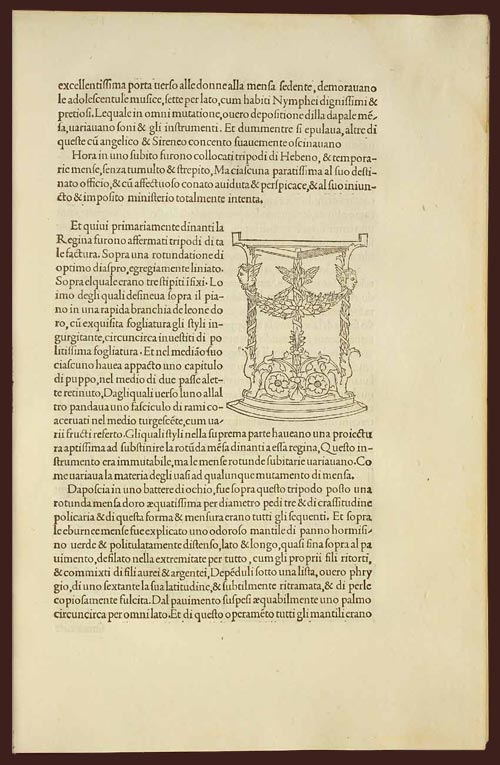
Any guesses as to when it was published? The title, Latin text, yellowed paper, and lack of page numbers might tip you off that it wasn’t exactly released yesterday. Turns out that Hypnerotomachia Poliphili was published in 1499, more than 500 years ago and only 44 years after Gutenberg published his famous Bible. It belongs to a group of books collectively referred to as incunabula, books printed with a printing press using movable type before 1501.
To contemporary eyes, the HP looks almost modern. The text is very readable. The typography, layout, and the way the text flows around the illustration; none of it looks out of the ordinary. When compared to other books of the time (e.g. take a look at a page from the Gutenberg Bible), its modernity is downright eerie. The most obvious difference is the absence of the blackletter typeface. Blackletter was a popular choice because it resembled closely the handwritten script that preceded the printing press, and I imagine its use smoothed the transition to books printed by press. HP dispensed with blackletter and instead used what came to be known as Bembo, a humanist typeface based on the handwriting of Renaissance-era Italian scholars. From a MIT Press e-book on the HP:
One of the features of the Hypnerotomachia that has attracted the attention of scholars has been its use of the famed Aldine “Roman” type font, invented by Nicholas Jenson but distilled into an abstract ideal by Francesco Biffi da Bologna, a jeweler who became Aldus’s celebrated cutter. This font — generally viewed as originating in the efforts of the humanist lovers of belles-lettres and renowned calligraphers such as Petrarch, Poggio Bracciolini, Niccolo Niccoli, Felice Feliciano, Leon Battista Alberti, and Luca Pacioli, to re-create the script of classical antiquity — appeared for the first time in Bembo’s De Aetna. Recut, it appeared in its second and perfected version in the Hypnerotomachia.
In that way, Hypnerotomachia Poliphili is both a throwback to Roman times and an indication of things to come.
The MIT Press site also notes a number of other significant aspects of the book. As seen above, illustrations are integrated into the main text, allowing “the eye to slip back and forth from textual description and corresponding visual representation with the greatest of ease”. In his 2006 book, Beautiful Evidence, Edward Tufte says:
Overall, the design of Hypnerotomachia tightly integrates the relevant text with the relevant image, a cognitive integration along with the celebrated optical integration.
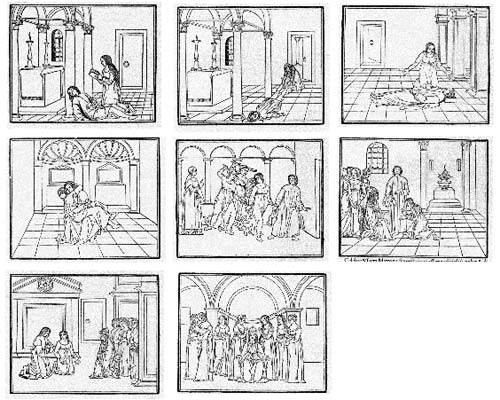
Several pages in the book make use of the text itself to illustrate the shapes of wine goblets. The HP also contained aspects of film, comics, and storyboarding…successive illustrations advanced action begun on previous pages:
All of which makes the following puzzling:
The Hypnerotomachia Poliphili is one of the most unreadable books ever published. The first inkling of difficulty occurs at the moment one picks up the book and tries to utter its tongue-twisting, practically unpronounceable title. The difficulty only heightens as one flips through the pages and tries to decipher the strange, baffling, inscrutable prose, replete with recondite references, teeming with tortuous terminology, choked with pulsating, prolix, plethoric passages. Now in Tuscan, now in Latin, now in Greek — elsewhere in Hebrew, Arabic, Chaldean and hieroglyphs — the author has created a pandemonium of unruly sentences that demand the unrelenting skills of a prodigiously endowed polyglot in order to be understood.
It’s fascinating that a book so readable, so beautifully printed, and so modern would also be so difficult to read. If you’d like to take a crack at it, scans of the entire book are available here and here. The English translation is available on Amazon.
A company called Cargo Cosmetics makes a line of makeup called blu_ray for use by people appearing on high-definition TV or film.
Developed in response to the needs of makeup artists shooting in high definition, these specialized products work for high-def and are ideal for perfecting the skin while still giving a natural look.
Available at Sephora. Has anyone used this? Does it work? Email me. (thx, doug)
Christopher Hitchens, worried about tall buildings carelessly built in the West Village of Manhattan, makes his case for non-gentrification.
It isn’t possible to quantify the extent to which society and culture are indebted to Bohemia. In every age in every successful country, it has been important that at least a small part of the cityscape is not dominated by bankers, developers, chain stores, generic restaurants, and railway terminals. This little quarter should instead be the preserve of — in no special order — insomniacs and restaurants and bars that never close; bibliophiles and the little stores and stalls that cater to them; alcoholics and addicts and deviants and the proprietors who understand them; aspirant painters and musicians and the modest studios that can accommodate them; ladies of easy virtue and the men who require them; misfits and poets from foreign shores and exiles from remote and cruel dictatorships. Though it should be no disadvantage to be young in such a quartier, the atmosphere should not by any means discourage the veteran.
The huge media conglomerates are re-imagining their cash-cow brands like Mickey Mouse, Bugs Bunny, and Strawberry Shortcake for today’s generation of kids. Poochie, anyone?
You want a dark, Goth version of Tweety Bird? Have at it.
This isn’t going to end well.
Moving Mario: imagine Super Mario Bros as created by Michel Gondry. Check out the video to get the gist.
A wonderful story about how an architect took it upon himself to build a scavenger hunt into one of his client’s apartments, all without telling them.
Finally, one day last fall, more than a year after they moved in, Mr. Klinsky received a letter in the mail containing a poem that began:
We’ve taken liberties with Yeats
to lead you through a tale
that tells of most inspired fates
iin hopes to lift the veil.
The letter directed the family to a hidden panel in the front hall that contained a beautifully bound and printed book, Ms. Bensko’s opus. The book led them on a scavenger hunt through their own apartment.
And it wasn’t an easy hunt either.
In any case, the finale involved, in part, removing decorative door knockers from two hallway panels, which fit together to make a crank, which in turn opened hidden panels in a credenza in the dining room, which displayed multiple keys and keyholes, which, when the correct ones were used, yielded drawers containing acrylic letters and a table-size cloth imprinted with the beginnings of a crossword puzzle, the answers to which led to one of the rectangular panels lining the tiny den, which concealed a chamfered magnetic cube, which could be used to open the 24 remaining panels, revealing, in large type, the poem written by Mr. Klinsky.
(thx, john)
In Brazil, soap operas, and specifically the small families they depicted, might have been a form of birth control, lowering the fertility of the audience:
In 1960, the average Brazilian woman had 6.3 children. By 2000, the fertility rate was down to 2.3. The decline was comparable to China’s, but Brazil didn’t have a one-child policy. In fact, for a while it was even illegal to advertise contraceptives.
Many factors account for the drop in Brazilian fertility, but one recent study identified a factor most people probably wouldn’t consider: soap operas (novelas). Novelas are huge in Brazil, and the network Rede Globo effectively has a monopoly on their production…
Using census data from 1970 to 1991 and data on the entry of Rede Globo into different markets, the researchers found that women living in areas that received Globo’s broadcast signal had significantly lower fertility. (And yes, the study did control for all sorts of factors and addressed the concern that the entry of Globo might have been driven by trends that also contribute to fertility decline. I’ll spare you the gory econometric details.) Additionally, people in areas with Globo’s signal were more likely to name their children after novela characters, suggesting that it was the novelas specifically, and not TV in general, that influenced childbearing.
Update (by jkottke): The Sabido Method:
Named after the pioneer in application of this entertainment-education strategy, Miguel Sabido, the Sabido Method is based on character development and plot lines that provide the audience with a range of characters that they can engage with — some good, some not so good — and follow as they evolve and change. Sabido developed this methodology when we was Vice President for Research at Televisa in Mexico in the 1970s.
According to the Mexican government’s national population council, a soap opera called Acompaname was responsible for large increases in people requesting family planning information, contraceptive sales, and enrollment in family planning clinics. From 1977 to 1986, when these soap operas were on, Mexico’s population growth rate fell by 34%. The Sabido Method was also recently covered in the New Yorker. (thx, omegar)
David “The Wire” Simon’s new show, Generation Kill, starts on HBO on July 13 and will continue for six Sundays after that.
Rave review of a 1995 documentary on the Yugoslavian War called The Death of Yugoslavia.
Despite some criticism about the accuracy of translation, the series would be in my list of top ten documentaries of all time, I cannot recommend it highly enough. It unravels the mechanism of the sordid path of human conflict, from nationalism to genocide, like no other film before or since. It is the film that never was made about the holocaust.
Sounds like a candidate for True Films. All six parts are available on Google Video…start with part one.
Photographer Sam Haskins, well known for doing in-camera montage, briefly describes how composite photos were made in the time before Photoshop.
Its a single exposure with the model viewed through optical glass at 45° and the fabric positioned to the side. At the time there was zero retouching after the event. Now of course I have the luxury of scanning the transparency to clean and refine the image in Photoshop - God bless its digital socks.
Video of a bunch of people (including what looks like a 8-yo girl) shooting the shit out of cars and stuff with fully automatic machine guns…the footage is from the Oklahoma Full Auto Shoot & Trade Show.
KILL THE CAR is on of the favorite events we have here at OFASTS. In this event, there will be a car, loaded with explosives located on the far side of the shooting range. Anyone who wants, can participate, and try and “KILL THE CAR”. Which basically means, try and blow it up first. It’s a real BLAST!!
(via delicious ghost)
Any Wikipedia entry that references Adolf Wolfli is a friend of mine. Horror vacui:
Horror vacui is the filling of the entire surface of an artwork with ornamental details, figures, shapes, lines and anything else the artist might envision. It may be considered the opposite of minimalism.
(More of my friends here, apparently.)
Kevin Kelly on a fascinating concept called scenius. As defined by Brian Eno:
Scenius stands for the intelligence and the intuition of a whole cultural scene. It is the communal form of the concept of the genius.
Kelly lists four factors that are important in nuturing scenius:
1. Mutual appreciation — Risky moves are applauded by the group, subtlety is appreciated, and friendly competition goads the shy. Scenius can be thought of as the best of peer pressure.
2. Rapid exchange of tools and techniques — As soon as something is invented, it is flaunted and then shared. Ideas flow quickly because they are flowing inside a common language and sensibility.
3. Network effects of success — When a record is broken, a hit happens, or breakthrough erupts, the success is claimed by the entire scene. This empowers the scene to further success.
4. Local tolerance for the novelties — The local “outside” does not push back too hard against the transgressions of the scene. The renegades and mavericks are protected by this buffer zone.
Long but entertaining and informative interview with Cory Doctorow.
One of the things I’ve noticed about writing every day is that there are days when writing that page feels like flying. Like the hand of God reached down and touched my keyboard, and every word is just pure gold. And then there are days that I feel I’m writing absolute, totally forgettable junk that shouldn’t have been committed to phosphors, let alone saved to disc. The thing is, a month later, you can’t tell the difference. The difference between a day when it feels like you’re writing brilliantly and a day when it feels like you’re writing terribly is entirely in your head, it’s not in the prose.
This phrase is attributed to French monk Dom Pierre Pérignon upon his discovery of Champagne:
Venez vite, je goûte les étoiles!
It’s typically translated into English as:
Come quickly, I am drinking the stars!
Although Pérignon made important advances in sparkling wine production, a reproducible process for making sparkling wine (of which Champagne is one variety) was actually first described by an Englishman, Christopher Merret, some thirty years before. In a paper presented to the Royal Society, Merret noted that the addition of sugar to wine would result in a second fermentation, which made the wine sparkle.
Merret came to sparkling wine through his interest in glass. The process of secondary fermentation had been known since before medieval times but was not reproducible because the glass bottles would explode under the pressure. Using stronger English glass and sturdy corks, Merret was able to dependably reproduce the sparkling effect and publish the technique for anyone to do the same. A bit less glamorous than “drinking the stars” perhaps, but a deft illustration of the scientific method nonetheless.
BTW, Moët and Chandon, producers of the Dom Pérignon brand of Champagne, still perpetuate the myth that Dom Pérignon invented the method for making sparkling wine. From the DP web site:
Make “the best wine in the world.” It took a visionary spirit and exceptional daring to set such an exalted ambition at the end of the 17th century. But vision and daring were second nature to Pierre Pérignon. Before him, there was only what was known as the wines of Reims, of La Montagne and of La Rivière, according to their origins in the Champagne region. With amazing intuition, Dom Pérignon was the first to see the fabulous promise of luxury. He took very ordinary wines and gave them body, spirit and grace. Through his efforts Champagne wine entered a new world.
Whatever helps you sell the Champers, I guess.
Tweetup n.
A real world meeting between two or more people who know each other through the online Twitter service.
I had a tweetup with my wife this morning. And last night. And the day before that. TMI?
It’s been hot in NYC for the past few days, but I don’t know if it was ice-lickin’ hot.
Is Deborah Solomon, the NY Times Magazine’s notoriously irritating Q&A interviewer, turning over a new leaf? After complaints about her columns surfaced last fall, the NY Times public editor agreed that Solomon had not complied with the Times’ policy of fairly representing the answers of her interviewees. Ben Wheeler noted that her most recent piece is an excellent straightforward interview with zero snarky asides or abusive questions.
If you point out when they suck, you gotta point out when they do well. On Sunday, Deborah Solomon’s weekly NY Times Magazine interview was an excellent talk with Enrique Penalosa, former mayor of Bogota known for his Susan Jacobs/Scandinavian vision of urban planning. Solomon’s old method, of inserting snide remarks and different questions after the fact, is gone; we can thank Ira Glass and Amy Dickinson (Ann Landers’s successor) for that, since they complained when she did it to them. But beyond that change, Solomon here just asks good, sensible questions of an interesting subject.
I spend far too much of my life daydreaming about scenarios like this:
I wanted to ask for survival tips in case I am unexpectedly transported to a random location in Europe (say for instance current France/Benelux/Germany) in the year 1000 AD (plus or minus 200 years). I assume that such transportation would leave me with what I am wearing, what I know, and nothing else. Any advice would help.
To which Tyler Cowen replies:
Find someone who will take care of you for a few days or weeks and then look for employment in the local church. Your marginal product is quite low, even once you have learned the local language. You might think that knowing economics, or perhaps quantum mechanics, will do you some good but in reality people won’t even think your jokes are funny. Even if you can prove Euler’s Theorem from memory no one will understand your notation. I hope you have a strong back and an up to date smallpox vaccination.
The comments are full of informative and entertaining options. I side with the commenters who feel that the most likely outcome is death within a few days. Unless you’re skilled at wilderness survival, finding edible food, shelter, and potable water in a time when those things were much more scarce than now will prove difficult. If you do manage to survive, maybe you could set up shop selling goods that people could use:
I’d start a shop that did nothing but boil water and then sell it. I’d market it as “de-spirited” water and sell it to midwives, priests, doctors - anyone who would be charged with the health of another. The boiled, micro-organism free water would dramatically improve the health outcomes for anyone with cholera or plague or infection. Even marginally better outcomes using clean water would bolster my reputation and business. Of course, barriers to entry would be pretty low in my business, but if I were widely copied, I’d start a health revolution. For that quantum timeline anyway.
Again, assuming you survive, other commenters suggest that you “invent” something, sell it, and become rich so that your wealth will insulate you from further problems, stuff like gunpowder, mass production, long bows, guns, soap, steel, the printing press, double-entry accounting, whiskey, capitalism, and hot air balloons. I’m skeptical of this approach…how many people living in the US know how to make gunpowder from scratch? Given enough time, I guess I could build a hot air balloon that actually flies and carries human passengers but anything involving chemistry would prove tougher.
How would you survive if suddenly transported back to 1000 AD? Leave your suggestions for survival in the comments.
Kevin Kelly highlights wooden bikes from around the world, including those from Rwanda, Tanzania, and the Philippines.
Buffett to hedge fund managers: your customers would do better investing in a no-load index fund. To prove his point, Buffett has bet $1 million to that effect on Long Bets.
Costs skyrocket when large annual fees, large performance fees, and active trading costs are all added to the active investor’s equation. Funds of hedge funds accentuate this cost problem because their fees are superimposed on the large fees charged by the hedge funds in which the funds of funds are invested.
A number of smart people are involved in running hedge funds. But to a great extent their efforts are self-neutralizing, and their IQ will not overcome the costs they impose on investors. Investors, on average and over time, will do better with a low-cost index fund than with a group of funds of funds.
After yesterday’s iPhone 3G revelry, the inevitable hangover. AT&T is done playing nice with iPhone customers. First off, the data plan for 3G is $10 more than the old plan. Second, in-store activation is required, “which takes 10-12 minutes”…with the old version of the iPhone, you could activate through iTunes and it took 2 minutes. (That means no online ordering of phones either.) Third, Apple and AT&T may be working on a purchase penalty for those who don’t activate their phones within 30 days…so no more buying a phone to use on another network. Four: no prepaid plans. Yay?
Chris Gilmour makes intricate life-sized art entirely out of cardboard. Bikes, microscopes, cars, typewriters, wheelchairs, etc. (via fire wire)
Man, I love this video. It’s some guy explaining how the banana — “the atheist’s nightmare” — so perfectly fits in the human hand and peels so easily that it must have been made by God**. Kirk Cameron listens intently. I can’t wait for the follow-up video where he explains why watermelons don’t have handles and what God was thinking when he built the coconut.
** Not that this guy cares or whatever, but the modern banana is a cultivated fruit…i.e. pressured by humans to, oh what’s the word…evolve into its present form. And other varieties of bananas are smaller or larger and differently shaped. Some wild bananas have large hard seeds. I could go on….
Transcript and video of JK Rowling’s Harvard commencement address, The Fringe Benefits of Failure, and the Importance of Imagination.
You might think that I chose my second theme, the importance of imagination, because of the part it played in rebuilding my life, but that is not wholly so. Though I will defend the value of bedtime stories to my last gasp, I have learned to value imagination in a much broader sense. Imagination is not only the uniquely human capacity to envision that which is not, and therefore the fount of all invention and innovation. In its arguably most transformative and revelatory capacity, it is the power that enables us to empathise with humans whose experiences we have never shared.
Imagination as Rowling perceives it is essential in telling other people’s stories and is sorely missing in the media today. And the blogosphere can almost be defined by its lack of empathy. (thx, adriana)
Video of the 2008 Democratic primary in 8 minutes.
Awesome recap…and mostly new to me because I didn’t pay much attention to all the weighty issues that were bandied about during the whole thing. (via jakob)
Google is providing real-time stock prices now…no page refresh necessary. So you can, for instance, watch Apple’s stock price drop after Jobs’ keynote. Now I know how daytraders feel…I can’t take my eyes off of the screen.
What new brushed metal magic treats will Steve Jobs unveil this year at the Apple Worldwide Developer Conference? Hover car? Neverlost keys? Orgasm pills? Electric pony? All that and more at 1pm ET….live blogging of Jobs’ keynote at MacRumors, Mac Observer, Engadget, and Ars Technica (which includes a spectacularly nerdy photo of Gizmodo’s Brian Lam and his liveblogging contraption). Let the games begin.
Update: Holy shit! Michael Sippey is on stage right now.
Update: Here’s some live streaming audio of the keynote. This feels like cheating. (thx, andy)
Update: New iPhone announced with 3G, GPS, flush headphone jack (!!), thinner, cheaper, and better battery life. Price: $199 for 8 gig iPhone. $299 for 16 gig. Available in white.
Update: This is an interesting tech tidbit about how Apple fit all of those protocols into the phone:
iPhone 3G delivers UMTS, HSDPA, GSM, Wi-Fi, EDGE, GPS, and Bluetooth 2.0 + EDR in one compact device - using only two antennas. Clever iPhone engineering integrates those antennas into a few unexpected places: the metal ring around the camera, the audio jack, the metal screen bezel, and the iPhone circuitry itself. And intelligent iPhone power management technology gives you up to 5 hours of talk time over 3G networks.
A video clip of La Paz, Bolivia’s crossing guard zebras, the Cebra Voluntaria. Traffic in La Paz is so dangerous that its mayor started a program to have youths dressed as zebras help people across the city’s busiest intersections. From the recent issue of Monocle:
It doesn’t get much busier than La Paz’s Plaza San Francisco of a Friday afternoon. Two zebras stand on the curb chatting with a teenage girl. Then something remarkable happens: the traffic light turns red, and at the sight of the zebras, the cars actually stop. One driver, however, is a little slow and the nose of his car is left hanging over the crossing. One of the zebras skips over to the offending car and mimes pushing it backwards. Then he continues skipping across to the other side of the street.
The stunning Calatrava-designed Chicago Spire is due to be completed in 2011 and will, ahem, tower over the Sears Tower by more than 500 feet. Check out the view from the 140th floor.
Robert McCrum, the outgoing literary editor of The Observer, recently summed up the last decade in books in ten short chapters (with accompanying timeline).
People will argue about the decisive milestones (I have come up with my own 10, which I have set out in chapters), but there will be general agreement that, in Britain, a decade of change starts with the election of New Labour in 1997. That was also the year Random House launched its website, John Updike published a short story online and Vintage started a series of reading guides to encourage new book clubs. As well as new readers, the millennium saw the emergence of a new literary generation, writers born in the Sixties and Seventies, and few of them more fascinating than Zadie Smith…
McCrum also shares a tidbit about Malcolm Gladwell’s first book which I’d never heard before.
The Tipping Point was almost a flop. It was published to mixed reviews in the US, did no serious business in the UK and was saved by — yes — word of mouth. After a dismal launch, and as a desperate last resort, Gladwell persuaded his American publisher to sponsor a US-wide lecture tour. Only then did the book ‘tip’. Eventually, it would become a literary success of its time, turn its author into a pop cultural guru and spend seven years on the New York Times bestseller list. This was one of those pivotal moments that illustrates the story of this decade.
At the WH Smith shop at Heathrow last weekend, the paperback copy of The Tipping Point was still #5 on the business bestsellers list and nearly sold out.
Typographically inspired movie titles, including Full Meta Jacket, Bembo: First Blood, and He-Man and the Masters of the Univers.
Newer posts
Older posts







Socials & More