Lost and found: 1) a Massachusetts lighthouse missing since 1925 turned up in California and 2) an Egyptian pyramid discovered in the 1840s and subsequently lost again was recently rediscovered.
Snow is good — soft, deep, drifted snow. Snow is lovely. Remember that you are the pilot and your body is the aircraft. By tilting forward and putting your hands at your side, you can modify your pitch and make progress not just vertically but horizontally as well. As you go down 15,000 feet, you can also go sideways two-thirds of that distance — that’s two miles! Choose your landing zone. You be the boss.
If your search discloses no trees or snow, the parachutist’s “five-point landing” is useful to remember even in the absence of a parachute. Meet the ground with your feet together, and fall sideways in such a way that five parts of your body successively absorb the shock, equally and in this order: feet, calf, thigh, buttock, and shoulder. 120 divided by 5 = 24. Not bad! 24 mph is only a bit faster than the speed at which experienced parachutists land. There will be some bruising and breakage but no loss of consciousness to delay your press conference. Just be sure to apportion the 120-mph blow in equal fifths. Concentrate!
Leave it to the Japanese to put barcodes on tombstones. Scannable by mobile phone, the tombstones can deliver images and video of the deceased to future mourners.
In addition to images of the deceased, people can view a greeting from the chief mourner at the funeral and browse through the guest book. They can also make entries using their cell phones.
On the subject of hand dryers (a hot popular topic, judging by the amount of email that post generated in my inbox), while on vacation, we also experienced the sheer power of the XLERATOR hand dryer (in a Heathrow bathroom). Where the Dyson Airblade is a bit clever as to how it dries your hands, the XLERATOR expels the damp from your mitts with great force…so forcefully that the skin flaps on your hands like this guy’s face during high-g training. My wife feels the XLERATOR is the superior dryer. (thx, monsur)
Sasha Frere-Jones on Auto-Tune, the studio gizmo responsible for the cool/cheesy voice effects in Cher’s Believe and, more recently, most of T-Pain’s work.
T-Pain, who is currently working on his third album, “Thr33 Ringz,” spoke to me on the phone from his studio in Miami. He first heard the Auto-Tune effect on a song by Jennifer Lopez — he doesn’t remember which one — and borrowed it for a mixtape appearance in 2003. He says it’s no trade secret that he uses Auto-Tune with the retune speed set to zero, and likes to recall a time he spent selling fish out of a truck with his father in Tallahassee: “My dad said, ‘They can know what you’re using, but they’ll never know how to use it. They can see that we’re using salt and pepper.’”
In July 1968, a train delivered the body of Robert Kennedy from NYC to Washington D.C. so that he could be buried in Arlington National Cemetery next to his brother. Photographer Paul Fusco was on that train and shot a bunch of photos of the hundreds of thousands of people that spontaneously turned up along the train route to mourn Kennedy, photos that were recently rediscovered. Fusco narrates a slideshow of the photos.
I’ll let the pictures speak for themselves, but I’ll also tell you the only area where Paul and I disagreed. For Paul, the event and the photographs represented the end of hope. To me they represent the indomitability of the American spirit.
Either way, the photos are powerful but also show the ordinary American-ness of that time period.
The new UI still offers the Quick Cash feature, but in a much smarter way. Instead of one Quick Cash button, we introduced a whole column of shortcut buttons that behave somewhat like the History menu in a web browser. It is still possible to customize them through Set My ATM Preferences, but hardly necessary since they always reflect the most recent transactions.
An inventive cover version of Radiohead’s Nude played by the following instruments: Sinclair ZX Spectrum computer, Epson dot matrix printer, HP Scanjet scanner, and an array of hard drives. Skip ahead to 1:08 if you can’t wait through the opening. This isn’t the correct technological time period to be steampunk. Bitpunk anyone? (via waxy)
It is written on a completely clear slate, by someone who had not already been taught how to regard the cinema by a thousand other writers, and the newness of it all leaps from the page. What is remarkable is Gorky’s prescience in the last two paragraphs, as he leaps ahead from his description of the first films to speculation on what directions the cinema might eventually take, toward sex and violence. How did he know?
The bulk of Gorky’s short review concerns the absence of color and sound from the films, as if he’s viewing shadows of reality.
Their smiles are lifeless, even though their movements are full of living energy and are so swift as to be almost imperceptible. Their laughter is soundless although you see the muscles contracting in their grey faces. Before you a life is surging, a life deprived of words and shorn of the living spectrum of colours — the grey, the soundless, the bleak and dismal life.
Photography has ceased to record immobility. It perpetuates the image of movement. When these gadgets are in the hands of the public, when anyone can photograph the ones who are dear to them, not just in their immobile form, but with movement, action, familiar gestures and the words out of their mouths, then death will no longer be absolute, final.
And this one from the projectionist of the first Lumiere in NYC:
You had to have lived these moments of collective exaltation, have attended these thrilling screenings in order to understand just how far the excitement of the crowd could go. With the flick of a switch, I plunge several thousand spectators into darkness. Each scene passes, accompanied by tempestuous applause; after the sixth scene, I return the hall to light. The audience is shaking. Cries ring out.
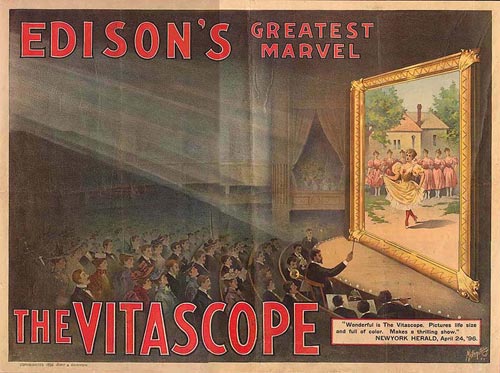
The vitascope projects upon a large area of canvas groups that appear to stand forth from the canvas, and move with great facility and agility, as though actuated by separate impulses. In this way the bare canvas before the audience becomes instantly a stage upon which living beings move about.
So enthusiastic was the appreciation of the crowd long before this exhibition was finished that vociferous cheering was heard. There were loud calls for Mr. Edison, but he made no response.
By 1898, the language of cinema was beginning to sort itself out, more or less, as this Times editorial notes.
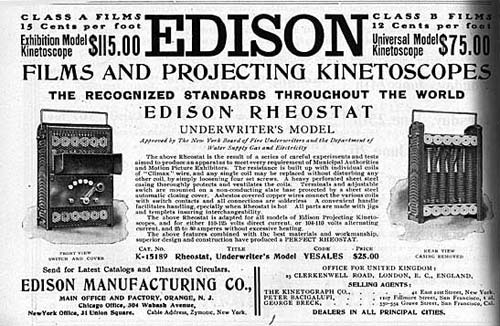
All the resources of the word-builders see to have been exhausted in finding names for the simple but ingenious machine that throws moving pictures on a screen. The essential features in every device of this sort are the same — a brilliant light before which a long band of minute photographs is rapidly drawn, and a lens to focus and distribute the rays properly. The arrangements for the manipulation of the light, the band, and the lens are numerous, but they vary only in the inconsequential details, and for all practical purposes the machines are identical. Some mysterious impulse, however, has impelled almost every purchaser of the apparatus to buy with it, or to invent for it, a distinctive name. Vitascope and biograph are most familiar here, with cinematograph coming next at a considerable distance. These hardly begin the list that might be formed from a careful study of the amusement advertisements in the papers of this and other countries. From such sources might be taken phantoscope, criterioscope, kinematograph, wondorscope, animatoscope, vitagraph, panoramograph, cosmoscope, anarithmoscope, katoptikum, magniscope, zoeoptrotrope, phantasmagoria projectoscope, variscope, cinograph, cinnomonograph, hypnoscope, centograph, and xograph. This is far from exhausting the supply. Electroscope exists, and so do cinagraphoscope, animaloscope, theatrograph, chronophotographoscope, motograph, rayoscope, motorscope, kinotiphone, thromotrope, phenakistoscope, venetrope, vitrescope, zinematograph, vitropticon, stinnetiscope, vivrescope, diaramiscope, corminograph, kineoptoscope, craboscope, vitaletiscope, cinematoscope, mutoscope, cinoscope, kinetograph, lobsterscope, and nobody knows how many more. Here, surely, is a curious development of the managerial mind.
It’s difficult to read these accounts and not think about how we’ll all sound in 100 years as we now attempt to explain the internet, mobile phones, the web, blogs, and the like.
The average U.S. citizen completely ignores the regularity with which the automobile kills him, maims him, embroils him with the law and provides mobile shelter for rakes intent on seducing his daughters. He takes it into his garage as fondly as an Arab leading a prize mare into his tent. He woos it with Simoniz, Prestone, Ethyl and rich lubricants — and goes broke trading it in on something flashier an hour after he has made the last payment on the old one.
By last week, this peculiar state of mind had not only sucked thousands of American oil wells dry, stripped the rubber groves of Malaya, produced the world’s most inhuman industry and its most recalcitrant labor union, but had filled U.S. streets with so many automobiles that it was almost impossible to drive one. In some big cities, vast traffic jams never really got untangled from dawn to midnight; the bray of horns, the stink of exhaust fumes, and the crunch of crumpling metal eddied up from them as insistently as the vaporous roar of Niagara.
The NBA Finals start tonight, pitting the LA Lakers against the Boston Celtics. Despite having finished with the best regular season record in the league, the Celtics find themselves underdogs against the Lakers, who ripped through the tough Western conference bracket with little difficulty. I’m going with the majority on this one: Lakers in six games (possibly even five) and continued heartbreak for New England fans after the high of the Red Sox’s second World Series victory last season.
Swiss watch brands are patriotic to a fault. Rolex is one of the few high-end manufacturers that does not stamp “Swiss Made” on the watch face in the belief that Rolex defines Switzerland rather than the other way around.
Every year or so, the same question is asked: how is the Moneyball strategy working out for the Oakland A’s. This year’s answer is: pretty damn good.
Additions like [Frank] Thomas, motivated by this incremental approach, help explain why the A’s have won so many games in recent years even though they’ve consistently traded away or declined to re-sign their top players (Jason Giambi, Miguel Tejada, Tim Hudson, etc.), who demand top dollar—and largely on the basis of past performance. In short, Beane has bought low and sold high repeatedly and systematically, and as a result the A’s have won more games this decade than every team in the league except the Yankees (whose team payroll is routinely two-to-four times larger than Oakland’s).
We were talking about the cocksure Christopher Hitchens at lunch today and when I get back to my desk, a link to an interview with Hitchens appears in my newsreader.
Oh, and I do not “profess” to despise religious extremists. I really do despise them.
The sizes of the photographs are deliberately large - taking advantage of the majority of web users who have screens capable of displaying 1024x768 or larger. The long-held tradition of keeping images online tiny and lightweight is commendable still - when designing a general purpose site. But one dedicated to quality imagery should take full advantage of the medium, and I hope I’ve struck a good balance with The Big Picture.
When I see quality photography consigned to the archives, or when I see bandwidth readily given up to video streams of dubious quality, or when I see photo galleries that act as ad farms, punishing viewers into a click-click-click experience just to drive page views - those times are the times I’m glad I was able to get this project off the ground (many thanks to my friends within boston.com)
Written around 1924, when Nabokov was in his mid-twenties (five years after his family fled Russia, and two years after his father was assassinated in Berlin), it was discovered in the writer’s archives at the Library of Congress a couple of years ago, and was translated by his son, Dmitri.
A fantastic example of my favorite kind of Wikipedia entry: placeholder name.
Placeholder names are words that can refer to objects or people whose names are either irrelevant or unknown in the context in which it is being discussed.
Whatchamacallit, junk, widget, gizmo, Joe Blow, shitload, Podunk, and beer o’clock are all examples. Placeholder names are also used extensively in non-English languages.
The German equivalent to the English John Doe for males and Jane Doe for females would be Max Mustermann and Erika Mustermann, respectively. For many years, Erika Mustermann was used on the sample picture of German id-cards (“Personalausweis”). In Austria, Max Mustermann is used instead. Sometimes the term Musterfrau is used as the last name placeholder, possibly because it is felt to be more politically correct genderwise.
Last night I was watching a rerun of Family Guy on TBS and right before the show went to commercial, this happened:
See what they did there? They paused the TV show, ran a little mini-commercial for some show that no one cares about, and then returned to the last two seconds of the segment before going to commercial. Jesus Christ. I realize that Time Warner doesn’t actually care about the people who watch their shows and that television programs are just the networks’ way of getting people to watch advertising, but this is too much. Do these things actually work or just piss people off in droves? Is there some marketing hot dog at Time Warner who thinks that Family Guy viewers want to watch the blue collar comedy stylings of Bill Engvall? I’m sorry that the DVR is ruining your business model, but can you kick the bucket a little more gracefully? (Digg this?)
When eating out, people reported consuming about 35 percent more calories on average than when they ate at home. But importantly, respondents reduced their caloric intake at home on days they ate out (that’s not to say that people were watching their weight, since respondents who reported consuming more at home also tended to eat more when going out). Overall, eating out increased daily caloric intake by only 24 calories. The results for urban and suburban consumers were similar.
Yesterday, New York raised the tax on cigarettes by $1.25. With the previous taxes, the city tax of $1.25, and the variable pricing one sees at retail outlets around the city, people are now paying somewhere between $8 and $12 for a pack of cigarettes in NYC. Some smokers are understandably upset about the price but how does it compare to other enjoyments? If smoking a single cigarette takes five minutes and at $10 & 20 cigarettes per pack, smoking costs a smoker $6/hour. Some other NYC diversions, priced roughly by the hour:
Ice skating in Central Park: $4.25/hr
Yankees game (cheap seats): $5/hr
Smoking: $6/hr
Visit to MoMA: $8/hr
After-work drinks: $10/hr
Movie w/popcorn & soda: $11/hr
Dinner @ McDonald’s: $11/hr
Dinner @ Daniel: $85/hr
Helicopter tour of NYC: $600/hr
Spitzer-grade call girl: $1000+/hr
For reference, NY State minimum wage is $7.15/hr. (Digg this?)
The Griffey card was the perfect piece of memorabilia at the perfect time. The number the card was given only furthered the prospect of his cardboard IPO. Junior was chosen to be card No. 1 by an Upper Deck employee named Tom Geideman, a college student known for his keen eye for talent. Geideman earned his rep by consistently clueing in the founders of The Upper Deck, the card shop where the business was hatched, on which players would be future stars. Geideman took the task of naming the player for the first card very seriously. Using an issue of Baseball America as his guide, Geideman knew that card No. 1 would belong to Gregg Jefferies, Sandy Alomar Jr., Gary Sheffield, or a long-shot candidate, the phenom they called “The Kid.” It’s probably the most thinking Geideman ever did compiling a checklist, save for the 1992 Upper Deck set when he assigned numbers that ended in 69 to players with porn-star-sounding names. (Dick Schofield at No. 269, Heathcliff Slocumb at No. 569, and Dickie Thon at No. 769.)
I still remember when I got my one and only “Griffey card” (as everyone called it then). My friend Derek and I ventured out in a downpour in response to a call from Al, the owner of our small town’s only card shop. Al ran his shop out of his mother’s garage; he was maybe 30 years old at the time, still lived with his mom, and was one of the nicest, most generous people I’ve ever met. He had half a box of Upper Deck packs that he’d procured from who knows where. Derek and I bought the lot at a slight markup over retail and opened them right there in the cold garage. We both got a Griffey that night; I’ve still got mine sheathed in a hard plastic case.
When I think back on how precious those cards were to me then and consider my current purchasing power relative to my 16-year-old self, I feel a giddy power in the realization that if I wanted to, I could go out right now and buy 10 or 20 Griffey cards. Gah, where’s that eBay login info?
Ever find yourself in a room with a bunch of people, often at work, and you stumble across a mysterious acronym? Someone will recite the acronym and wonder, “what does that mean?” The instant this happens, a weird silence usually falls over the room as everyone revs up their minds, racing to be the first to construct a goofball interpretation of the acronym. Then someone will blurt one out, and soon all the remaining quickwits will follow with their own version. AND NONE OF THEM WILL BE FUNNY.
I was in Vermont over the weekend and talking to a dairy farmer about the rising price of milk. I was surprised when she said that higher sawdust prices was one of the causes. Sawdust? Sawdust, it turns out, is used for bedding the cows and the price of dust has doubled in the past year. I surmise that the downturn in housing construction has meant a reduced demand for lumber and thus less sawdust.
Discovered in the bathroom of Jamie Oliver’s restaurant, Fifteen: the Dyson Airblade hand dryer. You stick your hands in and slowly draw them out through a thin jet of fast-moving air. Your hands are dry in about 8 seconds.
Update: Reports are coming from around the NYC metro area that the Dyson Airblade can be found quickly drying hands in the third-floor public bathrooms in the Time Warner Building. Fans of dry hands, the A, B, C, D, and 1 trains are available for your pilgrimage. (thx, all)
McCain himself has obviously changed [since the 2000 campaign]; his flipperoos and weaselings on Roe v. Wade, campaign finance, the toxicity of lobbyists, Iraq timetables, etc. are just some of what make him a less interesting, more depressing political figure now — for me, at least. It’s all understandable, of course — he’s the GOP nominee now, not an insurgent maverick. Understandable, but depressing. As part of the essay talks about, there’s an enormous difference between running an insurgent Hail-Mary-type longshot campaign and being a viable candidate (it was right around New Hampshire in 2000 that McCain began to change from the former to the latter), and there are some deep, really rather troubling questions about whether serious honor and candor and principle remain possible for someone who wants to really maybe win.
“There is an assumption in the corporate world that you need to integrate swiftly,” Mr. Iger said. “My philosophy is exactly the opposite. You need to be respectful and patient.” Key to the successful integration, analysts say, has been Mr. Iger’s decision to give incoming talent added duties. Instead of just buying Pixar and moving on, Mr. Iger understood what made the acquisition valuable, said Mr. Price, the author. “If you are acquiring expertise,” he said, “then dispatch your newly purchased experts into other parts of the company and let them stretch their muscles.”
It also sounds as though Pixar has loosened their high standards since the acquisition…they’re outsourcing some animation, doing more sequels (Cars 2, presumably for the merchandising), and making several direct-to-DVD movies.
The six paintings are composed in his characteristic swiping, blurred style of over-painted and obliterated layers, fine-tuned nuances of grey and white worked through with coruscating colours — carmine, emerald, turquoise, cadmium yellow, fiery orange — dragged across the canvas, smeared, wiped, leaving fragments of beauty on cool but sensuous surfaces. They suggest rain and mist, instability and displacement, absence and endings, classical rigour and postmodern ruin. They echo the northern European palette of earnest darkness and piercing brightness that goes back to Grunewald and Caspar David Friedrich, but Richter is also a minimalist, a denier of meaning, ideals, personal signatures. He has named the works in honour of composer John Cage, in reference to his Lecture on Nothing — “I have nothing to say and I’m saying it.”
Three other things I found interesting there:
1) Miroslaw Balka’s 480x10x10, a sculpture consisting of used bars of soap held together by a stainless steel rope hanging from the ceiling. It’s not often that contemporary art smells Zestfully Clean.
3) The Turbine Room is an amazing, amazing space…I could have spent hours in there. I took this photo of Ollie attempting to take his first steps in the Turbine Room. Oh, and they’ve patched the cracks from Doris Salcedo’s Shibboleth. The patching is shoddy…I wonder if that’s on purpose as a permanent aftertaste of the artwork.
the album title is translated into english as “with a buzz in our ears we play endlessly” with the english spelling of the icelandic album title being “med sud i eyrum vid spilum endalaust”
So Jason K., the man, the myth, is, as I write, crossing the Atlantic in one single bound, on his way back from merry olde England. Which means that I am going back to my long, cryogenic sleep, to dream about the finer things in life, such as Angela Lansbury’s sexuality, dinosaur bones, lasers, and circuses. It’s been fun while it’s lasted. Many thanks to all of you kind enough to write in with nice things to say about my run, and thanks especially to JK. Until next time, I’ll be at my own, slightly ruder blog, Delicious Ghost (which is dedicated to oddities and visual culture), and sundry other dead-tree places. Keep your feet on the ground, and keep reachin’ for the stars.
Update: Thanks, Cliff…it’s good to be home. And thanks for more than holding down the fort while I was away…I enjoyed reading kottke.org in my absence. -jkottke
IEEE Spectrum, which has quickly become a magazine as good as any out there—including the New Yorker, Wired, what have you—has a new issue devoted only to Kurzweil’s idea of a singularity: That once computers possess greater-than-human intelligence, it will trigger a cascade of changes in how we live. So the question is, when will the singularity come, and from what arena? What are the limits and impetuses for it’s development? The issue isn’t a self-parody of futurism, but there’s plenty of blow-your-mind angles:
On consciousness, we have John Horgan, whose book The Undiscovered Mind describes how the mind resists explanation. We also have Christof Koch and Giulio Tononi, neuroscientists who specialize in consciousness. Rodney Brooks, of MIT’s Computer Science and Artificial Intelligence Laboratory, weighs in on the future of machine intelligence. IEEE Spectrum journalism intern Sally Adee reports on a wildly ambitious effort, just gathering steam now, to map the human brain in enough detail to learn its secrets—and eventually re-create it. Robin Hanson, an economist, describes a future in which capitalist imperatives and technological capabilities drive each other toward a society that the word weird doesn’t even begin to describe. Nanotechnology researcher Richard Jones, philosopher Alfred Nordmann, and semiconductor researcher Bill Arnold all consider aspects of singularitarian visions and explain where they’re myopic.
Felix Salmon ponders why people for some reason tend not to pony up for good food, but will pony up for good wine:
Why does food behave in the opposite manner to wine, in this respect? The same bottle of wine, we know, will taste better the more expensive it is. Yet while price reassures us in the case of wine, and even intimidates us into liking the bottle more, it seems to serve no such role in the case of food, where we’re much more likely to consider a high price a sign of being ripped off.
I’ve thought about this before; basically I refuse to pay a lot for wine but I’ll pay a good deal for great food. My argument: Compare a $10 bottle of wine to $100 bottle of wine. If they’re both great, the more expensive bottle won’t be ten times more delicious. And either way, you’re unlikely to notice the deliciousness after a glass and a half.
Compare that to a $10 plate of food versus a $40 plate of food. If you’re careful with your restaurant choice, I’m betting the $40 plate of food potentially can be at least four times better than the cheaper one. (Though cheap, amazing meals are always out there.) And you’ll probably enjoy every single bite. As a corollary, I really do think EVERY great restaurant, if they’re as serious about their food as they are about their receipts, will offer cheap bottles on their menu. One example: Babbo. Though I think the restaurant isn’t as great as it once was, Batali has always offered bottles below $40.
Update: I just remembered that even Per Se offers cheap bottles—$35, if I recall right—at dinner.
Update 2: After an interesting conversation I had with Michael, I got to thinking about what it might mean to say that one subjective experience—like the taste of a meal—is “four times” better than another. And I think there’s a simple way to quantify it: Would you recall, with fondness, the experience of one four times as often as the experience of the other? Take my experience at Per Se, for example: I’ve told the story of that meal—the food, not the setting—many many times. At least 20 times as often as I’ve told people about the deliciousness of the duck at my favorite noodle shop. And the meal probably cost about 20 times more.
An amazing story about Oscar Kokoschka, one of the three great giants of Viennese expressionist art (the others being Klimt and Schiele). From The Nonist:
I wonder whether any of you have seen the film Lars and the Real Girl? It was a sweet, chaste sort of film considering its casting of a Real Doll as the female lead, and though I enjoyed it I couldn’t help but spend its entire length being reminded of the altogether less sweet, less chaste, true life corollary of “Oscar and the Alma Doll.”
I have lots of friends who make their living in advertising; I myself live off of it, indirectly. But nonetheless, I hate it by in large, and I always looked forward to time that new media would at least marginalize the extent of billboards and their visual pollution. Not even close. A new technology is adding the one thing that billboards have lacked: demographic data.
For the most part, they are still a relic of old-world media, and the best guesses about viewership numbers come from foot traffic counts or highway reports, neither of which guarantees that the people passing by were really looking at the billboard, or that they were the ones sought out.
Now, some entrepreneurs have introduced technology to solve that problem. They are equipping billboards with tiny cameras that gather details about passers-by—their gender, approximate age and how long they looked at the billboard. These details are transmitted to a central database.
I’m thinking that this will mean crazier and crazier billboards in every nook of big cities like NYC—big companies will see that the same demographics of a glossy magazine are available on select corners, on the cheap. And they’ll respond by simply plastering ads on every inch of downtown New York that’s still naked.
An editor of mine once told me his job was to “make something that kept the ads from sticking together.” Now, perhaps the goal of every business on every street corner could be seen as providing a pleasant interlude between “ad impressions”?
The trailer for the new Coen Brothers movie, Burn After Reading. It’s straight up comedy. The Coen Brothers should have rights to punch up every script ever written by Hollywood.
Inspired by the LOST finale, was reading up about Jeremy Bentham. He was an amazing guy—a former child prodigy (just like his friend and fellow paragon of Utilitarianism, J.S. Mill) and an astonishingly liberal thinker. He was also, among other things, the inventor of the panopticon and responsible for convincing Adam Smith to advocate letting interest rates regulate themselves. Moreover, he went out in style:
As requested in his will, his body was preserved and stored in a wooden cabinet, termed his “Auto-icon”. Originally kept by his disciple Dr. Southwood Smith,[11] it was acquired by University College London in 1850. The Auto-icon is kept on public display at the end of the South Cloisters in the main building of the College. For the 100th and 150th anniversaries of the college, the Auto-icon was brought to the meeting of the College Council, where he was listed as “present but not voting”.[12] Tradition holds that if the council’s vote on any motion is tied, the auto-icon always breaks the tie by voting in favour of the motion.
The Auto-icon has always had a wax head, as Bentham’s head was badly damaged in the preservation process. The real head was displayed in the same case for many years, but became the target of repeated student pranks including being stolen on more than one occasion. It is now locked away securely.
The picture is priceless. The “cabinet” is more like a telephone booth, and Bentham looks like a ventriloquist’s puppet. People were so tiny in the 19th century!
Tangentially related: The average man storming the Bastille in 1789 was 5 feet ZERO, and 100 pounds—he looked not like a valiant solider, but like a “thirteen year old girl.” You’ll learn that and more in Burkhard Bilger’s fascinating article about height from a few years back.
Note: If you are a member and tried to log in, it didn't work, and now you're stuck in a neverending login loop of death, try disabling any ad blockers or extensions. Or try logging out and then back in. Still having trouble? Email me!







Socials & More