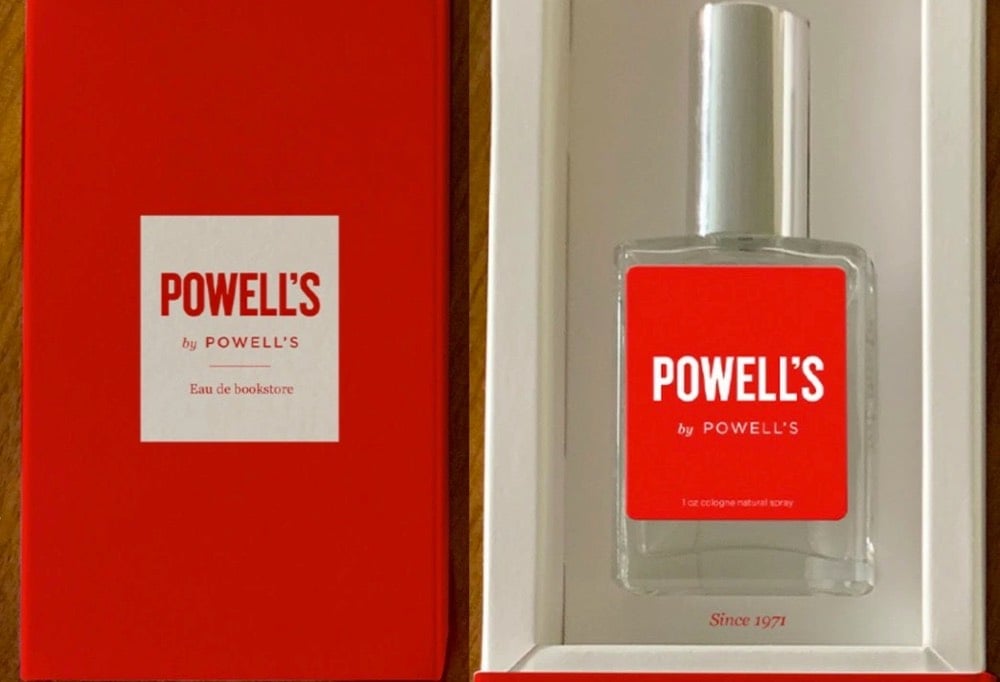
Beloved Portland indie bookseller Powell’s Books is selling a unisex fragrance that smells like a bookstore.
This scent contains the lives of countless heroes and heroines. Apply to the pulse points when seeking sensory succor or a brush with immortality.
According to KOIN, the company noticed that customers missed the smell when they were closed during the pandemic lockdown in the spring.
Powell’s Books is releasing a limited edition unisex fragrance that captures what they said is what customers missed most about Powell’s — the aroma.
Store officials said they surveyed customers about what they missed while the store was temporarily closed by the pandemic. It’s not the books. It’s the smell.
The perfume comes packaged in something that looks like a book, like a hidden bottle of hooch or a gun.
If you can’t get your hands on Powell’s scent, you have other options. Demeter makes a fragrance called Paperback that’s available in a variety of formats (cologne, shower gel, diffuser oil) and Christopher Brosius offers a scent called In The Library in his shop. (via moss & fog)
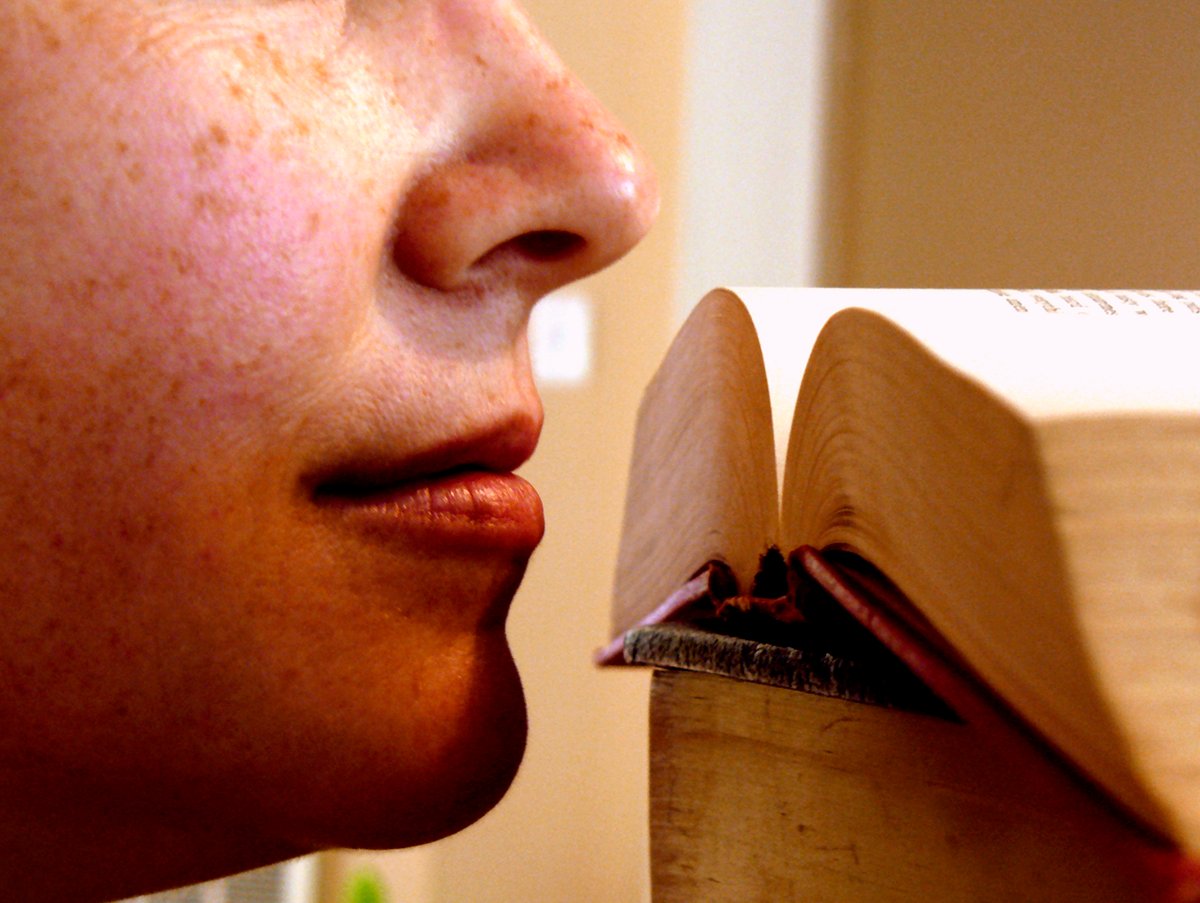
Earlier this week, I wrote about how literature transforms text into voice and experience — the word made flesh, basically. But the examples I used of “experience” focused, as such discussions often do, on the image: in other words, vision. And it should be obvious that embodied experience is much richer than that. Experience is tactile and spatial, mental and auditory. It’s not photography; it has a taste and a temperature.
Smell might be the most ineffable feature of animal life. Words and food go through the mouth, so language and taste have a more intimate relationship than it does with smell, the seat of breath. The language of taste colonizes other experiences almost as much as vision does. The word “taste” alone testifies to this.
Smell is more delicate, and harder to explain or describe. In conversation, we have words, sure, but mostly communicate smell through grunts or exaggerated faces. Or again, through analogy with taste — with which it’s closely linked.
It’s probably safe to say that the deeper we move into language, especially the more cerebral side of language, the more alienated we become from smell. The world stops being beings among beings, and becomes res extensa.
Still, writers have to try to find a way to square this circle. How do you do it? Do you try to dominate the reader and go all pulpy, immersive, and visceral? Or do you write around it: using smell as a starting point for memory and sensibility, counting on readers to fill in the gaps?
Consider this passage from Helena Fitzgerald and Rachel Syme’s perfume newsletter, The Dry Down:
What we know as “leather” in scent is really an intellectual idea and not a true distillation of anything; it’s the ingenious concept of covering up the smell of dried-out skins with flowers so that these skins can be sold as luxury goods. The real story behind this idea is one of violence and hideous smells: many of the bloody, gut-strewn tanneries of 16th century France were located in close proximity to the Grasse perfume distilleries (where flowers were also sent to their deaths by hot steam or being suffocated in tallow), so close that the air in town became a heady melange of life and death, all mixed up; it must have smelled overwhelming and nauseating and murderous and terrifying (but then, that was the way most of Europe smelled before sewage systems were invented). Legend has it that this intermingling began when Catherine de Medici came over from Italy to rule France in 1547 and asked the Grasse tanners to start scenting their gloves with jasmine to rid them of the putrid scent of the kill; oiled gant then became de rigeur among aristocratic French try-hards…
It was all the rage to pretend that the dead thing you were wearing on your hands arrived to your palace smelling like a rose; and that’s still pretty much where we are with leather. When you close your eyes and think of what a pure leather smells like to you (a S&M dungeon? Frye boots crunching over autumn leaves? A tawny satchel worn down by years of use?), what you must know is that whatever you are imagining is an artificial smell, a clever creation passed down from some genius in post-classical Provence who conjured up a way to give a pushy queen exactly what she desired. That smell of suede, of the inside of a new handbag, that’s always a damn lie. Actual leather smells like rotting, like wretching, like rigor mortis. It’s not pleasant, but then, luxury is about high-stakes deceit, about playing hide-the-damage inside buttery language and astronomical price tags.
Later, Rachel writes about a perfumer she met names Stephen Dirkes:
When we first met, Dirkes brought me real ambergris to smell, waving an antique tin of pungent whale belly under my nose; I will never forget it. He also brought civet and castoreum, true animal secretions, to show me how very close to death we are at all times when we love perfume. These materials don’t smell fresh or vibrant, they smell like the other side of the bell curve, the decline, the decay. Stephen was the first person to tell me about the Grasse tanneries, and I remember he said something like “There is a death drive in these smells,” and that perfume is often an expression of self-loathing as much as it is of self-love. And that’s what leather is to me. You can’t wear it unless deep down, you loathe humanity as much as you love it, unless you acknowledge the gory hidden history of our hedonism, unless you know, in your heart, that opulence is a cover-up job.
Helena, in the same newsletter, writes the following beautiful observation about the smell of books:
What makes old book smell work as a scent that can be worn on the skin is a leather note, and the other smells that mingle in a university library, the kind of place where more hidden corners, more secret hide-outs, reveal themselves the longer you stay - the undercurrent of cooped-up people’s sweat, a hum of anxiety and ambition and want, the waft of the snacks that somebody snuck in, the sudden out-of-place hope when someone cracks a window, the residue of cigarettes clinging to people’s hair and clothes when they come back in from one more smoke break during a marathon study session. It smells like the gummy, self-satisfied leather of old book bindings and the grateful sinking feeling when you flop onto a broken-down Chesterfield sofa. Leather dominates New Sibet, but it is rounded out by notes of ash and carnation, iris and fur and moss, and it comes together to smell like a library not in the romantic Beauty and the Beast sense of a library, but the lived-in, slightly gross, sleep-deprived, buzzing all-too-human and really pretty rank smell of a college library. Old book smell made human is admittedly a little bit gross, in the way that even the fanciest college with the most prestigious pedigree, the most beautiful wrought iron gates and most gracious green quadrangles is still full of college students, and college students are inevitably kind of disgusting. But that human grossness is what’s missing from old book smell, and it’s what makes New Sibet into a wearable expression of old book smell. It smells not just like books but like their context, the people crowding in around them, the bodies sinking time as lived experience into the leather covers of old books through their human smell.
I’m not much of a perfume person. I am, however, a writing and smelling person. And I love the way Helena and Rachel write about smells.
Via Amanda Mae Meyncke, who adds:
This is the thing I’ve told more people about in 2017 than anything else — it is an utter delight. I never cared about perfume at ALL before this, and their writing is so good and so precise, so intelligent and so ACCURATE, that every suggestion they’ve made has smelled exactly like their descriptions — which are a mixture of memory, sense, history and more — and they’ve done the impossible, making this aloof-seeming shit absolutely accessible and delightful.
(This is also a relatively cheap, luxurious, happy-making hobby in the midst of perilous times.)
A “scent solutions” company called Air Aroma made a Macbook Pro unboxing smell for an art exhibition in Melbourne last year.
To replicate the smell a brand new unopened Apple was sent to our fragrance lab in France. From there, professional perfume makers used the scents they observed unboxing the new Apple computer to source fragrance samples. On completion the laptop was sent back to Australia, travelling nearly 50,000kms and returned to our clients together with scent of an Apple Macbook Pro.
(via @buzz)
Your font: Helvetica. Your smell: Helvetica The Perfume.
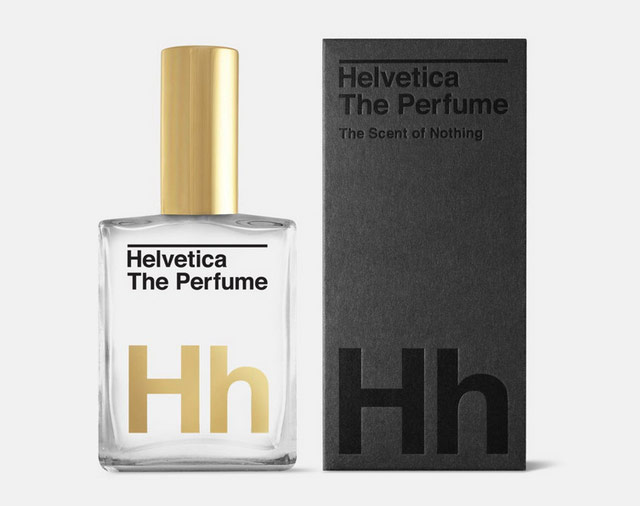
Helvetica has gone on to become arguably the most ubiquitous and widely used typeface in history.
It is in this spirit that we have created the ultimate Modernist perfume — a scent distilled down to only the purest and most essential elements to allow you, the content, to convey your message with the utmost clarity.
Air. Water. You.
2 oz. of distilled water. Precious bodily fluids, Mandrake.
I don’t wear cologne (or colon) or really care for the smell of perfume, but I love reading about perfume and scent. Roja Dove is an independent perfumer who creates bespoke scents for well-heeled clientele.
His custom-made leather Dunhill case holds small eyedropper bottles with the 238 tinctures, resinoids, absolutes and essential oils that comprise the “building blocks of every single fragrance that you can think of.” It also folds neatly into a piece of hand luggage should a client require him to pay a flying visit.
“Most of my formulas are quite short, normally between 20 and 50 ingredients,” he says. “It’s like painting; if you use too many colors, all you get is a dirty gray.”
A short video about the ingredients that go into every can of Play-Doh:
Sadly, the composition of the amazing fragrance is not revealed, but Wired asked a perfumer about it a couple of years ago:
Hasbro’s patent admits to vanilla, but that’s just to throw us off the scent. The real formula for this iconic odor is guarded like the crown jewels. After talking with New York perfumer Christopher Brosius, who offers a Play-Doh fragrance, we suspect that it draws from the aromatic flowers of the heliotrope, aka the cherry pie plant.
And if you’d like Play-Doh as your signature scent, Demeter makes a Play-Doh cologne. (Off topic, but the word “cologne” always makes me think of this hilarious Twitter search.)
From Sarah Marshall, a list of celebrity fragrances that didn’t quite make it to market.
Goldbloom by Jeff Goldblum: This fragrance, meant to be drizzled down the wearer’s forearm (preferably while in a moving car) is redolent of warm eyeglasses, tanning oil, and Velociraptor musk. Perfect for work or leisure.
Wintour Harvest by Anna Wintour: Peppery, balsamic, indecisive, and fresh. Notes of warm blood and Galliano Sequin enliven this fragrance designed for the gal on the go.
Paper Passion is a perfume that smells like a book.
This is an opportunity to celebrate all the gloriosensuality of books, at a time when many in the industry are turning against them. The idea is that is should relax you, like when you read a book, to a level of meditation and concentration. Paper Passion has evolved into something quite beautiful and unique. To wear the smell of a book is something very chic. Books are players in the intellectual world, but also in the world of luxury.
Gloriosensuality! (via @jjg)
While listing his ten favorite fragrances, NY Times perfume critic Chandler Burr recalls Luca Turin’s definition of chic.
Luca once called something chic, and I asked him why, or rather what “chic” was exactly. He sighed and said despairingly, “Chic is the most impossible thing to define.” He thought about it. “Luxury is a humorless thing, largely. Chic is all about humor. Which means chic is about intelligence. And there has to be oddness — most luxury is conformist, and chic cannot be. Chic must be polite, but within that it can be as weird as it wants.”
(via gold digger)
Perfumer Christopher Brosius has a little shop in Brooklyn, out of which he offers several surprising and offbeat perfumes.
When my parents visited New York, I gave them a tour of my favourite scents in the shop. This took some time: the accords include clever riffs on the smell of rubber, from the intoxicating Inner Tube to a just-short-of-noxious Rubber Cement. Equally impressive is Wet Pavement, which strikes me as wearable, even pretty. Burning Leaves is startlingly alluring, and Ink smells so authentic that I held up the bottle to show my mother that the fluid was clear and not an indelible blue. Roast Beef is predictably revolting, but still a must-smell. My mother lingered over In the Library, a blend that Christopher describes as “First Edition, Russian and Moroccan Leather, Binding Cloth and a hint of Wood Polish”.
Unsurprisingly, Brosius also created the Demeter line of fragrances, featuring scents like Creme Brulee, Wet Garden, Funeral Home, Dirt, and Sugar Cookie.
In remembrance of her grandmother, Chicagoan Jessica Dunne created her own perfume called Ellie.
She sought out Michel Roudnitska, a perfumer who lives in France, to be her collaborator. Her family in her hometown of Villanova, Pa., served as her focus group. A friend volunteered to tie by hand the grosgrain ribbon bow that decorates each package. Then Ms. Dunne cold-called Claudia Lucas, the perfume buyer at Henri Bendel in Manhattan, and asked whether she could send a sample of the perfume.
More information about Ellie, as well as a more contemporary scent called Ellie Nuit, is available on Dunne’s site.
This is the second rave review I’ve read of Perfumes: The Guide.
Now there’s a book called Perfumes: The Guide, by the husband and wife team of Luca Turin and Tania Sanchez, which is not just enlightening, but beautifully written, brilliant, often very funny, and occasionally profound. In fact, it’s as vivid as any criticism I’ve come across in the last few years, and what’s more a revelation: part history, part swoon, part plaint. All of the other reading I was supposed to do was put aside while I went through it, and it took me some time to finish, in part because I was savoring it and in part because I kept stopping to copy out passages to e-mail off to friends. In the library of books both useful and delightful, it deserves a place on the shelves somewhere between Pauline Kael’s 5001 Nights at the Movies and Brillat-Savarin’s incomparable Physiology of Taste.
The first review was this New Yorker article:
The joy of Turin and Sanchez’s book, however, is their ability to write about smell in a way that manages to combine the science of the subject with the vocabulary of scent in witty, vivid descriptions of what these smells are like. Their work is, quite simply, ravishingly entertaining, and it passes the high test that their praise is even more compelling than their criticism.
Perfume is one of those things that I don’t particularly like in real life but that I really enjoy reading about.
How do you describe a smell or a taste? John Lanchester discusses that and a recent book of perfume reviews in this recent New Yorker article.
The language of taste has, therefore, reached something of an impasse. On the one hand, we have the Romantic route, in which you are free to compare a taste to the last unicorn or the sensation you had when you were told that you failed your driving test-and others are free to have no idea what you are talking about. On the other, we have the scientific route, which comes down to numbers, and risks missing the fundamental truth of all smells and tastes, which is that they are, by definition, experiences.
Among the featured designs at the National Design Triennial was the Demeter Fragrance Library. The company, run by Christophers Brosius and Gable, puts out perfumes, lotions, soaps, candles, and body gels with scents like Creme Brulee, Wet Garden, Funeral Home, Dirt, and Sugar Cookie. According to this article in Happi, the New Zealand fragrance was developed for the Lord of the Rings movie and Demeter’s odd scents might have other uses:
Tomato, for example, was found to be an odor absorber. Some of the edible fragrances are said to help curb cravings. And though the company has yet to perform psychological tests, researchers said the Dirt fragrance made Alzheimer patients more lucid.
Perhaps I should tag along with Meg the next time she goes to Sephora. (Never thought I’d find myself saying that…)


Stay Connected