kottke.org posts about video
In September 1986, as part of a United Way fundraiser, the city of Cleveland released 1.5 million balloons simultaneously in a bid to get into the Guinness Book of World Records. As this short documentary by Nathan Truesdell shows, things didn’t really go according to plan.
Nathan Truesdell’s short documentary, Balloonfest, depicts the helium-filled spectacle using archival news footage from local television stations. When the balloons are first released, they form a mass of colorful orbs that wraps around Cleveland’s Terminal Tower, by turns resembling a meteorological phenomenon, a mushroom cloud, or a locust infestation. The image is both awe-inspiring and haunting.
The local news footage is kind of amazing. One of the news reporters inexplicably kisses a woman goodbye he’d just interviewed on-air. When the balloons are released, another commentator screams that America doesn’t have crappy ol’ Cleveland to kick around anymore because baaaallllllloooooooooooons!!
I remember seeing this stunt when I was a kid, probably on Tom Brokaw on NBC’s Nightly News broadcast. This kind of ballooning was big in the mid-80s. Right around the same time, we did a balloon release at school. Each student tied a card with their name and the school’s address on it onto a helium balloon in the hope that whoever found the balloon would write back with their location, which locations would collectively be plotted on a map for unspecified learning purposes. I never heard back about my balloon, and I don’t think anyone else did either.
Balloon messaging turns out to be a very low bandwidth communications medium — and not very good for the environment either. Sometime after Balloonfest ‘86, mass balloon releases began to be discouraged as people realized it was actually just littering on a massive scale and harmful to wildlife. Fun while it lasted though, I guess.
The makers of Country Time Lemonade are running a unique promotion this summer. If you’re the parent of a child 14 or younger who has incurred a fine for running an unlicensed lemonade stand or who has paid for a permit, Country Time will “cover your fine or permit fees up to $300”. This video explains (ok, I lol’d at “tastes like justice”):
Open to legal residents of the 50 U.S. (including D.C.), who are the parents or legal guardians of a child 14 years of age or younger operating a lemonade stand. Program ends 11:59pm ET on 8/31/18 or when $60,000 worth of offers have been awarded, whichever comes first.
In a related promotion, Domino’s Pizza is working to fix potholes in streets around the US.
I guess it’s nice of these companies to step in here, but it’s sad that America’s crumbling infrastructure and antiquated legal system have become promotional opportunities for massive multinational corporations that spend millions each year trying to avoid paying local, state, and federal taxes that might conceivably go towards fixing problems like this in a non-ad hoc way. But hey, pizza and lemonade, mmmmmm.
In mid July, HBO will premiere a 2-hour documentary about Robin Williams called, cheekily, Robin Williams: Come Inside My Mind. Here’s the trailer:
The film explores his extraordinary life and career, revealing what drove him to give voice to the characters in his mind. With previously unheard and unseen glimpses into his creative process through interviews with Williams, as well as home movies and onstage footage, this insightful tribute features in-depth interviews with those who knew and loved him, including Billy Crystal, Eric Idle, Whoopi Goldberg, David Letterman, Steve Martin, Pam Dawber and his son, Zak Williams.
From BBC Earth, the team behind Planet Earth II and Blue Planet II, a 10-hour video of soothing oceanscapes: whales swimming, jellyfish pulsing, fish swarming, sharks circling, and rays swooping.
This is super chill, but if I were an EDM DJ, I’d put this up on the screen behind me during my shows and just go nuts with the music.
See also 40+ hours of relaxing Planet Earth II sounds.
In this video, a duo using squirt boats surfs the underwater current in the New River Gorge. Squirt boats, which I just learned about, are low-volume flat kayaks optimized for performing tricks…sort of a cross between a kayak and a surfboard that you sit inside of.
When I was a kid, I devoured books like locusts ravage crops on the plains. My sister and I would go to the library, get 5 or 6 books each, and when I was done reading all of mine, I’d read hers — Little Women, Judy Blume, The Baby-Sitters Club…I was not picky. I read Roald Dahl, all the Little House books, Where the Red Fern Grows, Encyclopedia Brown, E.B. White, the Bobbsey Twins, Nancy Drew, all kinds of biographies of famous people, and almost everything else in our local library. Reading was how I learned about the world outside my tiny town. Reading was how I came to know about Robert Wadlow, the world’s tallest man.
In 1981, when I was 8 years old, our household acquired two books that I would read more than any other during my childhood: a set of World Book encyclopedias and the Guinness Book of World Records.1 The encyclopedia, a prized family possession, sat on a shelf in the living room and one of my favorite things was to grab a random volume, crack it open to a random page, and start reading. The Guinness Book of World Records, in contrast, sat on a small table in the bathroom; I read it while sitting on the toilet.
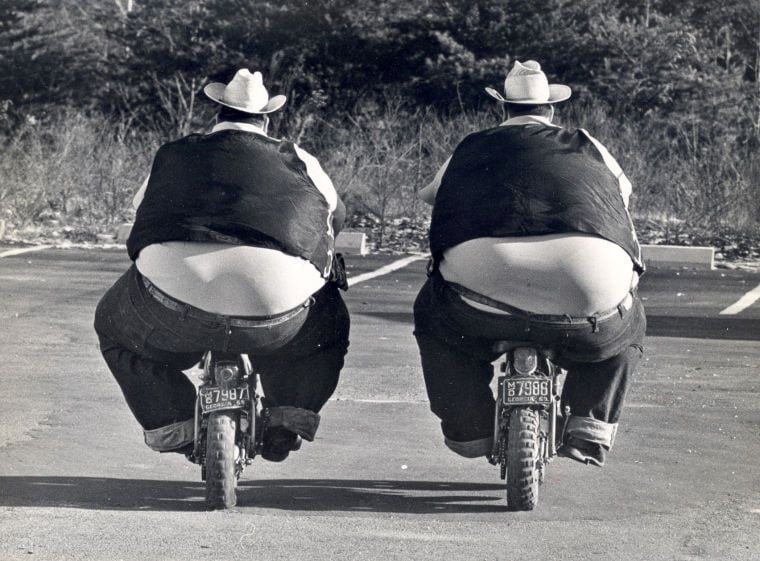
The first few pages of the book, which I am pretty sure is still sitting on that table in my dad’s bathroom, contained records related to the human body. I particularly remember reading about Robert Earl Hughes, then the world’s heaviest human, and The McGuire Twins, the world’s heaviest twins; they liked to ride motorcycles:
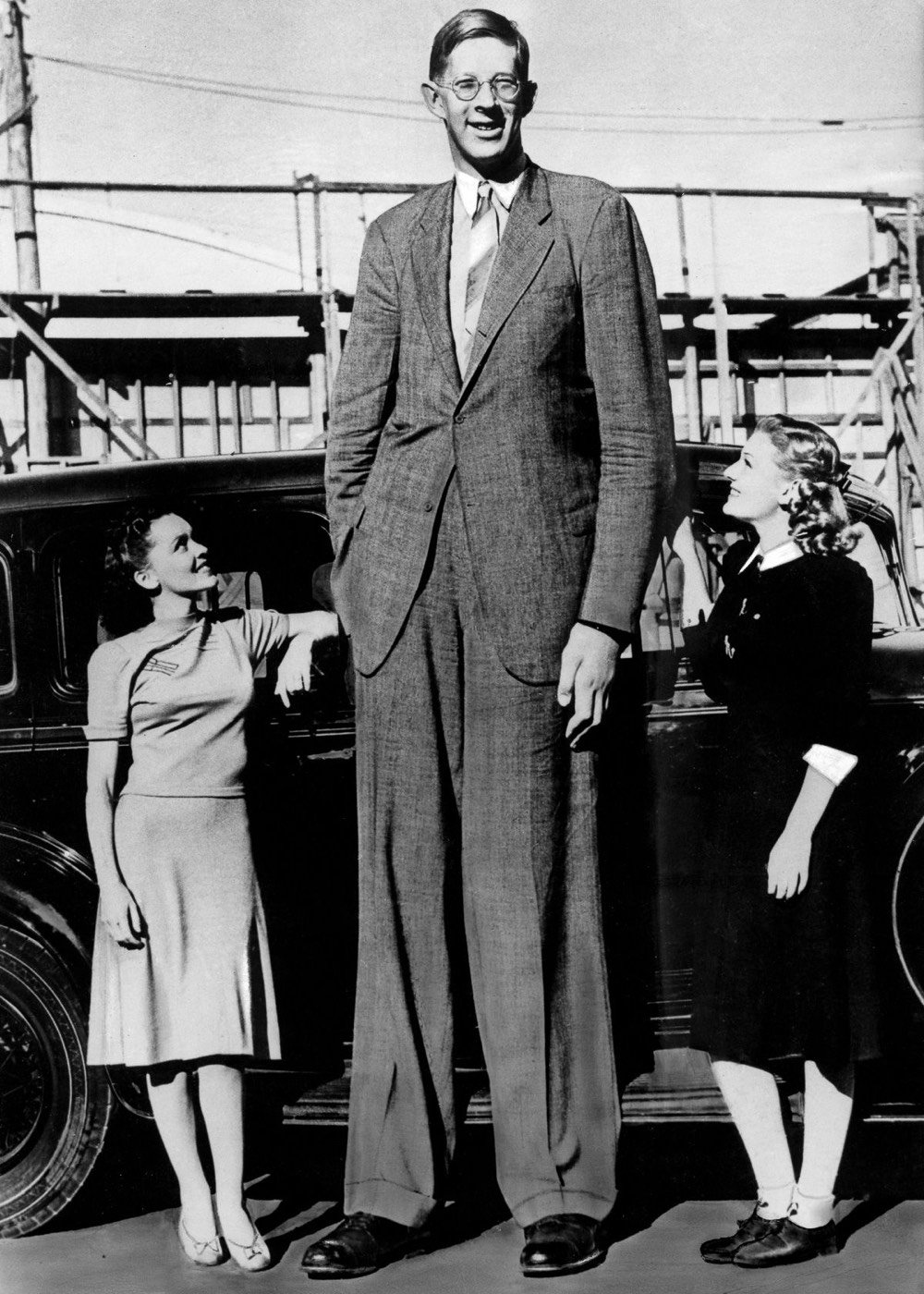
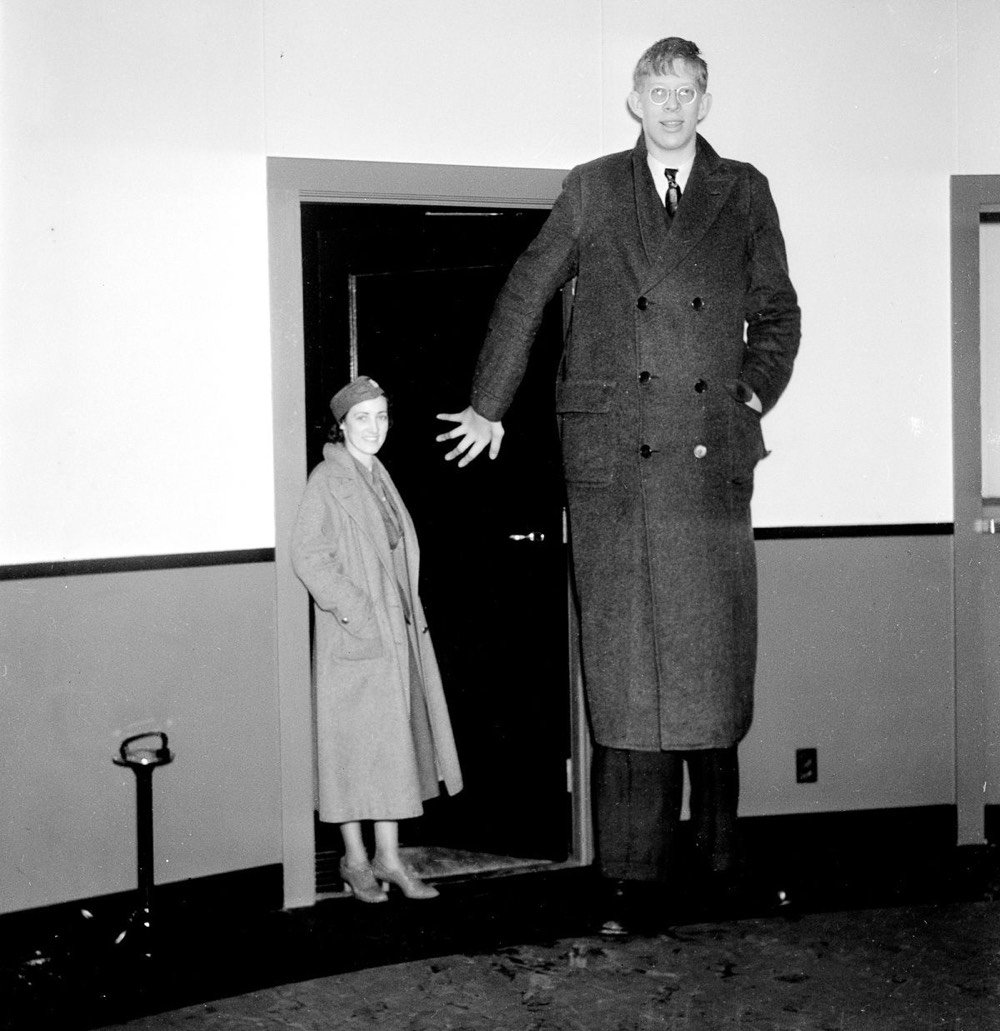
But most captivating part of that book was the section about Robert Wadlow, the world’s tallest person: 8ft 11in tall, shoe size of 37AA, wingspan of 9.5 feet, and he could carry his father up the stairs at age 9, a feat unimaginable by a scrawny Wisconsin boy of the same age. The tallest person I’d ever seen up until then was probably like 6’3” — a man almost 9 feet tall was like something out of the stories I read from the library. Who needs fiction when you’ve got facts like these?
I hadn’t thought about any of this in years until I ran across a short video of Wadlow the other day (there’s more footage here, here, and elsewhere on YouTube):
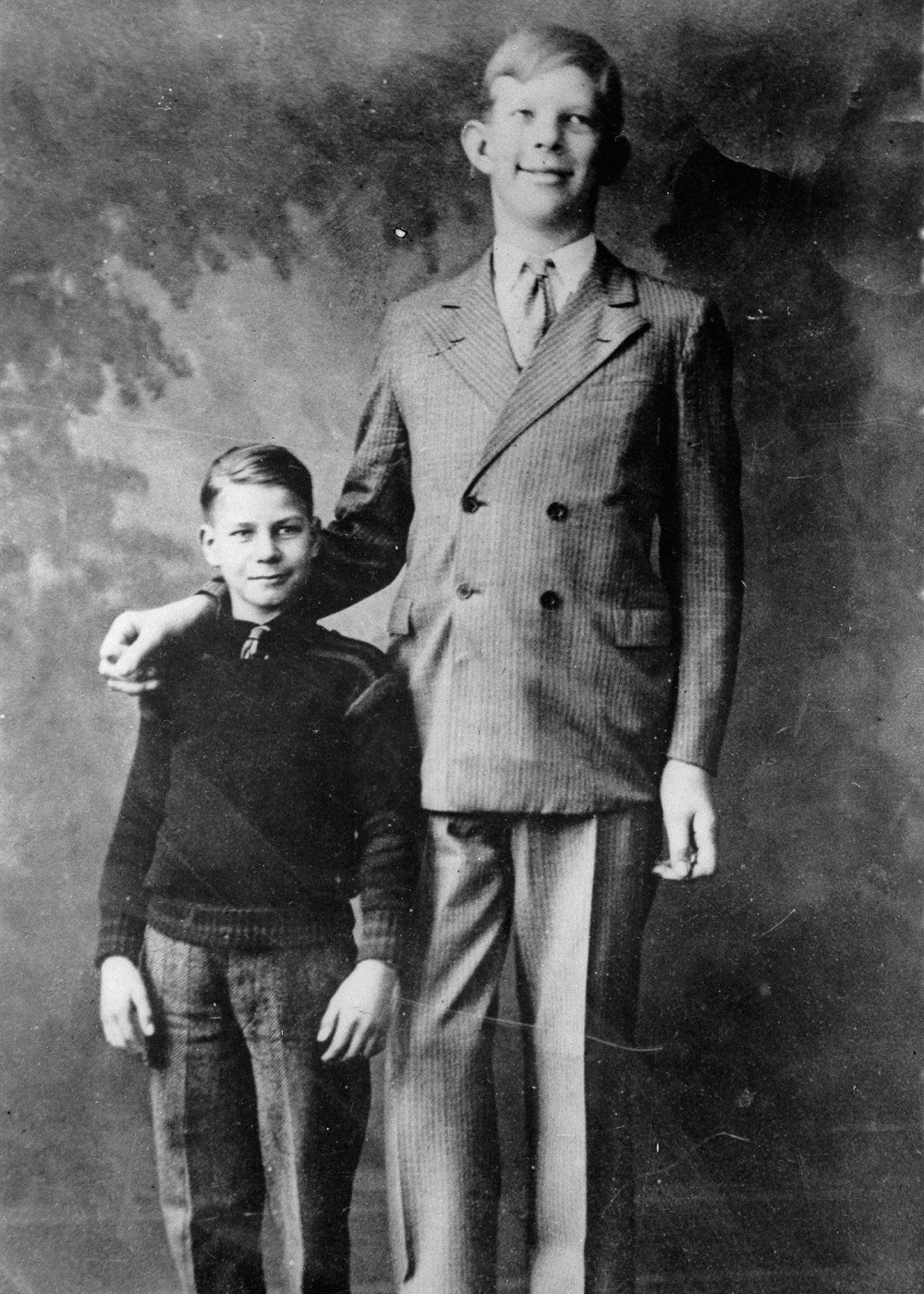
Holy shit. Suddenly this almost mythical person from my childhood is walking across my screen! Digging a little, I found the Retronaut’s collection of Wadlow photos, only a couple of which were included in my Guinness book. Here’s Wadlow at 10 years old, when he was already 6’5”:
And here are a couple more photos that show just how tall he was:
You can read more about Wadlow on Wikipedia, on Retronaut, or, yes, on the Guinness World Records site. I don’t care what anyone says…the World Wide Web is still a marvel. It brought Robert Wadlow alive for me, all these years later. What a thing.
Cameras that can take usable photos in low light conditions are very useful but very expensive. A new paper presented at this year’s IEEE Conference on Computer Vision and Pattern Recognition shows that training an AI to do image processing on low-light photos taken with a normal camera can yield amazing results. Here’s an image taken with a Sony a7S II, a really good low-light camera, and then corrected in the traditional way:

The colors are off and there’s a ton of noise. Here’s the same image, corrected by the AI program:
Pretty good, right? The effective ISO on these images has to be 1,000,000 or more. A short video shows more of their results:
It would be great to see technology like this in smartphones in a year or two.
For these two videos, FunWithGuru collected scenes from movies & TV that can trigger ASMR. He featured movies like Phantom Thread (rustling cloth) and Amelie (whispering) as well as well as calmer moments from more unlikely fare like Inglourious Basterds, Edward Scissorhands, and The Office. The clips show ASMR staples like calm talking, people quietly performing tasks, whispering, hair brushing, pouring water, and rustling paper.
In his latest video, Evan Puschak compares the action scenes from Marvel and DC superhero movies and shows how DC comes up short. Some don’t appreciate all of the humor packed into Marvel’s films, but the DC movies take themselves WAY too seriously. And don’t even get me started on Zack Snyder — outside of 300, his take on action is not good. It’s not a coincidence that Snyder didn’t direct Wonder Woman, the best of the DCEU films in terms of action (and everything else).
See also the problem with action movies today and why are action movie trailers sounding more musical lately?
Over 300 different people drew/illustrated moments from a real-life dance performance, which Kristen Lauth Shaeffer then assembled into one cool animated performance. This strongly reminds me of Oliver Laric’s clip-art animation.
One of the recurrent topics here at the ol’ dot org is paying our respects to people who are mind-bendingly good at what they do. Case in point: watch this woman turn a magic scarf into about 100 different pieces of clothing in about 90 seconds. Reader, I audibly gasped at ~0:25 when she turned a scarf into a dress in the blink of an eye.
This extraordinary garment has been compared to a Thneed, a fictional garment from Dr. Seuss’ The Lorax:
I’m being quite useful. This thing is a Thneed.
A Thneed’s a Fine-Something-That-All-People-Need!
It’s a shirt. It’s a sock. It’s a glove. It’s a hat.
But it has OTHER uses. Yes, far beyond that.
You can use it for carpets. For pillows! For sheets!
Or curtains! Or covers for bicycle seats!”
There are quite a few magic scarves available for purchase on Amazon if you want to try one out for yourself, but check those seller ratings…some of them look a little sketchy. (via @dunstan)
From the Atlantic, a quick visual history of human-created light sources over the past ~400,000 years, from wood fires to candles to the electric light.
3,000 BCE: The “rushlight” candle is invented in Ancient Egypt. It is made of a pithy stalk of rush soaked in animal fat.
1500 BCE: Babylonian/Assyrian lamps are created from olive or sesame oil. They had a linen wick and were fashioned from stone, terracotta, metal, or shells.
100 CE: The Romans create the tallow candle, which has a small wick with a thick, hand-formed layer of tallow.
One of the more interesting inventions along the way was the moonlight tower. In the early days of electric lights, mimicking the bright light of the Moon was one of the ways that towns chose to light their streets.
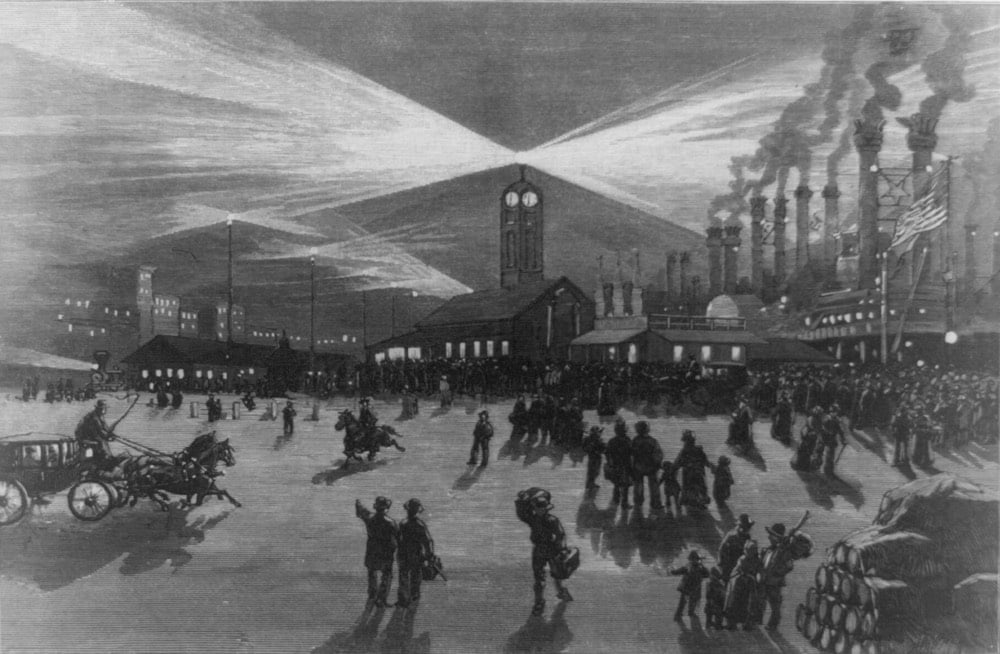
Humans, too, found the high-slung orbs to be as disorienting as they were ethereal. As tall as the towers were, they still left shadows in their wake — shadows tinged with sharp blue light, Freeberg notes, which left pedestrians “dazed and puzzled.” Foggy evenings, combined with the air pollution of a newly industrialized America, could thrust all of Detroit into effective darkness — meaning, Freeberg writes, that “Detroiters could only speculate about the lovely sight that their lights must be creating as they shone down on the blanket of mist and soot that smothered the city.” Even during occasions when the fog broke enough to allow some light to penetrate to the streets below, “many found themselves groping along sidewalks in an eerie gloom.”
In the end, the many costs of the artificial moonlight outweighed its beauty and poetry. The structures meant to inspire awe among outsiders ended up inspiring, ultimately, something more akin to pity. (“It appears to me,” one frank observer put it, “that you are taking a very expensive way of getting a minimum benefit from the electric lights.”)
For this year’s 36 Days of Type project, Ben Huynh submitted this 3D animation of the alphabet from A to Z. You can see animations of the individual letters on Huynh’s Instagram. (via colossal)
In 1923, Inkwell Studios1 released a 20-minute animated explanation of Albert Einstein’s theory of relativity, perhaps one of the very first scientific explainer videos ever made. Films were still silent in those days and the public’s scientific understanding limited (the discovery of Pluto was 7 years in the future, and penicillin 5 years) so the film is almost excruciatingly slow by today’s standards, but if you squint hard enough, you can see the great-grandparent to YouTube channels like Kurzgesagt, Nerdwriter, TED Ed, minutephysics, and the 119,000+ videos on YouTube returned for a “einstein relativity explained” search. (via open culture)
Ama is a short film that was written, directed, and performed by freediver Julie Gautier.
Ama is a silent film. It tells a story everyone can interpret in their own way, based on their own experience. There is no imposition, only suggestions.
I wanted to share my biggest pain in this life with this film. For this is not too crude, I covered it with grace. To make it not too heavy, I plunged it into the water.
I dedicate this film to all the women of the world.
This is really beautiful. Watch it all the way through…the end is not to be missed. (via swissmiss)
As he does every year, voracious reader Bill Gates has recommended five books worth reading this summer. Gates’ recommendations often have a Wizard bent and the video he produced for the list probably had a greater budget than the amount I’ve spent on running kottke.org over the past 5 years:
The book I’m most curious about is Origin Story: A Big History of Everything by David Christian. I’ve long wanted to check out his Big History course (due to another Gates rec) and this seems like a good way to do that.
David created my favorite course of all time, Big History. It tells the story of the universe from the big bang to today’s complex societies, weaving together insights and evidence from various disciplines into a single narrative. If you haven’t taken Big History yet, Origin Story is a great introduction. If you have, it’s a great refresher. Either way, the book will leave you with a greater appreciation of humanity’s place in the universe.
Here are his four other recommendations:
Leonardo da Vinci by Walter Isaacson.
Lincoln in the Bardo by George Saunders.
Everything Happens for a Reason: And Other Lies I’ve Loved by Kate Bowler.
Factfulness: Ten Reasons We’re Wrong About the World - and Why Things Are Better Than You Think by Hans Rosling.
This is a blooper reel from Emmet Otter’s Jug-Band Christmas, a 1977 TV special produced by The Jim Henson Company. Take after take, they’re trying to roll a tiny drum out of a doorway in a very specific way and the Muppet characters get increasingly frustrated and amusing as it goes along. If the voice of the Ma character sounds familiar, that’s Frank Oz, who is also the voice of Yoda, Grover, and Bert from Sesame Street.
Phil Holland shot some aerial footage of NYC that he stitched together into a video with a resolution of 12K. That’s a 100-megapixel image, folks, “48.5 times the resolution of HD 1080p”. Holland has a writeup of the process used to capture the video, which is available at a down-sampled resolution of merely 8K. He shared several down-sampled 4K stills from the video, but I wish he would have included a 12K image as well, just to see what kind of detail is possible.
Is 12K footage of any practical use without 12K displays? My computer screen has 5K resolution, so I can’t even view 8K video or photos at full resolution, much less 12K. Does a 12K image down-sampled to 8K viewed on a 5K display look better than a 5K image on a 5K display? Better than an 8K image down-sampled to 5K on a 5K display?
Update: Cinematographer Steve Yedlin, who most recently was director of photography for The Last Jedi, did a comparison of different resolutions last year and concluded that bigger is no longer better. No Film School has a short summary of Yedlin’s findings.
The biggest takeaway for filmmakers is that we have already likely passed the point where extra resolution is noticeable to an end user. While going from standard definition to high definition was a huge leap in image quality, going from HD to UltraHD won’t even be noticeable for most users, and anything beyond that offers no benefit at all. The goal of these tests it to have technical discussions in a fashion that is understandable by laypeople, and Yedlin does a great job of that.
This is a similar conclusion to where we’ve been with smartphone and other digital cameras for awhile: megapixel count is no longer the thing that matters. (via @byBrettJohnson)
In this short video, Art House Politics goes through all of the characters in Mario Kart 8 and describes their political alignments.
Mario is just your average working class guy, like “oh get the government off my back” kinda guy. Luigi is a Republican, like a nerdy technocratic…like he cares about the debt to GDP ratio. Princess Peach: monarchist. Daisy is an environmentalist. Rosalina is a flat-earther. Tanooki Mario would only care about kink shaming. Cat Peach is alt-right, but one of those female alt-right YouTube personalities that are really popular.
Hot on the heels of the Yanny/Laurel audio illusion, many people shared other illusions that are just as weird and fun.
The McGurk effect pairs different mouth movements with speech, and you tend to hear different things with different mouth movements.
In this video, you hear the word for whatever object is on the screen (bill, mayo, pail) even though the audio doesn’t change:
And in this one, whichever word you focus on, “green needle” or “brainstorm”, that’s what you hear:
What all of these effects demonstrate is that there are (at least) two parts to hearing something. First, there’s the mechanical process of waves moving through the air into the ear canal, which triggers a physical chain reaction involving the ear drum, three tiny bones, and cochlear fluids. But then the brain has to interpret the signal coming from the ear and, as the examples above show, it has a lot of power in determining what is heard.
My kids and I listen to music in the car quite often (here’s our playlist, suggestions welcome) and when Daft Punk’s Get Lucky comes on, my son swears up and down that he hears the mondegreen “up all Mexican lucky” instead of “up all night to get lucky”. If I concentrate really hard, I can hear “Mexican lucky” but mostly my brain knows what the “right” lyric is…as does his brain, but it’s far more convinced of his version.
Update: On the topic of misheard lyrics to Get Lucky, there is this bit of amazingness:
(via @jaredcrookston)
Degrees of Uncertainty is an upcoming documentary by Neil Halloran that “uses data-driven animation to explore the topic of global warming”. It’s based on this XKCD comic of A Timeline of Earth’s Average Temperature.
Halloran is a creator of the excellent The Fallen of World War II interactive documentary, so I’m looking forward to seeing what he does with the topic of climate change.
A 10-part Netflix/ESPN documentary series on Michael Jordan and the 1990s Chicago Bulls? Sure, I will watch the hell out of that. The Bulls were my team1 when I was a kid and for me, Jordan is still the greatest basketball player of all time. Ok, I am admittedly biased and you could probably talk me into Bill Russell (all those championships), Kareem (stats, championships, longevity), or more recently, Tim Duncan (championships, longevity, consistency)…they were certainly all far more decent people than Jordan, an ultra-competitive dick, was.
But you can get out of here with your LeBrons and Steph Currys…until they start stringing together back-to-back-to-back championships, they are not in the conversation. Jordan had the stats and the championships; the Bulls were a proper dynasty. I’ll put it this way: for eight straight years in the NBA, the most intensely competitive sports league in the US, when Michael Jordan played a full season (in six of those years), his team won the NBA championship. They had it on lock. When he didn’t, they didn’t. Case closed.
(Also, I don’t want to tell the filmmakers their business, but if one of these episodes isn’t just 50 straight minutes of Jordan highlights, they’re cheating the American public.)
For the Universe in Verse 2018 poetry event, Kelli Anderson created this wonderful papercraft stop motion animation to accompany Jane Hirshfield’s reading of her short poem, Optimism.
More and more I have come to admire resilience.
Not the simple resistance of a pillow, whose foam
returns over and over to the same shape, but the sinuous
tenacity of a tree: finding the light newly blocked on one side,
it turns in another. A blind intelligence, true.
But out of such persistence arose turtles, rivers,
mitochondria, figs — all this resinous, unretractable earth.
The music is by Zoë Keating…a song called Optimist. Here’s more on the project from Maria Popova.
Black Panther animation supervisor Daryl Sawchuk goes through some of the digital visual effects from the film, with an emphasis on the suits for Black Panther and Killmonger, both of which are extensively digital throughout the film.
I don’t know exactly when this happened, but somewhere in the past few years, the digital visual effects in these big action movies stopped looking fake to me. Either I’m less discerning about my blockbuster entertainment these days or the effects have successfully crossed the uncanny valley. Probably a bit of both. Engadget’s Devindra Hardawar disagrees, btw: ‘Black Panther’ is amazing. Why are its CG models so terrible?
You can see some more of Black Panther’s visual effects in this video and read about them in Art of VFX.
I’m a big fan of Estelle Caswell’s Earworm series for Vox, and this most recent one might be my favorite. It’s about the “orchestra hit” sound that became super popular in the 80s…but which has its origins in an unauthorized sample of Igor Stravinsky included with an influential digital audio workstation invented in the late 70s.
If you listen to the first few seconds of Bruno Mars’ “Finesse” (hint: listen to the Cardi B remix) you’ll hear a sound that immediately creates a sense of 80s hip-hop nostalgia. Yes, Cardi B’s flow is very Roxanne Shante, but the sound that drives that nostalgia home isn’t actually from the 1980s.
Robert Fink and the inventor of the Fairlight CMI, Peter Vogel, help me tell the story of the orchestra hit — a sound that was first heard in 1910 at the Paris Opera where the famed 20th century Russian composer Stravinsky debuted his first hit, The Firebird.
Here’s the isolated sound from the original sample:
I love that all these musicians in the 80s got excited about a bit of classical music composed for a 1910 ballet, to the point where it became perhaps the signature sound of the decade.
The popularity of the orchestra hit is also a good reminder about the power of default settings. The musicians and producers who used the Fairlight CMI could record and sample any sound in the world but they ended up using this one included with the machine. Even the heavyweights — Herbie Hancock, Afrika Bambaataa, etc. — went with a default sample.
Caswell made a playlist of songs that feature the orchestra hit, with songs from Keith Sweat, Britney Spears, Janet Jackson, U2, and The Smiths. Not included is the song it was sampled from…you can listen to that here.
From TED-Ed, Massimo Pigliucci, and Compote Collective, a short animated introduction to the philosophy of Stoicism.
What is the best life we can live? How can we cope with whatever the universe throws at us and keep thriving nonetheless? The ancient Greco-Roman philosophy of Stoicism explains that while we may not always have control over the events affecting us, we can have control over how we approach things.
Pigliucci recorded a 50-minute presentation about Stoicism if you’d like to learn more. (via open culture)
Last month when I posted a video comparing the sizes of various microorganisms, I noted the weirdness of bacteriophages, which are bacteria-killing viruses that look a bit like a 20-sided die stuck on the top of a sci-fi alien’s body.
Bacteriophages are really real and terrifying…if you happen to be a bacteria. Bacteriophages attack by attaching themselves to bacteria, piercing their outer membranes, and then pumping them full of bacteriophage DNA. The phage replicates inside of the bacteria until the bacteria bursts and little baby bacteriophages are exploded out all over the place, ready to attack their own bacteria.
I couldn’t find a good explainer (video or text) about these organisms, but over the weekend, Kurzgesagt rode to the rescue with this video. In the second part of the video, they discuss whether bacteriophages might form the basis of an effective treatment for antibiotic-resistant infections.
Dollar Street is a project by Anna Rosling Rönnlund that imagines the world as a street ordered by income…poor families live at one end and rich families live at the other. A team of photographers went out and photographed the everyday items owned by families of all income levels — shoes, toothbrushes, TVs, beds, lights, sinks — so that visitors to the site can see how much income affects how families live.
Everyone needs to eat, sleep and pee. We all have the same needs, but we can afford different solutions. Select from 100 topics. The everyday life looks surprisingly similar for people on the same income level across cultures and continents.
Rönnlund explained her project at TED recently:
Bill Gates, who lives just one house in from the very end of the street (Bezos currently occupies the cul de sac), wrote about Dollar Street recently:
Income can often tell you more about how people live than location can. Whenever I visit a new place, I look for clues about which income level local families live on. Are there power lines? What kind of roofs do the houses have? Are people riding bikes or walking from place to place?
The answers to these questions tell me a lot about the people there. If I see power lines, I know homes probably have electricity in this area — which means that kids have enough light to do their homework after the sun sets. If I see patchwork roofs, families likely sleep less during the rainy season because they’re wet and cold. If I see bikes, that tells me people don’t have to spend hours walking to get water every day.
However, Gates’ conclusion — “It’s a beautiful reminder that we have more in common with people on the other side of the world than we think” — is not what I would take away from this. (via @roeeb/status/994474179339501568)
This is a French film from 1915 that shows the evolution of the bicycle from 1818 to what is pretty much the rear chain-driven bicycle of today. The intertitles are in Dutch, but Aeon has helpfully translated them into English.
9. In 1878, Renard created a bicycle with a wheel circumference of more than 7 feet. Just sitting down on one of these was an athletic feat!
Open Culture shared a similar film made by British Pathé in 1937.
In this 27-minute video, Bismuth explains how fellow speedrunner Kosmic achieved the world record for the fastest Super Mario Bros game ever. 27 minutes may sound daunting, but if you’ve ever played SMB more than casually, it’s fascinating. As Craig Mod said, “it’s like watching a swiss clock maker explain his machine”.
Heck, even if you aren’t into video games it’s pretty interesting. Here’s why. One of the reasons for the popularity of sports and sports media (analysis, etc.) is that, unlike many other human endeavors, it’s relatively easy for spectators to judge and compare and analyze athletes’ performances, to see how & why they fail, where they might improve, and how they stack up against past performances and records. This is similar to a point David Foster Wallace made in his piece about tennis player Tracy Austin (collected in Consider the Lobster):
Top athletes are compelling because they embody the comparison-based achievement we Americans revere — fastest, strongest — and because they do so in a totally unambiguous way. Questions of the best plumber or best managerial accountant are impossible even to define, whereas the best relief pitcher, free-throw shooter, or female tennis player is, at any given time, a matter of public statistical record. Top athletes fascinate us by appealing to our twin compulsions with competitive superiority and hard data.
In the video analysis of this speedrun, if you forget the video game part of it and all the negative connotations you might have about that, you get to see the collective effort of thousands of people over more than three decades who have studied a thing right down to the bare metal so that one person, standing on the shoulders of giants in a near-perfect performance, can do something no one has ever done before. Progress and understanding by groups of people happens exactly like this in manufacturing, art, science, engineering, design, social science, literature, and every other collective human endeavor…it’s what humans do. But since playing sports and video games is such a universal experience and you get to see it all happening right on the screen in front of you, it’s perhaps easier to grok SMB speedrun innovations more quickly than, say, how assembly line manufacturing has improved since 2000, recent innovations in art, how we got from the flip phone to iPhone X in only 10 years, or how CRISPR happened.
Anyway, that video is interesting & well done, you should watch it, the end.
Newer posts
Older posts




Socials & More