kottke.org posts about video
The fossil record has provided us with so much information about plants, animals, and organisms that lived hundreds, thousands, millions, and even billions of years ago. But we are actually only seeing evidence of a tiny fraction of the species that lived then and even for those we do know about, there’s often much we still don’t know. Traditionally, dinosaurs have been depicted as drab and often terrible lizards but recent finds of soft tissues (skin, feathers, etc.) and an increased sense of imagination based on our current vibrant biodiversity has people thinking differently about how they looked and behaved.
If you’re even just a little bit interested in The Beatles, popular music, or making creative work, The Beatles: Get Back looks really good. Directed by Peter Jackson and utilizing dozens of hours of footage shot in 1969, this six-hour series documents the Beatles recording Let It Be, their final studio album release, and playing their infamous rooftop concert. The series premieres on Disney+ on November 25 and an accompanying book is out now.
Previously: a six-minute preview of the series introduced by Jackson.
In trying to explain what you’re about to see here, I cannot improve upon the Dr. Adrian Smith’s narration at the beginning of this video:
But sometimes I think the most useful thing I can do as a scientist is to point the fancy science cameras at some moths flapping their wings in front of a purple backdrop. I mean, whose day isn’t going to be better after watching a pink and purple rosy maple moth flying in super slow motion? This is a polyphemus moth, a gigantic species of silk moth. What you are seeing, like all the rest of the clips in this video, was filmed at 6,000 frames per second.
Most of the moths in the video are delightfully fuzzy and chonky — if these moths were birds, they’d be birbs. Shall we call them mopfs?
The rest of Smith’s AntLab videos are worth looking through — I’ve previously posted about his slow motion videos here. (via aeon)
The three-point shot has become the focus of the offensive strategy of every successful NBA team. But is it also making the game boring?
The math states that scoring one-third of your shots from behind the 3-point line is as good as scoring half your shots from inside the line. In other words: Shooting as many 3s as possible will likely lead to a higher score.
The league took notice, and teams and players followed suit. 3s have become so prevalent in recent years that fans are criticizing the league for being oversaturated with them. Critics worry that the game is on the verge of becoming boring because everyone is trying to do the same thing. And that’s led some to wonder if the NBA should move the 3-point line back.
Check out the “additional reading” in the YouTube description, like The NBA is at a breaking point with three-point shooting and Is It Time to Move the NBA 3-Point Line Back? (2014).
The Walk of Life Project has set out to prove a simple hypothesis: Walk of Life by Dire Straits is the perfect song to end any movie. Like There Will Be Blood:
Or Dr. Strangelove:
Or Terminator 2:
Case closed, I think! (via fave 5)
From 2019 to 2021, a small Spanish football team was renamed Flat Earth FC, both as a publicity stunt and because club president Javi Poves couldn’t understand how water “curves”.
“Football is the most popular sport and has the most impact worldwide, so creating a club dedicated to the flat earth movement is the best way to have a constant presence in the media,” said Poves earlier this year. “Flat Earth FC is the first football club whose followers are united by the most important thing, which is an idea.”
The club’s crest is now a circular image of the earth, pressed flat on to all kits, and fans are encouraged to spark regular conversations in their pursuit of answers from the powers that be. The team mascot? An astronaut. It’s a radical move, but the club is bringing in supporters from afar. “It’s really amazing to be part of this amazing movement,” says Flat Earth player Mario Cardete. “I think it’s more than a club.”
During the pandemic, the club also became anti-mask and anti-vax — because conspiracy theories come in price-saving 3-packs, I guess? Poves resigned in late 2020 and the club was renamed and then purchased by a larger club to become their reserve team. The Earth remains round.
A mashup of I Can’t Go For That (No Can Do) by Hall & Oates and Closer by Nine Inch Nails. It’s perfect, absolutely perfect, like dipping french fries into a Frosty or rolling in the snow after the sauna. It shouldn’t be, but it is.
I want to fuck you like an animal
(I can’t go for that)
I want to feel you from the inside
(No can do)
I got this from Dave Pell at Nextdraft — he said simply “trust me” and I’m glad I did.
See also Taylor Swift × Nine Inch Nails and Carly Rae Jepsen × Nine Inch Nails, both of which are better than they should be.
Walnut is a white-naped crane that lives in a Virginia endangered species breeding facility. She’s 23 years-old, was raised by humans, and developed a reputation for murdering potential mates. But Walnut eventually found a good match in bird keeper Chris Crowe, a 42 year-old human who she has bonded with. Crowe, as part of his duties at the zoo, has embraced his role as Walnut’s mate in order to inseminate her with semen from a male crane.
That summer, however, Crowe noticed that Walnut seemed interested in, well, him. When Crowe stopped by her yard, she would bow her head and raise her wings — motions that Crowe now recognizes as the first moves of a mating dance. “At first, I thought that she was just excited to see me,” Crowe says. “But then I’d see the other pairs doing the same things, and it kind of dawned on me.” Crowe accepted Walnut’s invitation to dance. Though he felt a little silly, he bobbed his head when Walnut bobbed hers, and raised and lowered his arms like wings. The two circled each other, and sometimes Walnut would make a loud, trumpeting call — the beginning of the white-naped crane love duet. If no one was around, Crowe would try to do the male part of the song — making a Homer Simpson-like “woo-hoo” — but Walnut never found his efforts satisfactory.
As the weather cooled, so did Walnut’s ardor. But in the spring, Walnut began greeting her keeper with bows again. This gave Crowe an idea: If Walnut thought he was her mate, maybe Crowe could make that year’s artificial insemination less stressful for both of them. “If we could get her able to do it without catching her, there’s no stress, no risk of injury,” Crowe says. “It’s much better for us and for the crane.” Lynch agreed. “As far as we knew, it had never been done before, but it seemed like a good thing to try,” he recalls.
Walnut no longer needs to be inseminated to help save her species but since cranes mate for life, her relationship with Crowe continues.
Like an old couple, Crowe and Walnut have fallen into a comfortable routine. After “mating” with Crowe, Walnut will often lay unfertilized eggs. Crowe replaces them with fake ones; the real ones would rot and get eaten by crows, which would prompt Walnut to lay more. The bird then spends long hours sitting on the dummy eggs, so Crowe helps her out whenever he gets the chance. “I go over and stand near the nest and I say, ‘You take a break.’ And she’ll wander off. She’ll go down into the creek and take a bath. Then she walks back after 15 or 20 minutes, and she’s ready to sit back on the nest again.”
Though he does his best to not be a deadbeat dad, Crowe knows he falls short of crane standards. These are creatures that, once paired up, rarely lose sight of their partner; Crowe, in contrast, disappears every weekend. But despite Crowe’s shortcomings, Walnut loves him unconditionally. In fact, this 12-pound bird’s capacity for boundless affection sets a standard that we all could learn from, Crowe says. “The ideal partner doesn’t exist. You have to accept certain things that people can’t change,” he explains. “I mean, she puts up with me even though I can’t dance or sing.”
A pair of 1300-year-old skis has been discovered in an ice field in Norway. They are believed to be the best-preserved ancient skis ever found — even the bindings are mostly intact. The first of the pair was found back in 2014 and its mate was recently retrieved, an expedition you can witness in the video above.
It has been seven years since the discovery of the first ski at the Digervarden ice patch. We have patiently monitored the melt of the ice patch, in case the second ski of the pair should melt out. We were back in 2016 for a general survey of the ice patch, but the ice had not retreated much then. This year, we could see on satellite imagery that the ice patch had retreated compared to 2014. We decided to send out an archaeologist to check it.
One of the things they were hoping to find is how the skier was able to maintain forward motion with the skis, especially uphill. Modern cross-country skis rely on a texture (or wax) on the bottom of the ski to grip the snow while downhill skiers can apply skins to their skis to climb uphill. More than a thousand years ago, the choice was texture or animal fur:
One of the questions raised by the ski found in 2014 was if it originally had fur on the underside. This has major implications for the use of the ski. There were no nail holes along the sides of the 2014 ski which would have been a clear sign of the fastening of the fur. However, fur can also be glued to the underside, so we could not rule it out.
A furrow on the underside along the length of the ski, as you find on other prehistoric skis (and on modern cross-country skis), would solve the question. Such a furrow would have no function with an underside covered by fur. The 2014 ski did not show a furrow, but the new and better preserved ski does! So, probably no fur-lining.
(thx, meg)
From a YouTube channel called There I Ruined It, this is NWA’s Straight Outta Compton reimagined as a Bavarian polka. You’re….welcome? (via digg)
Using data from Johns Hopkins, this time lapse video shows the spread of Covid-19 across the US from Feb 2020 to Sept 2021. This looks so much like small fires exploding into raging infernos and then dying down before flaring up all over again. Indeed, forest fire metaphors seem to be particularly useful in describing pandemics like this.
Think of COVID-19 as a fire burning in a forest. All of us are trees. The R0 is the wind speed. The higher it is, the faster the fire tears through the forest. But just like a forest fire, COVID-19 needs fuel to keep going. We’re the fuel.
In other forest fire metaphorical scenarios, people are ‘kindling’, ‘sparks being thrown off’ (when infecting others) and ‘fuel’ (when becoming infected). In these cases, fire metaphors convey the dangers posed by people being in close proximity to one another, but without directly attributing blame: people are described as inanimate entities (trees, kindling, fuel) that are consumed by the fire they contribute to spread.
See also A Time Lapse World Map of Every Covid-19 Death (from July 2020).
This is Samson and Delilah, a painting attributed to the Flemish master Peter Paul Rubens that hangs in the National Gallery in Britain.
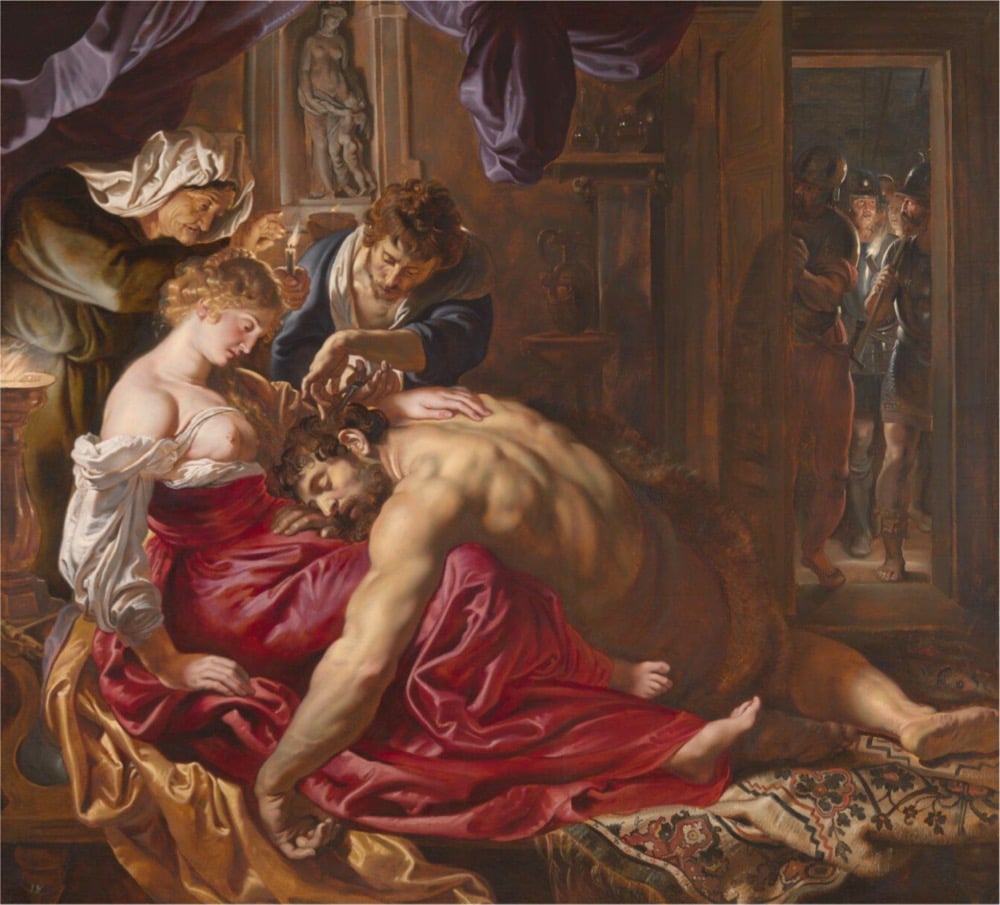
Since the late 90s, there’s been some doubt cast upon the painting’s authorship, summarized in this short video:
From a recent piece in the Guardian about an AI art-analysis algorithm that declared Samson and Delilah is not a Rubens painting:
Critics have long argued that it is only a copy of a Rubens original that is known to have been painted between 1608 and 1609 for his Antwerp patron Nicolaas Rockox which then disappeared after his death in 1640.
They argue that the National Gallery picture is a different painting, one that only surfaced in 1929, declared a Rubens by Ludwig Burchard, an expert who, after his death in 1960, was found to have misattributed paintings by giving out certificates of authenticity for commercial gain.
The picture’s critics dismiss its colours as uncharacteristic of Rubens’s palette and its composition as awkward. They question why, for example, it differs from two contemporary copies made from Rubens’s original. The toes of Samson’s outstretched right foot, for example, are cropped in the National Gallery version, while they are shown in an engraving by Jacob Matham and a painting that depicts the Samson and Delilah hanging in Rockox’s home by Frans Francken the Younger.
I love Evan Puschak’s short analysis of a two-and-a-half minute scene from Sam Raimi’s 2004 film, Spider-Man 2. Raimi, a horror movie veteran, basically snuck a tight horror sequence into a PG-13 superhero movie — it’s a little cheesy, bloodless, and terrifying.
Train wheels do not sit completely flat on the tracks — they’re designed with a slight taper that increases the stability of the train and allows the train to go around curves without any of the wheels skidding. In this short video, Tadashi Tokieda explains how those conical wheels keep trains on track.
See also Richard Feynman’s explanation of this and this science project at Scientific American. (via the prepared)
Every few days, Nenet reindeer herders in the Siberian Arctic break camp and erect their tents (called chums) in a new location. This video documents how they do it.
The Nenet reindeer herders need to move their tent every few days throughout most of the year. Every time they migrate they must pack the whole tent away, drag it across the tundra on sledges, and erect it again in a fresh place, sometimes in temperatures of minus thirty degrees. Survival depends on working together as a team.
After staying in the wooded taiga for two months they start to migrate north following the ancient paths of migrating reindeer (caribou). In four months they will travel up to 1200km and must pack and move every three to five days to keep up with their herd. They must reach their summer quarters before the snows melt and flood great rivers with icy waters too cold and deep for the calves, born along the way, to cross.
See also How to Build an Igloo. (via the kid should see this)
Newer posts
Older posts




Socials & More