The first episode of a new web series “about dressing like a grownup” called Put This On is about denim. Denim like a jean. Put This On is hosted by Jesse Thorn of The Sound of Young America and Adam Lisagor, the web’s loneliest sandwich.
I was watching The Perfect Storm on The Weather Channel the other night and witnessed the worst cut to commercial in the history of television.
If you’re not familiar with the film, this is *the* scene in the movie, the climax…when this huge wave overwhelms the Andrea Gail and all souls are lost at sea. Bravo, Weather Channel. Next time, have somebody view the movie before you chop it up randomly for ads.
Update:This one might be worse. With about two minutes remaining in extra time of a 0-0 match between Everton and Liverpool, ITV cut away to commercial and back just in time…to see the players celebrating the winning goal. I think “wankers!” is the appropriate response here.
This cut to commercial during Battlestar Galactica (spoilers! or so I’m told) is pretty bad as well. (thx, michael & gerald)
Meet Shanna Pacifico, the chef de cuisine & butcher at Back Forty restaurant in New York City. She helped devise a sustainable meat program that brings in whole animals to make up their menu, where everything gets used and nothing goes to waste.
NSFV (not safe for vegetarians). (via serious eats)
The banners, measuring just a few centimetres across, seem to be causing the beleaguered flies a bit of piloting trouble. The weight keeps the flies at a lower altitude and forces them to rest more often, which is a stroke of genius on the part of the marketing creatives: the flies end up at about eye level, and whenever a fly is forced to land and recover, the banner is clearly visible. What’s more, the zig-zagging of the fly naturally attracts the attention because of its rapid movement.
One marketing creative’s stroke of genius is another person’s animal cruelty.
Update: The audio clip used in that commercial might not be Whitman after all. From the inbox:
The Walt Whitman recording that is being used by the Levi’s commercial that you posted on the 28th is actually not Whitman, and is now considered by most audio archivists to be a hoax.
More information about this most interesting recording can be found in Vol. X, No. 3 of Allen Koenigsberg’s Antique Phonograph Monthly magazine from 1992, pages 9-11.
Among things pointed out, one is that the speech on the soundtrack ends with the quote, “Freedom Law and Love,” whereas the original printed version of the poem ends with “Chair’d in the adamant of Time.”
Koenigsberg also points out that Whitman’s last years were chronicled on a daily basis by his personal secretary, and being wheelchair-bound, such a visit for Whitman would have been difficult, unprecedented, and undoubtedly noted.
Ever since this video blew my mind when I first watched it, I’ve wondered how it was made. Turns out Gondry tested the concept out on a sidewalk with oranges, shoes, videotapes, and drinking glasses. Alas, the making of doesn’t cover the three months of post production required by the finished product, although the video isn’t completely digital as you might expect:
The video is based on DV footage Gondry shot while on vacation in France. They shot the train ride 10 different times during the day to get different light gradients.
If you’ve ever wanted to see someone shoot an anvil 200 feet into the air, you should watch this video. (And not just someone…a world champion anvil shooter.)
With gunpowder and a fuse. Just like Wile E. Coyote! (thx, rob)
This short film was made in 1909 and depicts Wilbur Wright flying one of his airplanes around an open field. At 1:38, they attach the camera to the plane and shot what is thought to be the first video footage shot from a powered flying machine.
Then the plane started up again, followed a launching pad and took off: the camera was fixed for the first time on the ground that gave way…and the emotion was there, so great you could almost touch it! The image was as unstable as the cabin of the plane flying at low altitude, flying over the countryside and gradually approaching a town.
Some folks from the web magazine Double X wondered what it would be like to drink as much in the workplace as the characters do on Mad Men. So they spent the day getting hammered and tried to do some work. The results are somewhat different than on the show.
The tulip, by gratifying our desire for a certain kind of beauty, has gotten us to take it from its origins in Central Asia and disperse it around the world. Marijuana, by gratifying our desire to change consciousness, has gotten people to risk their lives, their freedom, in order to grow more of it and plant more of it. The potato, by gratifying our desire for control, control over nature so that we can feed ourselves has gotten itself out of South America and expanded its range far beyond where it was 500 years ago. And the apple, by gratifying our desire for sweetness begins in the forests of Kazakhstan and is now the universal fruit. These are great winners in the dance of domestication.
In 1973, Tom Snyder interviewed Alfred Hitchcock for the Tomorrow Show. Thought to be lost, the whole thing is now up on YouTube after being transferred from a VHS tape. Here’s part one:
What I love about the approach is that it’s showing us a complicated, virtuoso performance, but making it really clear and accessible at the same time. It’s entertaining, but it’s also an exercise in demystification — which of course is exactly the opposite objective of every music video, ever. Their purpose has been to mystify, to masquerade, to mythologize in real-time.
Every seven years, designer Stefan Sagmeister closes his New York studio for a yearlong sabbatical to rejuvenate and refresh their creative outlook. He explains the often overlooked value of time off and shows the innovative projects inspired by his time in Bali.
The really amazing part — nope, not the instant bullet liquification (!!!) — is how quickly other things happen after the bullet hits something. Glass seems to crack almost instantly, even at a million fps, making the bullets seem pokey in comparison.
The worm is consumed by the snail, and begins its development in the snail digestive tract. Once it grows and matures, it moves into the snail’s optical tentacles, where it will pulsate and writhe as an example of aggressive mimicry, turning the tentacle into a dead-ringer for a caterpillar larvae, and making the snail a visible snack to a passing bird. The worm’s dance is also deadly because it renders the snail insensitive to light, making it incapable of shielding itself from predators. After the bird eats the infected snail, the worm matures fully inside the bird’s digestive tract, there it reproduces and lays eggs. Once the bird excretes the Leucochloridium larva, it is consumed by snails, thus continuing its life cycle.
Maybe you’re tired of un-pop-music-like things being run through Auto-Tune, but I’m not quite there yet. This Auto-Tuned Carl Sagan mix is very nearly sublime.
A video clip of what fashion designers in the 1930s predicted that people would be wearing in the year 2000. While the predictions for the women only accurately depict Lady GaGa’s wardrobe, the designers of the past were slightly closer to the mark when it came to men’s fashion:
“He’ll be fitted with a radio, telephone, and containers for coins, keys, and candy for cuties.”
By which they must have meant credit cards.
Update: FASHION magazine responded to this video. It turns out that it was eerily accurate, with designs like Alexander Wang and Marc Jacobs parading futuristic wares that are perfectly current.
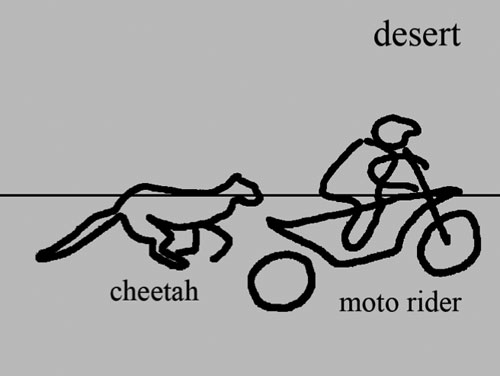
Wow. With PhotoSketch, you just draw a sketch, label each item, like so:
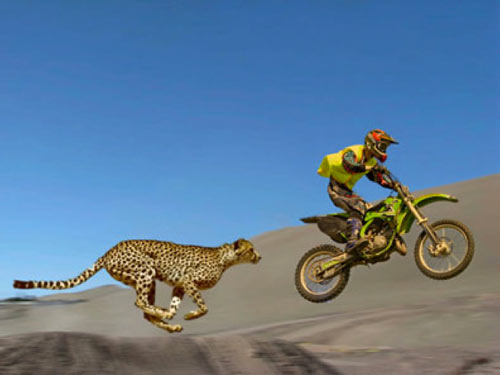
and then the system goes out, finds photos that match the sketched items and their labels, and automatically pastes it all together into one composite image:
Update: I’ve seen many references to Photosketch saying that it has to be fake (here’s a sampling). But it’s pretty obviously real. For one thing, here’s the source code; try it out (Windows only). It was presented at SIGGRAPH Asia 2009; here’s the listing of papers presented. The authors all have web pages on university sites and have published work using similar techniques and technology (Ping Tan and Ariel Shamir for example). And is what it does really that unbelievable? At the most basic level Photosketch is just find me a man that’s sorta shaped like this, a dog that looks like this, and paste them together with a background that looks like this. That the results are so impressive (especially for a demo) is a testament to the team’s execution and attention to the small details. Even if it turns out to be an elaborate hoax, I have no doubt that someone could actually build a working version of Photosketch…I mean, look at TinEye and Photosynth.
8-Bit Trip is the result of two brothers spending 1,500 hours moving LEGO bricks and taking pictures. An homage to 1980s video-games, it’s considered by many to be the greatest among the micro-genre of LEGO music videos, sometimes known as brickfilms. Originally made famous by director Michel Gondry for his work with the White Stripes, these block-by-block masterpieces are now being put to more use than just trippy visuals for killer beats, recently there was a LEGO PSA for bicyclists, warning against the dangers of running red lights.
A skier with a video camera on his helmet gets caught in an avalanche and then, four and a half minutes later, gets rescued. The good stuff starts around one minute in.
This was a decent sized avalanche. 1,500 feet the dude fell in a little over 20 seconds. The crown was about 1 - 1.5m. The chute that he got sucked through to the skier’s right was flanked on either side by cliff bands that were about 30m tall. He luckily didn’t break any bones and obviously didn’t hit anything on the run out.
I had always assumed — and this is likely based almost entirely on an episode of The Simpsons — that you had options when buried by an avalanche…like digging yourself out or at least being able to move. Not so says the Utah Avalanche Center FAQ:
It doesn’t matter which way is up. You can’t dig yourself out of avalanche debris. It’s like you are buried in concrete. Your friends must dig you out.
The FAQ contains a story by the director of the UAC about surviving an avalanche of his own; he confirms the concrete-like hardness of post-avalanche snow.
But after a long while, after I was about to pass out from lack of air, the avalanche began to slow down and the tumbling finally stopped. I was on the surface and I could breathe again. But as I bobbed along on the soft, moving blanket of snow, which had slowed from about 50 miles per hour to around 30, I discovered that my body was quite a bit denser than avalanche debris and it tended to sink if it wasn’t swimming hard. […] Eventually, the swimming worked, and when the avalanche finally came to a stop I found myself buried only to my waist, breathing hard, very wet and very cold.
I remembered from the avalanche books that debris instantly sets up like concrete as soon as it comes to a stop but its one of those facts that you don’t entirely believe. But sure enough, everything below the snow surface was like a body cast. Barehanded, (the first thing an avalanche does is rip off your hat and mittens) I chipped away at the rock-hard snow with my shovel for a good 5 minutes before I could finally work my legs free.
Nothing like a little science on the Moon, I always say.
Astronaut David Scott in 1971, from the Apollo 15 Lunar Surface Journal. Scott was part of the Apollo 15 crew, and applied Galileo’s findings about gravity and mass by testing a falcon feather and a hammer. The film, shown in countless high school physics classes, is the nerdy, oft-neglected cousin of Neil Armstrong’s space paces.
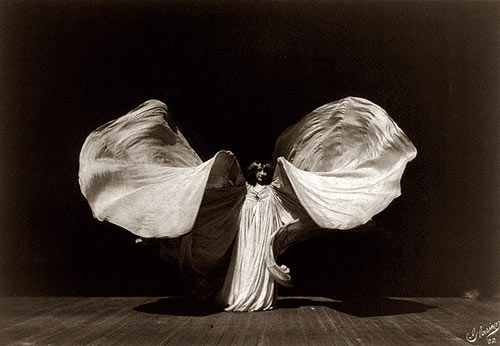
Each frame of this 19th century film by the Lumière brothers was hand-colored to create an early color moving picture. The color-shifting effect of the dress looks quite modern.
The dancing was inspired by Loie Fuller, a modern dance pioneer.



Socials & More