

How Porsches are made: by hand
Here’s the first part in a series of five videos from the 1960s that show how Porsches are made:
A Continuous Lean has the other four parts.

This site is made possible by member support. 💞
Big thanks to Arcustech for hosting the site and offering amazing tech support.
When you buy through links on kottke.org, I may earn an affiliate commission. Thanks for supporting the site!
kottke.org. home of fine hypertext products since 1998.
Beloved by 86.47% of the web.
Here’s the first part in a series of five videos from the 1960s that show how Porsches are made:
A Continuous Lean has the other four parts.
This is possibly the most American thing I’ve ever seen:
Such ingenuity combined with such conspicuous waste. (via waxy)
From 1970, this video shows how Eames fiberglass shell chairs were made.
Greg Allen says:
The idea of design has been so thoroughly associated with computers in my mind, I’d forgotten the essential sculptural processes it used to involve: carving, modelmaking, molding, pouring… How design and art ever stayed separate in those days, I cannot imagine.
In this video, Lynch describes a visit with George Lucas and why he turned down Lucas’ offer to direct Return of the Jedi.
So, he took me upstairs and he showed me these things called Wookiees. And now this headache is getting stronger.
I’m ashamed of Rosebud. I think it’s a rather tawdry device. It’s the thing I like least in Kane. It’s kind of a dollar book Freudian gag. It doesn’t stand up very well.
Even calmly answering interview questions and sipping on tea from fine china, Welles is an imposing presence. (via clusterflock)
Update: Here’s the first part of the full 50-minute CBC interview from which the snippet above was pulled. Part two, part three, part four, part five, and part six. (thx, blake)
Loosely based on Howard Zinn’s A People’s History of the United States, The People Speak is a show that features well-known actors reading famous speeches and letters from American history.
Using dramatic and musical performances of the letters, diaries and speeches of everyday Americans, The People Speak gives voice to those who spoke up for social change throughout U.S. history, forging a nation from the bottom up with their insistence on equality and justice.
The show starts airing this Sunday but many of the performances are already available online.
Watch as one of Manhattan’s main arteries pulses with the entering and exiting subway trains.
This video of what Earth would look like with Saturnine rings is pretty ho-hum, yeah, there’s a shot from orbit of the Earth with Saturn’s rings around it, and then BAM! here’s what it would look like at night in NYC:
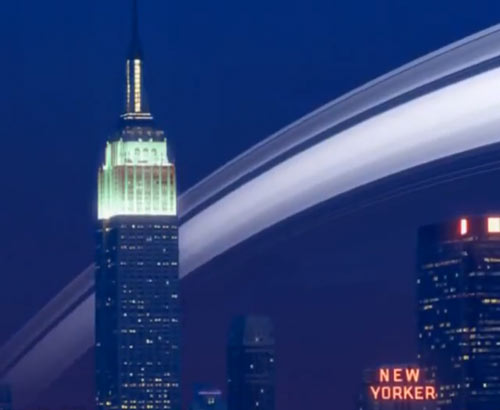
The view from Ecuador is pretty great too.
Update: Greg Allen wants an iPhone app that adds in Saturn’s rings to any shot you take with the camera.
With the combination of GPS and orientation data that’s baked in to so many digital photographs, it should be possible to create a filter — I hear the kids call them apps now — that automatically inserts properly positioned Saturn rings into any sky you want.
An augmented reality app would be nice too.
Video of Jeff Mangum of Neutral Milk Hotel singing Two-Headed Boy at the Knitting Factory in NYC on March 7, 1998.
Intensity.
Jesus, this is nerdy (and hilarious): a Lady Gaga parody about a typeface.
(via @caterina)
A delightfully low-tech but colorful music video from OK Go. Looks like it was shot it one take.
You may remember OK Go from their famous treadmill video. (thx, mike)
Update: Here’s how they made the video. (thx, everyone)
Kazuo Uyeda demonstrates his hard shake:
From an article in the NY Times about cocktail shaking:
Mr. Uyeda, who owns a bar named Tender in the Ginza district, is the inventor of a much-debated shaking technique he calls the hard shake, a choreographed set of motions involving a ferocious snapping of the wrists while holding the shaker slanted and twisting it. According to his Web site, this imparts, among other things, greater chill and velvety bubbles that keep the harshness of the alcohol from contacting the tongue, while showering fine particles of ice across the drink’s surface.
This is amazing: a stop-motion recreation of the Neo-dodges-bullets-on-the-roof scene from The Matrix done entirely in Lego.
Another great video essay from Matt Zoller Seitz: Feast, a tribute to images of food on film.
Cooking, perhaps more than any activity, lets an actor exude absolute physical and intellectual mastery without seeming domineering or smug. Why is that? It’s probably because, while cooking is a creative talent that has a certain egotistical component (what good cook isn’t proud of his or her skills?), there’s something inherently humbling about preparing food for other people. It doesn’t matter whether you’re a workaday gangster footsoldier giving lessons on how to cook for 20 guys, like Richard Castellano’s Clemenza in The Godfather, or a hyper-articulate, super-fussy kitchen philosopher like Tony Shalhoub in Big Night, (“To eat good food is to be close to God…”), when you’re cooking, it’s ultimately not about you; it’s about the people at the table. Their approval and pleasure is the end game.
A visualization of the decline of the world’s four maritime empires (British, Portuguese, French, Spanish) from 1800 to 2009.
France pretty much just explodes around 1960.
A short video in which Milton Glaser extols the virtues of drawing while drawing.
It is only through drawing that I look at things carefully.
For his piece Steak Filter, Noah Feehan ran a video signal of a steak cooking through the actual steak. The deterioration of the video signal becomes a sign of how done the steak is.
Quite literally, I am plugging composite video into a big steak, which is then cooked. The video signal going through the steak is the image of the steak cooking. Gradually, the steak loses moisture and signal can no longer pass.
The videos don’t really show too much, but I love the idea. (via eat me daily)
This is really well done. (thx, joris)
Update: The next 100 greatest quotes from The Wire. (thx, charlie)
A timelapse video of 15-days of game play in Grand Theft Auto IV. Sadly not set to the music of Philip Glass. (thx, rob)
Update: An early teaser video for GTA IV featured Philip Glass’ music as well as some timelapse footage. (thx, michael)
When you shoot video of water drops falling into a puddle in super slow motion, it turns out that they bounce in really interesting ways.
(via 3qd)
As part of Newsweek’s extensive 2010 project (more on that next week), they’ve produced a 7-minute video showing the highlights from the past decade.
Wassup! Wassup! What a decade. (thx, jr)
If you liked the film of the 1905 streetcar ride down Market Street in San Francisco, you might enjoy this 1927 film of various sites around London, including several down-the-street shots. Oh, and it’s in color. In the 1920s.
This clip is from a larger film called The Open Road by Claude Friese-Greene. He shot the film with a process his father William had developed called Biocolour.
William began the development of an additive colour film process called Biocolour. This process produced the illusion of true colour by exposing each alternate frame of ordinary black-and-white film stock through a two different coloured filters. Each alternate frame of the monochrome print was then stained red or green. Although the projection of Biocolour prints did provide a tolerable illusion of true colour, it suffered from noticeable flickering and red-and-green fringing when the subject was in rapid motion. In an attempt to overcome the colour fringing problem, a faster-than-usual frame rate was used.
(via @jamesjm)
This video was offline so soon after I posted it and is so crazy that I thought it deserved more than an update to the old post. So here it is again. Watch it, watch it, watch it. (thx, tomek)
Man, lots of good stuff today. This is a film of a trip down Market Street in San Francisco taken in 1905 from the front of a streetcar. The array of driving styles and vehicles on display here is dazzling. (via justin blanton)
Update: The film is actually from 1906, filmed four days before the deadly earthquake. Here’s the whole thing on YouTube:
A section of this film from later in 1906 offers a post-earthquake view of the same trip down Market Street (from 2:23 to 5:55).
Somehow Ricardo Autobahn has constructed a coherent mix-video song from all sorts of movie and TV clips. It’s just flat-out awesome; watch it:
See also Christian Marclay. (via fimoculous)
There was a short CG special effects sequence in Star Wars (the Death Star explanation at the Rebel briefing); here’s how it was made.
Timelapse video of a trip from Denver to Singapore and back again.
I made a time lapse video of a weekend trip I did to singapore by hanging a point and shoot around my neck, taking a snapshot every couple minutes/hours.
Socials & More