kottke.org posts about video
My main thought in watching these VFX videos for The Martian, Star Wars, and Mad Max is how amazing visual effects are now. The effects folks do their jobs so well now that audiences don’t even notice the effects…it’s almost boring.
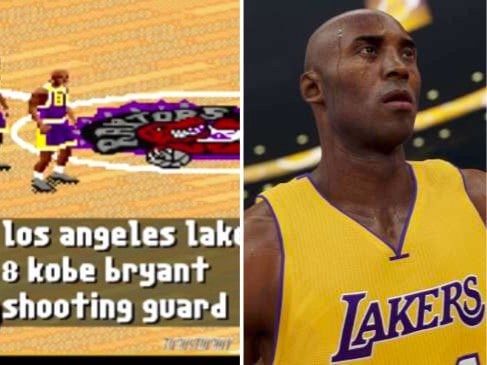
Related: see also how much video game graphics have improved from the beginning of Kobe Bryant’s NBA career to now.
Film editor Vashi Nedomansky took five movies whose ASL (average shot length) is under 2 seconds and sped them up by 12 times. You can judge for yourself, but according to Nedomansky, Mad Max: Fury Road is the only one that’s still comprehensible at that speed. Huge props to director George Miller and editor Margaret Sixel.
Just as he did a couple of years ago, Casey Neistat busted out his board yesterday and went snowboarding behind a 4WD Jeep in the blizzard covered streets of Manhattan. (thx, david)
Fury Road was by far the prettiest movie I saw in the past year. Lots of practical effects, but every single frame of the film was also digitally altered (mostly color correction). This piece goes way more into detail.
Neoantigen vaccines use the DNA from a cancer patient’s own tumor to, hopefully, eradicate the cancer.
For some 50 years, cancer biologists have tried to incite the immune system to attack cancer by targeting molecules that commonly stud the surfaces of malignant cells. These “antigens” act as homing beacons that immune cells find and lock onto (much as antigens on viruses attract the immune system, the basis for preventive vaccines such as that for measles).
Trouble is, normal cells sometimes sport the same antigens as tumors, and the immune system is programmed not to attack antigens found on healthy cells. As a result, revving up the immune system to target common tumor antigens hasn’t worked, leading to a number of failed experimental cancer vaccines.
That led biologists to a different approach: siccing the immune system on antigens found only on cancer cells — and only on the cancer cells of a single patient. “It’s highly unlikely that any two patients have the same neoantigens,” said Dr. Catherine Wu of Boston’s Dana-Farber Cancer Institute. “That’s why we have an opportunity to make cancer vaccines truly personalized, loaded with patient-specific neoantigens.”
In 2009, The Insurance Institute for Highway Safety conducted a crash test between a 1959 Chevrolet Bel Air and a 2009 Chevy Malibu. The video plainly shows how much progress has been made in passenger safety in those 50 years. Even though the Malibu is much lighter, its crumple zone absorbs much of the impact while the Bel Air lets the newer car’s front end slam right into the driver.1
Even though I’ve seen crash test footage before, I was shocked at how quickly the airbag deployed in the newer car…it’s fully inflated before the rest of the car and its occupants even realize that inertia is about to do some bad things.
From Vox, a history of the conflict between the Israelis and the Palestinians. More here.
Last week, after the State of the Union address, President Obama was interviewed by three prominent YouTube users. Oh, the outcry that arose! (Even though he did the same thing last year.) The President giving valuable country-running time over to mere social media stars, what has this country come to?
Well, it turns out if you get different kinds of people asking different kinds of questions, you’re going to get answers you normally wouldn’t hear. Case in point: Ingrid Nilsen was one of the three YouTubers chosen to interview the President. She asked him to talk about a meaningful item from his house and the President told a wonderful story about what he carries in his pockets every day:
Obama continues to be delightful and Nilsen might be my new favorite person after watching her YT channel for a bit this morning. I mean, just watch the first few minutes of this video where she came out to her viewers.
I like how Cinefix does these videos. They pick the ten films, but they also mention other films that take similar approaches. In this case, the picks are also more populist than usual, which I appreciate.
Questlove tells some great stories — I’m partial to the one about Will Smith’s house — and this story about his attempt to DJ for Prince and how a Pixar movie intervened is top notch.
Harry Potter and the Half-Blood Prince reimagined as a wacky teen comedy. Excellent editing and music choice elevate this above similar efforts.
Swearing in Hollywood movies was banned from the 1930s until 1968. And even then it took two more years for a movie (MASH) to use the word “fuck”. NSFW if you’ve got your fucking sound turned up.
This is a bunch of animated naked people falling into two precise columns. Mesmerizing. Perhaps a little NSFW? And throw some headphones on…the sound, while subtle, is essential.
See also that video — you remember the one — of a bunch of computer-generated people being mowed down by a rotating bar.
This month, HBO is airing a special edition of The Godfather that presents scenes from the first two movies in chronological order with some deleted scenes mixed in for good measure. It’s more than 7 hours long. It’s not listed anywhere on HBO’s site, but supposedly it’ll run all month on HBO and their online and on-demand services.
YouTube user DJ Hammers has been uploading videos of start-to-finish trips on NYC subway lines from the perspective of the operator at the front of the train. The realtime videos are interesting to watch, but the 10x time lapses are probably a better use of your attention. Here’s the time lapse of the Queens-bound 7 train (realtime version):
See also Slow TV.
The London Underground recently conducted an experiment on one of the escalators leading out of the busy Holborn station. Instead of letting people walk up the left side of the escalator, they asked them to stand on both sides.
The theory, if counterintuitive, is also pretty compelling. Think about it. It’s all very well keeping one side of the escalator clear for people in a rush, but in stations with long, steep walkways, only a small proportion are likely to be willing to climb. In lots of places, with short escalators or minimal congestion, this doesn’t much matter. But a 2002 study of escalator capacity on the Underground found that on machines such as those at Holborn, with a vertical height of 24 metres, only 40% would even contemplate it. By encouraging their preference, TfL effectively halves the capacity of the escalator in question, and creates significantly more crowding below, slowing everyone down. When you allow for the typical demands for a halo of personal space that persist in even the most disinhibited of commuters — a phenomenon described by crowd control guru Dr John J Fruin as “the human ellipse”, which means that they are largely unwilling to stand with someone directly adjacent to them or on the first step in front or behind — the theoretical capacity of the escalator halves again. Surely it was worth trying to haul back a bit of that wasted space.
Leaving aside “the human ellipse” for now,1 how did the theory work in the real life trial? The stand-only escalator moved more than 25% more people than usual:
But the preliminary evidence is clear: however much some people were annoyed, Lau’s hunch was right. It worked. Through their own observations and the data they gathered, Harrison and her team found strong evidence to back their case. An escalator that carried 12,745 customers between 8.30 and 9.30am in a normal week, for example, carried 16,220 when it was designated standing only. That didn’t match Stoneman’s theoretical numbers: it exceeded them.
But not everyone liked being asked to stand for the common good:
“This is a charter for the lame and lazy!” said one. “I know how to use a bloody escalator!” said another. The pilot was “terrible”, “loopy,” “crap”, “ridiculous”, and a “very bad idea”; in a one-hour session, 18 people called it “stupid”. A customer who was asked to stand still replied by giving the member of staff in question the finger. One man, determined to stride to the top come what may, pushed a child to one side. “Can’t you let us walk if we want to?” asked another. “This isn’t Russia!”
There’s a lesson in income inequality here somewhere…2
Update: The NY Times wades into the not walking on escalators debate: Why You Shouldn’t Walk on Escalators. Standing on the escalator, meet American self-interest.
It would be hard to persuade people that “everybody wins” if they all merely stood on the escalator, Curtis W. Reisinger, a psychologist at Zucker Hillside Hospital in Glen Oaks, N.Y., said.
“Overall I am not too optimistic that people’s sense of altruism can override their sense of urgency and immediacy in a major metro area where the demands for speed and expediency are high,” he wrote in an email.
Sam Schwartz, New York City’s former traffic commissioner and a fellow in transportation at Hunter College, said people’s competitive nature tends to trump logic and science.
“In the U.S., self-interest dominates our behavior on the road, on escalators and anywhere there is a capacity problem,” he wrote in an email. “I don’t believe Americans, any longer (if they ever did), have a rational button.”
There’s nothing more American than a few people gaining a few extra seconds at the expense of many having to wait a lot longer. See also Tom Junod’s piece from Esquire, The Water-Park Scandal and Two Americas in the Raw: Are We a Nation of Line-Cutters, or Are We the Line?
Update: Cheddar did a short video on standing vs walking on escalators:
If you’re keeping tabs at home, this is the third video I’ve posted to kottke.org featuring self-destructing washing machines. While not quite as good as this one — “it seems as though the washer is attempting to turn into the Picasso version of itself” — there’s a sublime moment where this chaotic neutral washing machine seemingly defies gravity by hanging in the air like Michael Jordan.
It took me a few minutes to realize that FootGolf, like chessboxing, is an actual sport and not a Funny or Die skit. As you might have guessed, FootGolf is golf but with soccer balls and feet instead of golf balls and clubs.
Has your day been insufficiently creepy? Not anymore! You may not be able to sleep properly after looking at this video of animatronic babies, some of them without their “skin” on. (via @machinepix)
I love watching Gordon Ramsay make scrambled eggs. I first saw this video years ago and, possibly because I am an idiot, have yet to attempt these eggs at home. You and me, eggs, next weekend.
P.S. Jean-Georges Vongerichten makes scrambled eggs in a very similar way. Not quite soft-scrambled…Serious Eats calls them fancy French spoonable eggs.
P.P.S. Anyone have a square Japanese omelette pan I can borrow?
P.P.P.S. In Jiro Dreams of Sushi (now on Netflix!), an apprentice talks about making tamagoyaki (Japanese omelette) over 200 times before Jiro declared it good enough to serve in his restaurant.
That apprentice, Daisuke Nakazawa, is now the head chef at Sushi Nakazawa, one of the five NYC restaurants that currently has a four-star rating from the NY Times (along with the aforementioned Jean-Georges and not along with Per Se, which recently got dunce capped down to 2 stars by populist hero Pete Wells).
Evan Puschak, aka the Nerdwriter, explains why the third movie in the Harry Potter series, The Prisoner of Azkaban, is the best film in the series — spoiler: because Alfonso Cuarón — and why that matters for the young fans of the series: for some, it’s their first exposure to good filmmaking.
A look at how some of the most arresting visual effects were done in Star Wars: The Force Awakens. The filmmakers used many real sets and models (i.e. practical effects), but there were also 2100 shots in the movie with digital effects.
Update: The original video was removed, but I replaced it with one that’s a bit better.
Update: Here’s how the visual effects on the Millennium Falcon’s escape from Jakku scene were done.
Update: ILM released their official look at the visual effects.
James Corden does this thing on the Late Late Show where he drives around with singers doing karaoke in a car. Yesterday, he picked up Adele and they drove around singing a few of her songs and then she did, without dropping a word, Nicki Minaj’s verses from Monster1 (starts at about the 10:15 mark). Soooo good. (via @djacobs)
A video exploring Stanley Kubrick’s use of color in his films. See also Kubrick’s use of the color red. (via @john_overholt)
The man who shot the video writes:
An inspiration for this session was a conversation with my 3year old daughter while dressing up to go out:
- Daddy, I don’t want to put this jacket on. - she moaned
- Me too, darling but it is very cold outside. - I explained
- How cold?
and I had to figure out an interesting answer which would satisfy a preschooler’s curiosity, so I told her:
- It is so cold that even soap bubbles freeze and it looks really beautiful, you know?
I saw a sparkle in her eye so I promised to make a film to show her that. She was so excited about this idea that of course she forgot that she didn’t want to put her jacket on. It wasn’t easy to capture those bubbles because only around 5-10% of them didn’t break instantly and as you can imagine it was a challenge to be patient at -15 Celsius ;) but it was worth it because now that my daughter has seen it, winter is magic for her.
(via devour)
Riffing on Kathryn Schulz’s piece about the five best punctuation marks in literature, Max Tohline explores how editing in film can function as punctuation to separate or join together characters, shots, and ideas within movies.
They should have roped Mothersbaugh in on the music, but this was actually really informative! And the Bobby Jindal slow-mo was [kiss-fingers emoji].
Chris Wilmore was devastated after his close friend was shot to death on Christmas Eve in 2013, in a dispute over a woman.
Mr. Wilmore, known in his Harrisonburg, Va., neighborhood as Scarface, has his own history with weapons and crime, but he began thinking of ways to squash the gun violence plaguing his community.
He started actively recruiting people with “beefs” to put on boxing gloves and take their arguments off the streets and into his backyard fight club, where he films the action and a referee calls a winner.
I did not enjoying watching the actual fighting, but the second half of the video, in which Wilmore attempts to get a pair of men into gloves to solve an argument, is A+. I read Ron Chernow’s Alexander Hamilton over the holiday break (spoiler: it was excellent); Streetbeefs is new-school dueling with gloves.
A short entertaining look at Star Wars’ secret sauce. Joseph Campbell? Kurosawa? Flash Gordon? The ancient future? The sounds? (PS: The Wilhelm Scream shows up pretty early on in The Force Awakens, as Poe and Finn exit the First Order hangar bay.)
In the first few seconds of this video, Margaret Leng Tan introduces herself:
I’m the first woman to graduate with a doctorate from Juilliard and now I play the toy piano. Life works in mysterious ways.
You can hear more of Tan’s toy piano music on Spotify. (via @robinsloan)
Newer posts
Older posts






Socials & More