kottke.org posts about video
Well, this is a treat. In February, before the pandemic lockdown, Alicia Keys recorded a Tiny Desk Concert and NPR released the video earlier this week.
As she approached her piano, a bit surprised at the amount of people in the room, she smiled and remarked over her shoulder, “Gee, the Tiny Desk is tiny!” She kicked off the set with an uncanny ode to combat the darkness of this moment in American history: “Show Me Love,” a single she released in 2019. No one could have predicted then how much her lyrics and musical healing would be crucial during this emotionally fraught time of unprecedented political and racial unrest, heightened by three months of quarantine due to a global pandemic.
The stand-out moment during her Tiny Desk was the premiere of “Gramercy Park”, a song from her upcoming self-titled album, ALICIA, which is set to be released this fall. It’s one of those timeless songs that will transcend radio formats and genres, with lyrics that address how utter selflessness and worrying about making everyone happy but yourself can throw your own center askew. The song’s spiritual refrain is sure to be a sing-along moment for the rest of Keys’s career.
As an encore, she and her band played Fallin, her first big single. As someone in the comments said:
Can we all just appreciate the fact that she can pull fallin out her back pocket, dust it off like an old record, and make us fall in love all over again.
Keys’ almost casual brilliance blew me right away here. Wow.

As promised last week, Barcelona’s Gran Teatre del Liceu reopened on Monday with a string quartet performance of Puccini’s Crisantemi played before a packed house of 2,292 plants. You can watch the performance here:
A strange & beautiful performance. I love that they did the “please silence your mobile phones and no pictures please” announcement before beginning.
The performance was the brainchild of artist Eugenio Ampudia, who wanted to “offer us a different perspective for our return to activity, a perspective that brings us closer to something as essential as our relationship with nature”. Afterwards, the plants were donated to healthcare workers who have been battling Covid-19 for the past few months.
See also A Forest Grows on an Austrian Soccer Pitch.
Former NFL linebacker and sports media personality Emmanuel Acho has started a video series on YouTube called Uncomfortable Conversations with a Black Man. From the first episode (of two), here’s his mission statement:
In the midst of all this chaos in our world, so many of y’all have reached out to me. And by y’all, I mean white people have reached out to me asking, “How can I help? How can I join in? How can I stand with you?” So I’ve created this for you because in order to stand with us and people that look like me, you have to be educated on issues that pertain to me. And fully educated so that you can feel the full level of pain so that you can have full understanding. I fervently believe that if the white person is your problem only the white person can be your solution. And so this is made for you my white brothers and sisters to increase your level of understanding so that you can increase your level of compassion and lead ultimately to change.
For the second episode, Acho sat down with fellow Austin resident Matthew McConaughey and yes, the conversation is a little cringe-y at times:
After watching that, you might be interested in reading Langston Hughes’ poem Let America Be America Again.
O, let America be America again-
The land that never has been yet-
And yet must be-the land where every man is free.
The land that’s mine-the poor man’s, Indian’s, Negro’s, ME-
Who made America,
Whose sweat and blood, whose faith and pain,
Whose hand at the foundry, whose plow in the rain,
Must bring back our mighty dream again.
In this video from Fender, the legendary producer/composer/guitarist Nile Rodgers sits down with his iconic Stratocaster and talks about how he took a folky tune that David Bowie came up with and turned it into the jazzy backbone of the pop song Let’s Dance, arguably Bowie’s biggest hit. Listening to where the song started off before Rodgers started tweaking, it’s hard for this musical simpleton to recognize that it’s even the same tune.
Update: Rodgers told a variation of this story in 2015.
In their newest video, Kurzgesagt explores the question of responsibility around climate change: which countries are most responsible for carbon emissions and for fixing the damage they’ve caused. As always, their source material is worth a look.
Netflix has put When They See Us, Ava DuVernay’s 4-episode mini-series about the Central Park Five, in front of their paywall for free viewing. Here’s the trailer:
The 2013 Ken Burns documentary The Central Park Five is available to watch on the PBS site and also on Amazon.
As previously noted, DuVernay’s 13th and Selma are also both available to watch online for free.
For 35 years, activist and archivist Marion Stokes recorded television news coverage on VHS tapes, amassing a collection of hundreds of thousands of hours of footage. Matt Wolf has produced a documentary about Stokes called Recorder: The Marian Stokes Project.
For over 30 years, Marion Stokes obsessively and privately recorded American television news twenty-four hours a day. A civil rights-era radical who became fabulously wealthy and reclusive later in life, her obsession started with the Iranian Hostage Crisis in 1979 — at the dawn of the twenty-four hour news cycle. It ended on December 14, 2012 as the Sandy Hook massacre played on television while Marion passed away. In between, Marion filled 70,000 VHS tapes, capturing revolutions, wars, triumphs, catastrophes, bloopers, talk shows and commercials that show us how television shaped the world of today and in the process tell us who we were.
A mystery in the form of a time capsule, Recorder delves into the strange life of a woman for whom home taping was a form of activism to protect the truth (the public didn’t know it, but the networks had been disposing their archives for decades into the trashcan of history) and though her visionary and maddening project nearly tore her family apart, her extraordinary legacy is as priceless as her story is remarkable.
The trailer is above and you can watch the whole thing for free on PBS for a limited time.
A Thelonious Monk live album that was recorded in 1968 is set to be released for the first time on July 31, 2020. You can hear the first single from the album on YouTube, Spotify, or several other places. (The song is now unavailable — see the update below.)
The story behind the performance is a little nutty — a student hired Monk to play at his high school and many folks didn’t buy tickets until the jazz great actually pulled into the parking lot.
After the assassination of Dr. Martin Luther King, Jr. in 1968, racial tensions across the country rose. Palo Alto, a largely white college town in California, was not immune to the events of the day. Danny Scher, a rising junior at Palo Alto High School, had a dream to bring Thelonious Monk to Palo Alto to perform and help bring about racial unity in his community as well as raise funds for his school’s International Committee. After somehow securing Monk’s services to perform on Sunday, October 27, Scher initially had trouble selling tickets and convincing people that Monk was even going to show up. With many twists and turns along the way and several hundred people waiting in the school’s parking lot to await Monk’s arrival before purchasing tickets, the concert eventually happened and was a triumph in more ways that Monk or Scher could have imagined. This is a recording of that historic concert.
(via, who else?, @tedgioia)
Update: One of the high school’s custodians took charge of tuning Monk’s piano and recording the session. A crowdsourced effort is underway to identify and recognize his efforts.
Update: The album’s release has been “indefinitely delayed”.
“I received word that there was a dispute between the estate and Monk’s previous label,” Scher said during a phone conversation on Monday, July 27. So the release has been taken off of the schedule indefinitely “due to circumstances beyond the label’s control,” according to a statement by Impulse! Records. Co-producer Feldman was unable to provide any further information at this time.
The album’s first single has been scrubbed from all the streaming services as well.
Today is Juneteenth, a holiday that started in Texas that celebrates the emancipation of enslaved people in the United States. From Vox’s Juneteenth, explained:
A portmanteau of “June” and “nineteenth,” Juneteenth marks the day in 1865 when a group of enslaved people in Galveston, Texas, finally learned that they were free from the institution of slavery. But, woefully, this was almost two and a half years after President Abraham Lincoln signed the Emancipation Proclamation; the Civil War was still going on, and when it ended, Union Maj. Gen. Gordon Granger traveled to Texas and issued an order stating that all enslaved people were free, establishing a new relationship between “former masters and slaves” as “employer and hired labor.” As much as Juneteenth represents freedom, it also represents how emancipation was tragically delayed for enslaved people in the deepest reaches of the Confederacy.
And freedom was further delayed, but the holiday stuck. From What Is Juneteenth? by Henry Louis Gates, Jr.:
When Texas fell and Granger dispatched his now famous order No. 3, it wasn’t exactly instant magic for most of the Lone Star State’s 250,000 slaves. On plantations, masters had to decide when and how to announce the news — or wait for a government agent to arrive — and it was not uncommon for them to delay until after the harvest. Even in Galveston city, the ex-Confederate mayor flouted the Army by forcing the freed people back to work, as historian Elizabeth Hayes Turner details in her comprehensive essay, “Juneteenth: Emancipation and Memory,” in Lone Star Pasts: Memory and History in Texas.
Those who acted on the news did so at their peril. As quoted in Litwack’s book, former slave Susan Merritt recalled, ” ‘You could see lots of n***ers hangin’ to trees in Sabine bottom right after freedom, ‘cause they cotch ‘em swimmin’ ‘cross Sabine River and shoot ‘em.’ ” In one extreme case, according to Hayes Turner, a former slave named Katie Darling continued working for her mistress another six years (She ” ‘whip me after the war jist like she did ‘fore,’ ” Darling said).
Hardly the recipe for a celebration — which is what makes the story of Juneteenth all the more remarkable. Defying confusion and delay, terror and violence, the newly “freed” black men and women of Texas, with the aid of the Freedmen’s Bureau (itself delayed from arriving until September 1865), now had a date to rally around. In one of the most inspiring grassroots efforts of the post-Civil War period, they transformed June 19 from a day of unheeded military orders into their own annual rite, “Juneteenth,” beginning one year later in 1866.
From the NY Times’ collection of articles to mark the Juneteenth holiday, Veronica Chambers writes:
“Recently, I heard Angela Davis talk about the radical imagination,” Ms. [Saidiya] Hartman said. “And a fundamental requirement is believing that the world you want to come into existence can happen. I think that that is how black folks have engaged with and invested in and articulated freedom, as an ideal and as an everyday practice.”
I couldn’t agree more. As someone who has celebrated Juneteenth for a long time, I think we need it now — not in lieu of the freedom, justice and equality we are still fighting for — but in addition, because we have been fighting for so very long.
The elemental sermon embedded into the history and lore of Juneteenth has always been one of hope. The gifts of the holiday are the moments of connection, renewal and joy for a people who have had to endure so much, for so long.
Gina Cherelus shares how folks around the country celebrate, past and present — This Is How We Juneteenth:
Kenneth Timmons, who works for a federal government agency in Houston, said the first thing he usually does before every Juneteenth is take the day off work. Mr. Timmons usually invites friends over to cook and eat together.
“My co-workers know why I’m off, I tell them I don’t work Juneteenth,” Mr. Timmons, 47, said. “I don’t work on my Independence Day.”
Born and raised in Lufkin, Texas, a town more than 100 miles northeast of Houston, Mr. Timmons remembers attending community Juneteenth celebrations as a child, where he would watch rodeo shows, pageants, eat barbecue and participate in calf chasing contests.
“Even though the United States celebrates July 4 as their independence, we were still considered slaves,” said Mr. Timmons. “So for us, that is the day that our ancestors were finally released from servitude and slavery and could escape the South.”
Calls for Juneteenth to be a federal holiday have grown over the past few years. Here’s the case from the staff of The Root and Danielle Young — Juneteenth Is Finally Entering the Mainstream American Consciousness. Now Make It An Official Federal Holiday.
Forget the 4th of July! Juneteenth is the day that should be celebrated by all as a pivotal point in America’s freedom story.
93-year-old Texas resident Opal Lee is working to get Juneteenth recognized as a national holiday. You can follow her efforts here and sign her petition.
And finally, here are some ways to get involved in the movement for Juneteenth, including educational resources, events & protests, suggestions for how to invest in the Black community, places to donate, volunteer opportunities, etc.
In 1854, Dr. John Snow produced a map of a London cholera outbreak which showed deaths from the disease concentrated around a water pump on Broad Street. The prevailing view at the time was that cholera spread through dirty air, but Snow hypothesized that it was actually spread through water and constructed this early medical data visualization to help prove it.
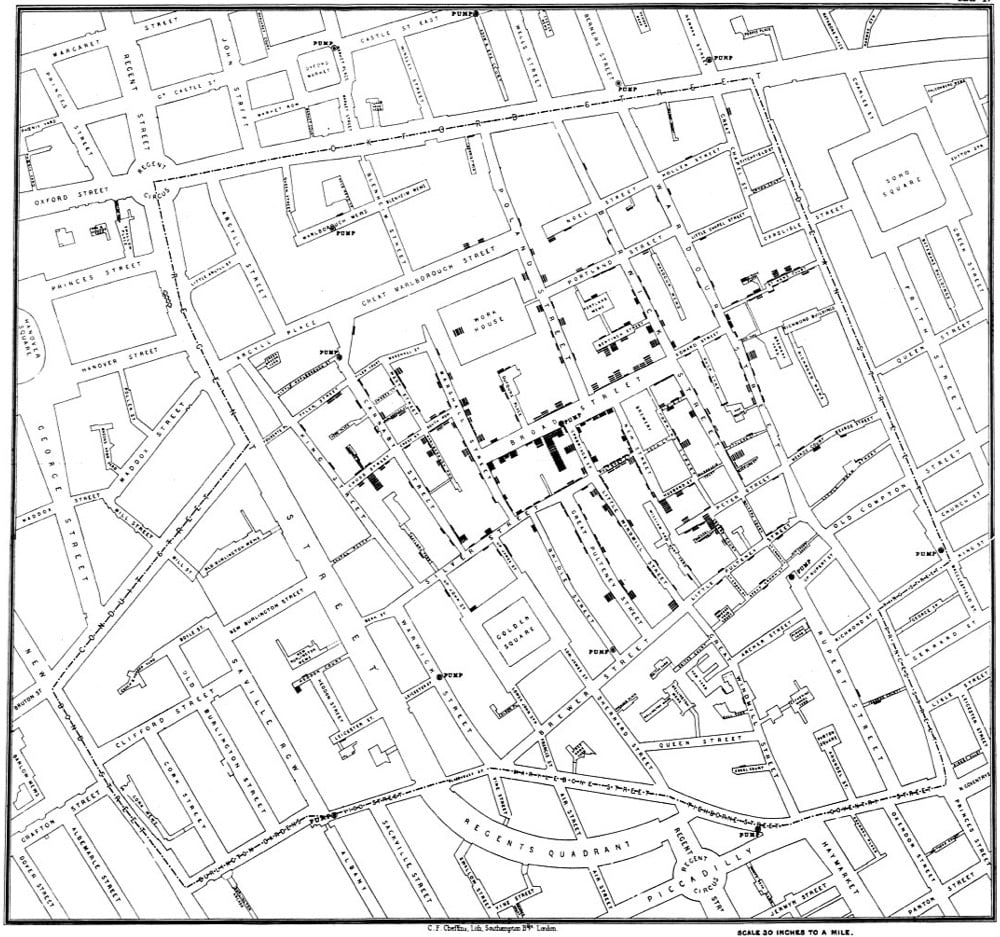
Through a mix of personal interviews, clever detective work, and data analysis that included tables and a famous map, Snow managed to stop the outbreak and convince local public health officials, eventually, that cholera could be transmitted through water, not a miasma. Since his breakthrough study, the map has become an iconic piece of epidemiological history, as an illustration of keen detective work, analysis, and visual representation with a map that, even today, tells a story.
Aside from the cluster of deaths around the pump (which could be argued were the result of a miasma cloud and not contaminated water), stories of nearby people who didn’t get sick (brewers who drank the beer they produced rather than well water, people in buildings with their own wells) and far away people who died because they had drunk water from the well were also essential in proving his theory:
I was informed by this lady’s son that she had not been in the neighbourhood of Broad Street for many months. A cart went from broad Street to West End every day and it was the custom to take out a large bottle of the water from the pump in Broad Street, as she preferred it. The water was taken on Thursday 31st August., and she drank of it in the evening, and also on Friday. She was seized with cholera on the evening of the latter day, and died on Saturday
You can read more about John Snow and how his map changed science and medicine in Steven Johnson’s excellent Ghost Map.
For Slate’s 2015 podcast series The History of American Slavery, Andrew Kahn created an interactive visualization of the 20,000+ voyages that made up the Atlantic slave trade that lasted 315 years. A video of the interactive map is embedded above.
As we discussed in Episode 2 of Slate’s History of American Slavery Academy, relative to the entire slave trade, North America was a bit player. From the trade’s beginning in the 16th century to its conclusion in the 19th, slave merchants brought the vast majority of enslaved Africans to two places: the Caribbean and Brazil. Of the more than 10 million enslaved Africans to eventually reach the Western Hemisphere, just 388,747 — less than 4 percent of the total — came to North America. This was dwarfed by the 1.3 million brought to Spanish Central America, the 4 million brought to British, French, Dutch, and Danish holdings in the Caribbean, and the 4.8 million brought to Brazil.
Roughly 400,000 enslaved Africans were brought to the United States before the practice was banned in 1808. The ban was mostly (but not entirely) enforced and yet in 1860, the population of enslaved persons was almost 4 million in the South. That’s because the 1808 ban, according to Ned & Constance Sublette’s book The American Slave Coast: A History of the Slave-Breeding Industry, was a form of trade protectionism that protected the forced breeding of enslaved peoples by American slaveowners. From a review of the book:
In fact, most American slaves were not kidnapped on another continent. Though over 12.7 million Africans were forced onto ships to the Western hemisphere, estimates only have 400,000-500,000 landing in present-day America. How then to account for the four million black slaves who were tilling fields in 1860? “The South,” the Sublettes write, “did not only produce tobacco, rice, sugar, and cotton as commodities for sale; it produced people.” Slavers called slave-breeding “natural increase,” but there was nothing natural about producing slaves; it took scientific management. Thomas Jefferson bragged to George Washington that the birth of black children was increasing Virginia’s capital stock by four percent annually.
Here is how the American slave-breeding industry worked, according to the Sublettes: Some states (most importantly Virginia) produced slaves as their main domestic crop. The price of slaves was anchored by industry in other states that consumed slaves in the production of rice and sugar, and constant territorial expansion. As long as the slave power continued to grow, breeders could literally bank on future demand and increasing prices. That made slaves not just a commodity, but the closest thing to money that white breeders had. It’s hard to quantify just how valuable people were as commodities, but the Sublettes try to convey it: By a conservative estimate, in 1860 the total value of American slaves was $4 billion, far more than the gold and silver then circulating nationally ($228.3 million, “most of it in the North,” the authors add), total currency ($435.4 million), and even the value of the South’s total farmland ($1.92 billion). Slaves were, to slavers, worth more than everything else they could imagine combined.
You can read more about the economics of slavery in this post from 2016, including how American banks sold bonds that used enslaved persons as collateral to international investors. (via open culture)
In the second video in his Concatenation series (check out the first one), Donato Sansone edited a bunch of footage of Olympic divers, gymnasts, and track & field athletes together to make a single twisting, jumping, tucking, spinning routine that’s both seamless and completely disorienting. (via colossal)
In a clip from a TV advertisement for the SDP-Liberal Alliance, John Cleese entertainingly talks about the benefits of extremism.
The biggest advantage of extremism is that it makes you feel good — because it provides you with enemies. Let me explain. The great thing about having enemies is that you can pretend that all the badness in the whole world is in your enemies and all the goodness in the whole world is in you.
Even if you don’t believe that moderate politics is the way forward (and I wonder if anyone does anymore), you can appreciate the truth that having external enemies can prevent you from discovering and addressing your views and practices that are harming others and that you need to work on.
Comedian Dave Chappelle has released the video of a set he did recently near Dayton, Ohio. In it, he addresses the death of George Floyd and the resulting protests. From Slate:
Chappelle opens with a thank-you to young protesters — “You all are excellent drivers. I am comfortable in the back seat” — and keeps circling back to his ambivalence about taking a piece of their spotlight, even as he’s heard the calls for people with platforms the size of his to speak out. “This is the streets talking now,” he says. “They don’t need me right now.” But he also keeps coming back to the number that gives the special its title, the eight minutes and 46 seconds during which Derek Chauvin watched George Floyd’s life ebb away while three other police officers stood by “with their hands in their pockets.” “Who are you talking to?” he asks them. “What are you signifying — that you can kneel on a man’s neck for eight minutes and 46 seconds and feel like you wouldn’t get the wrath of God? That’s what is happening right now. It’s not for a single cop. It’s for all of it. Fucking all of it.”
This very much is worth watching. Even though this isn’t a comedy set, Chappelle demonstrates that he and comedians like him are often the most keen observers and skilled translators of culture that we have.
The conclusion from a recent paper in the Proceedings of the Royal Society A:
We conclude that facemask use by the public, when used in combination with physical distancing or periods of lock-down, may provide an acceptable way of managing the COVID-19 pandemic and re-opening economic activity. These results are relevant to the developed as well as the developing world, where large numbers of people are resource poor, but fabrication of home-made, effective facemasks is possible. A key message from our analyses to aid the widespread adoption of facemasks would be: ‘my mask protects you, your mask protects me’.
From a Reuters report on the paper:
The research, led by scientists at the Britain’s Cambridge and Greenwich Universities, suggests lockdowns alone will not stop the resurgence of the new SARS-CoV-2 coronavirus, but that even homemade masks can dramatically reduce transmission rates if enough people wear them in public.
“Our analyses support the immediate and universal adoption of face masks by the public,” said Richard Stutt, who co-led the study at Cambridge.
A pair of recent papers used the geographic differences in mask usage in Germany to gauge the effectiveness of masks in preventing the spread of Covid-19. Face Masks Considerably Reduce COVID-19 Cases in Germany:
We use the synthetic control method to analyze the effect of face masks on the spread of Covid-19 in Germany. Our identification approach exploits regional variation in the point in time when face masks became compulsory. Depending on the region we analyse, we find that face masks reduced the cumulative number of registered Covid-19 cases between 2.3% and 13% over a period of 10 days after they became compulsory. Assessing the credibility of the various estimates, we conclude that face masks reduce the daily growth rate of reported infections by around 40%.
And Compulsory face mask policies do not affect community mobility in Germany suggests that people don’t go out more or “feel invincible” when they’re wearing masks:
We use anonymised GPS data from Google’s Location History feature to measure daily mobility in public spaces (groceries and pharmacies, transport hubs and workplaces). We find no evidence that compulsory face mask policies affect community mobility in public spaces in Germany. The evidence provided in this paper makes a crucial contribution to ongoing debates about how to best manage the COVID-19 pandemic.
And these are just from the last few days. Why WHY WHY!!!! are we still talking about this? There’s no credible evidence that wearing a mask is harmful, so at worse it’s harmless. If there’s like a 1-in-10 chance that masks are somewhat helpful — and the growing amount of research suggests that both 1-in-10 and “somewhat helpful” are both understatements — isn’t it worth the tiny bit of effort to wear one and help keep our neighbors safe from potential fucking death? Just in case?
I mean, look at where we are as a country right now. Most of the US is reopening while the number of infections continue to rise. Testing is still not where it needs to be in many areas. Tracing and isolation are mostly not happening. According to epidemiologists, those are the minimum things you need to do to properly contain a pandemic like this. Maybe if you’re Iceland you can pooh pooh the efficacy of masks because you test/trace/isolated to near-perfection, but if you’re going to half-ass it like the US has chosen to do, then wearing masks under semi-lockdown conditions is all we have left! Can we do the bare minimum that is asked of us?
Update: And some anecdotal evidence from Missouri: two hairstylists saw 140 clients while symptomatic last month and it resulted in zero infections. Both the hairstylists and their clients wore masks and took other precautions (staggered appointments, chairs spaced apart).
Update: I deleted a reference to this paper that many epidemiologists et al. have flagged as problematic (see here, here, and here for instance). (via @harrislapiroff)
The Masks Masquerade by Nassim Nicholas Taleb is worth a read.
“Libertarians” (in brackets) are resisting mask wearing on grounds that it constrains their freedom. Yet the entire concept of liberty lies in the Non-Aggression Principle, the equivalent of the Silver Rule: do not harm others; they in turn should not harm you. Even more insulting is the demand by pseudolibertarians that Costco should banned from forcing customers to wear mask — but libertarianism allows you to set the rules on your own property. Costco should be able to force visitors to wear pink shirts and purple glasses if they wished.
Note that by infecting another person you are not infecting just another person. You are infecting many many more and causing systemic risk.
Wear a mask. For the Sake of Others.
And finally, obviously, if wearing a mask is not advisable for you — for a genuine medical reason or if it makes you look dangerous to a racist policing system for instance — then you shouldn’t wear one! But the vast majority of us should be able to manage it.
Update: A study in Health Affairs analyzing the infection rates in US states with face mask mandates versus those without finds that a mandate was associated with a decline in the Covid-19 growth rate (italics mine).
Mandating face mask use in public is associated with a decline in the daily COVID-19 growth rate by 0.9, 1.1, 1.4, 1.7, and 2.0 percentage points in 1-5, 6-10, 11-15, 16-20, and 21+ days after signing, respectively. Estimates suggest as many as 230,000-450,000 COVID-19 cases possibly averted By May 22, 2020 by these mandates. The findings suggest that requiring face mask use in public might help in mitigating COVID-19 spread.
In a comparison among countries, those where people wore masks early fared much better than those where people didn’t. This is a pretty stark difference:
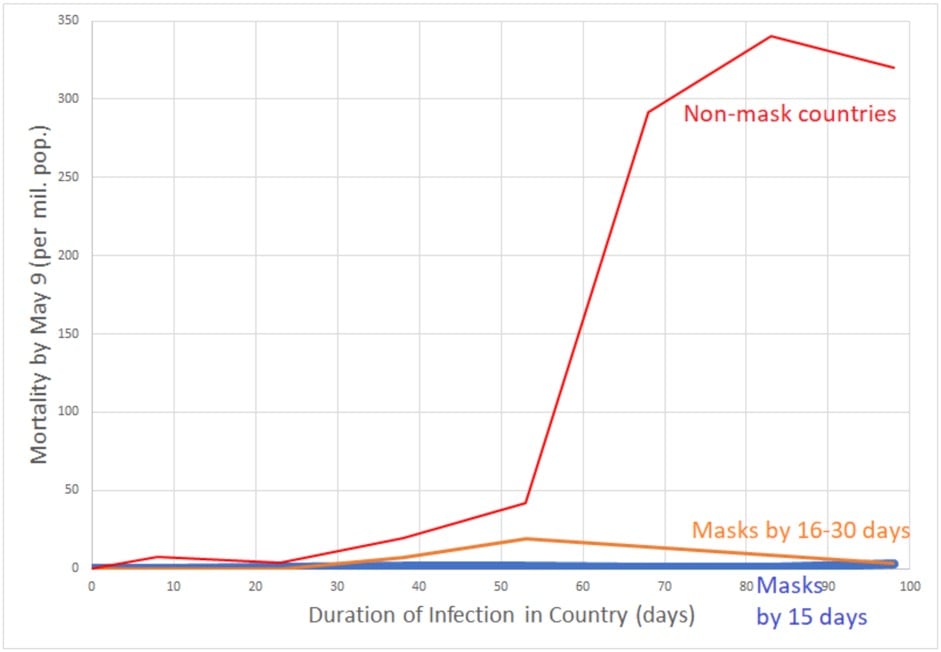
And this study noted that Google search volume of people searching for masks in various countries correlated with the infection rate — in general, the earlier the search volume increased in a given country, the fewer infections recorded in that country.
Update: A list of 70 scientific studies, dating all the way back to 2003, that support the wearing of face masks to prevent disease spread.
Bill Nye recently did a quick mask demonstration featuring a candle to show how effective homemade cloth masks are at blocking exhaled breath. He calls wearing a mask in public to protect other people “literally a matter of life and death”.
Stewart Reynolds shares some reasons to not wear a face mask, including selfish syndrome and chronic dickishness.
And this is a sad and all-too-typical American story in four parts. April: I’m not buying a mask; June: crowded pool party; July: complaining about being sick followed by an obituary. We need to fix this, now. People should not be dying like this — this is a 100% preventable death.
Update: The most recent version of an ongoing review of scientific studies about face mask efficacy was recently published online. From the abstract:
We recommend that public officials and governments strongly encourage the use of widespread face masks in public, including the use of appropriate regulation.
Newer posts
Older posts

Socials & More