kottke.org posts about video
From Jez Burrows, 30 minutes of rain from video games like Uncharted, Batman: Arkham Knight, Donkey Kong Country, Spider-Man, and Animal Crossing.
A supercut of video game characters taking a break from solving crime or shooting people to enjoy a meditative minute of miserable weather.
(via @kellianderson)
Coronation is a feature-length documentary film by Ai Weiwei about the lockdown in Wuhan, China, during the initial Covid-19 outbreak in early 2020. The trailer is not super compelling tbh, but it’s Ai Weiwei and the description sounds interesting:
The film showcases the incredible speed and power of China’s state machinery with its construction of massive coronavirus hospitals, deployment of roving sanitation-fogging robots, implementation of an exhaustive testing and contact-tracing protocol, and punctiliously engineered protective measures for health workers.
On the other side of the scale is the crushing bureaucracy of that same machine, its totalitarian decision-making, clear deception of ordinary citizens, the absence of civic communication, and perhaps, worst of all, a cold-eyed lack of empathy for those suffering loss and kept away from home.
Ai Weiwei paints a moving and revelatory portrait not just of China’s response to the pandemic but also of ordinary people in Wuhan, showing how they personally cope with the disaster.
Hyperallergic’s Dan Schindel has a review of the film. You can watch Coronation on demand at Vimeo or Alamo. (via colossal)
From Netflix, Challenger: The Final Flight is a four-part documentary series about the 1986 Challenger Space Shuttle disaster.
Incorporating never-before-seen interviews and rare archival material, this series offers an in-depth look at one of the most diverse crews NASA assembled, including high school teacher Christa McAuliffe, who was selected to be the first private citizen in space.
The series debuts on Netflix on Sept 16.
As a huge fan of Mario Kart (and a relatively recent owner of a Switch), this looks absolutely amazing (if it works smoothly). In Mario Kart Live: Home Circuit, you race a physical kart (against other peoples’ physical karts if you want) through your actual house, controlling it via onscreen AR on your Nintendo Switch (the onscreen view comes from a tiny camera mounted on the kart). Here’s what Nintendo says about it:
Created in partnership with Velan Studios, Mario Kart Live: Home Circuit brings the fun of the Mario Kart series into the real world by using a Nintendo Switch or Nintendo Switch Lite system to race against opponents using a physical Kart. The physical Kart responds to boosts in-game and in the real world, stops when hit with an item and can be affected in different ways depending on the race. Players place gates to create a custom course layout in their home, where the only limit is their imagination. Race against Koopalings in Grand Prix, unlock a variety of course customizations and costumes for Mario or Luigi, and play with up to four players in local multiplayer mode.
Watch the trailer above…it does look totally cool.
The Story of Fascism is an hour-long TV special from travel guru Rick Steves about the history of fascism in Europe, from its post-WWI rise in Italy and Germany to the defeat of the fascist powers in WWII to efforts by modern-day right-wing ideologues to revive it.
We’ll trace fascism’s history from its roots in the turbulent aftermath of World War I, when masses of angry people rose up, to the rise of charismatic leaders who manipulated that anger, the totalitarian societies they built, and the brutal measures they used to enforce their ideology. We’ll see the horrific consequences: genocide and total war.
Because Steves hosts a travel show, they visit some of the places where this history played out, including Nuremberg, Auschwitz, and Rome, talk to historians and tour guides, and discuss fascist and anti-fascist art, including Picasso’s Guernica.
The combination of the weighty subject matter and Steves’ jaunty TV voice is a bit jarring at first, but this packs a lot of information and context into an hour. There are obviously parallels throughout to contemporary leaders and their tactics, but check out Benito Mussolini’s mannerisms and facial expressions starting at 11:05 and see if they remind you of the current inhabitant of the White House. (via open culture)
Earlier today, illusionist and “endurance performer” David Blaine grabbed onto a bunch of big helium balloons and floated into the sky.

Over the next 50 minutes, he rose to an altitude of almost 25,000 feet before letting go and skydiving/parachuting safely to the ground. The video embedded above is a livestream of the event — liftoff takes place a couple of minutes after the 2-hour mark.
In their third video of their ant trilogy (see also The World War of the Ants and The Billion Ant Mega Colony and the Biggest War on Earth), Kurzgesagt goes up into the treetops to tell us about the weaver ants.
Deep in tropical jungles lie floating kingdoms ruled by beautiful and deadly masters: They are sort of the high elves of the ant kingdoms: Talented architects that create castles and city states. But they are also fierce and expansionist warriors and their kingdoms are ensnared in a never ending war for survival. Oecophylla weaver ants.
The nests that weaver ants build out of leaves and silk from larve (that the ants use as “tiny cute glue guns”) are incredible. Since Kurzgesagt is animated, I went looking for some actual footage of weaver ants doing their thing. Here’s a clip from BBC Earth:
I found this video via The Kid Should See This, who explains that a mango orchard in Thailand uses the ants to keep pests away without using chemical pesticides:
In this mango orchard in Northern Thailand, weaver ants are nurtured so they can thrive and protect the harvest. The ants hunt the pests that would eat the mangoes, eliminating any need to use harmful chemical pesticides. The farmer creates strategic highways of red string to connect the weaver ants to new trees, expanding where they forage.
You can also watch this documentary on Australian weaver ants and this video from AntsCanada (whose videos always have amazing narration) to learn more about weaver ants.
Actor Chadwick Boseman died on Friday after a four-year battle with colon cancer. Boseman played both Jackie Robinson and James Brown in films, but he was best known for his role as T’Challa / Black Panther in four Marvel movies. In this short video featuring behind-the-scenes footage from those films and interviews from his colleagues, Marvel pays tribute to the best possible person they could have gotten to play that role.
I watched Black Panther for the third or fourth time over the weekend and while Michael B. Jordan always blows me away, it’s Boseman’s quiet intensity and magnetism that grounds Jordan’s performance and makes the whole “the bad guy has a point” plot work. Yeah ok, it’s just a superhero movie, but I think Black Panther is going to be one of those films that’s going to be relevant and reverberate for a long time.
I’ve said this before, but I could sit and listen to musicians talk about how they make their music all day long, particularly rap & hip hop producers because of all the history and context they are intentionally inserting into the music. In this video, 9th Wonder talks about DUCKWORTH., a song from Kendrick Lamar’s DAMN. that he created three beats for.
In an associated article, Marcus J. Moore (author of The Butterfly Effect: How Kendrick Lamar Ignited the Soul of Black America) writes:
But it’s on album closer “DUCKWORTH.,” produced by 9th Wonder, that the elements of jazz, hip-hop and soul come into the sharpest focus. 9th has a history of blending records from all genres into kaleidoscopic sets of deep soul and hip-hop. Each track has its own distinctive flair, but you can still tell it’s a 9th Wonder beat — the drums lock into a hypnotic groove and the vocal samples crack with nostalgic beauty. “DUCKWORTH.” mashes three beats into a tight coil of repurposed folk, progressive rock and experimental soul, on which Kendrick details a chance encounter between his father, Kenny Duckworth, and his future label boss, Anthony “Top Dawg” Tiffith. Years before “Top Dawg” became a music mogul, he walked into a Kentucky Fried Chicken and saw Kendrick’s future father working there. “Top” was planning to rob the restaurant and stood in Kenny’s line to demand the cash. But Kenny had seen “Top” rob and shoot up the store before, so to spare his own life, he gave him free chicken and two extra biscuits to get on his good side. “You take two strangers and put ‘em in random predicaments,” Kendrick rapped. “Whoever thought the greatest rapper would be from coincidence?”
Watch all the way to the end of the video — you get the rare treat of watching someone realize something about their own work and their collaborating partner that they hadn’t before…
For a few months now, NPR has been broadcasting their Tiny Desk concert series from the homes and studios of the featured musicians. Tame Impala was a recent guest and Lenny Kravitz has played a home concert as well. Here’s Rodrigo y Gabriela, who are super good live:
But Billie Eilish and her brother Finneas recently did something unique: a Tiny Desk (Home) Concert that actually looks like they’re playing in the NPR office (even though they are not).
Watch through to the end to see how they pulled it off. (via waxy)
Ammonite is an upcoming romantic drama from director Francis Lee. It takes place in the 1840s and stars Kate Winslet as a palaeontologist & Saoirse Ronan as her assistant; the pair clash then fall in love. The story is based on the life of Mary Anning, who made several important contributions to paleontology.
Paleontology wouldn’t be the same without Mary Anning. She scoured the dreary coast of southern England for secrets not seen since the Jurassic, fueling the nascent 19th-century field of fossil studies with evidence of strange sea dragons, flying reptiles and other fascinating fragments of life long past. And now, over 170 years after her death, she’s got her own movie.
However, there’s no evidence that Anning and her friend, Charlotte Murchison, ever had a romantic relationship.
I have to wonder what Anning would say to this. As she wrote in a letter, “The world has used me so unkindly, I fear it has made me suspicious of everyone.” In the sexist, male-dominated world of 19th-century science, Anning’s finds were celebrated while she herself was barred from joining academic societies or even finding a path to gain equal footing with the likes of William Buckland, Gideon Mantell and other traditional heroes of paleontology who parasitized her labor. Now, in having her life’s story made a fiction, is the world using Anning again?
Ammonite opens in US theaters in November? (I mean, they reopened schools in Florida against all expert advice and common sense, so why not theaters?) Anyway, looking forward to the third movie in the Portrait of a Lady on Fire trilogy next year.
This is a teaser trailer for season four of The Crown that really lives up to its name. We know that Gillian Anderson is playing Margaret Thatcher (!!) and Princess Diana makes her first appearance in the series (played by newcomer Emma Corrin), but we don’t really get to see either of them clearly in the trailer. Which is frustrating but definitely gets me excited for its premiere on November 15th.
I have a bit of a thing for kooky covers of AC/DC’s Thunderstruck — see Thunderstruck on the bagpipes and on a washing machine — so I was plum tickled to find this ukulele cover today:
That’s from a Brazilian duo called Overdriver Duo, who have also done GNR’s Sweet Child O’ Mine, Nirvana’s Smells Like Teen Spirit (on a Frozen-branded uke!), and Every Breath You Take by The Police. (via open culture)
This is a short but mesmerizing clip of a performance of choreographer Yoann Bourgeois’ “Celui qui tombe” (He who falls) in which six performers move about a spinning platform. The spinning allows them to run without appearing to go anywhere and lean at seemingly impossible angles without Michael Jackson’s patented Smooth Criminal shoes. From a review in the Guardian:
Lowered into a horizontal position, this structure begins to revolve, slowly at first, then faster. Subjected to increasing centrifugal force, the dancers cluster together, their bodies inclining inwards at ever more acute angles. Individuals depart the group and make exploratory sorties, circling the platform as if battling against a great wind.
(Brief science interlude: my high school physics teacher told us never to use “centrifugal force” instead of “centripetal force” because it wasn’t actually a thing. More on that here.)
Anyway, it’s an amazing physical performance to watch. I’ve featured Bourgeois’ choreography on the site before: The Mechanics of History and A Relaxing Acrobatic Performance to Debussy’s Clair de Lune — both use trampolines to create illusions that mess with the viewer’s intuitions about gravity.
Researchers have demonstrated that they can make a working 3D-printed copy of a key just by listening to how the key sounds when inserted into a lock. And you don’t need a fancy mic — a smartphone or smart doorbell will do nicely if you can get it close enough to the lock.
The next time you unlock your front door, it might be worth trying to insert your key as quietly as possible; researchers have discovered that the sound of your key being inserted into the lock gives attackers all they need to make a working copy of your front door key.
It sounds unlikely, but security researchers say they have proven that the series of audible, metallic clicks made as a key penetrates a lock can now be deciphered by signal processing software to reveal the precise shape of the sequence of ridges on the key’s shaft. Knowing this (the actual cut of your key), a working copy of it can then be three-dimensionally (3D) printed.
How Soundarya Ramesh and her team accomplished this is a fascinating read.
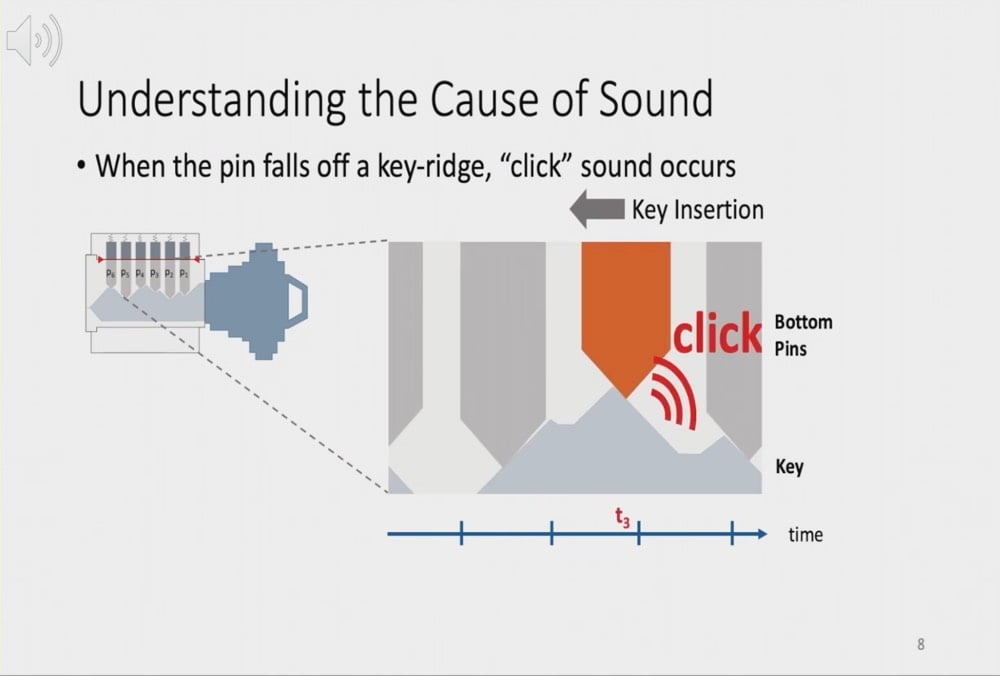
Once they have a key-insertion audio file, SpiKey’s inference software gets to work filtering the signal to reveal the strong, metallic clicks as key ridges hit the lock’s pins [and you can hear those filtered clicks online here]. These clicks are vital to the inference analysis: the time between them allows the SpiKey software to compute the key’s inter-ridge distances and what locksmiths call the “bitting depth” of those ridges: basically, how deeply they cut into the key shaft, or where they plateau out. If a key is inserted at a nonconstant speed, the analysis can be ruined, but the software can compensate for small speed variations.
The result of all this is that SpiKey software outputs the three most likely key designs that will fit the lock used in the audio file, reducing the potential search space from 330,000 keys to just three. “Given that the profile of the key is publicly available for commonly used [pin-tumbler lock] keys, we can 3D-print the keys for the inferred bitting codes, one of which will unlock the door,” says Ramesh.
Here’s Ramesh presenting her research at a conference back in March.
This reminded me of a couple of things. If you have a photo of a key, you can make a copy of it. And if you record high speed video of objects like plants or potato chip bags, you can use the observed vibrations to reconstruct the sound near those objects. All these secrets lying out in the open, just waiting for clever technologies to hoover them up. (via @nicolatwilley)
Newer posts
Older posts





Socials & More