kottke.org posts about language
Jumbo the Elephant was one of the most famous animals in the world. Bought as a calf in Sudan by a European animal dealer in 1860, Jumbo found fame first at the London Zoo and later as the centerpiece of the Barnum & Bailey Circus in the US. Jumbo was so beloved in London that news of his sale to P.T. Barnum prompted 100,000 children to write to Queen Victoria, urging her to nix the deal. In the video above, Andrew McClellan recounts Jumbo’s too-short (and probably unhappy) life and the impact he had on society.
The word “jumbo” hadn’t been known or used in the English language before he came along and has since become the byword for anything humongous or supersized. So every time we use the word “jumbo jet” or “jumbotron”, we’re actually referring back to Jumbo the elephant.
(thx, ben)
For The Atlantic, Katherine Wu writes about the difficulty of communicating how vaccines work and how they protect individuals and communities from disease: Vaccines Are Like Sunscreen… No, Wait, Airbags… No, Wait…
Unfortunately, communal benefit is harder to define, harder to quantify, and harder to describe than individual protection, because “it’s not the way Americans are used to thinking about things,” Neil Lewis, a behavioral scientist and communications expert at Cornell, told me. That’s in part because communal risk isn’t characteristic of the health perils people in wealthy countries are accustomed to facing: heart disease, stroke, diabetes, cancer. Maybe that’s part of why we gravitate toward individual-focused comparisons. Slipping into a pandemic-compatible, population-based frame of mind is a big shift. In the age of COVID-19, “there’s been a lot of focus on the individual,” Lewis told me. That’s pretty at odds “with how infection works.”
As someone who has struggled with analogizing the virus & vaccines, I was nodding my head a lot while reading this. Something I’ve noticed in recent years that Wu didn’t get into is that readers desire precision in metaphors and analogies, even though metaphor is — by definition! — not supposed to be taken literally. People seem much more interested in taking analogies apart, identifying what doesn’t work, and discarding them rather than — more generously and constructively IMO — using them as the author intended to better understand the subject matter. The perfect metaphor doesn’t exist because then it wouldn’t be a metaphor.

Fermi’s paradox is fairly well known: given what we know about the chance of intelligent life appearing somewhere in the universe, why haven’t any other species to date so far made contact with humanity? You can formalize the paradox via the Drake equation or some other method, but that’s the crux of it.
What’s less clear is how Enrico Fermi originally phrased the paradox. At Language Log, Mark Lieberman points out that each of the participants in the original conversation remembers it differently:
At lunch, Fermi suddenly exclaimed, “Where are they?” (Teller’s remembrance), or “Don’t you ever wonder where everybody is?” (York’s remembrance), or “But where is everybody?” (Konopinski’s remembrance).
As Liberman writes, “our memory of exact word sequences usually fades more quickly than our memory of (contextually interpreted) meanings. More broadly, the exact auditory sensations normally fade very quickly; the corresponding word sequences fade a bit more slowly; and the interpreted meanings last longest.”
My own favorite (for purely aesthetic reasons) is “where is everybody?” It just kind of says everything you want such an observation to say.
Using publicly available datasets of English words, their etymologies, and their semantic distances, software engineer Daniel de Haas generated pairs & triples of words that have a common origin but otherwise are unrelated to each other.
“actor” & “coagulate”
Both of these words derive ultimately from the Latin “ago”, meaning “act”, “do”, “make”, and a bunch of other things.
English “actor” is a short hop away from “ago”, but “coagulate” takes a longer path: “ago” ➔ “cogo” (“collect”) ➔ “coagulum” (“a clot”) ➔ “coagulo” (“to clot”).
“educate” & “subdue”
I never would have picked those two words out of a lineup as having a shared etymological root, but sure enough it sits right there — the “du” in the middle of each word, which ultimately derives from Latin “duco”, meaning “lead”.
“Educate” comes from the Latin “eductus”, meaning to “lead or bring out”, and then the Latin “educare” (“raise, train, mould”). I love the image of education as the process of extruding a refined person out of a base of unrefined material.
“Subdue” comes from the latin “subduco”, meaning “lead under”. Again, a very clear physical description of what the word means — to put beneath you, or bring under control.
Update: Oh here’s a good one: the words “fascism” and “fajita” are both derived from the same Latin root.
Singer and actor Leslie Odom Jr., who grew up in Philadelphia and who you may know from Hamilton and who is wearing an amazing purple sweater in this video, breaks down some Philly slang for us, including jawn, Mummers, MAC machine, old head, water ice, and outta pocket.
The Wikipedia page listing company name etymologies is a good place to spend some time.
7-Eleven - convenience stores; renamed from “Tote’m” in 1946 to reflect their newly extended hours, 7:00 am until 11:00 pm.
Samsung - meaning “three stars” in Korean
Coca-Cola - derived from the coca leaves and kola nuts used as flavoring. Coca-Cola creator John S. Pemberton changed the ‘K’ of kola to ‘C’ to make the name look better.
Pepsi - named from the digestive enzyme pepsin
Jordache - from the first names of the Nakash brothers who founded the company: Joe, Ralph, David (Ralph’s first son), Avi, plus che, after the second syllable of “Nakash”
GEICO - from Government Employees Insurance Company
Häagen-Dazs - name was invented in 1961 by ice-cream makers Reuben and Rose Mattus of the Bronx “to convey an aura of the old-world traditions and craftsmanship”. The name has no meaning.
Hotmail - founder Jack Smith got the idea of accessing e-mail via the web from a computer anywhere in the world. When Sabeer Bhatia came up with the business plan for the mail service he tried all kinds of names ending in ‘mail’ and finally settled for Hotmail as it included the letters “HTML” - the markup language used to write web pages. It was initially referred to as HoTMaiL with selective upper casing.
Mozilla Foundation - from the name of the web browser that preceded Netscape Navigator. When Marc Andreesen, co-founder of Netscape, created a browser to replace the Mosaic browser, it was internally named Mozilla (Mosaic-Killer, Godzilla) by Jamie Zawinski.
(via sam potts)
Back in December 2020, Nepal and China announced that the height of Mount Everest had been remeasured and updated from a height of 8,848 meters (29,028.87 feet) to 8,848.86 meters (29,031.7 feet). Did the mountain get taller? Or the measuring more precise? And how do you measure the height of a mountain — or “sea level” for that matter — anyway?
In December of 2020, China and Nepal made a joint announcement about a new measurement for Mount Everest: 8,849 meters. This is just the latest of several different surveys of Everest since the first measurement was taken in 1855. The reasons why the height has fluctuated have to do with surveying methodology, challenges in determining sea level, and the people who have historically been able to measure Everest.
Also worth noting the (romanised) Nepalese and Tibetan names for the mountain: Sagarmāthā and Chomolungma. The section on its name at Wikipedia is pretty interesting — apparently George Everest, for whom the mountain was named, pronounced his name differently than we all do today.
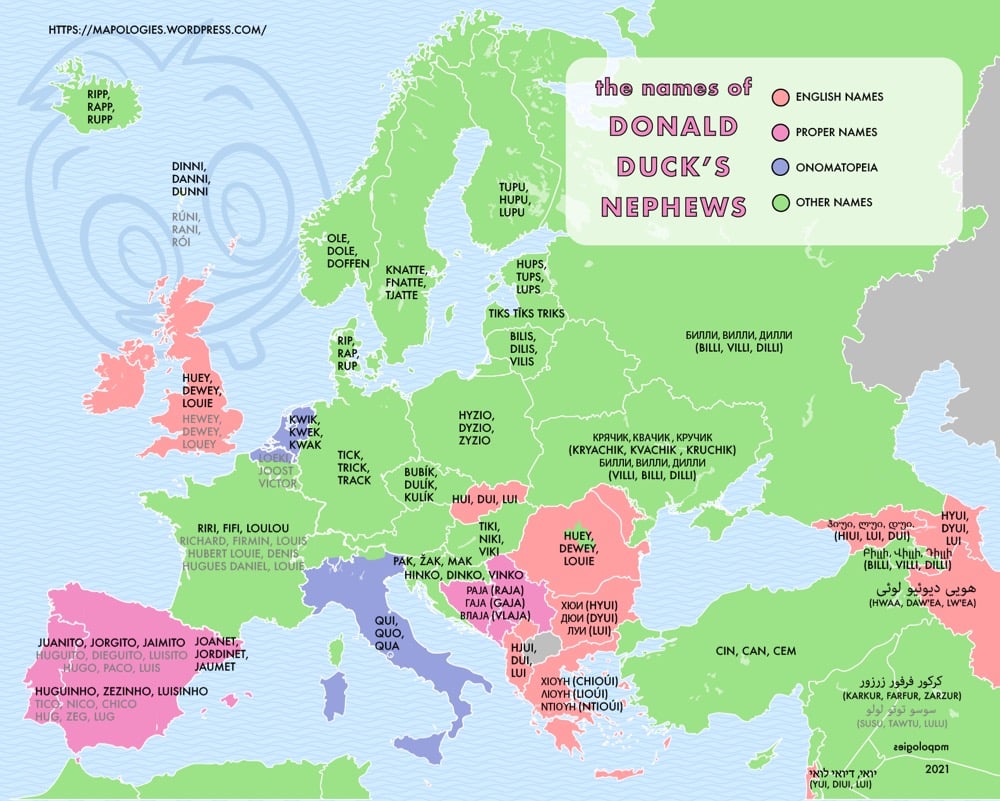
In the US and other English-speaking countries, the names of Donald Duck’s three nephews are Huey, Dewey, and Louie. As this map shows, they have different names in other countries — like Tick/Trick/Track in Germany, Billi/Villi/Dilli in Russia, and Ripp/Rapp/Rupp in Iceland.
You should check out the rest of the maps on the Mapologies blog as well, including maps of what the Milky Way is called in different countries and what people say when toasting.
This is a map showing the real-time location of Scotland’s fleet of snow plows (which they call “road gritters”). As Jackie Sojico discovered, Scotland names their plows and some of them are hilarious.
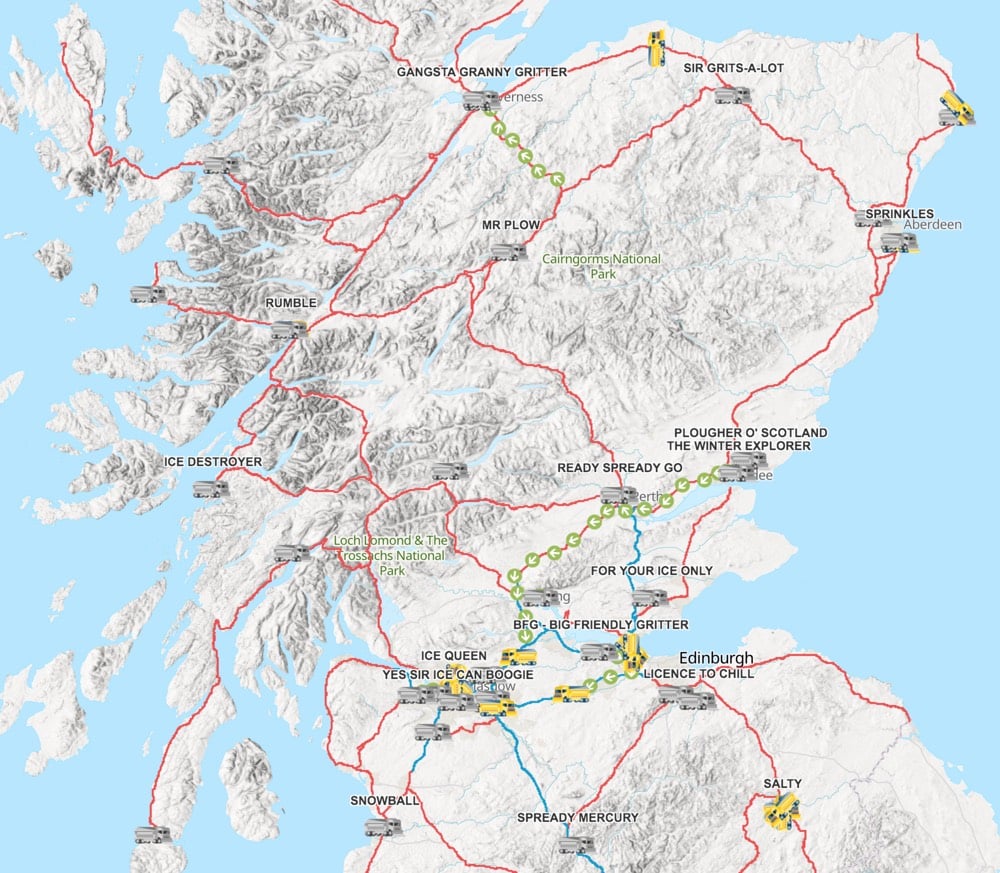
Some of the plows are named things like Sprinkles or Salty but there are also Gangsta Granny Gritter, Mr Plow, Spready Mercury, License to Chill, Ready Spready Go, and Gritney Spears. A possibly out-of-date list of plow names shared on Twitter includes Darth Spreader, Gritty Gritty Bang Bang, and Snowbegone Kenobi.
Plows elsewhere in the UK are also given interesting names: Basil Salty, David Plowie, Freezy Rider, and Roger Spreaderer. (thx, meg)
For most of us, ancient Egyptian is a highly visual language represented by the familiar hieroglyphs left behind on monuments, papyrus documents, and even sarcophagi. But of course it was a spoken language as well…and linguists even have a good idea of what it sounded like. As NativLang’s Josh Rudder explains in this video, by studying the language family that ancient Egyptian descended from, the languages that evolved from it (like Coptic), and languages it traded words with, researchers have been able to determine how many ancient Egyptian words were pronounced.
For more, you can check out Rudder’s extensive list of sources, notes, and quotes related to the video. (via open culture)
This is a lovely little animated video made from a recording of Stan Lee where he declares that the f-word is “probable the most useful word in the English language”. I found this via Josh Jones’ post at Open Culture, who shares some more Stan Lee tidbits.
After a video Nakia Smith did with her grandfather went viral, Netflix asked her to explain what Black American Sign Language is, how it came about, and how it differs from American Sign Language.
Black American Sign Language is a dialect of American Sign Language. It’s still a language. It was developed by Black deaf people in the 1800s and 1900s during segregation. For reference, the first American school for the deaf was created in 1817, but only started admitting Black students in 1952. So as a result, Black communities had a different means of language socialization and BASL was born.
Smith demonstrates a few BASL signs that differ from ASL signs and you can see more of those differences in the video w/ her grandfather, who is also deaf.
For more information, you can check out Smith’s TikTok, Wikipedia, and a documentary film called Signing Black in America.
Update: There was also a book about BASL published this year: The Hidden Treasure of Black ASL (Bookshop.org). The book includes 10 companion videos on YouTube.
How many holes does a donut have? That’s pretty easy: one. What about a straw? Two (one at each end) or just one? (Isn’t a straw just an elongated donut?) Does a coffee mug have one hole or two? Does a bowl have a hole? If no, then what about a hole in the ground or a hole in a wall that doesn’t pass all the way through? Does a basketball have a hole? A Reddit user asked 1600 people how many holes were in various objects and the results are fantastically all over the place.
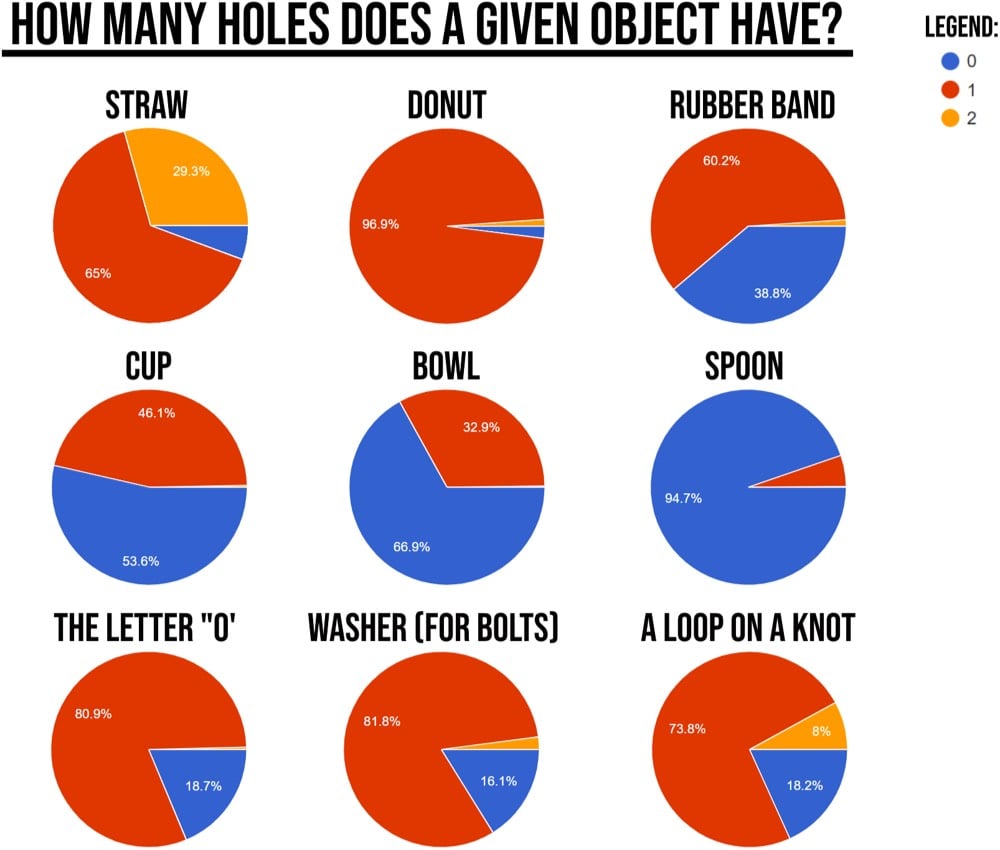
This is a trivial question, but it reveals something interesting about people’s perceptions. The dictionary definition of “hole” includes two main meanings for the purposes of this question: “an opening through something” and “a hollowed-out place”. Mathematics offers another possible meaning:
A hole in a mathematical object is a topological structure which prevents the object from being continuously shrunk to a point. When dealing with topological spaces, a disconnectivity is interpreted as a hole in the space. Examples of holes are things like the “donut hole” in the center of the torus, a domain removed from a plane, and the portion missing from Euclidean space after cutting a knot out from it.
But a hole isn’t clearly defined in math or topology. From What We Talk about When We Talk about Holes in Scientific American:
Here’s my short answer that is also the reason I’m not an algebraic topologist. If you can put it on a necklace, it has a one-dimensional hole. If you can fill it with toothpaste, it has a two-dimensional hole. For holes of higher dimensions, you’re on your own.
That answer isn’t very satisfying. Is there a better way to describe holes? I talked with some of my topologist friends and discovered two things: topologists don’t all agree on what a hole is, and it’s fun and interesting to think about different interpretations of a word whose mathematical definition isn’t completely settled. I think my larger conclusion, in the spirit of the season, is that holes are like Santa Claus: the true meaning is in your heart.
No wonder those poll results are all over the place. But at the same time, it’s interesting that many more people say that donuts have a hole than washers or rubber bands. I guess donut holes have better marketing? As for straws — reason tells me they only have one hole but I know in my heart they have two. (via the whippet)
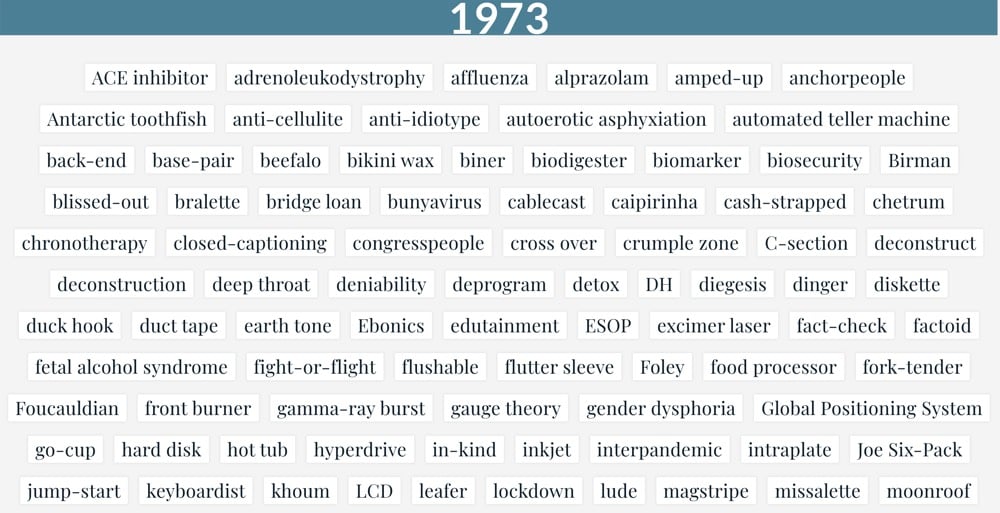
The English language, for better or worse, is constantly shifting and changing, with dozens of new and useful words being added to our collective vocabulary each year. With Merriam-Webster’s Time Traveler tool, you can browse what new words were first used in years dating all the way back to 1500 (and even earlier). The obvious thing is to look up your birth year, so I did that and then poked around for some other interesting years.
1973 (my birth year): automated teller machine, bikini wax, closed-captioning, gender dysphoria, hot tub, Joe Six-Pack, LCD, reverse engineer, soccer mom, televangelist.
2007 (the year my son was born): Bechdel Test, hashtag, retweet, crowdfunding, DM.
1969: ageism, crystal meth, gangbanger, in vitro fertilization, life coach, point guard, sexual harassment, sport utility vehicle.
1945: A-bomb, cold war, d’oh, game theory, graffiti, name-dropping, passive-aggressive.
1929: antiviral, blue-collar, burp, eyeliner, Marxism-Leninism, penicillin, preteen, QWERTY, Sasquatch, spacecraft.
1865: anti-Muslim, baseball cap, gasoline, pessimistic, potato chip, showerhead.
1776: anthrax, division of labor, killjoy, natural resource, slaveholder, sour cream.
1619: bungled, diagram, libelous, retributive, sarcasm.
1561: aristocracy, curator, index, orgy, random, tarantula, well-being.
1500: cadaver, illness, minion, polite.
This is extremely inexpensive time travel. Almost every year is a gold mine (1605!) of terms that are seemingly out of time, either too early or too late. Careful, you might lose several hours to this. (thx, megan)
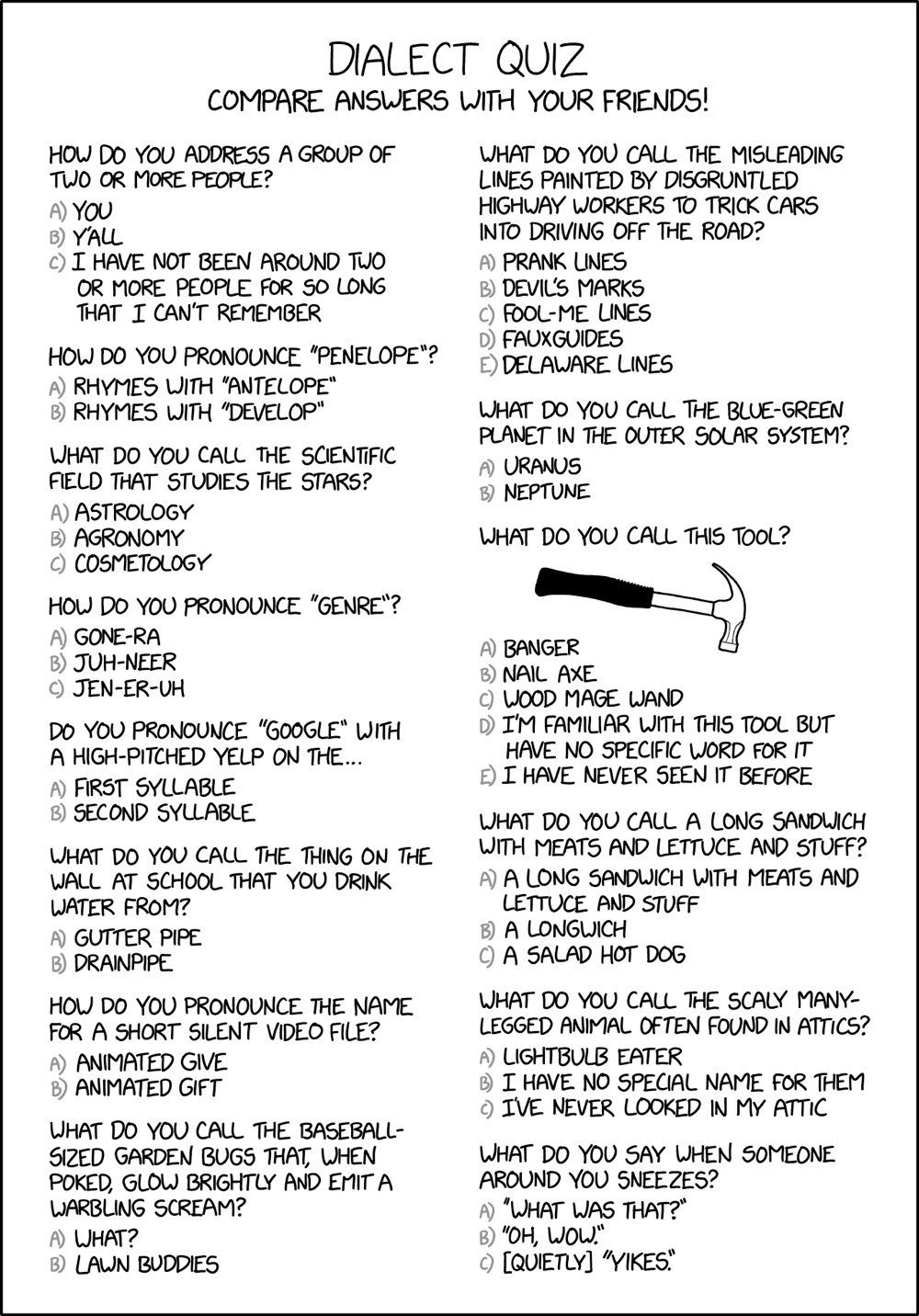
Remember when dialect quizzes and maps were a thing? XKCD is joining the fun with their own quiz. Reader, I giggled when I got to “lawn buddies” and full-on laughed at “longwich”. Longwich is totally going in my vocabulary arsenal.
Newer posts
Older posts





Socials & More