kottke.org posts about food
Bluefin tuna are being caught faster than they can reproduce, which is terrible news for bluefin tuna and people who like to eat them (but seriously for the tuna). These fish are awesome, and I didn’t know farming tuna was possible, but it is, with a few caveats. Bluefin in captivity don’t procreate unless they’re shot with a hormone-tipped spear gun (really). Also, the fish the bluefin are fed still have to come from somewhere, so calling farm raised fish sustainable is something of a misnomer. More sustainable though. I loved this video from Perennial Plate looking at a Japanese tuna farmer. The farmer seems so happy (but does not consider himself a conservationist).
You also ought to spend some time looking at the Perennial Plate back catalog of videos. Lots of gems in there. (via The Atlantic)
Richard Paterson, Whyte & Mackay’s master whisky blender, shows us the proper way to enjoy Scotch. It gets a little messy.
Here’s another video from the same guy in which he demonstrates what to do when a bartender hands you a Scotch on the rocks. (via the new yorker)
Friendly reminder: ten episodes of Anthony Bourdain and David Chang’s Mind of a Chef are available to view for free on the PBS website. I am through two episodes so far and it’s my favorite cooking/food show since The Naked Chef.1 Here’s the first episode, all about ramen:
[I removed the embed because it was autoplaying for some unlucky people. You can watch the first episode here.]
The first four episodes will be taken down after Friday so act now.
[1] No joke, those first couple seasons of Oliver’s show were really good. It’s not the original Iron Chef or anything, but still. ↩
While I’m not sure I’d call it food, what this kit produces is apparently edible. According to the YouTube notes:
No artificial colours. No preservatives. 96 calories.
…Yum
(thx @chrisoverzero)
How had I not heard about this before now? The Mind of a Chef is a PBS consisting of sixteen half-hour shows that follows David Chang through his world of food. As far as I can tell, this series is basically the TV version of Lucky Peach. Episode one is about ramen:
In the series premiere, David dissects the roots of his passion for ramen dishes and tsukemen on a trip to Japan. Learn the history of this famous noodle as David visits a ramen factory, has a bowl of the original tsukemen, and examines how alkalinity makes noodles chewier and less prone to dissolving in broth.
Check out an excerpt here, in which Chang reveals how he used to eat instant ramen noodles right out of the bag with the pork flavor powder sprinkled on top. The series starts this weekend…check your local listings, as they say. (via ny times)
Emeril Lagasse made an appearance on Treme on Sunday. I watched a clip of his scene a few days ago and have been thinking about it on and off ever since. In the scene written by Anthony Bourdain, Emeril takes a fellow chef to the building that used to house Uglesich’s, a small-but-beloved New Orleans restaurant that closed back in 2005. The chef is having misgivings about expanding her business, particularly about all the non-cooking things you have to do, and Emeril explains that the way the owners of Uglesich’s did it was one way forward:
You see, they kept it small, just one spot, just a few tables. There’d be a line around the corner by 10 am. You see, they made a choice. Anthony and Gail made a choice to stay on Baronne Street and keep their hands on what they were serving. They cooked, everyday they cooked, until they could cook no more.
But there’s also another way to approach your business:
The other choice is that you can build something big but keep it the way that you wanna keep it. Take those ideas and try to execute them to the highest level. You got a lotta people around you, right? You’re the captain of the ship. Or what I should say is that you’re the ship. And all these people that look up to you and wanna be around you, they’re living in the ship. And they’re saying, “Oh, the ship is doing good. Oh, the ship is going to some interesting places. Oh, this ship isn’t going down just like all the other fucking ships I’ve been on.” […] You’ve got a chance to do your restaurant and to take care of these people. Just do it.
kottke.org has always been a one-person thing. Sure, Aaron posts here regularly now and I have guest editors on occasion, but for the most part, I keep my ass in the chair and my hands on what I am serving. I’ve always resisted attempts at expanding the site because, I have reasoned, that would mean that the site wouldn’t be exactly what I wanted it to be. And people come here for exactly what I want it to be. Doing the site with other people involved has always seemed unnatural. It would be selling out…that’s how I’ve thought about it, as opposed to blowing up.
But Emeril’s “until they could cook no more” and “you’re the ship”…that got to me. I am a ship. I don’t have employees but I have a family that relies on the income from my business and someday, when I am unable to do this work or people stop reading blogs or all online advertising moves to Facebook or Twitter, what happens then? Don’t I owe it to myself and to them to build something that’s going to last beyond my interest and ability to sit in a chair finding interesting things for people to look at? Or is it enough to just work by yourself and produce the best work you can?
Or can you do both? John Gruber’s Daring Fireball remains a one-man operation…as far as I know, he’s never even had an intern. I don’t have any inside knowledge of DF’s finances, but from the RSS sponsorship rate and the rate for sponsoring Gruber’s podcast, my conservative estimate is that DF grosses around $650,000 per year. And with a single employee/owner and relatively low expenses, a large amount of that is profit. So maybe that route is possible?
I don’t have any answers to these questions, but man, it’s got me thinking. Emeril got me thinking…who saw that coming? Bam!
Joshua David Stein takes Guy Fieri deep in a biting review of the ridiculous fat-food huckster’s new restaurant in Times Square.
It would be disingenuous to claim that Times Square represents anything but a regurgitation of the American dream, monetized, metastasized, made blindingly bright by light-emitting diodes and shoved back down the gullets of those souls unlucky enough to have mistakenly stumbled into the red zone, or worse, like moths to the incinerating flame, have actively sought it out. To deride Mr. Fieri for opening his restaurant there as if he’d taken a dump in the Louvre is silly. He pooped on a pile of bright shiny poop, Jeff Koonsian poop, Guy Debordian poop. But public defecation is still a crime in New York City (Health Code Section 153.09), and his offenses rest not in their location but in their very nature.
Mr. Fieri not only serves truly horrible-tasting food, an awkward origami of clashing aleatory flavors, but he serves this punishing food emulsified with a bombastic recasting of deep-fried American myth. Mr. Fieri’s most egregious transgression isn’t what he puts into his fellow citizens’ stomachs, it’s how the cynical slop interfaces with what he puts into their minds.
Sukiyabashi Jiro is a 3-star Michelin restaurant in Tokyo that many say serves the best sushi in the world. The chef/owner, 86-year-old Jiro Ono, was the subject of last year’s excellent Jiro Dreams of Sushi documentary film.
Adam Goldberg of A Life Worth Eating ate at Sukiyabashi Jiro yesterday. The meal was 21 courses, about US$380 per person (according the web site, excluding drinks), and lasted only 19 minutes. That’s more than a course a minute and, Goldberg estimates, around $20 per person per minute. And apparently totally worth it.
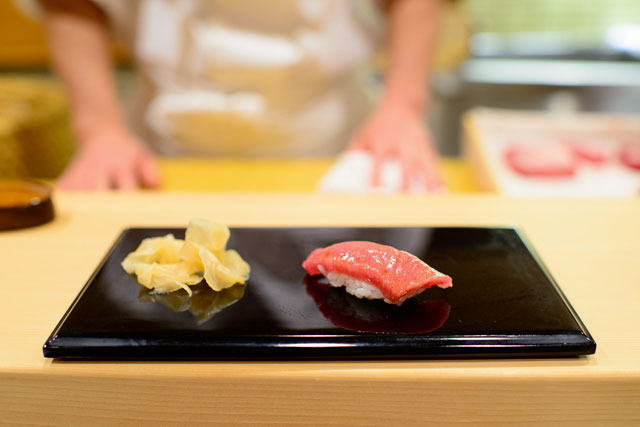
Goldberg has photos of each course up on Flickr and his site has a write-up of his 2009 meal.
Three slices of tuna came next, akami, chu-toro, and oo-toro increasing from lean, to medium fatty, to extremely fatty cuts. The akami (lean toro) was the most tender slice of tuna I’ve ever tasted that did not contain noticeable marbelization. The tuna was marinated in soy sauce for several minutes before service, perhaps contributing to this unique texture. The medium fatty tuna had an interesting mix of crunch and fat, while the fatty tuna just completely melted in my mouth. My friend with whom I shared this meal began to tear (I kid you not).
Lest you think Goldberg’s meal was an anomaly, this is a typical meal at Sukiyabashi Jiro. Dave Arnold wrote about his experience earlier this year:
The sushi courses came out at a rate of one per minute. 19 courses in 19 minutes. No ordering, no real talking — just making sushi and eating sushi. After the sushi is done you are motioned to leave the sushi bar and sit at a booth where you are served your melon. We took that melon at a leisurely 10 minute pace, leaving us with a bill of over $300 per person for just under 30 minutes time. Nastassia and Mark thought the pace was absurd and unpleasant. They felt obliged to keep up with Jiro’s pace. I didn’t feel obliged, but kept up anyway. I didn’t mind the speed. I could have easily eaten even faster, but I’m an inhuman eating machine — or so I’m told. At the end of the meal, Jiro went outside the restaurant and stood guard at the entrance, waiting to bid us formal adieu. This made Nastassia even more nervous about rushing to get out. Not me. At over 10 dollars a minute I have no problem letting an 86 year old man stand and wait for me to finish my melon if he wants to.
(via ★kathryn)
My son thinks corks grow on trees…not sure whether to pop his bubble on this or not.
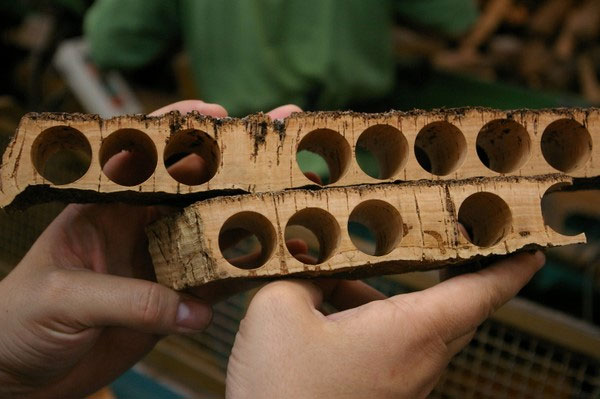
It all starts in the forest. Cork oaks are harvested every nine years, once they reach maturity. It doesn’t harm the tree, and the cork bark regrows. Most cork forests are in Portugal and Spain.
Actor & Scotsman Brian Cox pronounces the names of different kinds of Scotch, including Bruichladdich, Laphroaig, An Cnoc, Auchentoshan, and Lagavulin.
Of course, this is how you really pronounce Laphroaig, courtesy of Pronunciation Manual.
(via @benhammersley)
A 70 year-old Oregon farmer was eaten by his hogs after somehow being overcome by them during feeding time. An initial search of the pig pen resulted in only the farmer’s dentures being found, and coroners were still trying to determine the cause of death, though it seems obvious. (via ★pieratt)
Hilarious New Yorker piece by Bill Barol imagining Vice President Joe Biden as a waiter in a restaurant.
Our fish special is halibut with a mango-avocado salsa and Yukon Gold potatoes, and it’s market-priced at sixteen-ninety-five. Sounds like a lot of money, right? Sounds like “Hey, Joe, that’s a piece of fish and a little topping there, and some potatoes.” “Bidaydas,” my great-grandmother from County Louth would have called ‘em. You know what I’m talking about. Just simple, basic, sitting-around-the-kitchen-table-on-a-Tuesday-night food. Nothin’ fancy, right? But, folks, that’s not the whole story. If you believe that, you’re not… getting… the whole… story. Because lemme tell you about these Yukon Gold potatoes. These Yukon Gold potatoes are brushed with extra-virgin olive oil and hand-sprinkled with pink Himalayan sea salt, and then José, our prep guy… . Well. Lemme tell you about José. (He pauses, looks down, clears his throat.)
I get… I get emotional talking about José. This is a guy who — José gets here at ten in the morning. Every morning, rain or shine. Takes the bus here. Has to transfer twice. Literally gets off one bus and onto another. Twice. Never complains. Rain, snow, it’s hailin’ out there…. The guy literally does not complain. Never. Never heard it. José walks in, hangs his coat on a hook, big smile on his face, says hello to everybody — Sal the dishwasher, Angie the sous-chef, Frank, Donna, Pat…. And then do you know what he does? Do you know what José does? I’ll tell you what he does, and folks, folks, this is the point I want to make. With his own hands, he sprinkles fresh house-grown rosemary on those potatoes (raises voice to a thundering crescendo), and they are golden brown on the outside and soft on the inside and they are delicious! They are delicious! They are delicious!
(via @tadfriend)
Julia Moskin reports that the production of real buttermilk is on the rise in the US.
“My buttermilk has pieces of butter floating in it, which it’s probably not supposed to,” said Ms. St. Clair, who has a herd of eight Jersey cows at her farm (called Animal Farm and located in the town of Orwell, Vt.), and makes butter and buttermilk for the chef Thomas Keller’s restaurants. “But it certainly tastes good that way.”
She, Mr. Patry and a few other dedicated dairy producers here and in the South have just begun to bring old-school buttermilk to greenmarkets and groceries, as small-scale bottling operations become more affordable.
Their efforts fit neatly into several culinary trends: working with traditional agricultural products, and embracing the once-rejected byproducts and odd bits of favored ingredients. Buttermilk even manages to represent both the American South and Scandinavia, two of the liveliest influences in food today.
Ambitious chefs all over are suddenly wallowing in buttermilk. In New York City alone, Roberto Mirarchi is saucing earthy sweet potatoes with tangy buttermilk at Blanca; Wylie Dufresne of WD-50 glazes sweetbreads with nasturtium-infused buttermilk; and the young gun Matthew Lightner strains the stuff till thick and uses it to fill crisp-fried sunchoke skins at Atera.
The resurgence of real buttermilk is great news; you can’t make the world’s best pancakes without it.
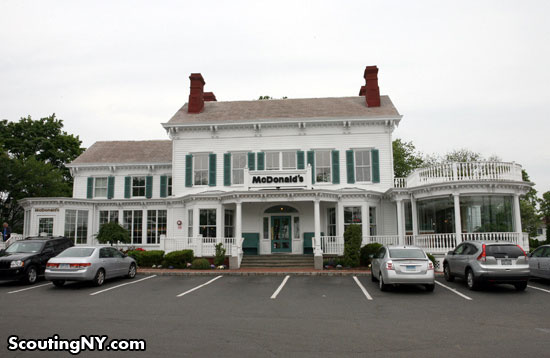
When Ronald McDonald bought a run-down house that dated back to 1795 with the intention of tearing it down to put up a hamburger restaurant, the citizens of New Hyde Park successfully got the house landmarked. Instead of cutting their losses, McDonald’s renovated the house into the nation’s classiest fast food joint.
Serious Eats put together an extensive guide to the regional sandwich cuisine of the US that covers everything from the universally available sloppy joe and grilled cheese to the spiedie, the hot brown, and the dutch crunch.
An international edition is also available (gyro! banh mi! bocadillo! chip butty!).
Many of the food robots I’ve featured on the site look like machines. Not so this Chinese noodle -making robot:
Silvery, pulsing eyes…it looks like something out of a Tom Baker-era Doctor Who serial. Fantastic. (via @leesnelgrove)
The Cheesecake Factory has a hundred and sixty restaurants that each feature more than three hundred menu items that are served up to cool eighty million customers a year. Whether you’re a fan of the Cheesecake Factory or not, there’s no denying that — like many major chains that enjoy the benefits of scale — their product is consistent, the prices remain under control, and their efficiency is impressive. The New Yorker’s always excellent Atul Gawande wonders: What can hospitals learn about quality from the Cheesecake Factory?
Nicola Twilley of Edible Geography interviews Laura Shapiro and Rebecca Federman, curators of the NYPL’s Lunch Hour NYC exhibition, about how lunch became a meal and what the city had to do with it.
Sliced wrapped bread first appeared in 1930, and that became the sandwich standard right away. They had the slicing technology before then, but they didn’t have the wrapping technology and the two had to go together.
Before sliced bread, the lunch literature is full of advice on social distinctions and the thickness of bread in sandwiches. You slice it very thick and you leave the crusts on if you’re giving them to workers, but for ladies, it should be extremely, extremely thin. Women’s magazines actually published directions on how to get your bread slices thin enough for a ladies lunch. You butter the cut side of the loaf first, and then slice as close to the butter as you possibly can.
We often describe inventions as being the best thing since sliced bread, but most of us don’t know much about that particular slice of history. Otto Rohwedder created the first commercial bread-slicer and the Chillicothe Baking Company put it to use in 1928. A local reporter explained that, “one realizes instantly that here is a refinement that will receive a hearty and permanent welcome.” Here’s a brief history of sliced bread.
If you put enough rubber bands around a watermelon, it will explode.
(via serious eats)
This is a five-minute video of Andy Warhol eating a Burger King hamburger accompanied by Heinz ketchup.
The scene is part of a film done by Jorgen Leth called 66 scenes from america.
Leth had his assistant buy some burgers and directly advised him to buy some in halfway neutral packaging as Leth was afraid that Warhol might reject some brands (Warhol always had an obsession with some of his favorite brands).
So Andy Warhol finally did arrive at the studio, of course along with his bodyguards, and when he saw the selection of burgers the assistant had brought he asked “Where is the McDonald’s?” and Leth — slightly in panic — was immediately like “I thought you would maybe not like to identify…” and Warhol answered “no that is the most beautiful”. Leth offered to let his assistant quickly run to McDonald’s but Warhol refused like “No, never mind, I will take the Burger King.”
(via bon appetit)
The baguette is one of the foods most commonly associated with France, so it’s surprising that for a long time, the French baguette was uncommonly bad. Samuel Fromartz travelled to Paris to apprentice with a baker and discovered how the baguette got its groove back.
“For years I had watched the sensorial quality of French bread palpably deteriorate,” he told me. The decline first set in, he said, when bakers switched from levain to commercial yeast in order to shorten the bread-making process. Yeast could work as an acceptable substitute for levain, but instead of relying on minute amounts of yeast and letting the dough ferment over 24 hours- as Delmontel does with his baguettes-bakers added more yeast and cut the rise period to as little as one hour, “suppressing the first fermentation that is the source of all taste,” Kaplan said.
The situation worsened in the 1950s, when bakers started using intensive kneading machines that satisfied consumer desire for an ever-whiter crumb. They started sprinkling in additives such as vitamin C to spike fermentation, and heaps of salt to mask the absence of flavor. In short, while pursuing the promises of modernity-efficiency, speed, and whiter bread-what French bakers lost was the one indispensable ingredient: time.
“For me, bread was a crucial dimension of what the French proudly call their ‘cultural exception,’” or national identity, said Kaplan. “They did not seem to be aware that they were putting it in grave peril.” By the 1980s, the French ate less and less bread. Boulangeries folded; those that remained competed with supermarkets, which baked frozen baguettes and sold them as loss leaders.
Corby Kummer investigates how breakfast cereals are made and how the big food companies are working to make them healthier. As he discovers, it’s a tricky business.
The area of experimentation that most caught my interest uses enzymes to break down whole grains and cereals into easier-to-digest powders that can be sneaked into foods like cake mixes and light breads in which whole grains would be unpalatably heavy, and into foods where you’d never expect to find them: soups, sauces, puddings and creamy fillings that already have starch in some form. “Why not whole-grains starch?” asked Monica Fischer, head of the food science and technology department. Breaking down the grains can also create sweetness, which raises the possibility of substituting whole grains for sugar in certain products. I saw packages of two Peruvian cereal drinks: Ecco and Nesquik, both marked “con cereales Andinos” (containing Andean cereals), including corn, quinoa and amaranth. Those and other grains from affiliates in South America and Abidjan, Ivory Coast, are being studied to understand how and whether they can be extruded into pasta and noodles and used in place of northern European wheat.
Because the research is basic, Nestle doesn’t know yet which of its hundreds of food businesses will apply its findings-the actual testing of products takes place in 300 “application groups” around the world. But Nestle already buys locally grown grains in the U.S. and Canada and will likely increase the percentage. Not long from now we might find Stouffer’s turkey tetrazzini with whole grains in both the noodles and the sauce; one of those cereal drinks on a local supermarket shelf; amaranth in a health drink; and more fiber and whole grains in Purina pet food, a big part of Nestle business. (Nestle won’t talk about its future marketing plans.) Or whole-grain Kit Kats, which Nestle has already marketed in England. Or Buitoni quinoa fusilli, which the rising number of gluten-intolerant people will certainly welcome. But will Ecuadoreans?
The research I saw at the world’s largest and sixth-largest food companies will, of course, come at a price. Processing, even to restore a food’s natural ingredients or not remove them in the first place, always adds to a food’s cost. Another potential threat of the new food research is that these products could co-opt traditional markets, like the ones for quinoa and amaranth, and begin to erase native foods, which can be made for a fraction of the cost and have been shown for millennia to be healthful and practical. And there are plenty of other costs I’m leaving out: the treatment of labor, the environmental costs of packaging and transport, the general destruction of small businesses as large corporations grab local markets with lower prices and often bad-for-you food, deceptive claims and advertising, the checkered political history of all these companies.
Some Californians are shoving foie gras down their throats so fast they look like stuffed geese. As of Sunday, that food is outlawed.
Despite the prospect of a $1,000-per-day fine, a few of Lefebvre’s chef peers are rumored to be stashing away foie gras to quietly serve to favored customers, he said, and some have considered charging a fee to prepare foie gras brought in by patrons. Lefebvre won’t sell any of the product, but plans to “investigate” his options.
This. This is what happens to an egg 60 feet under water.
This is gonna revolutionize poaching eggs! (via ★adamkuban)
Adam Roberts, aka The Amateur Gourmet, has a new book coming out in the fall called Secrets of the Best Chefs. For the book, Roberts traveled the US cooking with some of the country’s best chefs, including Marco Canora, Alice Waters, Anita Lo, and José Andres.
The culmination of that journey is a cookbook filled with lessons, tips, and tricks from the most admired chefs in America, including how to properly dress a salad, bake a no-fail piecrust, make light and airy pasta, and stir-fry in a wok, plus how to improve your knife skills, eliminate wasteful food practices, and create recipes of your very own. Most important, Roberts has adapted 150 of the chefs’ signature recipes into totally doable dishes for the home cook. Now anyone can learn to cook like a pro!
Adam, maybe it’s time to upgrade yourself to the Semi-Pro Gourmet?
This is a long zoom look at how pizza gets delivered to hungry people. It starts by looking at the routes taken by a Dominos delivery person during a typical night and slowly zooms out to reveal the pizza giant’s national supply chain.
Embark with Kwon on a trip that begins with a pizza delivery route in New York City, then goes across the country to California’s Central Valley, where nearly 50 percent of America’s fruits, nuts and vegetables are grown, and into the heartland for an aerial look at our farmlands.
Why does McDonald’s food look so much better in the ads than at the restaurant? Watch as the director of marketing for McDonald’s Canada buys a Quarter Pounder at McDonald’s and compares that to a burger prepared by a food stylist and retouched in post by an image editor.
Short answer: the burger at the restaurant is optimized for eating and the photo burger is optimized for looking delicious. (via ★interesting)
On the label of most Hebrew National meat products, the company (which is actually now a division of ConAgra) proclaims that, “We answer to a higher authority.” In the short run, that higher authority will be a civil court where ConAgra will defend itself against claims that its hot dogs are not actually kosher at all. Next we’ll find out that Ballpark Franks don’t really plump when you cook ‘em.
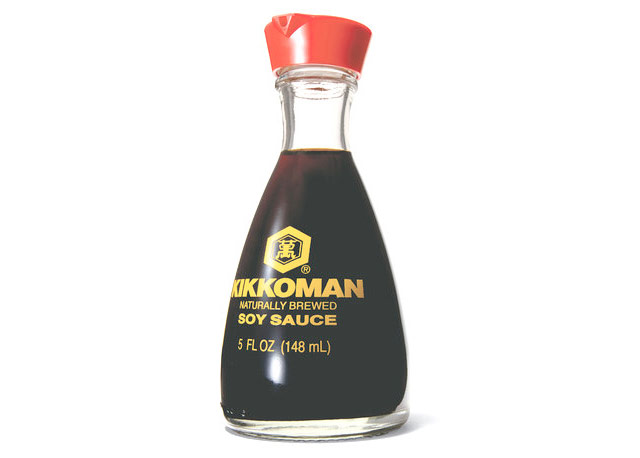
The iconic bottle was designed by Kenji Ekuan and his team at GK Design.
It took three years for Ekuan and his team to arrive at the dispenser’s transparent teardrop shape. More than 100 prototypes were tested in the making of its innovative, dripless spout (based on a teapot’s, but inverted). The design proved to be an ideal ambassador. With its imperial red cap and industrial materials (glass and plastic), it helped timeless Japanese design values — elegance, simplicity and supreme functionality — infiltrate kitchens around the world.
Newer posts
Older posts




Socials & More