kottke.org posts about food
Here’s a weird story, and let’s not bury the lede: Cooked squid retain the ability to implant spermatophores in your mouth. We all know how eating raw squid runs this risk, but a recently published report (“Penetration of the oral mucosa by parasite-like sperm bags of squid: a case report in a Korean woman.”) details the first known case of spermatophores from cooked squid implanting. Read this post on Squid a Day for a much more nuanced explanation of what exactly a spermatophore is.
In order not to leave calamari connoisseurs unduly freaked out, I should clarify two points. First, most Western squid preparations remove the internal organs and serve only the muscle, so there’s no danger of accidentally ingesting spermatophores. Second, it’s perfectly fine to handle spermatophores—just don’t put them in your mouth. The skin on your hands, and most of the rest of your body, is much too thick to get stuck. I’ve probably had hundreds of spermatophores ejaculate on my fingers and never felt a sting.
This is Friday Squid Blogging material for sure.
Squids and octopi are not the same creature, and cephalopodian purists will disdain, but for the purpose of this post let’s agree that, especially to the layblogger, they share certain similar characteristics. Please allow an octopus link to follow a squid link. Here’s a little explainer about how octopus camouflage works. Be sure to watch the video. (via @neilhimself)
In the vast cheese warehouses of Europe, robots are employed to flip the cheeses as they age. Here’s a Gruyere flipper:
The food truck trend has invaded Paris, where young people use the phrase “très Brooklyn” to denote food that combines “informality, creativity and quality”.
On a bright morning last month at the Marché St.-Honoré, a weekly market in an elegant residential section of Paris, several sleekly dressed women struggled to lift the thick burgers to their mouths gracefully. (In French restaurants, and sometimes even fast-food joints, burgers are eaten with utensils, not hands.) A few brave souls were trying to eat tacos with a knife and fork. “C’est pas trop épicé,” said one, encouraging a tentative friend — “It’s not too spicy,” high praise from the chile-fearing French.
Street food itself isn’t new to France. At outdoor markets like this one, there is often a truck selling snacks like pizza, crepes or spicy Moroccan merguez sausages, cooked on griddles and stuffed into baguettes.
But the idea of street food made by chefs, using restaurant-grade ingredients, technique and technology, is very new indeed.
Not content to ban cigarettes, educate the public on calorie counts, and grade the city’s restaurants, the Bloomberg administration wants to ban the sale of large sugary drinks.
The proposed ban would affect virtually the entire menu of popular sugary drinks found in delis, fast-food franchises and even sports arenas, from energy drinks to pre-sweetened iced teas. The sale of any cup or bottle of sweetened drink larger than 16 fluid ounces — about the size of a medium coffee, and smaller than a common soda bottle — would be prohibited under the first-in-the-nation plan, which could take effect as soon as next March.
The measure would not apply to diet sodas, fruit juices, dairy-based drinks like milkshakes, or alcoholic beverages; it would not extend to beverages sold in grocery or convenience stores.
Over my dead fat diabetic body!
According to a recent study, the cause of Pine Mouth (where eating pine nuts can make food taste horrible for days afterwards) is still unknown. The full text of the study is behind a paywall but The Awl has a short summary of the findings.
Now, a new publication by the Journal of Agricultural & Food Chemistry finds esteemed scientists literally throwing up their hands. They learned a lot about pine nuts and their composition! But nothing useful.
cc: Megnut.
Earlier in the year I shared a lovely short film about Prime Burger, a midtown Manhattan institution.
For many of the guys that work here, the restaurant is like a second home — some of them have been slinging burgers, making shakes, and waiting on customers at this location for decades. Opened in 1938, the place hasn’t been altered since the early ’60s, and it looks all the better for it.
Sadly, as of Saturday, Prime Burger is no more, booted out by the new ownership of their building.
Prime Burger, the 74-year-old coffee shop and restaurant, run for 36 years by the DiMiceli family, is closing. And though Michael DiMiceli spoke hopefully on Friday of finding a new space in which to reinstall Prime Burger’s futuristic “Jetsons”-era d’ecor, the family has scarcely had time yet to look or to strike a deal. The small building in which Prime Burger is a tenant was sold recently, and the new owners sent the restaurant packing.
Sipping Stones are small stones that you put into your drink instead of ice. Gives new meaning to “on the rocks”!!! LOL LMAO ROFLCOPTER, etc.
When enjoying a premium spirit, why tarnish the taste with water? Providing a slight chill protects the taste without drowning the quality.
Sipping Stones are made of all natural soapstone, which is non-porous and won’t impart any taste or flavor. Generally Regarded As Safe (GRAS) by the FDA soapstone is comprised of talc, which will not react to water, alcohol, or other drinks. When used with care, Sipping Stones will not scratch your glassware.
You can get nine of them for $15 from Amazon. Has anyone used these? Are they any good?
Craig Claiborne was the NY Times’ first dedicated restaurant critic, providing an example that was soon followed by newspapers everywhere in the US.
Some American writers had nibbled at the idea of professional restaurant criticism before this, including Claiborne, who had written one-off reviews of major new restaurants for The Times. But his first “Directory to Dining,” 50 years ago this month, marks the day when the country pulled up a chair and began to chow down. Within a few years, nearly every major newspaper had to have a Craig Claiborne of its own. Reading the critics, eating what they had recommended, and then bragging or complaining about it would become a national pastime.
As the current caretaker of the house that Claiborne built, I lack objectivity on this subject. Still, I believe that without professional critics like him and others to point out what was new and delicious, chefs would not be smiling at us from magazine covers, subway ads and billboards. They would not be invited to the White House, except perhaps for job interviews. Claiborne and his successors told Americans that restaurants mattered. That was an eccentric opinion a half-century ago. It’s not anymore.
A few years ago, I wrote about the first restaurant review to appear in the Times in 1859…it’s still one of my favorite posts.
In this Smithsonian interview, University of Minnesota history professor Jeffrey Pilcher drops serious knowledge on the history of tacos. Among other bits of taco trivia, Pilcher, author of the forthcoming book Planet Taco: A Global History of Mexican Food, roughly disabuses us of the lie spread by Glen Bell (of Taco Bell) that Bell invented the hard shell.
What made the fast-food taco possible?
The fast-food taco is a product of something called the “taco shell,” a tortilla that has been pre-fried into that characteristic U-shape. If you read Glen Bell’s authorized biography, he says he invented the taco shell in the 1950s, and that it was his technological breakthrough. Mexicans were cooking tacos to order — fresh — and Glen Bell, by making then ahead, was able to serve them faster. But when I went into the U.S. patent office records, I found the original patents for making taco shells were awarded in the 1940s to Mexican restaurateurs, not to Glen Bell.
Pilcher’s other books include editing The Oxford Handbook of Food History, and writing The Sausage Rebellion: Public Health, Private Enterprise, and Meat in Mexico City, 1890-1917 and Que vivan los tamales! Food and the Making of Mexican Identity. The Sausage Rebellion indeed.
Turns out that “real” buttermilk, aka the byproduct of making butter, hasn’t been common for almost a century…today it’s been almost entirely replaced by cultured buttermilk.
So how did that buttermilk, the original buttermilk, turn into the thick, sour, yogurty beverage I sampled at Threadgill’s? The confusion surrounding this drink dates back to the 18th century or before. Until the age of refrigeration, milk soured quickly in the kitchen, and most butter ended up being made from the slightly spoiled stuff. As a result, some historical sources use the word buttermilk in the Laura Ingalls Wilder sense, to describe the byproduct of butter-making; others use it to describe butter-making’s standard ingredient at the time-milk that had gone sour from sitting around too long. To make matters more confusing, the butter-byproduct kind of buttermilk could be either “sour,” if you started out with the off milk that was itself sometimes called buttermilk, or “sweet,” if you started out with fresh cream (like Laura’s mom did). So, prior to the 20th century, buttermilk could refer to at least three different categories of beverage: regular old milk that had gone sour; the sour byproduct of churning sour milk or cream into butter; and the “sweet” byproduct of churning fresh milk or cream into butter.
We occasionally get the real stuff for making the world’s best pancakes and it definitely makes a difference.
At McSweeney’s, John Peck whips up some bandwiches.
Bjork: Sliced narwhal, mustard, whole wheat bread.
Grateful Dead: Lemon verbena sorbet, peanut butter, clarified hemp butter, deep-fried brownie bites, M&Ms, stale focaccia.
Sex Pistols: Deep-fried Frank Sinatra LP, Russian mustard, spackle, tacks, stale rye bread.
John Cage: Silence, warmth, indirect sunlight, the memory of lettuce, the idea of bread.
The Jimi Hendrix Experience: Bacon-double cheeseburger, mescaline pesto, sourdough bread.
From Food52, a round-up of ten different kinds of salt you might run across in recipes, including table salt, fleur de sel, and Himalayan salt.
Hand-mined from ancient sea salt deposits from the Khewra Salt Mine in Pakistan, Himalayan salt is rich in minerals and believed to be one of the purest salts available — hence its frequent use in spa treatments. It ranges in color from pure white to shades of pink and deep red. Hand cut into slabs, Himalayan salt is frequently used as a surface for serving food. Due to their ability to hold a specific temperature for an extended period of time, these slabs can be used for anything from serving cold ice cream to cooking fish, meats, and vegetables. Himalayan salt can also be used as a cooking or finishing salt. Or use it to rim the edge of a glass for a warm-weather cocktail.
Tom Scocca wonders why recipe writers don’t tell the truth about how long caramelizing onions really takes.
Onions do not caramelize in five or 10 minutes. They never have, they never will-yet recipe writers have never stopped pretending that they will. I went on Twitter and said so, rudely, using CAPS LOCK. A chorus of frustrated cooks responded in kind (“That’s on some bullshit. You want caramelized onions? Stir for 45 minutes”).
As long as I’ve been cooking, I’ve been reading various versions of this lie, over and over. Here’s Madhur Jaffrey, from her otherwise reliable Indian Cooking, explaining how to do the onions for rogan josh: “Stir and fry for about 5 minutes or until the onions turn a medium-brown colour.” The Boston Globe, on preparing pearl onions for coq au vin: “Add the onions and cook, stirring often, for 5 minutes or until golden.” The Washington Post, on potato-green bean soup: “Add the onion and cook for 8 to 10 minutes, stirring occasionally, until golden brown.”
Dozens of books have been written on this topic but for the less obsessive visitor to NYC, Serious Eats’ Carey Jones has written an excellent guide to where to eat when you come to NYC. The guide is arranged along a number of different vectors like “on the cheap”, “I’ll go anywhere”, and “five-star chefs, three-star prices”. Here’s the “with kids” section:
It’s sad but true that plenty of New York restaurants will raise an eyebrow if you bring in the kids. But plenty won’t! Consider spacious, friendly Coppelia downtown (Latin fare) or Kefi uptown (Greek) for great food that’s inexpensive for a sit-down spot and has enough simpler options that there will be something for picky eaters. The next morning, take the kids to Doughnut Plant (if you’re willing to sacrifice the notion of a balanced breakfast) for all sorts of flavors they’ll stare at wide-eyed. PB-loving kids will love Peanut Butter and Company for lunch, where they can get their favorite sandwich in a dozen ways. Other good options include Shake Shack for burgers or Bark for hot dogs, if you’re out in Park Slope.
If you need a snack uptown, the gigantic chocolate chip cookies at Levain should do the trick (take note: these are big enough to share). Kefi’s a logical choice nearby for dinner, but if you find yourself downtown, consider Mario Batali’s Otto, where parents will appreciate the sophistication and kids will love the huge plates of pasta. (Try to make a reservation as waits can be long, which might not be good with tired kids.)
If there was a “Jason shortlist” category, I would include Ssam Bar, Shake Shack, Gramercy Tavern, Marea, Per Se, Mendy’s (chix salad sandwich), Katz’s, Ma Peche, Spotted Pig, Fedora, Joseph Leonard, Parm, Despana, Xi’an Famous Foods, Colicchio and Sons, Tia Pol, The Modern Bar Room, Pastis, Patsy’s, Morandi, Murray’s Cheese Shop, Hill Country Chix, Grey Dog, Nice Green Bo, Peter Luger, Keen’s, Artisinal, Bouchon Bakery, Burger Joint, and The Beagle. Ok, not such a short list and I’m sure I forgot some of my favorites. (via @anildash)
Paul Simms lists various violations of a hypothetical restaurant mental health code. A couple of favorites:
Solo diner blows out table candle to avoid accidentally setting his newspaper on fire, only to have it relit repeatedly by busboy.
Member of all-white waitstaff barks at member of all-Hispanic busboy staff in way that makes customers feel like those who just stood by and watched in Vichy France.
Nicholas Kristof on factory farmed chicken…farmers load the birds up with caffeine, Tylenol, Benadryl, Prozac, and arsenic. Yes, arsenic. The poison.
Poultry-growing literature has recommended Benadryl to reduce anxiety among chickens, apparently because stressed chickens have tougher meat and grow more slowly. Tylenol and Prozac presumably serve the same purpose.
Researchers found that most feather-meal samples contained caffeine. It turns out that chickens are sometimes fed coffee pulp and green tea powder to keep them awake so that they can spend more time eating. (Is that why they need the Benadryl, to calm them down?)
And yet foie gras is the big problem. Right. Sadly, I imagine that hogs aren’t treated any differently.
Update: The National Chicken Council has released a statement about this study.
Chickens in the United States produced for meat are not given “arsenic” as an additive in chicken feed, or any of the other compounds mentioned in this study. Some flocks used to be given feed that contained a product called Roxarsone, which is a molecule that includes organic (carbon-rich, pentavalent) arsenic - not the inorganic, trivalent form that is considered a poison. This product was removed from the market last year, it is no longer manufactured and it is no longer used in raising chickens in the United States. Regardless, as the study’s authors point out: “There’s no evidence that such low levels of arsenic harm either chickens or the people eating them.”
In fact, organic arsenic is a naturally occurring element in our environment that is widely distributed within the earth’s crust. It is not surprising that in this study arsenic was detected on bird’s feathers because it is naturally present in the air, soil and water.
I’ll just quickly note a couple of things about this. This bit — “the top priority for America’s chicken farmers and processors is to raise healthy, top quality birds” — is pretty hilarious. But it’s the National Chicken Council…what are they gonna say? Also note they did not specifically deny giving chickens caffeine and the active ingredients in Prozac, Tylenol, and Benadryl.
If I hadn’t seen it on the official Emmentaler web site, I would have thought this video about cheese producers using geckos to produce better cheese was fake.
Pesky flies buzzing around our cows cause them stress. And this affects the quality of the milk. Which is why we quite simply put a gecko on our cows which gets rid of all these pesky flies — by eating them. The result is milk that is smoother, and cheese that is smoother too.
(thx, urs)
Update: sigh This is likely an early April Fools joke or whatever. INTERNET, I THOUGHT WE HAD AGREED THAT APRIL FOOLS IS STUPID AND FOR STUPID PEOPLE AND EVEN IF THAT IS NOT THE CASE TO CONFINE THE STUPIDITY TO ONE DAY, APRIL FIRST, AND NOT DO ANYTHING BEFOREHAND. God, I hate April Fools Day. Fuck you.
Allan Benton makes ham, some of the most delicious ham you’ll ever taste. In a pair of documentaries, Benton talks about his approach to life, business, and ham. The first is short, just a couple of minutes, and offers a taste of Benton’s daily schedule:
And this one is a more straightforward documentary look at Benton and his philosophy of ham.
Benton was interviewed by Esquire in 2009:
It’s not the dollar that motivates me so much as the compliment.
and profiled by Gourmet in 2006, in which Benton takes a trip to some of the NYC restaurants using his products:
David Chang of Momofuku, the iconoclastic ramen and small plates bar, is a stalwart. He has been using Allan’s bacon and ham since January 2005. When Allan and Sharon arrive, Chang beams. He genuflects. He stands tall by the stove and dishes a soup of cockles in a ham broth. He whisks a ham-skin-scented dashi into a pan of yellow grits, then tops them with a poached egg, crescents of ruby shrimp, and a thatch of crisp chopped bacon. And as Allan and Sharon fold their napkins, Chang exits the galley kitchen and joins them at the counter.
Allan, who has the countenance and intellect of a presidentialera Jimmy Carter, ducks his head and grins. He snags an afterthought of bacon with his chopsticks and drags it through a puddle of yolk. “I had no idea what you were doing with my bacon and ham,” he says, his face twisting upward, the corners of his mouth gone vertical. “This is amazing, just amazing, especially for a purebred Tennessee hillbilly.”
I get the Benton’s ham every time I go to Ssam Bar. You can order hams and bacon from Benton’s web site, which, with its odd URL (bentonscountryhams2.com) and default page title (“Network Solutions E-Commerce Web Site - Home”), is just as delightfully old timey as the rotary telephone in Benton’s office.
Frank Bruni, who was the food critic at the NY Times for five years, was recently diagnosed with gout. Since his diagnosis, he’s had to cut back on much of his previous food and drink favorites.
You never really quite appreciate just what a cornucopia of food alternatives exists — just how many culinary directions you can set off in — until a few are cut off and you’re forced to re-route yourself. That’s a lesson that people with celiac disease and with diabetes have learned. It’s what vegetarians have long asserted. And it’s what gout is teaching me. In diet books, the word “substitution” comes across as some pathetic euphemism for “sacrifice” and “compromise,” a positive-spin noun born of negative circumstances. But substitution is indeed a plausible course, and not necessarily a punitive one. At breakfast, oatmeal thickened with a heaping tablespoon of peanut butter can provide the same wicked indulgence that pork sausage does. At dinnertime, chicken prepared with care and ingenuity can go a long way toward replacing lamb, and the right kind of omelet can be wholly satisfying.
After Wendy’s tweeted that “Dubstep sounds like a broken Frosty machine”, illustrator Chris Piascik made this:

It took me a few seconds to notice the Skrillex-ification of Wendy. Awesome. Prints are available or you can get it on a t-shirt. (via @unlikelywords)
Cocktail enthusiast Martin Doudoroff explains how to make an Old Fashioned without using any of the “various bad ideas” (e.g. “There is no slice of orange in an Old Fashioned”) that have crept in over the years.
Sugar (and the scant water it is dissolved in) mellows the spirit of the drink. Not much is required, just a little, as the quality of today’s spirits is so much higher than it typically was when the Old Fashioned was born. A little splash of simple syrup generally suffices. Gum syrup, rich simple syrup, demerara syrup, brown sugar syrup, sugar cane syrup (the variety filtered of molasses solids) all are great choices. Agave syrup or other neutral diet-sensitive sweeteners may suffice.
Honey, maple syrup, molasses or other strongly-flavored sweeteners do not belong in an Old Fashioned, which is not to say you cannot or should not create nice variations on the Old Fashioned with them.
(via ★kathryn)
The Shake Shack gets a lukewarm one-star review from Pete Wells at the NY Times…the main problem was consistency.
How the burger could change lives I never divined, but on occasion it was magnificent, as beefy and flavorful as the outer quarter-inch of a Peter Luger porterhouse.
More often, though, the meat was cooked to the color of wet newsprint, inside and out, and salted so meekly that eating it was as satisfying as hearing a friend talk about a burger his cousin ate.
Even when the burgers were great, they could be great in one of two distinct ways. In the classic Shake Shack patty, a tower of ground beef is flattened against a searing griddle with a metal press and made to stay there, spitting and hissing, until one surface turns all brown and crunchy. A patty handled this way takes command of a Shackburger, standing up to its tangy sauce, its crisp lettuce, its wheels of plum tomato.
Sometimes, though, the grill cook hadn’t had the energy needed for smashing and searing. Instead the patty was tall, soft and melting, so pink inside that its juices began to soak the bun at the first bite. Good as this version was, it was anomalous.
The Shack Burger is still my favorite hamburger and sitting in Madison Square Park eating one on a warm night with friends — hell, even waiting in line for 45 minutes catching up — is one of my favorite NYC activities.
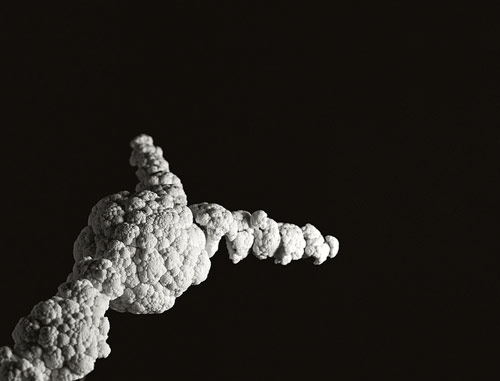
I love these cauliflower explosions done by Brock Davis…you can find them in his Food Stuff set on Flickr. Here’s the Challenger explosion in cauliflower:
(via @josephholmes)
The NY Times has a short documentary film by Errol Morris on El Wingador, a five-time winner of the Wing Bowl. My favorite line from the film, uttered by an off-camera Morris:
Wait a second. That’s cannibalism!
Though his several wins came early on in the competition’s history, El Wingador is still competing in the Wing Bowl. In the 2012 competition, held today, El Wingador came in third while Takeru Kobayashi completely demolished the competition in his first attempt, eating 337 wings in the process.
From the This Must Be the Place series, a lovely short film about the Prime Burger Restaurant in midtown Manhattan. The restaurant opened in 1938 and one of the servers, Artie, has been there since 1952.
For many of the guys that work here, the restaurant is like a second home — some of them have been slinging burgers, making shakes, and waiting on customers at this location for decades. Opened in 1938, the place hasn’t been altered since the early ’60s, and it looks all the better for it. Here the waiters and workers of Prime Burger discuss their views on their chosen profession, and the unique nature of the place itself.
(via @daveg)
Update: Over at Serious Eats, Ed Levine gives some advice on how to order properly at Prime Burger.
So why the need to order right? Because to keep up with the fast food chains, the DiMicelis started par-broiling their burgers. Par-broiling produces a less juicy burger. So when you order at Prime Burger specify you want your burger ($5.25 for a hamburger, $5.95 for a cheeseburger) made from scratch, and that you’re willing to wait the extra few minutes.
Well some of them are. The plain old American Oreo didn’t sell so well in China, so Kraft had to rethink everything about the cookie.
It turns out that if you didn’t grow up with Oreos and develop an emotional attachment to the cookie, it can be a weird-tasting little thing. And this started a whole process in the Chinese division of Kraft of rethinking what the essence of an Oreo really is.
Key terms in this article include “the essence of Oreoness” and “Twist, Lick, Dunk”.
I don’t know if the nudie playing cards are absolutely essential, but this trick is pretty neat.
(via @itscolossal)
Micro-Macro is a Powers of Ten-style video in which the various scales are depicted with food.
(via ★glass)
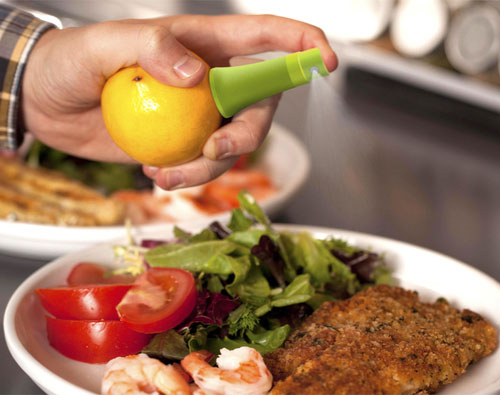
When life gives you lemons, turn them into spray bottles. This nifty little attachment lets you do just that.
The Planet Money podcast explores why lard fell out of favor for cooking and baking. Upton Sinclair and Crisco each take some of the blame. (thx, jim)
Newer posts
Older posts





Socials & More