kottke.org posts about food
Earlier in the week I posted about how climate change is affecting wine. Turns out that coffee is in trouble as well.
But in recent years, keeping the world’s coffee drinkers supplied has become increasingly difficult: The spread of a deadly fungus that has been linked to global warming and rising global temperatures in the tropical countries where coffee grows has researchers scrambling to create new varieties of coffee plants that can keep pace with these new threats without reducing quality.
While coffee researchers can do little to prevent climate change, they’re hard at work to keep up as Earth braces for temperature increases of several degrees over the next several decades.
“Coffee is the canary in the coal mine for climate change,” says Ric Rhinehart, executive director of the Specialty Coffee Association of America. “If you can’t think about the long term risk for planetary impacts, think about the short term risk for your coffee. Know that a day without coffee is potentially around the corner.”
(via nextdraft)
Veniamin Konstantinovich Balika recently used false paperwork to load his 18 wheeler with 42,000 pounds of Muenster cheese worth about $200K. Balika’s plan was to sell the cheese to retailers on the east coast.
“There’s a black market for everything,” said Sissman. “We’ve seen everything stolen. We’ve found stolen beer, stolen food, stolen machine parts, but this is the first time, we’ve found stolen cheese.
I wanted the opinion of an industry professional so I reached out to Aaron Foster, Head Buyer at Murray’s Cheese Shop.
I’ve seen a lot of people wondering how the culprit was planning to unload 40,000 lbs of cheese without raising suspicion. Is there such a thing as a cheddar fence? In my opinion, it really wouldn’t be that hard. While the larger retailers and chains — and, of course, Murray’s — have all become much more conscious of food safety and food security, there remains plenty of retailers who would jump at the chance to buy their product for pennies on the dollar, no questions asked. Literally as I wrote this, I received a vague email with the subject “RE: Special sale - Mega aged WI Cheddar”. I’ll pass, thanks. Groceries, specialty shops, and bodegas that work with perishables need every edge they can get to scrape by. Think about that next time you order your egg and cheese from the corner store.
And then I couldn’t help but find out more about stolen cheese. Cheese theft isn’t actually that uncommon. In fact, cheese is the most stolen food item of all with up to 4% of all cheese stolen at some point in it’s journey from maker to mouth. A cursory Google search turned up trunks full of stolen cheese in Michigan, 52-year old naked library denizens arrested with knives and stolen cheese, stolen government cheese in 1983(!), stolen cheese spread all over a Hy-Vee men’s room, video of brazen cheese wheel thieves, “the crushing authoritarianism of the Crown of England,” a cheese thief in Brooklyn, and a shoplifting celebrity chef. (thx, drew)
There’s prior art, but this image toaster is still pretty cool.
Toastagram? Toastr? I foresee BERG putting out a smaller version of this, perhaps printing out the day’s news on a small-crumb cocktail bread; they’ll call it Little Toaster. (via sly oyster)
McDonald’s started out as McDonald’s Bar-B-Q in San Bernardino, CA in 1940. Here’s a copy of the menu from that time:
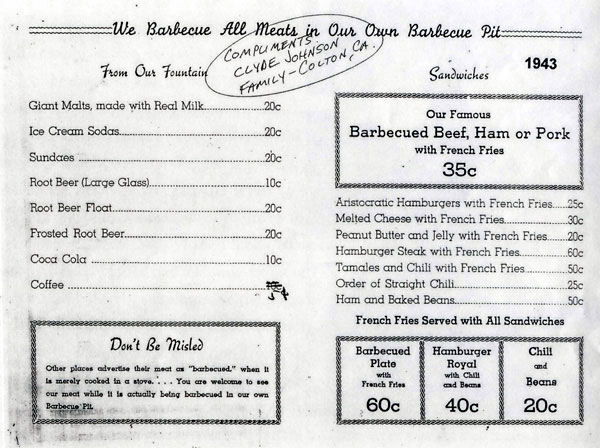
The drive-in BBQ restaurant was a great success:
The restaurant had carhops serving guests and would often see 125 cars crowding the lot on weekends. They quickly saw their annual sales topping $200,000 on a regular basis.
But competitors opened similar restaurants and they were selling more hamburgers than barbequed ham so the McDonald brothers closed their place for three months to retool. They reopened as plain old McDonald’s, serving cheap fare (like hamburgers) quickly. This is what an early version of the menu looked like:
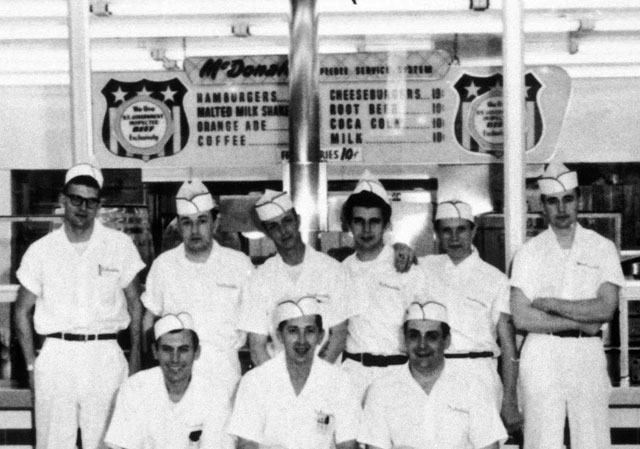
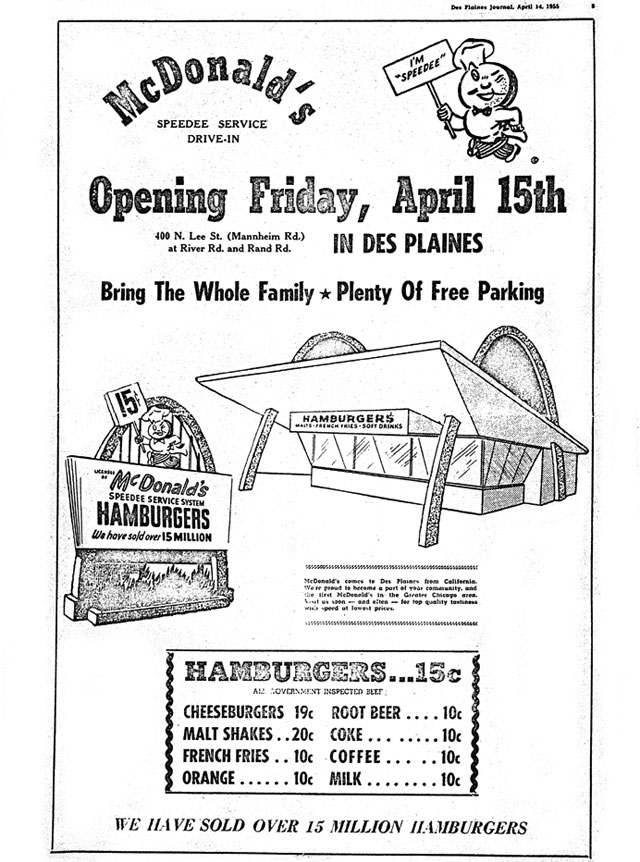
The original McDonald’s served potato chips and pie, which were swapped out for french fries and milkshakes after the first year; that photo must have been taken sometime after the switch. Ray Kroc got involved in 1955 and opened the first McDonald’s franchise east of the Mississippi in Des Plaines, Illinois:
The version of the menu currently going around (on Reddit; I found it here) looks like it’s from the Kroc era, the arches having been introduced in 1953, shortly before he got involved:
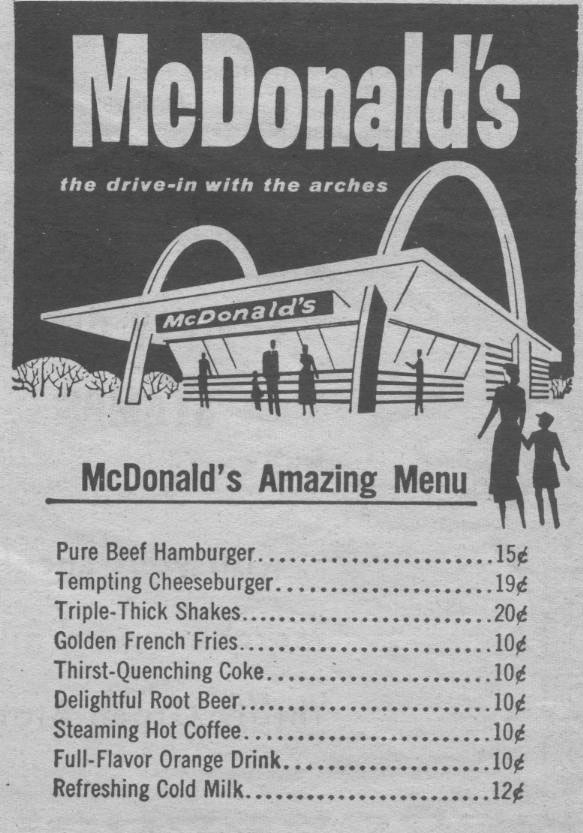
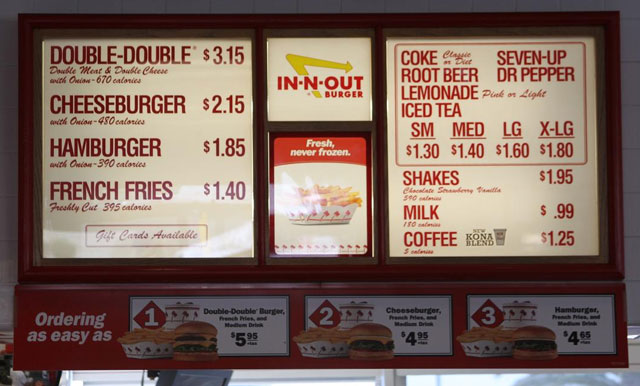
It’s interesting to compare these early McDonald’s menus to the current menus of places like In-N-Out Burger and Five Guys, especially in comparison with the sprawling McDonald’s menu of today:
After reading all these menus, you’re probably getting hungry. So here’s how to make a hamburger that tastes like an original McDonald’s hamburger from 1948 (as well as recipes for a bunch of other McDonald’s menu items, from McNuggets to the McRib to the dipping sauces). Enjoy!
This is a clip from Samsara, a 2011 film directed by Ron Fricke, who was the director of photography for Koyaanisqatsi. The chicken picker machine hoovering up chickens and depositing them into drawers is one of the most dystopian things I’ve ever seen.
The whole film doesn’t look this depressing, but this short clip really gives full visual meaning to the mass production of food. (via @colossal)
Danny Meyer’s Union Square Hospitality is opening two Shake Shacks and a Blue Smoke in Delta’s new Terminal 4 at JFK airport.
In the spirit of I, Pencil, here’s how a can of Coke makes its way from the bauxite mines of Australia and the forests of Sri Lanka to your local grocery store shelf.
Coca-Cola is made from a syrup produced by the Coca-Cola Company of Atlanta. The main ingredient in the formula used in the United States is a type of sugar substitute called high-fructose corn syrup 55, so named because it is 55 per cent fructose or “fruit sugar”, and 42 per cent glucose or “simple sugar” — the same ratio of fructose to glucose as natural honey. HFCS is made by grinding wet corn until it becomes cornstarch. The cornstarch is mixed with an enzyme secreted by a rod-shaped bacterium called Bacillus and an enzyme secreted by a mold called Aspergillus. This process creates the glucose. A third enzyme, also derived from bacteria, is then used to turn some of the glucose into fructose.
In case you missed it a few months ago on PBS, the excellent The Mind of a Chef is out in downloadable form on iTunes and at Amazon. The first episode is available for free on the PBS site for try-before-you-buy purposes.
Michael Moss is a Pulitzer-winning investigative journalist for the NY Times and he’s written a book called Salt Sugar Fat.
From a Pulitzer Prize-winning investigative reporter at The New York Times comes the explosive story of the rise of the processed food industry and its link to the emerging obesity epidemic. Michael Moss reveals how companies use salt, sugar, and fat to addict us and, more important, how we can fight back.
Every year, the average American eats thirty-three pounds of cheese (triple what we ate in 1970) and seventy pounds of sugar (about twenty-two teaspoons a day). We ingest 8,500 milligrams of salt a day, double the recommended amount, and almost none of that comes from the shakers on our table. It comes from processed food. It’s no wonder, then, that one in three adults, and one in five kids, is clinically obese. It’s no wonder that twenty-six million Americans have diabetes, the processed food industry in the U.S. accounts for $1 trillion a year in sales, and the total economic cost of this health crisis is approaching $300 billion a year.
Moss researched the book for four years, interviewing hundreds of current and former processed-food industry employees and reviewing thousands of pages of industry memos. This weekend’s NY Times Magazine has a lengthy excerpt from the book that’s well worth a read.
Eventually, a line of the [Lunchables] trays, appropriately called Maxed Out, was released that had as many as nine grams of saturated fat, or nearly an entire day’s recommended maximum for kids, with up to two-thirds of the max for sodium and 13 teaspoons of sugar.
When I asked Geoffrey Bible, former C.E.O. of Philip Morris, about this shift toward more salt, sugar and fat in meals for kids, he smiled and noted that even in its earliest incarnation, Lunchables was held up for criticism. “One article said something like, ‘If you take Lunchables apart, the most healthy item in it is the napkin.’ “
Well, they did have a good bit of fat, I offered. “You bet,” he said. “Plus cookies.”
The prevailing attitude among the company’s food managers - through the 1990s, at least, before obesity became a more pressing concern - was one of supply and demand. “People could point to these things and say, ‘They’ve got too much sugar, they’ve got too much salt,’ ” Bible said. “Well, that’s what the consumer wants, and we’re not putting a gun to their head to eat it. That’s what they want. If we give them less, they’ll buy less, and the competitor will get our market. So you’re sort of trapped.” (Bible would later press Kraft to reconsider its reliance on salt, sugar and fat.)
And this is classic processed food as molecular gastronomy right here:
I brought him two shopping bags filled with a variety of chips to taste. He zeroed right in on the Cheetos. “This,” Witherly said, “is one of the most marvelously constructed foods on the planet, in terms of pure pleasure.” He ticked off a dozen attributes of the Cheetos that make the brain say more. But the one he focused on most was the puff’s uncanny ability to melt in the mouth. “It’s called vanishing caloric density,” Witherly said. “If something melts down quickly, your brain thinks that there’s no calories in it… you can just keep eating it forever.”
(via @bryce)
Some enterprising genius has registered the domain for Guy Fieri’s (famously panned) restaurant in Times Square and put up a fake menu chock full of hilarious foodstuffs. For instance, the Hobo Lobo Bordello Slam Jam Appetizer:
We take 38 oz of super-saddened, Cheez-gutted wolf meat, lambast it with honey pickle wasabi and pile drive it into an Ed Hardy-designed bucket. Sprayed with Axe and finished with a demiglaze of thick & funky Mushroom Dribblins.
Also, “Add a Cinnabon and two more Cinnabons $4.95”. Also, “superbanged”. Also, “ranch hose”.
Update: Copy for parts of the menu were crowdsourced from Twitter. Which doesn’t make it any less funny…just that the person who made it is not an “enterprising genius”. (via everyone)
For the NY Times, Ben Schott compiles an extensive list of wine-related jargon.
WHALE . PLAYER . BALLER . DEEP OCEAN
A serious drinker who will regularly DROP more than $1,000 on a single bottle. When on a furious spending spree, a WHALE is said to be DROPPING THE HAMMER. BIG WALES — or EXTRA BIG BALLERS (E.B.B.) — can spend more than $100,000 on wine during a meal.
Schott expanded on this list in a companion blog post:
But, vocabulary aside, the central thing I learned from these talented people is that if you are dining in a restaurant which employs a Sommelier, you should never, ever order your own wine.
If you know little or nothing about wine, they will guide you to a bottle far more interesting and suited to your food than you could possibly pluck from the list.
And if you are a wine aficionado, you will not know more than the Somm about their list - or what they are hiding off-list in the cellar.
See also What Restaurants Know (About You)
On Edible Geography, Nicola Twilley looks at what used to be a common process in Japan but is now only done on a boutique basis: apple tattooing.
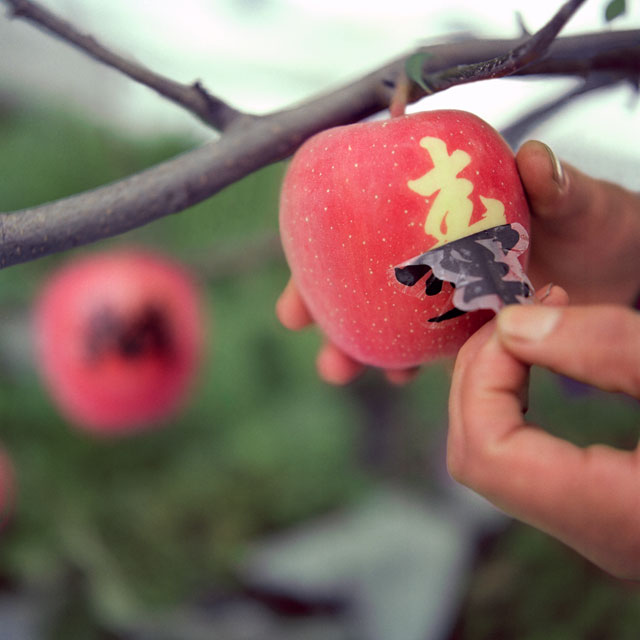
As they are finally exposed to the elements for the final few weeks before harvest, the most perfect of these already perfect apples are then decorated with a sticker that blocks sunlight to stencil an image onto the fruit. This “fruit mark” might be the Japanese kanji for “good health,” as Susan Brown mentioned. Others have brand logos (most notably that of Apple, the company), and some, according to Stevens, are “negatives with pictures. One Japanese pop star put his picture on apples to give his entourage for presents.”
The marked fruit of the Montreuillois first won renown at the 1894 Saint Petersburg exhibition, where they presented the czar of Russia with an apple stenciled with his own portrait. King Leopold of Belgium, Edward VII of England, and Teddy Roosevelt received similar fruits.
(via @stewart)
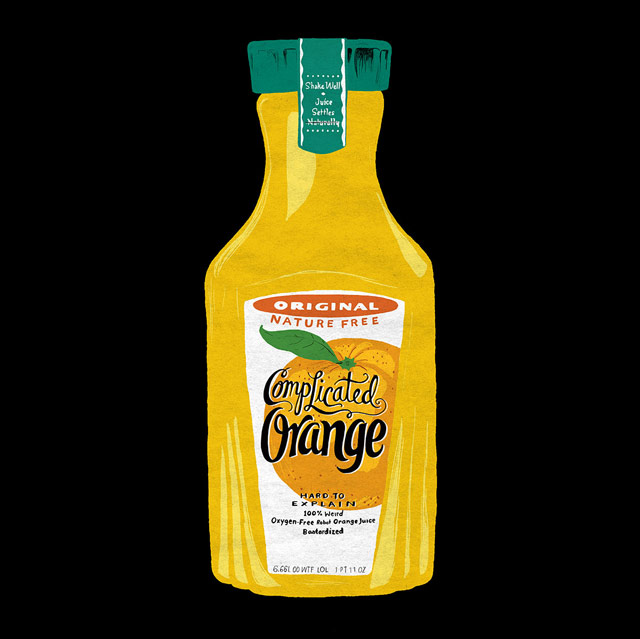
Simply Orange juice is actually not all that simple. The taste of the the Coca-Cola-owned brand is governed by a complex algorithm that allows for the 600+ juice flavors to be tweaked throughout the year to ensure consistency. I liked The Atlantic Wire’s take on the news:
The explanation behind Coke’s complicated new orange juice scheme is nothing short of ironic. Basically, all of their customers are realizing the soda is really bad for you, so demand is shifting to healthy — or at least healthy-seeming — alternatives like juice. Coke also figured out that people are willing to pay 25 percent more for juice that’s not processed, that is, not made from concentrate. Enter Simply Orange. It is indeed just oranges, but boy have those oranges been through hell and back.
This is like White Zombie’s More Human Than Human except More Orange Juice Than Orange Juice.
Note: Illustration by Chris Piascik…prints & more are available.
Update: I updated the post above to point to Businessweek’s original report on Coke’s OJ business.
For their Big Mac index (a way to look at currency exchange using global Big Mac pricing) this year, the Economist has released an interactive tool for exploring the data.
The Big Mac index was invented by The Economist in 1986 as a lighthearted guide to whether currencies are at their “correct” level. It is based on the theory of purchasing-power parity (PPP), the notion that in the long run exchange rates should move towards the rate that would equalise the prices of an identical basket of goods and services (in this case, a burger) in any two countries. For example, the average price of a Big Mac in America at the start of 2013 was $4.37; in China it was only $2.57 at market exchange rates. So the “raw” Big Mac index says that the yuan was undervalued by 41% at that time.
They’re also made the data set available in .xls format for at-home analysis.
The Perennial Plate videos always make me jealous, and this beautiful cut of a “day” in India is no exception. This is gorgeous and you should watch it on full screen.
From back in August, Atul Gawande visits a Cheesecake Factory and wonders if the combination of “quality control, cost control, and innovation” achieved by chain restaurants can offer lessons to hospitals and other health care organizations.
The company’s target last year was at least 97.5-per-cent efficiency: the managers aimed at throwing away no more than 2.5 per cent of the groceries they bought, without running out. This seemed to me an absurd target. Achieving it would require knowing in advance almost exactly how many customers would be coming in and what they were going to want, then insuring that the cooks didn’t spill or toss or waste anything. Yet this is precisely what the organization has learned to do. The chain-restaurant industry has produced a field of computer analytics known as “guest forecasting.”
“We have forecasting models based on historical data-the trend of the past six weeks and also the trend of the previous year,” Gordon told me. “The predictability of the business has become astounding.” The company has even learned how to make adjustments for the weather or for scheduled events like playoff games that keep people at home.
A computer program known as Net Chef showed Luz that for this one restaurant food costs accounted for 28.73 per cent of expenses the previous week. It also showed exactly how many chicken breasts were ordered that week ($1,614 worth), the volume sold, the volume on hand, and how much of last week’s order had been wasted (three dollars’ worth). Chain production requires control, and they’d figured out how to achieve it on a mass scale.
As a doctor, I found such control alien-possibly from a hostile planet. We don’t have patient forecasting in my office, push-button waste monitoring, or such stringent, hour-by-hour oversight of the work we do, and we don’t want to. I asked Luz if he had ever thought about the contrast when he went to see a doctor. We were standing amid the bustle of the kitchen, and the look on his face shifted before he answered.
“I have,” he said. His mother was seventy-eight. She had early Alzheimer’s disease, and required a caretaker at home. Getting her adequate medical care was, he said, a constant battle.
This piece was on several best-of-the-year longreads lists and deservedly so. But the Factory’s 3000-calorie plate of pasta will probably not help the state of American health care.
Speaking of haute fast food, Jessica Saia creates the finest in bodega-to-table cuisine with the likes of Fritos and SPAM.
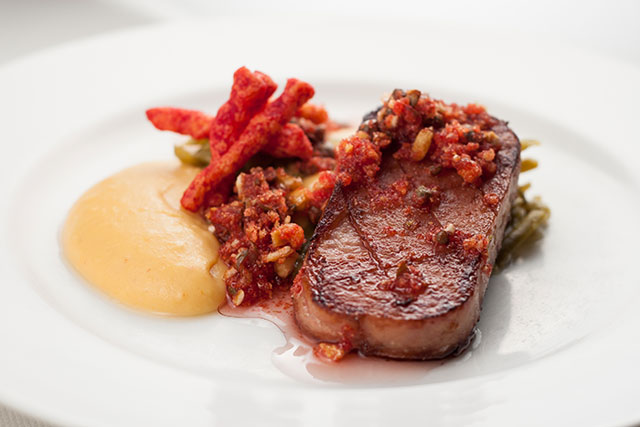
Seared Spam with Tostitos queso-dip mashed potatoes and canned green beans. Topped with a Flamin’ Hot Cheetos and Corn Nut salsa verde.
I want that into my mouth. Look at the sear marks on that SPAM! (via @mmpackeatwrite)

A truck carrying 27 tons of brunost, a Norwegian brown cheese, caught fire in a tunnel in Narvik on Thursday and burned with gooey rage until Monday. Closed during the fire, because who likes driving through tunnels of flame, the tunnel will take about a week to repair.
“This high concentration of fat and sugar is almost like petrol if it gets hot enough,” said Viggo Berg, a policeman.
Brown cheese is made from whey, contains up to 30 percent fat and has a caramel taste.
“I didn’t know that brown cheese burns so well,” said Kjell Bjoern Vinje at the Norwegian Public Roads Administration.
He added that in his 15 years in the administration, this was the first time cheese had caught fire on Norwegian roads.
(via @aaron_foster)
Note: Illustration by Chris Piascik…prints & more are available.
Writing for The Awl, Jeb Boniakowski shares his vision for a massive McDonald’s complex in Times Square that serves food from McDonald’s restaurants from around the world, offers discontinued food items (McLean Deluxe anyone?), and contains a food lab not unlike David Chang’s Momofuku test kitchen.
The central attraction of the ground floor level is a huge mega-menu that lists every item from every McDonald’s in the world, because this McDonald’s serves ALL of them. There would probably have to be touch screen gadgets to help you navigate the menu. There would have to be whole screens just dedicated to the soda possibilities. A concierge would offer suggestions. Celebrities on the iPad menus would have their own “meals” combining favorites from home (“Manu Ginobili says ‘Try the medialunas!’”) with different stuff for a unique combination ONLY available at McWorld. You could get the India-specific Chicken Mexican Wrap (“A traditional Mexican soft flat bread that envelops crispy golden brown chicken encrusted with a Mexican Cajun coating, and a salad mix of iceberg lettuce, carrot, red cabbage and celery, served with eggless mayonnaise, tangy Mexican Salsa sauce and cheddar cheese.” Wherever possible, the menu items’ descriptions should reflect local English style). Maybe a bowl of Malaysian McDonald’s Chicken Porridge or The McArabia Grilled Kofta, available in Pakistan and parts of the Middle East. You should watch this McArabia ad for the Middle Eastern-flavored remix of the “I’m Lovin’ It” song if for nothing else.
And I loved his take on fast food as molecular gastronomy:
How much difference really is there between McDonald’s super-processed food and molecular gastronomy? I used to know this guy who was a great chef, like his restaurant was in the Relais & Châteaux association and everything, and he’d always talk about how there were intense flavors in McDonald’s food that he didn’t know how to make. I’ve often thought that a lot of what makes crazy restaurant food taste crazy is the solemn appreciation you lend to it. If you put a Cheeto on a big white plate in a formal restaurant and serve it with chopsticks and say something like “It is a cornmeal quenelle, extruded at a high speed, and so the extrusion heats the cornmeal ‘polenta’ and flash-cooks it, trapping air and giving it a crispy texture with a striking lightness. It is then dusted with an ‘umami powder’ glutamate and evaporated-dairy-solids blend.” People would go just nuts for that. I mean even a Coca-Cola is a pretty crazy taste.
I love both mass-produced processed foods and the cooking of chefs like Grant Achatz & Ferran Adrià. Why is the former so maligned while the latter gets accolades when they’re the same thing? (And simultaneously not the same thing at all, but you get my gist.) Cheetos are amazing. Oscar Meyer bologna is amazing. Hot Potato Cold Potato is amazing. Quarter Pounders with Cheese are amazing. Adrià’s olives are amazing. Coca-Cola is amazing. (Warhol: ” A Coke is a Coke and no amount of money can get you a better Coke than the one the bum on the corner is drinking.”) WD50’s Everything Bagel is amazing. Cheerios are amazing. All have unique flavors that don’t exist in nature — you’ve got to take food apart and put it back together in a different way to find those new tastes.
Some of these fancy chefs even have an appreciation of mass produced processed foods. Eric Ripert of the 4-star Le Berdardin visited McDonald’s and Burger King to research a new burger for one of his restaurants. (Ripert also uses processed Swiss cheese as a baseline flavor at Le Bernardin.) David Chang loves instant ramen and named his restaurants after its inventor. Ferran Adrià had his own flavor of Lay’s potato chips in Spain. Thomas Keller loves In-N-Out burgers. Grant Achatz eats Little Caesars pizza.
One of Sean Wilson’s chicken laid a huge egg and when he cracked it open, it contained another egg.
Not even a hoax! As the curator of the egg collection at London’s Natural History Museum explains, the double egg is rare but real and results from a fully formed egg being pushed back into the ovary, where another egg forms around it. Here’s another double egg and a report of a Texan double egg. (via colossal)
This looks interesting: Our Global Kitchen: Food, Nature, Culture exhibition at the American Museum of Natural History in NYC.
In the new exhibition Our Global Kitchen: Food, Nature, Culture, the American Museum of Natural History explores the complex and intricate food system that brings what we eat from farm to fork. In sections devoted to growing, transporting, cooking, eating, tasting, and celebrating, the exhibition illuminates the myriad ways that food is produced and moved throughout the world. With opportunities to taste seasonal treats in the working kitchen, cook a virtual meal, see rare artifacts from the Museum’s collection, and peek into the dining rooms of famous figures throughout history, visitors will examine the intersection of food, nature, culture, health, and history — and consider some of the most challenging issues of our time.
The exhibition is on from November 17, 2012 to August 11, 2013.
Martyn Cornell took issue with First We Feast’s list of the 20 most influential beers of all time and came up with his own list.
I mean, Bear Republic Hop Rod Rye is more influential in the history of beer than Bass Pale Ale or Barclay Perkins porter? Don’t make me weep. Allagash White trumps Hoegaarden and Schneider Weisse? (You may not like Hoegaarden or Schneider Weisse, but I hope you won’t try to deny their influence.) Gueuze, Saison and Kolsch are such important styles they deserve a representative each in a “most influential beers of all time” list, while IPA and porter are left out? I don’t think so. And the same goes for Schneider Aventinus: where are the hordes of Weissebockalikes? Sam Adams Utopias has influenced who, exactly? “Generic lager”? I see where you’re coming from, in that much of what has happened over the past 40 years in the beer world is a reaction against generic lager, but still … And I love London Pride, but it’s not even the third most influential beer that Fuller’s brews.
I like arguments about beer way more than drinking beer.
That’s right, Adolf Hitler. Janet Flanner profiled him in three consecutive issues in 1936. Part one begins like so:
Dictator of a nation devoted to splendid sausages, cigars, beer, and babies, Adolf Hitler is a vegetarian, teetotaler, nonsmoker, and celibate. He was a small-boned baby and was tubercular in his teens. He says that as a youth he was already considered an eccentric. In the war, he was wounded twice and almost blinded by mustard gas. Like many partial invalids, he has compensated for his debilities by developing a violent will and exercising strong opinions. Limited by physical temperament, trained in poverty, organically costive, he has become the dietetic survivor of his poor health. He swallows gruel for breakfast, is fond of oatmeal, digests milk and onion soup, declines meat, which even as an undernourished youth he avoided, never touches fish, has given up macaroni as fattening, eats one piece of bread at a meal, favors vegetables, greens, and salads, drinks lemonade, likes tea and cake, and loves a raw apple. Alcohol and nicotine are beyond him, since they heighten the exciting intoxication his faulty assimilation already assures.
Sadly, access is subscriber-only. (You know who else kept information from people!? Etc.)
This week’s episode of This American Life is about doppelgangers, so they decided to have SNL’s Fred Armisen come on the show and co-host it as Ira Glass.
Fred Armisen worked up an imitation of Ira and put it into a skit on Saturday Night Live a couple years ago. But when they rehearsed it with an audience, there was not a roar of recognition; it seemed like Ira might not be famous enough to be mocked on network TV. So today Armisen finally gets a go as Ira’s doppelganger in our studios by co-hosting the entire show.
The first story on the show is about artificial calamari, aka hog rectum.
Ben Calhoun tells a story of physical resemblance — not of a person, but of food. A while ago, a farmer walked through a pork processing plant in Oklahoma with a friend who managed it. He came across boxes stacked on the floor with labels that said “artificial calamari.” So he asked his friend “What’s artificial calamari?” “Bung,” his friend replied. “Hog rectum.” Have you or I eaten bung dressed up as seafood? Ben investigated.
From the latest issue of Lucky Peach, a guide on what and how to order at a dim sum restaurant.
Regular patrons of North American dim sum restaurants will find most, if not all, of the selections pictured here familiar. Newcomers should find the illustrations-which have been grouped by their method of preparation and general type — helpful in identifying some of the more typical offerings. This arrangement will provide even first-time visitors to dim sum restaurants with access to field identification in a clear and rational array.
The first half of the Field Guide introduces steamed items; the second covers fried, baked, and sweet offerings. These general divisions have then been subdivided according to each dim sum’s predominant physical characteristics.
For the Financial Times’ Lunch with the FT series, editor John McDermott sits down with Tyler Cowen at an inexpensive Ethiopian restaurant located in a strip mall. Lots of interesting little tidbits throughout.
Cowen is walking-talking-tweeting evidence for his theory. Why, then, apart from an early surge in the 1990s, hasn’t the internet led to more measurable economic gains? “My view of the internet is that it is way overrated in what it’s done to date but considerably underrated in what it will do.” He notes that it took decades for earlier major inventions to have institutions built around them, such as roads for cars and grids for electricity. “If you’re an optimist about what has come before, you tend to be a pessimist about what’s on the way.”
You need predictable and changing seasons to grow grapes and the Game of Thrones world features long unpredictable seasons…so where does all that wine come from?
The seasons in George RR Martin’s medieval fantasy are a random, unpredictable mess. They could last anywhere from a few months to a decade and there’s no way to forecast them. As the story opens, the characters are near the end of a long, ten-year summer. They also worry about the coming winter, which will cause mass starvation if it also lasts years on end. This wonky climate is an irreplaceable part of Game of Thrones. Westeros would not be remotely the same without it.
But grapevines have a life cycle that depends on regular seasons. In winter, grapevines are dormant. Come spring they sprout leaves. As summer begins, they flower and tiny little grapes appear. Throughout the summer the grapes fill up with water, sugar and acid. The grapes are finally ready for picking in early autumn, then go back to sleep in winter. This cycle is why wineries can rely on a yearly grape yield. Obviously, in Westeros, something must be different about how grapes work.
(via bb)
The supposed debate among scientists over climate change has melted faster than the polar ice caps. National Science Board member James Lawrence Powell looked at all the related peer-reviewed scientific papers over the last several years. Twenty-four of those articles rejected the notion of climate change. Out of 14,000.
So let this be clear: There is no scientific controversy over this. Climate change denial is purely, 100 percent made-up political and corporate-sponsored crap.
It’s still easy for many of us to ignore the issue of climate change, but every now and then a headline makes us take notice. This one did it for me: The End of Pasta.
But if humans want to keep eating pasta, we will have to take much more aggressive action against global warming. Pasta is made from wheat, and a large, growing body of scientific studies and real-world observations suggest that wheat will be hit especially hard as temperatures rise and storms and drought intensify in the years ahead.
A ProPublica Investigation: Poisoning the Well: How the feds let industry pollute the nation’s underground water supply.
Federal officials have given energy and mining companies permission to pollute aquifers in more than 1,500 places across the country, releasing toxic material into underground reservoirs that help supply more than half of the nation’s drinking water.
In many cases, the Environmental Protection Agency has granted these so-called aquifer exemptions in Western states now stricken by drought and increasingly desperate for water.
While you ponder what that might be a euphemism for, I’ll just tell you that in actual fact tennis player Novak Djokovic has purchased the entire 2013 supply of cheese made from donkey milk. Only £800 per kilo.
Wimbledon winner and world No 1 Novak, 25, wants the donkey’s milk cheese to supply a new chain of restaurants in his Serbian homeland. The delicacy, known as pule, is made in Zasavica, Serbia, and is described as similar to Spanish manchego. Donkey milk is said to be very healthy for humans as it has anti-allergen properties and is low fat.
(via @tylercowen)
This article on getting the most out of your burrito-scarfing experience at Chipotle by William Hudson at Thought Catalog was better than I thought it could be.
1/2 meat + 1/2 meat = 3/2 meat. Forgetting is natural, like Chipotle meat, so let me remind you that when you add fractions you only add the top part, when the bottom part is the same number. Therefore, when you’re asked what type of meat, and you say “half chicken and half steak”, it should equal one serving of meat. But it never does. Because a scoop of meat is kinda just a scoop of meat, and nobody in Chipotle management has yet introduced new “half” scoops with which to more precisely address this perfectly legal request. So use it. IMPORTANT: Unlike with the beans, you should make your position on the half meats clear from the beginning, otherwise they charge you for “extra meat.”
These options should all have names like the In-N-Out secret menu items: the Blinko, the Meat and a Half, the Jimmy Stewart’s Bathtub, etc. (via digg)
Newer posts
Older posts





Socials & More