kottke.org posts about food
From Stanley Kubrick, instructions to the new guy concerning the preparation of his French toast.
You must understand that without the French toast I am no good to the cast and crew. And I will not eat the French toast if it is not prepared the right way. If I do not eat the French toast, my blood sugar will drop to precariously low levels, and I will be groggy and unable to make the necessary split-second decisions a director has to make in order for a film to be successful. Therefore, it is essential that you understand something about the French toast: it is not only my breakfast, it is the film.
Speaking of lobster, you could do much worse today than reading David Foster Wallace’s classic piece for Gourmet about attending the Maine Lobster Festival. As you might imagine, Wallace quickly veers from the event at hand into something more interesting and unsettling for Gourmet’s gourmet readers: do lobsters feel pain and do they suffer for your dinner?
Given this article’s venue and my own lack of culinary sophistication, I’m curious about whether the reader can identify with any of these reactions and acknowledgments and discomforts. I am also concerned not to come off as shrill or preachy when what I really am is confused. Given the (possible) moral status and (very possible) physical suffering of the animals involved, what ethical convictions do gourmets evolve that allow them not just to eat but to savor and enjoy flesh-based viands (since of course refined enjoyment, rather than just ingestion, is the whole point of gastronomy)? And for those gourmets who’ll have no truck with convictions or rationales and who regard stuff like the previous paragraph as just so much pointless navel-gazing, what makes it feel okay, inside, to dismiss the whole issue out of hand? That is, is their refusal to think about any of this the product of actual thought, or is it just that they don’t want to think about it? Do they ever think about their reluctance to think about it? After all, isn’t being extra aware and attentive and thoughtful about one’s food and its overall context part of what distinguishes a real gourmet? Or is all the gourmet’s extra attention and sensibility just supposed to be aesthetic, gustatory?
There are a lot of lobsters in the sea. You could even call it a glut. Over the past few years, the massive lobster harvests have resulted in a significant reduction in what buyers are paying for a lobster off the boat. So why aren’t we seeing major price drops at our local restaurants? Here’s part of the reason: A luxury good is considered a luxury good in part because it’s priced like one. Cheap lobster could throw the rest of your menu into chaos.
Studies have shown that people prefer inexpensive wines in blind taste tests, but that they actually get more pleasure from drinking wine they are told is expensive. If lobster were priced like chicken, we might enjoy it less.
In The New Yorker, James Surowiecki cracks open the surprising complexity of lobster prices.
And speaking of new iOS apps, Serious Eats has launched a monthly iOS magazine in conjunction with 29th Street Publishing. Here’s Kenji López-Alt on the app:
So how do we find content for these magazines? It’s a question we wracked our brains on long and hard before deciding that the most valuable service for our readers would be to craft issues around individual subjects — think barbecue, pizza, or pies — by combining the most popular recipes and features in our archives into single, elegant collections.
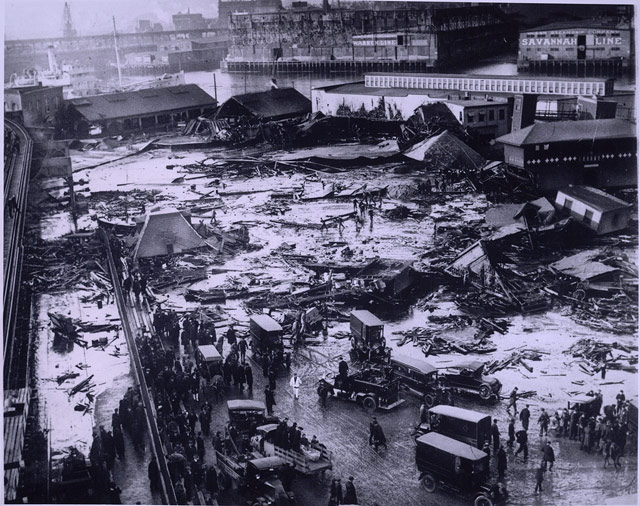
On January 15, 1919 in Boston’s North End, a storage container holding around 2.3 million gallons of molasses ruptured, sending a 8-15 ft. wave of molasses shooting out into the streets at 35 mph. Twenty-one people died, many more were injured, and the property damage was severe. In an article in Scientific American, Ferris Jabr explains the science of the molasses flood, including why it was so deadly and destructive.
A wave of molasses does not behave like a wave of water. Molasses is a non-Newtonian fluid, which means that its viscosity depends on the forces applied to it, as measured by shear rate. Consider non-Newtonian fluids such as toothpaste, ketchup and whipped cream. In a stationary bottle, these fluids are thick and goopy and do not shift much if you tilt the container this way and that. When you squeeze or smack the bottle, however, applying stress and increasing the shear rate, the fluids suddenly flow. Because of this physical property, a wave of molasses is even more devastating than a typical tsunami. In 1919 the dense wall of syrup surging from its collapsed tank initially moved fast enough to sweep people up and demolish buildings, only to settle into a more gelatinous state that kept people trapped.
This could just be a Boston urban legend, but it’s said that on hot days in the North End, the sweet smell of molasses can be detected wafting through the air.
Pretty interesting history of how the children’s menu came to “grace” restaurant tables around the country.
Children tend to rise to the culinary bar we set for them, and children’s menus in America set the bar very low indeed. To look at the standard kids’ menu, greasy with prefab items like chicken fingers, tater tots, and mac-and-cheese, you might think that industrial food manufacturers have been responsible for setting it. But the delusion that a child even needs a special menu is a lot older than the chicken nuggets that have come to dominate it. In fact, the children’s menu dates back to Prohibition, when, remarkably, it was devised with a child’s health in mind.
I hate kid’s menus. Our kids would happily order off the main menu but as soon as the promise of hot dogs and chicken fingers arrives with crayons, it’s difficult to steer them away.
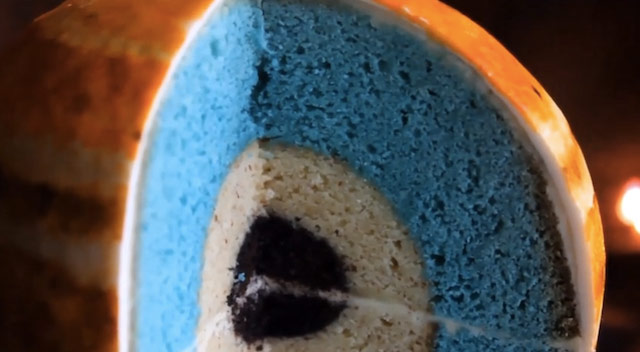
Each layer is different kind of cake which is baked and then pressed into the batter of the next larger cake, covered, and rebaked. The largest of which you bake in halves in two glass mixing bowls.
It’s like a dessert turducken. Mmmm.
(via @rustyk5)
Market researcher Clotaire Rapaille was interviewed for an episode of Frontline on advertising and marketing back in 2003. I like what he had to say about the differences in how the French and Americans think about cheese.
For example, if I know that in America the cheese is dead, which means is pasteurized, which means legally dead and scientifically dead, and we don’t want any cheese that is alive, then I have to put that up front. I have to say this cheese is safe, is pasteurized, is wrapped up in plastic. I know that plastic is a body bag. You can put it in the fridge. I know the fridge is the morgue; that’s where you put the dead bodies. And so once you know that, this is the way you market cheese in America.
I started working with a French company in America, and they were trying to sell French cheese to the Americans. And they didn’t understand, because in France the cheese is alive, which means that you can buy it young, mature or old, and that’s why you have to read the age of the cheese when you go to buy the cheese. So you smell, you touch, you poke. If you need cheese for today, you want to buy a mature cheese. If you want cheese for next week, you buy a young cheese. And when you buy young cheese for next week, you go home, [but] you never put the cheese in the refrigerator, because you don’t put your cat in the refrigerator. It’s the same; it’s alive. We are very afraid of getting sick with cheese. By the way, more French people die eating cheese than Americans die. But the priority is different; the logic of emotion is different. The French like the taste before safety. Americans want safety before the taste.
(via @pieratt)
Today’s fun game is: Golf Ball Innards or Bowl of Gelato? Let’s get started. Is this a creamy bowl of lemon-lime pistachio gelato or the inside of a golf ball?
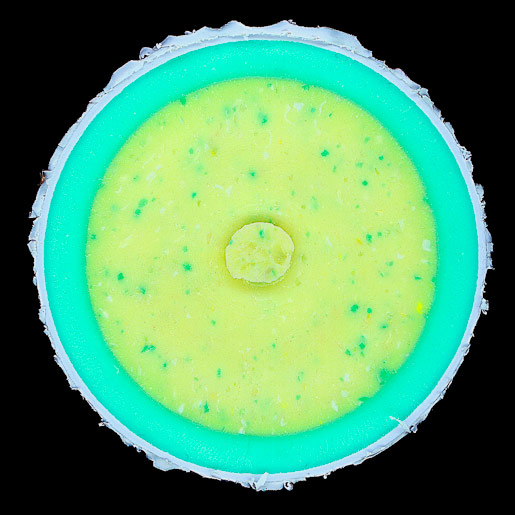
Ok, that was an easy one. How about this one…is this half of a crazy-ass golf ball or a delicious bowl of watermelon bubble gum gelato?
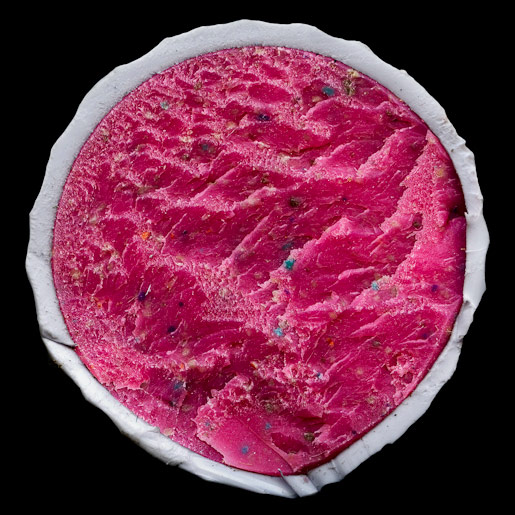
It’s gotta be gelato, right? Ok, last one: gelato or cross section of a golf ball from a project called Interior Designs by photographer James Friedman?
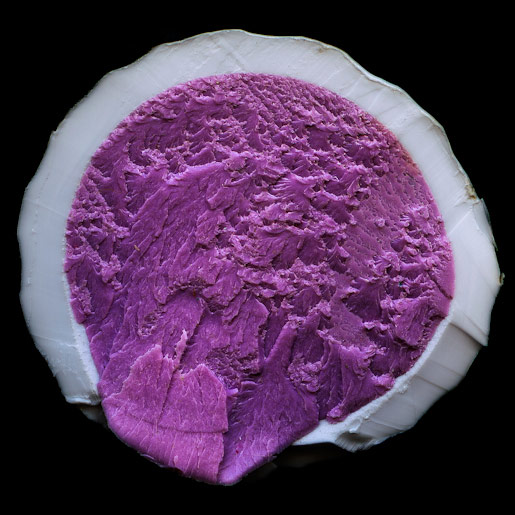
Yum, I can almost taste the blueberries through the screen. Well, that’s all the time we have today, folks. You’ve been a great group of contestants, and we hope to see you next week on Golf Ball Innards or Bowl of Gelato? (via edible geography)
Hannah Grant, a chef who used to work for highly influential Noma (among other places), is now the chef for the Saxo-Tinkoff cycling team currently competing in the Tour de France. She cooks for the entire team out of a food truck.
First of all, I set the menu. I mean, they can request stuff, the riders, if they want. I’ll note it and I’ll do it if it’s possible. But, obviously, then there’s rules to how to assemble the menu. Today’s a rest day, so we do a low-carb lunch for them. They’re not going so far, they just want to keep their legs going, so we don’t want to fill them up too much. And we don’t want to go too hard on the carbs so they don’t gain weight.
Then we have a philosophy of using lots of vegetables, proteins, and cold-pressed fats, and then we use a lot of gluten-free alternatives. So we try to encourage the riders to try other things than just pasta and bread. I do gluten-free breads as well.
It’s all to minimize all the little things that can stop you from performing 100 percent, that promote injuries, stomach problems, all those things. So that’s a big difference (from cooking in a restaurant), because I have to follow all those rules. I can’t just cook whatever I think is amazing. It has to be within those guidelines.
Then I take it as my personal job to take these guidelines and then make an incredible product from it, so they don’t feel like they’re missing out on things. It shouldn’t be a punishment to travel with a kitchen truck and a chef who cooks you food that’s good for you.
Grant’s cooking seems to be paying off for the team…Saxo-Tinkoff currently has two riders in the top five and is in second place overall in the team classification. (via @sampotts)
What has been the hottest IPO of the year so far? Some new-fangled technology perhaps? Or maybe a trend-setting company from one of the coasts set to take their product offering national and then global? Nope, it was a Denver-based, pasta-centric restaurant chain called Noodles & Co. The company’s IPO bucked a lot of trends (including, it seems, the war on flour). Here’s The Daily Beast on how a pasta chain punked Wall Street.
[That’s Dave Pell’s take from Nextdraft, but I have to weigh in here. I’ve eaten at Noodles & Co many times. I ate there last week, actually. The restaurants do well because the service is friendly & responsive, your order comes out quickly, and the food is remarkably good for the money you pay (like at Chipotle). No one would ever mistake the Pad Thai or Japanese Pan Noodles for the authentic thing, but they are both delicious. I like the Steak Stroganoff so much that I crave it even when surrounded by the amazing and varied food choices of NYC. No idea if Noodles & Co would do well in Manhattan, but they’d definitely have one customer. -jkottke]
Mary Roach travels to the state of Nagaland in India, where some of the world’s hottest chili peppers grow, to observe a chili-eating competition, in which contestants see who can eat the most insanely hot chilis in 20 seconds. This guy is dealing with the after effects of competing (perhaps on a vision quest):

The event itself is surprisingly low-key. The mood is one of stoic grimness. No one is screaming in pain. No one will be scarred by the heat. That’s not how capsaicin works. It only feels hot. The human tongue has pain receptors that respond to a certain intensity of temperature or acid. These nerve fibers send a signal to the brain, which it forwards to your conscious self in the form of a burning sensation. Capsaicin lowers the threshold at which this happens. It registers “hot” at room temperature. “It trips the alarm,” says Bruce Bryant, a senior researcher at the Monell Chemical Senses Center in Philadelphia. “It says, ‘Get this out of your mouth right now!’” The chili pepper tricks you into setting it free.
The whole affair is beginning to seem like an anticlimax when I look up from my notes to see Pu Zozam headed my way. I have seen people stagger in movies, but never for real directly in my sightline. Zozam’s legs buckle as he tries to keep walking. He goes down onto one knee and collapses sideways onto the floor. He rolls onto his back, arms splayed and palms up. He’s making sounds that are hard to transcribe. Mostly vowels.
This story gives me the chance to alert you to one of my favorite units of measure, the Scoville scale, a “measurement of the pungency (spicy heat) of chili peppers”. As the article states, the chili used in the contest has been measured at 1,000,000 Scoville heat units (SHU). As a comparison, Sriracha sauce is about 1000-2000 SHU, jalapenos register 3,500-8,000 SHU, and habanero is about 100,000-350,000 SHU. (via coudal)
“Sparks shoot all the way up to the brain” while “ideas quick-march into motion like battalions of a grand army to its legendary fighting ground, and the battle rages.”
That’s how Balzac described the effects of drinking coffee (and it’s tough to question his expertise on the topic as he famously downed the equivalent of 50 cups a day). We know caffeine can make us more energetic and increase our ability to concentrate. But does it also prevent the “wandering, unfocussed mind” that leads to creativity? From the New Yorker’s Maria Konnikova: How Caffeine Can Cramp Creativity.
Photographer Gabriele Galimberti travelled around the world (Morocco, Philippines, Italy, India) to get these shots of grandmothers and the foods they cook.
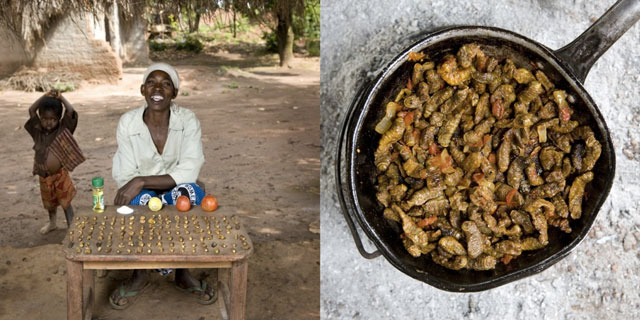
Each pair of photographs includes a recipe for making the pictured dish. Galimberti’s other projects are very much worth checking out as well. (via @youngna)
For the Food Lab, Kenji Lopez-Alt debunks some old wives’ tales related to cooking steak.
Myth #2: “Sear your meat over high heat to lock in juices.”
The Theory: Searing the surface of a cut piece of meat will precipitate the formation of an impenetrable barrier, allowing your meat to retain more juices as it cooks.
The Reality: Searing produces no such barrier-liquid can still pass freely in and out of the surface of a seared steak. To prove this, I cooked two steaks to the exact same internal temperature (130^0F). One steak I seared first over hot coals and finished over the cooler side of the grill. The second steak I started on the cooler side, let it come to about ten degrees below its final target temperature, then finished it by giving it a sear over the hot side of a grill. If there is any truth to the searing story, then the steak that was seared first should retain more moisture.
What I found is actually the exact opposite: the steak that is cooked gently first and finished with a sear will not only develop a deeper, darker crust (due to slightly drier outer layers-see Myth #1), but it also cooks more evenly from center to edge, thus limiting the amount of overcooked meat and producing a finished product that is juicier and more flavorful.
If you’re serious about home-cooked steak, the “Further Reading” section at the bottom of this piece is your new best friend.
People love Jerry Seinfeld so much that we will watch him driving cars and drinking coffee with other comedians. Wait, that actually sounds fantastic!
All the season one episodes are available on YouTube, featuring Ricky Gervais, Alec Baldwin, Michael Richards, and Larry David. (via devour)
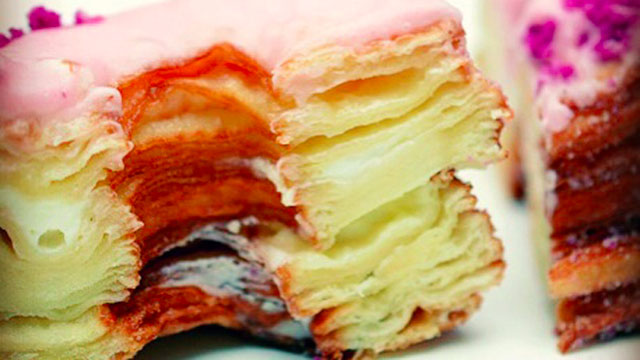
Cronuts are donuts made from croissant dough and they are all the rage here in NYC. They were invented by chef Dominique Ansel and they are only available in limited quantities at his bakery in Soho. Apparently people start lining up for them at 6am and all 200 of the world’s daily supply of cronuts are gone within minutes of opening. Naturally, a black market has sprung up, with cronuts selling on Craigslist for upwards of $25/item:

Kevin Roose has some ideas for Ansel about expanding the reach of the cronut, but in the meantime, Edd Kimber replicated the treat at home with a quickie croissant dough.
Since I wont be in New York any time soon I thought I would see if I could replicate them at home, and you know what? They are pretty damn good! Now the dough I’m using isnt a proper croissant dough, its my quick dough made with just 20 minutes active work which, compared to traditional croissant dough is a snap to make.
Update: Pillsbury has gotten into the act as well with a cronut recipe that uses their crescent dough.
Update: In his forthcoming cookbook, Ansel reveals the recipe for the cronut and it’s not for the faint of heart…the recipe takes three days to make.
Kenji Fujimoto spent more than a decade as Kim Jong-il’s personal chef and his children’s nanny. This is his amazing story.
At a lavish Wonsan guesthouse, Fujimoto prepared sushi for a group of executives who would be arriving on a yacht. Executive is Fujimoto’s euphemism for generals, party officials, or high-level bureaucrats. In other words, Kim Jong-il’s personal entourage. Andguesthouse is code for a series of palaces decorated with cold marble, silver-braided bedspreads, ice purple paintings of kimilsungia blossoms, and ceilings airbrushed with the cran-apple mist of sunset, as if Liberace’s jet had crashed into Lenin’s tomb.
At two in the morning, the boat finally docked. Fujimoto began serving sushi for men who obviously had been through a long party already. He would come to realize these parties tended to be stacked one atop another, sometimes four in a row, spreading out over days.
All the men wore military uniforms except for one imperious fellow in a casual sports tracksuit. This man was curious about the fish. He asked Fujimoto about the marbled, fleshy cuts he was preparing.
“That’s toro,” Fujimoto told him.
For the rest of the night, this man kept calling out, “Toro, one more!”
The next day, Fujimoto was talking to the mamasan of his hotel. She was holding a newspaper, the official Rodong Sinmun, and on the front page was a photo of the man in the tracksuit. Fujimoto told her this was the man he’d just served dinner.
“She started trembling,” Fujimoto said of the moment he realized the man’s true identity. “Then I started trembling.”
The man in the tracksuit invited Fujimoto back to make more sushi. Fujimoto didn’t speak Korean, so he had a government-appointed interpreter with him at all times. At the end of the evening, a valet handed the interpreter an envelope.
“From Jang-gun-nim,” the valet said.
Perhaps the reason Fujimoto hadn’t known he’d been serving Kim Jong-il was because “no one ever called him by his real name,” Fujimoto said. “Never.”
Maya Weinstein has created a DIY kit for making your own HFCS (high-fructose corn syrup). You may have already guessed that it’s an art project and that the artist lives in Brooklyn.
The DIY High Fructose Corn Syrup Kit (DIY HFCS KIT) begin as a journey to uncover the mysteries of processed food. Often times at the grocery store while reading common food labels one cannot distinguish what certain ingredients are or where they came from. The DIY HFCS Kit is a way to visualize as well as interact with the food science behind industrialized ingredients, it is citizen food science for everyone, everywhere. The ingredient chosen for this particular kit is one that is seen a lot in processed and pre-made foods, it is pretty much everywhere, and it goes by the name high fructose corn syrup. The interesting thing about high fructose corn syrup is that the ingredient pops up in so many foods; from cereal to bread, yogurt to ice cream, frozen dinners to canned soups; but high fructose corn syrup is never actually seen on its own. One of the main reasons for this is because it is a highly processed industrialized ingredient created in large factories behind very closed doors. The method for making for high fructose corn syrup was not easy to uncover, nor were the ingredients, but with a little help from some friends and a whole lotta research and testing the Kit was finally created.
Weinstein was planning a Kickstarter campaign for kit sales but “they didn’t really understand what I was doing, they said my business plan was unclear”. (via @CharlesCMann)
Interesting piece about how the shift in influence from the Michelin Guide to the World’s 50 Best Restaurants list has changed the approach of elite restaurants.
Just look at Eleven Madison Park, a restaurant that has over the past few years steadily risen the ranks of the World’s 50 Best list (it’s currently ranked No. 5). As recently as four years ago, it was just an expertly run restaurant, specializing in luxe ingredients, disarmingly warm service, and lovely meals. It got as many stars as it could from every venue that gave them out, but as a New Yorker story last September made clear, to get a high ranking on the World’s 50 Best list, the restaurant had to do something different, so they moved from a standard menu to a “grid” menu in 2010 that was designed to offer diners a greater sense of control over their meals. It ranked 50th on the 2010 list, 24th on the 2011 list, and 10th when the 2012 list was announced in April of that year. In July 2012, the restaurant announced they’d be switching formats yet again, this time to a single tasting menu focused on New York terroir. (Some theatrical service elements that accompanied the meal — long explanations of dish inspiration, for example — got a negative reaction and have been more or less excised.) Did any of these changes make the restaurant “better”? Having eaten there a number of times over the years, this author would say that it’s not really any better or worse — it was and still is operating at the highest possible level a restaurant can. But it doesn’t matter if the changes made the restaurant better: Every time the restaurant switched up its format, it got plenty of accompanying media coverage that let judges know they needed to return to see what was going on.
(via @Gachatz)
For Slate, Anna Weaver argues that Spam aligns quite well with current food trends in America and should be eaten more.
Consider that Spam contains not only ham (meat from the hind leg of the pig) but also pork shoulder. Today, pork shoulder is beloved by chefs and home cooks, but when Spam first hit the shelves, it was an underutilized and underappreciated cut. Hormel took that underrated meat and transformed it into a salty, meaty treat. “It’s a centuries-old idea,” says Hawaiian chef Alan Wong, who pays homage to Spam in his eponymous Honolulu restaurant. “You get all your trimmings and you turn them into sausage or a meatloaf or pate or a terrine.” I’ve never seen a meat-eater turn up his nose at sausage or pate — what rational basis is there, then, for eschewing their all-American cousin?
See also fast food as molecular gastronomy.
Momofuku’s David Chang cooks up some gourmet space food for celeb astronaut Chris Hadfield.
Unfortunately, it doesn’t work out so well. Who knew that gravity was so useful? But stay for the best part of the whole thing…right at the end, Hadfield feeds himself asparagus like a fish.
Perfect for a slow Friday afternoon. Have a good weekend everyone.
Adam Davidson on the asinine and broken food truck/cart system in NYC. This short paragraph not only explains what’s wrong with the food cart biz in NYC but also with American politics in general:
Economically speaking, the problem is a standard one, known as the J-curve, which represents a downslope on a graph followed by a steep rise. Some sensible changes to the current food-vendor system may have long-term benefits for everyone, but the immediate impact could spell short-term losses for those who now profit from the system. A small group of New Yorkers — particularly owners of commissaries and physical restaurants — are highly motivated to lobby politicians not to change things. And most of the potential beneficiaries don’t realize they’re missing out. Many of the rest of us would love to have more varied food trucks, but we don’t care enough to pressure the City Council.
(via @tylercowen)
In Lambert’s Cafe in Sikeston, MO, they just throw your bread to you from across the restaurant.
You’ve heard of oobleck, yeah? It’s a non-Newtonian fluid made of corn starch and water that doesn’t act like a normal fluid. Like, for instance, you can run on top of it:
Cooking Issues ran across a video of a cook preparing noodles made from a non-Newtonian batter. Watch as the batter solidifies when he slaps more batter into the sieve and then drains out of the bottom.
Love the technique here. See also the noodle-making robot, power of noodles, Korean honey candy, and, my favorite, flatbread tossing:
(via @Ianmurren)
This video would be a lot better without the first 15 seconds (sippy cups? talking? who cares?) but the rest of it is pants-wettingly amazing.
NPR’s Planet Money talked to Ed Herr of Herr Foods about how potato chip manufacturing has changed since 1946, when the company was housed in a barn on his family’s land.
Herr estimates that if they currently made chips the way they did back in the 1940s, they’d cost about $25 a bag.
Mark Bittman explores the world of healthy fast food and discovers that’s slowly becoming a thing.
Good Fast Food doesn’t need to be vegan or even vegetarian; it just ought to be real, whole food. The best word to describe a wise contemporary diet is flexitarian, which is nothing more than intelligent omnivorism. There are probably millions of people who now eat this way, including me. My own style, which has worked for me for six years, is to eat a vegan diet before 6 p.m. and then allow myself pretty much whatever I want for dinner. This flexibility avoids junk and emphasizes plants, and Lyfe Kitchen, which offers both “chickin” and chicken — plus beans, vegetables and grains in their whole forms (all for under 600 calories per dish) — comes closest to this ideal. But the menu offers too much, the service raises prices too high and speed is going to be an issue. My advice would be to skip the service and the wine, make a limited menu with big flavors and a few treats and keep it as cheap as you can. Of course, there are huge players who could do this almost instantaneously. But the best thing they seem able to come up with is the McWrap or the fresco menu.
Despite progress in recent years on causes and cures, colony collapse disorder has wreaked havoc on honeybee colonies across the country.
A mysterious malady that has been killing honeybees en masse for several years appears to have expanded drastically in the last year, commercial beekeepers say, wiping out 40 percent or even 50 percent of the hives needed to pollinate many of the nation’s fruits and vegetables.
Which is like, yeah, big whoop, it’s just bees, right? Except that:
The Agriculture Department says a quarter of the American diet, from apples to cherries to watermelons to onions, depends on pollination by honeybees.
Newer posts
Older posts






Socials & More