


This site is made possible by member support. 💞
Big thanks to Arcustech for hosting the site and offering amazing tech support.
When you buy through links on kottke.org, I may earn an affiliate commission. Thanks for supporting the site!
kottke.org. home of fine hypertext products since 1998.
Beloved by 86.47% of the web.
Entries for May 2021
100 Visions of Motherhood



Curated by The Luupe, this is “a collection of photographs and words celebrating the complexities of motherhood”. And somehow even 100 photographs don’t adequately capture the vast experience of motherhood around the world. Photos above by Dee Williams, Brittany Marcoux, Diane Allford (via storythings)
The evolution of butts. “Gently turn that blobby body around, and gaze deep into its marvelous, multifunctional anus.”
A Visualization of American Age Generations
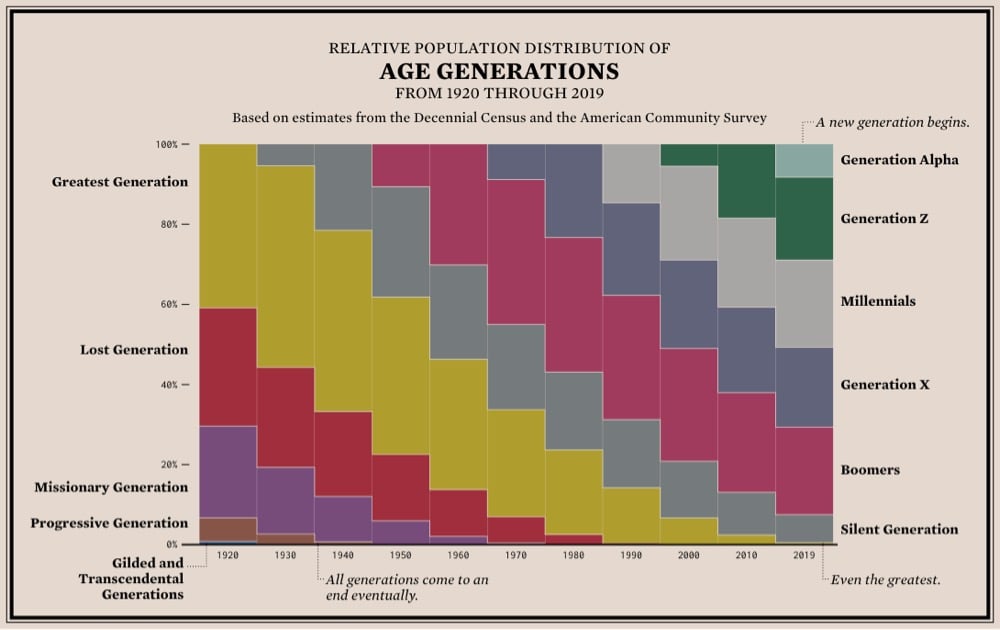
From Flowing Data, a stacked bar chart showing the relative population distribution of age generations from 1920 to the present. The thing that’s really apparent to me in this graph is how the size, increased life expectancy, and better quality of life of the Silent and (especially) Baby Boomer generations really shifted the social order in America. It’s a triple whammy: this large group of very healthy people stuck around so much longer than the previous generations that they were able to keep their wealth and political/corporate power instead of handing it off to the next generations. It’s a generational firewall — they didn’t leave any room for their children or grandchildren. Instead, Gen X and Millennials got branded as lazy/apathetic and financially careless. (via @mikey_two)
A profile of Vermont governor Phil Scott, who is a Republican thriving in the most liberal state in the US. As a Vermonter, I can say his handling of the pandemic was very good, conservative in the best sense.
The Continuing Trauma of the Pandemic
Because of the remarkable Covid-19 vaccines, the pandemic is easing in America. In many parts of the country, things are returning to some semblance of normal, whatever that means. But many will continue to struggle and come to terms with what happened for awhile longer. Ed Yong, What Happens When Americans Can Finally Exhale:
But there is another crucial difference between May 2020 and May 2021: People have now lived through 14 months of pandemic life. Millions have endured a year of grief, anxiety, isolation, and rolling trauma. Some will recover uneventfully, but for others, the quiet moments after adrenaline fades and normalcy resumes may be unexpectedly punishing. When they finally get a chance to exhale, their breaths may emerge as sighs. “People put their heads down and do what they have to do, but suddenly, when there’s an opening, all these feelings come up,” Laura van Dernoot Lipsky, the founder and director of the Trauma Stewardship Institute, told me. Lipsky has spent decades helping people navigate the consequences of natural disasters, mass shootings, and other crises. “As hard as the initial trauma is,” she said, “it’s the aftermath that destroys people.”
And it wasn’t just the pandemic:
Not everyone will feel this way. Perhaps most Americans won’t. In past work, Silver, the UC Irvine psychologist, found that even communities that go through extreme traumas, such as years of daily rocket fire, can show low levels of PTSD. Three factors seem to protect them: confidence in authorities, a sense of belonging, and community solidarity. In the U.S., the pandemic eroded all three. It reduced trust in institutions, separated people from their loved ones, and widened political divisions. It was something of a self-reinforcing disaster, exacerbating the conditions that make recovery harder.
Also, let’s not forget: “Globally, the pandemic is set to kill more people in 2021 than in 2020.”
The Last Words of Quintin Jones
Last week, I posted about Texas death row inmate Quintin Jones and his plea for clemency in the face of his pending execution. Again, here is his video message to Texas governor Greg Abbott:
On Wednesday evening, in the presence of two outside witnesses, Texas killed Quintin Jones. Two journalists who were to bear witness to the execution for the public were not called into the prison by officials who somehow “forgot” to do so:
Absent were two journalists who had been scheduled to attend the execution but whom prison officials said they had accidentally failed to summon.
Before he died, a video director for the NY Times recorded a short video of Jones’ last words to the public, in which he thanked everyone for helping him be a better person and even asked viewers to consider the trauma that death row prison guards endure in the course of doing their jobs. A separate statement of his last words was recorded by prison officials:
“Love all my friends and all the friendships that I have made,” Mr. Jones said, according to those state prison records. “They are like the sky. It is all part of life, like a big full plate of food for the soul. I hope I left everyone a plate of food full of happy memories, happiness and no sadness.”
Then he said, “I’m done, warden.” He was pronounced dead at 6:40 p.m.
That same day, Governor Abbott, who is a member of the so-called “pro-life” Republican party, signed a law that bans abortions in Texas after a fetal heartbeat can be detected, which is before many women are even aware they are pregnant.
A possibly novel coronavirus that may have jumped from dogs into humans has been detected in samples taken in Malaysia in 2017/18. NOT NOW JESUS CHRIST.
Just sent out this week’s @kottke newsletter. It features pencil typography, an infinite hotel, and a majestic thundercloud.
How to Take the Perfect Nap
As someone who is mostly unable to nap, I’ve always felt a twinge of envy towards those who can shut their eyes, drift off for 20 minutes, and awake refreshed & raring to go. Maybe I’ll have better luck after watching this TED-Ed lesson by sleep researcher Sara Mednick (author of Take a Nap! Change Your Life.), which explains when and how long you should nap for optimal results. (via open culture)
Documentary filmmaker Tim Wardle shares 15 things he wished he’d known about documentary filmmaking when he started out. “6. Embrace the nuance and psychological complexity/messiness of real people.”
“Every Child on Their Own Trampoline”
I suspect that if you read this site with any regularity, the pandemic has you thinking about our society’s prioritization of the rights & desires of the individual versus the needs of the community. Using the purchase of a backyard trampoline for his kids as a jumping off point, Jeremy Williams wonders if we haven’t “tipped too far towards private consumption”.
Capitalism pushes us towards private affluence. We aspire to acquire our own things. Shared things are seen as second best, something of an inconvenience. Politics responds accordingly, prioritising economic growth and ‘more money in your pocket’, rather than shared goods and services. So everyone has their own lawnmower while the grass grows long in the park. People get their own exercise bikes or rowing machines, and the gym at the local leisure centre starts to look tired and under-funded. The wealthy pay for childcare or hire a nanny, but the early years nursery closes down.
Having access to your own things looks like progress, but there is a cost. Community is one of the victims. Shared spaces are places where community happens, where people mix and meet. Nobody makes new friends on their own rowing machine, in front of the TV. Inequality is another. Those who can afford their own won’t notice, but those on lower incomes rely much more on shared resources. When a library closes, it’s those on the margins of society who lose access to books, internet access, or a warm place to sit and do their homework. There is also an environmental cost, as private ownership means endlessly duplicated goods, many underused objects across many owners rather than a few well used objects that are shared.
(via dense discovery)
The Micrometeorites All Around Us



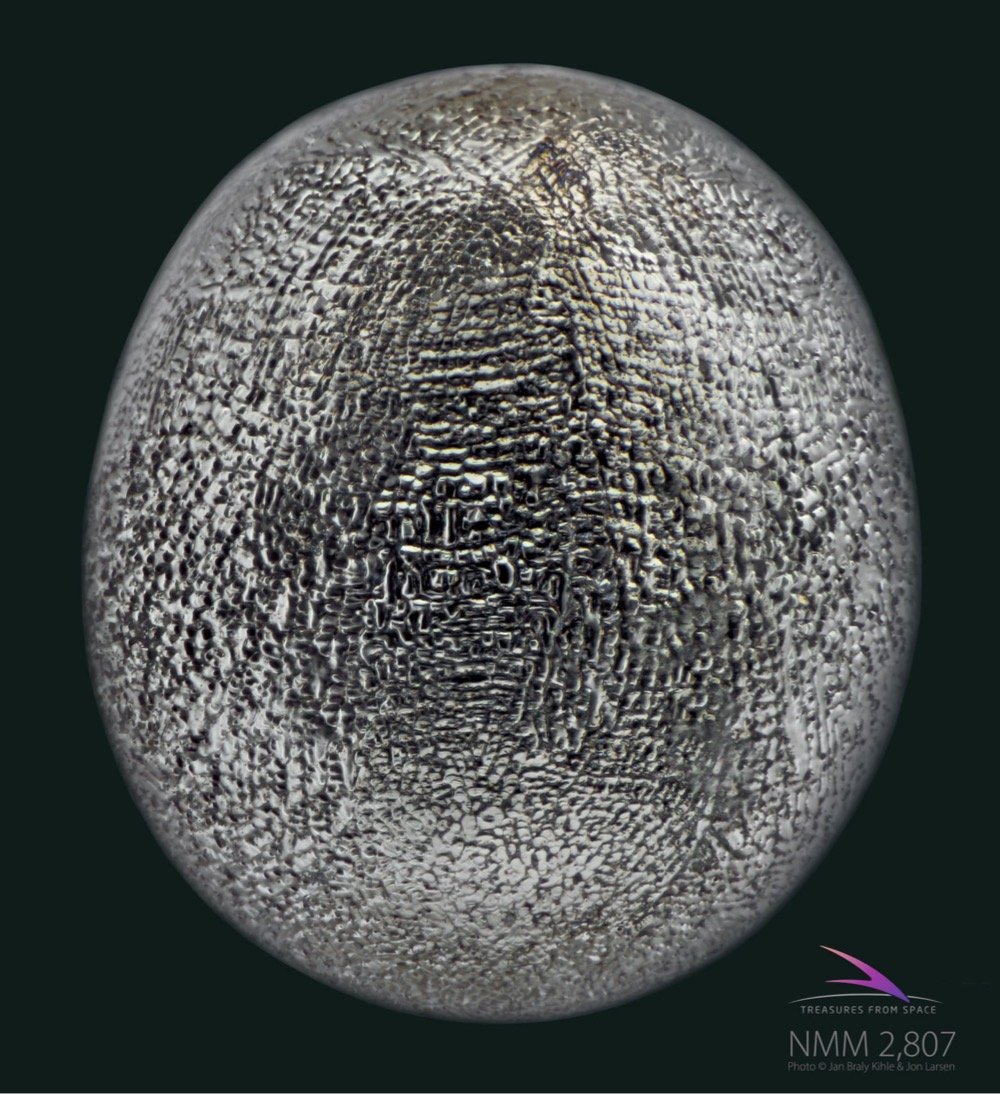
Jon Larsen collects and photographs micrometeorites from all over the world, finding them even in urban areas mixed in among terrestrial dust and dirt.
The cosmos is a swirling soup of stardust. Every day, approximately 60 tons of dust from asteroids, comets, and other celestial bodies fall to the Earth. These tiny metallic, alien stones of various shapes, textures, and colors-known as micrometeorites-are some of the oldest pieces of matter in the solar system.
Even though micrometeorites blanket the Earth, scientists have generally only been able to discover them in remote places devoid of human presence, such as Antarctic ice, desolate deserts, and deep-sea sediments. Scientists began searching for micrometeorites in the 1960s, and they predominantly thought the extraterrestrial dust would be impossible to find in urban environments. The conventional wisdom held that densely populated areas had too much man-made sediment that camouflaged the tiny space particles.
But Jon Larsen, a Norwegian jazz musician and creator of Project Stardust, was able to show that it is possible to find micrometeorites in more populated areas. In a study published in January 2017 in the journal Geology, he and his colleagues catalogued more than 500 lustrous micrometeorites (and counting), all recovered from rooftops in urban areas.
Check out Larsen’s Project Stardust for more photos and information on how to hunt for your own. (via the kid should see this)
A Harsh Review, Revisited
This is pretty unusual. Years ago, NY Times film critic AO Scott panned Sarah Silverman: Jesus Is Magic and Silverman, instead of reacting in a typical way, ultimately took his core criticism to heart and changed the way she thought about her comedy. The two of them recently linked up for a conversation about the “challenges both of doing comedy and of writing criticism”, namely that:
You’re supposed to be honest, and you’re supposed to tell the truth and not worry about giving offense. On the other hand, what you do, what I do has a risk of hurting people.
Here’s Silverman:
But the thing you wrote that kind of changed me on a molecular level, which is what, I think, you were kind of onto at the time was completely what I was abusing — and you saw that before anyone else, and you made me see it — which is I’m liberal, so I’m not racist, so I can say the N-word, because I’m illuminating racism.
My intentions were good but ignorant, and it’s funny that in that movie and in the subsequent series I did, my character was ignorant [and] arrogant, but what I didn’t realize was [that I] myself was arrogant [and] ignorant.
I couldn’t help thinking of Pixar’s Ratatouille here, in which the opposite thing happens: the artist changes the critic’s mind.
Pencil Typography

Even just looking at photos of pencils, I can still smell the sheets of mimeograph paper hot off the ditto machine.
Relaxing White Noise Album Made with Lego Bricks
I’m always on the lookout for sounds that help you focus and/or relax; I’ve collected a number of video soundscapes here. If you happen to find the sounds of Lego bricks relaxing, you can add these videos to your routine:
The first one features the sound of Legos being poured and the second one is the sound of someone digging through the Lego bin & snapping pieces together. The full 3.5-hour album of Lego sounds is available to stream on Spotify and Apple Music.
Here’s the company’s press release and a behind-the-scenes look at the album’s production from The Guardian.
The project was devised by Lego’s “head of creative” Primus Manokaran, who describes the streaming-only album as “a collection of soundscapes” designed to promote relaxation and mindfulness. Although the seven tracks, which each run to half an hour in length, are different in their granular details, essentially they were made by Lego pieces being poured out of tubs, sifted through and clicked together.
Manokaran’s team began thinking about why people love Lego during lockdown, and realised that a big hook was how it sounds. Inspired by the online craze for white noise as an aid to relaxation and focus, they began recording. “The acoustic properties of each brick was slightly different,” he says. “It was like composing with 10,000 tiny instruments.”
(thx, martin)
The Pain of the Commute
Luke O’Neil talked to dozens of people who were able to work from home during the pandemic about not missing the commute part of working in an office. A few of the responses:
No one’s stopping anyone who works from home from going out and riding in circles on the subway for 30 minutes before they go back to their desk.
I save roughly $100 a month now. I have time in the morning to take my dog for a long walk every day. I have time in the evening to cook dinner. Commuting is psychological torture and my physical and mental health is significantly better without it.
I love to drive 30 minutes to stare at a different computer
I can’t even calculate the savings in gas, wear on my car, etc. But I can tell you that with nearly two hours back in each of my days, plus the extra 40 minutes or so of making myself presentable to be in close proximity to others, I have been able to reinvest that time in myself. I have been eating better, I have time for the gym, I have time to give my dogs the exercise they need. I know this year has been mentally taxing on so many, but I’ve found these changes work so much better for me.
Why Confederate Lies Live On. “Confederate history is family history, history as eulogy, in which loyalty takes precedence over truth.”
My Recent Media Diet, the Fully Vaccinated Edition
Every few months for the past couple of years, I’ve shared the movies, books, music, TV, and podcasts I’ve enjoyed (or not) recently. Here’s everything I’ve “consumed” since early February, accompanied by a mini review.
How To with John Wilson. What happens near the end of the risotto episode got all the attention, but I’m all about the bag of chips saga. (B+)
Black Art: In the Absence of Light. I can listen to artists and critics talk about art all day long. Also? Everyone in this has impeccable eyewear. (A)
Spirited Away. A masterpiece. (A)
Pfizer-BioNTech Covid-19 Vaccine (BNT162b2). Possibly the best experience of the past 5 years. (A+++++)
Casino Royale. The best of the Daniel Craig Bonds IMO. (B+)
The Lying Life of Adults by Elena Ferrante. Another marvelously constructed world with vibrant characters by Ferrante. (A)
Wandavision. A love letter to television. Watched this with the kids and we all loved it. (A)
Looper. This is perhaps my favorite type of movie: clever sci-fi with a creative director and good actors that give a shit. (A-)
Sonic the Hedgehog. Jim Carrey is the highlight here and not much else. (C+)
The Remains of the Day. One of my favorite movies. I’ve watched this every few years since 1993 and what I get out of it changes every time. Great book too. (A+)
Judas and the Black Messiah. Fantastic performances by Daniel Kaluuya and LaKeith Stanfield. (A)
Zack Snyder’s Justice League. Way too long and nearly pointless. This is what happens when you start treating the director of Legend of the Guardians: The Owls of Ga’Hoole like an auteur. (B-)
A Promised Land by Barack Obama. I recommend the audiobook version of this. You can really tell the bits of the book he cares about and the stuff he phones in a little bit more. The tone of his voice when he talks about Michelle — that love is real. (B+)
Making Sense — The Boundaries of Self. I listened to this conversation with the poet David Whyte at the beginning of March and it was exactly what I needed to hear at that time. I must have listened to his short essay on Friendship about 5 times. (A)
Thunderstruck by Erik Larson. About the invention of the wireless telegraph and the beginning of our abundantly connected world. (B+)
Still Processing - The N Word. The way that Morris and, particularly, Wortham use inclusive language is fascinating. They invite people into the conversation without any loss of insight or critical capability. A bracing rebuttal to the idea that using so-called “woke” language is hamstringing discourse in America. (A-)
Matilda by Roald Dahl. Read this aloud to the kids and was told my rendition was not nearly as good as Kate Winslet’s. (B+)
You’re Wrong About (The continuing OJ saga). This has become the show’s version of Nicholson Baker’s The Mezzanine, with entire episodes dedicated to explaining mere minutes of the trial. I am here for it. (A)
Godzilla vs. Kong. I watched this after eating an edible and I think that’s the perfect way to do it. Monsters, roar! (B)
Star Trek VI: The Undiscovered Country. One of my favorite Trek movies. (A-)
The Falcon and the Winter Soldier. Less popular with me and the kids than Wandavision. Occasionally fun but also kind of a mess, especially when it comes to the “moral of the story”. (B)
The Talk Show with Craig Mod. Every single second of this 2.5-hour-long conversation between Craig Mod and John Gruber felt like it was created specifically for me. (A-)
Rough Translation - Liberté, Égalité, French Fries… And Couscous. A follow-up to a classic episode about a French McDonald’s that was commandeered by its employees. (B+)
Unstoppable. The perfect movie. I wouldn’t change a thing. (A)
Pac-Man 99. A nice update to this venerable game. The kids dismissed it as “too hectic”. (B+)
Fortnite. The perfect game for introverts — you can actually win by cleverly avoiding crowds and then dealing with a much more manageable 1-on-1 situation. But also I am old and there are too many buttons on this controller. (B+)
Croupier. Young Clive Owen, wow. (B+)
HazeOver. Recommended to me by Mike Davidson, this macOS app dims background windows to help you focus on your work. (B+)
Titanic. Had to rewatch after Evan Puschak’s video about it. Still an amazingly effective blockbuster movie. (A)
For All Mankind (Season One). So many people have recommended this to me over the past year and I finally got around to watching it. I was hooked within the first 5 minutes. (A)
The Mitchells vs. The Machines. Entertaining and stylistically interesting. (B+)
NYC. So much to say about this city and the resilience of the people who call it home. Still undefeated. (A)
Throughline — The Real Black Panthers. Great podcast on the political agenda and strategy of the Black Panther Party. A natural companion to Judas and The Black Messiah. (A)
Frick Madison. They have like 10% of the world’s Vermeers in just one room! (B+)
The Whitney. Great to be back here to see the work of Dawoud Bey and Julie Mehretu. (A)
The outdoor dining situation in NYC. The city has to keep this and the pandemic pedestrian areas reclaimed from cars. More room for people, less room for cars. (A)
Fairfax. This is the sister restaurant to my two favorite places in NYC, both of which closed permanently because of the pandemic, and the first restaurant I’ve been to since March 2020. We ate outside, I had too many cocktails, and it was perfect. (A+)
Past installments of my media diet are available here.
West Texas Thunderstorm

Photo by Laura Rowe. Wow. Evocative of Milton Glaser’s Bob Dylan poster. (via @mathowie)
Rick Steves: Germany’s Fascist Story
Rick Steves’ travel shows and videos typically highlight the positive aspects of travel destinations in Europe and around the world. But more recently, he’s also been making shows about Europe’s unpleasant past. In 2019, he did an hour-long TV special about the history of fascism in Europe
Because Steves hosts a travel show, they visit some of the places where this history played out, including Nuremberg, Auschwitz, and Rome, talk to historians and tour guides, and discuss fascist and anti-fascist art, including Picasso’s Guernica.
And earlier this year, Steves made a similar show that focused just on Germany, embedded above.
Traveling across Germany, we learn how fascism rose and then fell, taking millions of people with it. Visiting actual locations — from Munich to Nürnberg to Berlin — we trace the roots of Nazism in the aftermath of World War I, when masses of angry people were enchanted by Hitler. We explore the totalitarian society Hitler built, and see the consequences: genocide and total war. Learning from Germany’s fascist story, we can recognize that hateful ideology as well as the tricks of wannabe dictators in our own age.
(via open culture)
Novelty is the key to understanding the pandemic. “SARS-CoV-2 is new to our immune systems. That makes it very dangerous. Viruses that are new to us spread faster and are more lethal than old familiar ones.”
A profile of Shayne Bushfield and the relatively small online community he runs, LearnedLeague. “What Bushfield wants is to re-create, over and over, the experience of playing trivia with his friends at the office.”
Barry Jenkins Films the Gaze of His Ancestors
While he was filming the TV adaptation of Colson Whitehead’s The Underground Railroad, director Barry Jenkins was also working on this piece, entitled The Gaze. It’s a 50-minute, non-narrative video portrait of several of the show’s actors dressed in their period clothes, wordlessly looking into the camera.
I don’t remember when we began making the piece you see here. Which is not and should not be considered an episode of The Underground Railroad. It exists apart from that, outside it. Early in production, there was a moment where I looked across the set and what I saw settled me: our background actors, in working with folks like Ms. Wendy and Mr. and Mrs. King — styled and dressed and made up by Caroline, by Lawrence and Donnie — I looked across the set and realized I was looking at my ancestors, a group of people whose images have been largely lost to the historical record. Without thinking, we paused production on the The Underground Railroad and instead harnessed our tools to capture portraits of… them.
What flows here is non-narrative. There is no story told. Throughout production, we halted our filming many times for moments like these. Moments where… standing in the spaces our ancestors stood, we had the feeling of seeing them, truly seeing them and thus, we sought to capture and share that seeing with you.
(via the morning news)
An Infinite Hotel Runs Out of Rooms
This video from Veritasium is a nice explanation of the mathematician David Hilbert’s paradox of the Grand Hotel, which illustrates that a hotel with an infinite number of rooms can still accommodate new guests even when it’s full. Until it can’t, that is. See also Steven Strogatz’s explanation of Hilbert’s infinite hotel and how Georg Cantor’s discovery of different types of infinities complicated the hotel’s hospitality. (via digg)
TIL that my home internet service (that I use for producing @kottke) is not actually “broadband”. No wonder my kids complain about Fortnite lagging.
The Sparks Brothers
Edgar Wright has directed a documentary on a band called Sparks, which was formed by brothers Ron & Russell Mael in 1967 and the trailer (above) hails as “your favorite band’s favorite band”.
How can one rock band be successful, underrated, hugely influential, and criminally overlooked all at the same time? Edgar Wright’s debut documentary THE SPARKS BROTHERS, which features commentary from celebrity fans Flea, Jane Wiedlin, Beck, Jack Antonoff, Jason Schwartzman, Neil Gaiman, and more, takes audiences on a musical odyssey through five weird and wonderful decades with brothers/bandmates Ron and Russell Mael celebrating the inspiring legacy of Sparks: your favorite band’s favorite band.
The Sparks Brothers will be in theaters on June 18.
Watch as David Hockney Pages Through His Sketchbook
This is a treat: artist David Hockney wordlessly flipping through one of his sketchbooks from 2019 for 6 minutes. For the first few minutes, I thought that some verbal annotation would be nice, but it’s actually perfect as-is — you can just focus on looking. (via open culture)
“Maybe We Need Masks Indoors Just a Bit Longer”
Since yesterday’s announcement, I’d been feeling uneasy about the CDC’s decision to update its guidance to state that fully vaccinated people don’t need to wear masks in most situations indoors or out. Zeynep Tufekci’s piece in the Times nails why.
It’s difficult for officials to issue rules as conditions evolve and uncertainty continues. So I hesitate to question the agency’s approach. But it’s not clear whether it was responding to scientific evidence or public clamor to lift state and local mandates, which the C.D.C. said could remain in place.
It might have been better to have kept up indoor mask mandates to help suppress the virus for maybe as little as a few more weeks.
The C.D.C. could have set metrics to measure such progress, saying that guidelines would be maintained until the number of cases or the number vaccinations reached a certain level, determined by epidemiologists.
The vaccine is on its way to controlling Covid-19 in the US — but we’re not there yet. We’re not the UK or Israel…they’re further along in their vaccination campaigns and their daily cases and deaths are way down, warranting behavioral changes. In the US, over 600 people/day are still dying of Covid-19 and our case positivity rate is still above 3%. Too many people, including almost all children, are still vulnerable and as Tufekci says, the CDC could have waited a few more weeks to more quickly drive down the virus levels.
Update: The CDC’s move has been sharply condemned by National Nurses United, the nation’s largest union of registered nurses:
“The union noted that more than 35,000 new cases of coronavirus were being reported each day and that more than 600 people were dying each day. “Now is not the time to relax protective measures, and we are outraged that the C.D.C. has done just that while we are still in the midst of the deadliest pandemic in a century,” Ms. Castillo said.”
And Ken Schultz notes that the needle the CDC is trying to thread here might not work out the way that they’d hoped.
Imagine the social preference ordering is:
1. Unvaccinated wear masks, vaccinated don’t.
2. Everyone wears masks.
3. No one wears masks.Selfish, short-sighted behavior and the inability to monitor vaccination status mean that, in trying to get #1, you can end up at #3.
So I trust the CDC’s position that #1 is socially desirable from a scientific perspective. But by undermining mask mandates, they have made it more likely that we end up in #3, which science says is still risky. Living with #2 for now respects both science and social science.
A 12-Mile Video Walking Tour of Paris
Walking, cities, Paris, and YouTube are four of my favorite things, so this 5.5-hour, 12-mile video walking tour of Paris is right up my alley. Along the way, they visit the Notre Dame, the Arc de Triomphe, the market on Rue Mouffetard, the Jardins du Luxembourg, the Louvre, the Eiffel Tower, and lots more. If you turn the closed captions on, you can read about the histories of the places as the walk progresses. Hopefully this will tide me over until I can visit again. (via open culture)
Socials & More