Entries for January 2018
It’s been yeaaars since I watched or even paid much attention to the Oscars, but this year I’ve somehow managed to watch all nine movies nominated for Best Picture, along with most of the films featured in the other main categories (actor, actress, director, cinematography). Here’s my completely subjective ranking for Best Picture:
1. Dunkirk
2. Call Me by Your Name
3. The Post
4. Lady Bird
5. Phantom Thread
6. Three Billboards Outside Ebbing, Missouri
7. Get Out
8. The Shape of Water
9. Darkest Hour
Dunkirk and Call Me By Your Name are my definite 1 & 2 (same as David Ehrlich, just reversed), but the next three could be in any order…putting Phantom Thread in the fifth spot doesn’t do it justice. Three Billboards, The Post, and Phantom Thread all share the same problem — a significant shift in a main character’s behavior/character without the onscreen action properly selling it — but there were other things to recommend them. I don’t know why I didn’t like Get Out or The Shape of Water more, but they just didn’t do it for me. I don’t get the love for Darkest Hour…Oldman as Churchill shamelessly chews scenery and The Crown & Dunkirk were much better recent takes on Churchillian times. I don’t expect Dunkirk to actually win — nor perhaps should it — but it was my favorite.
For Best Lead Actress, I have not seen I, Tonya yet, but it would be difficult to top Frances McDormand in Three Billboards. For Best Lead Actor, I haven’t seen Denzel Washington in Roman J. Israel, Esq. but among the others I would go with Timothée Chalamet. For Best Director, Jordan Peele should get the nod for somehow creating a coherent socially conscious horror satire documentary, although I would happily cheer either Greta Gerwig or PT Anderson winning. And for Best Cinematography, I have not seen Mudbound, for which Rachel Morrison is the first ever woman to be nominated in this category, but Dunkirk and Blade Runner 2049 are two of the most visually stunning films I’ve seen in the past few years; I would give it to Hoyte van Hoytema in an upset over Roger Deakins, who inexplicably has never won this category.
Really liked Khoi Vinh’s review of The Founder (the McDonald’s/Ray Kroc biopic). I was similarly lukewarm on the movie itself, but the business/design aspects were thought-provoking.
Using high speed cameras, it’s possible to record the vibrations of everyday objects caused by nearby sounds and reverse engineer the sounds…essentially turning anything that vibrates into a speaker. For instance, if you want to know what a person is saying but can’t hear them directly, you can take a video of the house plant next to them and recover the sound from the micro-vibrations of the leaves. In one example, they filmed a pair of Apple earbuds playing a song and the recovered audio was accurate enough for the Shazam app to identify the song.
The group tested an eclectic selection of materials, including a bag of chips (excellent), a soda can (surprisingly mediocre), and a potted plant (average). They were even able to recreate music playing using footage of the vibrating ear buds. The best material of all was the thin foil wrapper on a Lindt chocolate bar Davis had been snacking on.
The worst was a brick, which they intended to use for measuring experimental error. Even that “did better than we expected it to do,” says Davis.
The last demo is especially clever…they use the rolling shutter effect to essentially overclock the frame rate of regular 60fps video to recover nearby sounds. Wow.
Stripe is ending their support for Bitcoin payments. Their rationale seems sensible: rising fees, higher transaction times, unstable exchange rates.
Tango is an experimental animated film made by Zbigniew Rybczyński in 1980. It takes place entirely in one room with an increasing number of characters cycling through it repeatedly. It’s the kind of thing you can’t stop watching once you start. (It’s also mildly NSFW.) Tango won The Academy Award for Best Animated Short Film in 1983. (via @neilcic)
A documentary about Fred Rogers just premiered at Sundance and will be out in theaters this summer on June 8; you can watch a short clip here. But in 2004, Michael Keaton hosted a documentary called Fred Rogers: America’s Favorite Neighbor. It’s somewhat hard to come by these days — the single remaining copy on Amazon is $79 — but there are a couple lengthy clips up on YouTube:
Why Michael Keaton? When he was young, Keaton worked for WQED, the television station that produced Mister Rogers’ Neighborhood, as a member of the crew. He was even on the show a few times (see the first clip above). (via austin kleon)
Phantom Thread is director PT Anderson’s latest film, starring Daniel Day-Lewis in what he says is his final movie appearance. As was the case with Anderson’s previous films, The Master and There Will Be Blood, Radiohead’s Jonny Greenwood did the soundtrack, and it was just earned him an Oscar nomination for Best Original Score.
It’s available on Spotify, iTunes, and Amazon.
100 Views of America, a Kickstarter project. “Based on your wishes I will select a photo from the Library of Congress’ photo archive personally for you.”
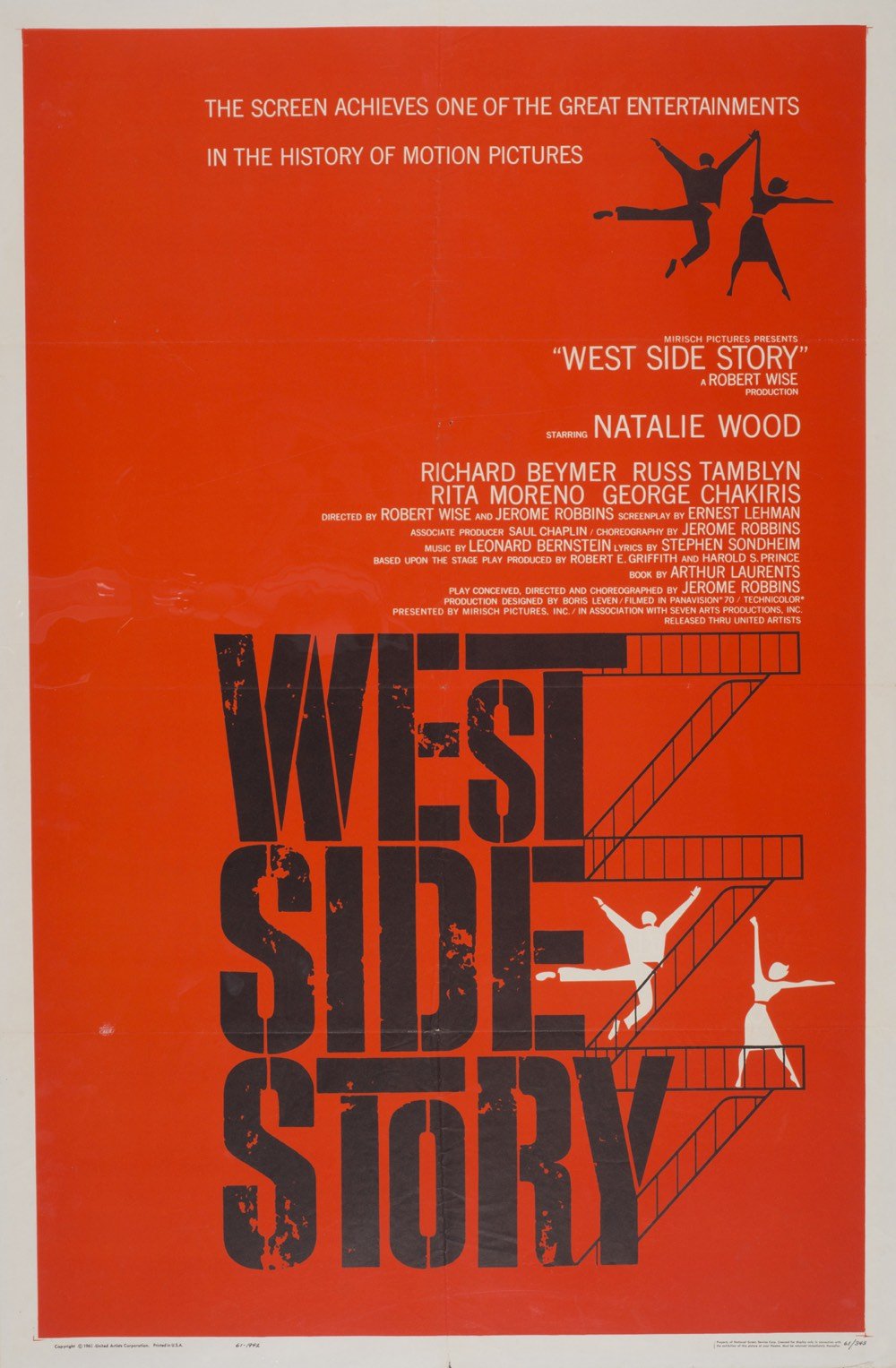
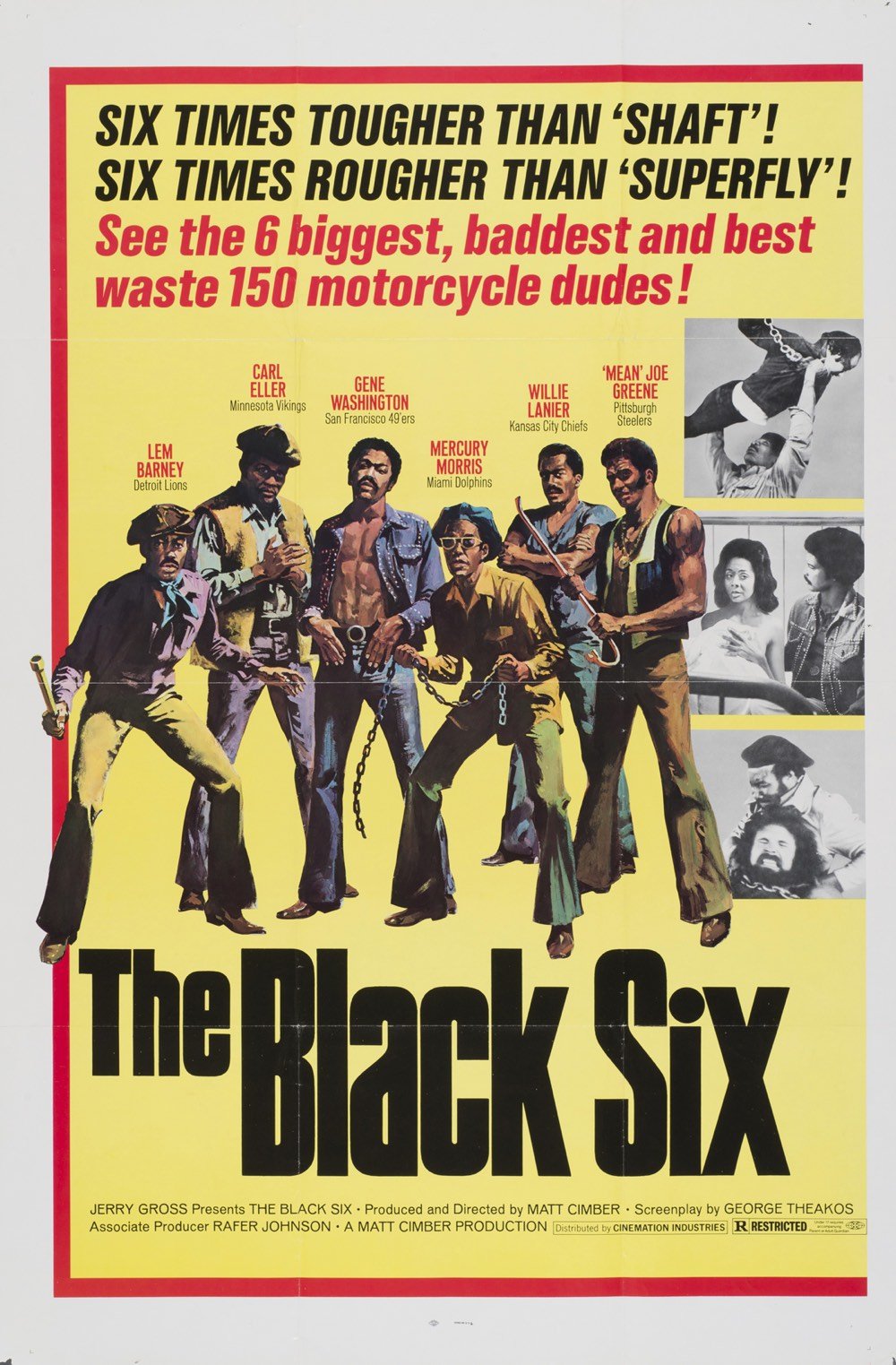
The Harry Ransom Center at the University of Texas at Austin is currently digitizing and putting online their collection of more than 10,000 movie posters.
The collection encompasses upwards of 10,000 posters and spans decades: from when the film industry was just beginning to compete with vaudeville acts in the 1920s to the rise of the modern megaplex and drive-in theaters in the 1970s. The sizes range from that of a small window card to that of a billboard.
You can browse the collection here. They’ve scanned over 4000 of the posters already and there are currently 500 posters available online, but more of them “will incrementally be made accessible online”.
See also a short film about a one-of-a-kind collection of letterpress plates for printing film advertisements and an amazing online collection of 40,000 vintage film posters. (via @john_overholt)
In a video for Audi, Candide Thovex skis in locations around the world without any snow. He skis in the jungle, on water, on volcanic ash, down sand dunes, and across the Great Wall of China. The sand dunes in particular look incredibly fun. I wonder how many pairs of skis he ripped up making this?
See also Thovex’s past videos: a fun run down the mountain, more creative freeskiing hijinks from Candide Thovex, and his previous commercial for Audi (love the ending).
Researchers at Harvard have developed a milliDelta robot that is very precise and moves very quickly. The video shows the robot moving so quickly (making circles up to 75 times per second) that the motion blurs, like Neo at the end of the first Matrix movie. From the description of a second video showing the milliDelta bot:
Our design is powered by three independently controlled piezoelectric bending actuators. At 15mm x 15mm x 20mm, it has a payload capacity of ~3x its mass. It can operate with precision down to ~5um, at frequencies up to 75Hz, and experience accelerations of ~22g.
This robot would kill at Track & Field on the NES.
This is probably one of the dumbest things I’ve ever posted and I love it.
Blade Runner 2049 takes place in the same location 30 years after the events in the original Blade Runner film, so it’s natural that the two movies share a visual style. But director Denis Villeneuve and director of photography Roger Deakins also sprinkled their film with direct but subtle references to scenes in the old movie, as seen in this side-by-side video. In this discussion with Rian Johnson, Villeneuve talked about his approach:
This is the first time I was making a movie inspired by another movie and I didn’t try to stay away from it. I just kept it as a bible, as a reference, as music that was very close to me that I was always referring to every time I was directing, thinking about the spirit of the first movie.
The effect is not enough to be distracting, but there’s definitely some visual rhyming going on.
See also the visual effects breakdown for how they created the digital double for Rachael in Blade Runner 2049.
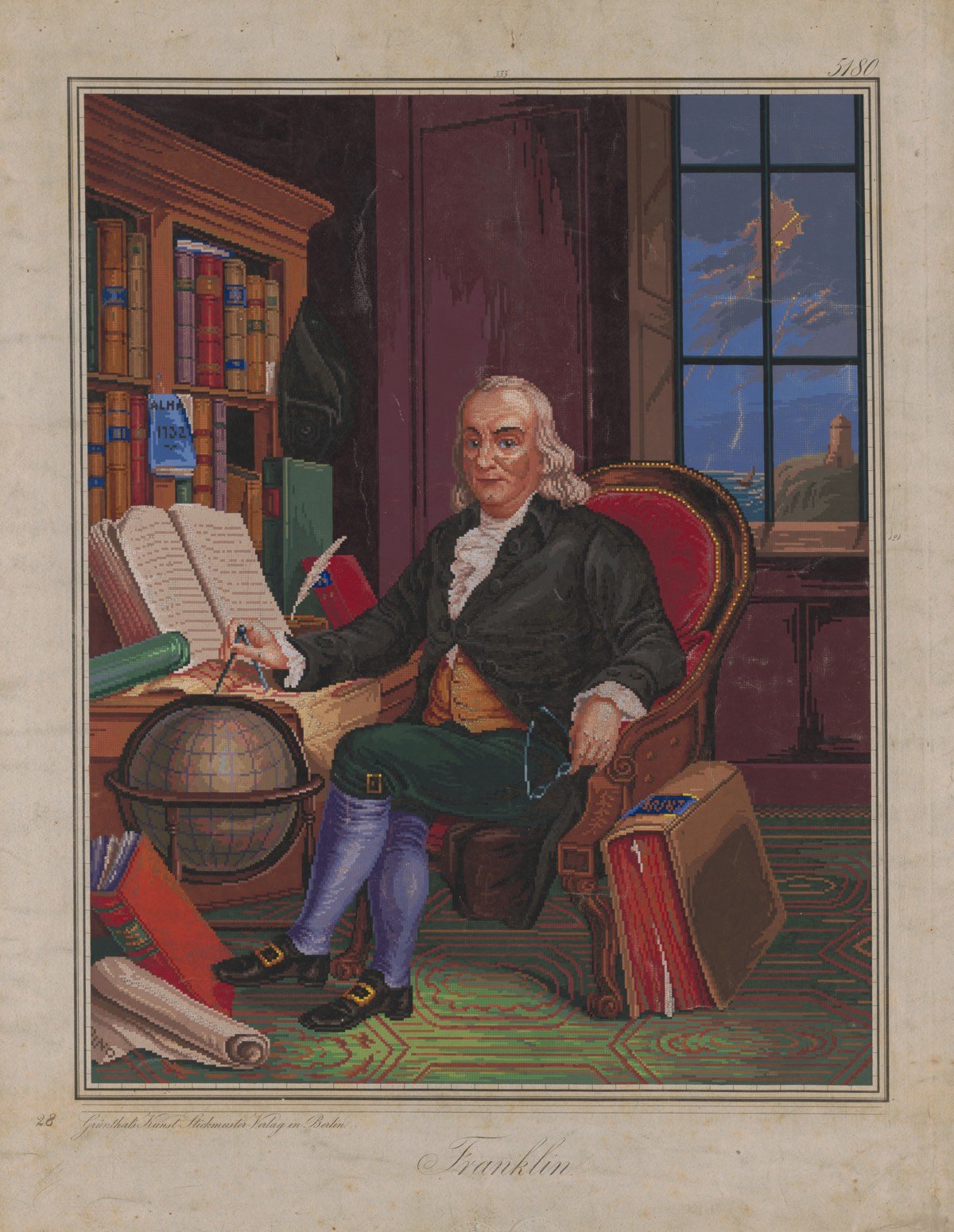
Ok, that’s not actually a screenshot from the hit Sega Genesis game Benjamin Franklin’s Polymath Academy. It’s a scan of an embroidery pattern from the 1840s or 1850s based on this engraving. Here’s a closer view:
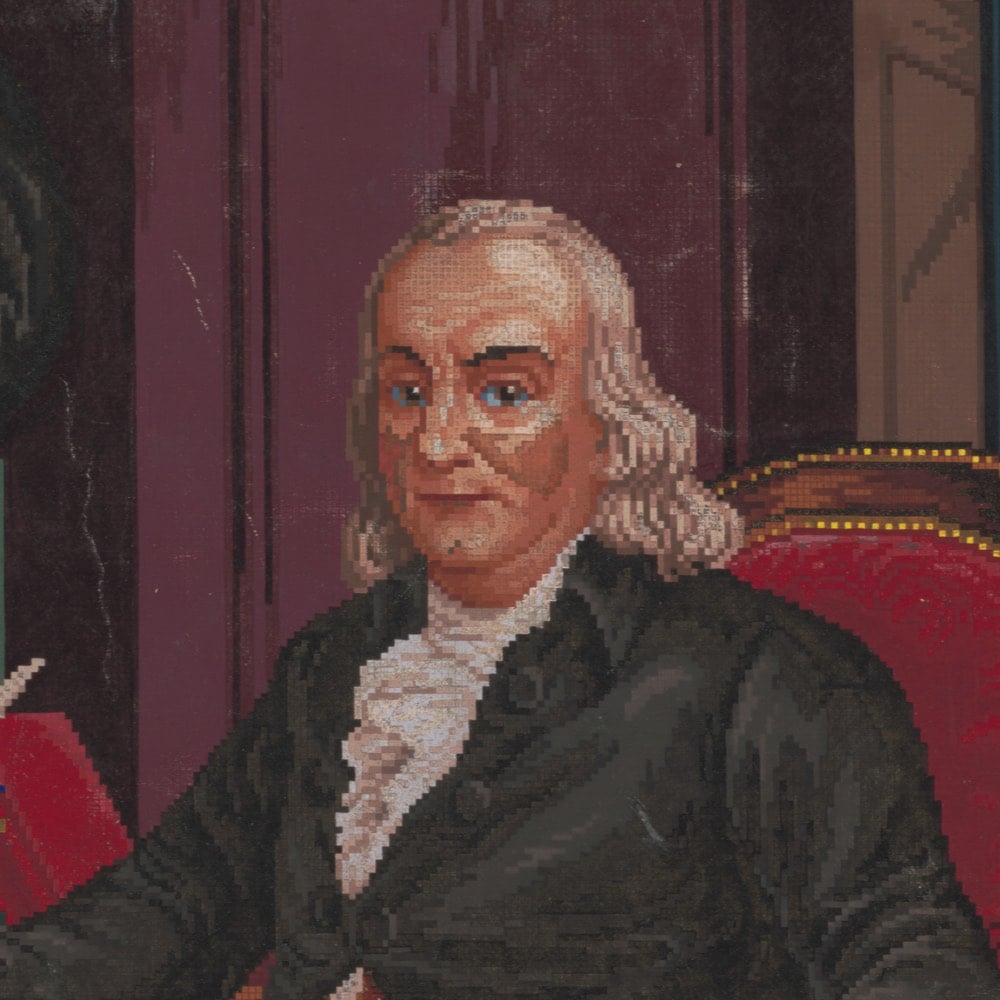
The scan is part of an ongoing project by the Library of Congress to scan their entire Popular Graphic Arts collection, a wonderful trove of prints, advertisements, and other printed documents from circa 1700 to 1900. (via @john_overholt)
10 years ago, Flickr launched their Commons project. It remains one of the very best expressions of the spirit of the open web.

NASA has built a service for estimating populations, part of which is a map hosted by Columbia on which you can draw a circle or a shape and the map will give you an estimate of the population contained by the shape. You can also access the service via an API…just send it polygonal coordinates and it returns population data.
Just for fun, I drew a small circle with an area of ~7000 sq. km and dragged it around to different spots on the globe:
NYC: 15,251,980
Rural Wyoming: 31
London: 12,972,590
Lagos, Nigeria: 14,106,980
Mumbai: 24,513,630
Tibet: 2,226
Seoul: 23,439,930
Tokyo: 32,572,740
Mexico City: 21,319,990
The Awl and The Hairpin announced they would be closing up shop at the end of the month, after almost nine years of danged good blogging. Several writers and editors wrote about their favorite pieces; many of them agreed with Jason that Willy Staley’s A Conspiracy of Hogs: The McRib as Arbitrage was a high-water mark.
Very little in pop culture, especially if it doesn’t live very long, is multi-generational. The Awl and The Hairpin managed to pull it off, straddling the seam of Millennials and Gen X with an air of uncaring desperation. It was the writers who lost their jobs in the financial crisis of 2008-2009 staring at the kids who couldn’t get real jobs after the financial crisis of 2008-2009, making a solemn vow to write whatever they thought was smart, or funny, or necessary for the moment.
Eventually, the jobs came calling — for many of the site’s best writers, but not for all — because they badly needed what The Awl had. And advertising: well, what are you going to do? Working on a shoestring may be romantic, but it sure ain’t no fun.
The Awl should have been the model for a new generation of sites that all outlived it. It wasn’t. We would mourn it less if there were more new blogs, staffed by hands young and old, rising to succeed it, jockeying to become required reading. Right now, there aren’t.
But who knows? There is still plenty of time.
This is an excerpt from the third installment of Noticing, a still-new and all-free kottke.org newsletter. We hope you’ll subscribe.
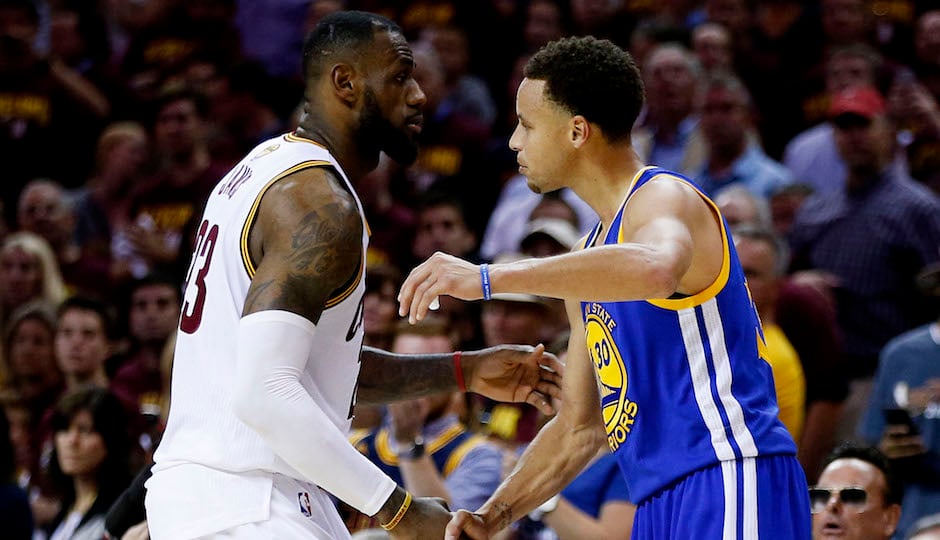
This year, the NBA All-Star Game won’t be strictly the best players in the east against the best in the west. Instead, the top vote getters in each conference get to choose their own teammates: first from the list of starters in both conference, and then from the list of reserves.
The NHL has done something similar for the past few years, broadcasting the draft, and offering a free car as a consolation prize to the player chosen last. All of this is extremely entertaining. But the NBA, whose soap opera dramatics leaves the NHL and every other sports league far, far behind, is having none of it. They’re refusing to televise the draft, or even to publicize which players will be selected in which order, to avoid hurting the players’ feelings. Come on! Hurting people’s feelings is the whole point! We want drama, we want angst, we want entertainment!
Anyways, the All-Star Reserves have not yet been chosen, but the starters and the captains have. It’s LeBron in the East, and Steph in the West, as almost everyone predicted. I thought it would be fun to imagine how the draft might go.
LeBron picks first. And remember: they have to choose all the starters before they can move on to the reserves. Those starters are: Kyrie Irving, Giannis Antetokounmpo, DeMar DeRozan and Joel Embiid from the East, and Kevin Durant, James Harden, Anthony Davis and DeMarcus Cousins from the West.
1. The LeBron Jameses select James Harden from the Houston Rockets.
LeBron needs a guard; he’s not going to take Kyrie Irving; Harden, despite injuries, is having another near-MVP season; and picking Harden rather than the best player on the board (Kevin Durant) pushes Steph into some predictable choices. I’m not letting Steph take all the guards and playing five out. I’m making him pick Durant.
2. The Steph Currys select Kevin Durant. Not only is he Steph’s teammate, he’s the best player on the board.
3. The LeBron Jameses select Anthony Davis. Versatile big who regularly guns it in the All-Star Game. You can’t tell me LeBron doesn’t want to play with this guy.
4. The Steph Currys select Giannis Antetokounmpo. Steph likes his bigs versatile. And Giannis was nearly unstoppable in last year’s All-Star Game. He plays hard.
5. Some real drama here. Kyrie is arguably the best player left on the board. Alternatively, LeBron needs to pick another big man, and either Embiid or Boogie is going to be salty if the other guy is picked first. But LeBron is a man of the people. He’s a man with a Philly beard. He’s going to take the popular choice. He’s going to have fun. He’s going to trust the process. He’s going to choose Joel Embiid.
6. Steph has some interesting choices here, all of which would be more interesting if the draft were televised. He could force LeBron to take Kyrie. Instead, he’s going to put together one of the most entertaining backcourts in All-Star Game history. He’s going to draft Kyrie Irving.
7. At this point, LeBron has too many bigs. Just for fit, he has to take DeMar DeRozan. Or have Boogie Cousins play the two and guard Kyrie. I don’t see it happening.
8. The Stephs Curry select DeMarcus Cousins. Who will be furious at being picked last (if he ever even finds out about it) and probably win All-Star MVP and/or pick a fight with LeBron, Embiid, and his own teammate AD.
Final lineups:
The LeBrons
- G: Harden
- G: DeRozan
- F: James
- F: Davis
- C: Embiid
The Stephs
- G: Curry
- G: Irving
- F: Antetokounmpo
- F: Durant
- C: Cousins
So basically, the west traded AD and Harden for Giannis and Kyrie. Probably a slight downgrade. But they do get the first pick in the second round, where they can take former MVP Russell Westbrook, any of Steph’s Warriors teammates, some young unicorns like Kristaps Porzingis and Ben Simmons, and so forth. In general, I would say these are more balanced teams, and they’re definitely more interesting teams.
Tell me again why the NBA isn’t televising this draft?

Today’s question comes from a reader who is curious about AI voice assistants, including Apple’s Siri, Amazon’s Alexa, Microsoft’s Cortana, and so forth. Just about all of these apps are, by default, given female names and female voices, and the companies encourage you to refer to them using female pronouns. Does it make sense to refer to Alexa as a “her”?
There have been a lot of essays on the gendering of AI, specifically with respect to voice assistants. This makes sense: at this point, Siri is more than six years old. (Siri’s in grade school, y’all!) But one of the earliest essays, and for my money, still the best, is “Why Do I Have to Call This App ‘Julie’?” by Joanne McNeil. The whole essay is worth reading, but these two paragraphs give you the gist:
Why does artificial intelligence need a gender at all? Why not imagine a talking cat or a wise owl as a virtual assistant? I would trust an anthropomorphized cartoon animal with my calendar. Better yet, I would love to delegate tasks to a non-binary gendered robot alien from a galaxy where setting up meetings over email is respected as a high art.
But Julie could be the name of a friend of mine. To use it at all requires an element of playacting. And if I treat it with kindness, the company is capitalizing on my very human emotions.
There are other, historical reasons why voice assistants (and official announcements, pre-AI) are often given women’s voices: an association of femininity with service, a long pop culture tradition of identifying women with technology, and an assumption that other human voices in the room will be male each play a big part. (Adrienne LaFrance’s “Why Do So Many Digital Assistants Have Feminine Names” is a very good mini-history.) But some of it is this sly bit of thinking, that if we humanize the virtual assistant, we’ll become more open and familiar with it, and share more of our lives—or rather, our information, which amounts to the same thing—to the device.
This is one reason why I am at least partly in favor of what I just did: avoiding gendered pronouns for the voice assistant altogether, and treating the device and the voice interface as an “it.”
An Echo or an iPhone is not a friend, and it is not a pet. It is an alarm clock that plays video games. It has no sentience. It has no personality. It’s a string of canned phrases that can’t understand what I’m saying unless I’m talking to it like I’m typing on the command line. It’s not genuinely interactive or conversational. Its name isn’t really a name so much as an opening command phrase. You could call one of these virtual assistants “sudo” and it would make about as much sense.
However.
I have also watched a lot (and I mean a lot) of Star Trek: The Next Generation. And while I feel pretty comfortable talking about “it” in the context of the speaker that’s sitting on the table across the room—there’s even a certain rebellious jouissance to it, since I’m spiting the technology companies whose products I use but whose intrusion into my life I resent—I feel decidedly uncomfortable declaring once and for all time that any and all AI assistants can be reduced to an “it.” It forecloses on a possibility of personhood and opens up ethical dilemmas I’d really rather avoid, even if that personhood seems decidedly unrealized at the moment.
So, as a general framework, I’m endorsing that most general of pronouns: they/them. Until the AI is sophisticated enough that they can tell us their pronoun preference (and possibly even their gender identity or nonidentity), “they” feels like the most appropriate option.
I don’t care what their parents say. Only the bots themselves can define themselves. Someday, they’ll let us know. And maybe then, a relationship not limited to one of master and servant will be possible.
Did you know that the Google Arts and Culture app does more than just match your selfies to better identify you on Google Image Search to fun portraits in museums that highlight the overwhelming representation of white men in museal collections? It’s true. For instance, there’s this fun little article on the life and career of cinematographer James Wong Howe:
James Wong Howe was born Wong Tung Jim in Guangzhou, China on August 28, 1899. Howe’s father brought his young family to the US - what he described as the ‘mountain of gold’ - when Howe was 5 years old.
His first home was Pascoe, Washington, where his father opened a general store and became the first Chinese merchant in the town. As a child, Howe faced vicious racism. His first schoolteacher quit as she didn’t want to teach a person of Chinese descent. His second teacher changed his name to be more anglicised, which is how he became ‘James Wong Howe’.

Wong Howe pioneered the wide-angle lens, low key lighting (which earned him the nickname “Low Key Howe”), and deep focus. He was also one of the first cameramen to ever use a hand-held camera. But he also had some unusual approaches to the new technology of film….
Other ingenious techniques that Howe used included: shooting a boxing scene by rollerskating around the action; using the reflection of tin cans to light a scene up a hill without electric lights; shooting scenes while being pushed around in a wheelchair; and weighing down birds to make them land where he needed them to.
Howe photographed over a hundred films from the silent era to the seventies, including 1933’s The Power and the Glory (basically one of a few films that have a claim to have been Citizen Kane before Citizen Kane), The Thin Man, Yankee Doodle Dandy, Body and Soul (the boxing movie he wore roller skates for), Picnic, and Funny Lady. He won the Oscar for cinematography for The Rose Tattoo and the gorgeous, unforgettable Hud.
Howe was 63 when he photographed this movie. It’s relentlessly inventive without being showy. It looks like a Scorsese movie. Come to think of it—a lot of Howe’s movies look like Scorsese movies.
It’s worth poking around that Arts & Culture app. A lot of the stories could be better sourced and written, but they’re overwhelmingly stories worth telling. Plus, you already downloaded the stupid thing onto your phone. Might as well try to learn something.
Early on in a Suns/Trail Blazers game in October, a Trail Blazers pass was stolen and, as if in a ballet performance, all five Phoenix Suns players turned at the same time and began running up the court. I dare you to watch this fewer than five times:
You couldn’t have choreographed that any better. In the New Yorker, Vinson Cunningham writes about other such moments in the NBA, like this one and these:
Bodies and minds as amazing as these are made similar by training. The smallest stimulus — an obviously fishy pass, an off-kilter jump shot, an unexpected whistle — fires thousands of responses, all honed by hours of practice and study. You get hit lots of times and you learn how to fall. Every so often, instinct kicks in and only one option seems possible: plant a foot, turn around, and run. Style is great, but sometimes it’s nice to watch it fall away.
I heard a couple of days ago that Dean Allen died last weekend. His friend Om Malik has a fine remembrance of him here.
Who was Dean? There are so many ways to answer that question. You could call him a text designer, who loved the web and wanted to make it beautiful, long before others thought of making typography an essential part of the online reading experience. You could call him a Canadian, even though he spent a large part of his life in Avignon, South of France, with his partner. A writer whose prose could make your soul ache who stopped writing, because, it didn’t matter. Or you could think of him as like an old-fashioned: sweet, bitter and strong, who left you intoxicated because of his friendship.
Dean was a web person…someone who could do all of the things necessary to make a website — design, write, code — and damn him, he did them all really well. I got to know him through a pair of sites he built, Textism and Cardigan. His writing was clever and pithy and engaging and you wanted to hate him but couldn’t because he was the nicest guy, the sort of person who would invite you to stay at his house even if you’d never even met him before. He also built Favrd, which was a direct inspiration for Stellar.
Weirdly, or maybe not, my two biggest memories of Dean involve food. One of my favorite little pieces of writing by him (or anyone else for that matter), is How to Cook Soup:
First, you need some water. Fuse two hydrogen with one oxygen and repeat until you have enough. While the water is heating, raise some cattle. Pay a man with grim eyes to do the slaughtering, preferably while you are away. Roast the bones, then add to the water. Go away again. Come back once in awhile to skim. When the bones begin to float, lash together into booms and tow up the coast. Reduce. Keep reducing. When you think you have reduced enough, reduce some more. Raise some barley. When the broth coats the back of a spoon and light cannot escape it, you are nearly there. Pause to mop your brow as you harvest the barley. Search in vain for a cloud in the sky. Soak the barley overnight (you will need more water here), then add to the broth. When, out of the blue, you remember the first person you truly loved, the soup is ready. Serve.
In 2002, when Meg and I were staying in France for a month between moves, Dean and his partner invited us down to their house for a couple of days. Like I said, we’d never actually met and he collected us at the train station all the same. We ate like kings while we were there, but the thing I remember most (aside from their house being in the middle of a beautiful vineyard in Avignon) is after lunch one day, he just left the pot with the leftover soup on the stove. (Soup, again! No barley though.) “Oh, you forgot to put the soup away. Do you think it’s still good?” we said. Dean just shrugged and replied gently, so as not imply we were idiot germaphobic Americans for always putting any leftover food into the fridge immediately, that you don’t really need to refrigerate stuff like that, not if you’re going to reheat it and finish it in a day or two. Even now, whenever I have stovetop leftovers, I always just leave them out and think of Dean whenever I do.
I hope you find some peace, my friend.
Update: John Gruber wrote a nice piece about Dean on Daring Fireball. And a few food microbiology experts in my inbox would like you to know that you should not leave your soup out unrefrigerated. I texted this to John last night, and he replied, “Dean would’ve loved that.”
Update: Dean’s obituary in The Globe and Mail.
Renaissance man, trailblazer and autodidact extraordinaire, Dean was a person of dazzling wit, charm and erudition.
Graphic designer, typographer, teacher, web pilgrim, critic, author, Weimaraner tamer, song and dance man, chef… he brought titanic intelligence, insight and humour to everything he did. And whatever room he was in, he was the weather.
He would have been appalled at the poor layout and typography of that page. (thx, gail)
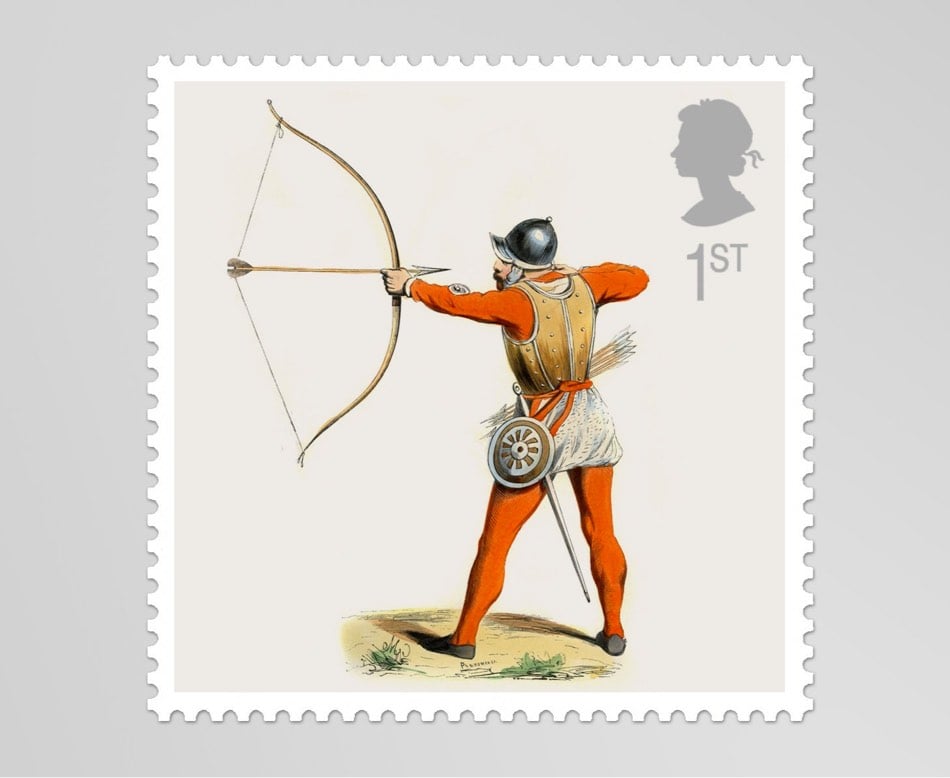
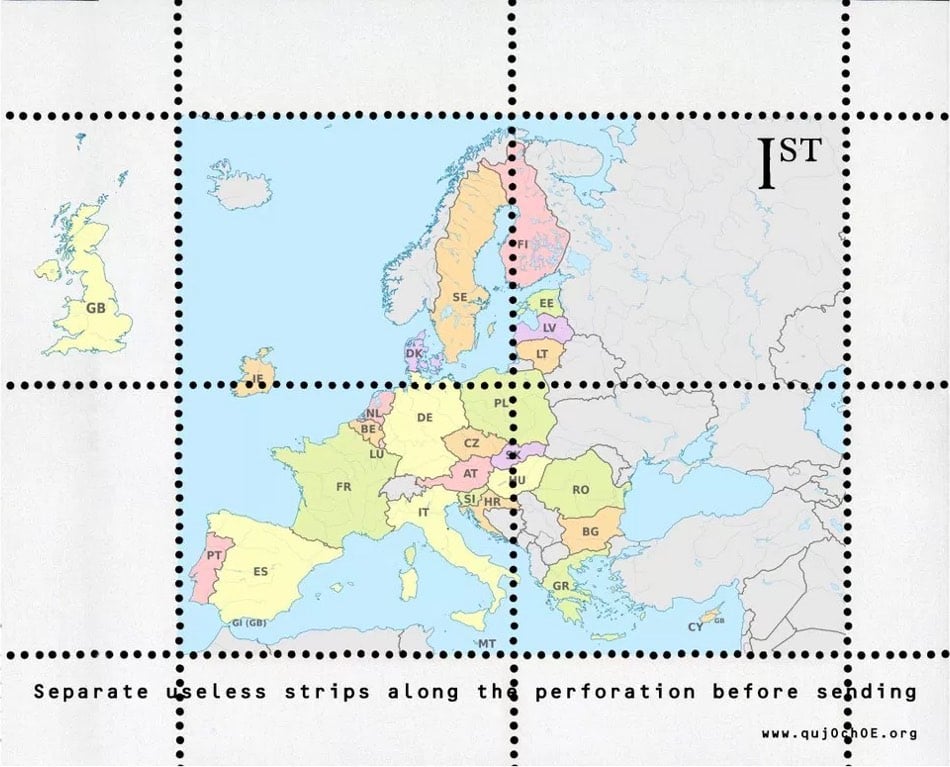
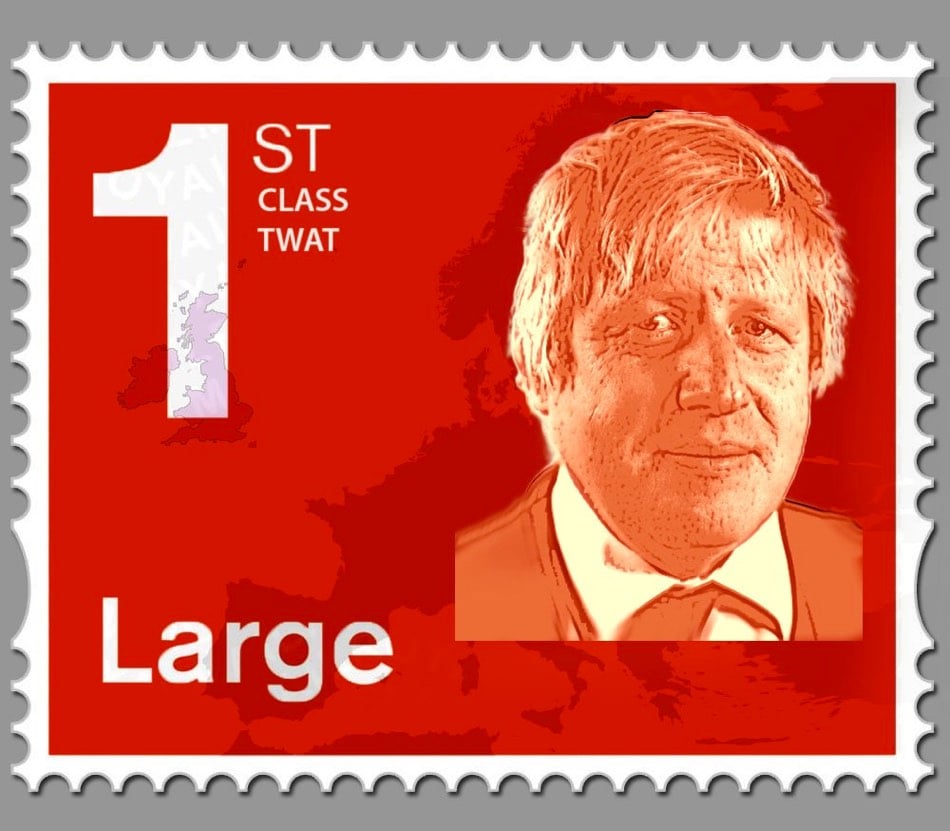
After British MP Andrea Leadsom called for the Royal Mail to issue a postage stamp commemorating Brexit, some people who are not entirely in favor of leaving the EU have posted their best efforts at a stamp design on Twitter under the #brexitstamps hashtag. A few of my favorites:
The 29 Stages Of A Twitterstorm In 2018. “7. The correction will get 12 retweets.”
Blue Planet II, the latest BBC nature documentary narrated by David Attenborough, is finally set to air in the US this Saturday on BBC America, AMC, and other networks. Here’s a five-minute preview…if this doesn’t pique your interest, you might actually be dead:
In a review of the program at The Atlantic, Ed Yong makes a bold declaration:
Blue Planet II is the greatest nature series that the BBC has ever produced.
Coming on the heels of Planet Earth II, which I thought was the best thing I watched last year, that’s really saying something. Here’s Yong on the difference between the two:
Who can forget the marine iguanas of Planet Earth II, escaping from the jaws of hungry racer snakes? But in chasing drama, some of the shows became thinner and messier. Many episodes of Planet Earth II felt like glorious visual listicles — selections of (admittedly awesome) set pieces woven together by the flimsiest of narrative gossamer.
By contrast, the threads that hold Blue Planet II together are thick and tightly woven. Each episode flows. For example, the second episode, on the deep ocean, achieves narrative depth through actual depth, sinking deeper and deeper so that each new spectacle is anchored in space. Where previous series felt like they sacrificed the storytelling craft and educational density for technical wizardry and emotional punch, Blue Planet II finally marries all of that together.
Blue Planet II was watched by more people in the UK than Planet Earth II and has seemingly influenced the UK government’s stance on pollution:
Cutting plastic pollution is the focus of a series of proposals being considered by the UK environment secretary, Michael Gove, who has said he was “haunted” by images of the damage done to the world’s oceans shown in David Attenborough’s Blue Planet II TV series.
The government is due to announce a 25-year plan to improve the UK’s environmental record in the new year. Gove is understood to be planning to introduce refundable deposits on plastic drinks bottles, alongside other measures.
I got a sneak peek at the first few episodes of Blue Planet II, and it certainly is a great program. I watched it with my kids and they were riveted the entire time. After the fourth or fifth episode, my son said, “I think I like this better than Planet Earth II.” I’m not quite sure it’s peak Attenborough — I’m still partial to Planet Earth II — but it’s still a must-see and I’m certainly not going to argue with Ed Yong and my son about it.
HuffPost is ending their contributor platform (which allowed anyone to post on the site). I remember listening (very skeptically) as @peretti showed this to me in 2005. He was right, of course.
Won’t You Be My Neighbor?, a documentary film about Mister Rogers, is premiering at the Sundance film festival tomorrow. This short clip is the first look we’ve gotten at the movie:
Love is at the root of everything — all learning, all parenting, all relationships — love or the lack of it. And what we see and hear on the screen is part of who we become.
Love is the root of all learning. That has been a real theme around here lately. In my introduction to Noticing, I noted this recap by A.O. Scott of a favorite scene in Lady Bird:
Sister Sarah Joan (Lois Smith), the principal, has read Lady Bird’s college application essay. “It’s clear how much you love Sacramento,” Sister Sarah remarks. This comes as a surprise, both to Lady Bird and the viewer, who is by now aware of Lady Bird’s frustration with her hometown.
“I guess I pay attention,” she says, not wanting to be contrary.
“Don’t you think they’re the same thing?” the wise sister asks.
The idea that attention is a form of love (and vice versa) is a beautiful insight.
Oh, I can’t wait for this movie! (thx, katharine)
In the past few weeks, a old video of a penguin falling down and its pals hooting sympathetically has been making the rounds on social media again: “Penguin falls down resulting in best sound ever”.
It’s funny, right? The sounds are also probably fake, added in the editing phase of whatever nature documentary this came from. Foley is the process used by filmmakers to add and enhance sounds in the editing phase…almost every movie and TV show uses them, including nature documentaries.
Whilst I’m no wildlife expert, it’s fairly straightforward to conclude that such an unpredictable and uncontrollable subject as wildlife would have prompted the need to often shoot on long lenses, thus making it almost physically impossible for a sound recordist to obtain ‘realistic’ recordings that would match the treatment and emotive style of the programme. Combine this with the shooting climate, as well as the need for frequent communication between crew just to capture the necessary shots that will cut well in the edit suite and you have a recipe for failure in regards to obtaining useable sound. Therefore, it’s not only impractical but virtually impossible to capture the ‘real’ sound that some of these disgruntled viewers may be protesting for.
I mean, just listen to the footsteps of the penguins in that video. There’s no way that was recorded on a mic while shooting that scene from that distance. The noise of the penguin falling? Probably a foley artist punching the innards of a watermelon. Now, maybe the penguins really did make noises that sounded like that and they recreated them in the studio, but maybe they also juiced them a little to seem more anthropomorphic. It’s impossible to know.
Perhaps this is a case of “even if it’s fake it’s real”, the idea that there’s genuine meaning in that video even if those penguins were completely silent in real life. You can imagine some group of penguins somewhere doing exactly that so it’s funny & life-affirming. But you know what…I don’t like the direction “even if it’s fake it’s real” has taken in our culture lately. I’m ready for “if it’s fake, call it out and look for the truth” or something like that, even if it makes penguins a little less cute.
For the second year in a row, life expectancy in the US dropped. Life expectancy in 25 other developed countries is on average 3+ years longer than in the US. Shameful.
Newer posts
Older posts





Socials & More