Entries for April 2017
Last year, Ariel Meadow Stallings of Offbeat Wed wrote a piece in the Guardian called Seven things I wish I’d known before my divorce: an optimistic guide to the future. It’s a good list, full of problems turned into opportunities, but the first item blew my mind a little.
1. Trip out on grief — it’s a hallucinogen.
Regardless of how your marriage ends, it’s a death. Maybe it’s a loving euthanasia that you both agree on, maybe it’s a violent one-sided decision that only one of you sees coming, but it’s a death regardless. This means both of you will go through grief — a powerful mind-altering substance.
In the darkest of my days, I felt like I was on a low dose of LSD at all times — time was weird, my vision was odd, I threw up for no reason, my emotions were out of control. Even eating was an intellectual exercise (chew, chew … swallow? Is that what you do next?). I generally felt like I was tripping.
This state of mind was profoundly uncomfortable, but also weirdly educational. Never a big crier, I received a crash course in what tear-induced catharsis felt like — and holy wow, it felt good. Like many mind-altering substances, there are lessons there if you want to learn them.
I didn’t realize it until I read this, but having experienced the sort of grief Stallings describes here and come out the other side (mostly) the better for it, I can attest to her description of it as a trippy educational experience.
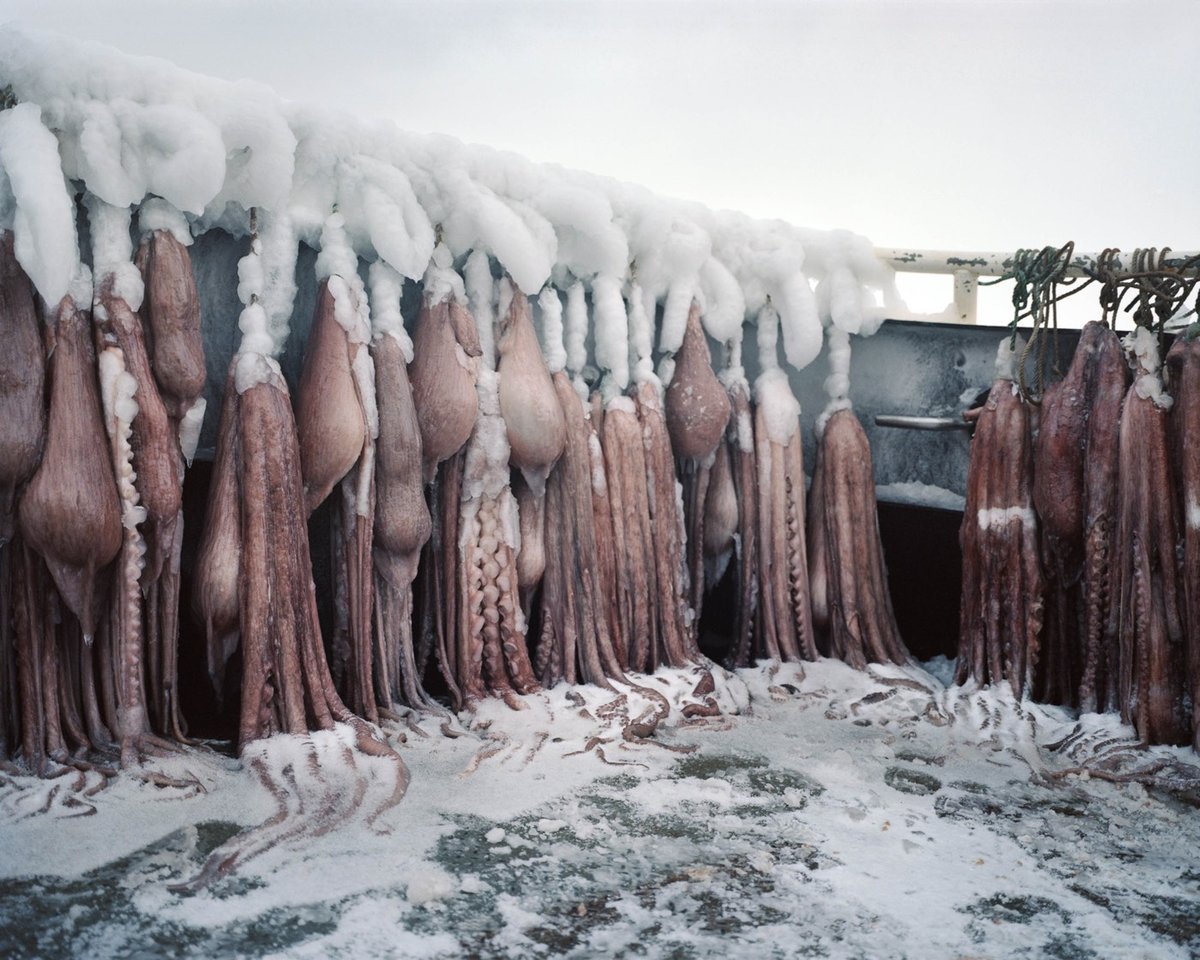
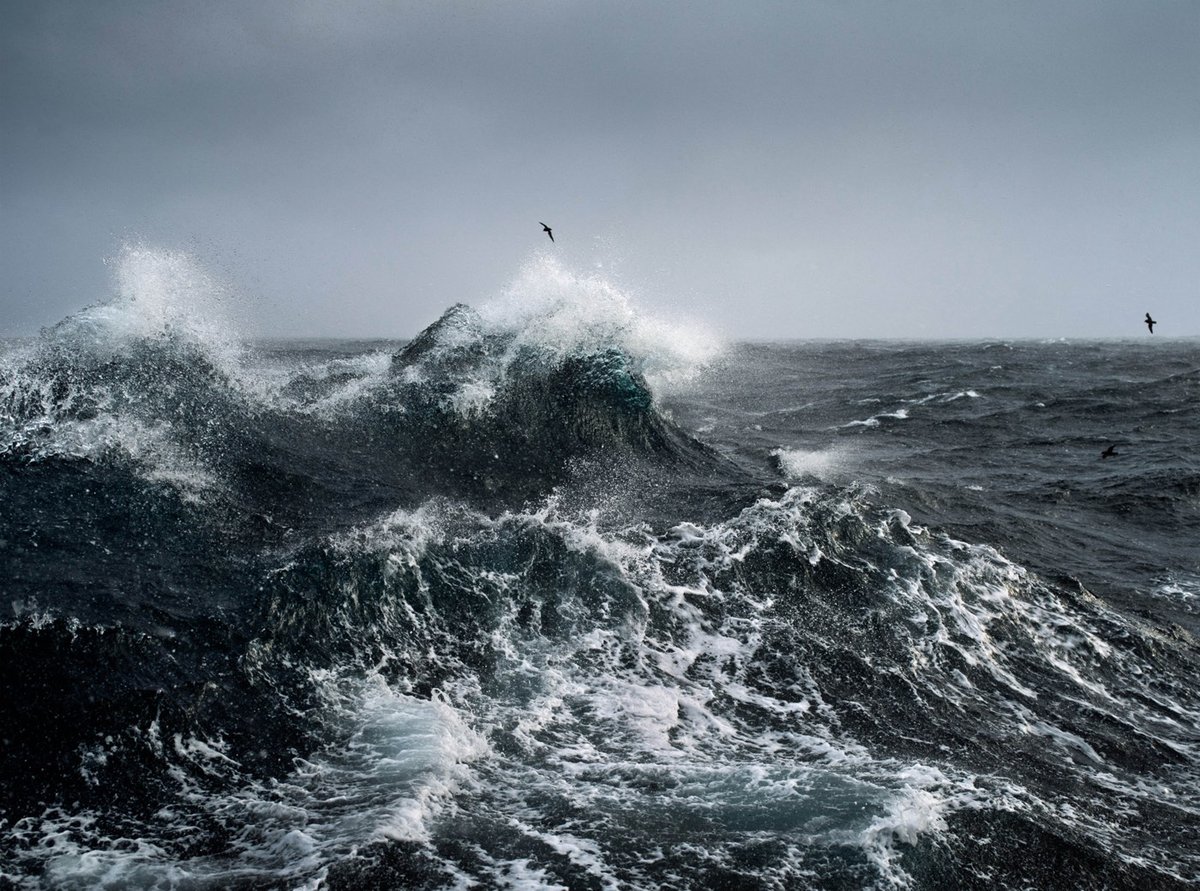
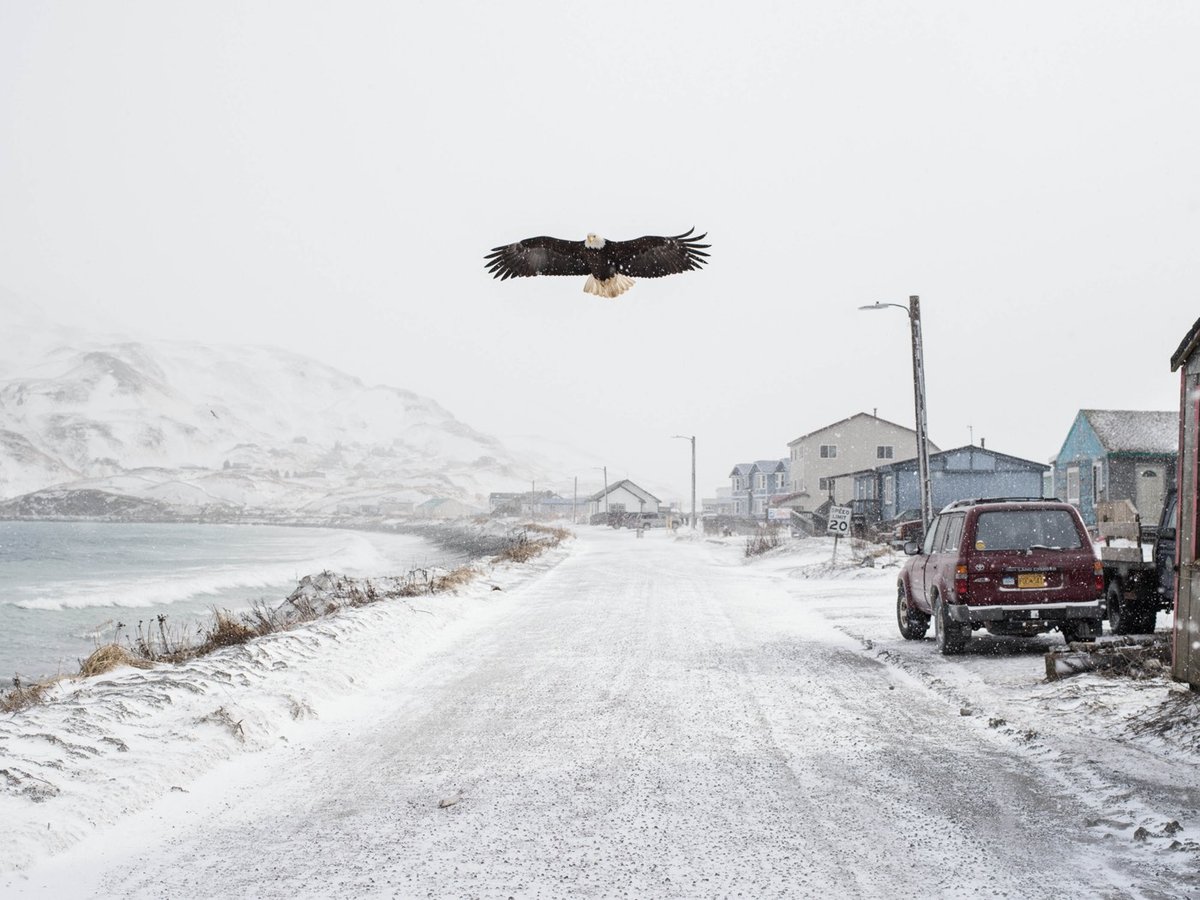
For a project called Aleutian Dreams, photographer and fisher Corey Arnold has documented the lives and landscapes of the fishing industry in Alaska’s Aleutian Islands.
Fifteen years ago, I wrote a job-wanted sign and hung it outside of a bathroom near Seattle’s Fisherman’s Terminal. It read: “Experienced deckhand looking for work on a commercial crab or halibut fishing boat in Alaska — hard worker — does not get seasick” I was 24 years old, energetic and ambitious, with a few years of salmon fishing experience but naive to the world of high seas fish-work. After a few shifty respondents, I was hired by a seasoned Norwegian fisherman and flew on a small prop plane past the icy volcanos and windswept passes of Alaska’s Aleutian Islands, eventually slamming down onto the short runway in Dutch Harbor. The experience would forever change the direction of my life and shape my identity as both a fisherman and photographer. Isolated from the mainland by some of the world’s roughest waters, Dutch Harbor is a thriving, working-class commercial fishing port surrounded by steep mountains and lonely windswept valleys. It’s a place where industry and nature collide in strange and beautiful ways, a place where people harvest seafood on a massive scale, and share their meals and their refuse with local wildlife — from rapacious bald eagles to curious foxes.
(via the guardian)


British sculptor Anish Kapoor and Zaha Hadid Architects have proposed a massive sculpture resembling a meteorite for the centerpiece of the UK Holocaust Memorial.
Meteorites, mountains and stones are often at the centre of places of reflection, especially in the Jewish tradition. They call on the vastness of nature to be a witness to our humanity. A memorial to the Holocaust must be contemplative and silent, such that it evokes our empathy. It must be a promise to future generations that this terrible chapter in human history can never occur again.
All ten shortlisted proposals can be viewed on the design competition site.
On the design of windshield wipers. I’m glad someone finds stuff like this as interesting as I do.


Mexican artist Moisés Hernández makes these simple, graceful bird sculptures by having a machine carve the shapes out of ash and filling in the plumage by hand-dipping them in watercolor paint, as if decorating Easter eggs.
In an attempt of generating a balanced dialogue between machine made and handmade objects, we made soft and continuous shapes milled with CNC technology contrasted with handmade painting done by immersion in coloured water, an experimental technique we developed for this project, which gives the birds a unique personality. This technique of painting allows to achieve an interesting texture of intersections and transparency made by layers of colour that resembles the plumage of birds. The amount of colour, hue and the way sections cross one another depends on the time and position the wood is plunged.
Lovely. (via colossal)
Last August, Dylan Matthews donated one of his kidneys to someone he’d never met before.
On Monday, August 22, 2016, a surgical team at Johns Hopkins Hospital in Baltimore removed my left kidney. It was then drained of blood, flushed with a preservative solution, placed on ice, and flown to Cincinnati.
Surgeons in Cincinnati then transplanted the kidney into a recipient I’d never met and whose name I didn’t know; we didn’t correspond until this past month. The only thing I knew about him at the time was that he needed my kidney more than I did. It would let him avoid the physically draining experience of dialysis and possibly live an extra nine to 10 years, maybe more.
Why did he do it? Because he thought it was the right thing to do morally.
I’d wanted to give a kidney for years — at least since I first heard it was possible after reading Larissa MacFarquhar’s New Yorker piece on “good Samaritan” kidney donors when I was in college. It just seemed like such a simple and clear way to help someone else, through a procedure that’s very low-risk to me. I studied moral philosophy as an undergrad, and there’s a famous thought experiment about a man who walks by a shallow pond where a child is drowning and does nothing, because leaping in to save the child might muddy his clothes.
As Matthews notes, all you need to do to get started on the road to becoming a living donor is fill out this form.
Barry Bonds was a ridiculously good baseball player. In this installment of the highly entertaining Chart Party series, Jon Bois answers a very hypothetical question: What if, during his monster 2004 season, Bonds had gone to the plate without a bat? This is super entertaining if you’re any kind of a baseball fan and the end result is really shocking. (via @caseyjohnston)
For awhile, I think Hollywood forgot that movies are supposed to be fun. This looks fun, like movies in the 80s were before the studios started fixating too much on boobs and bombs for teen boys, gritty reboots, and save-the-world movies.
Yesterday, a video of a man dragged from an overbooked United flight because he wouldn’t give up his seat went viral. Public reaction to the incident and United’s subsequent fumbling of the aftermath has resulted in UAL’s stock falling several percentage points this morning:
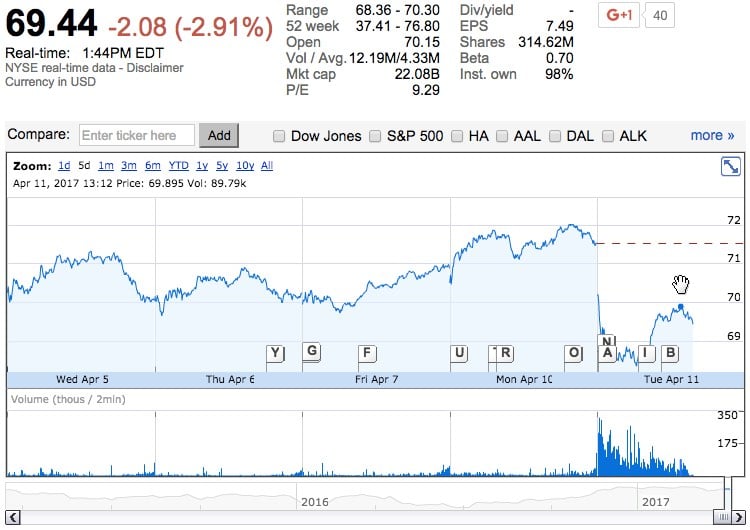
The stock has rebounded slightly this afternoon and will probably fully recover within the next few weeks.
Also yesterday, a man walked into a San Bernardino elementary school and killed a teacher (his estranged wife) and an 8-year-old boy before shooting himself. The story has received very light national coverage, particularly in comparison to the United story. In response, the stock prices of gun companies were up a few percent this morning (top: American Outdoor Brands Corp which owns Smith & Wesson; bottom: Sturm, Ruger & Company):
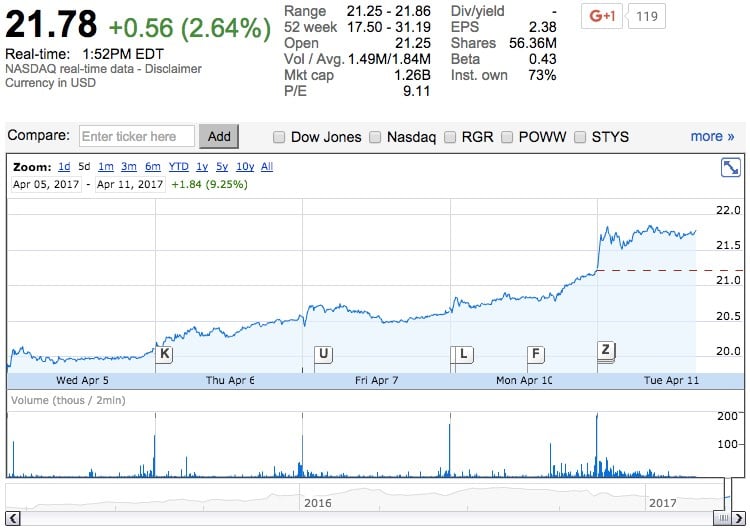
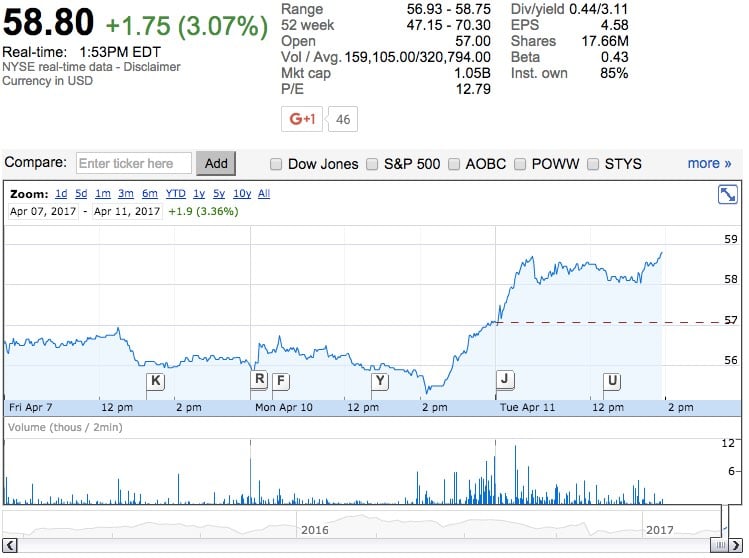
This follows a familiar pattern of gun stock prices rising after shootings; Smith & Wesson’s stock price rose almost 9% after the mass shooting in Orlando last year.
Update: It took about three and a half weeks, but on May 2, United’s stock had regained all of the value “lost” due to the incident and subsequent PR blunders. As of this writing (May 3 at 12:41 PM ET), UAL is actually up about 3.5% from the closing price before the incident.
From concept designer Ash Thorp, a reel of visual effects he worked on for Ghost in the Shell, from animation tests to completed effects featured in the film.
Early on in the film’s development, I met with Rupert to discuss some of the creative direction. He expressed his desire to paint the city with neon lights in a new form that he coined as “Solograms”, which are solid holograms. It is something in the realm of a particle system of light that can be moved and augmented in Z space. I loved the idea and instantly got to work building out concepts and ideas. Below you will see a mix of various style frames, concepts, and final production assets that made it into the film.
I saw this the other day and the effects are amazing; I wish the story could have been a little better.
Update: For more on the visual effects in Ghost in the Shell, see also this piece in Creative Review and this extensive look from Cinematography Database.
(via @firasd & @holgr)
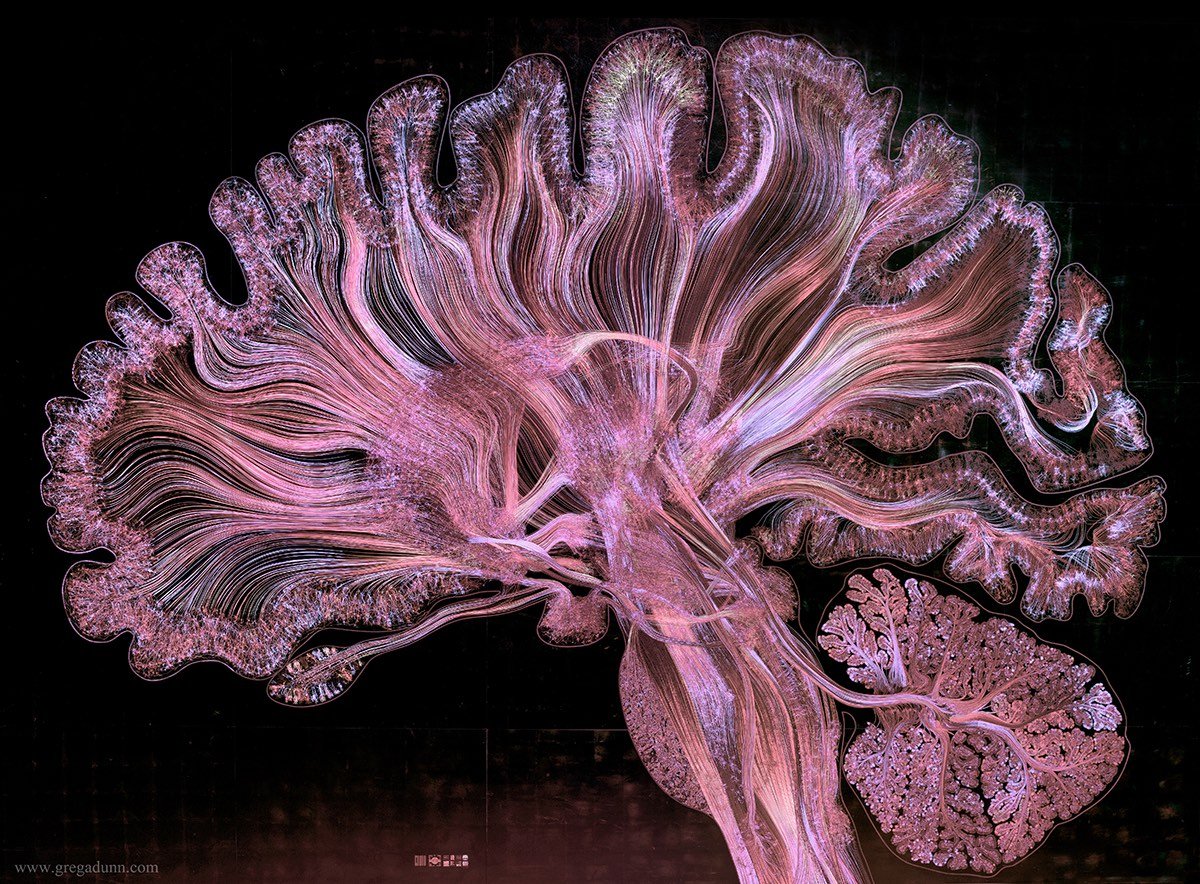
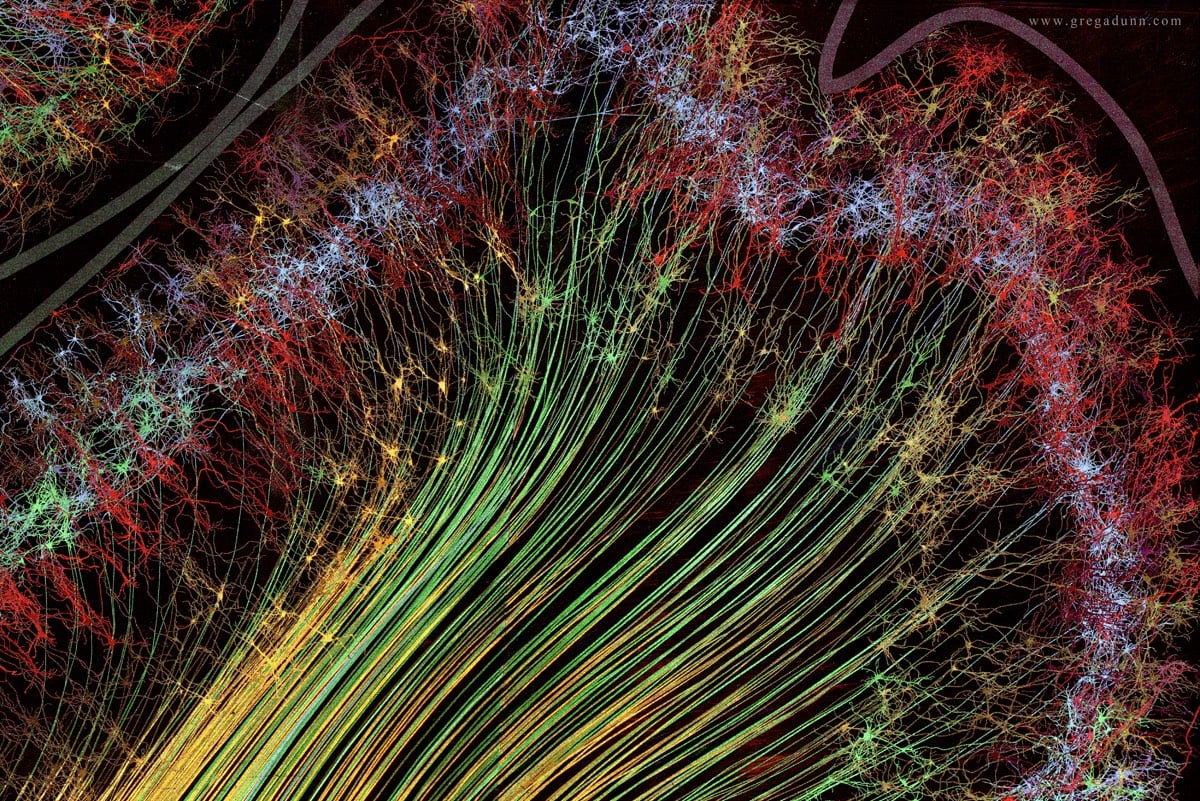
Self Reflected is a project by a pair of artist/scientists that aims to visualize the inner workings of the human brain.
Dr. Greg Dunn (artist and neuroscientist) and Dr. Brian Edwards (artist and applied physicist) created Self Reflected to elucidate the nature of human consciousness, bridging the connection between the mysterious three pound macroscopic brain and the microscopic behavior of neurons. Self Reflected offers an unprecedented insight of the brain into itself, revealing through a technique called reflective microetching the enormous scope of beautiful and delicately balanced neural choreographies designed to reflect what is occurring in our own minds as we observe this work of art. Self Reflected was created to remind us that the most marvelous machine in the known universe is at the core of our being and is the root of our shared humanity.
It’s important to emphasize that these images are not brain scans…they are artistic representations of neural pathways and other structures in the brain.
Self Reflected was designed to be a highly accurate representation of a slice of the brain and is informed by deep neuroscience research to allow it to function as a reliable educational tool as well as a work of art.
When The Shining premiered in 1980 in NYC and LA, there was a short scene in a hospital between the shot of Jack Torrence frozen in the maze and the long zoomed-in shot of the framed photo. After the premieres, director Stanley Kubrick decided the scene didn’t work and had it cut from dozens of prints and destroyed.
It’s also important to note that this was likely not the exact scene that Kubrick shot; since the scene no longer exists, it’s impossible to know how exactly it played. Even the many people who saw the epilogue when The Shining was first released have varying recollections of the exact details. Clearly, the final text about the Overlook’s history was an idea omitted during the writing process.
No known copy of the scene remains but you can read it in the screenplay and see brief glimpses in these Polaroids.
Aviation expert Henk Hesselink thinks that airports should have circular runways instead of straight ones. Among other things, large circular runways could reduce the need for crosswind landings, use airport land more efficiently, and increase the number of planes simultaneously landing and taking off.
As part of these efforts, NLR has been involved in a European project called ‘The Endless Runway’. This radical new airport concept is based on the construction of a circular runway with a diameter of approx. 3.5 km around an airport terminal. Such an airport would take up only a third of the space of a conventional airport. Another advantage is that aircraft would always be able to take off and land independently of the wind direction, since there is always a point without crosswind on the circular runway. Landing aircraft can also be routed away from residential areas because they are not dependent on a standard approach path. Finally, the ‘Endless Runway’ concept will enable multiple aircraft to take off and land simultaneously, resulting in increased airport capacity.
According to Hesselink’s research, a circular runway as long as three normal runways (and the diameter of one runway) could handle the traffic of four normal runways. (thx, dad)
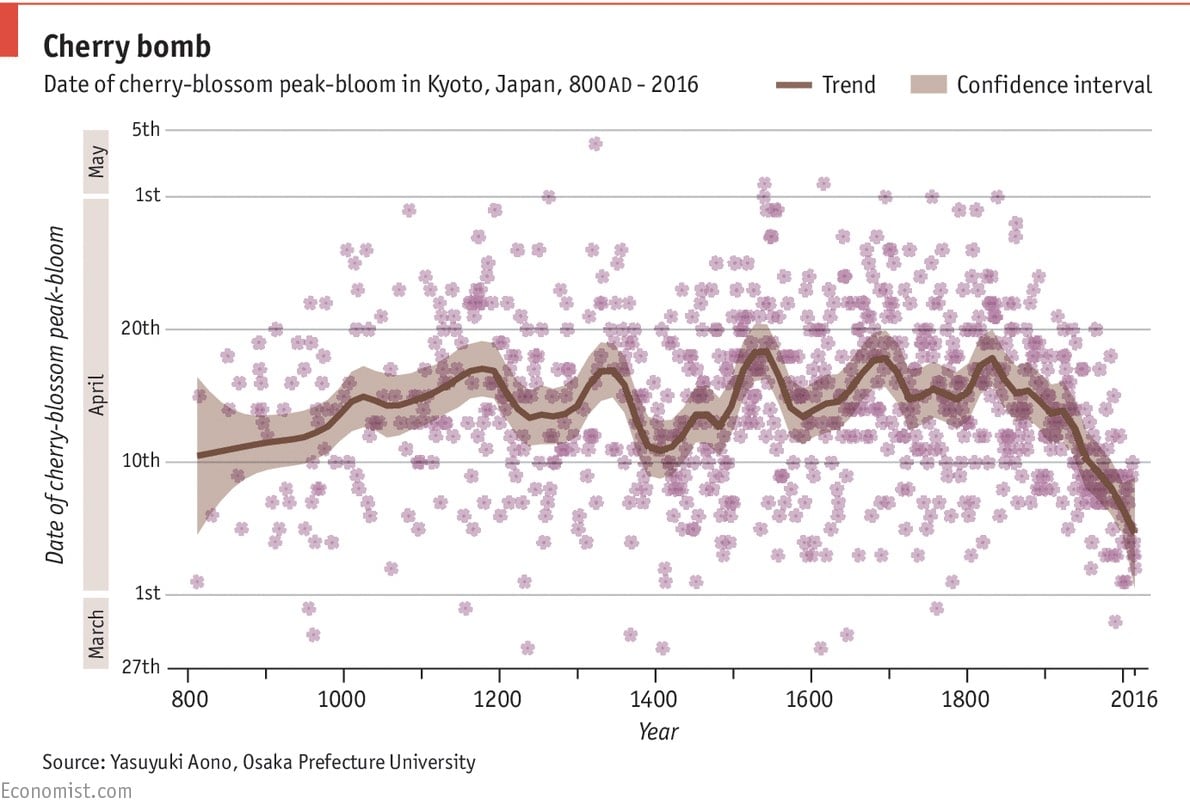
Records of when the cherry blossoms appear in Kyoto date back 1200 years. (Let’s boggle at this fact for a sec…) But as this chart of peak-bloom dates shows, since the most recent peak in 1829, the cherry blossoms have been arriving earlier and earlier in the year.
From its most recent peak in 1829, when full bloom could be expected to come on April 18th, the typical full-flowering date has drifted earlier and earlier. Since 1970, it has usually landed on April 7th. The cause is little mystery. In deciding when to show their shoots, cherry trees rely on temperatures in February and March. Yasuyuki Aono and Keiko Kazui, two Japanese scientists, have demonstrated that the full-blossom date for Kyoto’s cherry trees can predict March temperatures to within 0.1°C. A warmer planet makes for warmer Marches.
Temperature and carbon-related charts like this one are clear portraits of the Industrial Revolution, right up there with oil paintings of the time. I also enjoyed the correction at the bottom of the piece:
An earlier version of this chart depicted cherry blossoms with six petals rather than five. This has been amended. Forgive us this botanical sin.
Gotta remember that flower petals are very often numbered according to the Fibonacci sequence.
In SuperBabies Don’t Cry, Heather Kirn Lanier writes beautifully about the birth of her first daughter, disability, control, and acceptance.
By eight months Fiona developed a love for clapping. At nine months she had her first grand mal seizure. At eleven months she rolled from front to back. At one year old she weighed twelve pounds. During that first year, her syndrome revealed itself to be simultaneously life-altering and, in some strange way, just fine. A new normal. Her medical issues were manageable. The problem, it became clear, was mine: I wanted her different. The daily prayer inside me was an impossible wish to scrounge the earth and find that missing bit of her fourth chromosome. I imagined it was buried among fossils in an ancient, surreal sand dune.
Ten times this piece sent my thoughts spiraling out in all directions. I already know I’m gonna be thinking about this all week. (via @ftrain)
Adam Neely made a song that is constructed of smaller versions of itself, resulting in a musical fractal that sounds the same at full speed and at 1000 times slower. How does it work? Harmonic polyrhythms.
E=mc^2 tells us that mass and energy are the same thing, just on massively different scales. This is similar to the musician’s theory of relativity which says that rhythm, melody, and harmony are the same thing, just on similarly massively different scales.
So by slowing things way down or speeding things way up, you can convert between harmony and rhythm. (via waxy)
The X27 camera takes videos in darkness that looks like they were shot in the daytime. And they’re in color…none of this black and white, thermal, or infrared stuff. The camera was developed for military use, has an effective ISO rating of 5,000,000, and has a comically long name: “X27 Reconnaissance Day/Night high Fidelity true real time low light/low lux color night vision Imaging Security / Multi Purpose camera system”. Pricing information is not available, but I bet you’re paying for every single one of those words. (via digg)
Amber Galloway Gallego is a ASL interpreter who has developed new techniques and expressions to translate popular music into a richer experience for deaf and hard-of-hearing people than just simply translating the lyrics.
If you frequent music festivals and concerts, you might see her — or an interpreter like her — grooving to the music, mirroring the emotions and physicality of the artists onstage, interpreting their imaginative lyrics for concert-goers who rely on visual accommodations. She’s interpreted for more than 400 artists at this point, and has a special knack for interpreting hip-hop acts.
Part of the challenge here, particularly with fast-moving rap or hip hop, is combine or abbreviate signs in order to keep time with the lyrics. See Shelby Mitchusson performing Eminem’s Lose Yourself or Gallego doing a faster song of his, Rap God:
Sammi Grant is a dialect coach and voiceover artist for television and theater. In this video, she demonstrates her expertise in speaking English with several different accents, including Irish, Scottish, German, the American midwestern accent, and the Transatlantic accent, an accent invented to sound both American and British simultaneously.
No, really. That’s not a real accent. It’s a now-abandoned affectation from the period that saw the rise of matinee idols and Hitchcock’s blonde bombshells. Talk like that today and be the butt of jokes (see Frasier). But in the ’30s and ’40s, there are almost no films in which the characters don’t speak with this faux-British elocution-a hybrid of Britain’s Received Pronunciation and standard American English as it exists today. It’s called Mid-Atlantic English (not to be confused with local accents of the Eastern seaboard), a name that describes a birthplace halfway between Britain and America. Learned in aristocratic finishing schools or taught for use in theater to the Bergmans and Hepburns who were carefully groomed in the studio system, it was class for the masses, doled out through motion pictures.
This short video has some more examples of the Transatlantic (or Mid-Atlantic) accent:
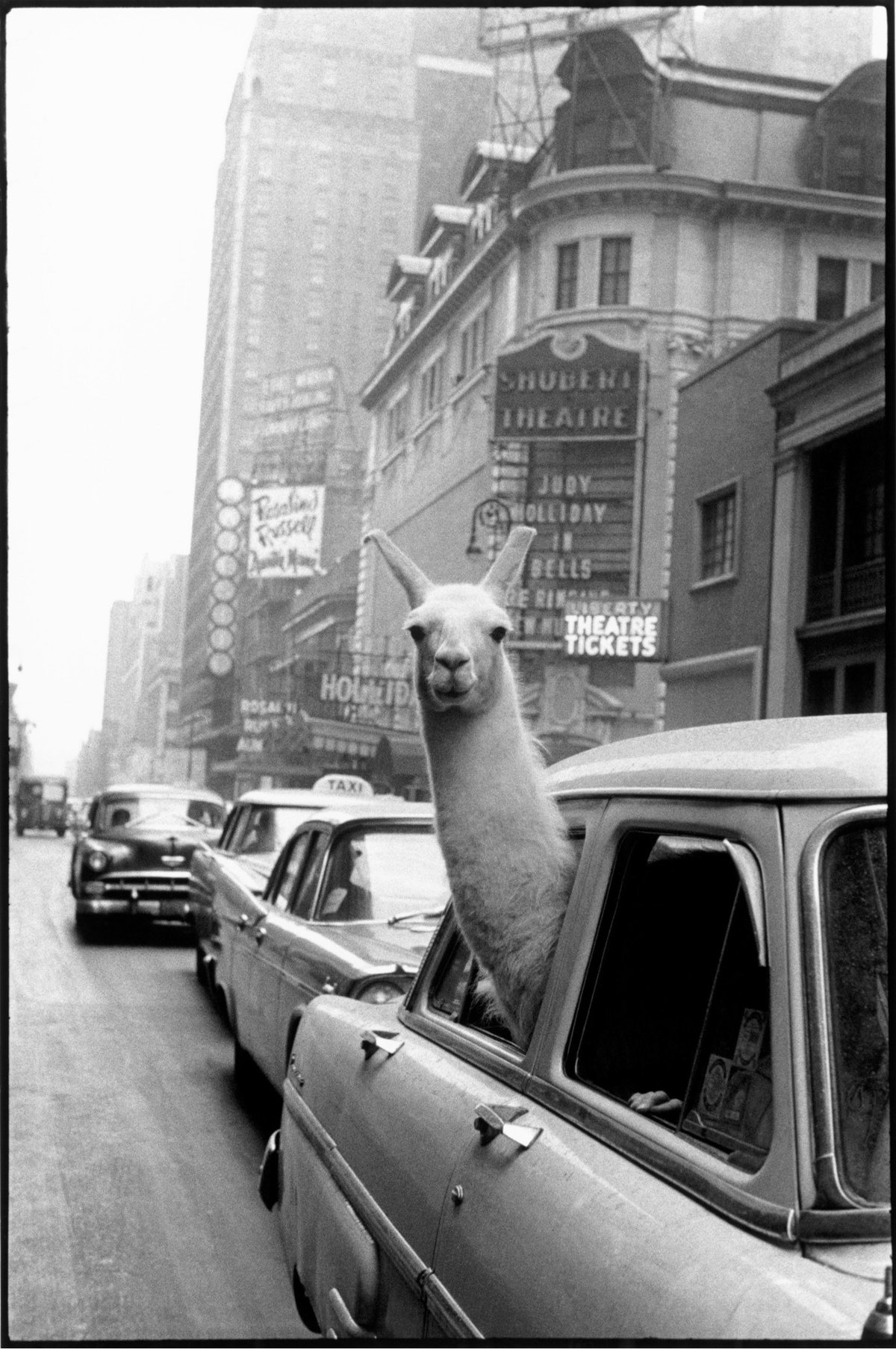
That’s Linda the Llama, photographed by Inge Morath for Life magazine. I have seen this photo many times in various contexts, but until today, I’d never really stopped to ask who photographed it or how a llama came to be riding through Times Square in a car. Perhaps it’s the context of the location, but it looks almost like something a tourist would have snapped…until further inspection reveals the perfect composition of a great photographer at work.
The caption read the llama was enroute to make a television appearance, but Morath recalled differently in her notes: “Linda, the Lama [sic] rides home via Broadway. She is just coming home from a television show in New York’s A.B.C. studios and now takes a relaxed and long-necked look at the lights of one of the world’s most famous streets.” Her contact sheets showed that Morath was already photographing the llama inside the studio, and the Inge Morath Foundation suggests the photographer might have acquainted herself with the llama and the trainer at least a year ahead of their photo-session.
Morath was a member of Magnum Photos, joining the collective a few years after its inception. She initially joined as an editor and researcher but after taking up photography herself and assisting Henri Cartier-Bresson, she became a full member as a photographer in 1955.
I think that in studying [Cartier-Bresson’s] way of photographing I learned how to photograph myself, before I ever took a camera into my hand. […] It was instantly clear to me that from now on I would be a photographer. As I continued to photograph I became quite joyous. I knew that I could express the things I wanted to say by giving them form through my eyes.
I love this story about Morath from her Wikipedia profile (originally from a piece in Time):
In 1959, while photographing the making of The Unforgiven, starring Audrey Hepburn, Burt Lancaster, and Audie Murphy, Morath accompanied Huston and his friends duck hunting on a mountain lake outside Durango, Mexico. Photographing the excursion, Morath saw through her telephoto lens that Murphy and his companion had capsized their boat 350 feet from shore. She could see that Murphy, stunned, was nearly drowning. A skilled swimmer, Morath stripped to her underwear and hauled the two men ashore by her bra strap while the hunt continued uninterrupted.
A poster of A Llama in Times Square is available for sale on Magnum’s website.
Rihards Vidzickis is a Latvian master woodworker (and materials scientist) who specializes in making dugout canoes and other rustic works out of wood. In this beautifully shot short film, Vidzickis crafts a dugout canoe from scratch over a period of a few months, using only hand tools. I’ve never considered “elegant” a word that could be associated with a dugout canoe, but here we are.
The video is long (18 min) and you’ll be tempted to skip ahead, but watching it is almost meditative and there are little woodworking tricks throughout that are really clever (like using wooden pegs for depth-finding while hollowing the canoe out). The film also provides ample evidence of the old adage “measure ten times, cut once” (or something like that).
Tonja Jacobi and Dylan Schweers have published the results of a study they’ve done related to the role of gender in the workings of the Supreme Court. They found that female justices are interrupted much more often by male justices and advocates than male justices are.
Our empirical study examines interruptions among justices, and between the justices and the advocates, during Supreme Court oral arguments. It shows that women still do not have an equal opportunity to be heard on the highest court in the land. In fact, as more women join the court, the reaction of the male justices and the male advocates has been to increase their interruptions of the female justices.
Even in the most powerful courtroom in the world, the women are being verbally dominated.
Even without adjusting for the low representation of women, the effect is stark. On average, women constituted 22 percent of the court, yet 52 percent of interruptions were directed at them. Overwhelmingly, it was men doing the interrupting: Women interrupted only 15 percent of the time and men interrupted 85 percent of the time, more than their 78 percent representation on the court.
Their study shows that seniority can’t explain this effect — “gender is approximately 30 times more influential than seniority” — but some of it can be explained in terms of political ideology: conservative justices interrupt more than liberal justices do.
We found that the power dynamic does not only affect women: In a court that has been dominated by Republican appointees for over half a century, conservative justices have also dominated liberal justices by interrupting them. We expected cross-ideological interruptions to occur more often than interruptions within ideological camps, and this is true: 62 percent of interruptions cross ideological lines, compared to 38 percent within an ideological camp. However, the effect does not go in both directions: 70 percent of interruptions were of liberals, and only 30 percent of conservatives. Once again, advocates display the same tendency. Advocates interrupting the liberal justices account for over ten percent of interruptions, yet advocate interruptions of the conservative justices account for less than three percent of interruptions.
I wonder what the results would look like if Clarence Thomas ever talked in court? (via @caitlin__kelly)
The Double King takes “thou shalt not have any other kings before me” very seriously. (via @tonyszhou)
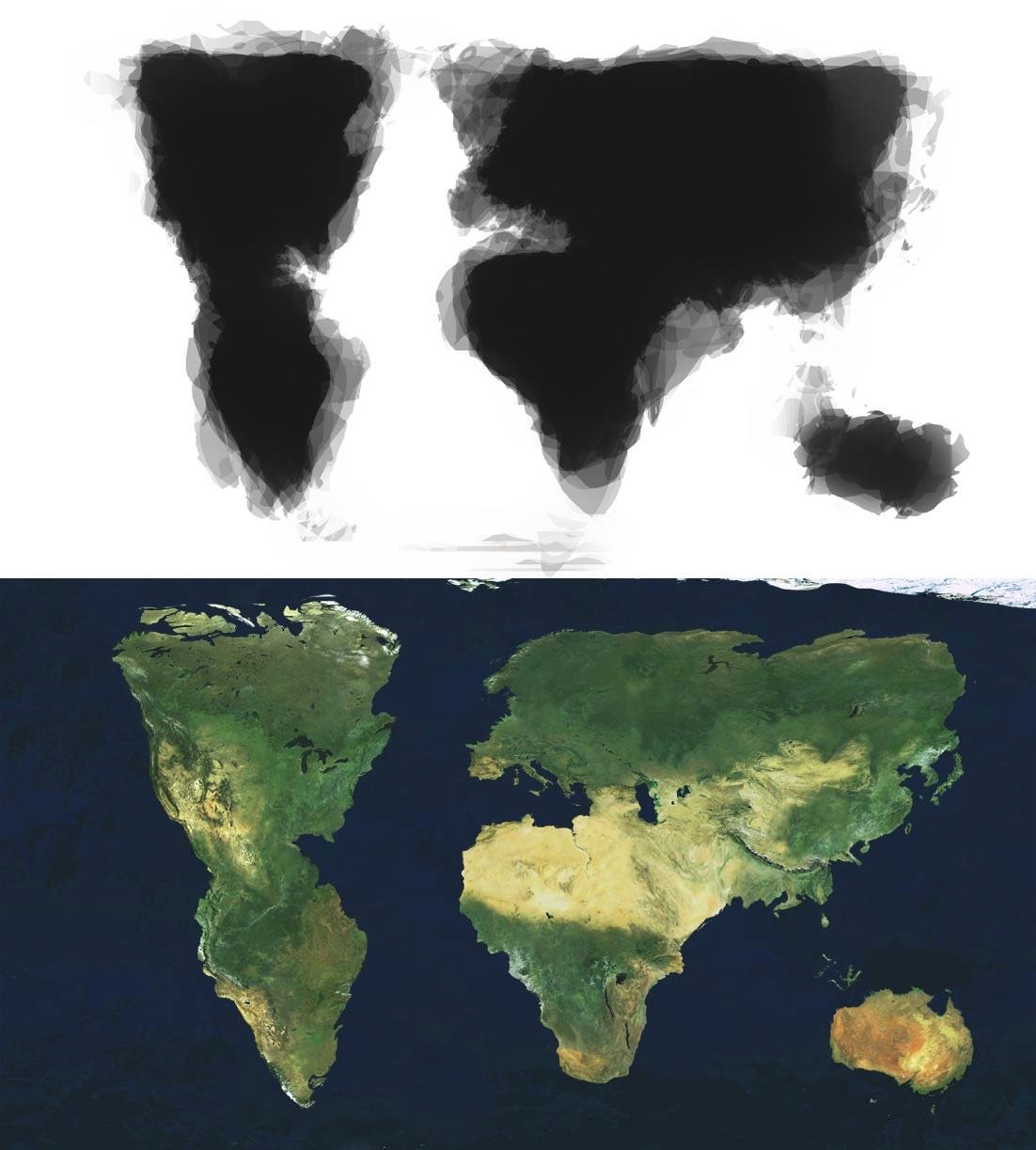
Zak Ziebell asked 30 people to sketch a map of the world and then averaged the results into the map above. I especially love the bottom one with the satellite terrain.
Tasked with creating “a piece of art that would reveal something unseen” as part of a pre-college fine arts program, Ziebell approached 29 strangers on the University of Michigan’s campus, handed them a pen and half a sheet of paper, and asked them, on the spot, to draw a map of the world. Ziebell, who recently posted his findings to Reddit, then completed the task himself and digitally merged the 30 maps into one image, overlaying the composite drawing with satellite data.
Update: This is yet another world map without New Zealand. (via @edmz)
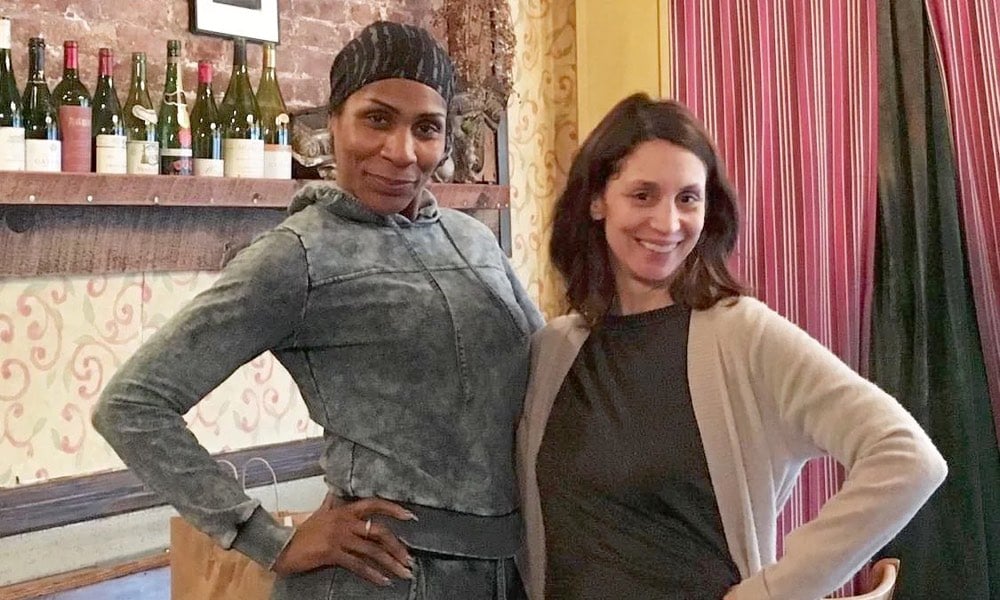
For years, a white woman named Lisa Davis was paying the price (sometimes literally) for tickets issued to other women named Lisa Davis living in NYC.
Finally, the DMV told me that I wasn’t the victim of identity theft; there was simply another Lisa S Davis with the same birthday in New York City. Our records were crossed. When cops run a license, they don’t check the person’s address, signature, or social security numbers. They check the name and the birthday, and both the other Lisa S Davis’s and mine were the same. We were, in the eyes of the law, one person, caught in a perfect storm of DMV and NYPD idiocy.
In fighting all of these improperly filed tickets, Davis learned that most of them issued for bullshit “broken windows” misdemeanors in predominately minority neighborhoods.
It was then that it became clear to me: the reason for the tickets wasn’t that these Lisa Davises were petty criminals. The reason was likely that they lived in highly policed areas where even the smallest infractions are ticketed, the sites of “Broken Windows” policing. The reason, I thought, was that they weren’t white.
That could have been the “proof” I offered to the judge. Brownsville’s population is less than 1% white. It almost couldn’t have been me. My neighborhood, though fairly diverse (and cheap) when I moved there in the early 90s, is now 76% white. I have never heard of anyone getting tickets in my neighborhood for any of the infractions committed by the Lisa Davises in neighborhoods of color.
I felt there was only one thing to do. I had to find the Lisa Davises, to untangle myself from them, to talk to them about being Lisa Davises, and to see if they agreed with my supposition: that the real “crime” they had committed was being non-white.
See also Pro Publica’s report published today, Minority Neighborhoods Pay Higher Car Insurance Premiums Than White Areas With the Same Risk.
The elaborate courtship rituals of animals from around the world are featured heavily in every BBC nature documentary series. (See, for instance, these birds of paradise…if you haven’t seen this before, wait for the giant clicking smile.) In the video above featuring a scene from the 2014 series Life Story, watch a Japanese puffer fish create an elaborate pattern in the sand in order to attract a mate. Narrator David Attenborough calls the puffer fish “probably nature’s greatest artist” and I gasped at the full reveal of his creation.
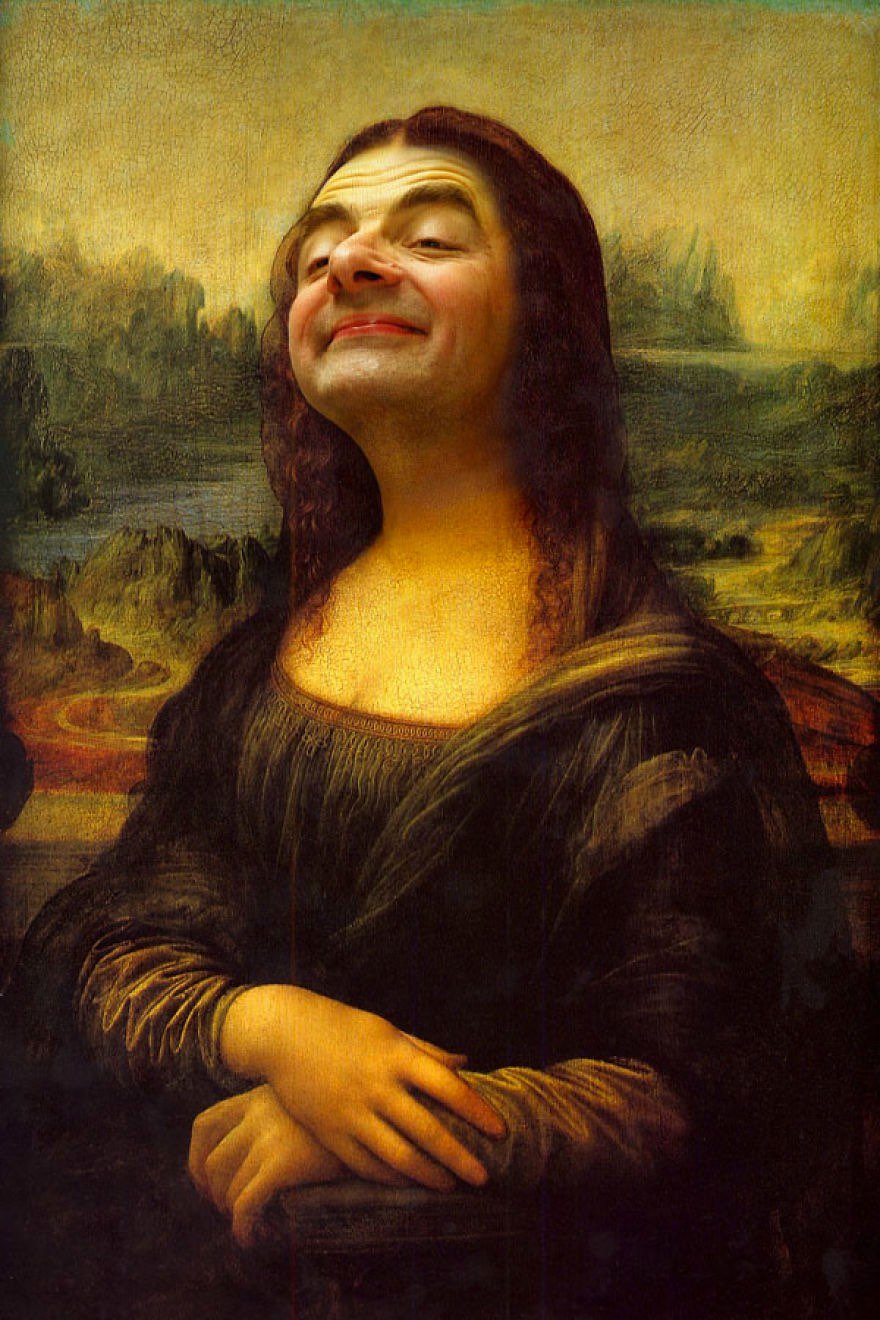
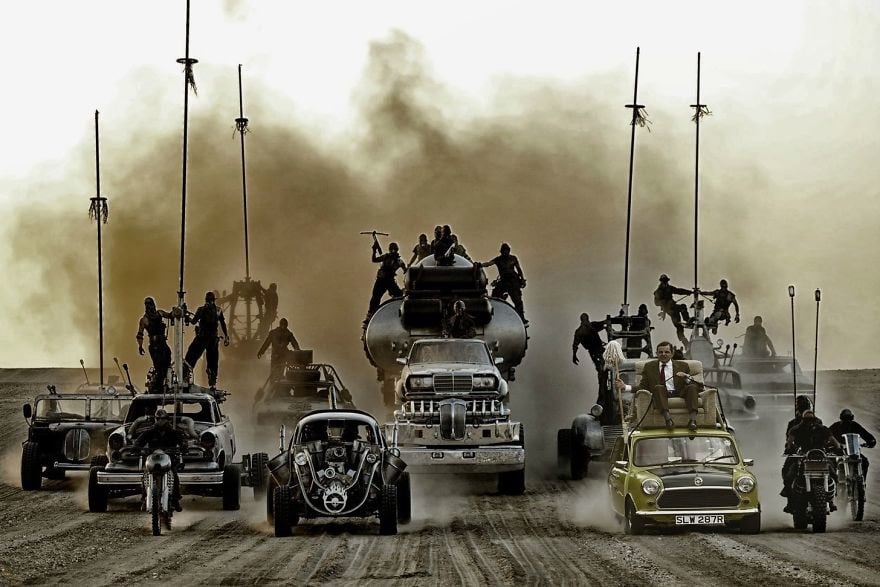
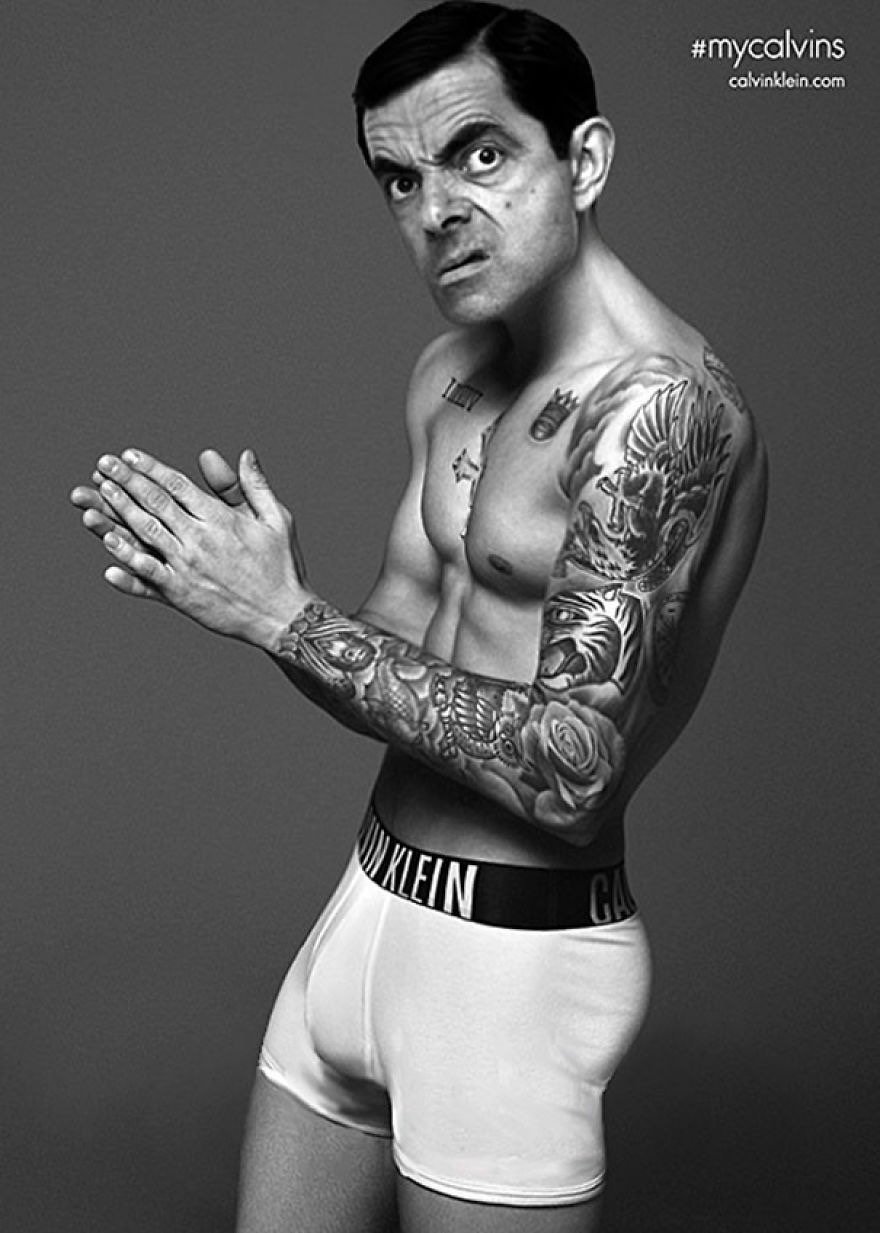
Sometimes when the world is crashing down around you, only the dumbest possible thing will do and today’s installment is Mr. Bean photoshopped into various things and I am loving it.
In 2006, Davis Guggenheim directed An Inconvenient Truth, a documentary film about Al Gore’s fight to educate the world about climate change. It made nearly $50 million at the box office, won the Oscar for Best Documentary Feature, and is credited for moving the conversation about climate change along (although not nearly fast enough, in my mind). This July, a followup documentary will be released: An Inconvenient Sequel: Truth to Power. From a review in the LA Times:
Eleven Sundances later, Gore’s star wattage seemed entirely undimmed at Thursday evening’s premiere of “An Inconvenient Sequel: Truth to Power,” an awkwardly titled, stirringly crafted follow-up that measures the progress that has and hasn’t been made in the battle against global warming. Taking over for Davis Guggenheim, the directors Bonni Cohen and Jon Shenk largely abandon the framing device of Gore’s lecture (which he and his international team of trainees continue to give regularly) in favor of a nimbler, more on-the-go approach.
Despite some updates on the continuing decline of the world’s glaciers and the link between climate change and the recent Zika virus outbreak, the focus this time is less on science than on politicking. Cohen and Shenk tag along with Gore on a globe-trotting mission to persuade various heads of state to invest in wind and solar energy, and reduce their reliance on fossil fuels — an effort that culminates on-screen with the signing of last year’s historic Paris climate accord.
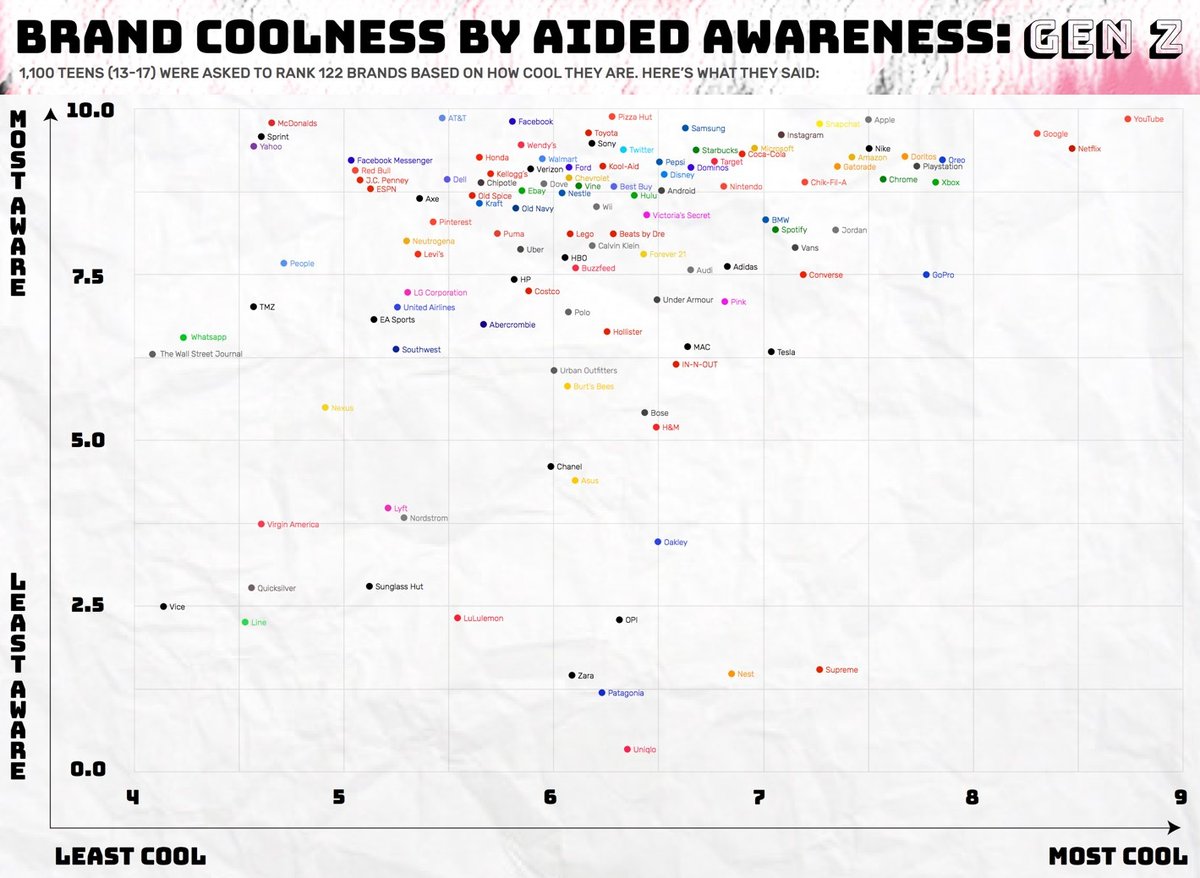
Google recently released a report about what US teenagers think is cool. The chart above is getting a bunch of attention on social media; teens aged 13-17 were asked to rank a bunch of brands according to how cool they think they are. Since the poll was commissioned by Google (and the results published by an internal marketing team), it’s unsurprising that three Google brands (YouTube, Google, Chrome) are in the top 10. Other interesting data points:
- Teens don’t know what Zara and Uniqlo are. Or Supreme.
- Buzzfeed is only slightly cooler than Ford and Chevrolet, which are both cooler than HBO. Perhaps because HBO can’t get you to a party and you can’t make out in a Buzzfeed?
- Kraft is cooler than Red Bull.
- Whatsapp, TMZ, Vice, and Yahoo are all super uncool.
- Twitter is cooler than Facebook, but Snapchat is much cooler than both.
- The Wall Street Journal is the least cool thing in the teen universe.
- This tweet is a good reminder not to take any of this too seriously.
There’s also this curious sentence in the introduction about Generation Z:
Unlike millennials, this group is ambitious, engaged, and feel like they can change the world.
Ouch. In what universe is that even a remotely true or fair statement?
Don’t pay too much attention to the letter grades, they’re super subjective. Oh, and don’t pay too much attention to the descriptions…also subjective. You know what, you should probably just skip this post and watch Planet Earth II instead. It’s objectively great.
The Handmaiden. Khoi Vinh turned me onto this. Loved it. (A)
What Happened, Miss Simone? Nina Simone is underrated. There are some spine-tingling live musical moments in this film. (B+)
The Three-Body Problem. Recommended by Barry. The first book is great, the next two are good but pretty depressing. (B+)
Moonlight. While this didn’t grab me as much as it did everyone else, the Academy got it right. (A-)
The Night Manager. I can see what Taylor Swift saw in Tom Hiddleston. (B+)
T2 Trainspotting. If you saw and loved the original, you should see this. It is somehow nostalgic and also not. (B)
Girls. The struggles of 20-something New Yorkers and the crises of 40-something males may not be the same, but they sure do rhyme. (B+)
Beauty and the Beast. Better than I expected, even for a musical about the Stockholm syndrome. (I mean, why didn’t the Beast let Belle go like waaaay sooner?) I never saw the original when I was a kid but somehow knew all the songs anyway? I even got a little teary at the end but perhaps that’s just because my emotional life is a puddly mess rn. (B)
Hidden Figures. Really liked this. (A-)
Turing’s Cathedral. Raging Bull. Manchester by the Sea. I am increasingly bored by stories about white dudes. Look at the rest of this list. The best stuff, the things I liked the most, are stories about or stories told by women or people of color or non-Americans. (C)
Homo Deus. Still haven’t finished this, but I’m persisting because Sapiens was so good. Hard to escape the conclusion that the sequel is not quite so good. (B-)
Planet Earth II. This is the best thing I’ve seen in the last year. Just fucking watch it already. (A+)
More Life. Liking this more than Views. Drake’s non-albums are better than his albums. (B+)
Mad Men. My second time through. Better than I remember and I remember it being great. (A+)
The Crown. Expected Downton (soapy but fun) but was rewarded with great acting and writing. Claire Foy as Elizabeth and John Lithgow as Churchill were *kisses fingers*. (A)
“Awaken My Love”. I’m sorry, I just couldn’t figure this one out. (C-)
Wonderland. Steven Johnson’s best book yet. (A)
The Underground Railroad. Nothing to say about this that already hasn’t been said. (A)
Logan. Producers are realizing they’ve stocked their superhero movies with great actors so maybe they should give them material worthy of their talents. (B+)
Finding Dory. It’s a movie about disability. (A-)
Abstract. Pretty good, but I agree with Rob Walker’s take. Niemann is closest to the way I work/think but I liked Bjarke’s episode the best…even though I’ve got some, er, issues with the guy. (B)
Harry Potter and the Cursed Child. The script, not the play. I have now read all 8 of the Harry Potter books with my kids…it took more than 4 years. Very sad it’s over…it ended up being one of the most rewarding things I’ve done with them. (B+)
Newer posts
Older posts



Socials & More