kottke.org posts about policing
In 1966, Huey Newton & Bobby Seale formed the Black Panther Party and wrote a 10-point manifesto of what the group stood for and what they wanted. Here’s the full text of the plan.
4. We Want Decent Housing Fit For The Shelter of Human Beings.
We believe that if the White Landlords will not give decent housing to our Black community, then the housing and the land should be made into cooperatives so that our community, with government aid, can build and make decent housing for its people.
5. We Want Education for Our People That Exposes The True Nature Of This Decadent American Society. We Want Education That Teaches Us Our True History And Our Role in the Present-Day Society.
We believe in an educational system that will give to our people a knowledge of self. If a man does not have knowledge of himself and his position in society and the world then he has little chance to relate to anything else.
Gareth Fearn writing for the London Review of Books about the student protests on US campuses: Liberalism without Accountability.
This is a toxic combination: universities reliant on investment portfolios in a system where mega-profits are made by companies that threaten and destroy human life, influenced by an increasingly radicalised class of billionaires, teaching students whose degrees won’t earn them enough to pay off their loans, managed by supine administrators threatened by (or willingly collaborating with) a reactionary right, who have decided that young people’s minds are being turned against capitalism not by their own lived experience of austerity and racialised police violence but by ‘woke Marxist professors’. This situation has now met with a live-streamed genocide which is supported, and brazenly lied about, by political leaders and commentators who claim to stand for truth and justice. Students, like much of the public, cannot square the reality of what they see with the world as constructed by politicians and the media.
Under such circumstances, pitching tents, raising placards and demanding divestment are really quite mild-mannered responses. That they have been met, in many US universities, with militarised policing reflects the fragility of liberalism — in the face of the growing hegemony of the conservative right as well as its own inability to offer a future even to Ivy League college students, let alone the less privileged.
An officer “accidentally” fired his weapon during an NYPD raid on a student-occupied building at Columbia University on Tuesday. Apparently, he mistook his gun for a flashlight. You may be wondering: how could this happen? Well, like this. From a 2014 article in the Denver Post:
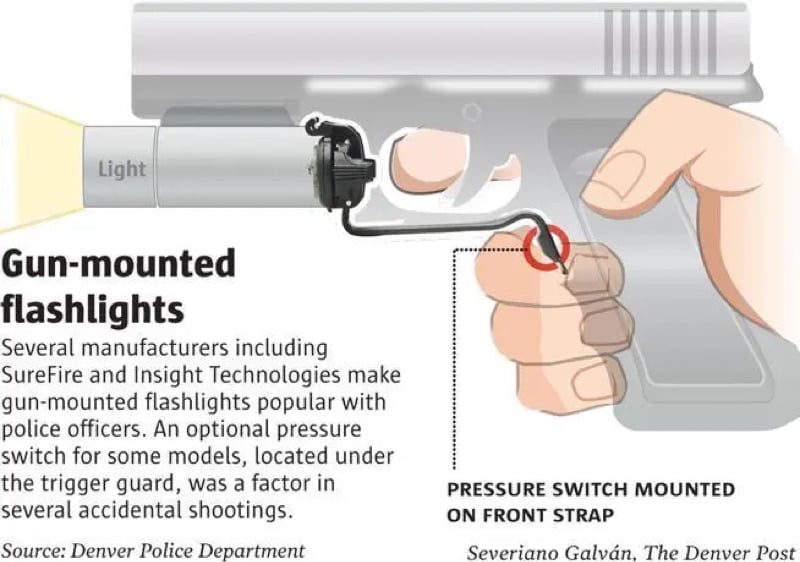
Ronny Flanagan took pride in his record as a police officer in Plano, Texas. He had an incident-free career. He took safety training regularly. He was known at the range as a very good shot.
Yet he killed a man when he was simply trying to press a flashlight switch mounted beneath the trigger on his pistol.
In a deposition, Flanagan expressed his remorse and made a prediction.
“I don’t want anyone to ever sit in a chair I’m in right now,” he said. “Think about the officers that aren’t as well trained, officers that don’t take it as seriously, and you put them in a pressure situation, another accident will happen. Not if, but will.”
Jeeeeesus Christ this is the most American shit ever. First of all: guns, guns, guns!! We love ‘em! Don’t forget the complete militarization of the police (they’ve got tanks!), which happens in tinpot countries where leaders fear the citizenry. Those gun flashlights were initially developed for the Navy SEALs and now city cops wield them around students.
And then. And then! There’s the completely genius idea of PUTTING A SECOND TRIGGER ON A GUN — I wish I had letters more uppercase than uppercase for this next part — RIGHT BELOW THE FIRST TRIGGER!!!!!!! 1
You know, the one that propels a projectile out of the weapon at deadly speeds!?
You’re familiar with those doors where the handle makes it seem like a pull but you actually have to push it? They’re called Norman doors, the canonical example of bad design. These flashlight guns are like Norman doors that kill people. W T Actual Fuck. (via @ygalanter.bsky.social)
This interview on This American Life with a Black Capitol Police officer who defended Congress against the domestic terrorists who stormed the Capitol Buidling on Jan 6th is essential listening. BuzzFeed’s Emmanuel Felton interviewed an anonymous officer he calls “Officer Jones”:
Emmanuel Felton: Have you ever been in a fight like that?
Officer Jones: No, not like that. No way. These people were deranged, and they were determined. I’ve played video games before. Well, you know, zombie games — Resident Evil, Call of Duty. And the zombies are just coming after you, and you’re just out there. I guess that’s what I could relate it to — Call of Duty zombies. And the further you go, the more and more zombies just coming. You’re just running, running, running. And they wouldn’t stop. You’re seeing they’re getting their heads cracked with these batons, and we’re spraying them, and they don’t care! It was insane.
Jones appealed to some of the mob who were carrying “Blue Lives Matter” flags and that stopped them for a bit. A couple of the insurrectionists pulled out their own police badges. But then the invaders turned hostile again:
They looked at me. They yelled at me. They were yelling at me. And I would not let them go past. They all want to go past me? I’m going to beat all your asses. One by one, I’m going to deck all of y’all. Come on. And that’s when one of the guys that was a cop said, “Hey, man, we’re going to stand here with you.” I was like, “No, get the fuck out of my building.” He was like, “This is our building.” And I was like, “This is my goddamn building. I’m in charge here. Get the fuck out.” And that’s when I started losing my temper even more. I mean, I got tears streaming down my face.
Felton wrote a related piece for BuzzFeed News: Black Police Officers Describe The Racist Attacks They Faced As They Protected The Capitol.
Writing for Vanity Fair, Josie Duffy Rice lays out the case for the abolition of policing.
Despite much reporting of a spike in murder this year, the long-term trend still shows the murder rate hovering roughly in the same place it was in the 1960s, half of what it was in 1980. And while procedurals may paint a picture of cops chasing serial killers weekly, the actual face of police is more mundane. In June, the New York Times culled available data and estimated that police spend roughly 4 percent of their time addressing “violent crime.” Most of their time is spent dealing with noncriminal matters. And yet no matter the call — the loud party next door, the permit for a parade, the expired car tags, the escort for a funeral procession, the elderly welfare check, the frolickers barbecuing in the park, the schoolyard fight, the opioid overdose, the homeless person outside in the cold, the stray dog — the state’s answer is to respond with armed agents blessed with the near unimpeachable right to kill.
YouTube channel Skip Intro is making a series of videos about copaganda, which Wikipedia defines as “the phenomenon in which news media and other social institutions promote celebratory portrayals of police officers with the intent of swaying public opinion for the benefit of police departments and law enforcement”. The introductory video embedded above introduces the concept and tracks the history of how police have been portrayed on TV in the movies. Two subsequent videos take a closer look at two contemporary police shows: Blue Bloods and Brooklyn Ninety-Nine.
See also Dan Taberski’s excellent podcast Running From COPS, which covers some of the same ground as the video series. (thx, david)
Update: Jacqui Shine wrote about the influence Dragnet had on how many Americans perceived the police: ‘Dragnet’ was straight up LAPD propaganda, on national TV for years.
When we see a cop on TV, we’re seeing the legacy of Dragnet. Everything we think we know about crime and law enforcement — and everything we believe about the police — bears the imprint of the show. It did no less than fashion the idea of modern policing in our cultural imagination. And, as viewers were reminded each week, all of it was true. But what most of us don’t know is that Dragnet was also calculated propaganda: the Los Angeles Police Department did far more than provide technical assistance, essentially co-producing the show.
From Khalil Gibran Muhammad and Chenjerai Kumanyika, a quick tour of the history of policing in America and how that history should shape our discussions around police reform, defunding, and abolition.
The story of policing in the United States is the story of systems meant to protect and serve only a fraction of Americans.
As Kumanyika says in closing, the police in America are fulfilling their purpose very well. But the public has other demands that are not being met.
See also A History of Policing in America and Why Police Reform Doesn’t Work In America.
Four years to the day after Colin Kaepernick kneeled during the national anthem of an NFL preseason game to protest the oppression of Black people in the United States, the Milwaukee Bucks refused to play their NBA playoff game and set off an NBA-wide strike, as well as strikes by teams in the WNBA, MLB, and MLS. They were reacting to the attempted murder of Jacob Blake by a Kenosha police officer on Sunday and the subsequent inaction by officials to take any disiplinary action against the officer.
The shooting prompted numerous N.B.A. players and coaches to express frustration and anger that the various measures they have been taking for weeks to support the Black Lives Matter movement, such as kneeling during the national anthem and wearing jerseys bearing social justice messages, were having little impact. Some also began to question, as the Nets’ star guard Kyrie Irving did in June before the 2019-20 season resumed, whether providing entertainment through basketball was actually diverting public attention away from the broader social justice movement.
Fueled by that frustration, Milwaukee’s players stunned league officials by organizing Wednesday’s boycott, a walkout that had virtually no precedent in N.B.A. history.
Milwaukee’s George Hill gave a glimpse of the Bucks’ mind-set on Monday when he openly questioned whether the league’s return had successfully amplified the players’ messaging.
“We shouldn’t have even come to this damn place to be honest,” Hill said. “I think coming here just took all the focal points off what the issues are.”
Former NBA player Kenny Smith walked off the set of TNT’s Inside the NBA in solidarity with the players.
As a reminder, here’s what Kaepernick said after kneeling four years ago:
I am not going to stand up to show pride in a flag for a country that oppresses black people and people of color. To me, this is bigger than football and it would be selfish on my part to look the other way. There are bodies in the street and people getting paid leave and getting away with murder.
You can see why the players believe that little has been done to address this state of affairs — there’s definitely more awareness now, but substantive change is not happening.
Update: A previous version of this post referred to the players’ walkout as a boycott (following the Times’ language). While boycott is technically accurate, it is generally used to refer to consumers withholding their purchase power as a protest. Strike is a more exact word to use in a situation where workers are withholding their labor (even though the players are not demanding concessions from their employers), so I updated the post to reflect that. (thx, david)
With the help of Harvard historian Khalil Gibran Muhammad, this video from BuzzFeed documents investigations into police brutality and racism from the past century and how reforms based on those investigations have not brought about meaningful change. These reports — exploring the causes of unrest in Chicago in 1919, Harlem in 1935 & 1943, LA in 1965, Ferguson in 2014 — demonstrate again and again the discriminent violence committed against Black people by the police, and yet that violence and racism continues until the next investigation is conducted with the same conclusion.
The American system of law enforcement is so deeply embedded into our national psyche that if you find the idea of defunding or abolishing the police challenging, I don’t blame you. But imagine calling an ambulance because a loved one was having trouble breathing or was suffering a stroke and, instead of the expected trained paramedics, a man with a gun showed up. Not great, right? As Jamie Ford explains in this thread, that was not unusual in America until recently.
Until the 70s, ambulance services were generally run by local police and fire departments. There was no law requiring medical training beyond basic first-aid and in many cases the assignment of ambulance duty was used as a form of punishment.
As you can imagine, throwing people with medical emergencies into the back of a paddy wagon produced less than spectacular health outcomes. Now imagine how much worse it became when disgruntled white police officers were demoted to ambulance duty in black neighborhoods.
From Kevin Hazzard’s The First Responders:
Emergency care was mostly a transportation industry, focused on getting patients to hospitals, and it was dominated by two groups: funeral homes and police departments. Call the local authorities for help and you’d likely get morticians in a hearse or cops in a paddy wagon. If you received any treatment en route to the hospital — and most likely you did not — it wouldn’t be very good. At best, one of the people helping may have taken a first-aid course. At worst, you’d ride alone in the back, hoping, if you were conscious, that you’d survive.
Pittsburgh’s Freedom House Ambulance Service changed all that, ushering in a new era of much improved medical care for communities around the US.
Together the two men hashed out a plan: Hallen would raise the money, Safar would contribute his medical expertise, and together they would design advanced ambulances and teach paramedics to provide care on the scene of an accident or emergency. It would be a pioneering medical effort, and Hallen, who was white, suggested another first. The Falk Fund was committed to mitigating racism, and Hallen wanted to staff the service with young black men from the Hill. He hoped that empowering individuals long deemed unemployable would be a source of pride in the black community, a symbol of equality, and a signal that bigoted notions about the black people of Pittsburgh standing in their own way were nonsense.
To help with recruitment, Hallen and Safar partnered with an organization called Freedom House Enterprises, a nonprofit dedicated to establishing and supporting black-run businesses in the city. Freedom House handled staffing for the fledgling ambulance service and recruited the first class of paramedics, including Vietnam veterans and men with criminal records.
So this is a great instance in which armed and untrained police officers have been relieved of a particular responsibility and replaced with specially trained personnel, resulting in a greatly improved outcome for members of the community. If you want other examples, just think about how odd, unhelpful, and dangerous it would be for our communities if the police showed up — armed with a loaded weapon — to collect your garbage, to put out fires, to inspect restaurants, to fix potholes, or to deliver the mail. No, we have sanitation workers, firefighters, public health inspectors, municipal maintenance workers, and postal workers to do these jobs — and they’re all trained in the ins and outs of their particular disciplines.
With these examples in mind, instead of armed personnel handling a wide variety of situations for which they are often not trained, it becomes easier to imagine traffic patrols conducting transportation safety stops, social workers responding to domestic disputes, special crisis centers assisting rape victims, mental health counselors helping people behaving erratically in public, housing guides finding homeless folks a place to stay, student safety coaches helping struggling students navigate school, unarmed personnel responding to property crime, and drug addiction counselors helping drug users stay safe. These are all areas where American communities have applied policing by default, like a flimsy bandaid. It’s ineffective, expensive, and dangerous, and communities should think seriously about supporting and funding alternatives that will be more effective, cheaper, safer, and produce better outcomes for everyone.
Update: See also (hear also?) 99% Invisible’s episode on the Freedom House Ambulance Service.
In a piece for Essence, prison industrial complex abolitionists Mariame Kaba and Andrea Ritchie challenge us to consider whether arresting and prosecuting the police officers who killed Breonna Taylor (or George Floyd or Elijah McClain) will result in justice.
Beyond strategic assessments of what is most likely to bring justice, ultimately, we must choose to support collective responses that align with our values. Demands for arrests and prosecutions of killer cops are inconsistent with demands to #DefundPolice because they have proven to be sources of violence not safety. We can’t claim the system must be dismantled because it is a danger to Black lives and at the same time legitimize it by turning to it for justice. As Angela Y. Davis points out, “we have to be consistent” in our analysis, and not respond to violence in a way that compounds it. We need to use our radical imaginations to come up with new structures of accountability beyond the system we are working to dismantle.
Noting that “turning away from systems of policing and punishment doesn’t mean turning away from accountability”, Kaba and Ritchie argue that use of a reparations framework would be more effective in delivering justice to Taylor’s family and in preventing future killings and violence by police.
Under a reparations framework Breonna’s family — and all of us — are also entitled to more than an individualized response to what is a systemic problem. We are entitled to immediate cessation of the actions that caused her death — no knock warrants, to be sure, but also short knock warrants, and dangerous drug raids in all their forms. And all of us are entitled to non-repetition, an end to the conditions that produced her death, including an end to the drug war that killed her, and the forces of gentrification that brought police into her neighborhood. It is long past time for an approach to drug use that saves lives instead of ending them — whether in a raid or in a cell — and a reckoning with the ways in which economic policies are driving deadly policing practices.
Read the entire piece at Essence.
From Alex Vitale, author of The End of Policing, a list of 10 Ways To Reduce Our Reliance On Policing And Make Our Communities Safer For Everyone, which includes proposals like having mental health and social workers to respond to crises, have crime labs operate independently of law enforcement, and replacing cops in schools with counselors & safety coaches.
For children growing up during the era of mass incarceration, seeing armed officers in their schools is commonplace. Federal grants have supported more and more cops in schools. Federal programs like the Community Oriented Policing Services (“COPS”) have provided millions of dollars to hire and train local police, including police in schools.
Police officers do not have specialized training in adolescent or childhood development. They are not mental health experts, social workers with licensed degrees, psychologists, or school counselors. They are not educators. To be clear, school resource officers are career law enforcement officers, with arresting authority, and a license to carry a weapon. Police officers patrol school hallways just like they do city streets. More than one and a half million students attend schools with an SRO, but no counselor.
There are better, safer, and cheaper alternatives. In 2016, Intermediate School District 287, a school west of the Twin Cities with a high concentration of students with special needs and mental health needs that can result in behavior issues, replaced their school resource officers with Student Safety Coaches. The Student Safety Coaches specialize in mental health, restorative justice, de-escalation, and building positive relationships with their students. Arrests decreased by 80 percent in the pilot school after implementation of the program.
The common, and commonsense, thread through all of these proposals is to replace armed, untrained responders who make difficult situations less safe with people & organizations that are specifically trained to help people in distress or crisis.
See also Police Abolition: The Growing Movement to Defund the Police.
This video provides a quick overview of the history of policing in America through the lens of race, from the slave patrols in the South to the violent and discriminatory policing of Black migrants in the North in the midst the Great Migration. At its conclusion, historian Khalil Gibran Muhammad, author of The Condemnation of Blackness, asks a very direct question:
And so the question that has to be asked in the wake of George Floyd — and I think this question is being asked and answered by more white people than I’ve seen in my lifetime is — do white people in America still want the police to protect their interests over the rights and dignity and lives of Black and, in too many cases, brown, Indigenous, and Asian populations in this country?
This video is a snippet from an hour-long podcast episode of NPR’s Throughline called American Police (transcript here). (via @GeeDee215)
For What the police really believe, Vox’s Zack Beauchamp interviewed several former police officers and policing experts to find out how police think of themselves, their jobs, and the communities they are supposed to be protecting and serving.
Police officers across America have adopted a set of beliefs about their work and its role in our society. The tenets of police ideology are not codified or written down, but are nonetheless widely shared in departments around the country.
The ideology holds that the world is a profoundly dangerous place: Officers are conditioned to see themselves as constantly in danger and that the only way to guarantee survival is to dominate the citizens they’re supposed to protect. The police believe they’re alone in this fight; police ideology holds that officers are under siege by criminals and are not understood or respected by the broader citizenry. These beliefs, combined with widely held racial stereotypes, push officers toward violent and racist behavior during intense and stressful street interactions.
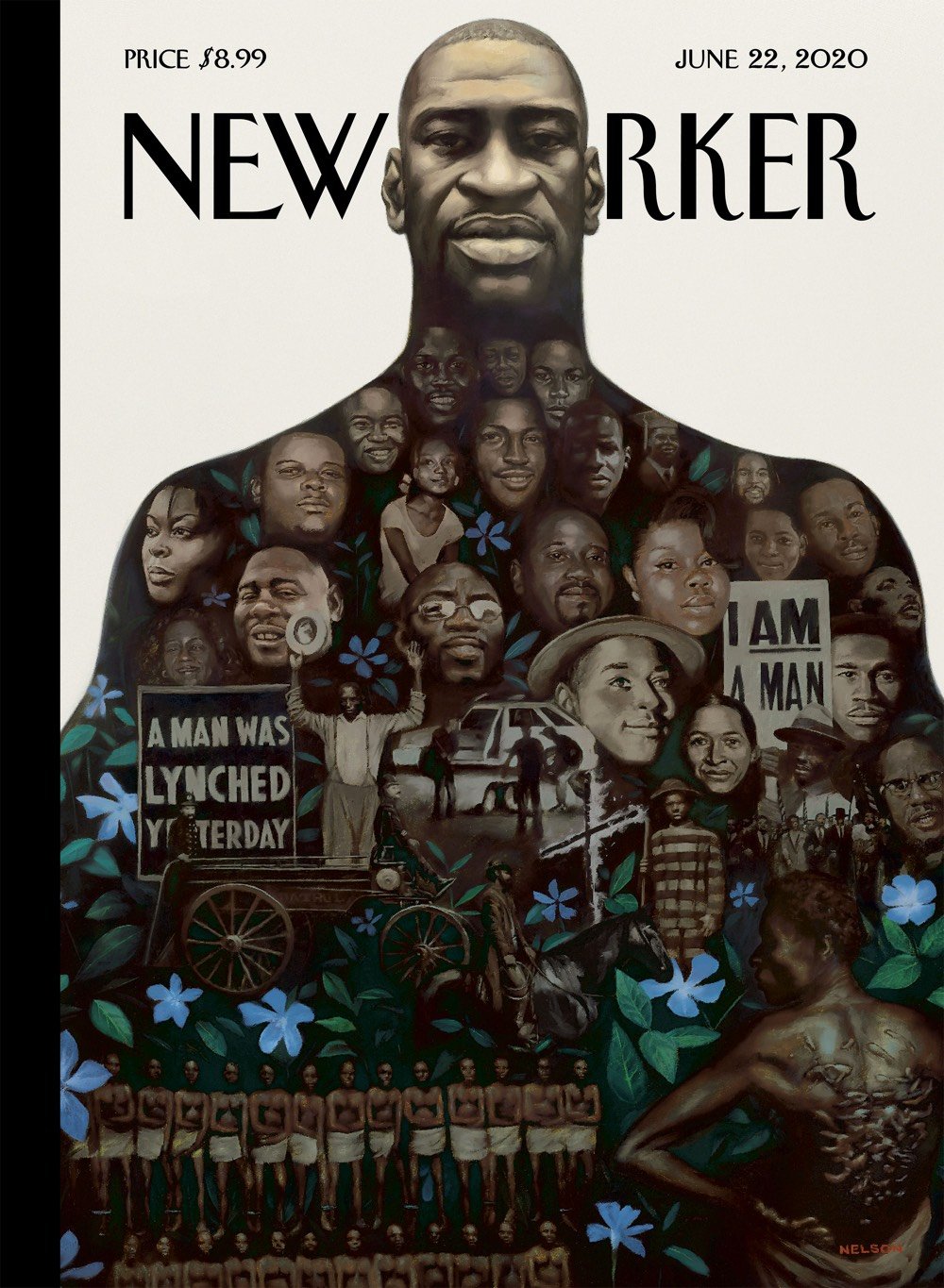
This week’s issue of the New Yorker features a cover designed by artist Kadir Nelson. The magazine has an interactive version of the cover online that identifies the people shown, along with their stories. Along with George Floyd, there’s Tony McDade, Trayvon Martin, Freddie Gray, Sandra Bland, Breonna Taylor, Tamir Rice, Martin Luther King, Jr., Medgar Evers, Emmett Till, Rodney King, the victims of the Tulsa Race Massacre, and too many others. The cover also features periwinkles, which have been used to locate the often unmarked graves of slaves.
The Periwinkle Initiative derives its name from the flower that certain scholars believe was the most common wildflower brought to gravesites of enslaved Americans. This perennial flower has guided researchers to many abandoned burial grounds that would have otherwise gone undetected. The resilient Periwinkle is a perfect symbol to represent the endurance of enslaved Americans and their legacy.
One other thing. According to the NYer, the name of the cover is “Say Their Names”. This is a take on the #SayHerName hashtag that was created to bring “awareness to the often invisible names and stories of Black women and girls who have been victimized by racist police violence”. Phrases and associated hashtags like “Say His Name” and “Say Their Names” have been used over the past few weeks, but some activists say that co-opting specifically takes the spotlight away from the victims the original hashtag was meant to highlight. Here’s Precious Fondren for Teen Vogue:
Since Floyd’s death, there have been uprisings around the country. There’s also been an influx of people using hashtags like #SayHisName and #SayTheirNames to remember the names of other male victims of police violence. While everyone deserves to be honored and remembered, especially when they are being murdered at the hands of those sworn to protect us, it should be noted that such hashtags muddle the very reasoning behind the creation of the #SayHerName.
Conceived in 2014 by the African American Policy Forum and the Center for Intersectionality and Social Policy Studies, the #SayHerName hashtag was meant to amplify the names and narratives of Black women and girls who have also been the victims of police killings; people simply couldn’t name them the way they can name Tamir Rice, Mike Brown, or Freddie Gray.
Older posts





Socials & More