Entries for November 2016
For the past year and a half, Casey Neistat has been putting out a daily 10-minute video blog about his day. After more than 500 episodes, Neistat announced that he’s hanging up his vblogging spurs to pursue other projects. In his final video, he discusses the complacency of success and the difficulty of advancing your career without taking creative risks, something many of us can identify with.
What [the vlog] hasn’t been doing is challenging me. It hasn’t been the creative fistfight that I want and need every single day.
I’m definitely a fan and can’t wait to see what he comes up with next.
Update: Ah, well that explains it: CNN Acquires Social-Video Startup Beme, Co-Founded by YouTube Star Casey Neistat.
CNN has acquired video-sharing app startup Beme, co-founded by popular YouTube creator Casey Neistat and Matt Hackett, and will invest in the team to launch a new standalone media brand.
Terms of the deal were not disclosed. CNN said the new venture that it’s forming out of the acquisition - aimed at reaching millennial viewers with the street cred of Neistat’s reporting and commentary - will launch in the summer of 2017. All 11 of Beme’s employees will join CNN; the cable news network will be shutting down Beme, which had garnered more than 1 million downloads.

The North American Cartographic Information Society has published the third volume of The Atlas of Design, a book consisting of “beautiful and inspiring maps from around the world”.
National Geographic took a look at some of the maps included in the book.
The striking panorama above of Denali and the Alaska Range was created by draping satellite imagery over a three-dimensional model of the terrain. Brooke Marston, a cartographer at the U.S. State Department’s Bureau of Intelligence and Research, was inspired by the Austrian artist Heinrich Berann, who is famed for his beautiful panoramas of mountain ranges.
While Berann took some artistic license with the precise location and positioning of mountains in his panoramas, Marston’s map is true to the geography. The oblique, bird’s-eye view emphasizes the sheer size of the mountains while maintaining a closeness with the viewer. “Good oblique mapping can transport the viewer straight into the landscape,” Elmer says. “This map makes me feel lost among the jagged, cold, majestic mountains just looking at it.”

NASA has published their highly anticipated and peer-reviewed analysis of the EM Drive and they’ve concluded the engine works despite appearing to violate Newton’s third law of motion.
In case you’ve missed the hype, the EM Drive, or Electromagnetic Drive, is a propulsion system first proposed by British inventor Roger Shawyer back in 1999.
Instead of using heavy, inefficient rocket fuel, it bounces microwaves back and forth inside a cone-shaped metal cavity to generate thrust.
According to Shawyer’s calculations, the EM Drive could be so efficient that it could power us to Mars in just 70 days.
But, there’s a not-small problem with the system. It defies Newton’s third law, which states that everything must have an equal and opposite reaction.
According to the law, for a system to produce thrust, it has to push something out the other way. The EM Drive doesn’t do this.
Yet in test after test it continues to work. Last year, NASA’s Eagleworks Laboratory team got their hands on an EM Drive to try to figure out once and for all what was going on.
There’s a lot of skepticism around this project, but NASA’s review is definitely a boost to the EM Drive’s credibility.
Update: Just to reiterate, even with this latest paper, there is still skepticism about the EM Drive.
In the end, we can’t conclude that this is a null result, nor can we excitedly say that it works. The sad truth is that this paper is not much better than the researchers’ last one, and it doesn’t actually have enough detail to let us fully evaluate the data. Nor does the paper have enough data to allow a conclusion in the absence of a model. And despite mention of a model in the paper, any model that exists is very well hidden.
Also a clue that the science isn’t quite there on this one yet: very few mainstream science outlets covered this. When the NY Times picks this up and gets prominent physicists on the record about the thruster’s promise, that’s when you’ll know something’s up. Until then, remain skeptical. (via @paudo)
Erik Singer is a dialect coach who works with actors to perfect different accents and dialects. In this video, he quickly analyzes the performances of 32 actors based on their use of accents. Pretty fascinating to watch. He singles out Philip Seymour Hoffman’s portrayal of Truman Capote as an exemplary use of the proper accent. High marks also go to Kate Winslet doing a Polish accent, Idris Elba’s South African accent while portraying Nelson Mandela (and his Bal’more accent in The Wire), and Cate Blanchett playing Katherine Hepburn in The Aviator.
Nicolas Cage in Con Air and Tom Cruise in Far and Away? Well, let’s just say they couldn’t pahk the cah in Hahvahd Yahd.
Update: Actress Sarah Jones takes a slightly different approach to speaking in different accents. Instead of aiming for a particular generalized dialect, she picks out a particular person to impersonate.
Let’s say you want to sound like a Trinidadian woman, as Ms. Jones does in her show. She recommends you watch YouTube clips of speakers at council meetings in Trinidad until you find the person you most want to sound like. If you can meet your subject in person, it will help make your goal much easier to reach.
“I ask them to speak something very slowly three times in a row and then I have them say it at normal speed the way they’d say it three times in a row,” she said. “I have them say it the way they’d say it in school as compared to how they’d say it to a friend.”
Be sure to play the embedded audio clips of Jones speaking as her different characters. And you can watch her in action in this TED Talk:
This is pretty simple: 8 songs from the Beastie Boys remixed using beats and samples from Daft Punk. If you need further prompting, it’s probably not for you.
There’s something — I don’t know, charming? — about this interview with restaurateur Keith McNally.
In May of 1961, President John F. Kennedy told Congress and the rest of the American public that the US was going to send a man to the Moon. Just over 11 years later, as part of the Apollo 17 mission in December 1972, humans set foot on the Moon for the last time.1 The Last Steps is a summary of that final mission, during which NASA accomplished the near-impossible yet again and was met with increasing public indifference about a journey that had taken on the ease of a car trip to grandma’s house.
Update: Perhaps humans will set foot on the Moon sooner than 2060. The European Space Agency is planning on a manned mission “by 2030” and China is shooting for 2036. (via @T_fabriek)
Over at Literary Hub, Emily Temple offers a “reading list for resistance”, a list of 25 Works of Fiction and Poetry for Anger and Action.
Included are The Handmaid’s Tale by Margaret Atwood:
This is the book women will be whispering about to one another in Trump’s America-an all-too-real vision of our country under a totalitarian theocracy where women are stripped of their rights and kept around only as breeders or servants.
The Dispossessed by Ursula K. Le Guin:
There was a wall. It did not look important. It was built of uncut rocks roughly mortared. An adult could look right over it, and even a child could climb it. Where it crossed the roadway, instead of having a gate it degenerated into mere geometry, a line, an idea of boundary. But the idea was real.
And of course, George Orwell’s 1984:
To know and not to know, to be conscious of complete truthfulness while telling carefully constructed lies, to hold simultaneously two opinions which cancelled out, knowing them to be contradictory and believing in both of them, to use logic against logic…
1984 was my favorite book for a long time — I first read it when I was about 10 years old and reread it every year or two well into my 20s. I haven’t read it in more than 10 years…perhaps it’s time for another go.
The Pokémon Cookbook! (Note: this book does not teach you how to cook Pokémon characters.)
This is the trailer for the animated film Bee Movie, except that the action and audio is slowed down every time someone says “bee”. That is a little bit clever.
Update: Monkeying with bits of video based on simple rules is a full-blown thing on YouTube right now. The Bee Movie seems to have started it off and there are now many variations on the theme: every “bee” is repeated by how many were said before it, every time they say bee it gets faster, the Seinfeld theme plays every time they say bee, and every time they say bee it does the whole trailer really fast. It’s spread to other media: here’s the video for All Star by Smash Mouth but it gets 15% faster every time he says “the” (which is a great illustration of exponential growth, like compound interest), the first Harry Potter movie but every time they say his name it gets faster, and so on. (via @waxpancake)

Something is rotten to the north of Denmark. Climate scientists are alarmed at the extreme warmth in the Arctic right now. It’s currently dark up there 24 hours a day, which usually means cold temperatures and rapidly freezing ice. Instead, temperatures are rising…Arctic temps are currently a whopping 36°F above normal.
“The Arctic warmth is the result of a combination of record-low sea-ice extent for this time of year, probably very thin ice, and plenty of warm/moist air from lower latitudes being driven northward by a very wavy jet stream.”
Francis has published research suggesting that the jet stream, which travels from west to east across the Northern Hemisphere in the mid-latitudes, is becoming more wavy and elongated as the Arctic warms faster than the equator does.
“It will be fascinating to see if the stratospheric polar vortex continues to be as weak as it is now, which favors a negative Arctic Oscillation and probably a cold mid/late winter to continue over central and eastern Asia and eastern North America. The extreme behavior of the Arctic in 2016 seems to be in no hurry to quit,” Francis continued.
Is 2017 the year the Arctic finally loses most of the ice cap during the summer?


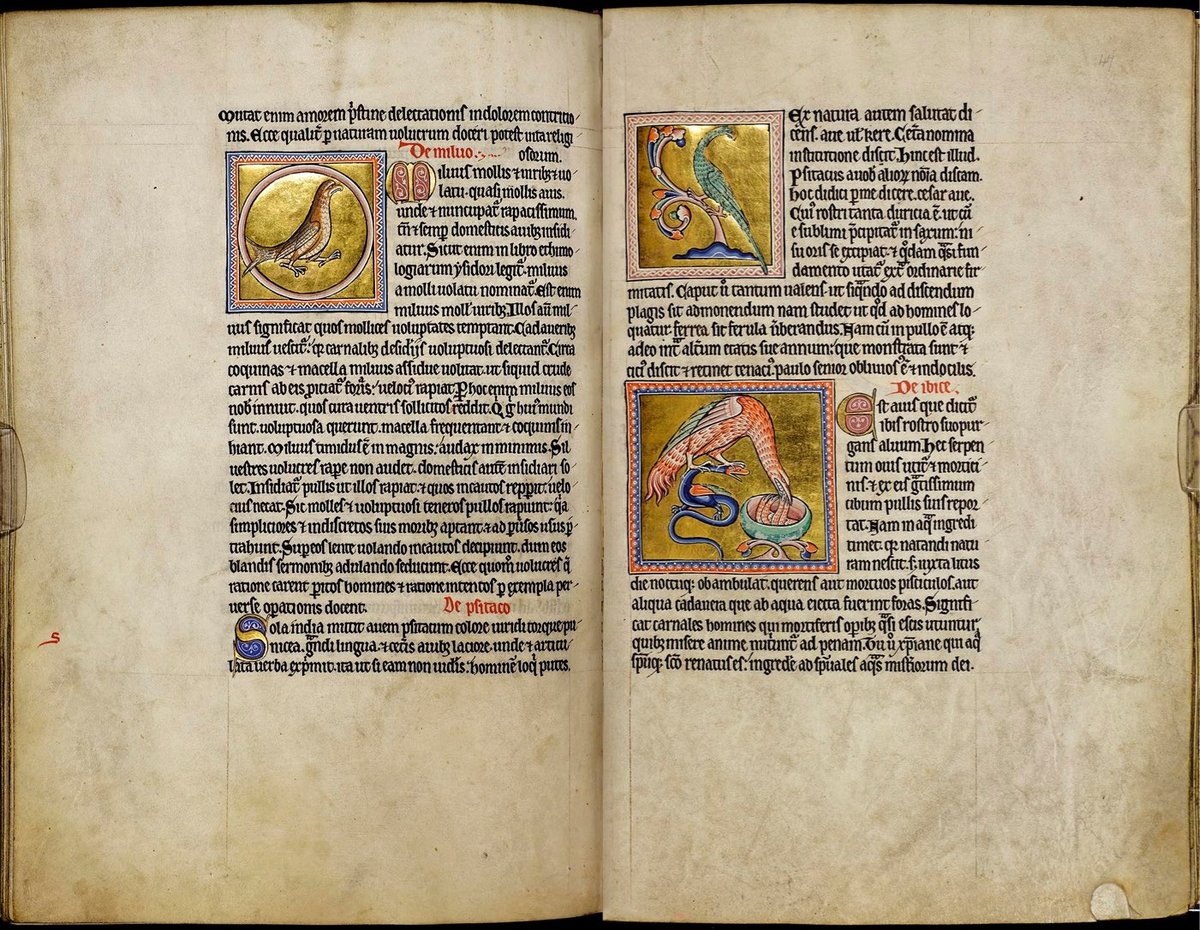
A bestiary was a type of book popular in the Middle Ages, featuring descriptions of animals accompanied by moral lessons. The Aberdeen Bestiary is a particularly fine example of a 12th century bestiary.
The Aberdeen Bestiary (Aberdeen University Library MS 24) is considered to be one of the best examples of its type due to its lavish and costly illuminations. The manuscript, written and illuminated in England around 1200, is of added interest since it contains notes, sketches and other evidence of the way it was designed and executed.
Thanks to the work of the University of Aberdeen in Scotland, where the book has been housed since the 1620s, a high-resolution copy of the book is available to browse online. The level of detail at full magnification is incredible. The text accompanying the top image of a panther is translated as:
There is an animal called the panther, multi-coloured, very beautiful and extremely gentle. Physiologus says of it, that it has only the dragon as an enemy. When it has fed and is full, it hides in its den and sleeps. After three days it awakes from its sleep and gives a great roar, and from its mouth comes a very sweet odour, as if it were a mixture of every perfume. When other animals hear its voice, they follow wherever it goes, because of the sweetness of its scent. Only the dragon, hearing its voice, is seized by fear and flees into the caves beneath the earth. There, unable to bear the scent, it grows numbed within itself and remains motionless, as if dead. Thus our Lord Jesus Christ, the true panther, descending from Heaven, snatched us from the power of the devil. And, through his incarnation, he united us to him as sons, taking everything, and ‘leading captivity captive, gave gifts to men’ (Ephesians, 4:8). The fact that the panther is a multi-coloured animal, signifies Christ, who is as Solomon said the wisdom of God the Father, an understanding spirit, a unique spirit, manifold, true, agreeable, fitting, compassionate, strong, steadfast, serene, all-powerful, all-seeing.
Jesus, the true panther. (via hyperallergic)
For most of the past decade, consumption of meat in the United States remained flat or declined.
For environmental, health, and animal welfare advocates, this was great news. Surely it meant that efforts to raise awareness about the disturbing impacts of meat production were inspiring people to cut back on hamburgers and bacon. As Paul Shapiro, vice president of Farm Animal Protection for the Humane Society of the United States, wrote in 2012, “The pressure is being felt all over, and for the first time in decades, our overconsumption of meat is beginning to get reined in.”
But according to research by a Dutch bank, US meat consumption jumped in 2015.
Not only was last year noteworthy for the near 5% increase in per capita consumption, but also due to the fact that the growth was achieved without the help of beef, consumption of which was flat. We expect US protein production growth of 2.5% per annum through 2018 — down from 3% in 2015 — with beef being the largest contributor relative to pork and poultry.
What drove the decline in the first place? Price. It always comes back to supply and demand.
Ranchers and farmers trimmed their herds because of the recession, historically high feed costs, and drought in the Great Plains. Meanwhile, domestic disease outbreaks like porcine epidemic diarrhea virus, or PEDv, meant that tens of thousands of hogs never made it to market. So Americans cut back on meat.
But by 2015, many of these issues driving higher prices were resolved. The retail price of beef has dropped by 22 percent, pork by 7 percent, and chicken by 5 percent. So Americans are eating more meat again.
“Consumers are responding to falling prices. That’s a big part of the story,” says Sawyer. The chicken industry, in particular, has also gotten more efficient and more capable of raising chickens fast.
I was at the grocery store last night and was shocked by the prices in the meat aisle. Lots of cuts on sale for just a few dollars a pound. (via the latest and particularly excellent issue of Susan MacMillan’s newsletter)

The New York Times took a map of the US and split it in two based on areas that voted for Clinton and Trump in the 2016 election. (Clinton’s map is pictured above.)
Mrs. Clinton’s island nation has large atolls and small island chains with liberal cores, like college towns, Native American reservations and areas with black and Hispanic majorities. While the land area is small, the residents here voted for Mrs. Clinton in large enough numbers to make her the winner of the overall popular vote.
That’s fun, but it’s another reminder of how strictly geographical maps distort election results.
P.S. They missed a real opportunity to call the chain of islands in the southern states The Cretaceous Atoll.

Originally conceived as a year-long project, artist Charles Young keep going and has built an entire model city out of paper consisting of more than 600 buildings. It’s called Paperholm and many of the structures are constructed with moving parts.

I would like to live in some of these buildings, please. (via colossal)
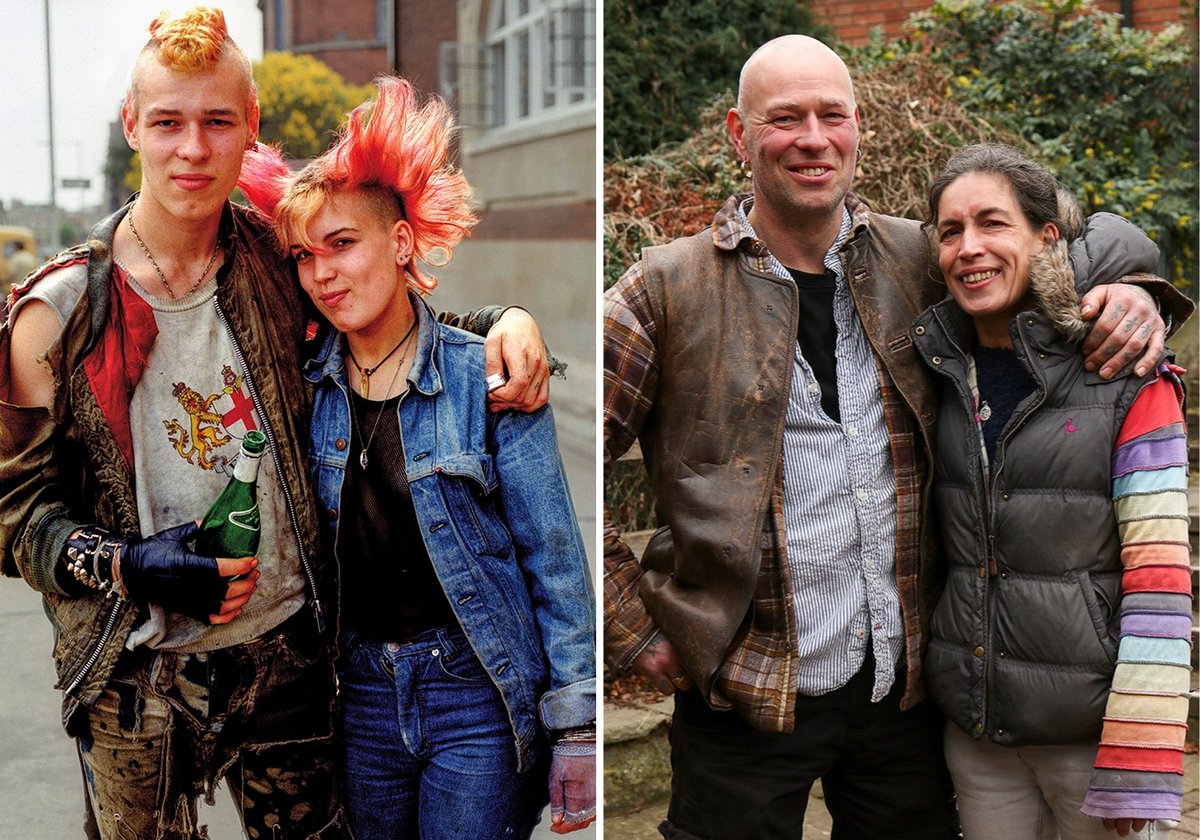

Photographer Chris Porsz has been taking candid photos of people on the streets of the English city of Peterborough since the 1970s. Recently, he tracked down a bunch of his subjects — many of them strangers — to recreate photos taken decades before, often in the same location. See also The Up Series, I should think.
You can order a book of the photographs directly from Porsz’s website.
A pair of greatest hits albums by David Bowie have been released.
The album collects together a selection of Bowie’s most popular tracks and singles, from 1969’s ‘Space Oddity’, through to the final singles ‘Lazarus’ and ‘I Can’t Give Everything Away’, issued earlier this year.
BOWIE - LEGACY will be available as a 1 CD and a Deluxe 2 CD from November 11th. These will be followed by a double vinyl album version on January 6th, 2017.
The album is available in a shorter 1-disc length and as a double album (embedded above). 2016 took Bowie from us, but maybe a little Bowie can help us through the rest of the year.
In 1995, Italian novelist and philosopher Umberto Eco wrote a piece for The New York Review of Books on fascism.1 As part of the article, Eco listed 14 features of what he called Ur-Fascism or Eternal Fascism. He began the list with this caveat:
These features cannot be organized into a system; many of them contradict each other, and are also typical of other kinds of despotism or fanaticism. But it is enough that one of them be present to allow fascism to coagulate around it.
Here’s an abbreviated version of Eco’s list:
1. The cult of tradition. “One has only to look at the syllabus of every fascist movement to find the major traditionalist thinkers. The Nazi gnosis was nourished by traditionalist, syncretistic, occult elements.”
2. The rejection of modernism. “The Enlightenment, the Age of Reason, is seen as the beginning of modern depravity. In this sense Ur-Fascism can be defined as irrationalism.”
3. The cult of action for action’s sake. “Action being beautiful in itself, it must be taken before, or without, any previous reflection. Thinking is a form of emasculation.”
4. Disagreement is treason. “The critical spirit makes distinctions, and to distinguish is a sign of modernism. In modern culture the scientific community praises disagreement as a way to improve knowledge.”
5. Fear of difference. “The first appeal of a fascist or prematurely fascist movement is an appeal against the intruders. Thus Ur-Fascism is racist by definition.”
6. Appeal to social frustration. “One of the most typical features of the historical fascism was the appeal to a frustrated middle class, a class suffering from an economic crisis or feelings of political humiliation, and frightened by the pressure of lower social groups.”
7. The obsession with a plot. “The followers must feel besieged. The easiest way to solve the plot is the appeal to xenophobia.”
8. The humiliation by the wealth and force of their enemies. “By a continuous shifting of rhetorical focus, the enemies are at the same time too strong and too weak.”
9. Pacifism is trafficking with the enemy. “For Ur-Fascism there is no struggle for life but, rather, life is lived for struggle.”
10. Contempt for the weak. “Elitism is a typical aspect of any reactionary ideology.”
11. Everybody is educated to become a hero. “In Ur-Fascist ideology, heroism is the norm. This cult of heroism is strictly linked with the cult of death.”
12. Machismo and weaponry. “Machismo implies both disdain for women and intolerance and condemnation of nonstandard sexual habits, from chastity to homosexuality.”
13. Selective populism. “There is in our future a TV or Internet populism, in which the emotional response of a selected group of citizens can be presented and accepted as the Voice of the People.”
14. Ur-Fascism speaks Newspeak. “All the Nazi or Fascist schoolbooks made use of an impoverished vocabulary, and an elementary syntax, in order to limit the instruments for complex and critical reasoning.”
I found this list via Paul Bausch, Blogger co-inventor and long-time MetaFilter developer, who writes:
You know, we have a strong history of opposing authoritarianism. I’d like to believe that opposition is like an immune system response that kicks in.
It difficult to look at Eco’s list and not see parallels between it and the incoming Trump administration.2 We must resist. Disagree. Be modern. Improve knowledge. Welcome outsiders. Protect the weak. Reject xenophobia. Welcome difference. At the end of his piece, Eco quotes Franklin Roosevelt saying during a radio address on the “need for continuous liberal government”:
I venture the challenging statement that if American democracy ceases to move forward as a living force, seeking day and night by peaceful means to better the lot of our citizens, fascism will grow in strength in our land.
And Eco himself adds: “Freedom and liberation are an unending task.”



Alan Taylor has compiled a bunch of satellite photography showing how humans have altered the landscape of the American Southwest.
Humans have lived in what we now call the American Southwest for centuries, making a wide impact on the land, much of it visible from aerial and satellite photography. Nuclear detonations, housing subdivisions, oil exploration, hydroelectric facilities, solar power facilities, roads, mines, farms, ranches, cities, and towns have altered much of the land over the years.
The photos, from top to bottom: a road cuts through White Sands, NM, a former nuclear testing site in NV (those are craters left from nuclear explosions), and a housing development south of Denver.
A group of children and young adults are suing the United States over climate change.
The young plaintiffs, who range in age from 9 to 20, allege that climate change violates their constitutional rights to life, liberty, and property by causing direct harm and destroying so-called public trust assets such as coastlines. The case argues that climate change is worsened by the aggregated actions of the federal government in permitting fossil fuel development, subsidizing the fossil fuel industry, and many other such actions. Further, the children and their lawyers say these government actions are willfully prioritizing short-term profit, convenience, and the concerns of current generations over those of future generations. The plaintiffs state that the government and these companies have continued to prioritize these short-term gains for more than five decades with full knowledge of the extreme dangers they posed.
Last week, federal district court judge Ann Aiken in Oregon ruled against the federal government’s motion to dismiss, an important hurdle to clear for the lawsuit to move forward. Aiken wrote:
I have no doubt that the right to a climate system capable of sustaining human life is fundamental to a free and ordered society. Just as marriage is the foundation of the family, a stable climate system is quite literally the foundation of society, without which there would be neither civilization nor progress. … To hold otherwise would be to say that the Constitution affords no protection against a government’s knowing decision to poison the air its citizens breathe or the water its citizens drink.
You can donate to their effort on their website.
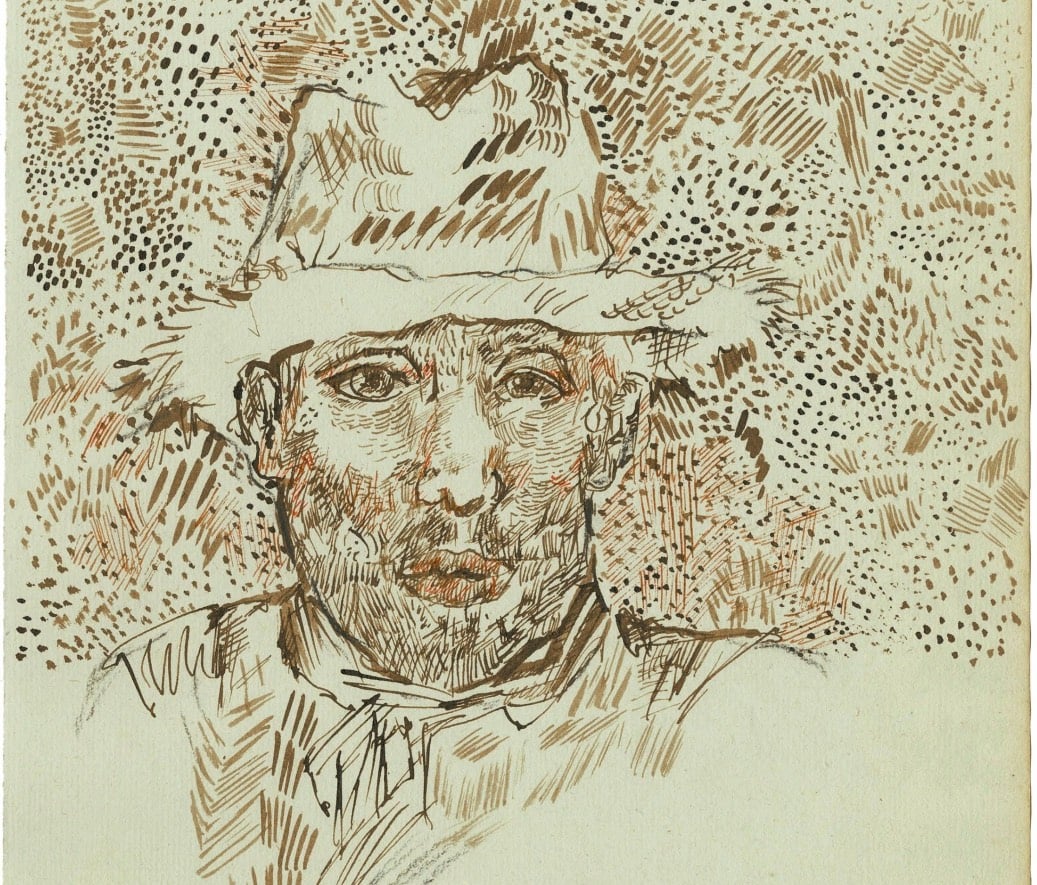
In 2013, art historian Bogomila Welsh-Ovcharov was asked to look at some drawings that may have been done by Vincent van Gogh. What she found was an entire sketchbook containing 65 drawings done by the artist during his time spent in Provence.
As Welsh-Ovcharov began the painstaking process of authenticating the works over the past three years, the story of the sketchbook also came to light.
It was, in fact, an old-fashioned business ledger, approximately 26 by 40 centimetres, that had been given to van Gogh in May 1888 by the owners of a café in Arles, where he was temporarily living. The high-quality blank pages were ideal for use as an artist’s sketchbook.
Two years later, after van Gogh cut off his ear following an argument with the painter Paul Gauguin and spent many months in hospitals in Arles and Saint-Rémy, a doctor he had befriended returned the book of drawings to the café owners. Then for generations, it languished, likely stored with other business ledgers.
Fortunately, there was independent proof that this was van Gogh’s work, thanks to a small notebook that had also belonged to the café, documenting daily activities. It contained an entry for May 20, 1890 noting that van Gogh’s friend, Dr. Felix Rey, had returned a large album of drawings, along with some empty olive jars and towels, to the café owners on behalf of the artist.
Drawing from the sketchbook are being released as a book: Vincent van Gogh: The Lost Arles Sketchbook.
Update: As noted in the CBC piece, The Van Gogh Museum disputes the authenticity of the sketchbook.
At an earlier stage (in 2008 and 2012), our experts gave their opinion on its authenticity — an opinion not mentioned in the publication — at the request of various owners of drawings from the album. Our researchers and curators are happy about every new work that can correctly be attributed to Van Gogh, but on the basis of high-quality photographs sent to them of 56 of the 65 drawings now published, they concluded that these could not be attributed to Vincent van Gogh. After examining a number of the original drawings in 2013 and reading the recent publication, our experts have not changed their minds.
Their evidence is that the drawings do not show van Gogh’s characteristic style, use the wrong ink, contain many topographical errors, and so on. (thx, everyone)
According to a marketing study conducted by Dr. David Lewis-Hodgson, the most relaxing song in the world is Weightless, by ambient band Marconi Union. The song was produced by the band in collaboration with the British Academy of Sound Therapy.
The song makes use of many musical principles that have been shown to individually have a calming effect. By combining these elements in the way Marconi Union have has created the perfect relaxing song. The study found this to be the world’s most relaxing song. It contains a sustaining rhythm that starts at 60 beats per minute and gradually slows to around 50. While listening, your heart rate gradually comes to match that beat.
Many songs were tested and found to relax the participants, but Weightless stood out:
In fact, listening to that one song — “Weightless” — resulted in a striking 65 percent reduction in participants’ overall anxiety, and a 35 percent reduction in their usual physiological resting rates.
This is a “neuromarketing” study conducted on behalf of a company that makes bubble bath and shower gel so grain of salt and all that, but it is a remarkably relaxing song. Here’s a Spotify playlist of ten of the most relaxing songs from the study:
And right now I’m listening to this 10-hour version of Weightless on YouTube:
Awwwww. Much better than the Black Mirror music from this morning.
In this video, American poet Maya Angelou recites her poem Still I Rise, which was published in 1978. The recitation includes some opening remarks…the poem begins like so:
You may write me down in history
With your bitter, twisted lies,
You may trod me in the very dirt
But still, like dust, I’ll rise.
Does my sassiness upset you?
Why are you beset with gloom?
‘Cause I walk like I’ve got oil wells
Pumping in my living room.
Just like moons and like suns,
With the certainty of tides,
Just like hopes springing high,
Still I’ll rise.
Wonderful. That little chuckle after “Does my sassiness upset you?” — amazing. And it’s interesting to see how she deviates from the written text in her performance, a reminder that even the finest things in the world — like freedom, like liberty, like democracy — need to be refreshed and remade anew in order to remain vital. (via swiss miss)
Perhaps listening to the pulsing, creepy, and foreboding music from Black Mirror is too much at a time like this, but in case you’d really like to wallow, there are several albums of music from the show available on Spotify: Be Right Back, White Bear, White Christmas, Nosedive, and Men Against Fire. I’ve added all five albums to this Black Mirror playlist.
I hadn’t realized while watching, but the show used some top-shelf composers for the music, including Clint Mansell, Max Richter, and Geoff Barrow & Ben Salisbury (who did the Ex Machina soundtrack).
Black Mirror creator Charlie Brooker also put together a playlist of 80s music from the stand-out episode of season 3, San Junipero.
The playlist includes “tracks from the episode, tracks which didn’t make it in (for rights/other reasons)…and a couple which inspired elements of the story”.
Update: I’ve updated the Spotify playlist of Black Mirror soundtracks to include soundtracks up through season 5.




In the wake of the election, Matthew Chavez, who goes by “Levee” and is the instigator of Subway Therapy, encouraged New Yorkers to share their post-election grief on Post-it Notes stuck to the wall of the tunnel between the 6th and 7th Ave subway stations on 14th St. Joe Holmes visited the tunnel and took photos of people interacting with the wall. (All photos above by Joe Holmes.)
Music is an essential aspect of Wes Anderson’s films. Michael Park has created a 9-hour playlist of music from Anderson’s movies, from Bottle Rocket (Artie Shaw & Chet Baker) to The Royal Tenenbaums (Elliott Smith & Nico) to Fantastic Mr. Fox (Burl Ives & The Rolling Stones) to The Grand Budapest Hotel (mostly by Alexandre Desplat).
Newer posts
Older posts




Socials & More