Entries for October 2015
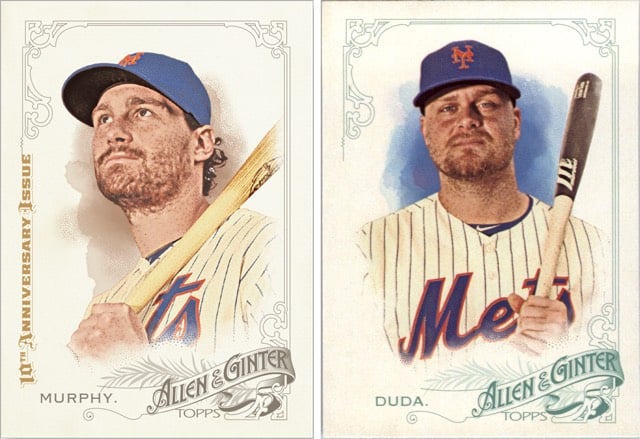
Ahhhh! Dan Barry of The NY Times went all olde tymey in his recap of game four of the NLCS between the Cubs and Mets, sorry, Metropolitans.
The Metropolitans — also known as the “Mets” — sent six safely across the plate before the third inning, mostly as a result of the derring-do of their Bunyanesque first-sacker, Lucas Duda. The mighty Californian smote a home run and a double to tally five of those six runs before the Cubs seemed to comprehend that a game concerning their possible erasure from the 2015 field was well underway.
The ignominious rout of the valiant but overmatched hometown squad turned the deafening cheers of the Chicago multitudes into plaintive keens, for now their agonizing wait for another championship — the last in 1908, during the presidency of the rough-riding Theodore Roosevelt — must continue.
I say! Capital stuff, old chap.
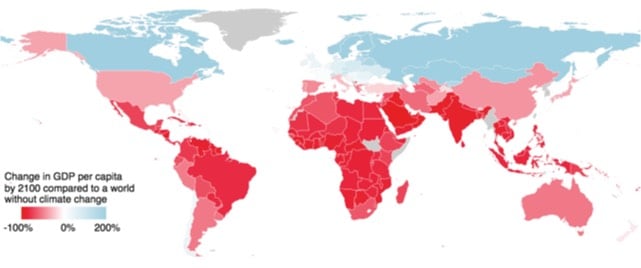
A new study from scientists and economists at Stanford and Berkeley has taken a stab at determining how climate change will affect the world’s economic activity. As part of their study, they look at which countries might benefit from climate change and which might lose out. As you might expect, countries in the Northern Hemisphere with cooler climates stand to benefit while the rest of the world will not. Here are some of the projected big winners (the Nordic countries) and losers (the Middle East):
Mongolia +1413%
Finland +516%
Iceland +513%
Russia +419%
Estonia +259%
Saudi Arabia -96%
Kuwait -96%
Oman -94%
United Arab Emirates -94%
Iraq -93%
Canada (+247%) is another one of the potential big winners while the US (-36%) stands to lose out…along with all of Africa, South America, India, and China. This quote by one of the study’s lead authors, really grabbed me by the throat:
What climate change is doing is basically devaluing all the real estate south of the United States and making the whole planet less productive. Climate change is essentially a massive transfer of value from the hot parts of the world to the cooler parts of the world. This is like taking from the poor and giving to the rich.
Among other many things, anthropogenic climate change is an issue of discrimination.1 Rich, predominantly white countries caused the problem and can do the most to limit the damage, but climate change will disproportionately affect poor countries, poor people (even in rich countries), women, and people of color. The rich need to do something about it so that the poor will not suffer. The problem is, the world’s wealthy have a long history of not being incentivized to help anyone but themselves. I hope this will turn out differently…or, as sometimes happens, the desires of the wealthy and the needs of the poor dovetail into action of joint benefit.
Some amazing person has collected the full tracks of the songs that were sampled by the Beastie Boys on six of their best-known albums and provided them as a downloadable zip file. That’s 286 tracks, 22 hours of music, and encoded between 256kbps and 320kbps.
Obviously not every sample or drum break can or ever will be identified, but this is about as close as it’s gonna get! With the completion of this eighteen year long ongoing project, I want to personally thank each and every single person out there that has lent insight, shared knowledge, or provided me with any of the tracks that were used to compile this amazing piece of history. It goes without saying that much love, gratitude, and respect is owed to the Beastie Boys for introducing me (and you) to some amazing music via sampling that may otherwise not be heard, let alone acknowledged in this light.
Some of the included tracks:
Led Zeppelin - When The Levee Breaks
Kurtis Blow - Christmas Rappin’
Johnny Cash - Folsom Prison Blues
The Beatles - Sgt. Pepper’s Lonely Hearts Club Band
Jimi Hendrix - Foxey Lady
Stephen Sondheim - Act I: Company
Peggy Lee - Sittin’ On The Dock Of The Bay
See also Paul’s Boutique Without Paul’s Boutique, where Tim Carmody provides some context behind the Beasties’ sampling:
The remix is fun to listen to, but mostly, it just reminds you that Paul’s Boutique sounds amazing because its sampled sources were amazing. Like De La Soul’s Three Feet High and Rising, released the same year, Paul’s Boutique lifts tracks that would cost a small mint to borrow from today. (Three Feet High has never had an official digital release because the rights holders still can’t sort out the royalties.) The Beatles, The Supremes, The Ramones, Curtis Mayfield, Dylan, Hendrix, Sly, Bernard Hermann, and James Brown (of course) are all there. But mostly, it’s a love letter to old-school New York City hip hop: Kurtis Blow, Afrika Bambaataa and the Jazzy 5, The Sugarhill Gang, The Funky 4 +1, and contemporaries like Run-DMC, Boogie Down Productions, and Public Enemy are the glue that holds the whole project together.
Now, if you know Paul’s Boutique well, you can’t hear those older songs any more without hearing Paul’s Boutique. There’s specific moments in those songs that hide there waiting for you to trip over them, like quotations of ancient Greek in an Ezra Pound or TS Eliot poem. Beastie Boys didn’t just find a way to make older music sound new; they found a way to invent their own precursors.
(via @tcarmody)

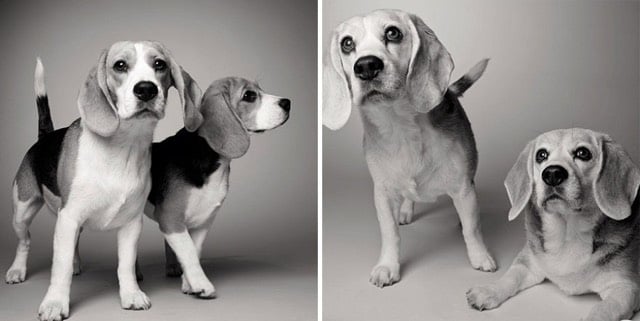
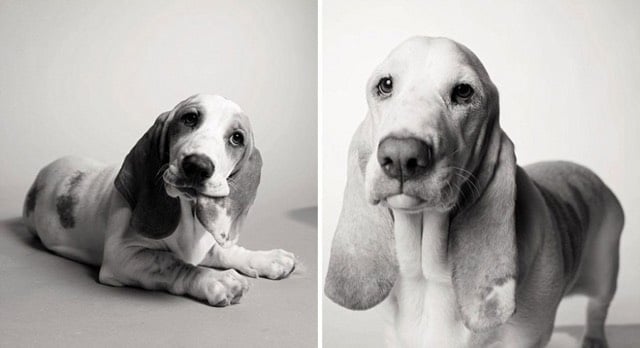
From pet photographer Amanda Jones comes a coffee table book featuring pairs of photographs of dogs, one taken as a puppy and again as an older dog.
See also The Brown Sisters by Nicholas Nixon and many other time passage photography projects. (via bright side)
The scientists who conducted a study at the Delft University of Technology in the Netherlands say they have proved that quantum entanglement is a real effect.
The Delft researchers were able to entangle two electrons separated by a distance of 1.3 kilometers, slightly less than a mile, and then share information between them. Physicists use the term “entanglement” to refer to pairs of particles that are generated in such a way that they cannot be described independently. The scientists placed two diamonds on opposite sides of the Delft University campus, 1.3 kilometers apart.
Each diamond contained a tiny trap for single electrons, which have a magnetic property called a “spin.” Pulses of microwave and laser energy are then used to entangle and measure the “spin” of the electrons.
The distance — with detectors set on opposite sides of the campus — ensured that information could not be exchanged by conventional means within the time it takes to do the measurement.
The study, published in Nature, has yet to be verified, but still, exciting!
In the New Yorker, Matthew J.X. Malady writes about finding his deceased mother standing outside her house on Google Street View and, more generally, when technology clumsily reminds us of loved ones who are no longer with us.
When I reached my mother’s house, that all changed. First, I noticed that a gigantic American flag had been affixed to the mailbox post at the corner of the driveway. That was new. Then I spotted the fire pit in the front yard that my mom and her husband, my stepfather, used for block parties, and the grill on the patio, and my mom’s car. And then there she was, out front, walking on the path that leads from the driveway to the home’s front door. My mom.
At first I was convinced that it couldn’t be her, that I was just seeing things. When’s the last time you’ve spotted someone you know on Google Maps? I never had. And my mother, besides, is no longer alive. It couldn’t be her.
Facebook in particular has been dinged for inadvertent algorithmic cruelty, but they have recently been making strides in a better direction. (via @tcarmody)

From Nathan Yau at FlowingData, a look at the places in the US where people need to make the longest drives to visit a grocery store.
The nearest grocery store is more than 10 miles away in about 36 percent of the country and the median distance is 7 miles. However, a lot of these areas are rural with few (if any) people who live there.
Wyoming contains very few grocery stores:

And Nevada is even more of a food desert. Looks like Massachusetts, Delaware, and New Jersey have plenty of grocery stores everywhere. (via feltron)
Is this for real? 43 people simultaneously tossed coins into jars while standing 15 feet away with only a single miss? Impressive.
If it is fake, how’d they do it? CG? Coins dropped from above each jar? It seems unlikely the broken jar near the beginning of the sequence was done in CG or resulted from a coin falling from above. The coins, jars, and tossing seems real. How about 43 motion-captured green-screened robotic arms accurately tossed the coins and the actors were added in later. Or was it magic?
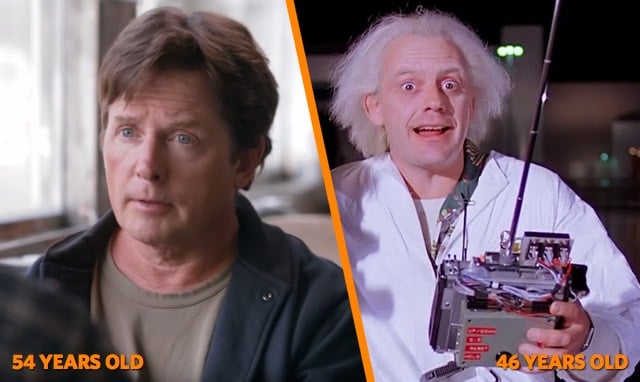
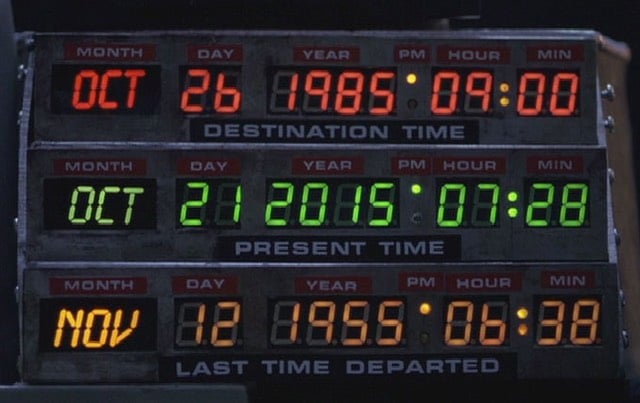
If you haven’t heard, today is the day to which Doc, Marty, and Jennifer travel forward in time in Back to the Future II.
Because of this and my love of cultural time travel, I thought I’d take the opportunity to point out that Michael J. Fox (aka Marty McFly) is nearly 8 years older now than Christopher Lloyd was when he played Doc Brown when Back to the Future was released in 1985. That’s heavy.

Matt Green plans to walk on every single street in NYC. Of an estimated 8-9000 miles of streets, trails, and paths in the city, he has already covered 7000 miles, including what looks like nearly all of Brooklyn.
I am going to walk every block of every public street in all five boroughs of New York City, excluding only the high-speed expressways and parkways that prohibit pedestrian traffic. I will also walk every bridge with pedestrian facilities, as well as many private streets, multi-use greenway paths, pedestrian paths and trails through parks and cemeteries, boardwalks, and accessible stretches of coastline.
It is my understanding that the total length of all the public streets in NYC is somewhere in excess of 6,000 miles. Add the bridges, private streets, paths, and coastline to that, as well as all the blocks I will end up covering more than once, and I expect to have walked more than 8,000 miles before I’m done.
Matt previously walked across the United States and visited every NYC subway station in one go.
William Helmreich is also attempting to walk every block in the city, and he and Green recently met to compare notes.
That video is wonderful, btw…two curious souls fully engaging with their surroundings. If you click on none of the other links in this post, you should at least watch the video. (thx, mike)
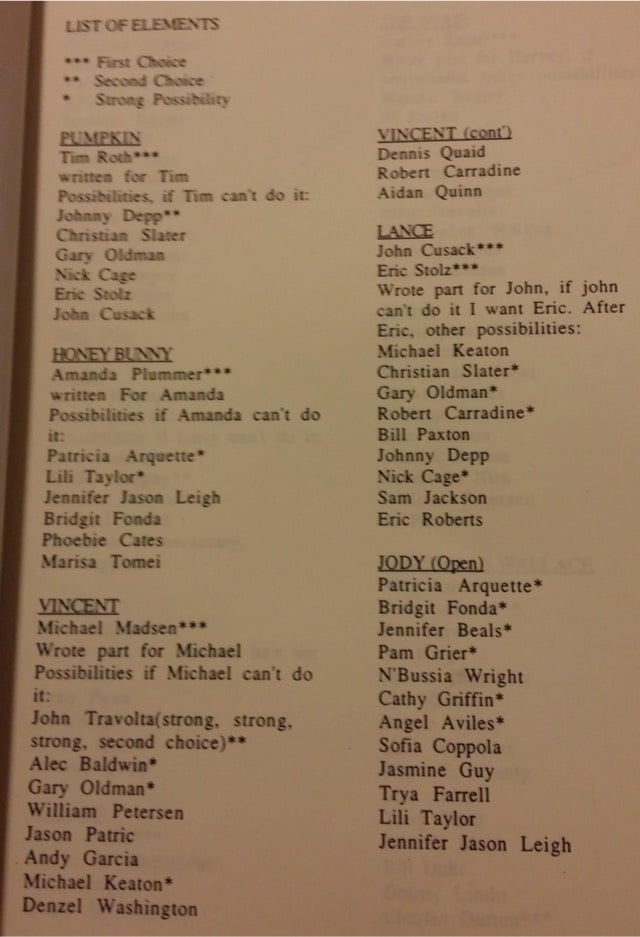

Quentin Tarantino is the type of writer/director who writes roles in movies with specific actors in mind. For Pulp Fiction, he wanted Harvey Keitel to play Winston Wolf, Tim Roth to play Pumpkin, and Ving Rhames to play Marcellus Wallace. But he also wanted Michael Madsen to play Vincent (with Travolta as a strong second choice), John Cusack to play Lance, Matt Dillon to play Butch, and Laurence Fishburne to play Jules. Another possibility for Jules was Eddie Murphy, and Tarantino also specified “No Rappers” for that role. Bruce Willis and Uma Thurman weren’t even listed for their respective roles. Gary Oldman, Nicholas Cage, Johnny Depp, and Alec Baldwin were considered for several roles but ultimately didn’t appear in the film.
Here’s the full list. (via open culture)
Kevin Kelly and Mark Frauenfelder polled 1600 people to find a list of the 50 best non-fiction podcasts. The list skews nerdy, science, and tech. The top 5 is unsurprising:
1. This American Life
2. Radiolab
3. Serial
4. 99% Invisible
5. WTF with Marc Maron
In 1997, shortly after Apple’s purchase of NeXT, Steve Jobs took the stage at Apple’s annual developer conference to answer questions from the audience for at least 50 minutes. It was a different time for sure. Apple was reeling, Jobs had just returned as an advisor and then interim CEO, his last company, NeXT, had not succeeded on its own, and the iPod & Apple Stores were years off.
When he arrived at Apple after the NeXT acquisition, Jobs moved swiftly to pare down the number of projects that the company was working on. In this first video, Jobs responds to a question about Apple killing a promising technology called OpenDoc.
Jobs talks about how “focus means saying ‘no’” and how Apple’s loss of focus has made the company less than the sum of its parts and not more. Even at this early stage in Apple’s comeback, you can see the seeds of how it was going to happen.
In the second video, a later questioner tells Jobs “it’s sad and clear that on several accounts you’ve discussed, you don’t know what you’re talking about”, asks him to comment on OpenDoc again, and also tell the audience what “he’s personally been doing for the last seven years”, a reference to his answer to the earlier question in the video above and the failure of NeXT.
Instead of laying into the guy, as a caricature of Steve Jobs might, he responds thoughtfully and almost humbly about how Apple needs to focus on its “larger, cohesive vision” of selling products to people, starting with customer experience rather than technology, and most importantly, making decisions.
Of course, in hindsight, it is obvious how overwhelmingly right Jobs was in his assertions. Since then, Apple has focused relentlessly on what worked and has succeeded brilliantly, beyond anything anyone, save perhaps Jobs, would have ever imagined. I wonder what that cheeky engineer is up to now? (via alphr)
(Also, can we talk about the patches on Jobs’ jeans? That’s not a fashion thing, right? Like, those aren’t $450 jeans made to look worn out. To me, those are obviously Steve’s favorite pair of jeans — probably Levi’s, I can’t tell for sure — patched up because he wants to keep wearing them. No one in technology has been picked apart like Steve Jobs by people looking for clues to who he was as a person and how that informed his business activities.1 Was he an asshole? Was he an artist? Was he just all smoke and mirrors? If we can stoop to the level of assessing a man’s character by the clothes he wears, it seems to me that whatever else he did, Jobs was at once pragmatic and dreamy when it came to products, to objects. What a potent combination that turned out to be.)
Update: The man who takes a swipe at Jobs in the later video was possibly identified on Quora last year by an anonymous person who said they worked on the WWDC event and spoke to the man in question.
The audience member is named Robert Hamisch. Mr. Hamisch was a consultant at a security firm in the 1990’s that did consultant services for Sun Microsystems (their billing and payroll department) for a short period of time. As far as I know, he left the company (the consulting firm, he never worked for Sun directly) and has since retired. He attended the 1997 WWDC sponsored by his security consulting firm, although never had any stake in Sun Microsystems as a whole besides general system security for their billing and payroll department. I don’t know why he specifically asked about Java, but he may have just been frustrated with Jobs and his performance as a whole.
A short web search turned up no information on Hamisch. (thx, charles)
In McSweeney’s, Vijith Assar writes about the increasingly pernicious use of the passive voice in the media and how it may have developed, one small step at a time, from:
The quick brown fox jumps over the lazy dog.
to “the ultimate in passive voice”:
Speed was involved in a jumping-related accident while a fox was brown.

A much tinier number die alone in unwatched struggles. No one collects their bodies. No one mourns the conclusion of a life. They are just a name added to the death tables. In the year 2014, George Bell, age 72, was among those names.
That has changed since the NY Times’ N.R. Kleinfield wrote a piece on the life and death of a random New Yorker: The Lonely Death of George Bell.
Trailer: watched. Tickets: bought. Luke Skywalker: still missing.
New Yorker staff writer Larissa MacFarquhar has written a book on people who are wholly devoted to helping others called Strangers Drowning: Grappling with Impossible Idealism, Drastic Choices, and the Overpowering Urge to Help. At least a few of the books’ subjects were first profiled in the NYer by MacFarquhar, including this amazing story of a couple who adopted 20 children and a Japanese monk confronting his culture’s suicide problem.
David Wolf of The Guardian recently wrote about MacFarquhar and her unique writing style, writing from the perspective of her subjects, like they themselves had written the piece.
MacFarquhar attributes her restlessness with form to getting “productively bored”: “For a profile, I do try to make the piece sound and feel as though it were written by the person themselves, rather than by me. What I’m trying to get at is a sense of intimacy, a sense that you are, insofar as is possible, inside the mind of the person, so that you understand why they’re in love with the ideas they fell in love with, what moves them, what drives them.”
These principles guide most of her stylistic decisions. Anything that diminishes the immediacy of the reader’s access to her subject is thrown out. “People think I’m a total freak for not using the first person,” she says. “The way I think about it is that if you’re making a conventional feature film, all it takes is for the director to walk across the camera just once and you have a completely different relationship to the whole story. For that reason, even though it sometimes means sacrificing great scenes, I take myself out.”
What point of view is that? It’s like a mix of first person and third person. Is one-third person POV a thing?
The Hood Internet has released their ninth mixtape. Ninth! The highlight so far as I listen for the first time: Daft Punk’s Around the World mixed with The Weeknd’s Can’t Feel My Face. (via @mathowie)
Update: Downloads and track listing are available on The Hood Internet’s website.
In 1948, contact lenses were huge hunks of glass that don’t look at all comfortable. And the fittings started with a plaster cast of your eyeball. Ok, probably not plaster but still, ew. (via @FastidiumSum)
Astronaut Scott Kelly, who is spending a continuous year in space,1 tweeted out a photo by fellow ISS resident Oleg Kononenko of NYC on Saturday night.

Of the many possibilities, I’d like to point out just three interesting things.
1. Times Square! And not just that, but the whole of central Midtown is now lit up like a Christmas tree from 34th Street to Central Park.
2. The bright spot of light in the upper right corner of the image above is Citi Field. The photo must have been taken during Game 1 of the NLCS between the Mets and the Cubs. The Mets won that game 4-2. #LGM!
3. You’ll notice that the streetlights in much of the city are orange. But in the bottom right corner, in Brooklyn, you can see the future. NYC is currently replacing all of the orange-glowing sodium vapor streetlights with blue-glowing LED lights that are longer lasting and more energy efficient. But they are also brighter and some are already complaining about the harsh blue light.
The new LEDs may be environmentally sensitive, but they are also optically harsh.
“The old lights made everybody look bad,” said Christopher Stoddard, an architect, who lives at the corner of Fuller Place. “But these are so cold and blue, it’s like ‘Night of the Living Dead’ out there.”
“We’re all for saving energy,” his wife, Aida Stoddard, also an architect, said, “but the city can do so much better.”
A few blocks away, Rose Gallitelli taped up black garbage bags on her bedroom windows so that she could sleep. “They’re the heavy-duty kind,” she said.
The lighting refit is scheduled to be completed in two years. The city will look different when it’s done, in real life, on Instagram, and in film. (via @ginatrapani)
Update: Photographer Pari Dukovic has a shot of one of the old sodium vapor street lamps in the New Yorker this week.
vintage post from Oct 2015
· gift link
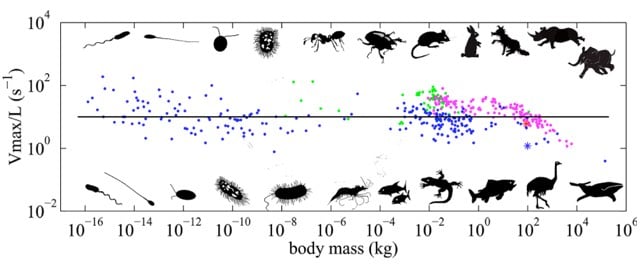
A recent paper found that the time it takes for an animal to move the length of its own body is largely independent of mass. This appears to hold from tiny bacteria on up to whales — that’s more than 20 orders of magnitude of mass. The paper’s argument as to why this happens relies on scaling laws. Alex Klotz explains.
A well-known example is the Square-Cube Law, dating back to Galileo and described quite well in the Haldane essay, On Being the Right Size. The Square-Cube Law essentially states that if something, be it a chair or a person or whatever, were made twice as tall, twice as wide, and twice as deep, its volume and mass would increase by a factor of eight, but its ability to support that mass, its cross sectional area, would only increase by a factor of four. This means as things get bigger, their own weight becomes more significant compared to their strength (ants can carry 50 times their own weight, squirrels can run up trees, and humans can do pullups).
Another example is terminal velocity: the drag force depends on the cross-sectional area, which (assuming a spherical cow) goes as the square of radius (or the two-thirds power of mass), while the weight depends on the volume, proportional to the cube of radius or the first power of mass. As Haldane graphically puts it
“You can drop a mouse down a thousand-yard mine shaft; and, on arriving at the bottom, it gets a slight shock and walks away, provided that the ground is fairly soft. A rat is killed, a man is broken, a horse splashes.”
Scaling laws also come into play in determining the limits of the size of animals: The Biology of B-Movie Monsters.
When the Incredible Shrinking Man stops shrinking, he is about an inch tall, down by a factor of about 70 in linear dimensions. Thus, the surface area of his body, through which he loses heat, has decreased by a factor of 70 x 70 or about 5,000 times, but the mass of his body, which generates the heat, has decreased by 70 x 70 x 70 or 350,000 times. He’s clearly going to have a hard time maintaining his body temperature (even though his clothes are now conveniently shrinking with him) unless his metabolic rate increases drastically.
Luckily, his lung area has only decreased by 5,000-fold, so he can get the relatively larger supply of oxygen he needs, but he’s going to have to supply his body with much more fuel; like a shrew, he’ll probably have to eat his own weight daily just to stay alive. He’ll also have to give up sleeping and eat 24 hours a day or risk starving before he wakes up in the morning (unless he can learn the trick used by hummingbirds of lowering their body temperatures while they sleep).
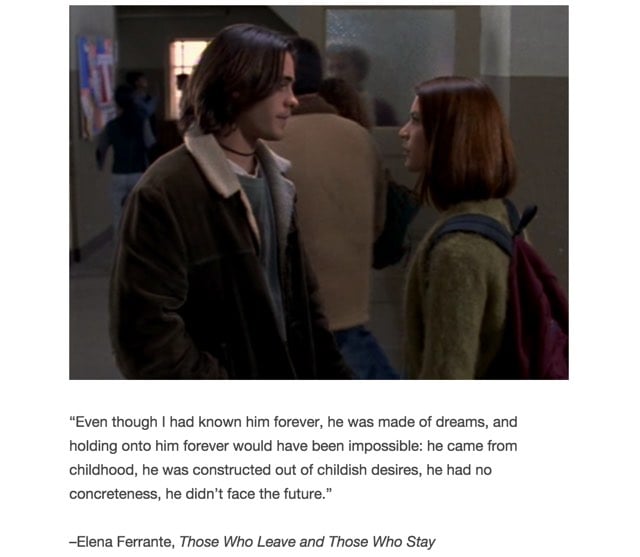
In 2009, back in the heyday of witty Tumblrs, Maris Kreizman started marrying pop culture imagery with literary quotes on Slaughterhouse 90210. Kreizman has turned her efforts into a book, out last week.
Slaughterhouse 90210 is subversively brilliant, finding the depth in the shallows of reality television, and the levity in Lahiri. A picture of Taylor Swift is paired with Joan Didion’s quote, “Above all, she is the girl who ‘feels things’. The girl ever wounded, ever young.” Tony Soprano tenderly hugs his teenage son, accompanied by a line from Middlemarch about, “The patches of hardness and tenderness [that] lie side by side in men’s dispositions.” The images and quotes complement and deepen one another in surprising, profound, and tender ways.
I am a sucker for the high/low culture thing.
Hopes&Fears asked a group of scientists and researchers if reality is actually real or if it’s all an illusion or hallucination.
How do we know this is real life? The short answer is: we don’t. We can never prove that we’re not all hallucinating, or simply living in a computer simulation. But that doesn’t mean that we believe that we are.
There are two aspects to the question. The first is, “How do we know that the stuff we see around us is the real stuff of which the universe is made?” That’s the worry about the holographic principle, for example — maybe the three-dimensional space we seem to live in is actually a projection of some underlying two-dimensional reality.
Lewis Bond takes a look at the work of master filmmaker Hayao Miyazaki and what sets him apart from other makers of animated movies, including his work’s realism and empathy.
I am not a watch person. Haven’t worn one since high school, no interest in getting an Apple Watch, etc. But this post on We Made This about watches that appeal to graphic designers lists a few watches I would consider wearing. The Braun is a classic, of course:

But this one from Instrmnt is also quite nice, although I would prefer slightly larger numbers:

And for kottke.org superfans only, I would recommend the Timex Weekender.

PS to the superfans: if you don’t like watches, may I interest you in a Vancouver bridge or a warehouse in Milton Keynes?
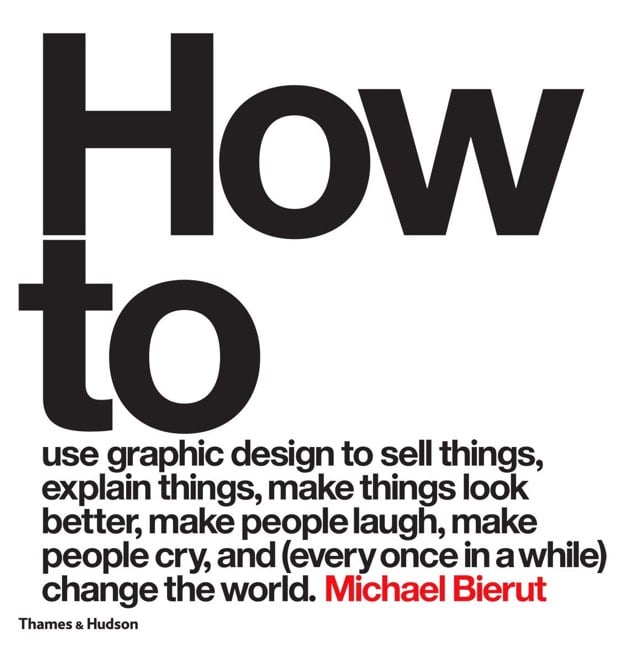
Michael Bierut is popping off right now. The School of Visual Arts recently honored him with their Masters Series Award, which includes an exhibition of his work that runs until early November. And he’s also out with a new book with a large title, How to Use Graphic Design to Sell Things, Explain Things, Make Things Look Better, Make People Laugh, Make People Cry, and (Every Once in a While) Change the World.
Update: Bierut’s brief interview in the WSJ is worth a read. I enjoyed his Jack Donaghy-esque take on NYC work fashion:
I always wear a necktie to work. I didn’t claw my way all the way from Ohio just to dress like a farmer.
And his love for Wile E. Coyote:
He had this endless faith and brand loyalty and never thought to try the competition even though Acme products failed him time and time again.
Although in fairness, the deck was stacked against the Coyote (see rule #7). (via @PaulAntonson)
From Kevin Slavin and Bunnie Huang on location in Shenzhen, China, a look at what changes when you stop designing phones for companies and start designing them for people. You end up with a variety of phones satisfying different desires, from tiny phones that double as Bluetooth earpieces to phones that look like a race car or a pack of cigarettes or a soda can to phones with built-in lamps.



A spin around the internet reveals many more examples of these kinds of phones: flashlight phones, lighter phones, phones with up to 4 SIM slots, super-rugged phones w/ walkie talkie capability, credit card-sized phones, watch phones, and USB key phones. (via @triciawang)

Some iOS apps still seem like magic. Case in point: PhotoMath. Here’s how it works. You point your camera at a math problem and PhotoMath shows the answer. It’ll even give you a step-by-step explanation and solution.
From a paper presented at SIGGRAPH Asia by a group from Stanford, a system for tracking the facial expressions from one person and putting them on the face of a second person in real-time. This is crazy. (via @gavinpurcell)
vintage post from Oct 2015
· gift link
Drawing upon the work of colleagues, historian Michael Todd Landis proposes new language for talking about slavery and the Civil War. In addition to favoring “labor camps” over the more romantic “plantations”, he suggests retiring the concept of the Union vs the Confederacy.
Specifically, let us drop the word “Union” when describing the United States side of the conflagration, as in “Union troops” versus “Confederate troops.” Instead of “Union,” we should say “United States.” By employing “Union” instead of “United States,” we are indirectly supporting the Confederate view of secession wherein the nation of the United States collapsed, having been built on a “sandy foundation” (according to rebel Vice President Alexander Stephens). In reality, however, the United States never ceased to exist. The Constitution continued to operate normally; elections were held; Congress, the presidency, and the courts functioned; diplomacy was conducted; taxes were collected; crimes were punished; etc. Yes, there was a massive, murderous rebellion in at least a dozen states, but that did not mean that the United States disappeared.
C’mon! The Die Hard series doesn’t need an origin story. The original Die Hard *is* the origin story.
In seemingly disparate languages around the world, the words for “mother” and “father” are surprisingly similar…usually “mama” or “nana” for “mother” and “papa”, “baba”, “dada”, or “tata” for “father”. It’s tempting to believe these parental words were all derived from a single proto-language, but according to the work of Roman Jakobson, the words come from the first sounds all babies make.
If you’re a baby making a random sound, the easiest vowel is ah because you can make it without doing anything with your tongue or lips. Then, if you are going to vary things at all, the first impulse is to break up the stream of ahhh by closing your lips for a spell, especially since you’ve been doing that to nurse. Hence, mmmm, such that you get a string of mahs as you keep the sound going while breaking it up at intervals.
(via df)
Gary Collins, a London police constable, is extraordinarily gifted at recalling people’s faces. He’s a super recognizer.
Friends call Constable Collins Rain Man or Yoda or simply The Oracle. But to Scotland Yard, London’s metropolitan police force, he is known as a “super recognizer.” He has a special gift of facial recall powers that enables him to match even low-quality and partial imagery to a face he has seen before, on the street or in a database and possibly years earlier. The last time he had come face to face with Mr. Prince was during a fleeting encounter in 2005.
Aside from Collins, Scotland Yard now employs more than 150 super recognizers who scan the streets and crowds for known criminals.
Astronomers are interested in the goings-on around a star in our galaxy called KIC 8462852. There appears to be a lot of debris around it, which is a bit unusual and might have any number of causes, including that an extraterrestrial intelligence built all sorts of things around the star.
Jason Wright, an astronomer from Penn State University, is set to publish an alternative interpretation of the light pattern. SETI researchers have long suggested that we might be able to detect distant extraterrestrial civilizations, by looking for enormous technological artifacts orbiting other stars. Wright and his co-authors say the unusual star’s light pattern is consistent with a “swarm of megastructures,” perhaps stellar-light collectors, technology designed to catch energy from the star.
“When [Boyajian] showed me the data, I was fascinated by how crazy it looked,” Wright told me. “Aliens should always be the very last hypothesis you consider, but this looked like something you would expect an alien civilization to build.”
Boyajian is now working with Wright and Andrew Siemion, the Director of the SETI Research Center at the University of California, Berkeley. The three of them are writing up a proposal. They want to point a massive radio dish at the unusual star, to see if it emits radio waves at frequencies associated with technological activity.
Phil Plait has more context on this weirdo star and how the alien angle is pretty far-fetched but also worth checking out.
With its straightforward plot and action sequences, Mad Max: Fury Road would make a pretty good 8-bit video game. (via devour)
Newer posts
Older posts






Socials & More