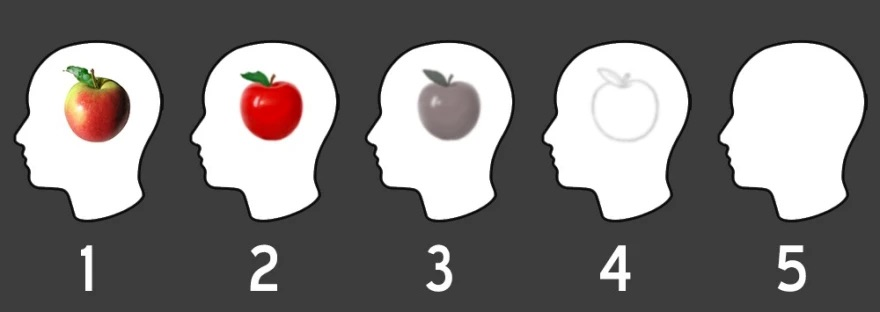
Aphantasia (the inability to visualize) is one of those things that I find endlessly fascinating; I’ve written about it a few times since 2016, most recently in response to Larissa MacFarquhar’s 2025 piece for the New Yorker: Some People Can’t See Mental Images. The Consequences Are Profound.
Many of his correspondents, he learned, had discovered their condition very recently, after reading about it or hearing it described on the radio. Their whole lives, they had heard people talk about picturing, and imagining, and counting sheep, and visualizing beaches, and seeing in the mind’s eye, and assumed that all those idioms were only metaphors or colorful hyperbole. It was amazing how profoundly people could misunderstand one another, and assume that others didn’t mean what they were saying—how minds could wrest sense out of things that made no sense.
Some said that they had a tantalizing feeling that images were somewhere in their minds, only just out of reach, like a word on the tip of their tongue. This sounded right to Zeman—the images must be stored in some way, since aphantasics were able to recognize things. In fact, it seemed that most aphantasics weren’t hampered in their everyday functioning. They had good memories for facts and tasks. But many of them said that they remembered very little about their own lives.
Psychoanalyst Jamieson Webster read the piece and realized she was aphantasic. Webster recently interviewed MacFarquhar for Cultured: What Not Having Mental Imagery Implies for Psychoanalysis, Trauma, and Our Sense of Self, which I read with a lot of head-nodding. Like:
I didn’t have a lot of memories, which I always sort of chalked up to trauma, but I got memories back over the course of analysis. I realized while reading your piece that my memories were always spatial. I would remember a space or placements of things. I was always reconstructing a landscape, but without it really being imagistic.
And this is exactly how college was for me:
When I realized I had aphantasia, I reflected on how I always thought I had a photographic memory. For example, when I took tests, I would make notes, and I could see what I wrote on the page because I knew where I had written it. But it’s not a photograph; it’s a spatial memory.
As I said last year:
The more I read about this, the more I think that for those at either end of the phantasic scale, their inability (or extreme ability) to see things in their minds is a major component of what we think of as personality. Even just thinking about myself, there are all sorts of behaviors and traits I can connect to not being able to visualize things in my head that clearly. In some ways, it might be one of the most me things about me.
(via @timoni)
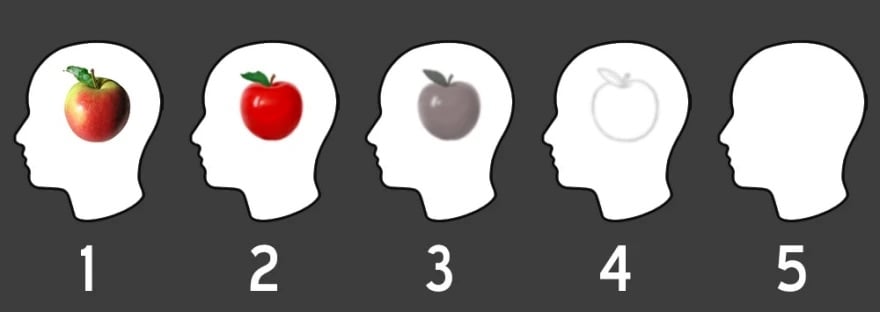
We’ve talked before about how some people can picture things in their heads quite vividly and others can’t at all. The latter group has a condition called aphantasia.
As soon as I close my eyes, what I see are not everyday objects, animals, and vehicles, but the dark underside of my eyelids. I can’t willingly form the faintest of images in my mind.
Larissa MacFarquhar wrote a fascinating article about aphantasia (and its opposite, hyperphantasia) for the New Yorker: Some People Can’t See Mental Images. The Consequences Are Profound.
Naturally, aphantasics usually had a very different experience of reading. Like most people, as they became absorbed, they stopped noticing the visual qualities of the words on the page, and, because their eyes were fully employed in reading, they also stopped noticing the visual world around them. But, because the words prompted no mental images, it was almost as if reading bypassed the visual world altogether and tunnelled directly into their minds.
Aphantasics might skip over descriptive passages in books — since description aroused no images in their minds, they found it dull — or, because of such passages, avoid fiction altogether. Some aphantasics found the movie versions of novels more compelling, since these supplied the pictures that they were unable to imagine. Of course, for people who did have imagery, seeing a book character in a movie was often unsettling — because they already had a sharp mental image of the character which didn’t look like the actor, or because their image was vague but just particular enough that the actor looked wrong, or because their image was barely there at all and the physical solidity of the actor conflicted with that amorphousness.
And also:
When aphantasics recovered from bereavement, or breakups, or trauma, more quickly than others, they worried that they were overly detached or emotionally deficient. When they didn’t see people regularly, even family, they tended not to think about them.
M.L.: “I do not miss people when they are not there. My children and grandchildren are dear to me, in a muffled way. I am fiercely protective of them but am not bothered if they don’t visit or call. … I think that leaves them feeling as if I don’t love them at all. I do, but only when they are with me, when they go away they really cease to exist, except as a ‘story.’”
The bits about hyperphantasia are just as interesting:
Hyperphantasia often seemed to function as an emotional amplifier in mental illness—heightening hypomania, worsening depression, causing intrusive traumatic imagery in P.T.S.D. to be more realistic and disturbing. Reshanne Reeder, a neuroscientist at the University of Liverpool, began interviewing hyperphantasics in 2021 and found that many of them had a fantasy world that they could enter at will. But they were also prone to what she called maladaptive daydreaming. They might become so absorbed while on a walk that they would wander, not noticing their surroundings, and get lost. It was difficult for them to control their imaginations: once they pictured something, it was hard to get rid of it. It was so easy for hyperphantasics to imagine scenes as lifelike as reality that they could later become unsure what had actually happened and what had not.
“I can imagine my hand burning, to the point where it’s painful. I’ve always been curious — if they put me in an fMRI, would that show up? That’s one of the biggest problems in my life: when I feel something, is it real?”
One hyperphantasic told a researcher that he had more than once walked into a wall because he had pictured a doorway.
The more I read about this, the more I think that for those at either end of the phantasic scale, their inability (or extreme ability) to see things in their minds is a major component of what we think of as personality. Even just thinking about myself, there are all sorts of behaviors and traits I can connect to not being able to visualize things in my head that clearly. In some ways, it might be one of the most me things about me. (thx, willy)
New Yorker staff writer Larissa MacFarquhar has written a book on people who are wholly devoted to helping others called Strangers Drowning: Grappling with Impossible Idealism, Drastic Choices, and the Overpowering Urge to Help. At least a few of the books’ subjects were first profiled in the NYer by MacFarquhar, including this amazing story of a couple who adopted 20 children and a Japanese monk confronting his culture’s suicide problem.
David Wolf of The Guardian recently wrote about MacFarquhar and her unique writing style, writing from the perspective of her subjects, like they themselves had written the piece.
MacFarquhar attributes her restlessness with form to getting “productively bored”: “For a profile, I do try to make the piece sound and feel as though it were written by the person themselves, rather than by me. What I’m trying to get at is a sense of intimacy, a sense that you are, insofar as is possible, inside the mind of the person, so that you understand why they’re in love with the ideas they fell in love with, what moves them, what drives them.”
These principles guide most of her stylistic decisions. Anything that diminishes the immediacy of the reader’s access to her subject is thrown out. “People think I’m a total freak for not using the first person,” she says. “The way I think about it is that if you’re making a conventional feature film, all it takes is for the director to walk across the camera just once and you have a completely different relationship to the whole story. For that reason, even though it sometimes means sacrificing great scenes, I take myself out.”
What point of view is that? It’s like a mix of first person and third person. Is one-third person POV a thing?
I loved this profile of novelist Hilary Mantel written by Larissa MacFarquhar. Not just for the subject matter but the lyrically novelistic way in which it’s written.
During this time, she discovered that her house was haunted. It wasn’t only she who felt it-she overheard adults talking about the ghosts as well. She realized that they were as frightened as she was, and were helpless to protect her. She already understood that the world was denser and more crowded than her senses could perceive: there were ghosts, but even those dead who were not ghosts still existed; she was used to hearing talk in which family members alive and dead were discussed without distinction. The dead seemed to her only barely dead.
Until she was twelve or so, she was deeply religious. “When you’re inculcated with religion at such an early age, or when you’re receptive to it, as I was, you become preoccupied with the unseen reality,” she says. “This other world, the next world, to me in my childhood seemed just as real as the world I was living in. It wasn’t that I had a mental picture of it — it was that I never questioned its existence. I used to conduct a lot of imaginary conversations with God. I don’t think Jesus was any less real to me than my aunts and uncles; the fact that I happened not to be able to see him was pretty irrelevant to me.”
She felt, as a child, in a permanent state of sin. There was something terribly wrong about her, for which she was to blame, but which she had only limited ability to change. Catholic guilt continued to grip her even after she stopped believing in God. Her family’s misery was encompassing and bewildering, and was it not likely that she was responsible for making her parents so unhappy? Might they not, without her, have a chance at a better life? But these suspicions were not so powerful as the effect of a thing that happened to her one day that she cannot explain.
That “thing that happened” was seeing… well, I don’t want to spoil it. Mantel wrote Wolf Hall, a recent favorite of mine, and a few days after this profile ran in the New Yorker, she won the Man Booker Prize for her new novel, Bring Up the Bodies.





Socials & More