


Meet the Aphantasics, Those Who Can’t See Mental Images
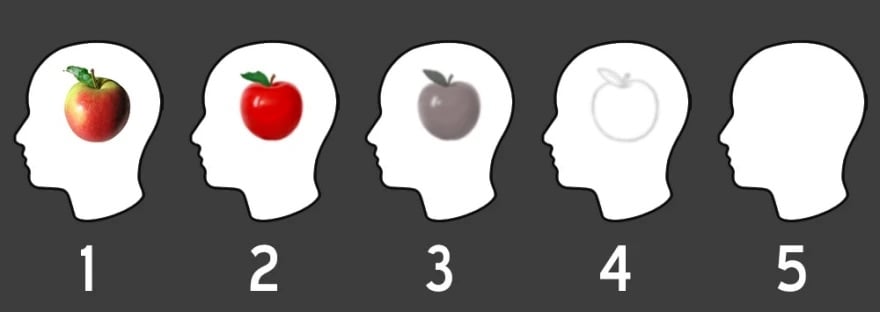
We’ve talked before about how some people can picture things in their heads quite vividly and others can’t at all. The latter group has a condition called aphantasia.
As soon as I close my eyes, what I see are not everyday objects, animals, and vehicles, but the dark underside of my eyelids. I can’t willingly form the faintest of images in my mind.
Larissa MacFarquhar wrote a fascinating article about aphantasia (and its opposite, hyperphantasia) for the New Yorker: Some People Can’t See Mental Images. The Consequences Are Profound.
Naturally, aphantasics usually had a very different experience of reading. Like most people, as they became absorbed, they stopped noticing the visual qualities of the words on the page, and, because their eyes were fully employed in reading, they also stopped noticing the visual world around them. But, because the words prompted no mental images, it was almost as if reading bypassed the visual world altogether and tunnelled directly into their minds.
Aphantasics might skip over descriptive passages in books — since description aroused no images in their minds, they found it dull — or, because of such passages, avoid fiction altogether. Some aphantasics found the movie versions of novels more compelling, since these supplied the pictures that they were unable to imagine. Of course, for people who did have imagery, seeing a book character in a movie was often unsettling — because they already had a sharp mental image of the character which didn’t look like the actor, or because their image was vague but just particular enough that the actor looked wrong, or because their image was barely there at all and the physical solidity of the actor conflicted with that amorphousness.
And also:
When aphantasics recovered from bereavement, or breakups, or trauma, more quickly than others, they worried that they were overly detached or emotionally deficient. When they didn’t see people regularly, even family, they tended not to think about them.
M.L.: “I do not miss people when they are not there. My children and grandchildren are dear to me, in a muffled way. I am fiercely protective of them but am not bothered if they don’t visit or call. … I think that leaves them feeling as if I don’t love them at all. I do, but only when they are with me, when they go away they really cease to exist, except as a ‘story.’”
The bits about hyperphantasia are just as interesting:
Hyperphantasia often seemed to function as an emotional amplifier in mental illness—heightening hypomania, worsening depression, causing intrusive traumatic imagery in P.T.S.D. to be more realistic and disturbing. Reshanne Reeder, a neuroscientist at the University of Liverpool, began interviewing hyperphantasics in 2021 and found that many of them had a fantasy world that they could enter at will. But they were also prone to what she called maladaptive daydreaming. They might become so absorbed while on a walk that they would wander, not noticing their surroundings, and get lost. It was difficult for them to control their imaginations: once they pictured something, it was hard to get rid of it. It was so easy for hyperphantasics to imagine scenes as lifelike as reality that they could later become unsure what had actually happened and what had not.
“I can imagine my hand burning, to the point where it’s painful. I’ve always been curious — if they put me in an fMRI, would that show up? That’s one of the biggest problems in my life: when I feel something, is it real?”
One hyperphantasic told a researcher that he had more than once walked into a wall because he had pictured a doorway.
The more I read about this, the more I think that for those at either end of the phantasic scale, their inability (or extreme ability) to see things in their minds is a major component of what we think of as personality. Even just thinking about myself, there are all sorts of behaviors and traits I can connect to not being able to visualize things in my head that clearly. In some ways, it might be one of the most me things about me. (thx, willy)
Comments 7
thread
latest
popular
Funny enough, my Puzzmo Crossword puzzle today is about this because I have it: https://www.puzzmo.com/play/crossword/
matt yglesias is aphantasic and wrote a angry/hopeful response to the new yorker piece.
I am aphantasic and a recent widow. This tracks. I miss my wife terribly, but the feeling is visceral/psychological. I don’t see her when she’s not here. I can’t. All the photos I have is all I have, and I can choose when to look. I do think this has made grief easier to bear than some of my peers.
Hyperfixed did a recent episode about this that was really touching and interesting:
https://overcast.fm/+ABKKVdmfXNk
"One of the most me things about me" is a great way of putting it! What does it say about me that it took me 50 years of being alive to figure it out 😜
So many of these articles have an “oh, those poor dears” tone, and I wish the quoted text was an exception. I don’t walk through my life lamenting my inability to visualize, constantly comparing my experience (unfavourably) to some imagined outside frame of reference. Is the author bereft at not being a tetrachromat with perfect pitch?
(I hope not. It sounds exhausting.)
I think in words instead of images. That's just me being me, the same way other people are just being other people. I can recognize my neighbours even though I couldn't describe them to a sketch artist. I might lose track of who's who in an ensemble romcom, but an above-average auditory memory means I'm often the first to recognize actors from roles decades apart. I mourn the family and friends I've lost even without being able to remember how they parted their hair. And if a novel that's loaded with descriptive text is boring, then it’s probably because it’s badly done.
I'm on the lower end of the phantasic scale, and I'm particularly bad with faces, but I never hear people talking about the auditory equivalent. I can close my eyes and listen to entire movies or albums in my head. My memory fades over time, but the prosodic contour of speech, especially if I've heard it more than once, is very sticky. Perfect pitch is a curse when you can't sing along in a different key because all the notes are different!
If you feel like this comment goes against the grain of the community guidelines or is otherwise inappropriate, please let me know and I will take a look at it.
This thread is closed for new comments & replies. Thanks to everyone for participating!