



Psst. Ghostbusters at Film Forum on Oct 26th.

Advertise here with Carbon Ads
This site is made possible by member support. 💞
Big thanks to Arcustech for hosting the site and offering amazing tech support.
When you buy through links on kottke.org, I may earn an affiliate commission. Thanks for supporting the site!
kottke.org. home of fine hypertext products since 1998.
Beloved by 86.47% of the web.
Entries for October 2015
Danny Meyer: no more tipping at my restaurants
Eater has the scoop: Danny Meyer’s Union Square Hospitality Group is eliminating tipping at all of their full-service restaurants.
Big news out of Manhattan: Dining out is about to get turned on its head. Union Square Hospitality Group, the force behind some of New York’s most important restaurants, will announce today that starting in November, it will roll out an across-the-board elimination of tips at every one of its thirteen full-service venues, hand in hand with an across-the-board increase in prices.
Why are they doing this? In part because cooks get the shaft at restaurants:
Under the current gratuity system, not everyone at a restaurant is getting a fair shake. Waiters at full-service New York restaurants can expect a full 20 percent tip on most checks, for a yearly income of $40,000 or more on average — some of the city’s top servers easily clear $100,000 annually. But the problem isn’t what waiters make, it’s what cooks make. A mid-level line cook, even in a high-end kitchen, doesn’t have generous patrons padding her paycheck, and as such is, on average, unlikely to make much more than $35,000 a year.
I hope this catches on.
Computer Show
From Adam Lisagor’s Sandwich Video comes Computer Show, a present-day send-up of a personal computing show set in 1983. The guests and their products are contemporary and real, but the hosts are stuck in 1983 and don’t really know what the web is, what Reddit is, what links are, or anything like that.
“Computer Show” is a technology talk show, set in 1983. The dawn of the personal computing revolution. Awkward hair and awkward suits. Primitive synths and crude graphics. VHS tapes. No Internet. But there’s a twist.
The guests on this show are tech luminaries — experts, founders, thinkers, entrepreneurs…from 2015. They are real, and they are really on “Computer Show” to talk about their thing. Will it go well? Can they break through to the host Gary Fabert (played by Rob Baedeker of the SF-based sketch mainstay Kasper Hauser) and his rotating cast of co-hosts, who know of neither iPhone nor website nor Twitter nor…hardly anything?
The first episode, featuring Lumi, is embedded above and here’s the second episode with Reddit cofounder Alexis Ohanian.
Hopefully they’ll get to make more.
Update: In an interview with Inc., Lisagor shares how Computer Show came about.
So it just became clear to Roxana and Tony, there was something here. Roxana had the idea to make something in this universe. To produce a show like “The Computer Chronicles”.
One day, over Slack, Roxana asked me for the contact info of a producer I know. When I asked why, she told me she had this idea, and also asked if I’d maybe be a contributor on it. When I got more info out of her (she tends to be a little private about her personal projects) and explained to me that she had this idea of a tech talk show set in the early 80’s, where the guests would interview people from modern day, I just about flipped out and lost my mind I was so excited.
Update: While we not-so-patiently await new episodes of Computer Show, at least we can buy the t-shirt.
The man who digitizes newspapers
For more than a decade, retired engineer Tom Tryniski has been digitizing old newspapers from microfilm and making their full text available and searchable online.
Tryniski’s site, which he created in his living room in upstate New York, has grown into one of the largest historic newspaper databases in the world, with 22 million newspaper pages. By contrast, the Library of Congress’ historic newspaper site, Chronicling America, has 5 million newspaper pages on its site while costing taxpayers about $3 per page. In January, visitors to Fultonhistory.com accessed just over 6 million pages while Chronicling America pulled fewer than 3 million views.
(via @ftrain)
50 Unknown Facts About Star Wars
50 unknown facts about Star Wars, many gleaned from How Star Wars Conquered the Universe. I’ve heard some of these before, but not many…the list doesn’t include low-hanging fruit like Harrison Ford’s carpentry.
Favorite facts: 1. Early on, Luke Skywalker’s nickname was “Wormy”. Wormy! 2. The actor who portrayed Vader, David Prowse, spoke his dialogue on set not knowing he would be dubbed over. Because of his West Country accent, the other cast members referred to Prowse as Darth Farmer.
Speaking of Harrison Ford’s carpentry, the new biography of Joan Didion has a good story about that time Didion and her husband John Dunne hired Ford to do some construction for them.
Off and on, for over six month, the Dunnes engaged a construction crew to expand the waterside deck, install waxed pine bookshelves, and lay terra-cotta floor tiles. The men tore out prefabricated plywood walls and pulled up “icky green” flooring. Harrison Ford headed the crew. “They were the most sophisticated people I knew,” Ford said. “I was the first thing they saw in the morning and the last thing they saw before cocktails.”
In Vegas, Dunne wrote, “[W]hat had started as a two-month job … [stretched] into its sixth month and the construction account was four thousand dollars overdrawn… I fired the contractor. ‘Jesus, man, I understand,’ he said. He was an out-of-work actor and his crew sniffed a lot of cocaine and when he left he unexpectedly gave me a soul-brother handshake, grabbing my thumb while I was left with an unimportant part of his little finger.” The next day, Dunne realized the only thing separating him and his family from the Pacific Ocean was a clear sheet of Pliofilm where the French doors were supposed to go. “I rehired the contractor,” he wrote. “‘Jesus, man, I understand,’ the contractor said.”
Much later, when Didion’s daughter was ill, Ford did the family a further service.
The following day, Didion flew from Teterboro to Los Angeles on Harrison Ford’s private plane, along with her friend Earl McGrath. Ford “happened to be in New York and heard about Q’s condition … and called to offer to take Joan,” said Sean Michael. “I find that to be a beautiful thing,” he said. “A man you hire to build cabinets, thirty years later is flying you in his private jet to your daughter’s hospital bedside.”
Jesus, man, I understand.
Update: Some of Ford’s comments from the book were taken from Carolyn Kellogg’s reporting on an awards festival.
As if to make up for her absence, a parade of stars was in attendance. Harrison Ford, who was prepared to present her the award, spoke somewhat extemporaneously instead. “I just want to tell you all how much her friendship has meant to me,” he said. Forty years ago, Didion and her husband, John Gregory Dunne, were “The most sophisticated people I knew.”
Then a carpenter, Ford was hired by Didion and Dunne to build their beach house in Malibu. “I was the first thing they saw in the morning and the last thing they saw” — he paused — “before cocktails.”
New York Historical Society’s Silicon City exhibit

The Silicon City exhibit at the New York Historical Society takes a look at the long history of computing in NYC.
Every 15 minutes, for nearly a year, 500 men, women, and children rose majestically into “the egg,” Eero Saarinen’s idiosyncratic theater at the 1964 World’s Fair. It was very likely their first introduction to computer logic. Computing was not new. But for the general public, IBM’s iconic pavilion was a high profile coming out party, and Silicon City will harness it to introduce New York’s role in helping midwife the digital age.
The exhibit opens on November 13, 2015 and runs through next April. The museum is using Kickstarter to help bring the Telstar satellite back to NYC for the exhibit.
Christopher Columbus is not worth celebrating
Columbus Day is to Native Americans as Uber Day would be to taxi dispatchers. Many schools and other institutions are off today. Vox celebrates with a rundown of nine reasons Christopher Columbus was a murderer, tyrant, and scoundrel.
Population figures from 500 years ago are necessarily imprecise, but Bergreen estimates that there were about 300,000 inhabitants of Hispaniola in 1492. Between 1494 and 1496, 100,000 died, half due to mass suicide. In 1508, the population was down to 60,000. By 1548, it was estimated to be only 500.
Understandably, some natives fled to the mountains to avoid the Spanish troops, only to have dogs set upon them by Columbus’s men.
The Oatmeal was less flattering.
Update: Here’s chapter one of Howard Zinn’s A People’s History of the United States, the first part of which concerns Columbus. (via @mathowie)
Mo’ money, mo’ happiness
Four years into a twenty-year study of the mental conditions of kids living in rural North Carolina, a quarter of the participants experienced a dramatic increase in annual income. The researchers used this opportunity to find out how that increase in wealth affected the wellbeing of the kids. What they learned is that even a little money goes a long way.
Not only did the extra income appear to lower the instance of behavioral and emotional disorders among the children, but, perhaps even more important, it also boosted two key personality traits that tend to go hand in hand with long-term positive life outcomes.
The first is conscientiousness. People who lack it tend to lie, break rules and have trouble paying attention. The second is agreeableness, which leads to a comfort around people and aptness for teamwork. And both are strongly correlated with various forms of later life success and happiness.
The Steal Like An Artist Journal
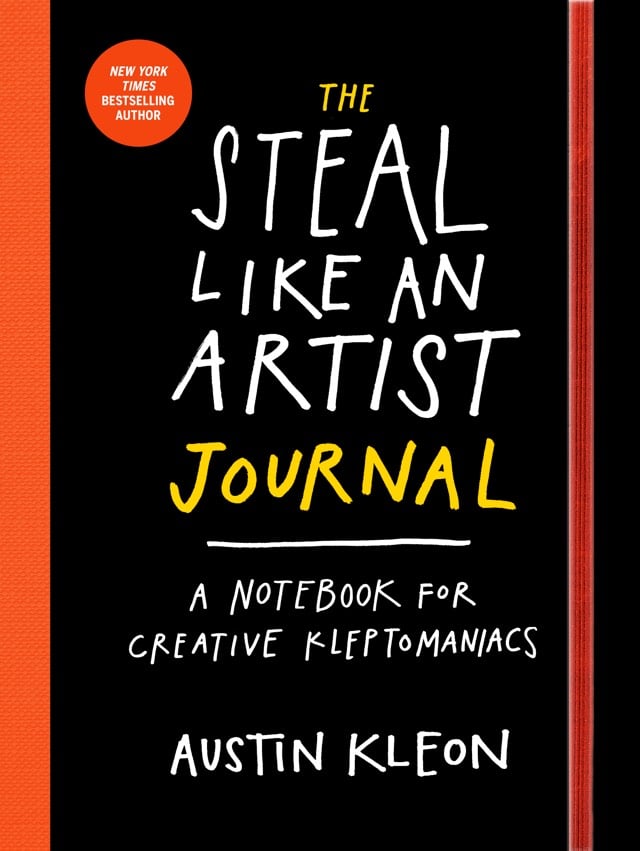
Austin Kleon, whose bestselling books you may have seen in airport bookstores (as well as regular bookstores), is out with a new one: The Steal Like An Artist Journal. The subtitle is A Notebook for Creative Kleptomaniacs, which, aren’t we all? Kleon writes:
For years, people have asked me what kind of notebook I recommend, so I went ahead and made the notebook I always wished existed. Based on my New York Times best-selling book, The Steal Like An Artist Journal will help get your creative juices flowing and record new (and stolen) ideas, thoughts, and discoveries. Think of it as a daily course in creativity: a portable workshop and coursebook, jammed full of inspiration, prompts, quotes, and exercises designed to turn you into a creative kleptomaniac.
Does every creative genius need a bitter rival?
Jacob Burak in Aeon: “Michelangelo and Raphael; Leibniz and Newton; Constable and Turner. Does every creative genius need a bitter rival?”
Turner and Constable are not alone in the pantheon of epic rivalries between creative giants. Isaac Newton and Gottfried Leibniz, two of the most brilliant mathematicians and thinkers of the 17th century, laid claim to the development of calculus, the mathematical study of change. Thomas Edison and Nikola Tesla both invented electrical systems in the 1880s. Steve Jobs and Bill Gates went head-to-head as pioneers of the computer age. If you Google almost any famous figure along with ‘rivalry’, you’ll find some interesting results.
The Good Dinosaur: “A Stunning Masterpiece”
Charlie Jane Anders of io9 has a great preview of Pixar’s upcoming film, The Good Dinosaur, including some juicy details on how the film was made. Because the film uses many big landscape shots, which would have been impossible to render in a timely fashion using their usual processes, the filmmakers needed to come up with another solution. They ended up using real topographical data and satellite images to render the landscapes.
Enter the U.S. Geographical Survey, which posts incredible amounts of topographical data to its website-including the height above sea level of all of the land features, and lots of satellite images. So Munier and his team tried downloading a lot of the USGS data and putting it into their computer, and then using that to “render” the real-life landscape. And it worked: They were able to take a classic Ansel Adams photograph of the Grand Tetons and duplicate it pretty closely using their computer-generated landscape. And with this data, they could point a digital “camera” anywhere, in a 360-degree rotation, and get an image.
Hail, Caesar!
Hail, Caesar! is the name of the Coen brothers’ new movie. It stars George Clooney as a movie star (what casting!) who is kidnapped during the shooting of a epic Roman gladiator picture called Hail, Caesar! This one looks fun. And with the exception of The Big Lebowski, the Coen’s fun movies are underrated,…I quite enjoyed both Intolerable Cruelty and Burn After Reading.
Slack, Basecamp, and simplicity as a design goal
Jason Fried wrote a preview of what’s coming in Basecamp 3. Jim Ray noted on Twitter that “Basecamp vs. Slack will be interesting”. And suddenly I remembered that back in 2002, Jason, Slack CEO Stewart Butterfield, and I hosted a “peer meeting” on Simplicity in Web Design at SXSW.1 The meeting’s description:
As the Web continues to increase in complexity, many designers are looking to simplicity as a tool in designing Web sites that are at once powerful and easy for people to use. Join your peers and colleagues in a discussion facilitated by three working designers who are committed to producing work which is simple: obvious, elegant, economical, efficient, powerful and attractive. We’ll be discussing what simplicity in Web design really means, the difference between Minimalism as an aesthetic and simplicity as a design goal, who is and who isn’t simple, how you can use simplicity to your advantage, and plenty more.
It’s fun to see those two going at it more than 13 years later, still focused on harnessing the power of simplicity to help people get their best work done. (I don’t know what the other guy’s deal is. He’s doing…. something, I guess.)
This was also the year I got food poisoning the first night of the conference, basically didn’t eat anything for 5 days, and lost 10 pounds. Either Stewart or Jason suggested running to a bakery to get cookies for everyone at the meeting, and a little nibble one of those chocolate chip cookies was one of the few things I had to eat in Austin that year. ↩
We have passed Peak Fish

I noted the other day that since the early 1980s, the world has lost about half of its coral reefs. According to a recent study, there’s more to worry about in the sea: the ocean contains half the fish it did 45 years ago.
Professor McIntyre and his contemporaries believed that overfishing was inherently self-correcting. People might catch too much, but then they would stop fishing, letting the stock recover. They did not reckon on improvements in technology such as a monofilament line, factory trawlers, or fish finders that make it possible to catch so many fish so quickly that it can take decades for a stock to recover (if it ever does). Nor did he or his contemporaries understand food webs and ecological connections; reducing stocks of some species has more of an impact than others.
Update: Here’s a PDF copy of the actual report by the WWF. (via @RachelAronson)
Paying the stereotype tax
I love this piece from NPR about how poker player Annie Duke uses her male opponents’ stereotypical views of women against them.
I figured it was part of the game that if somebody was at the table who was so emotionally invested in the fact that I was a woman, that they could treat me that way, that probably, that person wasn’t going to make good decisions at the table against me. So I really tried to sort of separate that out and think about it from a strategic place of, how can I come up with the best strategy to take their money because I guess, in the end, isn’t that the best revenge?
She noticed there were three types of chauvinist players and approached each with a different strategy.
VEDANTAM: She says she divided the men who had stereotypes about her into three categories.
DUKE: One was the flirting chauvinists, and that person was really viewing me in a way that was sexual.
VEDANTAM: With the guys who were like that, Annie could make nice.
DUKE: I never did go out on a date with any of them, but you know, it was kind of flirtatious at the table. And I could use that to my advantage.
VEDANTAM: And then there was the disrespecting chauvinist. Annie says these players thought women weren’t creative.
DUKE: There are strategies that you can use against them. Mainly, you can bluff those people a lot.
VEDANTAM: And then there’s a third kind of guy, perhaps the most reckless.
DUKE: The angry chauvinist.
VEDANTAM: This is a guy who would do anything to avoid being beaten by a woman. Annie says you can’t bluff an angry chauvinist. You just have to wait.
DUKE: What I say is, until they would impale themselves on your chips.
I got this link from Andy Baio, who also linked to the video of the specific match referenced in the NPR piece and noted “Phil Hellmuth attributes all of Annie’s wins to luck, all of his own to skill”.
Climate change and boiling frogs
I made a boiling frogs analogy in my post about coral bleaching this morning.
The oceans are slowly boiling and we’re the frogs who aren’t noticing.
James Fallows has been waging a small war on the use of that analogy for several years now.
You remember our old friend the boiled frog: It’s the staple of any political or business-management speech, used to show that problems that build up slowly can be explained-away or ignored, while ones that happen all of a sudden are more likely to be addressed.
Conservatives use it to talk about the expansion of the socialist state. Liberals use it to talk about climate change. Business managers use it to talk about a slide toward mediocrity. Everyone can use it to talk about something.
And that’s the problem with boiled-frogism. The minor issue is that the metaphor is flat wrong. If you put a frog in a pot of lukewarm water and gradually heat it up, the frog will stay there — until things get uncomfortably warm, at which point it will climb out. But if you drop a frog into a boil of already-boiling water, the poor creature will be so badly hurt and scalded that it will stay there and die.
I’m going to defend my usage just a little. The ocean is literally water that is getting warmer. But other than that, yeah, guilty as charged. (via @jpiz)
The Light L16 camera
The Light L16 camera looks interesting, both literally and figuratively. The L16 comes with 16 different built-in lenses, many of which fire at the same time, creating a super high-quality image at a 52-megapixel resolution.1 Having all those lenses firing at once lets you snap photos and decide on things like focal length and depth of field later.
Using a new approach to folded optics design, the Light L16 Camera packs DSLR quality into a slim and streamlined camera body. It’s like having a camera body, zoom, and 3 fast prime lenses right in your pocket. With 16 individual cameras, 10 of them firing simultaneously, the L16 captures the detail of your shot at multiple fixed focal lengths. Then the images are computationally fused to create an incredible high-quality final image with up to 52 megapixel resolution.
Would love to try this out if anyone from Light is reading.
It shoots 4K video too, at 35mm, 70mm, and 150mm.↩
The people who collect AOL sign-up CDs; “she has over 4,000 unique AOL discs stored in the basement”
The placebo effect grows stronger
It’s getting more difficult for new painkilling drugs to be approved because the rate of effectiveness vs. placebos in drug tests is falling. But oddly, the drop is only being seen in the US.
Based on patients’ ratings of their pain, the effect of trialled drugs in relieving symptoms stayed the same over the 23-year period — but placebo responses rose. In 1996, patients in clinical trials reported that drugs relieved their pain by 27% more than did a placebo. But by 2013, that gap had slipped to just 9%. The phenomenon is driven by 35 US trials; among trials in Europe, Asia and elsewhere, there was no significant change in placebo responses. The analysis is in press in the journal Pain.
(via @tomstandage)
Major global coral bleaching event underway

A persistent underwater heatwave is causing corals worldwide to bleach, and scientists believe up to 5% of the world’s coral will die permanently.
Hoegh-Guldberg said he had personally observed the first signs of bleaching on Australia’s Great Barrier Reef in the past fortnight, months before the warm season begins. He said the warming pattern indicated bleaching this summer would likely affect 50% of the reef, leaving 5-10% of corals dead. Eakin said seeing bleaching on the reef at this time of year was “disturbing”.
Also, no matter how many times I read this, it never gets less scary:
Since the early 1980s the world has lost roughly half of its coral reefs.
The oceans are slowly boiling and we’re the frogs who aren’t noticing. (via @EricHolthaus)
The Warmth of Other Suns
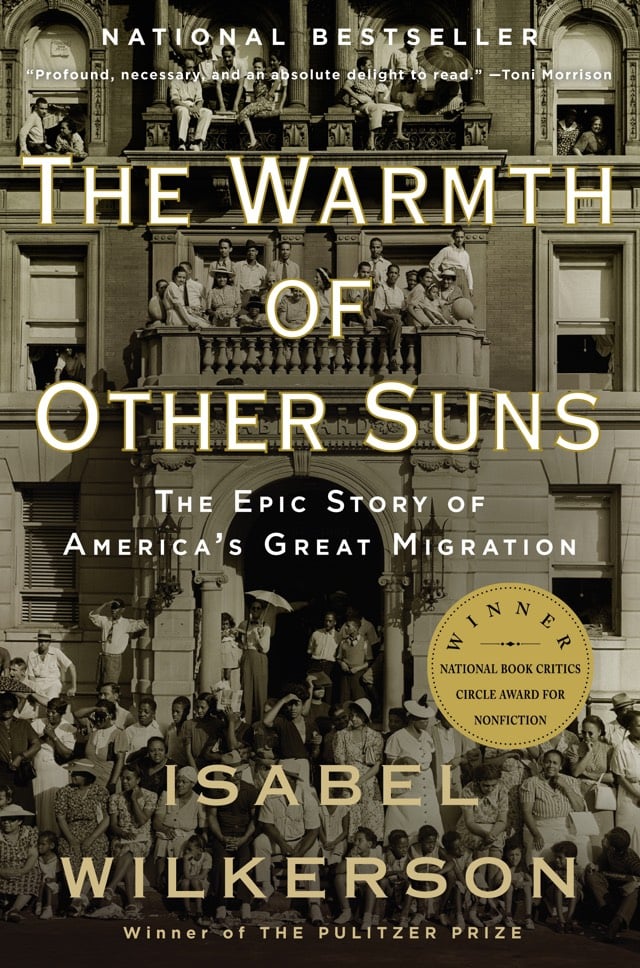
I read a lot of books by and about white men, many of them dead. So when a friend enthusiastically recommended The Warmth of Other Suns, I jumped at the chance to expand my reading horizons. I’m so glad I did…this is an amazing book.
Written by Pulitzer Prize-winning American journalist Isabel Wilkerson, The Warmth of Other Suns is about the Great Migration, the mass movement of African Americans from the Southern US to the Northeast, Midwest, and West between 1910 and 1970. During that time, roughly 6 million African Americans moved north and west to escape Jim Crow laws, discrimination, low wages, the threat of physical violence & death, and everyday humiliation & lack of freedom in the South. In the North, they found freedom, new opportunities, and better lives for their families, but they had less success escaping poverty, racism, and discrimination.
Wilkerson tells the story of the entire Migration by focusing on the paths of three people leaving the South:

Ida Mae Gladney, a Mississippi sharecropper pictured above with flowers in her hair, moved to Chicago with her family in 1937 and lived to cast a vote for Barack Obama.

George Starling, pictured above on the left, worked in the citrus groves of Florida before leaving for New York in 1945. He found a job as a baggage handler (and unofficial welcoming committee member) on a train, working the north/south lines that ferried millions of black Southerners to their new homes in the North.
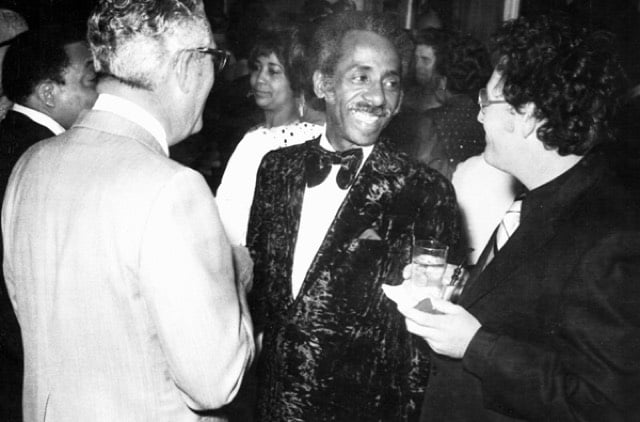
Robert Foster, the gentleman above in the bow tie, became a surgeon and moved from Louisiana to Los Angeles in 1953. There, he rose to the upper ranks of black society and became personal physician to Ray Charles. Foster left the South so thoroughly behind that his daughter didn’t know many of the details of his Louisiana childhood until she read it in Wilkerson’s book.
Through her compelling straight-forward prose, wonderful storytelling, and diligent journalism, Wilkerson more than convinces me that the Great Migration is the greatest untold, misunderstood, and largely unknown occurrence of the American 20th century. I don’t say this often, but The Warmth of Other Suns is a must-read, particularly if you want to begin to understand the racial issues still confronting the US today.
This is what it looks like to land on Mars
When the Curiosity rover landed on the surface of Mars, it took high-resolution photos all the way down. Luke Fitch took those photos and stitched them together into a first-person HD video of the rover’s landing.
Update: I was wondering if someone had done a stabilized version of this video and lo:
(via @willhains)
When I’m Gone
In this story by Rafael Zoehler, a father who dies at 27 wrote his son a series of letters to be opened at several of life’s milestones, including WHEN YOU HAVE YOUR FIRST KISS, WHEN YOU BECOME A FATHER, and WHEN YOUR MOTHER IS GONE. This letter was entitled “WHEN I’M GONE”:
Son,
If you’re reading this, I’m dead. I’m sorry. I knew I was going to die.
I didn’t want to tell you what was going to happen, I didn’t want to see you crying. Well, it looks like I’ve made it. I think that a man who’s about to die has the right to act a little bit selfish.
Well, as you can see, I still have a lot to teach you. After all, you don’t know crap about anything. So I wrote these letters for you. You must not open them before the right moment, OK? This is our deal.
I love you. Take care of your mom. You’re the man of the house now.
Love, dad.
PS: I didn’t write letters to your mom. She’s got my car.
(via @Atul_Gawande)
Kubrick: more like music than like fiction
How many videos can we watch about the films of Stanley Kubrick? If you’re anything like me, the answer is never enough. This montage hinting at connections between his films is particularly well done.
Hell’s Club, a place where all fictional characters meet
Mashups are so ubiquitous and overdone that the bar for actually watching one is pretty high. But this one, no joke, might be the best visual movie mashup I’ve ever seen. Hell’s Club is a tour de force of film editing, seamlessly combining scenes from dozens of different films — Austin Powers, Cocktail, Star Wars, Terminator, Staying Alive, Boogie Nights — into one cohesive scene. Give it 30 seconds and you’ll watch the whole thing.
Update: The sequel is just as tight. Amazing what a little color can do to trick the brain.
Here’s Johnny! @jack is back as permanent CEO of Twitter
Why is there something rather than nothing?
That is the question that physicist Lawrence Krauss answers in his book, A Universe from Nothing. The book’s trailer provides a little more context.
Everything we see is just a 1% bit of cosmic pollution in a Universe dominated by dark matter and dark energy. You could get rid of all the things in the night sky — the stars, the galaxies, the planets, everything — and the Universe would be largely the same.
And my favorite line from the trailer:
Forget Jesus, the stars died so you could be born.
(via open culture)
Some sexist tropes in The Martian. Totally noticed this in the book and it bugged me a lot.
Yale launches an archive of 170,000 Depression-era photos

Yale has made 170,000 Library of Congress photos of the US from 1935 to 1945 available online, searchable and sortable in many different ways.
In order to build support for and justify government programs, the Historical Section set out to document America, often at her most vulnerable, and the successful administration of relief service. The Farm Security Administration-Office of War Information (FSA-OWI) produced some of the most iconic images of the Great Depression and World War II and included photographers such as Dorothea Lange, Walker Evans, and Arthur Rothstein who shaped the visual culture of the era both in its moment and in American memory. Unit photographers were sent across the country. The negatives were sent to Washington, DC. The growing collection came to be known as “The File.” With the United State’s entry into WWII, the unit moved into the Office of War Information and the collection became known as the FSA-OWI File.
Naming names of shooters
Josh Marshall argues provocatively and persuasively that news media, law enforcement, and everyone else should name the offenders in these mass shootings, in part because the refusal has become an empty sort of action that people can take to “help”.
It is a grand evasion because we need to make ourselves feel better by finding a way to think we are doing ‘something’ even though we’re unwilling to do anything that actually matters. Except for those immediately affected or those in the tightly defined communities affected we also shouldn’t give ourselves the solace of watching teary-eyed memorials or all the rest. Again, as a society we’ve made our decision. I would go so far as to say that it’s good for us to know Mercer’s name since we are in fact his accomplices. It’s good that we know each other.
Withholding knowledge is not the way forward.
Update: From the NY Times back in August, Zeynep Tufekci writes: The Virginia Shooter Wanted Fame. Let’s Not Give It to Him.
This doesn’t mean censoring the news or not reporting important events of obvious news value. It means not providing the killers with the infamy they seek. It means somber, instead of lurid and graphic, coverage, and a focus on victims. It means not putting the killer’s face on loop. It means minimizing or not using the killers’ names, as I have done here. It means not airing snuff films, or making them easily accessible on popular sites. It means holding back reporting of details such as the type of gun, ammunition, angle of attack and the protective gear the killer might have worn. Such detailed reporting can give the next killer a concrete road map.
(via @riondotnu)
Update: Read all the way to the bottom of this Mother Jones article for ways that they have changed how they report on mass shootings.
Report on the perpetrator forensically and with dispassionate language. Avoid terms like “lone wolf” and “school shooter,” which may carry cachet with young men aspiring to attack. Instead use “perpetrator,” “act of lone terrorism,” and “act of mass murder.”
Socials & More