Entries for December 2014
Jordan Hoffman is a huge huge huge Star Trek fan. So great is his fandom that he is able to rank every single episode from every single Star Trek series from #695 to #1. Several TNG episodes make it into the top 10, including Yesterday’s Enterprise, Darmok, and The Best of Both Worlds.

Aerial Wallpapers is a collection of iPhone-sized wallpapers of satellite imagery and topographic maps from @juririm. I just downloaded several of these. The image above is a satellite image of the Namib Desert in southern Africa.
Update: See also Earth View, “a collection of the most beautiful and striking landscapes found in Google Earth”. Oh, and the Daily Overview. (via colossal)
Physics World, the magazine of the Institute of Physics, has named their 2014 Breakthrough of the Year and nine runners-up. The top spot goes to the ESA’s Rosetta mission for landing on a comet.
By landing the Philae probe on a distant comet, the Rosetta team has begun a new chapter in our understanding of how the solar system formed and evolved — and ultimately how life was able to emerge on Earth. As well as looking forward to the fascinating science that will be forthcoming from Rosetta scientists, we also acknowledge the technological tour de force of chasing a comet for 10 years and then placing an advanced laboratory on its surface.
The other nine achievements, which you can click through to read about, are:
Quasar shines a bright light on cosmic web
Neutrinos spotted from Sun’s main nuclear reaction
Laser fusion passes milestone
Electrons’ magnetic interactions isolated at long last
Disorder sharpens optical-fibre images
Data stored in magnetic holograms
Lasers ignite ‘supernovae’ in the lab
Quantum data are compressed for the first time
Physicists sound-out acoustic tractor beam
From Quora, an answer to the question “If we pour water on the sun with a bucket as big as the sun, will the sun be extinguished?”
The probable answer is “no.” The Sun involves a special type of fire that is able to “burn” water, and so it will just get hotter, and six times brighter.
Water is 89% oxygen BY MASS. And the Sun’s overall density is 1.4 times that of water. So if you have a volume of water the VOLUME of the Sun, it will have 1/1.4 = 0.71 times the mass of the Sun, and this mass will be .71*.89 = 63% of a solar mass of oxygen and 8% of a solar mass of hydrogen. The Sun itself is 0.74 solar masses of hydrogen and 0.24 solar masses of helium.
So you end up with a 1.7 solar mass star with composition 48% hydrogen, 37% oxygen, and 14% helium (with 1% heavier elements).
Now, will such a star burn? Yes, but not with the type of proton-proton fusion the Sun uses. A star 1.7 times the mass of the Sun will heat up and burn almost entirely by the CNO fusion cycle, after making some carbon and nitrogen to go along with all the oxygen you’ve started with. So with CNO fusion and that mass you get a type F0 star with about 1.3 times the radius and 6 times the luminosity of the present Sun, and a temperature somewhat hotter than the Sun (7200 K vs. the Sun’s 5800 K). It will be bluish-white, with more UV. That, along with that 6 times heat input, will cause the Earth’s biosphere to be fried, and oceans to probably boil.
Well, we probably shouldn’t do that then. (via gizmodo)
This time lapse video of storm clouds by Nicolaus Wegner is flat-out incredible, by far the best of its kind.
Crank up the sound for this one. Previously: Stormscapes 1. (via bad astronomy)
vintage post from Dec 2014
· gift link
While working as a filmmaker as part of the Scott Expedition, Temujin Doran made a beautifully shot and edited short film about a small team of people who live and work on Antarctica’s Union Glacier during the summer.
For me, this film seems a bit like an antithesis to many expedition and adventure documentaries. There is no great achievement or record broken, nor any real challenge to overcome. Instead it concerns minor details; the everyday tasks of the staff that were made more special by the environment surrounding them. And in fact, I think that’s what attracted me to make this film - the delightful trivialities of an average life, working in Antarctica.
Wes Anderson-esque. (thx, joseph)
Last year, I did a meta holiday gift guide where I picked some of the best items off of the best gift guides out there. Since we’re getting down to the wire here on shopping time (not that you should buy anything for anyone this holiday season or any other time of the year), let’s crank up this year’s version.
Consider giving to charity this year. If you can’t spare the time to volunteer (look here or Google for specific opportunities in your area), go on Charity Navigator or Give Well to find an organization worth your attention. Or go on Kiva and give small loans to dozens of families around the world.
For their list this year, The Wirecutter did a list of The Things We Want to Give. Items include The Neat Ice Kit, Benton’s ham, and The Flavor Thesaurus. Hmm, I picked all food stuff there. I must be hungry.
I recommend these every year: the Tovolo King Cube Ice Tray and the KitchenAid Professional 600 Series 6-Quart Stand Mixer.
From Boing Boing’s Happy Mutant’s Gift Guide 2014, the excellent Eyes on the Prize documentary on DVD, the LifeSpan TR1200-DT5 Treadmill Desk, a Lodge 10.5-inch round skillet (can personally vouch for this), and perhaps my favorite Amazon item of all time, the 55-gallon drum of personal lubricant. Don’t worry, the latter item includes a lube pump so you don’t need to buy it separately.
For the sports fan in your life, SB Nation’s 2014 Holiday Gift Guide includes Zubaz pants (!!), Big League Chew, the Bluetooth Gramophone, and a home beer brewing kit. Throwback-errific!
Among the items on the Tools & Toys Christmas Catalog, Bartlett’s Familiar Quotations and the Bellroy Slim Sleeve Wallet (which is my own personal wallet).
Nothing on Mat Honan’s 8 Perfect Gift Ideas for ‘Twitter Dads’ really grabbed me (even though I am an official Twitter Dad), except for the Bugaboo Bee. We had the first iteration of that stroller and it was the absolute best thing. We wore out two sets of wheels strollering Ollie and Minna around the city in that thing.
But I’ll take one of everything off of The Kid Should See This Gift Guide. Especially Animalium, the Crosley portable turntable, My Neighbor Totoro on Blu-ray, and a vintage typewriter. [Update: My friend Dan says to avoid Crosley turntables: “They use ceramic cartridges that track 3x as heavy as standard carts, permanently damaging records.” I have no idea what that means, but Dan knows things about turntables so you might want to make another choice.]
Good year for science-ish nonfiction books: How We Got to Now by Steven Johnson, What If? by Randall Munroe, Being Mortal by Atul Gawande, Superintelligence by Nick Bostrom, and Creativity, Inc. by Ed Catmull.
And cookbooks: Plenty More from Yotam Ottolenghi, MEAT by Pat LaFrieda, Tartine Bread by Chad Robertson, Michael Ruhlman’s Egg, Death & Co: Modern Classic Cocktails, My Paris Kitchen from David Lebovitz (whose Paris dining recommendations are top notch), and Jeffrey Morgenthaler’s The Bar Book.
The Brooklyn Holiday Gift Guide features products made locally in Brooklyn, including bracelets with subways maps and kottke.org favorite, Tattly.
Tom Bihn’s What We’re Giving list includes Fairbault wool blankets and their own Shop Bag. (via @widepipe)
One of many holiday lists from Food52, the Under $25 Gift Guide features Heirloom Seed Art Packets and this Water Bottle with Charcoal Filter.
The Continuous Lean went on a serious listing bender with The Epic ACL Holiday Gift Guide 2014. The stylish selections include the Whiskey Wedge, the Jaguar F-Type Project 7, and the Lego Architecture Fallingwater set.
Josh Rives made a list of gifts that don’t suck. Among the non-suckage is The Dangerous Book for Boys, Coudal and Draplin’s excellent Field Notes, and Cards Against Humanity.
Many many things on the NY Times Holiday Gift Guide, including Julia, Child these awesome cement stair planters, and History of the World in 1,000 Objects.
Since their acquisition by Vox, Eater has been better than ever. Their Holiday Gift Ideas 2014 package is overflowing with good choices, among them are sausages from Butcher & the Boar (smoooooked cheddarwurst!!!) and Fictitious Dishes.
Speaking of Vox, The Verge has a load of tech-oriented picks, including a selection under . They recommend MUJI notebooks and David Mitchell’s The Bone Clocks. One of The Verge’s more baller picks is the Nintendo Wii U Mario Kart 8 Deluxe Set. Which, droooooool. Santa, you got me covered on this?
Misc: the Good Web Bundle gives you subscriptions to five indie services/sites for one low price. You can get 8GB flash drives in necklace form now. From Haruki Murakami, a recently released short novel about “a boy imprisoned in a nightmarish library”. I have no idea if they are actually vintage or just made to look so, but you can find several vintage Soviet chess sets on Etsy (like this one); I bought one recently and if someone faked it, they did a good job. (Even if it’s fake, it’s real, etc.) You can buy Post-It Notes that are almost two-feet across.
Update: Added the guide from Tools & Toys and added a warning about the portable turntable. Added giant Post-It Notes. Added The Brooklyn Holiday Gift Guide. Added Tom Bihn’s list. Added Food52 list. Added The Continuous Lean set. Added a list of gifts that don’t suck. Added lists from the NY Times, Eater, and The Verge.
Whilst roving about Mars, Curiosity has slowly but surely racked up evidence for a past Mars that was warm, wet, and possibly habitable.
John P. Grotzinger of Caltech, the project scientist for the mission, reported at a news conference on Monday that the rover’s yearlong trek to Mount Sharp provided strong new evidence that Gale Crater had large lakes, rivers and deltas, on and off, for millions to tens of millions of years. The geology shows that even when the surface water dried up, plenty of water would have remained underground, he said.
Moreover, the team concluded, numerous deltalike and lakelike formations detected by orbiting satellites are almost certainly the dried remains of substantial ancient lakes and deltas. None of this proves that life existed on the planet, but the case for an early Mars that was ripe and ready for life has grown stronger.
“As a science team, Mars is looking very attractive to us as a habitable planet,” Dr. Grotzinger said in an interview. “Not just sections of Gale Crater and not just a handful of locations, but at different times around the globe.”
See also the interactive 28 Months on Mars.
Update: And right on cue, Curiosity has recorded a two-month-long methane burst on Mars. One explanation for the methane is that it’s a waste product of living organisms.
The presence of methane is significant because the gas cannot exist for long. Calculations indicate that sunlight and chemical reactions in the Martian atmosphere would break up the molecules within a few hundred years, so any methane there now must have been created recently.
It could have been created by a geological process known as serpentinization, which requires both heat and liquid water. Or it could be a product of life in the form of microbes known as methanogens, which release methane as a waste product.
Even if the explanation for the methane turns out to be geological, the hydrothermal systems would still be prime locations to search for signs of life.
Update: And now Curiosity has found “biologically useful nitrogen” on Mars.
There is no evidence to suggest that the fixed nitrogen molecules found by the team were created by life. The surface of Mars is inhospitable for known forms of life. Instead, the team thinks the nitrates are ancient, and likely came from non-biological processes like meteorite impacts and lightning in Mars’ distant past.
Features resembling dry riverbeds and the discovery of minerals that form only in the presence of liquid water suggest that Mars was more hospitable in the remote past. The Curiosity team has found evidence that other ingredients needed for life, such as liquid water and organic matter, were present on Mars at the Curiosity site in Gale Crater billions of years ago.
“Finding a biochemically accessible form of nitrogen is more support for the ancient Martian environment at Gale Crater being habitable,” said Jennifer Stern of NASA’s Goddard Space Flight Center in Greenbelt, Maryland.
Update: The analysis of a year of weather and soil data collected by Curiosity indicates that a small amount of liquid water could exist below the surface of Mars.
Martian weather and soil conditions that NASA’s Curiosity rover has measured, together with a type of salt found in Martian soil, could put liquid brine in the soil at night.
Perchlorate identified in Martian soil by the Curiosity mission, and previously by NASA’s Phoenix Mars Lander mission, has properties of absorbing water vapor from the atmosphere and lowering the freezing temperature of water. This has been proposed for years as a mechanism for possible existence of transient liquid brines at higher latitudes on modern Mars, despite the Red Planet’s cold and dry conditions.
New calculations were based on more than a full Mars year of temperature and humidity measurements by Curiosity. They indicate that conditions at the rover’s near-equatorial location were favorable for small quantities of brine to form during some nights throughout the year, drying out again after sunrise. Conditions should be even more favorable at higher latitudes, where colder temperatures and more water vapor can result in higher relative humidity more often.
The Guardian and other media outlets have translated this news into Nasa’s Curiosity rover finds water below surface of Mars even though NASA’s release clearly states “we have not detected brines”. Come on, guys.
The Entire Screen of One Game is like the video game version of Powers of Ten. The game isn’t fun or winnable, but it will confuse your brain after only a few seconds. (via @pieratt)
If you’ve ever wondered how a designer does their thing (or even if you haven’t), this look-over-the-shoulder view of Aaron Draplin designing a logo for a fictional company in about 10 minutes is great. A nice reminder that design is truly about making it up as you go along.
I love Draplin. Internet treasure, that guy. And that lefty writing claw! Go lefties!
Every once in awhile on the site, I’ll use the phrase “in my wheelhouse”, meaning something that is particularly interesting to me. Well, Grantland’s long oral history of the making of Boogie Nights is so in my wheelhouse that I might be the captain.
When [Anderson] set out to film Boogie Nights, it was with a resolve bordering on arrogance. Compromise wasn’t part of the plan. Still, after an intense production and postproduction period — one in which the director had to manage a cranky, confused Burt Reynolds and an untested, rapping underwear model named Mark Wahlberg — Anderson was forced once again to fight studio heads for his cut of the film.
But Anderson’s vision prevailed this time. Nearly 20 years later, Boogie Nights endures. For its beautiful portrait of nontraditional families; for Reynolds and Wahlberg, the surrogate father and son, who were never better; for Philip Seymour Hoffman, squeezing into character and breaking hearts; for its prodigy director sticking to his guns and nailing it; for John C. Reilly’s hot-tub poetry; for Roller Girl. Is everybody ready? This is the making and near unmaking of Boogie Nights.
Man, I love that movie. But think on this: Leonardo DiCaprio as Dirk Diggler, Drew Barrymore as Roller Girl, and Bill Murray as Jack Horner.
In a series of tweets this morning, surgeon and author Atul Gawande called out the doctors who helped the CIA torture people.
First do no harm.
Yarin Gal used an “inpainting” algorithm to extend the canvases of notable paintings. Like van Gogh’s Starry Night or Hokusai’s The Great Wave off Kanagawa:
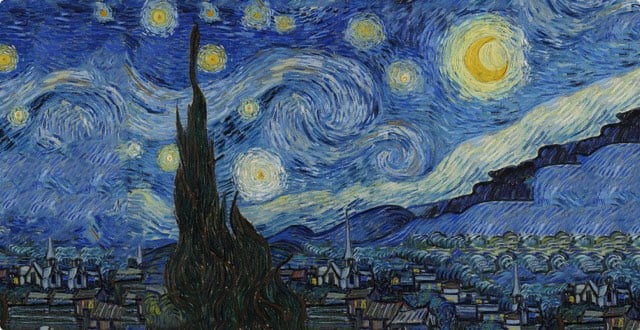
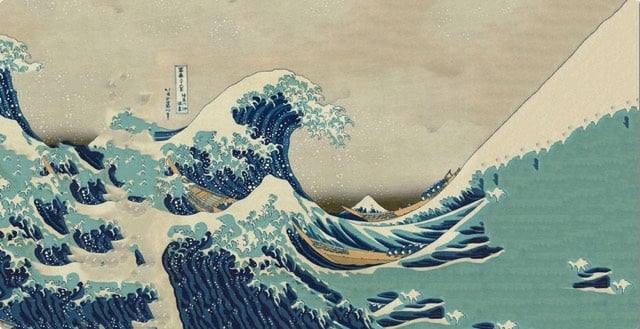
There’s a post on the Wolfram Alpha blog about how you can achieve similar effects using the Wolfram Language.
Wow, the art of making marbled paper, a short film from 1970. Charmingly British, just like the film about the Teddy Grays candy factory or the putter togetherer of scissors. Super cool how the inks are placed on a water bath, swirled expertly to make patterns, and then transferred to the paper.
Also of note: the segment on the conservation of old books starting at around 9:55…I never knew they took them apart like that to dunk the pages in water! Sadly, the Cockerell Bindery ceased operation in the late 1980s with the death of Sydney Cockerell and its contents were sold at auction. (thx, matt)
This is disgusting and awful and monstrous and I don’t even know what to say about it. The NY Times lists seven key points (full article) from a report released by the Senate Select Committee on Intelligence about the CIA’s torture practices. We knew it was bad, suspected it was worse, but this is just beyond.
The report describes extensive waterboarding as a “series of near drownings” and suggests that more prisoners were subjected to waterboarding than the three prisoners the C.I.A. has acknowledged in the past. The report also describes detainees being subjected to sleep deprivation for up to a week, medically unnecessary “rectal feeding” and death threats. Conditions at one prison, described by a clandestine officer as a “dungeon,” were blamed for the death of a detainee, and the harsh techniques were described as leading to “psychological and behavioral issues, including hallucinations, paranoia, insomnia, and attempts at self-harm and self-mutilation.”
This is surely the shit sandwich on top of an already unbearable year. I agree wholeheartedly with Vermont Senator Bernie Sanders, who issued this statement about the report:
A great nation must be prepared to acknowledge its errors. This report details an ugly chapter in American history during which our leaders and the intelligence community dishonored our nation’s proud traditions. Of course we must aggressively pursue international terrorists who would do us harm, but we must do so in a way that is consistent with the basic respect for human rights which makes us proud to be Americans.
“The United States must not engage in torture. If we do, in an increasingly brutal world we lose our moral standing to condemn other nations or groups that engage in uncivilized behavior.
There’s a good reason your cat looks so depressed. The days of her antics dominating YouTube are long gone. As the New Yorker’s Tad Friend explains, in addition to cats “YouTube was adults with camcorders shooting kids being adorably themselves. It was amateur hour.” Since then, YouTube has gone pro. Jeffrey Katzenberg predicts that “within five years, YouTube will be the biggest media platform of any, by far, in the entire world.” It’s where your kids are. It’s where the new stars are. And it’s where your cat isn’t. Welcome to the new Hollywood and Vine.
This is the craziest thing I’ve ever seen anyone do on skis: Cody Townsend skiing down a super steep face in a space between two rock walls no wider than a supermarket aisle. Powder Magazine called it “The Line of the Year”.
They forgot to put “Batshit Crazy” before the word “Line”. (via devour)
Rolling Stone lists the 40 most groundbreaking music albums in history. Kanye West makes the list with 808s and Heartbreaks, Dr. Dre with The Chronic, Nirvana with Nevermind, and the Beatles with Rubber Soul and Sgt. Pepper’s. About The Chronic:
The album sold a world to white America that it had never really seen before, and packaged it with a soundtrack so funky there was no avoiding it. It was both raw, uncut underground and carefully composed pop. If Public Enemy confronted white America, The Chronic seduced it. For the first time ever, hip-hop’s mainstream and America’s were one.
I counted only four women artists though: Mary J. Blige, Loretta Lynn, Nico, and Carole King.
John Lennon died 34 years ago today. The night he died, someone made a six-minute recording of what was playing on FM radio in NYC:
Almost every station was either discussing the death or playing a Beatles song. See also the front page of the NY Times the next day and the article in the Daily News about the shooting. (via wfmu & @UnlikelyWorlds)
Update: Legendary reporter Jimmy Breslin wrote a piece shortly after the shooting about the police officers that drove Lennon to the hospital that night.
As Moran started driving away, he heard people in the street shouting, “That’s John Lennon!”
Moran was driving with Bill Gamble. As they went through the streets to Roosevelt Hospital, Moran looked in the backseat and said, “Are you John Lennon?” The guy in the back nodded and groaned.
Back on Seventy-second Street, somebody told Palma, “Take the woman.” And a shaking woman, another victim’s wife, crumpled into the backseat as Palma started for Roosevelt Hospital. She said nothing to the two cops and they said nothing to her. Homicide is not a talking matter.
And that last paragraph, wow. (via @mkonnikova)
Using only squares, triangles, and the condition that each shape wants to move if less than 1/3 of its neighbors are like it, watch how extreme segregation appears in even the most random mixing of shapes.
These little cuties are 50% Triangles, 50% Squares, and 100% slightly shapist. But only slightly! In fact, every polygon prefers being in a diverse crowd. You can only move them if they’re unhappy with their immediate neighborhood. Once they’re OK where they are, you can’t move them until they’re unhappy with their neighbors again. They’ve got one, simple rule: “I wanna move if less than 1/3 of my neighbors are like me.”
Harmless, right? Every polygon would be happy with a mixed neighborhood. Surely their small bias can’t affect the larger shape society that much? Well… And… our shape society becomes super segregated. Daaaaang. Sometimes a neighborhood just becomes square, and it’s not their fault if no triangles wanna stick around. And a triangular neighborhood would welcome a square, but they can’t help it if squares ain’t interested.
Super super fascinating. Take your time and go through and play with all the interactive widgets. (via @ftrain)
A tribute to outer space in movies, featuring clips from Gravity, The Fountain, Alien, Star Wars, Solaris, Sunshine, Guardians of the Galaxy, and more.
Music is from Hans Zimmer’s soundtrack for Interstellar, which I was initially lukewarm on but have been listening to consistently over the past week or so. (via devour)
kottke.org favorite Matt Zoller Seitz weighs in on his top 10 best TV shows for 2014. For someone who doesn’t watch a ton of TV, I have seen a surprising number of these.
My friend David has been trying to tell me about Hannibal, but I haven’t been listening. Maybe I should start? Olive Kitteridge was great; Frances McDormand was incredible. True Detective was pretty good and I was lukewarm on Cosmos (I have NDT issues). Mad Men continues to be great…I keep waiting for it to fall off in quality, but it hasn’t happened. The Roosevelts was really interesting and like Seitz, I find myself thinking about it often. I’ve seen bits and pieces of John Oliver but I get enough of the “humans are awful ha ha” news on Twitter to become a regular viewer.
Other shows I’ve watched that aren’t on the list: Downton Abbey (my favorite soap), Game of Thrones (tied w/ Mad Men for my fave current show, although MM is better), Boardwalk Empire (strong finish), Sherlock (still fun, tho got a bit too self referential there), and Girls (gave up after s03e04 when it was airing but recently powered through rest of the 3rd season and is back in my good graces).
Photographer Noah Kalina (of Everyday fame) keeps a blog of his purchases from Amazon called Amazon Primed. Recently documented purchases include a Weber grill and a shoulder mount for a camera. Now Kalina has turned his blog into a book published by Amazon.
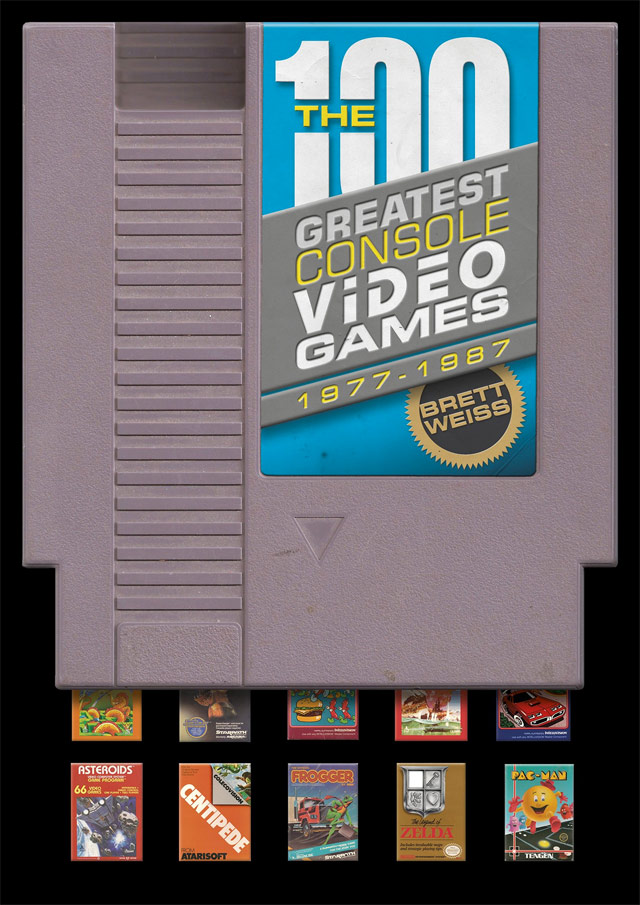
The 100 Greatest Console Video Games: 1977-1987 is a recent book chronicling the best games from the first golden era in console video games, from the Intellivision1 to the Atari 2600 to the Nintendo.
SWAPI is a new web service will use a RESTful interface to return JSON about the “Planets, Spaceships, Vehicles, People, Films and Species” from all six of the Star Wars movies. This API would be really useful if Disney would have done as Matt Webb suggested and turned Star Wars into a genre rather than a franchise.
Imagine, imagine if Disney had said: Star Wars isn’t a franchise, it’s a genre.
The legendary galaxy, a long time ago, far far away, is well understood: What’s true is what’s in the Holocron continuity database.
Open the Holocron. Show everyone what’s in it. Let it become history.
Then let anyone make movies and books that share the Star Wars world. Not like all those other franchises that argue about what’s canon and what’s not… rise above it, become a new shared set of conventions, formulas, history and myth, just like the western but for the 21st century.
My friend David suggested something similar with Harry Potter a few years ago…open it up and let any director take a shot at making Potter movies. Open source franchises.
Astonishing, if you think about it: that a person could live half his life without coming face-to-face with the one thing that unites us all. And I don’t think I’m alone in this.
Eric Puchner pays a visit to a sixth-generation funeral director who wants to reacquaint us all with the uncomfortable, eye-opening realities of death.
Update: The Death, Sex & Money podcast has a good episode about the same funeral director, Caleb Wilde, whose blog is worth a read. (via @mims)
Totally sweet and charming video of Apple co-founder Steve Wozniak talking about the early days at the company while setting up and using an old Apple II.
Of Apple’s two founding Steves, Wozniak was the technologist and Jobs was the one with the artistic & design sense, right? But it’s obvious from watching this video that Woz cared deeply about design and was a designer of the highest order. Those early Apple circuit boards are a thing of beauty, which is echoed in the precision and compactness with which Apple currently designs iPhone and Mac hardware. They each have their own unique way of expressing it, but Woz and Jony Ive speak in a similarly hallowed way about how their products are built.
Update: Wozniak still has improving the Apple II on his mind. From earlier this year:
I awoke one night in Quito, Ecuador, this year and came up with a way to save a chip or two from the Apple II, and a trivial way to have the 2 grays of the Apple II be different (light gray and dark gray) but it’s 38 years too late. It did give me a good smile, since I know how hard it is to improve on that design.
(via @samryan)
Update: From Founders at Work, an interview with Woz that goes a bit deeper into the genesis of the Apple I and the early days at Apple.
By the time I was done, the design of the Nova was half as many chips as all of the other minicomputers from Varian, Digital Equipment Corp., Hewlett-Packard, all of the minicomputers of the time (I was designing them all). And I saw that Nova was half as many chips and just as good a computer. What was different? The architecture was really an architecture that just fit right to the very fewest chips.
My whole life was basically trying to optimize things. You don’t just save parts, but every time you save parts you save on complexity and reliability, the amount of time it takes to understand something. And how good you can build it without errors and bugs and flaws.
Worth a listen: a 30-minute BBC Radio show on 2001: A Space Odyssey.
Francine journeys through time and space to uncover the mysteries of this 1968 classic. Searching for the mind of H.A.L. and lost alien worlds among the delights of the Stanley Kubrick Archive at London’s University of the Arts. Joining Francine on her voyage of discovery are 2001 chronicler Piers Bizony, former urbane spaceman Keir Dullea and the woman who built the moon! Other voices include production designer Harry Lange, make-up genius Stuart Freeborn, editor Ray Lovejoy, all now so much stardust, as well as those of lead ape ‘Moonwatcher’ (Dan Richter) & Stargate deviser Douglas Trumbull.
My favorite book when I was a kid was Cloudy With a Chance of Meatballs by Judi and Ronald Barrett.1 So I was excited when the kids brought home a book from the library from the same authors that I hadn’t seen before: Old MacDonald Had An Apartment House. The story is about an apartment building super who starts growing food and raising livestock in vacant apartments as the increasingly alarmed tenants move out. Totally awesome 70s hippie energy crisis stuff. It didn’t click that I had actually read (and loved!) this book as a kid until we reached this page:
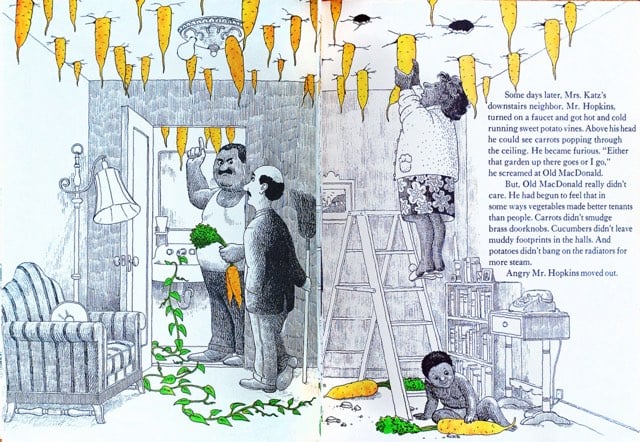
Love that page. Hot and cold running sweet potato vines.
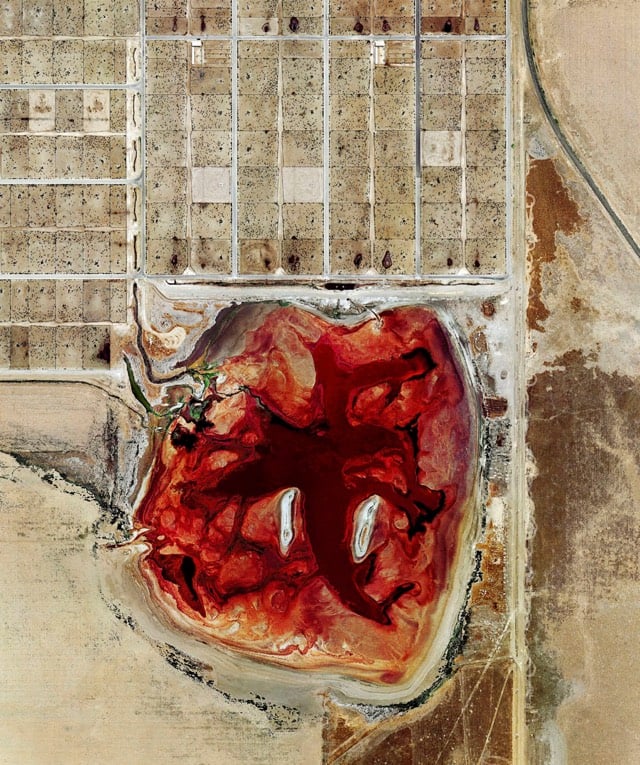
From artist Mishka Henner, a selection of satellite photos of Texas feedlots, where beef cattle are sent to be “finished”, aka to quickly gain weight for slaughter on a diet of corn. I’m pretty sure the redness of that pit/lake is not blood but algae (or whatever), but it sure creates that impression, doesn’t it?
What’s a large number? A billion? A billion times a billion? A billion to the billionth power? A googol? A googolplex? A googolplex is 10^googol, BTW:
So a googol is 1 with just 100 zeros after it, which is a number 10 billion times bigger than the grains of sand that would fill the universe. Can you possibly imagine what kind of number is produced when you put a googol zeros after the 1?
That’s pretty big, right? Not. Even. It turns out you can construct numbers that are so much larger than a googolplex, that it’s gonna light your head on fire just to read about them. Put on your asbestos hat and feast your eyes on Graham’s Number.
Moving up another level, exponentiation is iterated multiplication. Instead of saying 3 x 3 x 3 x 3, exponentiation allows me to bundle that string into the more concise 3^4.
Now, the thing is, this is where most people stop. In the real world, exponentiation is the highest operation we tend to ever use in the hyperoperation sequence. And when I was envisioning my huge googolplex^googolplex number, I was doing the very best I could using the highest level I knew — exponentiation. On Level 3, the way to go as huge as possible is to make the base number massive and the exponent number massive. Once I had done that, I had maxed out.
The key to breaking through the ceiling to the really big numbers is understanding that you can go up more levels of operations — you can keep iterating up infinitely. That’s the way numbers get truly huge.
You might get lost around the “power tower feeding frenzy” bit or the “power tower feeding frenzies psycho festival” bit, but persist…the end result is really just beyond superlatives. (via @daveg)
Update: In this video, you can listen to the inventor of Graham’s number, Ron Graham, explain all about it.
(via @eightohnine)
Businessweek is 85 years old and to celebrate, they’ve listed the 85 most disruptive ideas created during that time. They include kitty litter, Air Jordans, information theory, refrigeration, the jet engine, and the Polaroid camera.
Polaroids were the first social network. You’d take a picture, and someone would say, “I want one, too,” so you’d give it away and take another. People shared Polaroids the way they now share information on social media. Of course, it was more personal, because you were sharing with just one person, not the entire world.
I met Andy Warhol in the ’70s at the Whitney Museum and started doing projects with him because he loved my photographs. He’d never had a pal who was a photographer, so I was his guru, showing him what cameras to buy, what pictures to take. When Polaroid came out with its SX-70 model, the company sent big boxes of film and cameras to the Factory, which was at 860 Broadway (it’s now a Petco). Andy loved Polaroid. Everything was “gee whiz”; it was brand-new. So immediate. I took photos of him with his new toy.
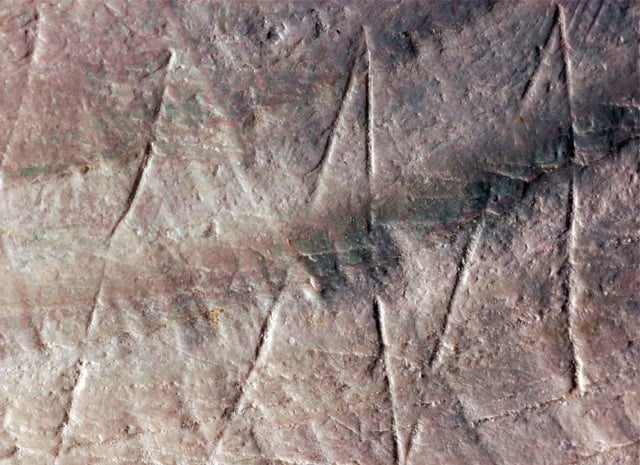
A shell found in the 1890s was recently found to have what scientists are calling the world’s oldest “abstract marking”, a 500,000-year-old etching made by Homo erectus, an extinct ancestor of modern humans.
Close inspection under the microscope suggested that the engraving was intentional. The weathering patterns of the grooves, each of which is about 1 centimetre long, show signs of significant ageing, and there are no gaps between turns, indicating that the maker paid attention to detail. He or she probably made the engraving on a fresh shell, and the newly made etching would have resembled white lines on a dark canvas, Joordens’ team notes. Sand grains still embedded in the shell were dated to around 500,000 years ago.
It turns out if you break some kinds of slow-growing corals into tiny pieces, these microfragments grow much much faster than usual, even 25-50 times faster.
“Part of the coral had grown over the back side and had attached to the bottom of the aquarium,” he said. When he grabbed it, “it broke off and left two or three polyps behind. I thought I just killed those. But oh, well, I moved the puck over.”
A week later he happened to glance at the abandoned polyps — the individual hydra-shaped, genetically identical organisms that make up a coral colony — on the bottom of the aquarium. “I noticed that those one to three polyps were now five to seven polyps,” he said. “They not only had lived — they had grown and had doubled in size.”
It was, he said, “my eureka mistake.” He cut a few more polyps from the original colony and placed them on other pucks. “And they grew like crazy. The coral seems to want to repair itself quickly and grow back over its lost ground before something else takes its territory.”
Both this and the article about the quickly regenerating corals I posted last month seem to hinge on a realization scientists have had recently about coral: what matters most is the surface area, not the volume. You look at a massive brain coral and you think the whole thing is the organism, but most of it is just a base for the thin layer of stuff coating it that actually matters.
Gear Patrol visited 12 whiskey distilleries (including Buffalo Trace, Maker’s Mark, and Jim Beam) to find out how bourbon is made.
Cool. Some of that I knew, and some I didn’t. My favorite detail is how the placement of the barrel in the aging room can affect the flavor of the bourbon within. Just like cheese. (via digg)
A weight-loss doctor from Indiana owns a surprising number of the world’s known meteorites, including about 2/3s of an unusual Martian meteorite called Black Beauty, which is valued at more than $10,000 per gram.
There is one diva in particular that I’m here to pay homage to: Black Beauty, a shiny, scaly-skinned, 4.4-billion-year-old rock from Mars. It began its journey to Earth more than 5 million years ago, about the time humans and chimpanzees were splitting from a common ancestor. That is when an asteroid struck Mars, catapulting the rock into space. Sometime in the last thousand years or so, orbital mechanics and gravity delivered the wandering rock to Earth. Surviving an incendiary plunge through the atmosphere, it landed in more than a dozen pieces in the western Sahara. There the fragments sat, untouched except by wind and sand. Finally, a nomad plucked a piece from the dunes. After passing through the hands of several Moroccan middlemen, the first piece wound up in Piatek’s hands in 2011. He would acquire nine more.
Black Beauty has since set the collecting world on fire, reaching values of more than $10,000 per gram. (Gold trades for $40 per gram.) The price is in no small part due to the parade of scientific discoveries emerging from the rock’s jumbled-up guts. It is the oldest rock from Mars and chock-full of the planet’s primordial water. Most intriguing of all, it appears to be the first martian meteorite made of sediment, deposited by wind or water. That makes Black Beauty not only a cosmic blessing-sedimentary rocks are fragile and thought unlikely to survive interplanetary launches-but also a boon for astrobiologists. “If you’re going to look for life, you want a sedimentary rock,” says Munir Humayun, a meteoriticist at Florida State University in Tallahassee who led a study that last year pinpointed the rock’s age.
The headline from Eric Holthaus’ latest piece is arresting: The Last Time There Was This Little Arctic Ice, Modern Humans Didn’t Exist.
Ice has been a relatively constant feature of the Arctic for most of the past 36 million years, but there have been some gaps. Scientists aren’t exactly sure what happened during the most recent major ice-free period, but it’s often considered an analog to our future, warmer Earth. The only difference is, this time, the gap in Arctic sea ice is being caused by us.
From the August 4, 1926 issue of The New Republic, here’s an essay about film by author Virginia Woolf, published the year before the release of the first talkie.
People say that the savage no longer exists in us, that we are at the fag-end of civilization, that everything has been said already, and that it is too late to be ambitious. But these philosophers have presumably forgotten the movies. They have never seen the savages of the twentieth century watching the pictures. They have never sat themselves in front of the screen and thought how, for all the clothes on their backs and the carpets at their feet, no great distance separates them from those bright-eyed, naked men who knocked two bars of iron together and heard in that clangor a foretaste of the music of Mozart.
The bars in this case, of course, are so highly wrought and so covered over with accretions of alien matter that it is extremely difficult to hear anything distinctly. All is hubble-bubble, swarm and chaos. We are peering over the edge of a cauldron in which fragments of all shapes and savors seem to simmer; now and again some vast form heaves itself up, and seems about to haul itself out of chaos. Yet, at first sight, the art of the cinema seems simple, even stupid. There is the King shaking hands with a football team; there is Sir Thomas Lipton’s yacht; there is Jack Horner winning the Grand National. The eye licks it all up instantaneously, and the brain, agreeably titillated, settles down to watch things happening without bestirring itself to think.
Back in September, I posted that HBO was remastering The Wire in HD. The company announced they’ve completed the process; it’ll be on HBO Go this month at full-frame 16x9 HD.
HBO announced today that they had completed the high-definition re-mastering of all five seasons of “The Wire,” which will debut in December on HBO Signature and HBO Go, be sold in digital HD (through iTunes, Google Play, etc.) starting January 5, and on Blu-ray starting next summer. As the press release notes, “The entire series has been beautifully re-mastered in 16x9 Full-Frame HD from more than 8,000 reels of original 35mm camera negative, allowing for a tighter fit on widescreen TVs and computer/tablet screens. The original negatives were scanned, edited, dust-busted and color-corrected with great care and attention taken to stay true to the look and feel of the original Standard-Definition 4x3 version.”
Well, well. That’s a welcome change from what I heard about how the show was shot and how they were going to remaster it (chop the top and bottom off the 4x3 frame). David Simon wrote extensively on how he became involved in the remastering process and came up with something to everyone’s satisfaction.
To their great credit, once we alerted HBO production executives to our absolute interest in the matter, they halted the fall HD release and allowed us to engage in detail. And over the past several months, looking at some of what the widescreen format offered, three things became entirely clear: First, there were many scenes in which the shot composition is not impaired by the transfer to 16:9, and there are a notable number of scenes that acquire real benefit from playing wide. An example of a scene that benefits would be, say, from the final episode of season two, when an apostolic semicircle of longshoremen forms around the body of Frank Sobotka. Fine as far as it goes, but the dockworkers are all that much more vulnerable, and that much more isolated by the death of their leader when we have the ability to go wider in that rare crane shot.
But there are other scenes, composed for 4:3, that lose some of their purpose and power, to be sure. An early example that caught my eye is a scene from the pilot episode, carefully composed by Bob, in which Wee Bey delivers to D’Angelo a homily on established Barksdale crew tactics. “Don’t talk in the car,” D’Angelo reluctantly offers to Wee Bey, who stands below a neon sign that declares, “burgers” while D’Angelo, less certain in his standing and performance within the gang, stands beneath a neon label of “chicken.”
That shot composition was purposed, and clever, and it works better in the 4:3 version than when the screen is suddenly widened to pick up additional neon to the left of Bey. In such a case, the new aspect ratio’s ability to acquire more of the world actually detracts from the intention of the scene and the composition of the shot. For that reason, we elected in the new version to go tighter on the shot in order to maintain some of the previous composition, albeit while coming closer to our backlit characters than the scene requires. It is, indeed, an arguable trade-off, but one that reveals the cost of taking something made in one construct and recasting it for another format. And this scene isn’t unique; there are a good number of similar losses in the transfer, as could be expected.
(thx jeff & @jasonsantamaria/)
Update: HBO Signature is currently running a marathon of all the HD episodes. They’re also available on HBO Go.
David Simon added some before-and-after video clips to his piece about the HD remastering process showing instances where the wider aspect was beneficial and not-so-beneficial.
This dive, by Leeds United midfielder Adryan in match against Derby County, might be the worst dive of all time.
He’s flopping around like Sonny Corleone getting shot up at the toll booth in The Godfather. Hilarious.

The Game Map from Dorothy is a street map made up of references to more than 500 video games.
The imaginary map is loosely based on an area of Tokyo, a city that was home to some of the all time classic arcade games of the late 1970’s and early 1980’s that paved the way for the modern day gaming industry. The map features districts dedicated to survival horror (Silent Hill, Resident Evil, Sweet Home), beat ‘em ups (Street fighter, Streets of Rage, Double Dragon) and Nintendo classics (Super Mario Kart, Donkey Kong Land, Luigi’s Mansion) as well as many geeky ‘in’ references to entertain the most hardcore (or the oldest) of gamers.
vintage post from Dec 2014
· gift link
Watch as a Latvian master blacksmith forges a Damascus steel1 knife with 320 layers of steel. Then he uses the finished knife to make a leather holder for it.
Pound it flat, fold it over. Pound it flat, fold it over. I love that twist he puts on the steel in the middle of the process. You can also see how their chisels are made, how their axes are made, or take a listen to what their knives sound like after being struck with a hammer (headphones on for this one).
The knives are available for sale from John Neeman (for $650), along with axes, chef’s knives, longbows, and other handmade items.
A new analysis of the genomes of two extinct human species (Neanderthals and Denisovans) shows more clearly that they interbred with our species of human, contributing 2-4% of our modern genomes in some cases.
“What it begins to suggest is that we’re looking at a Lord of the Rings-type world — that there were many hominid populations,” says Mark Thomas, an evolutionary geneticist at University College London who was at the meeting but was not involved in the work.
But, more interestingly, the analysis also detected the Denisovans also bred with an as-yet-unknown species of humans.
The Denisovan genome indicates that the population got around: Reich said at the meeting that as well as interbreeding with the ancestors of Oceanians, they also bred with Neanderthals and the ancestors of modern humans in China and other parts of East Asia. Most surprisingly, Reich said, the genomes indicate that Denisovans interbred with yet another extinct population of archaic humans that lived in Asia more than 30,000 years ago — one that is neither human nor Neanderthal.
Is this the first time a new human species has been discovered through DNA evidence alone?
Amazon’s newest fulfillment center1 features hundreds of robots. Watch them work in an intricate ballet of customer service through increased speed of delivery and greater local selection. Also, ROBOTS!
Now imagine this with McDonald’s hamburgers and every other thing we buy and watch Humans Need Not Apply again. (via @tcarmody)
Kermit the Frog, Fozzie Bear, and guests cover Naughty By Nature’s 1993 classic Hip Hop Hooray.
See also The Muppets covering The Beastie Boys, Kanye, and M.O.P.
I am still very much looking forward to the Shaun the Sheep movie, but the first official trailer is not inspiring much confidence:
Yeesh. That makes it look like The Smurfs movie or something. Movie company marketing departments don’t seem to know what to do with quirky stuff like Shaun or Wallace & Gromit. Has an Aardman movie ever had a good trailer? (via digg)

The International Exhibition of Modern Art held at the The 69th Regiment Armory in NYC in 1913 was the first large public exhibition of modern art in the US. It has become known simply as The Armory Show. Among the artists represented at the show were Paul Cézanne, Georges Braque, Georges Seurat, Vincent van Gogh, Auguste Rodin, Pablo Picasso, Wassily Kandinsky, Claude Monet, Marcel Duchamp, Henri Matisse, and Fernand Léger. So yeah, important show.
John Ptak noticed in a book he was reading that the sales total for the show was $44,148, which is something like $1,000,000 in today’s dollars. Of that total, two artists were responsible for almost a third of the total: Odilon Redon made $7000 and Cézanne made $6700. Duchamp sold four pieces for $972. It goes without saying that the ~1600 pieces exhibited at The Armory Show would fetch billions of dollars at auction now.
Scenes from Seinfeld can help illustrate economic concepts like incentives, thinking at the margin, and common resources. For instance, in The Strike from season nine (the episode that popularized Festivus), Elaine angles for a free sandwich:
Elaine has eaten 23 bad sub sandwiches, and if she eats a 24th, she’ll get one free. She is determined to do it, even though Jerry advises her to ignore sunk costs and walk away.
See also the economics of The Simpsons.
Newer posts
Older posts



Socials & More