Entries for June 2012
Microsoft announced their own tablet today called Surface. Here’s the slick intro video. (Microsoft. Now mit dubstep!)
That keyboard cover thing is a fantastic idea…the first iPad accessory maker to rip that off is going to make a fortune. The Verge has the whole story about the Surface.
A German experimental theater recently put on a production of Infinite Jest. They turned the 1079-page book into a 24-hour play that took place all over Berlin.
The play is Infinite Jest. Yes, the 1,079-page David Foster Wallace novel. Germany’s leading experimental theater, Hebbel am Ufer, had the gall not only to stage the world theatrical premiere of an Infinite Jest adaptation, but to play it on the grandest stage possible: the city of Berlin itself. Over the course of 24 hours, the shell-shocked and increasingly substance-dependent audience is transported to eight of the city’s iconic settings, which serve as analogs for the venues to which the discursive novel continually returns.
But so we’re at this AA meeting in a Boston school cafeteria, which in this case is the cultural center of a city quarter that was drawn up from scratch in the 1960s in the far, far north of Berlin, like practically halfway to the Baltic, this sticks-of-the-sticks-type section of town. And the actor sharing his history of teen addiction to Quaaludes and Hefenreffer-brand beer is droning on far too long and starting to give me the howling fantods.
Every internet article about Wallace is required by law to include footnotes and this one is no exception. (thx, paul)
In 1986, Sherri Rasmussen was murdered in the apartment that she shared with her husband. The police eliminated the husband and ex-lovers as suspects and the case remained unsolved for 20+ years until a pair of detectives pulled it from the cold case files and looked at the evidence with fresh eyes. Mark Bowden has the story in the latest issue of Vanity Fair.
Soon after the murder, [Sherri’s father] Nels was shown sketches of two Latin male suspects, and the burglary theory was explained. There was no way for him to recognize the drawings, and the whole scenario did not make sense to him. He had to wonder about the competence of these detectives. The apartment showed signs of a protracted fight. Mayer estimated that the struggle may have lasted for an hour and a half. How could his daughter have fought off two men for that long?, Nels asked. There was the bite mark on her forearm, which led Mayer’s partner, Steve Hooks, to conjecture that the suspect may have been a woman, on the theory that women are biters. But the notion was dismissed. Women don’t typically engage in breaking and entering, and fighting men have been known to use their teeth. There was also the bullet wound in the center of Sherri’s chest, and the hole and powder burns on the blanket. Mayer told Nels that his daughter had not simply been shot and killed; she had been assassinated. Why would a burglar do that?
Nels asked if they had checked to see if the lady cop had been working that day. Had they examined her, taken pictures of her? The answers were no. No one ever checked up on Lazarus. Mayer or Hooks or someone apparently did talk to her on the phone eventually, and the conversation was enough to close that line of inquiry. There is only one brief entry in the case file that mentions her, recorded on November 19, 1986, more than eight months after the murder. It reads, “John Ruetten called. Verified Stephanie Lazarus, PO [police officer], was former girlfriend.”
No arrests were ever made. The evidence of Sherri Rasmussen’s murder was packed away in commercial storage.
Update: I forgot to include this with the original post…it’s a video of the hour-long interrogation of Stephanie Lazarus, the “lady cop” Nels is referring to.
Also, The Atlantic ran a story about the Rasmussen case last year. (thx, dewayne)
The Sinaloa drug cartel is headed by a man who goes by El Chapo. That Chapo is 55 years old and still around tells you something about well he runs his business.
The drug war in Mexico has claimed more than 50,000 lives since 2006. But what tends to get lost amid coverage of this epic bloodletting is just how effective the drug business has become. A close study of the Sinaloa cartel, based on thousands of pages of trial records and dozens of interviews with convicted drug traffickers and current and former officials in Mexico and the United States, reveals an operation that is global (it is active in more than a dozen countries) yet also very nimble and, above all, staggeringly complex. Sinaloa didn’t merely survive the recession — it has thrived in recent years. And after prevailing in some recent mass-casualty clashes, it now controls more territory along the border than ever.
“Chapo always talks about the drug business, wherever he is,” one erstwhile confidant told a jury several years ago, describing a driven, even obsessive entrepreneur with a proclivity for micromanagement. From the remote mountain redoubt where he is believed to be hiding, surrounded at all times by a battery of gunmen, Chapo oversees a logistical network that is as sophisticated, in some ways, as that of Amazon or U.P.S. — doubly sophisticated, when you think about it, because traffickers must move both their product and their profits in secret, and constantly maneuver to avoid death or arrest. As a mirror image of a legal commodities business, the Sinaloa cartel brings to mind that old line about Ginger Rogers doing all the same moves as Fred Astaire, only backward and in heels. In its longevity, profitability and scope, it might be the most successful criminal enterprise in history.
In a clever bit of salesmanship, Apple angles the screens on the laptops in the Apple Store just enough that you can see the screen but not enough for comfortable viewing. Here’s why:
The point, explains Carmine Gallo, who is writing a book on the inside workings of the Apple Store, is to get people to touch the devices. “The main reason notebook computers screens are slightly angled is to encourage customers to adjust the screen to their ideal viewing angle,” he says — “in other words, to touch the computer.”
A tactile experience with an Apple product begets loyalty to Apple products, the thinking goes — which means that the store exists to imprint a brand impression on visitors even more than it exists to extract money from them. “The ownership experience is more important than a sale,” Gallo notes. Which means that the store — and every single detail creating the experience of it — are optimized for customers’ personal indulgence. Apple wants you to touch stuff, to play with it, to make it your own.
It’s a genius touch. I went in to the Apple Store last week just after it opened to see the new MacBook Airs and retina MacBook Pros and I’ll be damned if I didn’t have to adjust the screen in both cases. Get out of my head, man! (via @alexismadrigal)
Stanley Kubrick didn’t give long interviews…or didn’t like giving them anyway. But Jeremy Bernstein convinced him to sit down for one, perhaps because Kubrick was a huge chess nerd and Bernstein played chess seriously. So the two of them did this hour-long interview in 1965 that resulted in this New Yorker piece about his life, films, and the then in-production 2001.
During our conversation, I happened to mention that I had just been in Washington Square Park playing chess. He asked me who I had been playing with, and I described the Master. Kubrick recognized him immediately. I had been playing a good deal with the Master, and my game had improved to the point where I was almost breaking even with him, so I was a little stunned to learn that Kubrick had played the Master on occasion, and that in his view the Master was a potzer. Kubrick went on to say that he loved playing chess, and added, “How about a little game right now?” By pleading another appointment, I managed to stave off the challenge.
(via open culture)
NBA TV did a documentary on the 1992 Men’s Olympic basketball team, aka the Dream Team. It it, for now, available on YouTube:
Get it while you can…this looks like an unofficial copy and the NBA is likely to take it down soon. (thx, david)
British industrialist and billionaire James Dyson has a pretty healthy outlook on failure.
You once described the inventor’s life as “one of failure.” How so?
I made 5,127 prototypes of my vacuum before I got it right. There were 5,126 failures. But I learned from each one. That’s how I came up with a solution. So I don’t mind failure. I’ve always thought that schoolchildren should be marked by the number of failures they’ve had. The child who tries strange things and experiences lots of failures to get there is probably more creative.
Not all failures lead to solutions, though. How do you fail constructively?
We’re taught to do things the right way. But if you want to discover something that other people haven’t, you need to do things the wrong way. Initiate a failure by doing something that’s very silly, unthinkable, naughty, dangerous. Watching why that fails can take you on a completely different path. It’s exciting, actually. To me, solving problems is a bit like a drug. You’re on it, and you can’t get off. I spent seven years on our washing machine [which has two drums, instead of one].
See also: Dyson Airblade

The iconic bottle was designed by Kenji Ekuan and his team at GK Design.
It took three years for Ekuan and his team to arrive at the dispenser’s transparent teardrop shape. More than 100 prototypes were tested in the making of its innovative, dripless spout (based on a teapot’s, but inverted). The design proved to be an ideal ambassador. With its imperial red cap and industrial materials (glass and plastic), it helped timeless Japanese design values — elegance, simplicity and supreme functionality — infiltrate kitchens around the world.
Chinese construction company Broad Sustainable Building has announced plans to build the world’s tallest building…in just 90 days. When finished, it will be 220 stories high, 10 meters taller than Dubai’s Burj Khalifa.
This may sound impossible, but BSB has been constructing buildings quickly by making parts ahead of time and then just putting them together on site. Prefab skyscrapers. In the past two years, the company has built a 15-story building in 6 days and a 30-story hotel in just 15 days:
(via @daveg)
Turns out that video of people in front of really powerful fans is better than just photos.
(via laughing squid)
Here’s a weird story, and let’s not bury the lede: Cooked squid retain the ability to implant spermatophores in your mouth. We all know how eating raw squid runs this risk, but a recently published report (“Penetration of the oral mucosa by parasite-like sperm bags of squid: a case report in a Korean woman.”) details the first known case of spermatophores from cooked squid implanting. Read this post on Squid a Day for a much more nuanced explanation of what exactly a spermatophore is.
In order not to leave calamari connoisseurs unduly freaked out, I should clarify two points. First, most Western squid preparations remove the internal organs and serve only the muscle, so there’s no danger of accidentally ingesting spermatophores. Second, it’s perfectly fine to handle spermatophores—just don’t put them in your mouth. The skin on your hands, and most of the rest of your body, is much too thick to get stuck. I’ve probably had hundreds of spermatophores ejaculate on my fingers and never felt a sting.
This is Friday Squid Blogging material for sure.
Squids and octopi are not the same creature, and cephalopodian purists will disdain, but for the purpose of this post let’s agree that, especially to the layblogger, they share certain similar characteristics. Please allow an octopus link to follow a squid link. Here’s a little explainer about how octopus camouflage works. Be sure to watch the video. (via @neilhimself)
Garrett McNamara rode a wave off of Nazare, Portugal last November that some surfing experts billed at 85-90 feet. This would have smashed the world record wave height of 77 feet held by Mike Parsons. However, last month, after judges compared “McNamara’s height in a crouch and the length of his shin bone with the wave’s top and bottom,” the Guinness Book of World Records decided the wave was 78 feet and gave him the record. To get a feel for McNamara’s feat, go find an 8 story building and imagine riding down it on a surfboard.
And here’s another nice surfing video.
Here’s an interesting little tidbit from the Economist about Uber…drivers rate their passengers.
At the completion of a trip, a passenger is asked to rate the driver; the driver, in turn, rates the passenger. Drivers who have poor ratings do not last long, Mr Kalanick says, while poorly-behaved passengers may have trouble securing a ride, since a driver can decline a fare if the hailer has a bad reputation.
I’d expect more of this credit scoring in the future…you might have trouble getting a reservation, a hotel room, or seat on a plane if you’re an asshole.
In the vast cheese warehouses of Europe, robots are employed to flip the cheeses as they age. Here’s a Gruyere flipper:
When they were launched in 1977, the two Voyager spacecraft each carried with them a 12-inch gold-plated copper record containing multimedia pertaining to life on Earth, the idea being that if an extraterrestrial ran across one of these records millions of years from now, they could play it an learn something about our planet. This site has a listing of some of the music, images, and sounds contained on the records. Here are two of the images included…the first is a rudimentary mathematics primer and the second is a family portrait:


I wonder when we’ll see these records again. I mean, it seems more plausible that Elon Musk’s grandson will mount an expedition to retrieve a Voyager probe in 2077 than some alien running across the thing.
The secret meaning of the lines on a Solo cup orig. from Jun 13, 2012
* Q: Wha? A: These previously published entries have been updated with new information in the last 24 hours. You can find past updates here.
ESPN “goes there” with a piece about how, sometimes, athletes are so busy competing that they do not stop to poop.
Jesus pooped.
Tim Tebow does too. LeBron James poops. Derek Jeter, Maria Sharapova, Drew Brees — they all poop. Most of these stars will never have a Julie Moss moment or even a Serena Williams scare. And if they did, it’s highly unlikely they’d ever talk as openly about it as Paula Radcliffe does in discussing her own Defcon 1 incident. The British distance runner and Nike spokesperson was four miles from winning the 2005 London Marathon when she stopped suddenly and darted to the side of the course. Radcliffe had been losing time for several miles because of gastrointestinal disturbances — the kind that, according to one study, affect 83 percent of marathoners and that are usually preceded by gaseous outbursts that runners call walkie-talkies.
Radcliffe’s solution? She simply placed one hand on a metal crowd barricade for balance, used the other to curtain her shorts to the side and perched, precariously, over her shoes. Then, as they say in England, she proceeded to “have a poo” right there on the street and in broad daylight, within two feet of a startled spectator. “I didn’t really want to resort to that in front of hundreds of thousands of people,” she says, unfazed. “But when I’m racing, I’m totally focused on winning the race and running as fast as possible. I thought, I just need to go and I’ll be fine.”
She was fine. Radcliffe finished her pit stop, adjusted her shorts and floated through the next four miles to win by more than five minutes and set a world record for a women-only marathon. The most telling part of the whole scene was the BBC announcer’s description. He insisted Radcliffe was just stretching out “a cramp” during her brief detour. Cheeky bastard.
Afterward, there was no public backlash. That’s a tribute, Inglis says, to the supreme cultural power of sports. He offers this scenario: If Radcliffe had been out on the street in London a day earlier, walking with her kids or her dog, and stopped to relieve herself on the sidewalk, she would have been arrested, shunned and dropped by Nike within an hour. But the fact that she did it in the middle of a race made it not just okay but, in some weird way, kind of awesome. “You truly begin to get a sense of how influential sports are only when you realize it’s one of the few activities where society’s willing to override such strong feelings about defecation,” Inglis says. “We make something so taboo acceptable, for a little bit at least, because it’s being done for the sake of what we see as a higher sporting ideal.”
(via @delfuego)
After reading Noah Davis’ piece in The Verge about Tetris, Aaron Cohen collected a bunch of other long articles about Tetris.
Also worth watching is this hour-long BBC documentary on Tetris.
Alexey Pazhitnov, a computer programmer from Moscow, created Tetris in 1985 but as the Soviet Union was Communist and all, the state owned the game and any rights to it. Who procured the rights from whom on the other side of the Iron Curtain became the basis of legal wranglings and lawsuits; the Atari/Nintendo battle over Tetris wasn’t settled until 1993.
And there’s always the kottke.org tag for Tetris.
From The Royal Observatory, Greenwich, a short video explanation of how scientists measure the size of the Universe.
This is science for the layperson done right…PBS or the Discovery Channel would have inflated this into a 30-minute show. (via ★interesting)
I was trying to find out exactly what is happening in this video when I stumbled on the below video, and then it was off to the races. 30 minutes later, if they ever want to make a Shame-like movie about heavy tool machine porn, I’m available and sufficiently prepped. My brain about melted when I realized the drill wasn’t spinning.
The other video is 6 minutes of a blade cutting through steel with a soundtrack by the London Philharmonic, and it’s quite meditative to watch. (via @chrissandoval)
Here’s another slow motion drill with sparkles. Cripes. It might be better.
When some unknown ancient civilization invented the Solo cup, they placed several lines on the outside of the cup, seemingly at random intervals. Was it a star chart? A moon calendar? A representation of their water god? Recently internet memiticians have uncovered the startlingly simple pattern behind those lines. Are you ready for this?
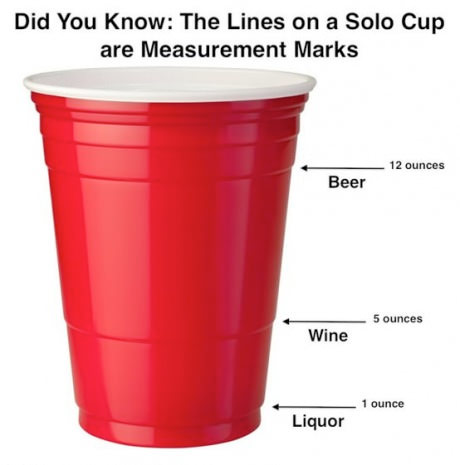
There you have it, the ancients used those marks to measure out appropriate quantities of alcohol, just like today’s college kids do at frat parties. Nevermind that Solo is moving away from that cup design…this is still an amazing discovery. (via stellar)
Update: Getting lots of mail about this…apparently the memiticians were wrong!
The lines on our Party Cups are designed for functional performance and are not measurement lines. If the lines do coincide with certain measurements, it is purely coincidental.
(thx, everyone)
I’m not sure this will make it from Reddit to the movie screen, but one intrepid gamer has been playing Civilization II off and on for 10 years. Lycerius’s posted some pictures that illustrate a “hellish nightmare of suffering and devastation” indeed. A sub-Reddit has been created complete with logo, Zuck is into it, and if you’re feeling lucky, punk, you can download the game as it stands and try your hand at ending the Eternal War.
The only governments left are two theocracies and myself, a communist state. I wanted to stay a democracy, but the Senate would always over-rule me when I wanted to declare war before the Vikings did. This would delay my attack and render my turn and often my plans useless. And of course the Vikings would then break the cease fire like clockwork the very next turn. Something I also miss in later civ games is a little internal politics. Anyway, I was forced to do away with democracy roughly a thousand years ago because it was endangering my empire. But of course the people hate me now and every few years since then, there are massive guerrilla (late game barbarians) uprisings in the heart of my empire that I have to deal with which saps resources from the war effort.
Actually, I changed my mind. I bet this does get turned into a movie. (via @zittrain / ★adamkuban)
From Ptak Science Books, a list of every different kind of computer ever made. Ok, I’m sure not every single kind of computer ever made is on there (the list only goes to 1988 for one thing), but it is a very extensive list. Some highlights:
Zuse, Z1, Germany, 1938
Bletchley, Colossus Mark I, Great Britain, 1943
Moore School, ENIAC, United States, 1947
IBM, 360, 30, USA, 1965
Intel, 8080, USA, 1974
Cray, Cray-1, USA, 1976
DEC, PDP-11, 34, 1977
Apple, Apple II, USA, 1977
IBM, PC, AT (and clones), 1984
Apple, Macintosh, USA, 1984
This history of the 1992 US Olympic basketball team might only be interesting to those who watched all those games. Which I did. And I am.
Chuck started Michael and Magic every game and then rotated the other three. Pippen would start one game, Mullin would start the next. Robinson and Ewing would alternate; Malone and Barkley would alternate. He was a master at managing. But in the second game against Croatia, there was never any doubt: He was putting Pippen on Toni Kukoc [who had just been drafted by the Bulls and had been offered a contract for more money than his future teammate]. Pippen and Jordan were tired of hearing about how great Kukoc was, because they were winning NBA championships.
You ever watch a lion or a leopard or a cheetah pouncing on their prey? We had to get Michael and Scottie out of the locker room, because they was damn near pulling straws to see who guarded him. Kukoc had no idea.
This video is Pablo Delcan’s hand drawn lettering portfolio and it’s pretty great. The chalk work especially.
(via @debbiemillman)
If you spend a lot of time in bars, you’ve probably seen some of these bets before, but if you haven’t…
The tomato in a glass bit is pretty clever. My favorite bet of this type is seeing who can empty a 2-liter bottle faster. The trick is to swirl the water to create a vortex in the bottle. That way, the air can quickly enter the bottle through the middle of the vortex while the water shoots out around the edge…no slow glug glug glug. (via ★interesting)
Robert Hodgin gave a talk at the recent Eyeo Festival for which he “created 12 new projects”. The thing is, any single one of these projects would stand out on a coding artist’s portfolio and Hodgin created all twelve for a conference talk. My favorite of the bunch is this demonstration of how he created the stars for the Planetary app.
I’ve seen a lot of art and sculpture made out of books but the detail and texture of these sculptures by Guy Laramee really sets them apart.

(via colossal)
A series of drawings by Adam Watson that imagine Star Wars characters drawn in the style of Dr. Seuss.

I sense a presence
which I know to be
the old Jedi,
Obi-Wan Kenobi
I sense his presence
I know he’s near
but I can’t find him
there or here!
(via @followSol)
On Thursday, 80 lawsuits against the NFL related to brain injuries and concussions were combined into one complaint and filed in Philadelphia. The suit also names helmet maker Ridell, and if I’m reading the article correctly, 2100 former players are involved in the case.
Former running back Kevin Turner, now suffering from Lou Gehrig’s Disease, said:
The NFL must open its eyes to the consequences of its actions. The NFL has the power not only to give former players the care they deserve, but also to ensure that future generations of football players do not suffer the way that many in my generation have. For the longest time, about the first 10 years after I retired in January 2000, I thought I had just turned into a loser overnight. I couldn’t figure out what was wrong. It was a very scary proposition — until I found out there were a lot more guys just like me. I find they had been through some of the same struggles. I realized this is no longer a coincidence.
Back in February, we linked to a Grantland piece by economists Tyler Cowen and Kevin Grier about head injuries leading to the end of the NFL. In their version, injuries to high school and college students result in lawsuits making the sport prohibitively expensive to offer to their students (along with a perception that it’s too dangerous for kids to play).
Is this case the beginning of that timeline? Depending on what comes out in the lawsuit, one (unjust) popular opinion will be that the players should have known they were playing a dangerous game and they were handsomely rewarded to boot. It’s not really a fair opinion, but people love their football. (You can see evidence of this in the comments to the ESPN article linked at the top.) A best case scenario, I would think, would be for the NFL to settle with some sort of acknowledgement of the issue. Not lip-service, but actual changes to current policies and future support for former players.
In happier NFL news, Trick Shot Quarterback, Alex Tanney was signed yesterday by the KC Chiefs. Regardless of setting the NCAA Division III record for passing with 14,249 yards, the NCAA record for touchdowns with 157, and only throwing 30 interceptions in college, Tanney had gone undrafted.
How crayons are made orig. from Sep 17, 2008
* Q: Wha? A: These previously published entries have been updated with new information in the last 24 hours. You can find past updates here.
Over a month and a half, Pixar story artist Emma Coats tweeted out a series of lessons she learned on the job about how to create appealing stories. Here are a couple of my favorites:
#4: Once upon a time there was ___. Every day, ___. One day ___. Because of that, ___. Because of that, ___. Until finally ___.
#12: Discount the 1st thing that comes to mind. And the 2nd, 3rd, 4th, 5th - get the obvious out of the way. Surprise yourself.
#19: Coincidences to get characters into trouble are great; coincidences to get them out of it are cheating.
(via @daveg)
You’re not going to believe me, but this mushroom processing machine is pretty fascinating. There’s lots of deceptively simple engineering to mechanically manipulate the mushrooms…the auto-alignment and size-sorting bits are especially interesting.
Plus there’s a trance soundtrack. See also how crayons are made, the robotic pancake sorter, and the salami sorting robot. (via @kdern)
PBS teamed up with Symphony of Science’s John Boswell for this remix, “the first in a series of PBS icons remixed.” I’ve listened to this 5 times.
You can grow ideas in the garden of your mind. (via sly oyster)
During World War I, specific trees on the battlefield were measured in detail and then replaced by replica trees that were actually hunting blinds.
To develop the O.P. Tree, Royal Engineers representatives selected, measured, and photographed the original tree, in situ, extensively. The ideal tree was dead; often it was bomb blasted. The photographs and sketches were brought back to the workshop, where artists constructed an artificial tree of hollow steel cylinders, but containing an internal scaffolding for reinforcement, to allow a sniper or observer to ascend within the structure. Then, under the cover of night, the team cut down the authentic tree and dug a hole in the place of its roots, in which they placed the O.P. Tree. When the sun rose over the field, what looked like a tree was a tree no longer; rather, it was an exquisitely crafted hunting blind, maximizing personal concealment and observational capacity simultaneously.
Max Fisher has a piece at The Atlantic about what travel guidebooks tell foreign visitors to the US.
Politics get heavy treatment in the books, as do the subtleties of discussing them, maybe more so than in any other guidebook I’ve read (what can I say, it’s an addiction). Lonely Planet urges caution when discussing immigration. “This is the issue that makes Americans edgy, especially when it gets politicized,” they write, subtly suggesting that some Americans might approach the issue differently than others. “Age has a lot to do with Americans’ multicultural tolerance.”
Rough Guide doesn’t shy away from the fact that many non-Americans are less-than-crazy about U.S. politics and foreign policy, and encouragingly notes that many Americans are just as “infuriated” about it as visitors might be. Still, it warns that the political culture saturates everything, and that “The combination of shoot-from-the-hip mentality with laissez-faire capitalism and religious fervor can make the U.S. maddening at times, even to its own residents.”
Munchausen by Internet is the act of inventing a malady or serious disease to generate online attention. The disorder, originally called ‘virtual factitious disorder,’ was first described in 1998 by psychiatrist Marc Feldman.
This Gawker piece documents a perfect example of Munchausen by Internet, an 11 year saga involving a young child with cancer and spanning across many early social platforms. The scam, which seems to have been started by an 11 year old girl, does not appear motivated by money (all donation requests were directed to a legitimate non-profit). Basically, this girl was playing real-life Sim City.
Huge swaths of the Dirrs social circle began disappearing, too. Gone were the Facebook profiles of J.S.’s hard-partying best friend, Mitchy Aaron, who would sometimes tag J.S. in party pics. Mitchy’s wife, who had only recently thanked the Dirrs on Facebook for taking care of their kids after Mitchy was in a motorcycle accident, disappeared, too. Dozens of J.S.’s ex-girlfriends, who sometimes sent Facebook friend requests to the real people J.S. knew online, much to J.S.’s annoyance, locked their profiles down. A small town’s worth of people—at least 71, according to Wright—had apparently been invented to support the Dirr fantasy, using hundreds of stolen pictures to create the appearance of a vibrant social life.
This 1998 NY Times article describes some early cases of Munchausen by Internet, including the case of an early-Internet version of Marla Singer.
Chased out of the eating-disorder chat room, the woman turned up in others, including one for sexual-abuse survivors. She was found out and banished from that one, too, then joined another group. When last heard from, she was dying of AIDS.
Lastly, here’s a Details story on Munchausen in the workplace, a behavior first identified by a Georgia Tech business school professor in 2007. Incidentally, that’s my friend Ben in the picture accompanying the article.
Grantland’s Bill Simmons and the New Yorker’s Malcolm Gladwell had one of their epic email conversations the other day and posted it to Grantland. Topics included the NBA playoffs, sports journalism, LeBron, fame in the internet era, sports philosophers, and football concussions.
Do we really need 25 people crammed in baseball locker rooms fighting for the same mundane quotes? What’s our game plan for the fact that — thanks to the Internet and 24-hour sports stations — a city like Boston suddenly has four times as many sports media members as it once had? Why are we covering teams the same way we covered them in 1981, just with more people and better equipment? If I could watch any Celtics game and press conference from my house (already possible), and there was a handpicked pool of reporters (maybe three per game, with the people changing every game) responsible for pooling pregame/postgame quotes and mailing them out immediately, could I write the same story (or pretty close)? If we reduced the locker room clutter, would players relax a little more? Would their quotes improve? Would they trust the media more? Why haven’t we experimented at all? Any “improvements” in our access have been forgettable. Seriously, what pearls of wisdom are we expecting from NBA coaches during those ridiculous in-game interviews, or from athletes sitting on a podium with dozens of media members firing monotone questions at them? It’s like an all-you-can-eat buffet of forgettable quotes, like the $7.99 prime rib extravaganzas at a Vegas casino or something. There’s Russell Westbrook at the podium for $7.99! Feast away! We laugh every time Gregg Popovich curmudgeonly swats Craig Sager away with four-word answers, but really, he’s performing a public service. He’s one of the few people in sports who has the balls to say, “This couldn’t be a dumber relationship right now.”
Here at kottke.org, we’ve invested in a couple of “start up” companies and thought it was time to disclose that information. We’re happy to announce that we’ve participated in a friends-and-family angel series-α round for Vooza, a “mobile web app that’s realtime, cloud-based, social, and local.” Joining us are several other great investors like Tim Conway, Paul Grayjoy, Mark Anderrssonn, Freddy Dubs, Denim Roberts, Katrina Faux, and Petrus T. Heel.
We also invested in a follow-on crowdfunded round for Ponzify several months ago.
Forget Facebook. Forget Groupon. Forget everything you know about Silicon Valley. Because Ponzify isn’t like other tech companies. We don’t promise results. We show them to you, on a piece of paper, that has your name and a monetary figure that increases every month.
Our business model is simple: Attract users, advertisers, positive press and a corporate buyer; then, pull the chord on that golden parachute and have cable news book you as an expert on startups from time to time. There may be a book deal in there, too. We haven’t decided.
Users love our product because it’s something free. Venture Capitalists love it because they can imagine themselves talking about it at T.E.D. or on Charlie Rose. Trust us: Once you invest in Ponzify, you’ll have a difficult time investing your money anywhere else ever again.
Such is the pace of technology and business at the intersection of technology and business that we’ve forgetten who else invested in Ponzify but rest assured that it didn’t include any women. Both these companies are going somewhere, you should check them out or you might miss them.
It’s a Western film about bounty hunting starring Jamie Foxx, Leonardo DiCaprio, and Christoph Waltz.
A wonderful comment over at Ask Metafilter by rumposinc about how valuable her nursing school cadaver was.
You have to take really exceptional care of your cadaver, so that it stays workable, free of pathogens, and easy to learn from. Towards the end, this care became very ritualistic for my lab team, and nearly reverent. She had been a very small lady, and so we had to be so careful. In the end, there is a very simple ceremony students can attend honoring the life, contribution, and cremation of our subjects. It was overwhelmingly emotional and I remember my lab partner reached over and held my hand, and though I almost hesitate to say so, there is a way that we felt like her family. She had shared so much of herself. It wasn’t something we talked about, but it was a palpable feeling.
(via ★choire)
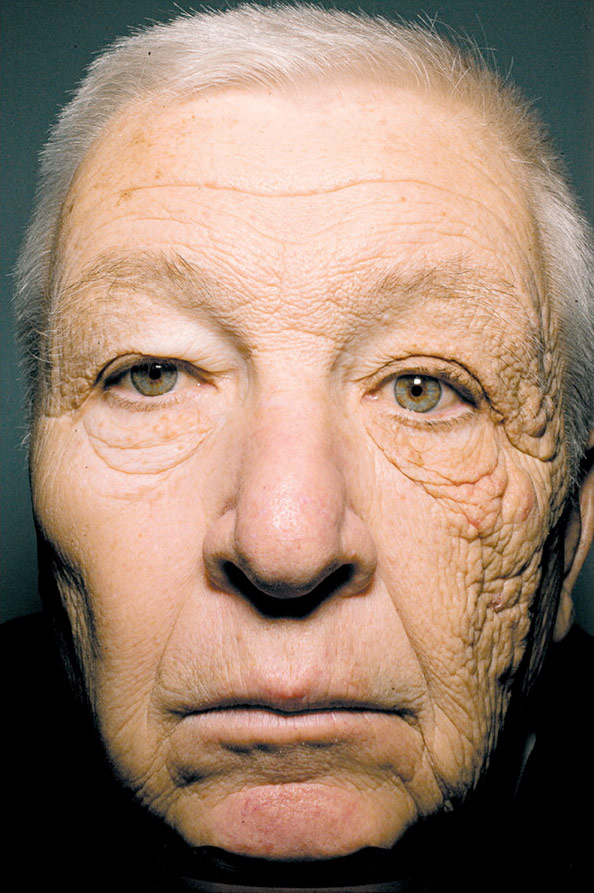
The New England Journal of Medicine recently reported on the 69 year-old man in the photo above. Constant sun exposure to one side of his face resulted in premature aging, though, the other side doesn’t look too bad for 69. The condition is called unilateral dermatoheliosis, which I think is Greek for make sure to wear sunblock.
The patient reported that he had driven a delivery truck for 28 years. Ultraviolet A (UVA) rays transmit through window glass, penetrating the epidermis and upper layers of dermis. Chronic UVA exposure can result in thickening of the epidermis and stratum corneum, as well as destruction of elastic fibers. This photoaging effect of UVA is contrasted with photocarcinogenesis.
(via gizmodo)

I’ve seen several versions of the iconic Tank Man photo but here’s a little-known wider view that shows just how many tanks the guy was holding up. Larger version here. There is also, amazingly, video of the incident:
You’ll note at the end that the man is hustled off by a group of people. See also the Tank Man of Tiananmen (via @polarben)
Update: There is also this view of Tank Man, taken from the ground level:

You can see how long he was standing there waiting for the arrival of the tanks.
Venus passed in front of the Sun yesterday for the last time until 2117. The transit took almost seven hours but this NASA video shows it in under a minute.
The world’s worst password requirements list orig. from Jun 04, 2012
* Q: Wha? A: These previously published entries have been updated with new information in the last 24 hours. You can find past updates here.
While we’re being entertained by blockbusters that feature fictional battles with imagined aliens, Foreign Policy takes a look at some very real efforts to develop weapons that could make it a fair fight. From a laser beam designed to “harness the speed and power of light to counter multiple threats,” to high-tech jets that can fly at speeds up to Mach-20, the preparations for the future of war are well underway. We just need to stun the aliens long enough for our bath-salted zombie cannibals to get their hands on them.
One of the most memorable images of the Vietnam War is Nick Ut’s photo of a naked Kim Phuc running from her just-napalmed village.

I’ve seen that photo hundreds of times but I had no idea that video footage of the event also exists. In this clip shot by Alan Downes and Le Phuc Dinh, you see the napalm dropped on the village and then a bunch of people, Phuc among them, come running down the road. [Warning, this footage is graphic…severe burns and burnt skin hanging off of young children.]
Wow. Ut won the Pulitzer for the photo but Phuc took much longer to make her peace with the image.
The photo was famous, but Phuc largely remained unknown except to those living in her tiny village near the Cambodian border. Ut and a few other journalists sometimes visited her, but that stopped after northern communist forces seized control of South Vietnam on April 30, 1975, ending the war.
Life under the new regime became tough. Medical treatment and painkillers were expensive and hard to find for the teenager, who still suffered extreme headaches and pain.
She worked hard and was accepted into medical school to pursue her dream of becoming a doctor. But all that ended once the new communist leaders realized the propaganda value of the “napalm girl” in the photo.
She was forced to quit college and return to her home province, where she was trotted out to meet foreign journalists. The visits were monitored and controlled, her words scripted. She smiled and played her role, but the rage inside began to build and consume her.
“I wanted to escape that picture,” she said. “I got burned by napalm, and I became a victim of war … but growing up then, I became another kind of victim.”
Phuc now lives in Ontario with her husband and has two children.
Newer posts
Older posts








Socials & More