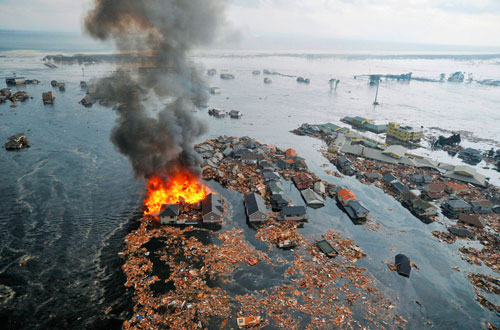
Had any other populous country suffered the 8.9 magnitude earthquake that shook Japan on Friday, tens of thousands of people might already be counted among the dead. So far, Japan’s death toll is in the hundreds, although it is certain to rise somewhat.
Over the years, Japan has spent billions of dollars developing the most advanced technology against earthquakes and tsunamis. The Japanese, who regularly experience smaller earthquakes and have lived through major ones, know how to react to quakes and tsunamis because of regular drills — unlike Southeast Asians, many of whom died in the 2004 Indian Ocean tsunami because they lingered near the coast despite clear warnings to flee.
Google has built a quick little app for people trying to locate friends and family in Japan. There are two options: 1) “I’m looking for someone” and 2) “I have information about someone”.
If you haven’t already heard, Al-Jazeera had (and continues to have) some of the best coverage of earthquake and tsunami in Japan. Here’s a clip from earlier showing the tsunami rushing through a populated area.
Contrast with CNN, which was apparently home to giggles and Godzilla jokes as the quake was being reported. In the last three or four big events in the world, Al-Jazeera has had the best coverage…is this a changing of the guard?
We did find an example of an American in Japan that made a reference that it was like a “monster movie” (which is included below) but Church handles herself completely appropriately.
Update: Mediaite found a video of the CNN broadcast in question where the anchor chuckles at something her interviewee says. And her whole tone sounds a bit more chipper than it ought to. The sing-song anchor voice might suffice when reporting non-news filler but fails when watching video of dozens of homes (possibly with people in them!) being swept along by a massive wave of water. (via @somebadideas)
The United States Geological Survey said the earthquake had a magnitude of 8.9, and occurred at about 230 miles northeast of Tokyo and at a revised depth of about 17 miles. The Japanese Meteorological Agency said the quake had a magnitude of 8.8, which would make it among the biggest in a century.
The quake occurred at 2:46 p.m. Tokyo time and hit off Honshu, Japan’s most populous island. The quake was so powerful that buildings in central Tokyo, designed to withstand major earthquakes, swayed.
For years, the Dalai Lama, the Tibetan spiritual leader, has spoken of his desire to cede political authority, or “retire,” as he has sometimes put it. But in Thursday’s speech he made it official, announcing that he would propose the change during the session of the Tibetan Parliament in exile that begins next week in Dharamsala, India.
“My desire to devolve authority has nothing to do with a wish to shirk responsibility,” he said, according to a prepared text of his speech. “It is to benefit Tibetans in the long run.”
Marco pushed an update to Instapaper today: Instapaper 3.0. And oh, say, this is interesting:
Nobody knew when or why to use Stars, so I’ve renamed them to Likes to clarify their purpose. Generally, you should Like articles that you think are interesting and that you might recommend to others. […] You can now browse your friends’ Liked items to find great articles to read.
Felicia “Snoop” Pearson had served a prison sentence for murder and returned to drug dealing on the streets of East Baltimore, before a visit to the set of “The Wire” led to a star turn on the show and offered a new chance to change her life.
But her past kept creeping back - she was a witness to a murder and was arrested after she refused to testify — and subsequent film and television offers were hard to come by.
Now, Pearson, 30, has been accused of playing a part in a large-scale drug organization, whose members were arrested in raids Thursday throughout Baltimore and surrounding counties, as well as in three other states.
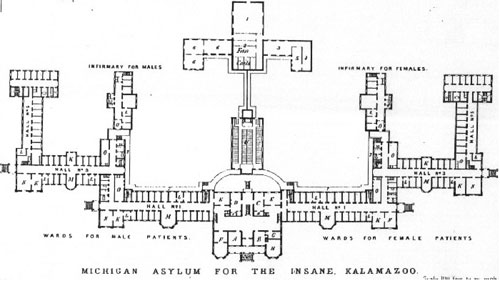
The Kirkbride plan consists of an enormous a symmetrical staggered wing, like a bird made out of lego. Men are on the left and women on the right in wings that radiate from the main entrance for increasingly violent or incurable patients. Early mental institutions where patients had to pay for their own incarceration would also vary in class (rich to poor) on the y axis. The staggering of the wings ensured the flow of air through each, purging them of diseased vapors perhaps, such was the Victorian obsession with fresh air, from outdoor Tuberculosis wards to seaside promenades and piers.
For the past several months, I’ve been working on a new web app/site called Stellar. Stellar helps you discover and keep track of your favorite things online. If you like playing around on Twitter or Flickr, you’ll probably enjoy Stellar. There are a few dozen people using Stellar right now and some of them seem pretty enthusiastic about it, so I’m encouraged to open the site up a bit more. As of just this minute, you’ll be able to do a few things with Stellar:
2. Sign up to reserve your preferred username and request an invite to the beta. FYI: I’m letting people in reeeeally sloooowly so even if you sign up right away it might be awhile before you get in.
3. Current Stellar users will each have a few site invites to give away.
And that’s about it for now. You’ll be hearing more about Stellar in the next few days/week/months here on kottke.org, but you can also follow the Stellar Twitter account for updates. Thanks.
If you a flick a web app past the bottom or top of the page, the page itself gets elastically tugged away from the URL bar or the button bar (or the bottom/top of the screen if it’s in full-screen mode).
This behavior is another giveaway that your app isn’t native, and it’s rarely the behavior you want in a native app.
To stop this behavior, capture touchmove events on the document in JavaScript and cancel them. You can do this by adding a handler to the body tag, and invoking the preventDefault method on the event object.
One big advantage of native apps that cannot be addressed by HTML/CSS/JS is the browser interface itself. The Gmail web interface is fantastic, but every time I open a link in my email, the browser goes through its elaborate new window opening process. And then when I want to go back to my email, I have to touch the windows button, close the current window, and then click back on the mail window. The whole process is too inefficient and slow compared to the same process in a native app: no starting browser animation process and one touch to get back to what you’re doing. If Apple addressed this issue — say by making it possible for a web app to “open” a sub-browser with different open/close interactions instead of a full-fledged new window — using web apps would be less of a pain in the ass.
The New Republic compared the Qaddafi family with Arrested Developments Bluth family and found some similarities.
Mohammed Qaddafi and Gob Bluth are both the oldest sons of tyrannical fathers, and both stand in the shadows of their younger, more favored brothers. The sibling rivalry can get intense — Mohammed’s feud with younger brother Mutassim over a Coca-Cola plant ended only after a worker had been injured and a cousin had been stuffed into a car trunk, while Michael and Gob’s dueling banana stands ended with the fire department being called twice.
Indian lunar orbiter Chandrayaan-1 has discovered a large cave on the Moon. Aside from the hey, cool, there’s a cave on the Moon factor, the other big feature of the cave is its constant and temperate temperature.
Temperatures on the moon swing wildly, from a maximum of 262 degrees Fahrenheit to a minimum of -292. The cave holds steady at a (relatively) comfortable -4, since the moon’s weather can’t penetrate its 40-foot-thick wall. It could also protect astronauts from “hazardous radiations, micro-meteoritic impacts,” and dust storms, according to paper published by the journal Current Science.
For their latest mission, Improv Everywhere got someone who looked very much like King Philip IV of Spain to sign autographs in front of a Velázquez painting of the monarch.
Polar explorer Ben Saunders is off again on another expedition. This time, he’s trying to break the North Pole speed record, but he’s doing it solo and unsupported.
In 2005 a guided team using dog sleds and several air-drops of food reached the Pole in 36 days, 22 hours, and in 2010 a Canadian team reached the Pole on foot in 41 days, 18 hours with one resupply flight. Ben is travelling alone and on foot, and will have no support en route.
Ben’s had rotten luck on his last two attempts (broken equipment and spoiled food); here’s hoping this time goes a lot better.
What you actually find when you arrive at L’Ami Louis is singularly unprepossessing. It’s a long, dark corridor with luggage racks stretching the length of the room. It gives you the feeling of being in a second-class railway carriage in the Balkans. It’s painted a shiny, distressed dung brown. The cramped tables are set with labially pink cloths, which give it a colonic appeal and the awkward sense that you might be a suppository. In the middle of the room is a stubby stove that also looks vaguely proctological.
Errol Morris is back with his first NY Times blog post since last summer. Don’t quite know where he’s going with it yet, but it features an ashtray thrown at Morris’ head by Thomas Kuhn, father of the paradigm shift and poor marksman.
I had written a paper on James Clerk Maxwell’s displacement current for Kuhn’s seminar on 19th century electricity and magnetism. The paper might have been 30 or so double-spaced pages. Kuhn’s reply, typed on unlined yellow paper, was 30 pages, single-spaced, with Courier marching all the way from the left to the right side of the paper. No margins. He was angry, really angry.
Jason Fried reveals how he got good at making money. I am not a full-fledged member of the Church of 37signals, but one of my favorite lessons from them is that a business needs to practice how to make money in order to get good at it…it’s not something that you just turn on when monetizing mode strikes.
So here’s a great way to practice making money: Buy and sell the same thing over and over on Craigslist or eBay. Seriously.
Go buy something on Craigslist or eBay. Find something that’s a bit of a commodity, so you know there’s always plenty of supply and demand. An iPod is a good test. Buy it, and then immediately resell it. Then buy it again. Each time, try selling it for more than you paid for it. See how far you can push it. See how much profit you can make off 10 transactions.
Start tweaking the headline. Then start fiddling with the product description. Vary the photographs. Take some pictures of the thing for sale; use other photos with other items, or people, in them. Shoot really high-quality shots, and also post crappy ones from your cell-phone camera. Try every variation you can think of.
Redesigns are always interesting, and non more so than when a title as significant and influential as the NYT makes changes. Duplessis has worked with new editor Hugo Lindgren (ex-Bloomberg Business Week and New York magazine) to provide a new vision for the title, researching the magazine’s archive and becoming fascinated by its 60s and 70s incarnations.
For some reason, it reminds me of Monocle, even though it probably shouldn’t? (thx, @nedward)
Kenji from Serious Eats went to In-N-Out, found a willing employee accomplice (“Awesome! I’ve been waiting for this day ever since I started working here!”), and proceeded to order one of everything off of the menu, the well-known secret menu, and the not-so-well-known super secret menu.
That should make you feel better about yourself when you tuck into the meat and cheese fest known as the Flying Dutchman — the ultimate Atkins-friendly menu item. Two slices of cheese melted between two burger patties. No rabbit food, no wimpy buns, just pure protein and fat. Want to kick up the manliness by yet another factor? Ask for a Flying Dutchman Animal Style and they’ll add a scoop of diced onions to the cheese. Pickles and spread will come on the side, so you’ll have to add them yourself. “I wish we could add the spread and pickles for you, but it’s just too messy for the cooks,” explained an apologetic Thomas. The result definitely wins the award for messiest menu item of all time.
When the Paris Exhibition closes electric light will close with it and no more be heard of.
- Erasmus Wilson (1878) Professor at Oxford University
Radio has no future.
- Lord Kelvin (1824-1907), British mathematician and physicist, ca. 1897.
The horse is here to stay, but the automobile is only a novelty — a fad.
- Advice from a president of the Michigan Savings Bank to Henry Ford’s lawyer Horace Rackham. Rackham ignored the advice and invested $5000 in Ford stock, selling it later for $12.5 million.
That the automobile has practically reached the limit of its development is suggested by the fact that during the past year no improvements of a radical nature have been introduced.
- Scientific American, Jan. 2, 1909.
There is not the slightest indication that [nuclear energy] will ever be obtainable. It would mean that the atom would have to be shattered at will.
- Albert Einstein, 1932.
One asked for a new pair of trainers and a television; another for a caravan on a travellers’ site in Suffolk, which was duly bought for him. Of the 13 people who engaged with the scheme, 11 have moved off the streets. The outlay averaged £794 ($1,277) per person (on top of the project’s staff costs). None wanted their money spent on drink, drugs or bets. Several said they co-operated because they were offered control over their lives rather than being “bullied” into hostels. Howard Sinclair of Broadway explains: “We just said, ‘It’s your life and up to you to do what you want with it, but we are here to help if you want.’”
£794 per person may sound high but not compared to the estimated £26,000 annually spent on each homeless person by the state.
So many choices. Which car insurance. Which cereal. Which deodorant, toothpaste, toothbrush, soap, shampoo. Rows and rows of products. Varieties, sizes, colors. Which is cheaper? Which is better? What’s the best buy? Which gum to chew? When he went into prison there were, like, two kinds of chewing gum. Now there are a zillion. One of the small gifts he gives himself is trying all the gums. “I can spoil myself a little so long as I stay within my means,” he says. Papaya juice! Kiwi and strawberry nectar! Green tea! Arnold Palmer — he was a golfer when Towler went down. Now he is a drink, sweet and so incredibly thirst quenching.
He loves work. He got out May 5 and started working June 21. Hell, I’ve been vacationing for thirty years. He wears a smock and pushes a mail cart. He stops at all the cubicles, greets everyone with his friendly smile. Ray even loves commuting to work, especially now, in his new car, a black Ford Focus. He’s like a sixteen-year-old who can finally drive himself to school. It costs almost the same to park as it does to take the train.
Here’s how you do it well, courtesy of Zappos (of course). Yesterday I tweeted:
I think my wife is having an affair with someone named “Zappos”. He sends her a package at least every third day. I am on to you, Mr Zappos!
Almost immediately, Zappos’ customer service Twitter account replied:
@jkottke I’m sorry sir, but our relationship with your wife is strictly professional.
Great, right? A company that gets the joke and participates meaningfully in an actual conversation with a full awareness of the context.
Here’s how not to do it, courtesy of United Airlines. Mena Trott, a co-founder of Six Apart, had her flight to NYC randomly cancelled on Monday night by “a robot”. (They actually blamed it on a robot!) In a series of threetweets, Mena voiced her displeasure:
Thanks @unitedairlines for randomly canceling my miles booked ticket for tonight, taking the miles & not letting me rebook for lack of miles
And then hanging up on me after I waited for an hour! I hate you @unitedairlines
Apparently the automated voice recognition system can’t tell what I’m saying through my tears @unitedairlines #IhateYouSoMuch
Reply from @unitedairlines? Nothing. But then while on her rebooked flight the next morning, Mena tweets sarcastically:
Thanks to @unitedairlines I can finally watch that Frasier episode I missed in 1994.
And unbelievably, @unitedairlines replied, pouring burning acid into Mena’s obviously still-tender wound:
@dollarshort “…I hear the blues a-callin’, Tossed salad and scrambled eggs..”
That is some serious customer service tone deafness right there. It would be easy to blame whatever social media jockey they’ve got manning the Twitter account for the faux pas, but obviously United customer communication problems run deeper (and originate higher up the pay scale) than that.
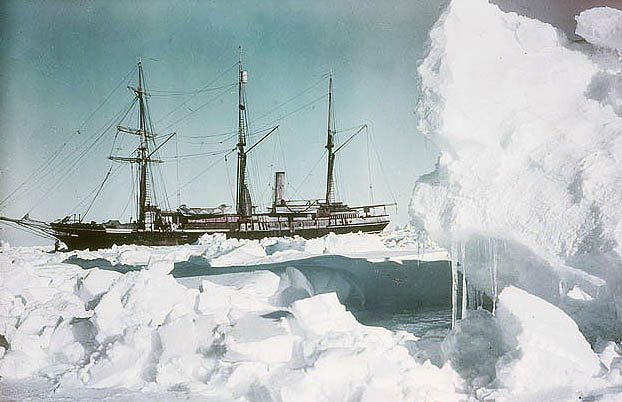
Early in 1915, their ship ‘Endurance’ became inexorably trapped in the Antarctic ice. Hurley managed to salvage the photographic plates by diving into mushy ice-water inside the sinking ship in October 1915.
Totally depressing article about how Hollywood movies suck worse than ever and “the potential death of the great American art form”.
For the studios, a good new idea has become just too scary a road to travel. Inception, they will tell you, is an exceptional movie. And movies that need to be exceptional to succeed are bad business. “The scab you’re picking at is called execution,” says legendary producer Scott Rudin (The Social Network, True Grit). “Studios are hardwired not to bet on execution, and the terrible thing is, they’re right. Because in terms of execution, most movies disappoint.”
With that in mind, let’s look ahead to what’s on the menu for this year: four adaptations of comic books. One prequel to an adaptation of a comic book. One sequel to a sequel to a movie based on a toy. One sequel to a sequel to a sequel to a movie based on an amusement-park ride. One prequel to a remake. Two sequels to cartoons. One sequel to a comedy. An adaptation of a children’s book. An adaptation of a Saturday-morning cartoon. One sequel with a 4 in the title. Two sequels with a 5 in the title. One sequel that, if it were inclined to use numbers, would have to have a 7 1/2 in the title.
The latest issue of the New Yorker has a new excerpt from David Foster Wallace’s The Pale King.
Every whole person has ambitions, objectives, initiatives, goals. This one particular boy’s goal was to be able to press his lips to every square inch of his own body.
His arms to the shoulders and most of his legs beneath the knee were child’s play. After these areas of his body, however, the difficulty increased with the abruptness of a coastal shelf. The boy came to understand that unimaginable challenges lay ahead of him. He was six.
Except that it’s not really new…Wallace did a reading of it back in 2000; the audio is available here. A comparison of the transcript of that reading and the “finished” version published in the NYer can be found here. (thx, @mattbucher)
Note: If you are a member and tried to log in, it didn't work, and now you're stuck in a neverending login loop of death, try disabling any ad blockers or extensions. Or try logging out and then back in. Still having trouble? Email me!







Socials & More