I got a look at the Henri Cartier-Bresson exhibit at MoMA the other day and loved it. Seeing his work, especially his earlier on-the-street stuff, makes me want to drop everything and go be a photographer. If you’re into photography at all, this show is pretty much a must-see.
This is likely the pull-quote of the week (I’ve seen it on about 20 sites in the last 10 minutes):
Of all the people in human history who ever reached the age of 65, half are alive now.
But only by a little…there’s lots more to chew on in the full article. Like how 65 became the retirement age:
The idea of a retirement age was invented by Otto von Bismarck in the 1880s, when as chancellor of Germany he needed a starting age for paying war pensions. He chose the age of 65 because that was typically when ex-soldiers died.
In order to see if a lava lamp would still function on Jupiter, Neil Fraser built a large centrifuge to try it out. This is the best homemade centrifuge video you’ll see today:
He used the accelerometer on an Android phone to measure the G force.
The centrifuge is a genuinely terrifying device. The lights dim when it is switched on. A strong wind is produced as the centrifuge induces a cyclone in the room. The smell of boiling insulation emanates from the overloaded 25 amp cables. If not perfectly adjusted and lubricated, it will shred the teeth off solid brass gears in under a second. Runs were conducted from the relative safety of the next room while peeking through a crack in the door.
Every episode of Shelley Duvall’s Faerie Tale Theatre can be found on Hulu. I had no idea this show existed until the other day, but it sounds like it was quite a program:
Faerie Tale Theatre brings to life twenty-six of the most magical fairy tales of all time. Directed by such masters of cinema as Tim Burton, Francis Ford Coppola and more, and star-powered by Robin Williams, Billy Crystal, Mick Jaggar, James Earl Jones, Howie Mandel, Christopher Reeve, Susan Sarandon and more, this collection is an unparalleled treasury of the best-loved tales of enchantment, adventure and wonder.
Around this time, I unwittingly made the first move that would unravel the whole deal. I applied for Library of Congress Cataloging in Publication data.
James Sturm, fearing he’s addicted to the internet, is going offline for four months. He’s blogging about it (via fax and phone) for Slate.
Even when I am away from the computer I am aware that I AM AWAY FROM MY COMPUTER and am scheming about how to GET BACK ON THE COMPUTER. I’ve tried various strategies to limit my time online: leaving my laptop at my studio when I go home, leaving it at home when I go to my studio, a Saturday moratorium on usage. But nothing has worked for long. More and more hours of my life evaporate in front of YouTube. Supposedly addiction isn’t a moral failing, but it feels as if it is.
It’s worth keeping in mind that there is a significant difference between the final seconds of Usain Bolt’s gold-medal run in Beijing in 2008 and the final seconds of his victory this afternoon in Call of Duty. In the video game, right up until the moment Sadiki took out the final terrorist, Bolt was on edge, nervous, uncertain. It taxed him. He almost lost.
Beating the video game was a challenge for him. Executing the most dominant and effortless performance in the history of the Olympic Games was not.
Ethan Siegel, a theoretical astrophysicist at Lewis & Clark College, recently charted a graph to demonstrate that, judging by the incremental progression of the 100-meter world record over the past hundred years, Bolt appears to be operating at a level approximately thirty years beyond that of the expected capabilities of modern man. Mathematically, Bolt belonged not in the 2008 Olympics but the 2040 Olympics. Michael Johnson, the hero of the 1996 Olympic summer games, has made the same point in a different way: A runner capable of beating Bolt, he says, “hasn’t been born yet.”
That 100-meter final at the Beijing Olympics still gives me goosebumps when I think about it. But all this business about no one being able to touch Bolt’s pace for another 30 years, that’s just bunk. The mark is out there. People are going to go for it. My prediction: Bolt will continue to break his own mark but someone else will approach or equal Bolt’s current record in fewer than five years, if not three.
In fiction, Dan Brown was #1 but James Patterson appears *five times* in the top 25. On the nonfiction side, a certain former Alaskan governor (no, not Walter J. Hickel) tops the list. The full list is here. (via the millions)
The Selby has some shots of Cindy Gallop’s apartment, which has to be one of most personality-drenched living spaces I’ve seen since Martha Stewart’s house. (Not that I’ve seen Martha Stewart’s house. But I can imagine.) Here is, for example, Gallop’s Gucci chainsaw:
She had a specific vision for her new home. “I was looking for something dramatic,” she says. So she told her designer, Stefan Boublil of the Apartment, a creative agency in Soho, “When night falls, I want to feel like I’m in a bar in Shanghai.”
So why I had found it easier to read from my iPhone? First, an ordinary page of text is split into about four pages. The spacing seems generous and because of this I don’t get lost on the page. Second, the handset’s brightness makes it easier to take in words. “Many dyslexics have problems with ‘crowding’, where they’re distracted by the words surrounding the word they’re trying to read,” says John Stein, Professor of Neuroscience at Oxford University and chair of the Dyslexia Research Trust. “When reading text on a small phone, you’re reducing the crowding effect.”
A spokeswoman for the company said the use of proper nouns would “add a new dimension” to Scrabble and “introduce an element of popular culture into the game”. She said: “This is one of a number of twists and challenges included that we believe existing fans will enjoy and will also enable younger fans and families to get involved.”
I also like this part:
Mattel said there would be no hard and fast rule over whether a proper noun was correct or not.
So you can just make shit up! Or maybe you don’t have to…look at all these useful and real brand abbreviations: BMW, IEEE, XHTML, VW, SQL, QT, BBC, AAA, NAACP. No vowels, lots of vowels, more Q and X words…no more discards.
Here’s what’s actually happening. Mattel, which owns the rights to Scrabble outside of North America, is introducing a game this summer called Scrabble Trickster. The game will include cards that allow players to spell words backward, use proper nouns, and steal letters from opponents, among other nontraditional moves. The game will not be available in North America, where rival toy company Hasbro owns Scrabble. Hasbro, I’m told, has no plans for a similar variation.
Alice in Wonderland is one of the most adapted works in cinema, which is surprising, really, when you reflect on the fact that the book is pretty much unfilmable. There’s no real narrative thread besides ‘Alice is curious’ and the story is little more than a series of tableaux where Carroll can flex his surrealist prose. In light of the recent Burton riff on this very popular story, I thought I’d do a little historical trek through the numerous filmed versions of this famous novel. (No I haven’t seen the 1976 porn version so don’t expect a review).
Bill Simmons has finally accepted the gospel of sabermetrics as scripture and in a recent column, preaches the benefits of all these newfangled statistics to his followers. The list explaining his seven favorite statistics in down-to-earth language is really helpful to the stats newbie.
Measure BABIP to determine whether a pitcher or hitter had good luck or bad luck. In 2009, the major league BABIP average was .299. If a pitcher’s BABIP dipped well below that number, he might have had good luck. If it rose well above that number, he likely had terrible luck. The reverse goes for hitters.
When I think about the differences [between me and my adoptive parents], I wonder if they’re personality traits I cultivated on my own or if they belong to someone else who passed them onto me. Things like a preference for morning or evening hours can often be genetic, and this is part of what I hope the DNA test will tell me.
I know someone who adopted a baby and they have never told her that she’s adopted and don’t plan to (she’s now in her 20s). When DNA testing becomes commonplace in another 5-15 years, I wonder how long that secret will last and what her reaction will be.
And let’s not confuse shyness with modesty or humility. Charles Darwin, who was very interested in shyness, correctly diagnosed it as a form of “self-attention” — a preoccupation with self. How do I fit in here? What do they think of me? It’s not always virtuous to sit on one’s personality and refuse to share it.
I don’t have it in front of me right now, but I read David Lipsky’s Although Of Course You End Up Becoming Yourself a few weeks ago (more on that in an upcoming post, I hope) and IIRC, during his sprawling conversation with David Foster Wallace, Wallace discussed the self-absorption of shyness: in unfamiliar or uncomfortable social situations, the introvert is always thinking of the me. (via fimoculous)
the next time i sat down at the computer, on a tablet of paper was written a number with an emphatic underline beneath it. it was in my father’s handwriting and it took me a moment to realize it was a score, his high score, to the game. it was also higher than my highest score to date.
Mega-Bug is available to play online…Troy has the full instructions in his post. I played this game when I was a kid too…it was called Dung Beetles on the Apple II and was one of my favorites.
All during the filming of 2001 we played chess whenever I was in London and every fifth game I did something unusual. Finally we reached the 25th game and it was agreed that this would decide the matter. Well into the game he made a move that I was sure was a loser. He even clutched his stomach to show how upset he was. But it was a trap and I was promptly clobbered. “You didn’t know I could act too,” he remarked.
We’re only a game or two into a long baseball season, but you might not see a better play all year than this one. Here’s a YouTube embed, although I don’t know how long it will last.
1835: Sir Albert Pembleton accidentially discovers low temperature fusion. His invention changes history. A nuclear hotbox is installed in an early aeroplane. Super heated steam, the technology of the age, drives all the systems.
Dribbble (that’s 3 ‘b’s…triple letters are the new omit the vowels) is a show and tell site for designers to display their works-in-progress. The color tags are a fine idea; ex: red. Launched, I believe, just today after a lengthy closed beta.
When the Altair was introduced in the mid-1970s, personal computers — then called microcomputers — were mainly intriguing electronic gadgets for hobbyists, the sort of people who tinkered with ham radio kits.
Dr. Roberts, it seems, was a classic hobbyist entrepreneur. He left his mark on computing, built a nice little business, sold it and moved on — well before personal computers moved into the mainstream of business and society.
The judges have spoken in a close race between The Lacuna and Wolf Hall. My vote went to Wolf Hall:
All three of the Tournament books I read (including Let the Great World Spin and The Lacuna) were more or less historical fiction, but Wolf Hall was the one that most put the reader into the action; it read very much like nonfiction. For that and Hilary Mantel’s graceful and beautiful and just flat-out great prose, Wolf Hall gets my vote for the Golden Rooster. (There is a Golden Rooster, right?)
Recent evidence suggests that bacteria in clouds may have evolved the ability to make it rain as a way of dispersing themselves around the globe.
The theory-called bioprecipitation-was pioneered by David Sands, a plant pathologist at Montana State University, in the 1980s. But little information existed on how the rainmaking bacteria moved through the atmosphere until Christner and his colleagues began their work in 2005. Sands told National Geographic News that the critters may even employ creative means of transportation: For instance, they could “ride piggyback” on pollen or insects. “We thought [the bacteria] were just plant pathogens [germs], but we found them in mountain lakes, in waterfalls, in Antarctica-they get around,” Sands said.
Lorem iPad dolor sit amet, consectetur Apple adipisicing elit, sed do eiusmod incididunt ut labore et dolore magna aliqua Shenzhen. Ut enim ad minim veniam, quis nostrud no multi-tasking ullamco laboris nisi ut aliquip iPad ex ea commodo consequat. Duis aute irure dolor iPad in reprehenderit in voluptate velit esse CEO Steve Jobs dolore eu fugiat nulla pariatur. Windows 7 ha ha ha. Excepteur sint occaecat battery life non proident, iPad in culpa qui officia deserunt mollit anim id est laborum.
Morbi erat justo, magical in semper posuere Jony Ive, molestie eget ipsum. Praesent eget erat no camera. Apple a erat sit amet ante pretium just a big iPod touch bibendum a at magna. Suspendisse Flash, sem sed tempor gravida, dolor mi auctor HTML5, vel feugiat justo metus nec diam. Maecenas quis iPad volutpat augue.
[Researchers] found that using only the rate at which movies are mentioned could successfully predict future revenues. But when the sentiment of the tweet was factored in (how favorable it was toward the new movie), the prediction was even more exact.
But as someone noted in the comments:
Works fine until people realize it works, then they start gaming it, and it stops working.
What amazes me is that you don’t feel like you’re using a website, or even that you’re using an e-reader on a new tablet device — which, technically, is what it is. It feels like you’re reading a magazine.
It’s nice to see the original concept come to life so quickly and completely. Get it in the App Store.
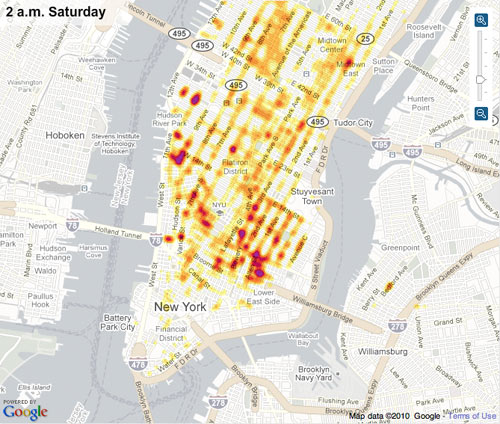
From a study on how people use Firefox, a heat map that highlights the most- and least-popular menu items. Bookmarks got the most use by far, followed by copy and paste. Copy was used about twice as much as paste, which suggests that about 50% of the time, people are copying things to be pasted into another program. Oh and not a single person used “Redo”. (via ben fry)
As I note in How We Decide, this data directly contradicts the rational models of microeconomics. Consumers aren’t always driven by careful considerations of price and expected utility. We don’t look at the electric grill or box of chocolates and perform an explicit cost-benefit analysis. Instead, we outsource much of this calculation to our emotional brain, and rely on relative amounts of pleasure versus pain to tell us what to purchase.
You know, by people who have actually used the thing for more than 5 minutes at a press event. Walt Mossberg from WSJ:
It’s qualitatively different, a whole new type of computer that, through a simple interface, can run more-sophisticated, PC-like software than a phone does, and whose large screen allows much more functionality when compared with a phone’s. But, because the iPad is a new type of computer, you have to feel it, to use it, to fully understand it and decide if it is for you, or whether, say, a netbook might do better.
The simple act of making the multitouch screen bigger changes the whole experience. Maps become real maps, like the paper ones. You see your e-mail inbox and the open message simultaneously. Driving simulators fill more of your field of view, closer to a windshield than a keyhole.
Also from Pogue, an interesting tidbit on how you buy access for the iPad through AT&T:
But how’s this for a rare deal from a cell company: there’s no contract. By tapping a button in Settings, you can order up a month of unlimited cellular Internet service for $30. Or pay $15 for 250 megabytes of Internet data; when it runs out, you can either buy another 250 megs, or just upgrade to the unlimited plan for the month. Either way, you can cancel and rejoin as often as you want — just March, July and November, for example — without penalty. The other carriers are probably cursing AT&T’s name for setting this precedent.
The most compelling sign that Apple got this right is the fact that despite the novelty of the iPad, the excitement slips away after about ten seconds and you’re completely focused on the task at hand … whether it’s reading a book, writing a report, or working on clearing your Inbox. Second most compelling: in situation after situation, I find that the iPad is the best computer in my household and office menagerie. It’s not a replacement for my notebook, mind you. It feels more as if the iPad is filling a gap that’s existed for quite some time.
The first iPad is a winner. It stacks up as a formidable electronic-reader rival for Amazon’s Kindle. It gives portable game machines from Nintendo and Sony a run for their money.
Maybe the most exciting thing about iPad is the apps that aren’t here yet. The book-film-game hybrid someone will bust out in a year, redefining the experience of each, and suggesting some new nouns and verbs in the process. Or an augmented reality lens from NASA that lets you hold the thing up to the sky and pinpoint where the ISS is, next to what constellation, read the names and see the faces of the crew members, check how those fuel cells are holding up.
I like it a lot. But it’s the things I never knew it made possible — to be revealed or not in the coming months — that will determine whether I love it.
The iPad does perform tasks — it runs apps and has the calendar, e-mail, Web browsing, office productivity, audio, video and gaming capabilities you would expect of any such device — yet when I eventually got my hands on one, I discovered that one doesn’t relate to it as a “tool”; the experience is closer to one’s relationship with a person or an animal.
Carla Harrington of Fredricksburg, Va., was surprised to find 82 percent of reviews recommended Schrute Farms. “I thought about what it would feel like not to know them as TV characters but to really go to this B & B,” she said in an interview. Her one-star slam called Dwight “an overbearing survivalist who appears to have escaped from the local mental asylum.”
Note: If you are a member and tried to log in, it didn't work, and now you're stuck in a neverending login loop of death, try disabling any ad blockers or extensions. Or try logging out and then back in. Still having trouble? Email me!








Socials & More