


Google Maps car chase
The idea is great but I wish they’d done a little more with it.

This site is made possible by member support. 💞
Big thanks to Arcustech for hosting the site and offering amazing tech support.
When you buy through links on kottke.org, I may earn an affiliate commission. Thanks for supporting the site!
kottke.org. home of fine hypertext products since 1998.
Beloved by 86.47% of the web.
Rachel Sussman, whose project to photograph the oldest living things on Earth I’ve mentioned on the site before, is trying to photograph a few more organisms before she bundles the photographs into a book.
- Searching the Antarctic Peninsula by boat for 5,000-year-old moss
- Backpacking in Tasmania and mainland Australia in search of several clonal shrubs in ranging from 10,000 to 43,000 years old
- Visiting a sacred site in Sri Lanka for a nearly 2,300-year-old Banyan Fig tree
- SCUBA diving in Spain to find the 100,000-year-old clonal sea grass
Sussman has started a Kickstarter campaign to raise $10,000 to fund those trips. If you like the project, you should consider supporting her efforts. (I kicked in $50.)
LCD Soundsystem is back with a new album and a new music video directed by Spike Jonze, who is also back. Directing music videos that is.
Fun! Not sure what Jonze was going for there though…maybe a visual representation of a typical YouTube comments thread?
Here’s a photograph of Albert Einstein’s Princeton desk taken only a few hours after he died in 1955.

It’s from a slideshow of photos taken at the time of Einstein’s death but never published before last week. (via clusterflock)
Attention designers, writers, photographers, illustrators, art directors: are you stranded in Europe or elsewhere by the volcanic ashcloud? Join Andrew Losowsky in producing a magazine.
If you’d like to be a part of the core creative team who will put together this impromptu publication, let me know as well. The only criterion for any contributor is that, like me, you have to be stuck somewhere unintentionally. If all goes well, the results will be published, probably via MagCloud and/or the Newspaper Club, and any proceeds sent to a charity that helps mitigate the effects of climate change on human populations. After all, we have to repent somehow.
Publication name to consider: The Eyjafjallajokull End-Times.
Doree Shafrir wrote this week’s New York magazine cover story on the NYC tech/media start-up scene. It’s the first one I’ve read in awhile in which Tumblr’s not the centerfold. Foursquare is the new hotness I guess.
Mad Men creator Matthew Weiner says that Mad Men will end after six seasons. Which is good news and completely unsurprising.
For fans who were holding out hope that we might see the show drag on into the ’70s or even ’80s — giving Don Draper a chance to try out key parties, double-knit polyester, muttonchops, and eventually cocaine and yuppie amorality in Reagan’s America — it’s probably a little disappointing. But for everyone else, it’s reassuring to know that Weiner is working with a specific endpoint in mind.
Television drama is known as a writer’s medium but directors wield increasing influence over the visual language of a show.
[Jack] Bender didn’t direct the Lost pilot — that was J.J. Abrams — but he helmed the second episode, “Walkabout,” and set some ground rules that have largely endured. Handheld cameras shouldn’t be used unless they serve a real dramatic purpose. (“I said, ‘OK, let’s not become the handheld show,’” Bender says.) Blues and greens, the main colors on the island, should largely be kept out of the flashback scenes. During the filming of “Walkabout,” Bender also made subtle changes to the script in order to heighten the drama. One scene, set on the beach amid the ruins of a crashed airplane, called for a knife to fly through the air and land in the trunk of a tree. Bender decided to send the knife into a seat cushion lodged in the sand, while a character sat in the adjacent seat.
Robert Wright ponders that question and offers a surprising answer: no, because it’s not that effective at weakening their organizations.
You might as well try to end the personal computer business by killing executives at Apple and Dell. Capitalism being the stubborn thing it is, new executives would fill the void, so long as there was a demand for computers.
Of course, if you did enough killing, you might make the job of computer executive so unattractive that companies had to pay more and more for ever-less-capable executives. But that’s one difference between the computer business and the terrorism business. Terrorists aren’t in it for the money to begin with. They have less tangible incentives - and some of these may be strengthened by targeted killings.
This photo was taken around 1940 and has not been digitally tampered with. So what’s the deal with the young man in the contemporary-looking sunglasses, t-shirt, and camera?

Proof of time travel? Forgetomori investigates. (After reading that page and looking at the photo several times, I half wondered whether this was one of those perception tests…”now, did you notice 12 pink polar bears in the photo?” It doesn’t appear to be.)
Writing for the New Yorker, Ken Auletta surveys the ebook landscape: it’s Apple, Amazon, Google, and the book publishers engaged in a poker game for the hearts, minds, and wallets of book buyers. Kindle editions of books are selling well:
There are now an estimated three million Kindles in use, and Amazon lists more than four hundred and fifty thousand e-books. If the same book is available in paper and paperless form, Amazon says, forty per cent of its customers order the electronic version. Russ Grandinetti, the Amazon vice-president, says the Kindle has boosted book sales over all. “On average,” he says, Kindle users “buy 3.1 times as many books as they did twelve months ago.”
Many compare ebook-selling to what iTunes was able to do with music albums. But Auletta notes:
The analogy of the music business goes only so far. What iTunes did was to replace the CD as the basic unit of commerce; rather than being forced to buy an entire album to get the song you really wanted, you could buy just the single track. But no one, with the possible exception of students, will want to buy a single chapter of most books.
I’ve touched on this before, but while people may not want to buy single chapters of books, they do want to read things that aren’t book length. I think we’ll see more literature in the novella/short-story/long magazine article range as publishers and authors attempt to fill that gap.
But mostly, I couldn’t stop thinking of something that Clay Shirky recently said:
Institutions will try to preserve the problem to which they are the solution.
When an industry changes dramatically, the future belongs to the nimble.
Dan Pink argues that businesses should engage their employees’ third drive, our “inherent tendency to seek out novelty and challenges, to extend and exercise their capacities, to explore and to learn”.
Management is the ideal technology if you’re seeking compliance — getting people to do what you want them to do, the way you want them to do it. But in today’s workforce, which demands much more in the way of creative and conceptual capabilities, we don’t want compliance. We want engagement. And self-direction is a far better technology for engagement.
(via bobulate)
Posters of classified ads from local newspapers, gussied up by a group of designers chosen by the Type Directors Club.
The beauty of this photo by The Sartorialist is not in the clothes or the model but in the way that everything in shot leans down and to the right: the sidewalk sloping away toward the curb, the higher cuff on her right leg, her left foot slightly in front of her right, hips slouched so that her belt is parallel to the sidewalk, the neckline on her shirt. And then that big wave of hair thrown over the other way, balancing everything else out.
The NY Times’ Paper Cuts blog calls Cartographies of Time “the most beautiful book of the year”. I cannot disagree. In attempting to answer the question “how do you draw time?”, the authors present page after page of beautiful and clever visual timelines.
Cartographies of Time is the first comprehensive history of graphic representations of time in Europe and the United States from 1450 to the present. Authors Daniel Rosenberg and Anthony Grafton have crafted a lively history featuring fanciful characters and unexpected twists and turns. From medieval manuscripts to websites, Cartographies of Time features a wide variety of timelines that in their own unique ways-curving, crossing, branching-defy conventional thinking about the form. A fifty-four-foot-long timeline from 1753 is mounted on a scroll and encased in a protective box. Another timeline uses the different parts of the human body to show the genealogies of Jesus Christ and the rulers of Saxony. Ladders created by missionaries in eighteenth-century Oregon illustrate Bible stories in a vertical format to convert Native Americans. Also included is the April 1912 Marconi North Atlantic Communication chart, which tracked ships, including the Titanic, at points in time rather than by their geographic location, alongside little-known works by famous figures, including a historical chronology by the mapmaker Gerardus Mercator and a chronological board game patented by Mark Twain. Presented in a lavishly illustrated edition, Cartographies of Time is a revelation to anyone interested in the role visual forms have played in our evolving conception of history.
The SEC has filed a lawsuit against Goldman Sachs for fraud. Specifically:
According to the complaint, Goldman created Abacus 2007-AC1 in February 2007, at the request of John A. Paulson, a prominent hedge fund manager who earned an estimated $3.7 billion in 2007 by correctly wagering that the housing bubble would burst.
Goldman let Mr. Paulson select mortgage bonds that he wanted to bet against — the ones he believed were most likely to lose value — and packaged those bonds into Abacus 2007-AC1, according to the S.E.C. complaint. Goldman then sold the Abacus deal to investors like foreign banks, pension funds, insurance companies and other hedge funds.
But the deck was stacked against the Abacus investors, the complaint contends, because the investment was filled with bonds chosen by Mr. Paulson as likely to default. Goldman told investors in Abacus marketing materials reviewed by The Times that the bonds would be chosen by an independent manager.
Goldman’s stock price is currently off about 12%.
Culled primarily from the Charles W. Cushman collection, a selection of color photographs of NYC taken in the 40s, 50s, and 60s: Downtown 1941, Downtown 1960, Lower East Side, and Miscellaneous. Here’s a shot of Canal St in 1942 (with cobblestones!):
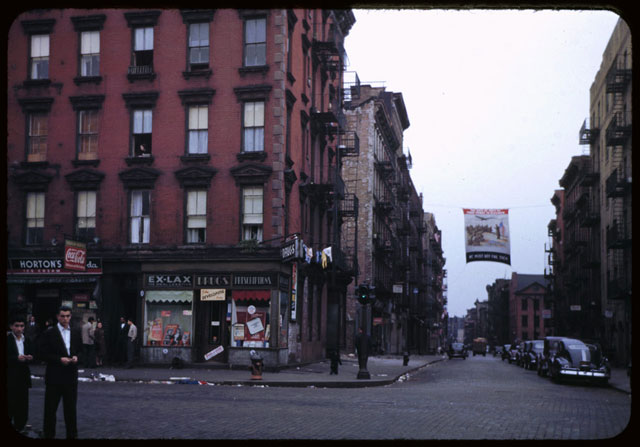
Does anyone know which corner this is? (Here’s another view.) I poked around on Google Maps for a bit trying to find it, but I fear that building is long gone…Canal St, particularly the western part, is much changed since the 1940s.
This was written by an anonymous someone at Something Awful and was reproduced a few months ago on Reddit. Here’s the whole wonderful thing:
This morning I was awoken by my alarm clock powered by electricity generated by the public power monopoly regulated by the US department of energy. I then took a shower in the clean water provided by the municipal water utility. After that, I turned on the TV to one of the FCC regulated channels to see what the national weather service of the national oceanographic and atmospheric administration determined the weather was going to be like using satellites designed, built, and launched by the national aeronautics and space administration. I watched this while eating my breakfast of US department of agriculture inspected food and taking the drugs which have been determined as safe by the food and drug administration.
At the appropriate time as regulated by the US congress and kept accurate by the national institute of standards and technology and the US naval observatory, I get into my national highway traffic safety administration approved automobile and set out to work on the roads build by the local, state, and federal departments of transportation, possibly stopping to purchase additional fuel of a quality level determined by the environmental protection agency, using legal tender issed by the federal reserve bank. On the way out the door I deposit any mail I have to be sent out via the US postal service and drop the kids off at the public school.
After spending another day not being maimed or killed at work thanks to the workplace regulations imposed by the department of labor and the occupational safety and health administration, enjoying another two meals which again do not kill me because of the USDA, I drive my NHTSA car back home on the DOT roads, to my house which has not burned down in my absence because of the state and local building codes and fire marshal’s inspection, and which has not been plundered of all its valuables thanks to the local police department.
I then log on to the internet which was developed by the defense advanced research projects administration and post on freerepublic.com and fox news forums about how SOCIALISM in medicine is BAD because the government can’t do anything right.
And to be fair and balanced (if you will), here’s the American liberal shitheel version:
This morning I was awoken by my alarm clock, powered by energy generated solely by Southern California Edison and manufactured by the Sony Corporation.
I then took a shower in my house constructed by Centex Homes, sold to me by a Century 21 real estate agent, and mortgaged by Citibank.
After that, I turned on my Panasonic television which I purchased with a Washington Mutual credit card to a local NBC Corporation affiliate to see what their team of hired meteorologists forecasted the weather to be using their weather radar system.
While watching this, I ate my breakfast of eggs and bacon, both produced by a local farm and sold to me by my local grocery store, and took my prescribed medication manufactured by Pfizer, GlaxoSmithKline, Astra-Zeneca, and Novartis.
When my Motorola-manufactured Cable Set Top Box showed the appropriate time, I got into my Toyota-manufactured Prius vehicle and set out to my graphic design workplace and stopped to purchase some gasoline refined by the Royal Dutch Shell company, using my debit card issued to me by Bank of the West. On the way to my workplace, I dropped off a package at the local UPS store for delivery, and dropped my children off at a local private school.
Then, after spending another day not being maimed or killed at work thanks to the company-mandated standards enforced at my workplace, I drive back to my house which had not burned down in my absence because of the high manufacturing quality of the products inside and of the company which built my house, and which has not been plundered of all its valuables thanks to the alarm services provided by Brinks Home Security. I was able to rest easy knowing that even had this happened, I would have an Allstate insurance policy which would cover any damage to my home and anything that was stolen.
I then logged onto the internet, financed and ran in part by various different private corporations such as Google, Comcast, AT&T, and Verizon, and posted on the Huffington Post and Daily Kos about how capitalism is the source of all evil in this country.
I think we can all agree that the word “shitheel” is hilarious. (via randomfoo)
In his collected writings, Shakespeare used 31,534 different words. 14,376 words appeared only once and 846 were used more than 100 times. Using statistical techniques, it’s possible to estimate how many words he knew but didn’t use.
This means that in addition the 31,534 words that Shakespeare knew and used, there were approximately 35,000 words that he knew but didn’t use. Thus, we can estimate that Shakespeare knew approximately 66,534 words.
According to one estimate, the average speaker of English knows between 10,000-20,000 words.
False: Fidel Castro was recruited to play professional baseball in the United States. True: after taking over Cuba in 1959, Castro played in a few exhibition games with his fellow revolutionaries.
Cubans know that Fidel Castro was no ballplayer, though he dressed himself in the uniform of a spurious, tongue-in-cheek team called Barbudos (Bearded Ones) after he came to power in 1959 and played a few exhibition games. There was no doubt then about his making any team in Cuba. Given a whole country to toy with, Fidel Castro realized the dream of most middle-aged Cuban men by pulling on a uniform and “playing” a few innings.
Here’s Fidel pitching in one of those games:
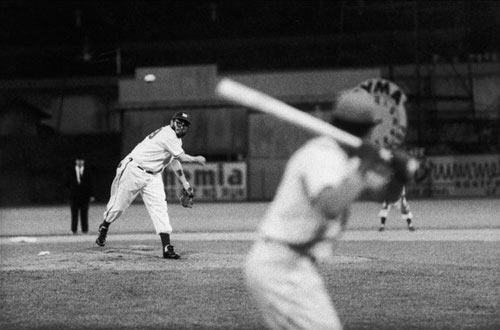
Here’s more information about Fidel’s baseball career. (via slate)
Take smaller bites!!
Ok, no. I’m talking about performance-based choking, or as Jonah Lehrer puts it, “performing below skill level due to performance related anxieties”. Lehrer points to some interesting research which suggests that simplified thinking about your general technique can be enough to ward off performance anxiety.
When the expert golfers contemplated a holistic cue word, their performance was no longer affected by anxiety. Because the positive adjectives were vague and generic, they didn’t cause the athletes to lose the flow of expert performance or overrule their automatic brain.
Watch as a pair of Tokyo DJs play a bunch of musical shoes.
Please note:
The NIKE FREE RUN+ is absolutely a running shoe.
Shoes sold at retail will NOT make music when bent or twisted.
(via @ftrain)
Love it. Robin Sloan has previously discussed this type of “production as performance” video on Snarkmarket but Pomplamoose has started using the term “VideoSong”:
This cover is a VideoSong, a new medium with 2 rules:
1. What you see is what you hear (no lip-syncing for instruments or voice).
2. If you hear it, at some point you see it (no hidden sounds).
As NPR explains, the band is actually making a living from their covers…they sold 100,000 songs last year. Here’s their album of covers on iTunes.
In the mid-1960s, Bell Labs’ A. Michael Noll programmed a computer to paint like Piet Mondrian. Can you tell who did this one before clicking through?

(via @christianbok)
A book about Agatha Christie’s working notebooks reveals that the writer known for her intricate plots worked in a highly nonlinear fashion. Sometimes she didn’t even know whodunnit until late in the writing process.
The contents of the notebooks are as multi-dimensional as their Escher-like structure. They include fully worked-out scenes, historical background, lists of character names, rough maps of imaginary places, stage settings, an idle rebus (the numeral three, a crossed-out eye, and a mouse), and plot ideas that will be recognizable to any Christie fan: “Poirot asks to go down to country-finds a house and various fantastic details,” “Saves her life several times,” “Inquire enquire-both in same letter.” What’s more, in between ominous scraps like “Stabbed through eye with hatpin” and “influenza depression virus-Stolen? Cabinet Minister?” are grocery lists: “Newspapers, toilet paper, salt, pepper …” There was no clean line between Christie’s work life and her family life. She created household ledgers, and scribbled notes to self. (“All away weekend-can we go Thursday Nan.”) Even Christie’s second husband, the archeologist Sir Max Mallowan, used her notebooks. He jotted down calculations. Christie’s daughter Rosalind practiced penmanship, and the whole family kept track of their bridge scores alongside notes like, “Possibilities of poison … cyanide in strawberry … coniine-in capsule?”
I don’t know why this approach seems so surprising. From all that I’ve read about how book authors work, writing a book is like sanding wood…you can’t just start with the extra-fine sandpaper and expect a smooth surface.
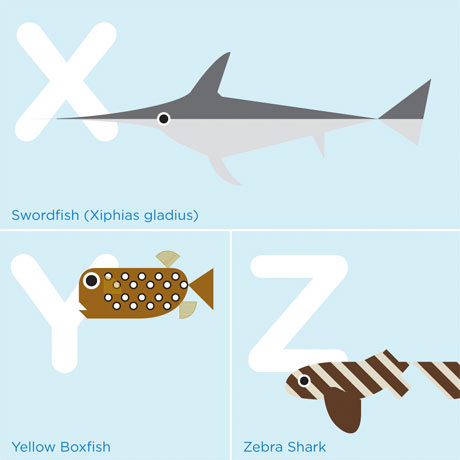
That’s from a lovely poster that James Mattison made for his daughter.
The theme and title of the piece was ‘Learn your A-B-Sea’ and took the format of an alphabet chart illustrated with fish and sea creatures that could be found in the local stretch of water, the Arabian Gulf.
(via @h_fj)
Everett Fahy, the former head of the European painting department at the Met, believes that one of the museum’s paintings by Francesco Granacci is actually by Michelangelo.
I believe Michelangelo painted it in 1506, two years before he started on the Sistine ceiling. It was already in my brain in 1971, the year after it was bought. When the Metropolitan showed it in 1971, I wrote for an exhibition called ‘Masterpieces of Fifty Centuries’ that the second panel recalled the figures in the Sistine Chapel. As years went by, it firmed up. I had long believed it to be by Michelangelo, but exactly when I don’t know. There wasn’t a moment when I suddenly said, ‘This is absolutely by Michelangelo.’ It was a gradual recognition.
One the clues Fahy used to make his determination involves the rocks in the painting; they resemble the quarry at which Michelangelo spent several months in 1497. The painting can be viewed larger on the Met’s website.
Sam Potts has fashioned a Special Deductions for Freelancers tax form; it attaches to your 1040-SCRIMP. There is a Twitter Deduction section and a special David Foster Wallace Memorial Deduction for Fiction Writers Who Use Footnotes.
Yesterday Kevin Rose tweeted:
OMG, Alice for the iPad, paper kids books are dead.
Alice for the iPad is indeed really nice:
My nearly 3-year-old son loves using the iPad. At best, the iPad is a proof-of-concept gadget for adults — they’ll get it right by version three — but it’s perfect for kids right now. It’s just the right size for little hands and laps and the interface is simple, intuitive, and easy to learn.
However, I’d like to assure the childless Rose that if paper books ever go extinct (they won’t), paper children’s books will be the last to go, particularly among the pre-K crowd. E-books are “broken” in several ways that are important to kids, not the least of which is that paper books are super useful as floors in really tall block buildings.
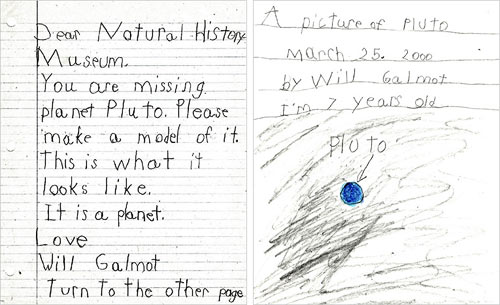
The Natural History Museum got a lot of hate mail from children when they demoted Pluto from planet to a resident of the Kuiper Belt, including this one from a fellow named Will:
Dawkins and Hitchens: arrest the Pope orig. from Apr 13, 2010
* Q: Wha? A: These previously published entries have been updated with new information in the last 24 hours. You can find past updates here.
Accompanied by a New Yorker writer, Christopher Walken visits Astoria, Queens, the neighborhood he grew up in.
“Hello, my name is Chris Walken,” he said. “This is very nice of you. When I was little, I used to have my diaper changed on the kitchen table here.” He stayed in the kitchen, a polite house guest. After a minute, he said, “Well, this was very interesting. God bless and good luck!” (“This sounds silly,” he said later, “but the first thing that I can remember I was on my back, on that kitchen table, and the window facing the street was open. I remember this marvellous warm breeze coming in, so it was around June, and I was a couple of months old. And I turned my head and right next to me was a white plate with scrambled eggs on it. I can still see it.”)
(via clusterflock)
David Lynch likes a lot of different filmmakers. These are some of them:
(via @brainpicker)
This is a photo taken by a pinhole camera:

Can you guess what’s in the photo before clicking through? Hint: it’s not a Blade Runner-esque hi-rise looming over a residential neighborhood. (via ben fry)
Richard Dawkins and Christopher Hitchens want to arrest the Pope when he visits Britain in September.
Dawkins and Christopher Hitchens, the atheist author, have asked human rights lawyers to produce a case for charging Pope Benedict XVI over his alleged cover-up of sexual abuse in the Catholic church. The pair believe they can exploit the same legal principle used to arrest Augusto Pinochet, the late Chilean dictator, when he visited Britain in 1998.
Update: The Times article quoted above is a little misleading says Dawkins.
Needless to say, I did NOT say “I will arrest Pope Benedict XVI” or anything so personally grandiloquent. You have to remember that The Sunday Times is a Murdoch newspaper, and that all newspapers follow the odd custom of entrusting headlines to a sub-editor, not the author of the article itself. What I DID say to Marc Horne when he telephoned me out of the blue, and I repeat it here, is that I am whole-heartedly behind the initiative by Geoffrey Robertson and Mark Stephens to mount a legal challenge to the Pope’s proposed visit to Britain.
Nonetheless, there is a legal challenge involving the Pope’s visit underway, initiated in part by Dawkins and Hitchens. (thx, lots of people)
Who knew that watching a towel-folding robot could be so funny and fascinating?
I found this on Mike Migurski’s site and I cannot improve upon his description of the video:
There is so much here. The “previously-unseen towel” part of the title, the slightly-femmy movements of the robot, the way the 50X speed-up makes it look like a Svankmajer film, the diligent care with which it smooths out each towel when it’s done, and the palpable shock when it returns to the towel table and there aren’t any left to fold.
Twitter announced their long-awaited advertising model last night: Promoted Tweets. Companies and people will be able to purchase tweets that will show up first in certain search results or right in people’s tweet streams. Which, if you rewind the clock a few years, is exactly the sort of thing that used to get people all upset with search engine results…and is one of the (many) reasons that Google won the search wars: they kept their sponsored results and organic results separate. It will be interesting to see if the world has changed in that time.
From VC Fred Wilson, The 10 Golden Principles of Successful Web Apps.
This collection of early computer generated art (1952-1978) includes this quite Whovian swirl:

(via do)
Great interview with Five Guys Burgers and Fries founder Jerry Murrell. Their entire focus is on the product.
The magic to our hamburgers is quality control. We toast our buns on a grill — a bun toaster is faster, cheaper, and toasts more evenly, but it doesn’t give you that caramelized taste. Our beef is 80 percent lean, never frozen, and our plants are so clean, you could eat off the floor. The burgers are made to order — you can choose from 17 toppings. That’s why we can’t do drive-throughs — it takes too long. We had a sign: “If you’re in a hurry, there are a lot of really good hamburger places within a short distance from here.” People thought I was nuts. But the customers appreciated it.
Good name too. My son frequently asks if we’re “going to go visit the five guys” to get “hangleburgers and peanuts”.
In Pursuit of Silence is a book about silence. And noise.
Instead of being against noise, I think we need to begin making a case for silence. This means getting imaginative about expanding our understanding of silence in ways that develop associations between silence and a vibrant, fulfilling life. Anti-noise activists often compare noise pollution to air pollution. But unlike smoke, lots of noises are good, at least some of the time. Instead, we might frame noise as a dietary problem. Most of us absorb far too much sonic junk. We need to develop a more balanced sound diet in which silence, and sounds we associate with quiet states of mind, become part of our daily regimen.
The author, George Prochnik, keeps a silence blog as well.
The current record for Asteroids is 41,336,440. It was set back in 1982, making it the longest-held record in video gaming.
[Fifteen-year-old Scott] Safran, who had been practicing nonstop at the game for the previous two years, agreed to play a marathon session of Atari’s popular outer-space shooting game as part of a charity event in Pennsylvania. His mother drove him to the event and lent him a quarter, which he dropped into the machine Nov. 13.
Why has the record held so long? Because Safran’s game took three continuous days to play with minimal breaks. Now, a new unofficial record has been set by John McAllister; he played 58 straight hours and beat Safran’s record by just over 2,000 points. Oh and those minimal breaks I mentioned:
When he needed a bathroom break, he stepped away from the machine and shed a few lives until his return. It got a little scary towards the end, because he started to run alarmingly short on extra lives as a result of his final bathroom break. He recovered well shortly thereafter, but not without giving all of us onlookers quite the scare first.
For reference, the contest in Hands on a Hard Body lasted 77 hours.
Phil Gyford’s spot-on critique of the number and quality of infographics currently choking the web. As Phil notes, far too many infographics decorate and don’t communicate.
A. Travis Pastrana. He’s that guy who can do a double backflip on a motorcycle.
B. Megaramp. The massive ramps used by skateboarders and BMXers to launch themselves dozens of feet into the air.
C. Big Wheel. Beloved children’s toy.
Here’s A backflipping a C on a B. Just watch:
Bonus: Big Wheel downhill racing by future Pastranas. (via that’s how it happened)
Tweetie, my favorite Twitter iPhone app, has been purchased by Twitter; they’ll be releasing Twitter-branded versions soon. As Gruber says:
Here’s to hoping that Twitter doesn’t fuck Tweetie up like Brizzly did to Birdfeed.
That is, Tweetie was developed as a what’s-best-for-the-user app. I’m hoping not, but a Twitter-brand app may be designed primarily as a what’s-best-for-Twitter-the-company app…which is not necessaily a good thing.
Even when jogging for fun, many male runners won’t let themselves be passed.
When I asked a male friend what he feels like when he’s passed, he said, “I don’t get passed.” Then he admitted that the reason he’s gotten in such good shape recently is so he won’t get passed. Another friend says that if he hears someone on his heels, he sprints. And if he passes someone, he also has to sprint, to keep from getting passed back.
Physicist John Wheeler devised a variant of the Twenty Questions game called Negative Twenty Questions in which, unbeknownst to the guesser, everyone privately picks their own object, resulting in a game where both the guesser and the object choosers are required to narrow their choice in object with each round.
When returning Joe (let’s call him) asks the standard bigger-than-a-breadbox question, if the first person says no, then the other players, who may have selected objects that are bigger, now have to look around the room for something that fits the definition. And if “Is it Hollow?” is Joe’s next question, then any of the players who chose new and unfortunately solid objects now have to search around for a new appropriate object. As Murch says, “a complex vortex of decision making is set up, a logical but unpredictable chain of ifs and thens.” Yet somehow this steady improvisation finally leads — though not always, there’s the tension — to a final answer everyone can agree with, despite the odds.
Wheeler thought the game resembled how quantum mechanics worked.
How do Tennyson, Longfellow, and Thoreau stack up in terms of the thickness of their beards? Surprisingly, that question has been asked and answered.
That “exalted dignity, that certain solemnity of mien,” lent by an imposing beard, “regardless of passing vogues and sartorial vagaries,” says Underwood, is invariably attributable to the presence of an obscure principle known as the odylic force, a mysterious product of “the hidden laws of nature.” The odylic, or od, force is conveyed through the human organism by means of “nervous fluid” which invests the beard of a noble poet with noetic emanations and ensheathes it in an ectoplasmic aura.
(via stamen)
Socials & More