


Amazing Matt Meola surfing video
This video was offline so soon after I posted it and is so crazy that I thought it deserved more than an update to the old post. So here it is again. Watch it, watch it, watch it. (thx, tomek)

This site is made possible by member support. 💞
Big thanks to Arcustech for hosting the site and offering amazing tech support.
When you buy through links on kottke.org, I may earn an affiliate commission. Thanks for supporting the site!
kottke.org. home of fine hypertext products since 1998.
Beloved by 86.47% of the web.
This video was offline so soon after I posted it and is so crazy that I thought it deserved more than an update to the old post. So here it is again. Watch it, watch it, watch it. (thx, tomek)
The fall of the Iron Curtain in pictures orig. from Nov 09, 2009
Donald Barthelme’s recommended reading orig. from Nov 10, 2009
* Q: Wha? A: These previously published entries have been updated with new information in the last 24 hours. You can find past updates here.
A syllabus compiled by American author Donald Barthelme composed of 81 books.
If the list’s books are skewed toward Barthelme’s particular obsessions — one of the entries is “Beckett entire” — this is only to its credit. Most are novels. All but two of the books, Knut Hamsun’s Hunger and Flaubert’s Letters (numbers 15, 40), were written in the twentieth century, most in the past thirty years. And all have that dizzying sense of otherness and surprise common to great books, an affluence of vitality.
Update: Phil Gyford copied the list into plain old text.
Olympia Le-Tan makes handbags — actually hand-embroidered rectangular box clutches — that look like book covers.
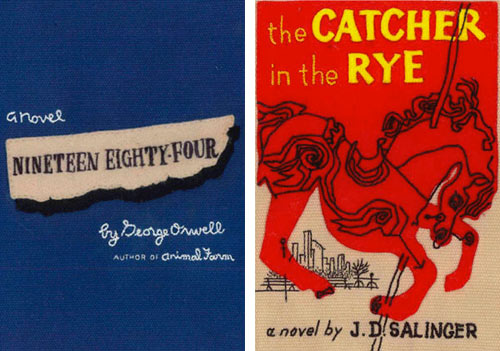
Update: Rebound Designs makes handbags made out of real books. Here’s Pride and Prejudice. (thx, pj)
Typekit launched today (details here).
This will change the way you design websites. Add a line of code to your pages and choose from hundreds of fonts. Simple, bulletproof, standards compliant, accessible, and totally legal.
I haven’t had a chance to play around with this yet, but hope to soon. And hey, you can use Silkscreen with Typekit.
In a New Yorker book review this week, Elizabeth Kolbert tears Levitt and Dubner a new one over the geoengineering chapter of SuperFreakonomics, calling the pair’s thinking on the issue “horseshit”.
Given their emphasis on cold, hard numbers, it’s noteworthy that Levitt and Dubner ignore what are, by now, whole libraries’ worth of data on global warming. Indeed, just about everything they have to say on the topic is, factually speaking, wrong. Among the many matters they misrepresent are: the significance of carbon emissions as a climate-forcing agent, the mechanics of climate modelling, the temperature record of the past decade, and the climate history of the past several hundred thousand years.
From The Morning News, a collection of maps without labels or legend…can you guess what each map represents?
Number one on the list is “drive the biggest vehicle you can afford to drive”. And #10:
If anyone tries to force you into your car or car trunk at gun point, don’t cooperate. Fight and scream all you can even if you risk getting shot in the parking lot. If you get in the car, you will most likely die (or worse).
The author calls this “Black Swan avoidance”. (via lone gunman)
The trailer for Tom Ford’s directorial debut, A Single Man, is gorgeous. No talking, just a simple ticking clock and images.
Reminds me of the trailer for A Clockwork Orange, only slower. Movie looks great too. (via fimoculous)
Update: Here’s the first version of the trailer, before it was de-gayed. (thx, brian)
The fall of the Iron Curtain in pictures orig. from Nov 09, 2009
Mirrors turning to look at you orig. from Oct 20, 2008
Watching them swim orig. from Jul 22, 2009
Restaurant server don’ts orig. from Oct 30, 2009
* Q: Wha? A: These previously published entries have been updated with new information in the last 24 hours. You can find past updates here.
AccidentSketch is a free web app that helps you to draw your car accident in order to assist with insurance claims, etc. Doesn’t work in Safari for some reason.
From The Times in the UK, the top 100 films of the decade. Before you look, see if you can figure out which one of the following is not in the top 5:
Grizzly Man
Cache
No Country for Old Men
Team America: World Police
There Will Be Blood
I’ve seen 58 out of the 100.
Vice has a list of the ten most dubious films included in the Criterion Collection…they call them little fuck-ups.
3. The Rock - Director Michael Bay, 1996
Ugh. That’s right. I failed to mention up top that there are not one, but two Michael Bay films in the Criterion Collection. It’s the kind of shock-inducing information you need delivered in increments. If they wanted to include an Alcatraz movie, uh, why not Escape from Alcatraz? Perhaps Criterion felt they needed a couple of signature “explosion” films to represent the genre. But given that logic, why not throw in Every Which Way but Loose to represent the “truck driver with an orangutan sidekick” genre too?
Also, Michael Bay is doing a remake of Hitchcock’s The Birds? What? WHAT??
Man, lots of good stuff today. This is a film of a trip down Market Street in San Francisco taken in 1905 from the front of a streetcar. The array of driving styles and vehicles on display here is dazzling. (via justin blanton)
Update: The film is actually from 1906, filmed four days before the deadly earthquake. Here’s the whole thing on YouTube:
A section of this film from later in 1906 offers a post-earthquake view of the same trip down Market Street (from 2:23 to 5:55).
Somehow Ricardo Autobahn has constructed a coherent mix-video song from all sorts of movie and TV clips. It’s just flat-out awesome; watch it:
See also Christian Marclay. (via fimoculous)
Just out. Haven’t listened yet (downloading now) but if the last three are any indication, this is gonna be a great Monday for listenin’. Sample tracks:
5. Lil Wayne (feat. Babyface) vs Royksopp - Comfortable Up Here
15. Michael Jackson vs Ratatat - Billie “Wildcat” Jean
19. R. Kelly (feat. Keri Hilson) vs Sally Shapiro - Number One Christmas
31. Ghostface Killah vs Beirut - Save Me Concubine
Somehow not sold out yet: Wes Anderson and Noah Baumbach talk about The Fantastic Mr. Fox at the 42nd St. NYPL tonight. Tickets here.
I’m sure there will be many of these published today. Send me more if you run across any and I’ll add them to the list.
Photos by Peter Turnley taken in Romania, Berlin, Czechoslovakia, Soviet Union, and Hungary, most of them in late 1989.
Update: Pictures from a Vanished Country by Magnum’s Thomas Hoepker.
Earlier this year I realized we would celebrate the 20th anniversary of the fall of the Berlin Wall. I went back into my archive and discovered that I had boxes full of negatives that I had never seen before, taken in East Germany over the past 50 years. It was a treasure which had to be unearthed.
(thx, bojan)
Update: The Berlin Wall: Rise and Fall, photos from Life magazine.
Mediabistro has collected video of how the news was reported on American television.
Update: The Big Picture weighs in: The Berlin Wall, 20 years gone.
The NY Times asked their readers to submit photos of the Wall: The View From the Wall.
The Times also has some nice split-screen photos of before and after the Wall fell. (thx, mau)
Photos from Poland in the 1980s. (thx, tomek)
From the WSJ: Wall’s Rise and Fall. (thx, paul)
In the opening scene of the season finale of Mad Men last night, Betty Draper goes to visit Roger Sterling in a freshly mowed hay field wearing a huge white wedding dress and gets shot in the head with a rifle by an off-screen Jane. She was aiming for Roger, but the first bullet missed and he hit the deck like a good soldier. As the second bullet entered the back of Betty’s head, the camera swung around 180-degrees in a Matrix-like way and we see the bullet exit her neck about two inches below the ear. A ray of light shines through the hole as the bullet exits, as if Betty is made of pure light.
And then I woke up. I haven’t seen the actual episode yet. (Friends, don’t let friends eat late Vietnamese dinners.)
The Higgs boson and the Enchantment Under the Sea dance orig. from Oct 21, 2009
* Q: Wha? A: These previously published entries have been updated with new information in the last 24 hours. You can find past updates here.
I would like to thank this week’s RSS sponsor, The Masters of Professional Studies in Branding at the School of Visual Arts in NYC. This is a new graduate degree program that will begin in fall 2010 focused on the study of “the art and science of branding”. More details about the program are available here and here.
They are having an open house tomorrow (that’s Saturday) at SVC in Chelsea from 2-4pm. If you’re interested in attending, contact either J’aime Cohen or Debbie Millman for details.
From 1971, a critique of Sesame Street from The Atlantic.
Nonetheless, and in spite of all its successes, I feel very strongly that Sesame Street has aimed too low, has misunderstood the problem it is trying to cure, and will be a disappointment in the long run. I also feel that it has misunderstood the nature and underestimated the opportunities of its chief subject, the three R’s, and its medium, television; and therefore, that even what it sets out to do in the short run it does not do nearly as well as it might.
There was a short CG special effects sequence in Star Wars (the Death Star explanation at the Rebel briefing); here’s how it was made.
The Denver Post followed high school graduate Ian Fischer as he enlisted in the Army, went through training, left for Iraq, and returned home; the photos tell quite a story.
The movie rights to Dave Eggers’ Zeitoun have been purchased by Jonathan Demme, who wants to make an animated movie out of it.
That’s not precisely true, but my book reading is down to a trickle of what it used to be. Most of my reading happens online for kottke.org and when I’m through with all that, the last thing I want to do is tuck into a book, no matter how good it is. But what I really haven’t been doing is talking about the books I’ve read or am interested in reading if I had the time. Oh, there have been a few mentioned on the site recently, but there are many more1 stacked on the bedside table, on the shelf next to where I put my keys, and in the “to shelve” pile near the bookshelves that have gone unmentioned.
I know there are a few of you who are interested in what I’ve been reading, if only to avoid the same titles, so I’m going to do a series of collective mini-reviews of every single book that has crossed my desk recently (where recently is loosely defined as the past four years or so). Here’s the first batch.
Create Your Own Economy by Tyler Cowen. I wanted to give this a full and proper review and perhaps still will, but right around the time I finished reading it was the shipping date for the second version of a project my wife and I were working on, Create Your Own Dependent Child. So this capsule will have to do. CYOE is an odd book consisting of two intertwining defenses: 1) of the internet in general and blogs/Twitter/Facebook in particular (one of the best defenses of the internet I’ve read, in fact), and 2) of autism, the main point being that a person on the autistic spectrum is not disabled or even differently abled but in many cases is better equipped to handle increasingly common situations in contemporary culture. I found Cowen’s interrelation of these two topics fascinating. This book is from out of left field in the best possible sense. Recommended.
Master of Shadows by Mark Lamster. Before Mark told me he was writing this book, I had no idea that Peter Paul Rubens was diplomat as well as a painter. I might give this one a whirl after I finish my tour of the Dark Ages.
Sailing Alone Around the Room by Billy Collins. Google sent me this book as a promotion of their Sidewiki thing. The book arrived with a bookmark in it that basically said “what if you could do this to any web page in the world?” I used Sidewiki for about 3 minutes and never went back. Mr. Collins book will likely remain unread and eventually find its way to Housing Works to find a better home than I can provide.
Extreme Fear by Jeff Wise. This book is due out in December; Wise sent me a copy after reading this post, one of many on the site about relaxed concentration and deliberate practice. If you enjoy when I write about these things, you may want to check out this book.
Lost and Found edited by Thomas Beller. This is a collection of essays and stories about specific places in New York City drawn from Beller’s web site, Mr. Beller’s Neighborhood.
Lost and Found, Volume II of the series, is a mosaic of voices, drawing on the diverse experiences of such New Yorkers as a frequent patron of Manhattan sex clubs, a diamond dealer on 47th Street, and a doorman on the Upper East Side. The book features many exciting new voices (Said Sayrafiezadeh, Rachel Sherman, Bryan Charles) alongside work by well-known writers, including Phillip Lopate, Jonathan Ames, Alicia Erian, Madison Smartt Bell, and Edmund White.
Bailout Nation by Barry Ritholtz. The subtitle of the book is “How Greed and Easy Money Corrupted Wall Street and Shook the World Economy” and it came out in May. It’s well-reviewed; the NY Times, WSJ, and the Freakonomics guys gave it favorable ratings. My son calls it his “pig book” for the porcine version of the Wall Street Bull on the dust jacket. Ritholtz blogs about economic and financial matters at The Big Picture.
SuperFreakonomics by Steven Levitt and Stephen J. Dubner. The sequel to the blockbuster economics book has only been out a couple of weeks but is already generating a lot of controversy. I’m keen to read this one and do a proper review; it looks like a fast read and, with all apologies to Mr. Rubens, might be next on the list.
Ok, that’s enough for now. More soon.
[1] This is probably a good spot to mention that some of the books above (spacially speaking…or below, temporally speaking) have been purchased by me and some have been sent to me by the author or author’s publishing company or author’s publicist. In most cases, especially with books I’ve had for more than a few weeks, I honestly can’t remember where I got them from, so I can’t imagine it matters much w/r/t to my “review”. How about this: if it seems relevent in a particular case, I’ll mention it. ↩
Larry Granillo explores how the Yankees’ World Series victories have been covered by the New York Times through the years.
Researchers have been able to create new human senses of a sort…and to cross-pollinate two different senses in order to, for example, see with your tongue.
With Arnoldussen behind me carrying the laptop, I walked around the Wicab offices. I managed to avoid most walls and desks, scanning my head from side to side slowly to give myself a wider field of view, like radar. Thinking back on it, I don’t remember the feeling of the electrodes on my tongue at all during my walkabout. What I remember are pictures: high-contrast images of cubicle walls and office doors, as though I’d seen them with my eyes.
I am reminded of magnetic fingers and the boy who sees through echolocation. I wouldn’t mind a sense of maps that worked via smell…follow the cinnamon scent to your destination or some such.
From Largehearted Boy, a roundup of lists of best music of the 2000s.
Temporarily recreating the Berlin Wall orig. from Nov 05, 2009
Cartoon girls I wanna nail orig. from Feb 07, 2008
The evolution of skateboarding orig. from Nov 04, 2009
* Q: Wha? A: These previously published entries have been updated with new information in the last 24 hours. You can find past updates here.
Timelapse video of a trip from Denver to Singapore and back again.
I made a time lapse video of a weekend trip I did to singapore by hanging a point and shoot around my neck, taking a snapshot every couple minutes/hours.
Fabio Viale makes unusual marble sculptures, like this skull that looks like it’s made out of styrofoam.
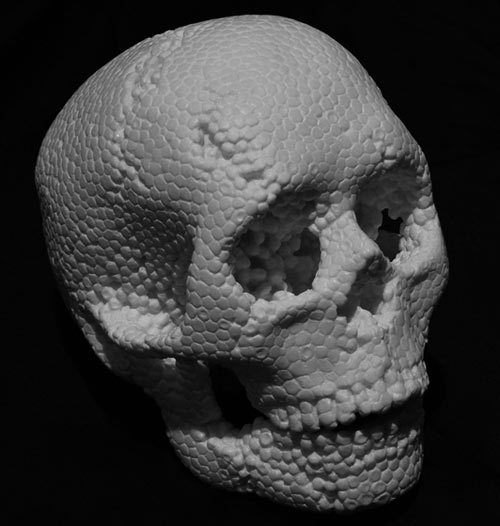
(via this is that)
This did unsurprisingly well when I posted it to Twitter, so I’ve archived it here for posterity. This is Carrie Fischer and her stunt double taking a nap under the Tatooine suns during the filming of Jedi.

Berliners! Artist Martin Butler is trying to find 33,000 people to recreate the Berlin Wall for the 20th anniversary of the Wall’s fall.
The idea is to form on the 9th of november 2009 — the night the Wall fell 20 years ago — a line of people that will recreate the Berlin Wall with their physical presence, marking the path where the wall once stood. Thousands of people will form a human chain that will make its way on the 9th of november around 8.15pm. This action will last for approximately 15 minutes.
If you want to be a part of the piece, sign up on the web site. (thx, søren)
Update: A U2 concert at the Brandenburg Gate has run into some trouble after — and I swear I am not making this up — a huge wall has been constructed to keep non-ticket holders out of the concert. (thx, john)
A 35-mile-long rift in Ethiopia will eventually become a new ocean.
Using newly gathered seismic data from 2005, researchers reconstructed the event to show the rift tore open along its entire 35-mile length in just days. Dabbahu, a volcano at the northern end of the rift, erupted first, then magma pushed up through the middle of the rift area and began “unzipping” the rift in both directions, the researchers explained in a statement today.
We should name it Billy. (via clusterflock)
Paho Mann takes photos of Circle K convenience stores that have since transformed into other businesses.

The slow individualization of re-inhabited Circle Ks caused by years of choices and actions caught my attention. These buildings do not show a linear progression of the corporatization and homogenization of suburbia, but rather serve as evidence of a more circular system — a system driven by a delicate negation between same and different, between complicated sets of actions and choices that shape our built environment.
(via do)
How bad is the pollution in China? James Fallows reports.
The Chinese government does not report, and may not even measure, what other countries consider the most dangerous form of air pollution: PM2.5, the smallest particulate matter, tiny enough to work its way deep into the alveoli. Instead, Chinese reports cover only the grosser PM10 particulates, which are less dangerous but more unsightly, because they make the air dark and turn your handkerchief black if you blow your nose. (Spitting on the street: routine in China. Blowing your nose into a handkerchief: something no cultured person would do.) These unauthorized PM2.5 readings, sent out on a Twitter stream (BeijingAir), show the pollution in Beijing routinely to be in the “Very Unhealthy” or “Hazardous” range, not seen in U.S. cities in decades. I’ve heard from friends about persistent coughs and blood tests that show traces of heavy metals. “I encourage people with children not to consider extended tours in China,” a Western-trained doctor said. “Those little lungs.”
Update: Here are some pretty compelling photos of Chinese pollution. (thx, kurt)
Update: Stephen Voss has a set of Chinese pollution photos along with an accompanying story.
Levi’s (sponsored by America) orig. from Oct 28, 2009
NYC subway prewalking aid orig. from Jul 07, 2009
Amazing surfing video of Matt Meola orig. from Nov 04, 2009
Worst cut to commercial ever orig. from Nov 02, 2009
Killer vaccines and the killers who kill with them orig. from Oct 27, 2009
* Q: Wha? A: These previously published entries have been updated with new information in the last 24 hours. You can find past updates here.
The press release for the upcoming newspaper issue of McSweeney’s is chock full of images from the paper…it looks great. Pre-order here.
Neat. Tetris on the Game Boy is still like a comfy chair after all these years. Runs best in Google Chrome. See also the Javascript Nintendo emulator.
It is difficult to watch this video of Matt Meola surfing and not think of the evolution of skateboarding, particularly the transition between freestyle skating and the invention of vert in the empty swimming pools of southern California. Most of the stuff he does looks impossible. (via matt’s a.whole)
Update: Gah, the video has been pulled offline for some reason. Here’s another one, not quite as good. You can also try YouTube.
Mark Pilgrim explores the question: why do we have an IMG element in HTML?
Why not an
element? Or an element? Why not a hyperlink with an include attribute, or some combination of rel values? Why an element?
What Pilgrim doesn’t touch on was how that IMG tag drove adoption of Mosaic. Having images embedded right into web pages was like Dorothy stepping out of her house and into the lush color of Oz. (via waxy)
Giles Turnbull convened a kiddie focus group and asked them what they call all the different Lego pieces.
Every family, it seems, has its own set of words for describing particular Lego pieces. No one uses the official names. “Dad, please could you pass me that Brick 2x2?” No. In our house, it’ll always be: “Dad, please could you pass me that four-er?”
Don’t miss the chart at the end.
The 1965 Skateboard Championships:
Del Mar Nationals, 1975:
The Bones Brigade Video Show, 1984:
Tony Hawk at X-Games, 1996:
Big Air competition at X-Games, 2008:
(thx, brian)
Update: The first video got removed from Vimeo…found a replacement on Google Video.
Books have stalled orig. from Nov 03, 2009
The Botany of Desire documentary orig. from Oct 14, 2009
Natural nuclear reactors orig. from Nov 03, 2009
* Q: Wha? A: These previously published entries have been updated with new information in the last 24 hours. You can find past updates here.
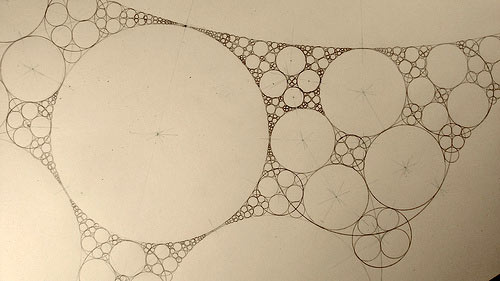
Unknown fractal. It’s sort of like a Sierpinski gasket but with circles. (via migurski)
Update: Turns out that this fractal is “the orbit of a circle under a Kleinian group generated by two Mobius transformations”. (thx, david)
The first episode of a new web series “about dressing like a grownup” called Put This On is about denim. Denim like a jean. Put This On is hosted by Jesse Thorn of The Sound of Young America and Adam Lisagor, the web’s loneliest sandwich.
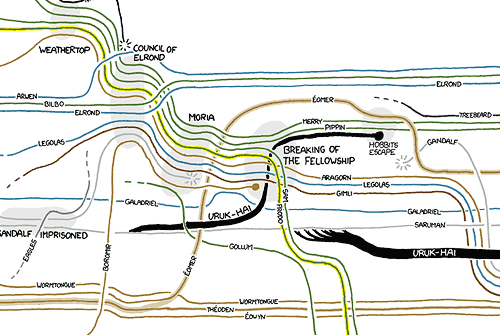
A wonderful character interaction map of the Lord of the Rings trilogy drawn by Randall Munroe. Here’s just a little part of it:
This is a curious exchange between “book mechanic” Michael Turner and interviewer Brian Joseph Davis. Turner says:
We are living at a time when, for the writer, the book is too little.
And then Davis replies, in part:
[The book] is stalled out, in terms of technology, at 1500 AD, and sociologically at around 1930.
The sociological stalling of the book around 1930…I have no idea what that means. Could someone more steeped in book culture explain what that might mean? (via ettagirl)
Update: Henrietta Walmark asked Davis what he meant by his “sociological stalling” remark. Here’s what he said:
Literature in book form, and discussion around it, was the mark of education, of the gentry and petit bourgeois. Literature in book form never really found a place in mass produced, post WW2 middle class culture.
That’s pretty much the consensus of my inbox as well…TV and radio took over as the cultural currency around then.
Several naturally occurring nuclear reactors have been discovered in Gabon, Africa. Groundwater flooding deposits of uranium ore made the reaction possible.
The natural nuclear reactor formed when a uranium-rich mineral deposit became inundated with groundwater that acted as a neutron moderator, and a nuclear chain reaction took place. The heat generated from the nuclear fission caused the groundwater to boil away, which slowed or stopped the reaction. After cooling of the mineral deposit, short-lived fission product poisons decayed, the water returned and the reaction started again. These fission reactions were sustained for hundreds of thousands of years, until a chain reaction could no longer be supported. Fission of uranium normally produces five known isotopes of the fission-product gas xenon; all five have been found trapped in the remnants of the natural reactor, in varying concentrations. The concentrations of xenon isotopes, found trapped in mineral formations 2 billion years later, make it possible to calculate the specific time intervals of reactor operation: approximately 2 hours and 30 minutes
Nice try Fermi, but Mother Nature got there first.
BTW, despite reading The Making of the Atomic Bomb (twice!), I can’t recall hearing this pair of anecdotes before:
Due to a mistranslation, Soviet reports on Enrico Fermi claimed that his work was performed in a converted “pumpkin field” instead of a “squash court”, squash being an offshoot of hard racquets.
When the first self-sustained nuclear chain reaction was achieved, a coded phone call was made by one of the physicists, Arthur Compton, to James Conant, chairman of the National Defense Research Committee. The conversation was in impromptu code:
Compton: The Italian navigator has landed in the New World.
Conant: How were the natives?
Compton: Very friendly.
Pumpkin field, tube alloy, the Italian navigator, the Manhattan Project…the building of the atomic bomb had no shortage of fanciful language.
Update: BLDGBLOG did a post on fossil reactors recently, which is probably where I got the link above in the first place.

Socials & More