Under such conditions, the tide of amateurism cannot but recede until there will be left only the mechanical device and the professional executant. Singing will no longer be a fine accomplishment; vocal exercises so important a factor in the curriculum of physical culture will be out of vogue. Then what of the national throat? Will it not weaken? What of the national chest? Will it not shrink?
I thought about his rant this week as the nation’s largest carriers reported first-quarter earnings. Or, more accurately, first-quarter losses. Except for AirTran and JetBlue, they all lost money. The legacy airlines — Delta/Northwest, American, United, Continental and US Airways — lost a lot of money. Collectively about $1.9 billion, in fact. Their revenue plummeted, too.
And do you know what most of them wanted to talk about? You guessed it. The baskets of ancillary revenue they’re harvesting by charging us fees for checking bags, choosing coach seats or whatever. Forget that their houses are burning down. They found a tap in the bathtub with some water leaking out, so they’re thrilled.
If you were to travel 2000 years into the past, how useful would you be in jumpstarting technological advancements? This 10 question quiz will help you figure out your technological usefulness.
I got a 6/10, which is probably more than I deserved…the invention of “new” technologies is not multiple choice. I wouldn’t have the faintest clue where to begin in actually making concrete or steel from scratch. (via ettagirl)
Update: Phew, I’ll just wear this shirt when I go back. (thx, runyon)
What I love about the approach is that it’s showing us a complicated, virtuoso performance, but making it really clear and accessible at the same time. It’s entertaining, but it’s also an exercise in demystification — which of course is exactly the opposite objective of every music video, ever. Their purpose has been to mystify, to masquerade, to mythologize in real-time.
After doing the script, working with the actors, and supervise the set design, Wes Anderson directed Fantastic Mr. Fox over email. He also didn’t want to use many contemporary stop-motion animation techniques. Both of these decisions ruffled some feathers.
“It’s not the most pleasant thing to force somebody to do it the way they don’t want to do it,” Anderson said. “In Tristan’s case, what I was telling him was, ‘You can’t use the techniques that you’ve learned to use. I’m going to make your life more difficult by demanding a certain approach.’
“The simple reality is,” Anderson continued, “the movie would not be the way I wanted it if I just did it the way people were accustomed to doing it. I realized this is an opportunity to do something nobody’s ever seen before. I want to see it. I don’t want afterward to say, ‘I could have gone further with this.’”
Every seven years, designer Stefan Sagmeister closes his New York studio for a yearlong sabbatical to rejuvenate and refresh their creative outlook. He explains the often overlooked value of time off and shows the innovative projects inspired by his time in Bali.
Due to all the Throwback tweets, Facebook fan pages, videos, blog posts, pics & pleas, Pepsi Throwback is coming back!! Starting December 28th Pepsi and Mountain Dew Throwback will be available again for 8 weeks with the same formula and natural sugar, but this time with an even more rad vintage look!
By mapping, among other variables, how many people click on a link, and how long they linger there, Google assigns it a value, known as PageRank, after Larry Page.
The really amazing part — nope, not the instant bullet liquification (!!!) — is how quickly other things happen after the bullet hits something. Glass seems to crack almost instantly, even at a million fps, making the bullets seem pokey in comparison.
I remember, every season, multiple occasions where I’d hit someone so hard that my eyes went cross-eyed, and they wouldn’t come uncrossed for a full series of plays. You are just out there, trying to hit the guy in the middle, because there are three of them. You don’t remember much. There are the cases where you hit a guy and you’d get into a collision where everything goes off. You’re dazed. And there are the others where you are involved in a big, long drive. You start on your own five-yard line, and drive all the way down the field-fifteen, eighteen plays in a row sometimes. Every play: collision, collision, collision. By the time you get to the other end of the field, you’re seeing spots. You feel like you are going to black out. Literally, these white explosions-boom, boom, boom-lights getting dimmer and brighter, dimmer and brighter.
Perhaps this is what Gladwell will be talking about at the upcoming New Yorker Festival?
Update: From Stephen Fatsis, a list of improvements for the NFL players union to consider to protect the health of the players.
N.F.L. players often get excellent medical treatment, but the primary goal is to return them to the field as quickly as possible. Players are often complicit in playing down the extent of their injuries. Fearful of losing their jobs — there are no guaranteed contracts in the N.F.L. — they return to the huddle still hurt.
And from GQ comes a profile of Bennet Omalu, one of the few doctors investigating the fate of these NFL players.
Let’s say you run a multibillion-dollar football league. And let’s say the scientific community — starting with one young pathologist in Pittsburgh and growing into a chorus of neuroscientists across the country — comes to you and says concussions are making your players crazy, crazy enough to kill themselves, and here, in these slices of brain tissue, is the proof. Do you join these scientists and try to solve the problem, or do you use your power to discredit them?
Goodell faced his harshest criticism from Representative Maxine Waters, Democrat of California, who called for Congress to revoke the league’s antitrust exemption because of its failure to care adequately for injured former players. “I believe you are an $8 billion organization that has failed in your responsibility to the players,” Waters said. “We all know it’s a dangerous sport. Players are always going to get injured. The only question is, are you going to pay for it? I know that you dearly want to hold on to your profits. I think it’s the responsibility of Congress to look at your antitrust exemption and take it away.”
A quick but big-time thanks to Ainsley Drew for helping me out here for the past couple of weeks. Again, you can find Ainsley at Jerk Ethic personally and Ministry of Imagery professionally.
Me? I’m still operating at half speed due to the new little one. But hopefully things won’t be too sporadic around here for too much longer.
In Kashiwa, Japan, there was briefly an unusual cafe where you recieve whatever the person in front of you ordered…and you’re ordering for the person behind you.
The Ogori cafe was an unforgettable travel moment, and an idea that has stuck with me: It was a complete surprise in our day. It encouraged communication between total strangers or, in this case, members of the Kashiwa community and a couple of weird guys from Oregon. It forced one to “let go”, just for a brief moment, of the total control we’re so used to exerting through commerce. It led you to taste something new, that you might not normally have ordered. It was a delight.
In recent years, the gifts on offer have grown increasingly extravagant and ridiculous: a modern Zeppelin for $10 million, a 3-hole golf course designed by Jack Nicklaus for your back yard for $1 million, and a private concert with Elton John for $1.5 million. (via girlhacker)
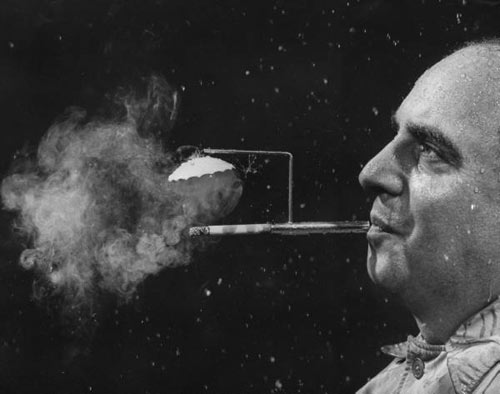
Life has a list of 30 dumb inventions, including the Hubbard Electrometer (invented by L Ron Hubbard to measure pain in tomatoes), the fast-draw robot, TV glasses, and the rainy day cigarette holder.
Used to be, back in my day, that new Popes were elected by a conclave of cardinals holed up in the Sistine Chapel burning unsuccessful ballots with a chemical compound that produces black smoke until a two-thirds majority is achieved, at which point the ballots are pierced with a needle and thread and burned, producing white smoke that the assembled masses take as a sign that the cardinals have chosen, and the Pope-elect is asked if he wants to be the Pope and, if so, what his Pope-name will be and then he chooses his papal garments from a selection of small, medium, and large — *not* tall, grande, and venti as you might expect, that being Italy and all — dons a ring, and is announced to the crowd in St. Peter’s Square.
The classic rescue pose gets perverted into a monstrous abduction — and possibly worse! — scenario, all the better to get movie audiences, especially impressionable teens and thrill-seekers, into the seats. Beautiful women apparently were in constant danger from a steady stream of robots, aliens, mummies, and the occasional mutant human who were ready to snatch these lovelies up, once they had fainted dead away, of course.
It’s true. There’s well-documented evidence that between the 1930s and the 1960s, monsters were picking up women like they were moonlighting at a firehouse. This has morphed into the horror movie poster of today, which usually features a grouping of the young, attractive cast from the bust up, half-shrouded in shadows and looking perturbed.
Nikolai Sutyagin decided to build himself a home befitting the owner of a lumber and construction company. This resident of Archanglesk, Russia, built a regular Izba, or wooden country dwelling, that was the standard two stories, because anything higher is considered a fire hazard by law. Once complete, he began to add to the roof bit by bit, using leftover lumber from his company. Eventually his home teetered at an unbelievable 12-15 stories, tall enough to view the White Sea from the top. Though Nikolai ran into some trouble with an embezzling employee and jail time for beating up said employee, he and his family are rumored to still dwell in the timber tower, which looks like something out of an Edward Gorey etching.
As black holes evaporate, they release Hawking radiation. Named after the legendary Stephen, who first argued for its existence in 1974, Hawking radiation emitted is measured by the mass, angular momentum, and charge of the black hole. Hawking radiation has been predicted to be part of the eventual catalyst for the heat death of the universe, and recent findings suggest that it’s possibly closer than astronomers originally calculated. Don’t max out your credit cards or adopt a Twinkie diet just yet. Scientists believe that it takes roughly 10^102 years for a supermassive black hole to evaporate, and chances are that global warming, war, or Twinkies will have done in humanity long before then.
The worm is consumed by the snail, and begins its development in the snail digestive tract. Once it grows and matures, it moves into the snail’s optical tentacles, where it will pulsate and writhe as an example of aggressive mimicry, turning the tentacle into a dead-ringer for a caterpillar larvae, and making the snail a visible snack to a passing bird. The worm’s dance is also deadly because it renders the snail insensitive to light, making it incapable of shielding itself from predators. After the bird eats the infected snail, the worm matures fully inside the bird’s digestive tract, there it reproduces and lays eggs. Once the bird excretes the Leucochloridium larva, it is consumed by snails, thus continuing its life cycle.
If a breaking ball crosses the plate at a point between a batter’s knees and the midpoint between his shoulders and pants, it’s a strike, no matter what the anachronism behind the plate thinks he sees. In eighteendicketysix, a human being was state-of-the-art technology for making these decisions. Now, you can get better information — we do get better information — by using better technology. Championships should be decided by the players and by what actually happened, not by what somebody thinks happened.
Maybe you’re tired of un-pop-music-like things being run through Auto-Tune, but I’m not quite there yet. This Auto-Tuned Carl Sagan mix is very nearly sublime.
Never eat something that is pretending to be something else.
Don’t yuck someone else’s yum.
If you are not hungry enough to eat an apple, then you are not hungry.
A group of ravens is referred to as a congress or an unkindness. The most famous unkindness of six ravens at the Tower of London are employees, kept on staff at the expense of the British government. There are claims that the ravens were decreed to be kept by King Charles II to prevent disaster, or that they had been placed near the Tower in order to dramatize execution proceedings. These days they’re kept around for tourists, and they are fed well (for ravens) on a diet consisting of raw meat, bird formula biscuits soaked in blood, whole rabbit, eggs once a week, and occasional pieces of fried bread.
Ravens are fairly vicious by nature, so the Tower’s Ravenmaster must bond with them over a period of six weeks when they are fledglings. These birds are so vital to the Tower’s image that several fledglings are kept as understudies for the six working birds as they die, even though the average raven lifespan is twenty-five years. The current raven roster at the Tower consists of Gwylum, Thor, Hugin, Munin, Branwen, Bran, Gundulf, Baldrick, Fleur, and Colin.
Update: The legend is that the decree from King Charles II stemmed from the prophecy that if the ravens are removed from the tower, the monarchy will fall. It is believed that John Flamsteed, who was a prominent astronomical observer, complained to the king that ravens were getting in the way of his observations at the Royal Observatory, which was located in the northeastern section of the White Tower. King Charles’ solution to the complaint was to order all of the ravens killed. It was then that a mysterious oracle informed the king that if the ravens left the Tower of London, the White Tower would topple and the whole of England would be plagued by disaster. Superstitious, King Charles ordered that at least six ravens should be kept at the Tower at all times, and he moved the Observatory to Greenwich. It’s rumored that this decree still stands today.
George Saunders (aka The Principal Researcher or PR) travelled to Fresno, California and set up a tent in a tent city (aka The Study Area) for the purposes of observing the inhabitants and reporting back for GQ. This story is a pain in the ass to read (28 pages with no “single page” option) but it’s worth wading through for Saunders’ observations.
Sometimes it seemed unimaginable that such poverty could exist in America and that the residents accepted it so passively. Why didn’t the place explode? Other times — when, for example, the PR had been out driving around the pleasant neighborhoods of Fresno — the Study Area seemed like a tiny blip on the radar, the necessary detritus of an insanely affluent country. The presence of 300 losers in a city of winners seemed not like a crisis, but rather a reasonable embodiment of Christ’s admonition that the poor would always be with us.
And then:
The Study Area presented a unique and vexing case: With all basic needs (food, shelter, laundry, etc.) met, did all suffering vanish? Based on the observations made during the Study, it did not. The well-fed homeless of Fresno, it was observed, suffered considerably.
They suffered with feeling inadequate and left behind. They spent considerable time and energy telling and retelling the story of their lives, as if looking for the place where things had gone astray. They were lonely and seemed to long for the better things in life: ease, property, companionship. Perhaps not surprisingly, this longing sometimes manifested as anger; also impatience, derision, a tendency to gossip ungenerously. In this the Study Area was similar to any other human community, but with the endemic poverty serving as a kind of process accelerator.
(thx, sean)
Update: Some kind soul has posted the whole thing on one page for easy reading. Hey, GQ! This is what your web site should look like. (thx, rakesh)
Seven new species of phosphorescent mushrooms have been discovered, bringing the grand total of documented glowing fungi species to 71. The new discoveries join the ranks of the other luminous mushrooms that produce light as a result of a chemical reaction. Although easily noticeable at night, phosphorescent mushrooms glow all day long. Ten new fungi species were documented between 2002 and 2006, which is surprising considering how difficult it is to write in the dark.
The ancient Roman vomitorium, or vomitoria, were supposedly places where diners could go and void their stomachs during a meal, in order to make room for more delicacies. There are even detailed descriptions of the rooms, stating that they had large slabs or pillars to lean over that would better facilitate voiding the stomach. Though it might come as a disappointment to preteen boys studying Latin, the vomitorium of such lore is a myth. A true vomitoria is actually a well-designed passage within an ampitheater that allowed large numbers of Romans to file in and out of large spaces quickly. The root of the word, vomere, translates to “spew out,” which makes sense when applied to hurried exits.
One of the finalists in the Roca’s bathroom-related design contest, Jump the gap, was Spanish design studio Yonoh’s “box.” It’s a self-contained, customizable modular bathroom that features enough room for a toilet, wash-basin, shower, seat, two shelves, a towel rack, and a section for extra space and storage. All of the faucets are electronic, with displays indicating the temperature and the amount of water consumed. This “box” requires hookups for water and electricity, and after water is used by the sink or the shower, it’s stored in a conservation-friendly water tank where it supplies the toilet. It remains to be seen if the eco-friendly “box” will compete with other cubic commodes. Regardless, it’s quite a leap from the Port-a-Potty.
“[Michelle] is representative of how we have evolved and who we are,” said Edward Ball, a historian who discovered that he had black relatives — the descendants of his white slave-owning ancestors — when he researched his memoir, “Slaves in the Family.”
“We are not separate tribes of Latinos and whites and blacks in America,” Mr. Ball said. “We’ve all mingled, and we have done so for generations.”
I wonder how much of this Obama was aware of before being contacted by the Times for comment (she declined):
The findings — uncovered by Megan Smolenyak, a genealogist, and The New York Times — substantiate what Mrs. Obama has called longstanding family rumors about a white forbear.
For those of you who are both creepy and crafty, a website specializing in Halloween prop projects and related antics has documented how they created a set of severed, twitching legs. There’s even a video of the finished product in action. It’s how a pair of pants can scare the pants off of partygoers.
Dijon mustard is to yellow mustard as a Rolls Royce is to your Honda. A 454 gram bottle sells for $6.99, and that is 5 cents per serving.
He adds up exactly how much homemade sandwiches cost based on the amount of ingredients and their correlating prices. The results are revealing: 98 cents for a processed turkey sandwich, 48 1/2 cents for a grilled cheese, and 64 cents for a pb&j. If you’d like to figure out how much bread you’ll need for your picnic, try out Cockerham’s sandwich calculator. For more dizzying and delicious equations, cut the corners off the drool-inducing Scanwiches.
Scientists discovered that it’s likely that some individuals with high testosterone actually perceive other people’s anger as a reward. Researchers tested the subjects’ testosterone levels and assigned them “learning tasks” where images of faces were subliminally flashed in response to their performance. Participants who had higher testosterone levels responded better to angry faces than to neutral ones, even though the faces were on screen too briefly to identify. Michelle Wirth, who led the study, explained how this can possibly be correlated to other testing methods:
“Better learning of a task associated with anger faces indicates that the anger faces were rewarding, as in a rat that learns to press a lever in order to receive a tasty treat. In that sense, anger faces seemed to be rewarding for high-testosterone people, but aversive for low-testosterone people.”
So the next time it seems like that person is trying to piss you off, reward them with a knuckle sandwich.
From an article in The Boston Globe by Samuel Arbesman, about his quest to name an asteroid after author George Plimpton:
There is a whole group of asteroids named after rock stars. Each member of Rush has a minor planet. Fantasia, Hammurabi, and Jerrylewis are all out there. While Goldfinger is not named after the Bond film (it’s named after an astronomer), Vespa is named after the motor scooter. Here is where we find the asteroid named Qwerty, and even an asteroid named ASCII.
While the author was on his mission to get Mr. Plimpton’s name on a piece of space real estate, he discovered some of the intricacies of naming objects up there. For example, the moons of Uranus have all been named after characters from works by Shakespeare and Alexander Pope. Also, those “name a star” advertisements on the radio are bunk. Although you get a certificate claiming your star has been named, the monikers aren’t recognized by the International Astronomical Union, the one organization that has authority in the matter.
We agreed that a lot of what we then considered “working hard” was actually “freaking out”. Freaking out included panicking, working on things just to be working on something, not knowing what we were doing, fearing failure, worrying about things we needn’t have worried about, thinking about fund raising rather than product building, building too many features, getting distracted by competitors, being at the office since just being there seemed productive even if it wasn’t — and other time-consuming activities. This time around we have eliminated a lot of freaking out time. We seem to be working less hard this time, even making it home in time for dinner.
I would likely give the same advice, but I wonder if it’s actually true. Perhaps working hard/freaking out was exactly what was needed at the time, whether or not it seems efficient or correct in retrospect. You need to travel that road so you can find a better way the second time around.
A video clip of what fashion designers in the 1930s predicted that people would be wearing in the year 2000. While the predictions for the women only accurately depict Lady GaGa’s wardrobe, the designers of the past were slightly closer to the mark when it came to men’s fashion:
“He’ll be fitted with a radio, telephone, and containers for coins, keys, and candy for cuties.”
By which they must have meant credit cards.
Update: FASHION magazine responded to this video. It turns out that it was eerily accurate, with designs like Alexander Wang and Marc Jacobs parading futuristic wares that are perfectly current.
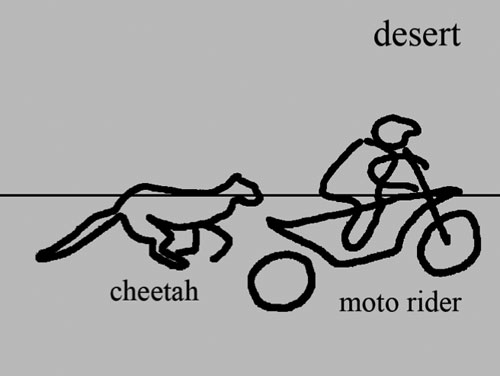
Wow. With PhotoSketch, you just draw a sketch, label each item, like so:
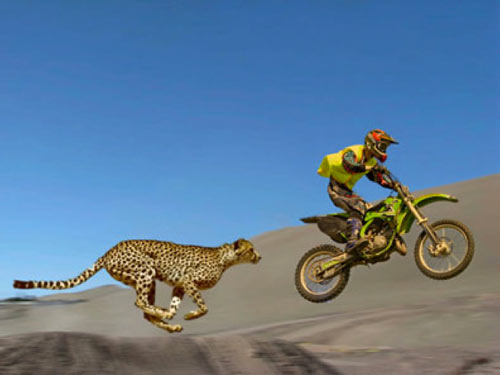
and then the system goes out, finds photos that match the sketched items and their labels, and automatically pastes it all together into one composite image:
Update: I’ve seen many references to Photosketch saying that it has to be fake (here’s a sampling). But it’s pretty obviously real. For one thing, here’s the source code; try it out (Windows only). It was presented at SIGGRAPH Asia 2009; here’s the listing of papers presented. The authors all have web pages on university sites and have published work using similar techniques and technology (Ping Tan and Ariel Shamir for example). And is what it does really that unbelievable? At the most basic level Photosketch is just find me a man that’s sorta shaped like this, a dog that looks like this, and paste them together with a background that looks like this. That the results are so impressive (especially for a demo) is a testament to the team’s execution and attention to the small details. Even if it turns out to be an elaborate hoax, I have no doubt that someone could actually build a working version of Photosketch…I mean, look at TinEye and Photosynth.
In 2001, Tim Hawkinson created Uberorgan for the gallery at MassMOCA.
Several bus-size biomorphic balloons, each with its horn tuned to a different note in the octave, make up a walk-in self-playing organ. A 200 foot-long scroll of dots and dashes encodes a musical score of old hymns, pop classics, and improvisational ditties. This score is deciphered by the organ’s brain - a bank of light sensitive switches - and then reinterpreted by a series of switches and relays that translate the original patterns into non-repeating variations of the score.
Part sculpture, part giant musical instrument, Hawkinson’s installation was a loose interpretation of the human body’s organ systems. Uberorgan conducted itself for five minutes every hour, on the hour. The exhibition traveled from MassMOCA to the Getty Center in Los Angeles, where it graced the museum’s entrance hall during the exhibit of Hawkinson’s work called Zoopsia, a name that means “visual hallucinations of animals.”
You can hear a minute long sample of the Uberorgan on the Getty Center website. To me it sounds like a duet between a three-year-old jamming out on a bass saxophone and an elephant in a good mood.
Update: Tim Hawkinson and the Uberorgan are featured the Art:21 episode,”Time.” Seeing and hearing the piece, even on the small screen, is impressive, and Hawkinson explains how he came about creating such a voluminous, volume-driven work of art. (thx, cliff)
Just in time for Halloween: a new study theorizes that eating too many Pez will land children in the pen. Researchers believe that using candy as a reward for a chore such as homework drives children to have difficulty handling anything but immediate gratification. The dopamine release that is caused by consuming sugar, and the inherent “addiction” that it causes, can lead to impulsive behavior when treats are withheld from kids. It’s the inability to successfully cope with delayed gratification that has doctors concerned, since rash behavior in children can be linked to criminal acts and violence in adults. The British study, which followed 17,000 children over four decades, found that, by the age of 34, 69% of daily candy eaters were apprehended for violent acts. Perhaps it’s the prevalence of penny candies that leads people to the penitentiary.
Update: It’s all in the subtleties. The article reads:
“The October 2009 study revealed that 69 per cent of those with a criminal record of violence consumed candy daily as children.”
This means that it can be inferred that those who have committed crime had sweet teeth as kids, but not that children who eat candy every day will therefore be predisposed to criminal behavior. Moreover, there are so many variables and unobserved factors that if you eliminated the sugary rewards, it wouldn’t necessarily mean a correlated drop in crime. It isn’t the candy that’s causing the trouble, it’s just that trouble-making and candy seem to be bedfellows. So much for trick or treat. (thx, neil and scott)
An article in Forbes postulates which countries billionaires could purchase, factoring in their estimated worth and the countries’ GDPs. On the list: Bill Gates, Warren Buffet, George Lucas, Zambia, Haiti, and Belize.
Update: A valid point to make here is that a billionaire’s income isn’t an accurate measure of their ability to “purchase” a country based on their GDP, especially if you think of the GDP as the equivalent of rental income. For instance, if a person’s net worth is $9 billion, which is equivalent to the Bahamas’ GDP, that doesn’t mean the billionaire could buy the islands. He or she could only rent it for a year, theoretically. Then again, the idea of countries being up for sale, and individuals purchasing (or renting) them, is a somewhat silly premise. (thx, ian)
Update: Perhaps purchasing countries isn’t such a silly premise after all. In 2003, the entire principality of Liechtenstein was up for rent. The tiny country, which borders Switzerland and Austria, attempted a “rent-a-state” program sponsored by Xnet. The idea was to draw attention to the tourist-friendly charms of Liechtenstein by essentially “renting” the country’s hotels, restaurants, and sports stadiums en masse. (thx, colin)
Note: If you are a member and tried to log in, it didn't work, and now you're stuck in a neverending login loop of death, try disabling any ad blockers or extensions. Or try logging out and then back in. Still having trouble? Email me!











Socials & More