



Twins triptych


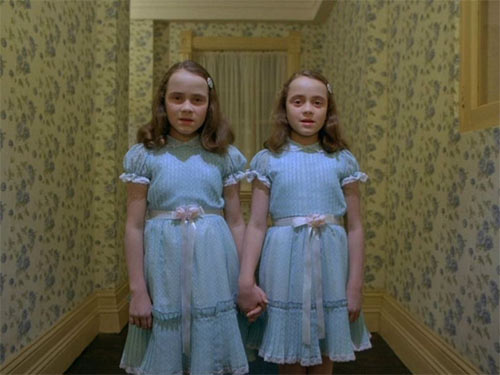
T to B: The Olsen twins (photographer unknown), Identical Twins, Roselle, New Jersey, 1967 by Diane Arbus, the Grady twins from The Shining by Stanley Kubrick. (via hysterical paroxysm)

This site is made possible by member support. 💞
Big thanks to Arcustech for hosting the site and offering amazing tech support.
When you buy through links on kottke.org, I may earn an affiliate commission. Thanks for supporting the site!
kottke.org. home of fine hypertext products since 1998.
Beloved by 86.47% of the web.
T to B: The Olsen twins (photographer unknown), Identical Twins, Roselle, New Jersey, 1967 by Diane Arbus, the Grady twins from The Shining by Stanley Kubrick. (via hysterical paroxysm)
A three-year-old’s view of the NYC subway orig. from Oct 22, 2009
* Q: Wha? A: These previously published entries have been updated with new information in the last 24 hours. You can find past updates here.
David Galbraith graphs the population of Rome from 300 BC to the present.
The population [of Rome] during the Renaissance was miniscule (yet it was still a global center), when Michelangelo was painting the Sistine Chapel it was considerably smaller than a town like Palo Alto is today (60K); Rome at its nadir was about the size of Google (20K employees); the growth of Rome during the Industrial era is much greater than the rise of Ancient Rome.
David, you should check out The Inheritance of Rome; I’m about 100 pages in and pretty interesting so far. Also, it would be instructive to do the same graph but Rome’s population as a percentage of world population.
All 19 episodes of My So-Called Life are available on Hulu for free. (US only.) My huge crush on Claire Danes persists into the present. I’ve seen this Soul Asylum video about 5 kajillion times and even liked her in Terminator 3. (I know, I know.) (via andrea inspired)
If you’ve ever wanted to see someone shoot an anvil 200 feet into the air, you should watch this video. (And not just someone…a world champion anvil shooter.)
With gunpowder and a fuse. Just like Wile E. Coyote! (thx, rob)
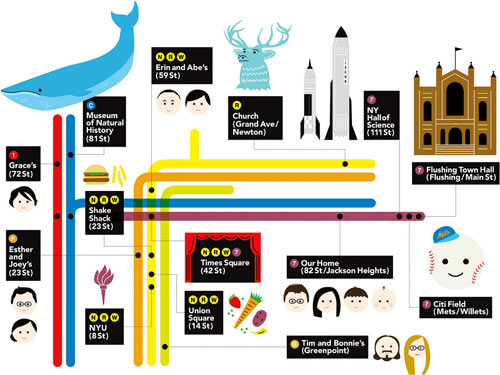
This was my present to my nephew for his 3rd birthday. He loves, loves, loves the subway so my sister asked me if I could make a custom map with all the places that mean something to him on the poster.
Best viewed a bit large.
Update: There’s been a bit of confusion…this is not something that I made. I don’t even have a nephew.
Update: The subway map was made by Erin Jang.
This short film was made in 1909 and depicts Wilbur Wright flying one of his airplanes around an open field. At 1:38, they attach the camera to the plane and shot what is thought to be the first video footage shot from a powered flying machine.
Then the plane started up again, followed a launching pad and took off: the camera was fixed for the first time on the ground that gave way…and the emotion was there, so great you could almost touch it! The image was as unstable as the cabin of the plane flying at low altitude, flying over the countryside and gradually approaching a town.
(via @ebertchicago)
Participants in a sensory deprivation experiment reported having hallucinations after just fifteen minutes.
They then put the participants, one by one, in a dark anechoic chamber which shields all incoming sounds and deadens any noise made by the participant. The room had a ‘panic button’ to stop the experiment but apparently no-one needed to use it.
(via wired)
You say to me “light photos” and I say “zzzzz”, but Alan Jaras’ light patterns captured on film are probably what the universe looked like at an early age.

(via justin blanton)
Really inspiring design by the folks at the newly launched The Bold Italic. It’s webby and magazine-y at the same time, but not overly so. Looks great on the iPhone too. Jealous. (via @timoni)
Congrats to Jen Bekman on getting funding for 20x2001.
“I love the idea of taking the friction out of the art world,” said Mr. Conrad. “A lot of people want to buy nice things, but don’t know how. Jen has built a business from that, which is growing very nicely and has a lot of repeat customers.”
[1] In light of the new FTC guidelines for disclosure by bloggers2, a few somewhat relevent statements. 1. 20x200 has in the past paid $1200 to sponsor the kottke.org RSS feed. 2. I have linked to 20x200 and Jen Bekman’s gallery several times on kottke.org, for which Jen Bekman has thanked me, which is a good feeling, to be thanked, and perhaps that subconsciously predisposes me towards future linking because who doesn’t like to be thanked? 3. Jen Bekman is a friend. 4. I also know Caterina Fake, Zach Klein, and Scott Heiferman socially; they are a few of 20x200’s angel investors. 5. I am a resident of New York City, in which 20x200 is headquartered. 6. I have purchased art from 20x200 in the past. 7. I may have received a 20x200 print from Jen Bekman herself, either as a straight-up gift or as a promotional item. Honestly, I can’t remember if she gave me anything, what it was, or the circumstances of the giving. 8. I have received 20x200 prints as gifts from others. They are thanked. 9. I know my wife and my wife knows Jen Bekman. 10. I may have unwittingly posed for photos next to 20x200 artwork hanging in my residence or in the residences of others, giving the impression that I am endorsing said artwork. Apologies. 11. I have agreed to, at some point in the future, curating a selection of artworks for 20x200 and then chatting casually with Jen Bekman about my choices, an edited transcript of which will appear on the 20x200 web site. As far as I know, no payment for this service is forthcoming and if it was, I would refuse it politely. 12. Jen Bekman’s dog’s name is Ollie. So is my son’s. ↩
[2] Why just for bloggers? Do New York Times book, music, and movie reviewers disclose that they received review copies for free? ↩
At 70, writer Charles Bukowski started using a computer — a Macintosh IIsi that his wife gave him for Christmas — and was so taken with it that he never went back to the typewriter.
There is something about seeing your words on a screen before you that makes you send the word with a better bite, sighted in closer to the target. I know a computer can’t make a writer but I think it makes a writer better. Simplicity in writing and simplicity in getting it down, hot and real. When this computer is in the shop and I go back to the electric, it’s like trying to break rock with a hammer. Of course, the essence of writing is there but you have to wait on it, it doesn’t leap from the gut as quickly, you begin to trail your thoughts — your thoughts are ahead of your fingers which are trying to catch up. It causes a block of sorts indeed.
Javascript code for navigating between posts using the j and k keys, just like on ffffound and The Big Picture. (via 37s)
Are the problems that have plagued the Large Hadron Collider and previous high-energy efforts (SSC, I’m looking at you here) a result of the Higgs boson travelling back from the future to meddle in its own discovery? A pair of scientists think it’s a possibility.
“It must be our prediction that all Higgs producing machines shall have bad luck,” Dr. Nielsen said in an e-mail message. In an unpublished essay, Dr. Nielson said of the theory, “Well, one could even almost say that we have a model for God.” It is their guess, he went on, “that He rather hates Higgs particles, and attempts to avoid them.”
This malign influence from the future, they argue, could explain why the United States Superconducting Supercollider, also designed to find the Higgs, was canceled in 1993 after billions of dollars had already been spent, an event so unlikely that Dr. Nielsen calls it an “anti-miracle.”
That’s heavy, Doc.
Update: Bread from the future halted operation of the LHC again.
Vivian Maier, recently discovered street photographer orig. from Oct 14, 2009
From the desk of Mr. Jagger orig. from Oct 15, 2009
* Q: Wha? A: These previously published entries have been updated with new information in the last 24 hours. You can find past updates here.
In his newest multipart essay for the NY Times, Errol Morris examines evidence of photo manipulations by the photographers of the Farm Security Administration during the Great Depression, including Walker Evans, Arthur Rothstein, and Dorothea Lange. Were they dispassionate observers of American life in the 1930s or employees after a certain type of story?
If one can imagine the political animosity that would have been generated if, as part of the current stimulus package, President Obama introduced a national documentary photography program, then it is possible to understand the opposition that the F.S.A. faced. Fiscal conservatives did not want to see their hard-earned tax dollars spent on relief, let alone a government photography program, of all things.
Not every magnetic substance has a north and a south pole…some are monopolar.
The work is the first to make use of the magnetic monopoles that exist in special crystals known as spin ice.
Spin ice! Also I guess they went with the awkward magnetricity name because electromagnetism was taken. (via mouser, who says “Suck it, Maxwell”)
Stolen art in the Los Angeles area results in some unorthodox art posters. Here’s a missing Warhol print of Mick Jagger:

Looks like something Warhol himself might have come up with.
Emigre has released a sans serif companion for Mrs Eaves, Mr Eaves.
Mr Eaves was based on the proportions of Mrs Eaves, but Licko took some liberty with its design. One of the main concerns was to avoid creating a typeface that looked like it simply had its serifs cut off. And while it matches Mrs Eaves in weight, color, and armature, Mr Eaves stands as its own typeface with many unique characteristics.
Very handsome. I’ve always liked the attitude and flourishes of Emigre’s typefaces. (via quips)
Interesting article about the technology behind the 4- and 5-bladed disposable razors.
Down the hall from the high-speed video lab is the room where they do three-dimensional motion analysis using infrared cameras: “It’s the same system they use in some of the latest blockbusters, like Spider-Man or Lord Of The Rings.” The changing positions of markers that reflect infrared light are triangulated by the cameras, so the movements of the razor and the shaver’s arm can be recreated in a virtual 3D space on a computer. “The way in which you hold that handle and you rotate that handle, if you watch men do it, it’s quite amazing. You think they could all be cheerleaders,” Stewart says. High-speed infrared cameras, running at around 2,000 frames a second, are also used to measure skin deformation and strain. A similar technique is used in the car and aeroplane industries, though Gillette have patented it for shaving research. Next door, sensors in a specially adapted razor measure the forces different men put on it while shaving.
(via justin blanton)
This is page 471 of The Anglo-American Telegraphic Code book (previously mentioned here).

Looks like the scanner caught one of Google’s pink-fingered elves at work. A quick search reveals several other such errors.
The Iconic Photos blog reminds me a bit of Letters of Note (and Footnotes of Mad Men). It’s one notable photo per post plus some context.
There’s no official API, but GReader’s Atom feeds include the likes data.
This means that as a publisher you can extract this information and see which of your items Reader users find interesting.
A diagram that shows the overlap of street photography, fine art photography, and photojournalism.
With a bit of research and social engineering, an enterprising burger enthusiast has figured out the recipe for the infamous Shake Shack burger.
Exclamation point interlude: !!!!!!!!!!!!!
Upon tasting it, my immediate thoughts are mayo, ketchup, a little yellow mustard, a hint of garlic and paprika, perhaps a touch of cayenne pepper, and an elusive sour quality that I can’t quite pinpoint. It’s definitely not just vinegar or lemon juice, nor is does it have the cloying sweetness of relish. Pickle juice? Cornichon? Some other type of vinegar? I can’t figure it out. This was going to take a little more effort.
Totally doing this for dinner one of these nights. We’ll probably cheat on the ground beef…we’ve got some Pat LaFrieda patties stockpiled in the freezer.
Phil Greenspun’s finance buddy explains how JPMorgan Chase and Goldman Sachs made $6.8 billion in profit last quarter. Basically they borrowed money from the US Govt at 0% and then bought bonds from the US Govt that paid 2-3%.
What kind of bonds are they buying? Are they investing the money in American business? “No, they are mostly buying Treasuries.” So the money is just being shuffled from one Federal bank account to another, with each Wall Street bank skimming off $1 billion per month for itself? “Pretty much.”
(via @linklog)
Kseniya Simonova won Ukraine’s Got Talent 2009 competition with her dramatization of Germany’s invasion of Ukraine during WWII, performed with sand on a giant lightbox. Sounds like the cheesiest thing, but this performance is amazing.
Watch until at least 1:06…that’s when my mouth dropped open a bit. The entire audience was in tears by the end. (via @jessicadeva)
Writing for The Atlantic, Benjamin Schwarz says we’ve got it all backwards regarding Mad Men: January Jones is a bad actress and the show’s appeal lies not in the accuracy of the production details but in the emotional intelligence.
Then there is the miraculous Hamm, playing the lead character, Don Draper. Here is an actor who at once projects sexual mastery and ironic intelligence, poise and vulnerability. That alchemy has created the greatest male stars, from Gable to Grant to Bogart to McQueen to Clooney, because it wins for them both the desire of women and the fondness of men.
For my money, Jones is just as good at Hamm in portraying her character’s multitudes.
Every issue of Life Magazine until the end of 1972 is available on Google Books for free. This archive joins Google’s already impressive archive of millions of photos from Life. (via footnotes of mad men)
A pair of McSweeney’s lists to brighten this sleepy Monday morning. 1. YouTube Comment or e.e. cummings?
1. loog a his lirow nose
2. there is some shit I will not eat
3. LISN bud LISN
2. What to Expect: The Third Decade
Your thirty-year-old adult may be able to…
Make a martini (vodka)
Refrain from discussing college
Get married
File his taxes (EZ form)
Remember 5-10 friends’ birthdays
Acknowledge other viewpoints (political)
Here’s what everyone has been most interested in on kottke.org this week:
The best flag in the world (#1 by a wide margin)
From sketch to photo instantly (this is insanely awesome)
Bullets are slow
The Rape Tunnel: FAKE
The most beautiful suicide
Beyonce’s Single Ladies covered by Pomplamoose
Cool cats
Carl Sagan Auto-Tune (feat. Stephen Hawking)
Parkour on a bicycle
From the desk of Mr. Jagger
Inventing the past
Minna Kottke
Dogfighting vs. football in moral calculus
The no control cafe
Drinking like Mad Men
George Saunders plays house(less)
Airlines nickel and diming themselves to death
Are you moving to San Francisco?
Wooden skyscraper
Huge Pepsi Throwback news
Flat-earthers
Rare hour-long Alfred Hitchcock interview
Popes, they don’t make ‘em like they used to
The most famous unkindness
Pizza pi
Again, the data is from Google Analytics and only includes URLs that were directly accessed…no search or referral traffic. Compare those to the most liked posts in the kottke.org RSS feed from roughly the same period of time, data courtesy of Google Reader:
The best flag in the world (174 likes)
From sketch to photo instantly (this is insanely awesome) (150 likes)
The no control cafe (98 likes)
Beyonce’s Single Ladies covered by Pomplamoose (84 likes)
Carl Sagan Auto-Tune (feat. Stephen Hawking) (81 likes)
Bullets are slow (71 likes)
Michael Pollan’s food rules (43 likes)
From the desk of Mr. Jagger (38 likes)
Pizza pi (37 likes)
Vivian Maier, recently discovered street photographer (37 likes)
The most famous unkindness (35 likes)
Airlines nickel and diming themselves to death (30 likes)
The vomitorium myth (29 likes)
Totally not burying the lede (29 likes)
Drinking like Mad Men (25 likes)
Thirty dumb inventions (25 likes)
Rare hour-long Alfred Hitchcock interview (24 likes)
Complaining about the inevitable (23 likes)
Glaciers from space (23 likes)
Cool cats (22 likes)
This only includes posts from the past week so the older stuff isn’t represented. Interesting differences. The stuff with images or videos tends to do better with likes on Google Reader than just text. If Google Reader had an API, you could use that and the Analytics API to make a pretty decent “here’s what’s popular on the site” sidebar thingie a la the NY Times and most other publications.
Gustavo Zamora Jr., a former Army ranger, has retrieved more than 50 children for parents left behind when someone else takes the kid to another country. Nadya Labi tags along as Zamora attempts to recover a boy from Costa Rica for Florida lawyer Todd Hopson.
If your ex-spouse has run off and taken your children abroad, and the international legal system is failing to bring them back, what are you to do? One option is to call Gus Zamora, a former Army ranger who will, for a hefty fee, get your children back. Operating in a moral gray area beyond the reach of any clear-cut legal jurisdiction, Zamora claims to have returned 54 children to left-behind parents. Here’s the story of number 55.
10/GUI is a new proposal for a way of interacting with personal computers using all ten fingers in a multitouch scheme. Very Minority Report.
(thx, david)
A long and meaty conversation about the work of Errol Morris.
The thing is, truth is always at the center of Morris’ films, as you’d expect of a documentary filmmaker, but he also acknowledges that truth is a complicated thing; he’s always toying with questions of truth and fiction. Morris’ films aren’t about The Truth; they’re about our personal, private truths, as well as the lies and rationalizations we create for our actions. So fiction and lies and manipulation are also at the center of Morris’ films. Fiction is as much the spine of his work as truth.
A short video about the making of Fantastic Mr. Fox.
In it, you can see a brief glimpse of one of the emailed videos that Wes Anderson sent his London-based crew from Paris.
As well, for reference, the director would send short films of himself enacting certain scenes. “It’s kind of embarrassing,” Anderson said, laughing. “For most of these things, the performance is just a few seconds. Somebody hearing a noise and looking at their watch. The simplest way to relate how to do it is to make these little movies.”
The making of video is from a site called, uh, Making Of, which was co-founded by Natalie Portman and contains a bunch of interesting stuff: a bunch of on-the-set stuff from A Serious Man, Where the Wild Things Are, The Lovely Bones, etc., director interviews from the likes of Aronofsky, Neill Blomkamp, Michel Gondry, Mira Nair, etc., and all sorts of other stuff. (via @akstanwyck)
From alfabeto to zitoni, here are over 150 illustrations of pasta shapes, a visual pasta encyclopedia, if you will.
Hiding at the very end of the listing is a pasta shape called Marille, which is unusual in that a) it’s a recent shape, b) its designer is known, and c) it is no longer available. Marille’s designer, Giorgetto Giugiaro, previously had designed some of the most distinctive cars in the world and in 1999 was named Car Designer of the Century. (via @nicolatwilley)
The NY Times has more information on the one-off newspaper that McSweeney’s is putting together.
Called San Francisco Panorama, the editors say it is, in large part, homage to an institution that they feel, contrary to conventional wisdom, still has a lot of life in it. Their experience in publishing literary fiction is something of a model.
“People have been saying the short story is dying for a lot longer than they’ve been saying newspapers are dying,” Jordan Bass, managing editor of the quarterly, said in an interview on Tuesday. “But you can still put out a great short-story magazine that people want to grab. The same is true for newspapers.”
(via romenesko)
Alex Ross has moved his blog from The Rest is Noise to the New Yorker site. It’s now called Unquiet Thoughts.
Werner Herzog is doing something called The Rogue Film School.
The Rogue Film School is about a way of life. It is about a climate, the excitement that makes film possible. It will be about poetry, films, music, images, literature. The focus of the seminars will be a dialogue with Werner Herzog, in which the participants will have their voice with their projects, their questions, their aspirations.
Some folks from the web magazine Double X wondered what it would be like to drink as much in the workplace as the characters do on Mad Men. So they spent the day getting hammered and tried to do some work. The results are somewhat different than on the show.
You are still reading Letters of Note, yes? A couple of recent letters include Bill Gates’ infamous An Open Letter to Hobbyists — “most of you steal your software” — and a letter from Mick Jagger to Andy Warhol about the design of an album cover in which Jagger gives the impression of being the perfect client…do whatever you want and let me know how much to pay you.
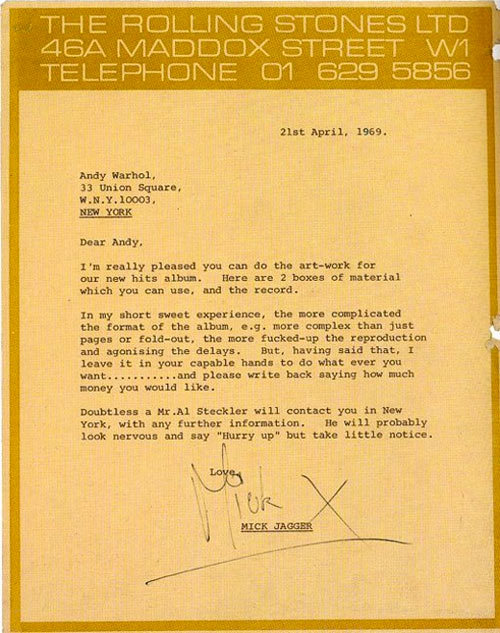
Update: Jagger’s letter to MC Escher didn’t work out quite as well.
By the way, please tell Mr. Jagger I am not Maurits to him, but
Very sincerely,
M. C. Escher.
(thx, @pjdoland)
A round pizza with radius ‘z’ and thickness ‘a’ has the volume pi*z*z*a. That and other math jokes are available on Wikipedia. Don’t you love it when people explain jokes:
In this case, DEAD refers to a hexadecimal number (57005 base 10), not the state of being no longer alive.
High larious. (via reddit)
Spacewar was one of the first video games and in 1972, Rolling Stone sent a 33-yo Stewart Brand to document the early days of computing as entertainment. The photographs were taken by a 23-yo Annie Leibovitz.
“We had this brand new PDP-l,” Steve Russell recalls. “It was the first minicomputer, ridiculously inexpensive for its time. And it was just sitting there. It had a console typewriter that worked right, which was rare, and a paper tape reader and a cathode ray tube display, [There had been CRT displays before, but primarily in the Air Defense System.] Somebody had built some little pattern-generating programs which made interesting patterns like a kaleidoscope. Not a very good demonstration. Here was this display that could do all sorts of good things! So we started talking about it, figuring what would be interesting displays. We decided that probably you could make a two-Dimensional maneuvering sort of thing, and decided that naturally the obvious thing to do was spaceships.”
You can play the original version of Spacewar in your Java-enabled browser.
Dogfighting vs. football in moral calculus orig. from Oct 12, 2009
Puddleblog orig. from Mar 12, 2008
The Rape Tunnel: FAKE orig. from Oct 14, 2009
Are you moving to San Francisco? orig. from Jul 07, 2009
The baked bean index and other economic indicators orig. from Sep 21, 2009
Inventing the past orig. from Oct 13, 2009
* Q: Wha? A: These previously published entries have been updated with new information in the last 24 hours. You can find past updates here.
PBS will be airing a two-hour-long documentary based on Michael Pollan’s excellent The Botany of Desire (previously recommended here).
The tulip, by gratifying our desire for a certain kind of beauty, has gotten us to take it from its origins in Central Asia and disperse it around the world. Marijuana, by gratifying our desire to change consciousness, has gotten people to risk their lives, their freedom, in order to grow more of it and plant more of it. The potato, by gratifying our desire for control, control over nature so that we can feed ourselves has gotten itself out of South America and expanded its range far beyond where it was 500 years ago. And the apple, by gratifying our desire for sweetness begins in the forests of Kazakhstan and is now the universal fruit. These are great winners in the dance of domestication.
A five minute preview of the show is available on YouTube:
I’ve watched the whole program and it’s a worthy companion to the book.
Update: PBS has put the whole thing online for free. (via unlikely words)
In 1973, Tom Snyder interviewed Alfred Hitchcock for the Tomorrow Show. Thought to be lost, the whole thing is now up on YouTube after being transferred from a VHS tape. Here’s part one:
To follow: part two, part three, part four, part five, and part six.
That’s the name of Ohio-based artist Richard Whitehurst’s latest work.
The artist plans to place himself in a room, the only entrance or exit being a 22 ft long plywood tunnel constructed by Whitehurst himself. Then he says that for the duration of the gallery’s opening (from 7:00 p.m. to midnight) he will rape anyone who travels through the tunnel into that room.
Whitehurst prototyped the idea with a previous project called The Punch-You-In-The-Face Tunnel.
As it turns out, I ended up breaking the nose of the third person to crawl through the tunnel, an aspiring model. She went to the hospital and eventually sued me. Her modeling career was put on hold. The civil case was long and drawn out and the matter still hasn’t been resolved. To this day she still has unpaid medical bills. The point of this long aside is that all this took place two years ago, and I’m still having an impact on this young lady’s life, something not many other artists could claim about their work.
Rape seemed like the next logical step.
Me? I would have built The Tickle Tunnel. I guess that’s why I’m not an artist. (via mxml)
Update: Oh, hell, it’s fake. (thx, dozens of people who aren’t saps like I am)
Tim Kreider muses on people’s changing relationships to each other as they grow older, specifically related to the choices that we’ve made in comparison to those around us.
The Referendum is a phenomenon typical of (but not limited to) midlife, whereby people, increasingly aware of the finiteness of their time in the world, the limitations placed on them by their choices so far, and the narrowing options remaining to them, start judging their peers’ differing choices with reactions ranging from envy to contempt. The Referendum can subtly poison formerly close and uncomplicated relationships, creating tensions between the married and the single, the childless and parents, careerists and the stay-at-home.
This article resonated with me to an uncomfortable degree, especially this line from a James Salter novel:
For whatever we do, even whatever we do not do prevents us from doing its opposite. Acts demolish their alternatives, that is the paradox.
Vivian Maier was a street photographer from the 1950s-70s in Chicago whose extensive body of work (40,000 negatives) was recently discovered at an auction. This blog is presenting that work to the public for (I think) the first time.
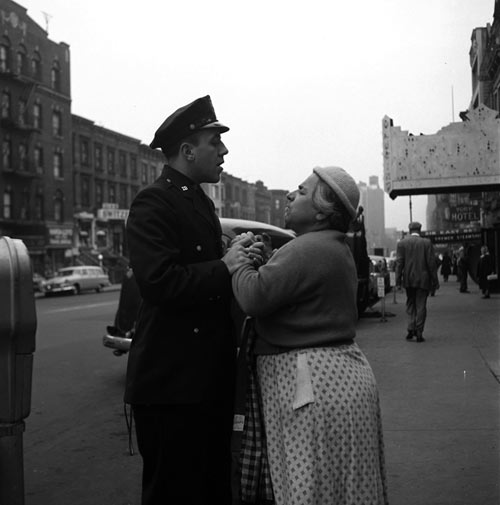
(thx, frank)
Update: Blake Andrews discusses some other photographers who came late to the public eye.
The other X factor in recognition is a curatorial champion. Bellocq had Friedlander. Atget had Abbot. Disfarmer had Miller. Without their discoverers, these photographers might still be anonymous. For Maier it’s been John Maloof. An interesting mental experiment is to wonder what would’ve happened had Maier posted her own photos on a blog while still alive. Would they have the same impact? Or would they just be another series of old images from some self-promoting has-been?
Socials & More