Some unknown person got the idea that avalanches could make a highly effective weapon. The avalanche war had begun. Avalanches could be started and even directed by just bombing a mountain. History has not yet calculated the exact number of deaths. Deaths have been estimated as high as 40,000 on each fighting side.
Claudia Goes to Class Wearing Sweatpants With Words On the Backside
Kristy’s Softball Friends Don’t Buy it That She’s Dating a Dude
Mary Anne Narcs On Her Roommate
When I was a kid, there were never enough books around the house that I hadn’t read (and I was apparently too lazy to go to the library) so when my younger sister started reading the Baby-Sitters Club series, I did too; she would finish a book and I’d pick it up right after her. At one point, I even got ahead of her and read the first six or seven in the series. This also explains why I’ve read all of the Anne of Green Gables series (yes, even Rilla of Ingleside), many of the Little House books, and quite a few Nancy Drew books. Anyway, great to see that Claudia, Kristy, Mary Anne, and Stacey made it to college!
I’ve made some little tweaks to kottke.org here and there. One little tweak was to the RSS feed…I’ve shored it up and moved to an Atom format. Aside from 40 unread duplicate entries flooding your feed reader (sorry, it’s a one time thing1), you shouldn’t notice a thing. Bug reports and feedback welcome.
[1] Oddly, Google Reader hiccuped this morning and spit out 40 unread duplicate entries for the kottke.org feed…before I even modified anything (i.e. not my fault). So a double apology to GR users. I hope this is the end of our Long National Unread Duplicate Entries Nightmare. ↩
I’m 23. I have a fresh liberal arts degree, $50,000 in student loans, and I can’t find a job. In the past, I’ve gotten through money-thin months by subletting my apartment or selling my personal possessions on eBay. But newly homeless and with my car, bike, and dressy trousers under new titles, I’ve nothing of worth left to proffer. Except, of course, myself.
For one of those Chicago adventures, we secretly borrowed a car almost as ridiculously conspicuous as the 1961 Ferrari 250 GT in the movie: my dad’s purple Cadillac El Dorado (yes, purple). Put an extra 113 miles on the odometer. Hoping to erase that telltale mileage, we raised the back on a pair of jacks and ran the car in reverse. The Caddy did not fly backward into a ravine, as in the film. What it did do is quickly take off a clean 10,000 miles. Oops. (Yes, you bet he noticed.)
Under close scrutiny, hardly any of the things we refer to as fruits actually are.
Strawberries, you will be glad to know, are a ‘false fruit’. Which seems reasonable enough. But at this point a small doubt started to grow in my mind… what, actually, then, was a real fruit? Oranges? No, they’re a modified berry. Bananas? Leathery berry. Plums? Drupe — fleshy bit with one stone inside.
Wilder scholarship is a flourishing industry, particularly at universities in the Midwest, and much of it seeks to sift fiction from history. The best book among many good, if more pedestrian, ones, “The Ghost in the Little House,” by William Holtz, a professor emeritus of English at the University of Missouri, explores a controversy that first arose after Wilder bequeathed her original manuscripts to libraries in Detroit and California. It is the work of a fastidious stylist, and, in its way, a minor masterpiece of insight and research. Holtz’s subject, however, isn’t Laura Ingalls Wilder. It is her daughter and, he argues, her unacknowledged “ghost,” Rose Wilder Lane.
Rose was an interesting character; she escaped the prairie life of her parents and transformed into a “a stylish cosmopolite who acquired several languages, enjoyed smoking and fornication, and dined at La Rotonde when she wasn’t motoring around Europe in her Model T”.
Calling all future-forward architects, urban designers, renegade planners and imaginative engineers: Show us how you would re-invent the suburbs! What would a McMansion become if it weren’t a single-family dwelling? How could a vacant big box store be retrofitted for agriculture? What sort of design solutions can you come up with to facilitate car-free mobility, ‘burb-grown food, and local, renewable energy generation? We want to see how you’d design future-proof spaces and systems using the suburban structures of the present, from small-scale retrofits to large-scale restoration—the wilder the better!
For the last several months, a large team of Googlers has been working on a secret project: a next-generation architecture for Google’s web search. It’s the first step in a process that will let us push the envelope on size, indexing speed, accuracy, comprehensiveness and other dimensions. The new infrastructure sits “under the hood” of Google’s search engine, which means that most users won’t notice a difference in search results.
Apple is finally offering the 15” MacBook Pro with an anti-glare screen. I bought a new MBP about a week before Marco but don’t want to pay $250 for the exchange even though the glossy screen bugs the shit out of me and ranks right up there with Apple’s worst design decisions ever (e.g. the Mighty Mouse and the puck mouse). Irritating.
Serious Eats made a short documentary (~9 min.) about the Union Square Greenmarket and one of the farmers who brings his goods to the market every week.
Now, here’s the part that really boggled me: the Consumption/Waste idea is a 1:1 correspondence (something in yields something out), what mathematicians call a linear function. The Parabola idea connects, pretty obviously, with parabolas — now we’re looking at x raised to the power of two. Annular Systems are modeled by circles which are given in analytic geometry by equations with both x^2 and y^2. Limits and Infinity, of course, become necessary in order to find the area of shapes under curves like parabolas and three-dimensional projections of circles.
Whoa. That is a tiny bit mind-blowing…do I really have time for a reread right now? (thx, nick)
Thom Yorke says that there will be no more Radiohead albums.
“None of us want to go into that creative hoo-ha of a long-play record again,” he said. “Not straight off … It worked with In Rainbows because we had a real fixed idea about where we were going. But we’ve all said that we can’t possibly dive into that again. It’ll kill us.”
“Was it a cultural choice that the Inuit up in the Arctic did not become farmers? No, it wasn’t. You could not have agriculture in the Arctic,” he bristles. “So it seems to me that the rise of agriculture in the modern world really does involve strong environmental influences. And if you want to call that geographical determinism, you can call it geographical determinism.
Even our closest relatives, the great apes, move smoothly from their juvenile to adult life phases — so why do humans spend an agonising decade skulking around in hoodies?
At the beginning of the 20th century, the idea of moving walkways was in vogue. After successes in Paris and Chicago, plans were drawn up for a three-speed moving sidewalk across the Brooklyn Bridge to alleviate traffic on the crowded bridge.
With the Brooklyn Bridge walkway, Schmidt upped the ante. This time he envisaged a loop system at each end of the bridge, with a series of four ever-faster walkways. Passengers moved from one to another until finally taking a seat on the benches aboard the fastest, which whisked them across the bridge at 16 km/h [~10 mph]. Because the system ran constantly, there would be no waiting and little momentum lost on stops and starts.
I found all my subjects through Craigslist. I began by asking the question “Are you masculine?” in the heading. In the body of the posting I talked briefly about the project. Much to the effect of: “I am doing a photography project on masculinity. If you identify as being masculine, please get back to me.”
Masculinity seems to involve a lot of shirtlessness (and pantslessness). This one is kind of amazing.
“I am masculine because I abandon women after taking their love. Because when you study Freud, you don’t let him study you. Because I study philosophy, not literature.”
More of States’ masculinity photos can be found on his web site.
At best, it would take 167 inbound lanes, or 84 copies of the Queens Midtown Tunnel, to carry what the NYC Subway carries over 22 inbound tracks through 12 tunnels and 2 (partial) bridges. At worst, 200 new copies of 5th Avenue. Somewhere in the middle would be 67 West Side Highways or 76 Brooklyn Bridges. And this neglects the Long Island Railroad, Metro North, NJ Transit, and PATH systems entirely.
Kinda puts the subway in perspective, doesn’t it? And don’t miss the map at the bottom that shows the size of the parking lots needed for all those cars.
The root bridges, some of which are over a hundred feet long, take ten to fifteen years to become fully functional, but they’re extraordinarily strong — strong enough that some of them can support the weight of fifty or more people at a time. In fact, because they are alive and still growing, the bridges actually gain strength over time — and some of the ancient root bridges used daily by the people of the villages around Cherrapunjee may be well over five hundred years old.
Warner Bros. didn’t know what to do with a movie about a killer robot who becomes a pacifist with the help of a patriotic kid in love with comics like Superman, the ultimate alien benevolent (and the Iron Giant’s eventual role model). “When we showed the executives the movie, they didn’t get it,” Iron Giant screenwriter Tim McCanlies said in 2003. One possible reason: The movie has no clearly defined protagonist or antagonist, a must for popcorn entertainment. “Let’s just have paranoia be the enemy,” McCanlies remembers Bird saying, “not the combined armies of the superpowers.” The Iron Giant’s domestic box office gross of $23 million didn’t come close to recouping the movie’s production budget, which reportedly hit $70 million.
As I’ve written before, 1999 was a great year for movies and The Iron Giant was one of my favorites. If you haven’t seen it, it’s only $6 on Amazon.
Well, of course, the big-market teams figured it out. They hired their own Ivy League consultants. They bought even better computers. Walks is only one tiny aspect in it … but who leads the American League in walks this year? The New York Yankees. Last year? The Boston Red Sox. The year before that? The Boston Red Sox. And so it goes. Now, six years later, it seems to me that the small-market teams are really grasping and trying to find some loophole, some opening that will allow them to win in this tough financial environment.
John told me about why he left Hollywood just a few years earlier. He was terrified of the impact it was having on his sons; he was scared it was going to cause them to lose perspective on what was important and what happiness meant. And he told me a sad story about how, a big reason behind his decision to give it all up was that “they” (Hollywood) had “killed” his friend, John Candy, by greedily working him too hard.
John saw something in me that I didn’t even see in myself. He had complete confidence in me as an actor, which was an extraordinary and heady sensation for anyone, let alone a 16-year-old girl. I did some of my best work with him. How could I not? He continually told me that I was the best, and because of my undying respect for him and his judgment, how could I have not believed him?
Rein him in, but only when necessary. You are his girlfriend, not his mother. If he wants to sing to the city on a giant float, let him do it. He’s a big man and he can deal with the consequences. You can nicely remind him, Look, if you do that there might be trouble, but if you throw a bitch fit and give him the silent treatmeant you will look fucking retarded when he has a new girlfriend on his arm from the impressive stunts he’s pulled.
Errol Morris shares Seven Lies About Lying, principles about lies often assumed to be true but which Morris believes are false.
5. Lying will be punished. Perhaps. But not as often as truth-telling. Lying effectively in many situations is generally superior than telling the truth, because often we have to search our minds for the truth, whereas a good lie can be easier to produce (though of course caution is indicated if the lie can be easily unmasked). Invariably a skillful liar makes a calculation about his chances of being exposed and avoids situations where a lie can be revealed. Lying is punished only if it is detected. A more reasonable assessment would be that ineffective and unskillful lying is severely punished. No one is held in greater contempt than an unskilled liar.
Morris also solicited Ricky Jay’s thoughts on a world without lying:
When you’re talking about Kant and trust, it made me think of one of the ways I tell people about the con game. I say, “You wouldn’t want to live in a world where you can’t be conned, because if you were, you would be living in a world with no trust. That’s the price you pay for trust, is being conned.”
Parking is heavily subsidized in the US; spaces in cities can cost between $10,000 and $50,000, a high price to pay to house hunks of metal that don’t do anything for 95% of the day.
Who pays for this? Everyone. The cost of building all that parking is reflected in higher rents, more expensive shopping and dining, and higher costs of home-ownership. Those who don’t drive or own cars thus subsidize those who do.
What is it about books that make them so truly great to read? I think it’s the way the words are printed on every page, the right way up and in just the right order.
This means you can start reading on the first page and then continue reading through the middle pages all the way to the last page.
Here are some of my absolute favorite books. War, by Leo Tolstoy. A great read. Bonus: You can get it as part of a two-volume edition which includes Peace by the same great author.
Shakespeare, by Shakespeare. He has so many great lines. “Shall I compare thee to a summer’s day?” “Frankly, my dear, I don’t give a damn.” “I am the Walrus.” “My heart will go on.” They’re part of the language.
Next week, we learn to peel a banana with a world-expert fruit psychologist.
As I write this, I am finishing the amazing three-week-long “Clean” detox program detailed below. Designed by New York cardiologist and detoxification specialist Dr. Alejandro Junger, this program allowed me to work and exercise regularly, something I cannot do if I am on a liquid-only detox. I followed it to the letter and I can report that it worked wonders. I feel pure and happy and much lighter (I dropped the extra pounds that I had gained during a majorly fun and delicious “relax and enjoy life phase” about a month ago). I also really enjoyed learning about the incredible health benefits of resting your digestive system, etc. This thing is amazing. And don’t forget to ask your doctor if a cleanse is right for you.
Cleanses, “relax and enjoy life phase”, resting your digestive system…I don’t know where to begin. (thx, dj jacobs)
Of Wrestling with Moses, the story of how Jane Jacobs took on Robert Moses and his plans for two Manhattan freeways, Tyler Cowen says:
The parts of this book about Jacobs are splendid. The parts about Moses are good, though they were more familiar to me. I believe there has otherwise never been much biographical material on Jacobs’s life.
Writing about the city remained her passion. She often went up to the rooftop of her apartment building and watched the garbage trucks as they made their way through the city streets, picking the sidewalks clean. She would think, “What a complicated great place this is, and all these pieces of it that make it work.” The more she investigated and explored neighborhoods, infrastructure, and business districts for her stories, the more she began to see the city as a living, breathing thing — complex, wondrous, and self-perpetuating.
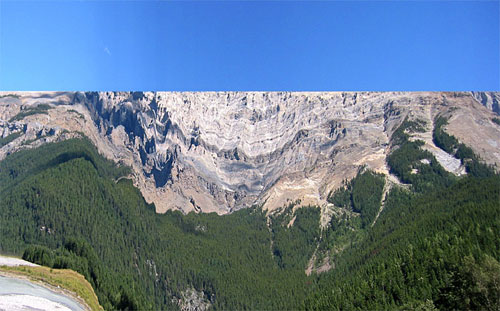
Photographs of mountains are computationally altered to flatten the mountain’s elevations, while an ocean horizon is altered to mimic the mountain’s original topography.
In the comments, he mentions that the effect is done with a combination of JavaScript and Photoshop…which I didn’t even know was a thing. (via today and tomorrow)
The dialogue is almost invariably witty, but the silences, of which there are many, speak loudest: Mad Men is a series in which an episode’s most memorable scene can be a single shot of a woman at the end of her day, rubbing the sore shoulder where a bra strap has been digging in. There’s really nothing else like it on television.
The article mentions that the show’s core group of writers are all women. The show’s portrayal of women is what really drew me into the show. The first 2-3 episodes were nothing but men behaving badly and I was ready to give up on it but then came episode 4 and it was like, oh, the women are sticking it to the men now…this could be interesting.
Behind the smooth-talking, chain-smoking, misogynist advertising executives on “Mad Men” is a group of women writers, a rarity in Hollywood television. Seven of the nine members of the writing team are women. Women directed five of the 13 episodes in the third season. The writers, led by the show’s creator Matthew Weiner, are drawing on their experiences and perspectives to create the show’s heady mix: a world where the men are in control and the women are more complex than they seem, or than the male characters realize.
Hurricane Katrina proved that modern America is resilient. It didn’t prove that we’ll be around forever. After watching the place where I grew up avert total annihilation, I can’t help but wonder what course of events will eventually wipe out New Orleans and America as a whole. When it comes to human civilization, entropy conquers all: Rome fell, the Aztecs were conquered, the British Empire withered, and the Soviet Union cracked apart. America may be exceptional, but it’s not supernatural. Our noble experiment, like every other before it, has to end sometime.
You know that image that’s been going around that shows several revisions to the Pepsi logo while the Coca-Cola logo is the same as it’s been since 1885? It tells a compelling story…Pepsi shifting its brand every few years in an attempt to catch up to steady market leader Coca-Cola. But of course it’s bullshit…Armin Vit constructs a more accurate brand timeline that shows many Coca-Cola logos over the years.
Man shaves head, walks across China for a year, grows beard & crazy hair, and takes daily photos and short videos of himself along the way, which he stitches into this.
“Thirty hours ago, Euna Lee and I were prisoners in North Korea,” Ms. Ling said in brief remarks to reporters, blinking back tears. “We feared that at any moment we could be prisoners in a hard labor camp. Then suddenly we were told that we were going to a meeting. We were taken to a location and when we walked through the doors, we saw standing before us President Bill Clinton.”
One could imagine a chart of the possible range of human experiences from negative to positive circa 2009; near one end would be “prisoners in a North Korean hard labor camp” and near the other, “personal meeting with President Bill Clinton”.
Update:Christopher Hitchens says that Clinton’s trip did little but gratify and flatter Kim Jong-il.
The Kim Jong-il gang was always planning to release them. They were arrested in order to be let go and were maintained in releasable shape until the deal could be done. Does this not — or should this not — slightly qualify and dilute our joy in seeing them come home? Does the Dear Leader not say to himself, That was easy? Are the North Korean people not being assured, through their megaphone media, that the sun shines so consistently out of the rear end of their celestial boss that even powerful U.S. statesmen will appear at the airport to bring apologies, pay tribute, and receive custody of uninvited guests in the workers’ paradise?
It is the story of a teenage girl who, after being brutally raped and murdered, watches from heaven as her family and friends go on with their lives, while she herself comes to terms with her own death.
Jackson personally purchased the film rights to the book and from the trailer, it seems like this is a return to his Heavenly Creatures days, with a bit of the LOTR fantasy and special effects sprinkled in. Looking forward to this one.
This slide deck is our current best thinking about maximizing our likelihood of continuous success.
There are literally dozens of great ideas on these 128 slides…a must-read for anyone who wants their business to grow and last for more than a few years.
What do you think are the odds that you will die during the next year? Try to put a number to it — 1 in 100? 1 in 10,000? Whatever it is, it will be twice as large 8 years from now. This startling fact was first noticed by the British actuary Benjamin Gompertz in 1825 and is now called the “Gompertz Law of human mortality.” Your probability of dying during a given year doubles every 8 years. For me, a 25-year-old American, the probability of dying during the next year is a fairly miniscule 0.03% — about 1 in 3,000. When I’m 33 it will be about 1 in 1,500, when I’m 42 it will be about 1 in 750, and so on. By the time I reach age 100 (and I do plan on it) the probability of living to 101 will only be about 50%. This is seriously fast growth — my mortality rate is increasing exponentially with age.
Read the whole thing…it’s not that long and is super interesting. (via mr)
The NY Times has named their replacement for outgoing restaurant critic Frank Bruni: current Times editor Sam Sifton. This is good news for me…I look a bit like Sifton; if I’m mistaken for him and incur favorable treatment at restaurants because of it, I won’t complain.
VICE THREE: PUT GAMBLING FIRST Gambling is at the heart of every worthwhile accomplishment in life. Consequently, vice three is essential for the success of your creativity. Instinctively, the highly creative person knows that nothing matters except the throw of the dice. As the French say, “There are two great pleasures in gambling: that of winning and that of losing.” Or, in the words of Mark Twain, “There are two times in a man’s life when he should [gamble]: when he can’t afford it and when he can.” These are vital lessons.
Watch as David Attenborough signals his interest in mating with a male cicada. Scientists think that cicadas have 13- or 17-year mating cycles because, being prime numbers, those periods are not divisible by those periods of potential predators. From Stephen J. Gould:
Many potential predators have 2-5-year life cycles. Such cycles are not set by the availability of cicadas (for they peak too often in years of nonemergence), but cicadas might be eagerly harvested when the cycles coincide. Consider a predator with a life-cycle of five years: if cicadas emerged every 15 years, each bloom would be hit by the predator. By cycling at a large prime number, cicadas minimize the number of coincidences (every 5 x 17, or 85 years, in this case). Thirteen- and 17-year cycles cannot be tracked by any smaller number.
Note: If you are a member and tried to log in, it didn't work, and now you're stuck in a neverending login loop of death, try disabling any ad blockers or extensions. Or try logging out and then back in. Still having trouble? Email me!







Socials & More