a conspiracy of theorists
an array of geeks
a melancholy of goths (more here)
a pratfall of clowns
an argument of lawyers
a tantrum of 2 year olds
a fondling of vicars
a meta of collective nouns
Update: And I’d completely forgotten about the perfection of a fixie of hipsters.
Update:An Exaltation of Larks is a book chock full of collective nouns written by James Lipton (yes, that James Lipton). (thx, david)
Walking home, I realized being certified isn’t necessarily about providing the aid. I didn’t stop the bleeding, though it subsided on its own. I didn’t try to examine her. This was in part because she refused my help initially but also because I knew the ambulance would be along soon. Mostly it was about providing comfort to someone in a difficult situation, helping them feel ok, and letting them know they weren’t alone. The certification gave me the confidence to do that: to kneel on the sidewalk, holding an old woman’s hand, and to help make those scary few minutes hopefully just a little bit better.
Features include four-player collaborative play (!!) and something called “demo play”.
The game will also be the first game on the Wii to feature “demo play”, where players will be able to pause the game, let the game complete the level for them, and resume play at any time by unpausing.
In my house, this was called the “give the controller to my 11-year-old cousin and let him show you how it’s done” feature. I both hated and loved that feature. (via object of my obsession)
After a lengthy stare down, the maitre d’ shows you to your table. Once seated, you must adhere to two conditions: you will cook your own meal with your own ingredients, and no photography. If you refuse these terms, you will be warned that a crushing defeat will soon be brought down upon your soul. Don’t give in, though; stick to your guns (to coin a phrase), and ask calmly for a menu. But don’t press your luck by asking for water. This is very important.
The Cove is a 2009 documentary film documenting the annual killing of more than 2,500 dolphins in a cove at Taiji, Wakayama in Japan. The film was directed by former National Geographic photographer Louis Psihoyos, and was filmed secretly during 2007 using underwater microphones and high-definition cameras disguised as rocks.
Dave Eggers has written a young adult novel called The Wild Things that is based loosely on Maurice Sendak’s Where the Wild Things Are and the screenplay he co-wrote with Spike Jonze for the movie version. The New Yorker published an excerpt of the book this week.
Max left the room and found Gary lying on the couch in his work clothes, his frog eyes closed, his chin entirely receded into his neck. Max gritted his teeth and let out a low, simmering growl.
Gary opened his eyes and rubbed them.
“Uh, hey, Max. I’m baggin’ a few after-work Z’s. How goes it?”
Max looked at the floor. This was one of Gary’s typical questions: Another day, huh? How goes it? No play for the playa, right? None of his questions had answers. Gary never seemed to say anything that meant anything at all.
“Cool suit,” Gary said. “Maybe I’ll get me one of those. What are you, like a rabbit or something?”
But while I was working on the book, it was funny, because I started going in new directions, different from any of the screenplay versions, pushing it into some territory that was personal to me. So in a way the movie is more Spike’s version of Maurice’s book, and this novel is more my version.
In reality, these longstanding facts provide the true foundation of journalism. But in practice, they play second-fiddle to the news, condensed beyond all meaning into a paragraph halfway down in a news story, tucked away in a remote corner of our news sites.
Again, my fingers were typing nonsense. Could I have made the same mistake twice? No, I was definitely starting out in the correct position. I watched my fingers move as I typed. Nothing looked wrong. The sensation was just as familiar as any other time I typed. My fingers moved with the same confidence, as though they knew exactly where they were going to reach the letters they needed to hit. And yet: gibberish on the screen.
Don’t miss the cliffhanger in the final paragraphs.
Sonar Ruler is an iPhone app that uses clicking sounds to measure distances.
Basically it uses the iPhone’s speaker to send out a short click sound and it then measures how long it takes for that sound to bounce off of something in the environment. It can be quite accurate to within an inch or so when used in the right situations. I’ll say right upfront it’s not perfect, and cannot measure something small like a person. It works best on a large flat surface that is perpendicular to the iphone (like a large wall.)
Things that come to mind: “reverify our range to target…one ping only”, the boy who sees by clicking, Daredevil, the last 30 minutes of The Dark Knight, and this app is going to be many architects’ new best friend. (thx, matt)
Friday, August 14th at 1pm marked the opening event of the Midtown Games: Olympics, and was attended primarily by the city’s punch-drunk, heat-stroked interns. With the blare of a foghorn the crowd closed in like a shield, trumpets sang out “Eye of the Tiger” and five swimmers in Speedos and caps leapt into the burbly water of a decorative fountain to swim its 50 metres or so in elegant racing style.
Inspired by the Steve Ward Diet, an iPhone developer wrote Bang Bang Diet to help you “diet like a robot”. Again, here are the rules:
You plot your desired weight on a desired date towards the right side, making sure that you’ve left the correct number of lines in between (one per day). You draw a line from the current weight/date to the desired weight/date. Every morning you weigh yourself and plot the result. If the point is below the line, you eat whatever you want all day. If the point is above the line, you eat nothing but broccoli or some other low-calorie food.
The app takes care of the plot for you and tells you either to “Eat Normal” or “Eat Light” on any particular day. Only $1.99 at the App Store.
Update: The folks behind Bang Bang Diet have cleverly applied the same idea to budgeting with their Simple Budget app…the app tells you to “Spend” or “Don’t Spend” based on how much you’ve already spent for the day.
THE GOONIES: Physically abused, retarded man finds love with overweight preteen. THE PASSION OF THE CHRIST: Mel Gibson fulfills fantasy of showing a Jew beaten to a bloody pulp and killed on-screen. TITANIC: Crazy old widow disregards lifelong memories of husband, children, and grandchildren in favor of that one time she fucked a bum. STAR WARS: Religious extremist terrorists destroy government installation, killing thousands. LORD OF THE RINGS: Midget destroys stolen property. DOCTOR WHO: Elderly man serially abducts young women. BOOGIE NIGHTS: Deformed boy goaded into life of crime.
The possibility of a sudden time-in would loom large in every coach’s mind at the most tense points in the game, introducing just enough concern and uncertainty to make the game different. Timeworn clock-management strategies would no longer be a given. And yet, for the average viewer on a Sunday, the game on the field would still be your father’s football.
In “Extract,” writer/director Mike Judge returns to the fertile territory of the American workplace, rotating his perspective away from the white collar cubicle warriors of “Office Space” and towards a blue collar boss — a small business owner — who employs an odd cast of losers, loners and misfits in his flavor extract factory.
Tarantino doesn’t just explore language’s capacity to reveal and conceal motives and personality, he shows how people pick words and phrases (consciously or subconsciously) in order to define themselves and others, and describe the reality they inhabit (or would like to inhabit). Even low-key and seemingly unimportant exchanges are as carefully choreographed as boxing matches. Clever flurries of interrogatory jabs are often blocked by witty responses; the course of conflict can be shifted by deft rhetorical footwork that re-frames the terms of debate.
The influential design magazine Emigre stopped publishing issues back in 2005, but now they’re releasing issue No. 70, which is actually a hardcover book celebrating the best of Emigre from the past 25 years.
This book, designed and edited by Emigre co-founder and designer Rudy VanderLans, is a selection of reprints, using original digital files, tracing Emigre’s development from its early bitmap design days in the late 1980s through to the experimental layouts that defined the so called “Legibility Wars” of the late 1990s, to the critical design writing of the early 2000s.
Can you resist reading an article that starts off with an anecdote this interesting? I couldn’t.
The playwright David Mamet and the theatre director Gregory Mosher affirm that some years ago, late one night in the bar of the Ritz-Carlton Hotel in Chicago, this happened:
Ricky Jay, who is perhaps the most gifted sleight-of-hand artist alive, was performing magic with a deck of cards. Also present was a friend of Mamet and Mosher’s named Christ Nogulich, the director of food and beverage at the hotel. After twenty minutes of disbelief-suspending manipulations, Jay spread the deck face up on the bar counter and asked Nogulich to concentrate on a specific card but not to reveal it. Jay then assembled the deck face down, shuffled, cut it into two piles, and asked Nogulich to point to one of the piles and name his card.
“Three of clubs,” Nogulich said, and he was then instructed to turn over the top card.
He turned over the three of clubs.
Mosher, in what could be interpreted as a passive-aggressive act, quietly announced, “Ricky, you know, I also concentrated on a card.”
After an interval of silence, Jay said, “That’s interesting, Gregory, but I only do this for one person at a time.”
Mosher persisted: “Well, Ricky, I really was thinking of a card.”
Jay paused, frowned, stared at Mosher, and said, “This is a distinct change of procedure.” A longer pause. “All right-what was the card?”
“Two of spades.”
Jay nodded, and gestured toward the other pile, and Mosher turned over its top card.
The deuce of spades.
A small riot ensued.
That’s from a 1993 profile of Ricky Jay, who is probably more well known now for his acting (Magnolia, Boogie Nights, Deadwood, The Spanish Prisoner, The Prestige) than his magic scholarship. Check out a couple of Jay’s tricks on YouTube: Four Queens and Sword of Vengence. (via df)
In the future, a famous person will die every fifteen minutes. Already it’s happening. The ascent of the microcelebrities, the 24 hour news cycle, citizen journalism, and our darkest fantasies all collide on Twitter now. The website’s rhetorical question “What are you doing?” sometimes feels more like “Who died today?”
Chances are in 15-20 years, someone famous whose work you enjoyed or whom you admired or who had a huge influence on who you are as a person will die each day…and probably even more than one a day. And that’s just you…many other famous people will have died that day who mean something to other people. Will we all just be in a constant state of mourning? Will the NY Times national obituary section swell to 30 pages a day? As members of the human species, we’re used to dealing with the death of people we “know” in amounts in the low hundreds over the course of a lifetime. With higher life expectancies and the increased number of people known to each of us (particularly in the hypernetworked part of the world), how are we going to handle it when several thousand people we know die over the course of our lifetime?
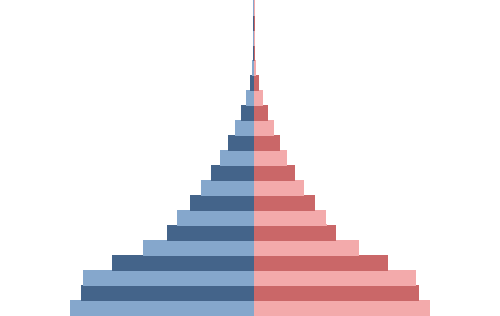
The population pyramid for who the average American knows (or knows of enough to care) probably looks something like this:
That’s a lot of future death.
Update:On Twitter, Kurt Anderson quoted David Kipen:
Baby Boomers have created so many celebrities that, in the future, somebody famous will die every fifteen minutes.
This summer could come to be known as the summer when baby boomers began to turn to the obituary pages first, to face not merely their own mortality or ponder their legacies, but to witness the passing of legends who defined them as a tribe, bequeathing through music, culture, news and politics a kind of generational badge that has begun to fray.
Taken together, 30-plus years of research add up to an increasingly persuasive conclusion: exposure to pesticides and other toxins increases the risk of Parkinson’s disease, and we are only now beginning to wrestle with the true scope of the damage.
Momus is first out of the gate with a summary of the 00s, what he calls a “mister narrative of the decade”…a one-man master narrative.
Other things that looked dead or dying this decade: I personally stopped going to the cinema. Why sit behind someone’s head in a fleapit when you can download all you need to see and project it at home? Copyright effectively died, overtaken, de facto, by events on the internet. Magazines and newspapers ended the decade looking very unhealthy indeed, although books seemed strong. Young people got a lot less interested in cars, leading some to label Japan a post-car society. Detroit pretty much collapsed. The polar ice caps melted rapidly; climate change is a fact. Banks — having invented what they thought were clever ways to spread risk around, and play with planet-sized sums of entirely fictional money — looked pretty shaky.
Bottled water is bad but Fiji bottled water is particularly odious. For starters, the country’s military regime monitors internet usage at internet cafes in real-time for information about the popular bottled water brand:
I sat down and sent out a few emails — filling friends in on my visit to the Fiji Water bottling plant, forwarding a story about foreign journalists being kicked off the island. Then my connection died. “It will just be a few minutes,” one of the clerks said. Moments later, a pair of police officers walked in. They headed for a woman at another terminal; I turned to my screen to compose a note about how cops were even showing up in the Internet cafes. Then I saw them coming toward me. “We’re going to take you in for questioning about the emails you’ve been writing,” they said.
Then the cops threatened the reporter with prison rape. The rest of the story isn’t much better.
This is why you shouldn’t text while driving. While you’re at it, knock it off with the phone conversations, lipstick application, and crossword puzzles. NSFW or for the faint-of-heart.
Television operators, the people who buy and produce things for people to watch on TV, are taking the position that films photographed in the 2.40:1 ratio should be blown up or chopped up to fit a 16:9 (1.78:1) ratio. They are taking the position that the viewers of television do not like watching 2.40 films letterboxed to fit their 16:9 screens, and that a film insisting on this is worth significantly less — or even nothing — to them.
He has particular contempt for AMC and HBO:
[HBO wants] everything pan/scanned. On the Ocean’s films I had to get somebody VERY HIGH UP WITH WAY BETTER SHIT TO DO to call them and make an exception. Their influence means they could make this problem go away single-handedly, but since they won’t, they get to be the poster child for stupidity. Not that they’re uninterested in hypocrisy too; while their PR caters to the most adventurous TV watchers, their actions indicate they think their viewers are very, very afraid of anything actually different.
I watched The Darjeeling Limited on Starz a few months ago. This is a movie where the wider aspect ratio is almost another character and the knuckleheads at Starz chopped the hell out of it. Blech.
Pressed for more details, Pietsch cites a commencement speech that Wallace gave at Kenyon University in 2005, which he says is “very much a distillation” of the novel’s material. “The really important kind of freedom,” said Wallace, “involves attention and awareness and discipline, and being able truly to care about other people and to sacrifice for them over and over in myriad petty, unsexy ways every day. That is real freedom… The alternative is unconsciousness, the default setting, the rat race, the constant gnawing sense of having had, and lost, some infinite thing.”
So, in a frankly insane healthcare reform effort, [Turkmenistan’s “President for Life” Saparmurat Niyazov] restricted the public’s access to care by replacing up to 15,000 doctors and nurses with unqualified military conscripts. The next year, he ordered hospitals and clinics outside of the capital, Ashgabat, to close — even though the vast proportion of Turkmenistan’s population lives in rural areas. The BBC quoted him as saying, “Why do we need such hospitals? If people are ill, they can come to Ashgabat.” He also implemented fees and created an “unofficial” ban on the diagnosis of certain communicable diseases, like hepatitis.
Battle Royale
Anything Else
Audition
Blade
Boogie Nights
Dazed & Confused
Dogville
Fight Club
Fridays
The Host
The Insider
Joint Security Area
Lost In Translation
The Matrix
Memories of Murder
Police Story 3
Shaun of the Dead
Speed
Team America
Unbreakable
At the track and field world championships in Germany this evening, Usain Bolt set another world record in the 100-meters: 9.58 seconds, besting his previous record of 9.69. Can he go under 9.5?
Update:Here’s the race in HD. It’s a lot closer than the Olympic final…Gay was really hauling as well. The Times reports that the 0.11 seconds Bolt shaved off the record was the largest difference since the advent of electronic timing in 1977.
But second off, you can also see that Usain Bolt is running much faster than humans ought to be running right now. This should give you an inkling of just how special these performances we’re seeing from him are. We shouldn’t be seeing times like this until the 2030s. Which means, honestly, that it ought to take around 30 years for someone else to come along and break his record.
Adam Lisagor notices that the iPhone 3GS camera might always be buffering images so that when you press that shutter button, you get the photo that you wanted, not the one delayed by slow software or a slow shutter. Adam’s observation gives me the opportunity to trot out one of my recent favorite informational factoids about the super high-speed cameras used to capture jumping great white sharks:
In order to get the jaw-dropping slow-motion footage of great white sharks jumping out of the ocean, the filmmakers for Planet Earth used a high-speed camera with continuous buffering…that is, the camera only kept a few seconds of video at a time and dumped the rest. When the shark jumped, the cameraman would push a button to save the buffer.
In Lower Manhattan, my computer screen fizzled and the air conditioner cut off. While walking back to Brooklyn over the Manhattan Bridge I heard the following rumors: 1) The power’s out in the entire country; 2) The power’s out in the entire country and all of Canada; 3) There was an explosion and somebody’s definitely behind this but I don’t know who. (The last one was from a cop.)
I reach 18th Street. Some shops are open, most are not. The ice cream shop is doing good business. The owner of a bodega has barricaded the door with shelves of food and stands watch with his employees.
The Supreme Court ruling in the Bryan case was expansive. More than just a ruling on taxation, it declared that states and the feds had the right to police the reservation only in the interest of “law and order” and had no civil or regulatory jurisdiction over sovereign Indian nations. Until this time, tribes and states more or less assumed that states had civil and regulatory power on reservations. But the Supreme Court maintained that as sovereign nations, Indian tribes had always had the right to govern themselves (including civil and regulatory powers), just as all nations do, and that tribes should deal with the U.S. federal government, not with states. Kansas, for example, has no power to levy taxes in Luxembourg — and not only because Luxembourg is far away.
Initially, I was attracted to the noisy amateur aesthetic of the raw images. Street Views evoked an urgency I felt was present in earlier street photography. With its supposedly neutral gaze, the Street View photography had a spontaneous quality unspoiled by the sensitivities or agendas of a human photographer. It was tempting to see the images as a neutral and privileged representation of reality — as though the Street Views, wrenched from any social context other than geospatial contiguity, were able to perform true docu-photography, capturing fragments of reality stripped of all cultural intentions.
Let’s say, for example, you want to bet on one of the highlights of the British sporting calendar, the annual university boat race between old rivals Oxford and Cambridge. One bookie is offering 3 to 1 on Cambridge to win and 1 to 4 on Oxford. But a second bookie disagrees and has Cambridge evens (1 to 1) and Oxford at 1 to 2.
Each bookie has looked after his own back, ensuring that it is impossible for you to bet on both Oxford and Cambridge with him and make a profit regardless of the result. However, if you spread your bets between the two bookies, it is possible to guarantee success (see diagram, for details). Having done the calculations, you place £37.50 on Cambridge with bookie 1 and £100 on Oxford with bookie 2. Whatever the result you make a profit of £12.50.
I say relatively because there are literally millions of pages on the web just about blackjack statistics. For instance, it’s easy to see how you’ll lose money playing blackjack in the long run — card counting aside — by looking at this house edge calculator. The only real advantage to the player occurs with a one-deck shoe and a bunch of other pro-player rules, which I imagine are difficult to find at the casinos. (via big contrarian)
In Multitask, you start off playing one game and then another and so on until you’re playing several games at the same time. I am horrible at this. (via waxy)
Atul Gawande and some colleagues searched the US for healthcare successes — hospitals and clinics where costs are relatively low and quality of care is high — and came up with a few lessons.
If the rest of America could achieve the performances of regions like these, our health care cost crisis would be over. Their quality scores are well above average. Yet they spend more than $1,500 (16 percent) less per Medicare patient than the national average and have a slower real annual growth rate (3 percent versus 3.5 percent nationwide).
I wanted this article to be much longer than it was with breakouts of each of the ten lessons with lengthy explanations.
Note: If you are a member and tried to log in, it didn't work, and now you're stuck in a neverending login loop of death, try disabling any ad blockers or extensions. Or try logging out and then back in. Still having trouble? Email me!







Socials & More