kottke.org posts about video
One of my favorite Wikipedia articles is the timeline of the far future, which details the predictions science makes about the possible futures of the Earth, solar system, galaxy, and universe, from Antares exploding in a supernova visible from Earth in broad daylight in 10,000 years to the end of star formation in galaxies 1 trillion years from now…and beyond.
In his new video, Timelapse of the Future, John Boswell takes us on a trip through that timeline, a journey to the end of time.
We start in 2019 and travel exponentially through time, witnessing the future of Earth, the death of the sun, the end of all stars, proton decay, zombie galaxies, possible future civilizations, exploding black holes, the effects of dark energy, alternate universes, the final fate of the cosmos — to name a few.
A regular time lapse of that voyage would take forever, so Boswell cleverly doubles the pace every 5 seconds, so that just after 4 minutes into the video, a trillion years passes in just a second or two.1 You’d think that after the Earth is devoured by the Sun about 3 minutes in, things would get a bit boring and you could stop watching, but then you’d miss zombie white dwarfs roaming the universe in the degenerate era, the black hole mergers era 1000 trillion trillion trillion trillion years from now, the possible creation of baby “life boat” universes, and the point at which “nothing happens and it keeps not happening forever”.
Why do we dance? It’s a silly question because the answer seems obvious — “because we want to, duh” — but this video from Aeon looks a bit closer at why humans like to collectively move to the beat. It has to do with our social nature and this great phrase, “collective effervescence”.
The answer, it seems, is in our need for social cohesion - that vital glue that keeps societies from breaking apart despite interpersonal differences. The French sociologist Émile Durkheim (1858-1917) theorised that ‘collective effervescence’ — moments in which people come together in some form of unifying, excitement-inducing activity — is at the root of what holds groups together. More recently, Bronwyn Tarr, an evolutionary biologist and psychologist at the University of Oxford who is also a dancer, has researched the evolutionary and neurological underpinnings of our innate tendency to bust a move. Drawing on the work of both Durkheim and Tarr, this Aeon Original video explores that unifying feeling of group ‘electricity’ that lifts us up when we’re enthralled by our favourite sports teams, participating in religious rituals, entranced by music - and, yes, dancing the night away.
You can read more about Durkheim and his work here and about Tarr’s work here.
One hypothesis is that it provides an opportunity for people to come together, making them move — dance — and in doing so we experience internal hormonal cascades which are made up of ‘feel good’ chemicals. These bursts of chemicals are part of our brain’s pain and pleasure and reward circuitry, and when they are triggered they provide an experience of elation and positive reward. When we get this kick in the presence of others, the result is that of collective joy — positive, shared experiences through which we establish and maintain important social connections with others. Now we feel like we belong to a unified, cohesive whole.
Being part of a cohesive social group would have been really important for our ancestors — collaborating with others to find shelter, hunt, rear young would have increased our chances of survival. Music and dance are by no means the only ways we can stimulate these positive social ‘highs’. But they’re really good ways of doing it because it’s an experience that we can share with lots of people at once. In order to understand why that would have given us such a great advantage we need to look at our species in the context of primates.
(via open culture)
NVIDIA has been doing lots of interesting things with deep learning algorithms lately (like AI-Generated Human Faces That Look Amazingly Real). Their most recent effort is the development and training of a program that takes rough sketches and converts them into realistic images.
A novice painter might set brush to canvas aiming to create a stunning sunset landscape — craggy, snow-covered peaks reflected in a glassy lake — only to end up with something that looks more like a multi-colored inkblot.
But a deep learning model developed by NVIDIA Research can do just the opposite: it turns rough doodles into photorealistic masterpieces with breathtaking ease. The tool leverages generative adversarial networks, or GANs, to convert segmentation maps into lifelike images.
Here’s a post I did 10 years ago that shows how far sketch-to-photo technology has come.
This two-minute scene rendered in real-time by a video game engine is almost indistinguishable from real life. Petapixel explains what’s going on here:
To prepare for the project, Quixel spent a month in cold and wet locations in Iceland, scanning all kinds of objects found in the natural environment using. The team returned with over 1,000 scans that captured the details of the landscape.
Using the scans — a part of Quixel’s Megascans library — a team of three artists at Quixel created the 1:45 cinematic film in real-time using the power of the Unreal Engine 4 game engine.
Ikea furniture is so ubiquitous that all sorts of hacks and modifications have been designed by fans to coax new uses out of familiar shelves and tables. Now Ikea itself has gotten into the hacks game by partnering with a pair of Israeli non-profits to develop modifications to their products to help make them more accessible and useful for people with disabilities.
The 3D model for each of the hacks is available for free download and can then be constructed with a 3D printer. Cane By Me is a ledge for a cane or walking stick that attaches to the Malm bed frame:
Glass Bumper is a wheelchair bumper that protects the glass doors on Billy bookshelves:
Couch Lift fits around the legs of the Karlstad sofa, raising it further off the ground for easier sitting & standing:
(via fast company)
2018’s most visually inventive movie was Spider-Man: Into the Spider-Verse. In this video, Danny Dimian, Visual Effects Supervisor, and Josh Beveridge, Head of Character Animation, talk about how they and their team created the look of the movie.
Two of my favorite details of the movie were the halftone patterns and the offset printing artifacts used to “blur” the backgrounds and fast-moving elements in some scenes. Borrowing those elements from the comic books could have gone wrong, it could have been super cheesy, they could have overused them in a heavy-handed way. But they totally nailed it by finding ways to use these techniques in service to the story, not just aesthetically.
Oh and the machine learning stuff? Wow. I didn’t know that sort of thing was being used in film production yet. Is this a common thing?
Update: Simon Willison did a Twitter thread that points to dozens of people who worked on Spider-Verse explaining how different bits of the film got made. What an amazing resource…kudos to Sony Animation for allowing their artists to share their process in public like this.
In the latest episode of Nerdwriter, Evan Puschak examines how Ian McKellen does a lot of heavy lifting with his eyes, especially in the Lord of the Rings trilogy. On his way there, I really liked Puschak’s lovely description of the physical craft of acting:
Part of that craft is understanding and gaining control of all the involuntary things we do when we communicate — the inflection of the voice, the gestures of the body, and the expressions of the face.
P.S. Speaking of actors being able to control their faces, have you ever seen Jim Carrey do wordless impressions of other actors? Check this out:
The Jack Nicholson is impressive enough but his Clint Eastwood (at ~1:15) is really off the charts. Look at how many different parts of his face are moving independently from each other as that jiggling Jello mold eventually gather into Eastwood’s grimace. Both McKellen and Carrey are athletic af in terms of their body control in front of an audience or camera.
Open the canned peaches because Al Swearengen, Seth Bullock, and the rest of your Deadwood favorites are back on May 31 in Deadwood: The Movie. Here’s a tease:
Swearengen: You ever think, Bullock, of not going straight at a thing?
…
Bullock: No.
I’m in 1000%. For more on the movie’s action/plot, read Tim’s post from December.
From America’s Test Kitchen and Dan Souza, the editor-in-chief of Cook’s Illustrated, a YouTube series called What’s Eating Dan? In each episode, Souza picks a different food — pizza, rice, salmon — shares some of the science involved, and then shows us the best way to cook it. For starters, I’d suggest the first episode on burgers and a more recent one on mushrooms:
From London motion design studio Mr. Kaplin, an animated alphabet where the animation for each letter is a experiment that was completed in a single day.
See also The ABCs in Motion.
If you look at the orbits of the planets adjacent to the Earth’s orbit (Venus & Mars), you’ll see that Venus’s orbit is closest to our own. That is, at its closest approach, Venus gets closer to Earth than any other planet. But what about the average distance?
According to this article in Physics Today by Tom Stockman, Gabriel Monroe, and Samuel Cordner, if you run a simulation and do a proper calculation, you’ll find that Mercury, and not Venus or Mars, is Earth’s closest neighbor on average (and spends more time as Earth’s closest neighbor than any other planet):
Although it feels intuitive that the average distance between every point on two concentric ellipses would be the difference in their radii, in reality that difference determines only the average distance of the ellipses’ closest points. Indeed, when Earth and Venus are at their closest approach, their separation is roughly 0.28 AU — no other planet gets nearer to Earth. But just as often, the two planets are at their most distant, when Venus is on the side of the Sun opposite Earth, 1.72 AU away. We can improve the flawed calculation by averaging the distances of closest and farthest approach (resulting in an average distance of 1 AU between Earth and Venus), but finding the true solution requires a bit more effort.
What the calculation also shows is that Mercury is the closest planetary neighbor to every planet, on average. Also, the authors of the paper don’t explicitly mention this, but the Sun (at 1 AU) is closer on average to the Earth than even Mercury (1.04 AU).
By some accounts, 99% of the wasabi consumed in the world is not actually wasabi — it’s horseradish + green food coloring. Real wasabi is difficult to grow:
Authentic wasabi, known as Wasabia japonica, is the most expensive crop to grow in the world. The temperamental semiaquatic herb, native to the mountain streams of central Japan, is notoriously difficult to cultivate. Once planted, it takes several years to harvest; even then, it doesn’t germinate unless conditions are perfect. Grated wasabi root loses its flavor within 15 minutes.
Profiled in the short film above, 75-year old Shigeo Iida is the 8th generation owner of a wasabi farm in Japan, where he’s been painstakingly growing the herb in a beautiful valley for decades. He loves his work, but like other aging Japanese responsible for long-lived family businesses, there’s uncertainty about the future. (via craig mod)
Quentin Tarantino brings back two of his biggest stars, Brad Pitt and Leonardo DiCaprio, in his new film Once Upon a Time in Hollywood. The teaser trailer is low on details, but we do know that Pitt plays stunt double to DiCaprio’s aging film star, the plot involves the murder of Sharon Tate by members of the Manson Family, and it opens on July 26. The film is also the last movie that Luke Perry made before he died.
Update: The full-length trailer is out:
Kate McCartney and Kate McLennan, a pair of comedians whose hilarious cooking show I’ve previously featured, are back with Get Krack!n, a series that parodies a typical TV morning show. In this clip, they debut a new segment that perfectly skewers how TV media provides a platform for radical kooks to promote hateful agendas for the mutual benefit of both kook & show. (Note: this clip contains swearing and simulated religious bigotry & misogyny.)
They’re not necessarily views that we endorse or share personally, Kate McCartney, but they’re definitely opinions that we are 100% complicit in broadcasting, and that in time we will go to hell for.
This is an Australian show, but a similar panel and topic could easily have appeared on any number of Fox News programs.
This week, Last Week Tonight covered the topic of public shaming and the episode included an interview by host John Oliver of Monica Lewinsky, who shared her experience of going through perhaps the most intense and enduring instance of public shaming ever.
The whole video is worth watching, but if you want to skip to the Lewinsky interview, it starts around the 15:00 mark. Lewinsky doesn’t do a lot of interviews, and it’s interesting that Oliver has built enough trust to get one, especially as the host of a comedy show.
Religion and philosophy have their own answers as to where our consciousness comes from, but in this video, Kurzgesagt explores how scientists believe consciousness first evolved, from organisms moving more quickly when consuming food to animals being able to animals who can remember where they hid food to reading the minds of competitors and allies.
The main source for the video is Rupert Glasgow’s Minimal Selfhood and the Origins of Consciousness (available as a free download). The complete list of their sources is here.
This guided meditation by Alan Watts really helped me this morning. (There’s a version without music as well.)
From The Practice of Meditation:
Simply sit down, close your eyes, and listen to all sounds that may be going on — without trying to name or identify them. Listen as you would listen to music. If you find that verbal thinking will not drop away, don’t attempt to stop it by force of will-power. Just keep your tongue relaxed, floating easily in the lower jaw, and listen to your thoughts as if they were birds chattering outside — mere noise in the skull — and they will eventually subside of themselves, as a turbulent and muddy pool will become calm and clear if left alone.
Also, become aware of breathing and allow your lungs to work in whatever rhythm seems congenial to them. And for a while just sit listening and feeling breath. But, if possible, don’t call it that. Simply experience the non-verbal happening. You may object that this is not “spiritual” meditation but mere attention to the “physical” world, but it should be understood that the spiritual and the physical are only ideas, philosophical conceptions, and that the reality of which you are now aware is not an idea. Furthermore, there is no “you” aware of it. That was also just an idea. Can you hear yourself listening?
And then begin to let your breath “fall” out, slowly and easily. Don’t force or strain your lungs, but let the breath come out in the same way that you let yourself slump into a comfortable bed. Simply let it go, go, and go. As soon as there is the least strain, just let it come back in as a reflex; don’t pull it in. Forget the clock. Forget to count. Just keep it up for so long as you feel the luxury of it.
(via open culture)
This trailer made by cinematographer and director Morgan Cooper imagines a contemporary reboot of The Fresh Prince of Bel-Air that’s a little darker and grittier than the original. I dunno about you, but that’s one of the best fan-made trailers I’ve ever seen. I say give Cooper the show and let him run with it.
This is a photo taken in Germany in 1914 by August Sander:
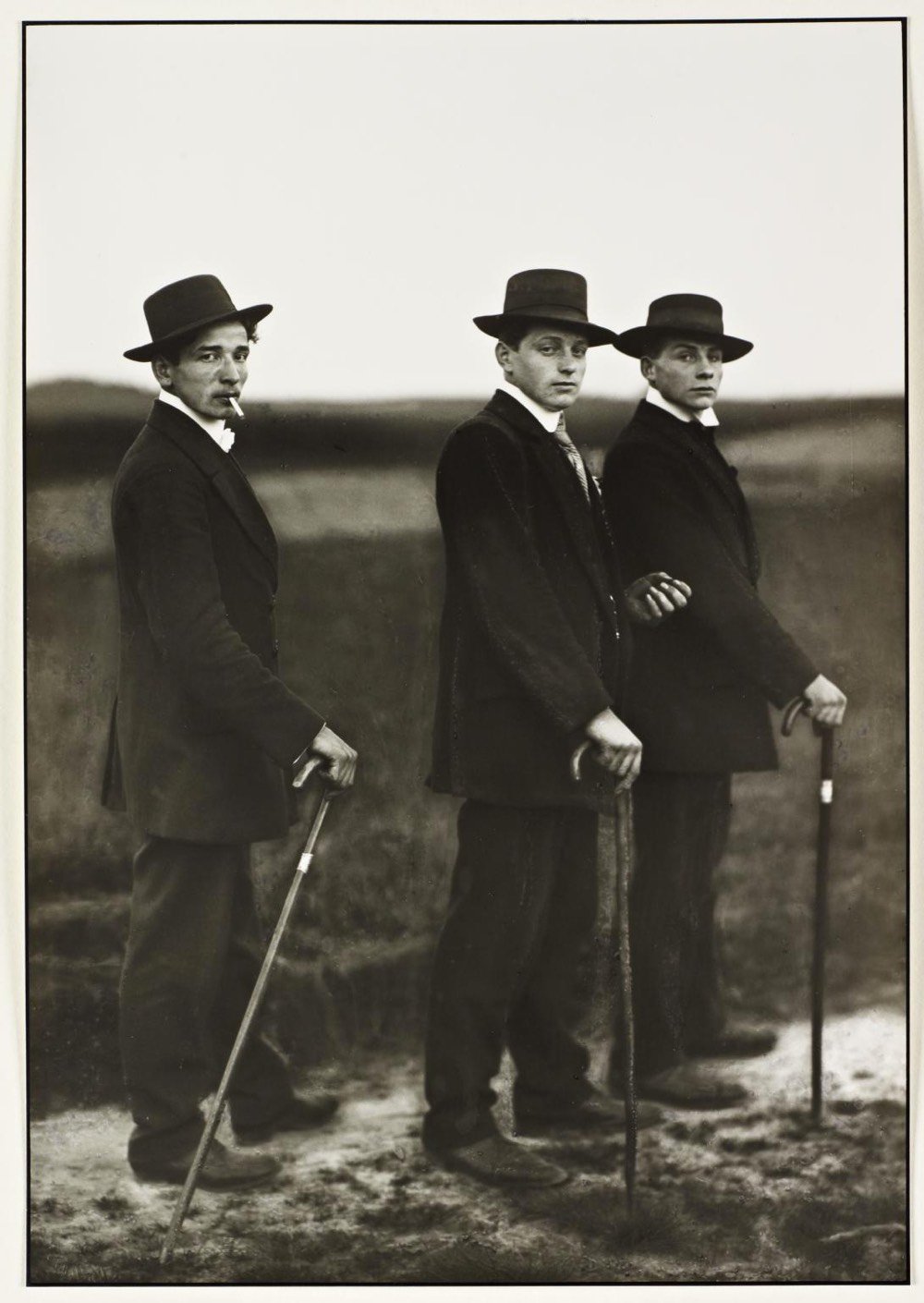
It’s called Young Farmers and it depicts three young men on their way to a dance in rural Germany. But as John Green explains in this video, there is so much more going on with this photo.
From The Tate, which has a print of Young Farmers in its collection:
The Marxist art critic John Berger famously analysed the photograph in his influential essay ‘The Suit and the Photograph’ (1980) writing: ‘The date is 1914. The three young men belong, at the very most, to the second generation who ever wore such suits in the European countryside. Twenty or 30 years earlier, such clothes did not exist at a price which peasants could afford.’ (Berger 1980, p.30.) Berger suggests that these mass market suits, emulating the higher quality attire of the bourgeois urban class, draws attention to, rather than disguises, their ‘social caste’, and not in a particularly flattering sense. In his essay, Berger considers that the three young men are of a social group not beyond the reach of aspirational advertising campaigns and travelling salesmen, and in a state of awkward transition, succumbing to a new ‘cultural hegemony’. The posturing of these three rural ‘lads’, perhaps on their way to a dance, confounds and subverts expectations of the peasant ‘type’, especially in that they smoke cigarettes. Peasants were traditionally depicted smoking a pipe handcrafted from wood, and which like the wooden canes that appear frequently in Sander’s volume of photographs devoted to peasants and farmers, including this one, connoted an organic connection to the native soil as well as a certain time-honoured wisdom. By contrast, the mass-manufactured cigarette was often seen at the time as an urban symbol of social dissolution.
However, Green also cautions that there’s only so much you can infer about people from a photograph (given, for example, that the three men weren’t actually farmers).
This video is from a new-to-me channel called The Art Assignment, which is about art and art history. Subscribed!
Jonathan Demme’s The Silence of the Lambs is one of the finest psychological thrillers ever made. In the episode of the always-illuminating Lessons from the Screenplay, the team analyzes a scene from the film with Hannibal Lecter and Clarice Starling that demonstrates how effective scenes follow the same three act structure as entire movies/books/stories do.
The Lessons team also did a podcast episode about the differences between the screenplay for the film and the book that inspired it.
Ron and Diana Watson have been eating dinner at the same restaurant in Wichita 6 nights a week for 15 years. It’s their only meal of the day and they skip the bread because Ron was gaining too much weight from the complimentary dinner rolls.
The ritual is all part of the order Ron Watson likes in his life. A Vietnam veteran, he dines only in restaurants that offer military discounts, and Texas Roadhouse gives vets 10 percent off. He still has some PTSD, he said, and he feels comfortable at table 412, which is a booth at the bar that gives him a good view of the door and everyone coming and going.
The couple also are regular enough customers that they know how to make the most of their money at Texas Roadhouse. Every Sunday through Wednesday, they arrive between 3 and 3:15 p.m. to take advantage of the restaurant’s early bird special, which is available from 3 to 5 p.m. Mondays through Thursdays and offers a full meal for $9.49.
I’m fascinated by people for whom routine is so important. I definitely have those tendencies; I watch favorite shows and movies repeatedly, wear pretty much the same outfit daily, return to familiar vacation destinations, and order the same dishes at the same restaurants again and again. So much of what I do for kottke.org focuses on finding the new — ideas, people, art, discoveries, culture — that it’s comforting to have parts of my life that aren’t relentlessly novel. But I also make ample time for new experiences that bring happiness & fulfillment into my life…and the rest I put on cruise control. (via tmn)
Update: From The Atlantic, The People Who Eat the Same Meal Every Day.
Many of the people I talked with emphasized the stress-reducing benefits of eating the same thing each day. Amanda Respers, a 32-year-old software developer in Newport News, Virginia, once ate a variation on the same home-brought salad (a lettuce, a protein, and a dressing) at work for about a year. She liked the simplicity of the formula, but the streak ended when she and her now-husband, who has more of an appetite for variety, moved in together six years ago. Would she still be eating the salad every day if she hadn’t met him? “Oh heck yeah,” she told me. “It would’ve saved so much time.”
Happy Pi Day! In celebration of this gloriously nerdy event, mathematician Steven Strogatz wrote about how pi was humanity’s first glimpse of the power of calculus and an early effort to come to grips with the idea of infinity.
As a ratio, pi has been around since Babylonian times, but it was the Greek geometer Archimedes, some 2,300 years ago, who first showed how to rigorously estimate the value of pi. Among mathematicians of his time, the concept of infinity was taboo; Aristotle had tried to banish it for being too paradoxical and logically treacherous. In Archimedes’s hands, however, infinity became a mathematical workhorse.
He used it to discover the area of a circle, the volume of a sphere and many other properties of curved shapes that had stumped the finest mathematicians before him. In each case, he approximated a curved shape by using a large number of tiny straight lines or flat polygons. The resulting approximations were gemlike, faceted objects that yielded fantastic insights into the original shapes, especially when he imagined using infinitely many, infinitesimally small facets in the process.
Here’s a video that runs through Archimedes’ method for calculating pi:
Strogatz’s piece is an excerpt from his forthcoming book, Infinite Powers: How Calculus Reveals the Secrets of the Universe.
Comedian Miel Bredouw packed every single type of interaction you’re ever going to have with another human being on a hiking trail into a video less than 40 seconds long. As a semi-frequent Vermont hiker (including this recent winter hike), I can vouch for every single one of these. They’re all here: the friendly dog greeting, the sing-song “hello”, the running “excuse me”, and the classic “hey how ya doin?” My go-to is usually the panting “hey”.
Float is a feature-length documentary film directed by Phil Kibbe about “the ultra-competitive sport of elite, stunningly-designed indoor model airplanes”. The main action of the film takes place at the F1D World Championships in Romania, where competitors from all over the world build delicately beautiful rubber-band-powered airplanes and compete to keep them afloat the longest.
After devoting years of time into construction and practice for no material reward, glory becomes their primary incentive. Like any competition, cheating and controversy are an integral part of the sport. FLOAT follows the tumultuous journey of Brett Sanborn and Yuan Kang Lee, two American competitors as they prepare for and compete at the World Championships.
“Designing, building, and flying the planes is truly an experience that requires patience and zen-like focus,” says Ben Saks, producer and subject in the film.
Float began as a Kickstarter project back in 2012…congrats to the team for their patience in getting it finished.
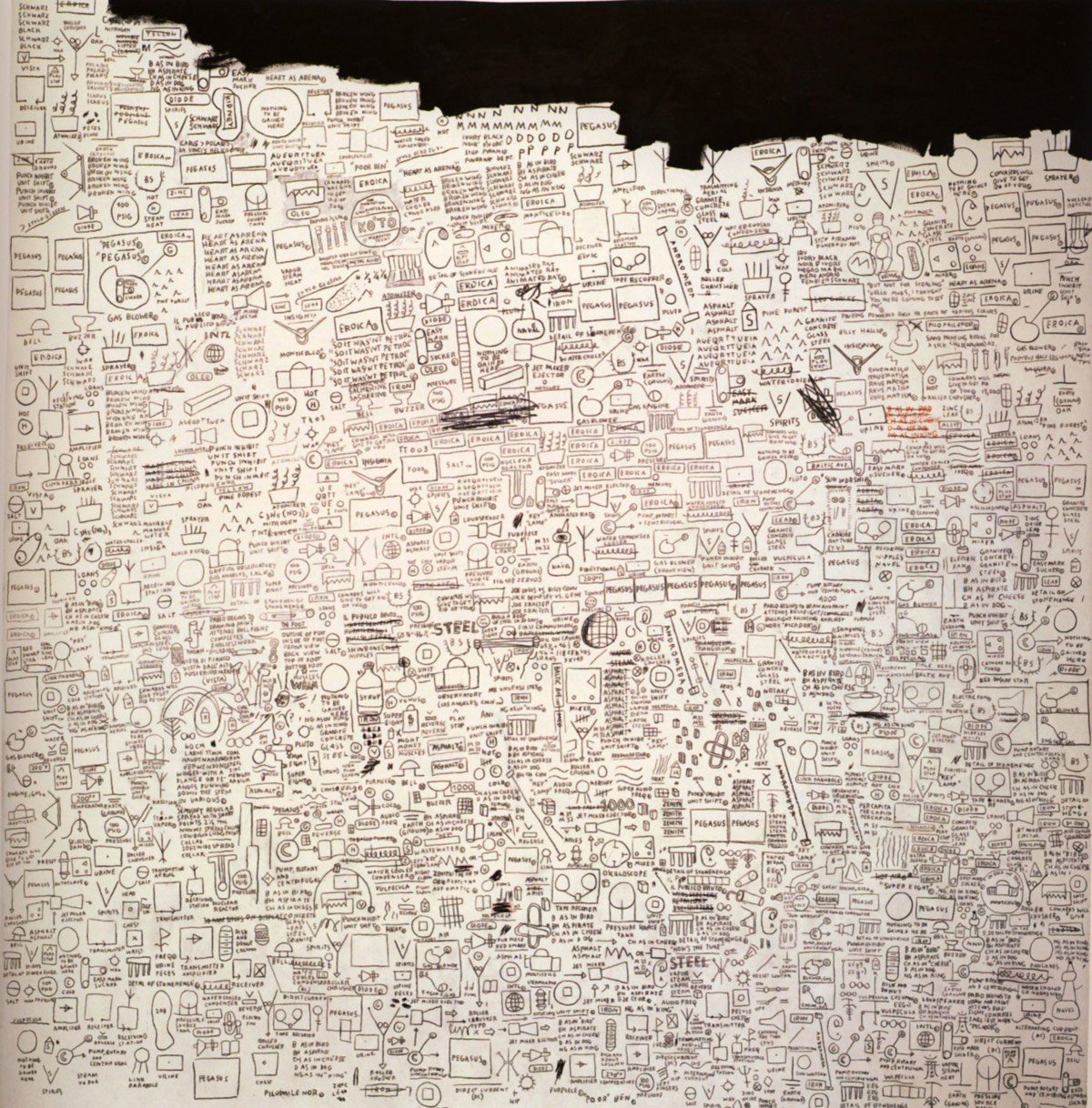
The drawing above is Pegasus by Jean-Michel Basquiat. His first art dealer, Annina Nosei, once called it “the most beautiful drawing ever”. I am not going to disagree with her. I’ve only seen Basquiat’s work sporadically, mostly single paintings included in larger exhibitions with Warhols and Harings, but when I saw Pegasus in this short video about the artist’s life & work, it grabbed me, an instant favorite.
The drawing is held in a private collection, but I hope I get to see it in person someday. For more on Basquiat, check out the 2009 documentary Jean-Michel Basquiat: The Radiant Child.
At SXSW, Congresswoman Alexandria Ocasio-Cortez was asked by an audience member about the economic challenge of a significant percentage of our labor force being replaced by automation. She responded, in part, by suggesting we decouple the idea of employment with being able to remain alive:
We should not be haunted by the specter of being automated out of work. We should not feel nervous about the toll booth collector not having to collect tolls anymore. We should be excited by that. But the reason we’re not excited by it is because we live in a society where if you don’t have a job, you are left to die. And that is, at its core, our problem.
Then she went on to say:
We should be excited about automation, because what it could potentially mean is more time educating ourselves, more time creating art, more time investing in and investigating the sciences, more time focused on invention, more time going to space, more time enjoying the world that we live in. Because not all creativity needs to be bonded by wage.
Her full answer, including a bit about “automated inequality”, is worth worth watching in full, starting at ~55:15:
In a 1970 article in New York magazine, the architect and futurist Buckminster Fuller wrote about the collision of technology and “this nonsense of earning a living”:
We must do away with the absolutely specious notion that everybody has to earn a living. It is a fact today that one in ten thousand of us can make a technological breakthrough capable of supporting all the rest. The youth of today are absolutely right in recognizing this nonsense of earning a living. We keep inventing jobs because of this false idea that everybody has to be employed at some kind of drudgery because, according to Malthusian-Darwinian theory, he must justify his right to exist. So we have inspectors of inspectors and people making instruments for inspectors to inspect inspectors. The true business of people should be to go back to school and think about whatever it was they were thinking about before somebody came along and told them they had to earn a living.
(thx to @claytoncubitt for the AOC-Fuller connection)
Starting when she was 21, Helen Fagin was imprisoned by the Nazis in the Radomsko and Warsaw ghettos in Poland. Her parents were sent to Treblinka and murdered there, but Fagin and her sister eventually managed to escape and, after a long journey around Europe, made it to the United States. Fagin has offered lengthy testimony about her experience of the Holocaust (for the USC Shoah Foundation and US Holocaust Memorial Museum), but in this short video, she reads a letter she wrote about how reading and stories gave a spark of hope to those under the Nazi boot in Warsaw.
Could you imagine a world without access to reading, to learning, to books?
At twenty-one, I was forced into Poland’s WWII ghetto, where being caught reading anything forbidden by the Nazis meant, at best, hard labor; at worst, death.
There, I conducted a clandestine school offering Jewish children a chance at the essential education denied them by their captors. But I soon came to feel that teaching these sensitive young souls Latin and mathematics was cheating them of something far more essential — what they needed wasn’t dry information but hope, the kind that comes from being transported into a dream-world of possibility.
One day, as if guessing my thoughts, one girl beseeched me: “Could you please tell us a book, please?”
I had spent the previous night reading Gone with the Wind — one of a few smuggled books circulated among trustworthy people via an underground channel, on their word of honor to read only at night, in secret. No one was allowed to keep a book longer than one night — that way, if reported, the book would have already changed hands by the time the searchers came.
The full text of the letter is here and is also collected in the book The Velocity of Being. (via open culture)
In a letter to his brother Theo, Vincent van Gogh called his 1888 oil painting The Night Café “one of the ugliest pictures I have done”.
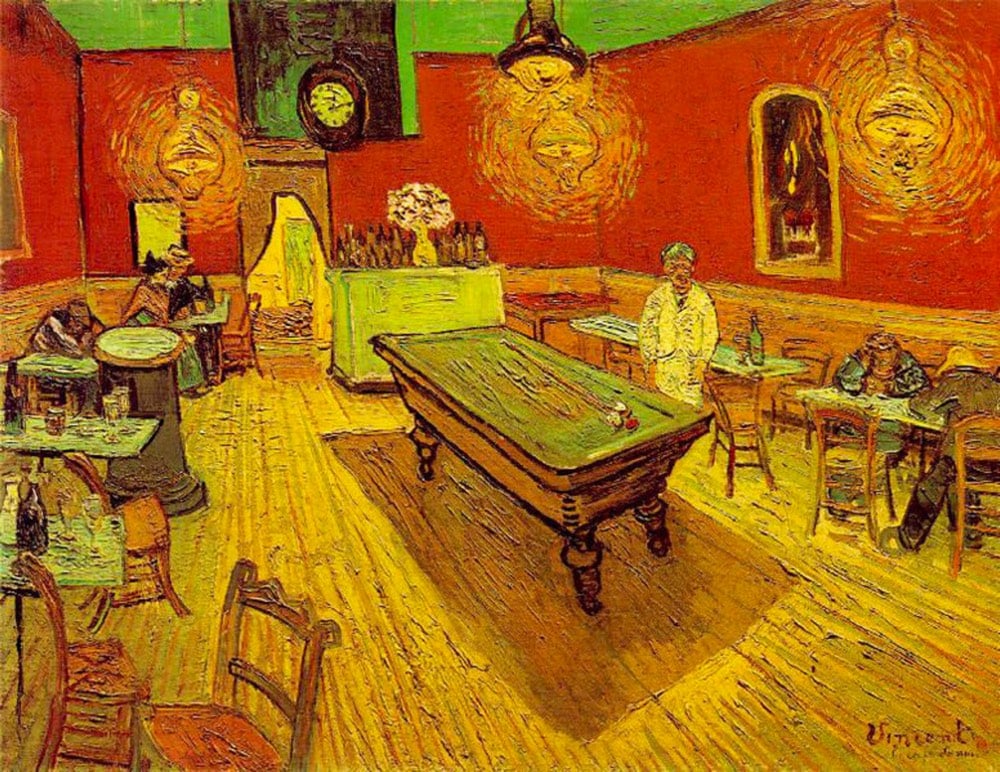
In this video, Evan Puschak looks at what van Gogh meant by that and how he used discordant colors together to suggest a mood.
van Gogh wrote of his intentions for the painting to his brother:
I have tried to express the terrible passions of humanity by means of red and green. The room is blood red and dark yellow with a green billiard table in the middle; there are four lemon-yellow lamps with a glow of orange and green. Everywhere there is a clash and contrast of the most alien reds and greens, in the figures of little sleeping hooligans, in the empty dreary room, in violet and blue. The blood-red and the yellow-green of the billiard table, for instance, contrast with the soft tender Louis XV green of the counter, on which there is a rose nosegay. The white clothes of the landlord, watchful in a corner of that furnace, turn lemon-yellow, or pale luminous green.
Hagfish are an eel-like sea creatures with the ability to excrete a teaspoon of slime that almost instantly expands to 10,000 times the volume. The slime, a combination of mucous and protein threads, is magical, too! Surprise, it’s not sticky, and it’s actually incredibly soft. Think about the softest thing you can think of. WRONG, this is softer. Hagfish slime is so soft, scientists had to create new ways to measure it when traditional instruments couldn’t hack it.
The proteins threads that give the slime cohesion are incredible in their own right. Each is one-100th the width of a human hair, but can stretch for four to six inches. And within the slime glands, each thread is coiled like a ball of yarn within its own tiny cell — a feat akin to stuffing a kilometer of Christmas lights into a shoebox without a single knot or tangle. No one knows how the hagfish achieves this miracle of packaging, but Fudge just got a grant to test one idea. He thinks that the thread cells use their nuclei — the DNA-containing structures at their core — like a spindle, turning them to wind the growing protein threads into a single continuous loop.
But that’s not all! Hagfish don’t have a jawbone, they’ve got kind of a sandpaper on their face, which is not the scientific way to describe it at all. They eat by burrowing into carcasses and rub their face around to get their fill. The skin of a hagfish is more efficient at processing nutrients than their intestines, so needless to say the burrowing really works for them. While hagfish use their slime to defend against attacks — the excreted slime clogs the gills of attackers — they also use their ridiculously squishy bodies as a defense. If a shark bites them, the important bits squish out of the way like one of those water wiggly toys. (Do you know how hard it is is to google the name of a toy you’ve played with your entire life without ever having known the name of? “Squishy squiggly water snake” is what worked for me.) Lastly, hagfish tie themselves in knots to rid themselves of slime AND to help them eat when they’re inside the dead bodies of recently passed sea friends. Now you know.
As a hagfish cleanser, sea otters hold hands while they’re sleeping so they don’t drift apart.
(Allow me an aside. The last time I wrote about the wacky world of sea creatures on Kottke.org, it was a post about the first known case of the sperm of cooked squid implanting in someone’s mouth. (At the time, of course, everyone knew the sperm of raw squid could implant, but this first case of cooked squid doing the same was big news).)
In this video released by JAXA, the Japanese space agency, you can see an on-board view of the Hayabusa2 probe touching down on an asteroid called Ryugu.
The blast you see is the probe firing a bullet made of tantalum at the surface in order to collect a sample. Here’s a photo of the landing site. From Wikipedia:
When the sampler horn attached to Hayabusa2’s underside touched the surface, a projectile (5-gram tantalum bullet) was fired at 300 m/s into the surface. The resulting ejecta particles were collected by a catcher at the top of the horn, which the ejecta reaches under their own momentum under microgravity conditions.
This is the first of three samples that are scheduled to be collected by Hayabusa2. The third sampling will try to collect material located under the surface of the asteroid. To achieve this, a separate gun will detach from the probe and fire a copper bullet at the surface, blasting a hole in the surface and exposing “pristine material”. Meanwhile, the probe itself will deploy a separate camera to watch the bullet’s impact, scoot out of the way to avoid debris, and then come back in a couple of weeks to collect a sample from the resulting crater, which will then be returned to Earth along with the other two samples. Ingenious! I love it when a plan comes together!
Newer posts
Older posts


Socials & More