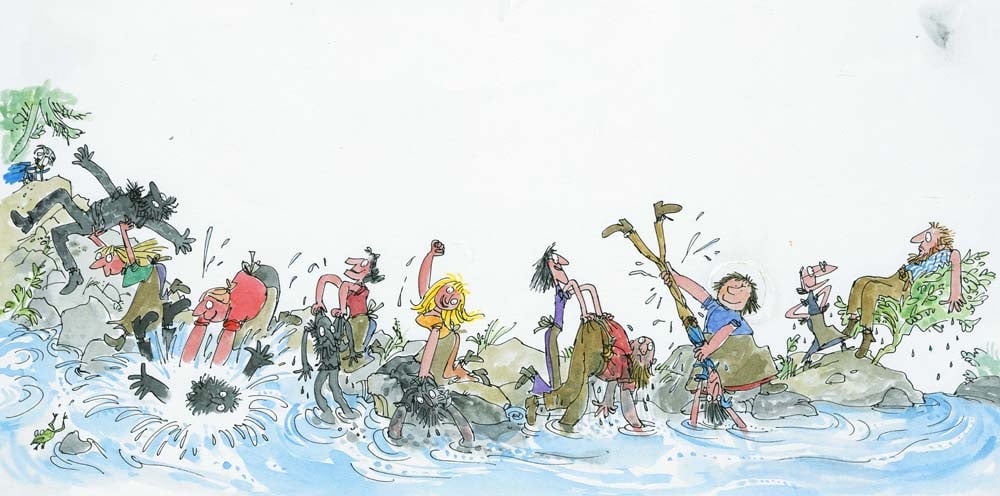
Illustrator Quentin Blake, who is most widely known for his energetic drawings for Roald Dahl’s books, generously shares his drawing process on his website and also in a series of videos.
I do a freewheeling sort of drawing that looks as though it is done on the spur of the moment. However even a single drawing needs a certain amount of preparation and planning. Most of the time I need to do a rough in which I find out how people stand, what sort of expressions they have and how they fit on the page.
Here are some of the videos he’s done. Quentin Blake draws a Hornswoggler:
Ten Minutes of Illustration (in three parts for some reason):
We Live in Worrying Times:
The illustration above is from The Wild Washerwomen.
In the first couple of minutes of this video, Roald Dahl introduces us to the writing hut behind his house that he used to write all of his famed children’s books like Charlie and the Chocolate Factory and Danny the Champion of the World. Dahl describes his working routine and details how he’s designed his writing environment, his “nest”, to be as free from distraction as possible.
The Guardian used to run a series about writers’ rooms and in 2008, illustrator Quentin Blake, who worked with Dahl on many of his books, wrote a piece about Dahl’s shed.
The whole of the inside was organised as a place for writing: so the old wing-back chair had part of the back burrowed out to make it more comfortable; he had a sleeping bag that he put his legs in when it was cold and a footstool to rest them on; he had a very characteristic Roald arrangement for a writing table with a bar across the arms of the chair and a cardboard tube that altered the angle of the board on which he wrote. As he didn’t want to move from his chair everything was within reach. He wrote on yellow legal paper with his favourite kind of pencils; he started off with a handful of them ready sharpened.
I like that he tied the footrest to the chair to keep it from sliding away when he rested his feet on it.
As someone who sits down daily to write, nothing seems so luxurious to me as a separate writing hut that is off limits to everyone and everything else. George Bernard Shaw and Mark Twain both had separate houses in which to write; Shaw’s shed could even rotate to catch the light throughout the day. Someday I’ll have one of my own…
P.S. Ernest Hemingway used a standing desk, as did Winston Churchill, Charles Dickens, and Virginia Woolf, among others. I got this one a few weeks ago and am still getting used to it. (via @ftrain)
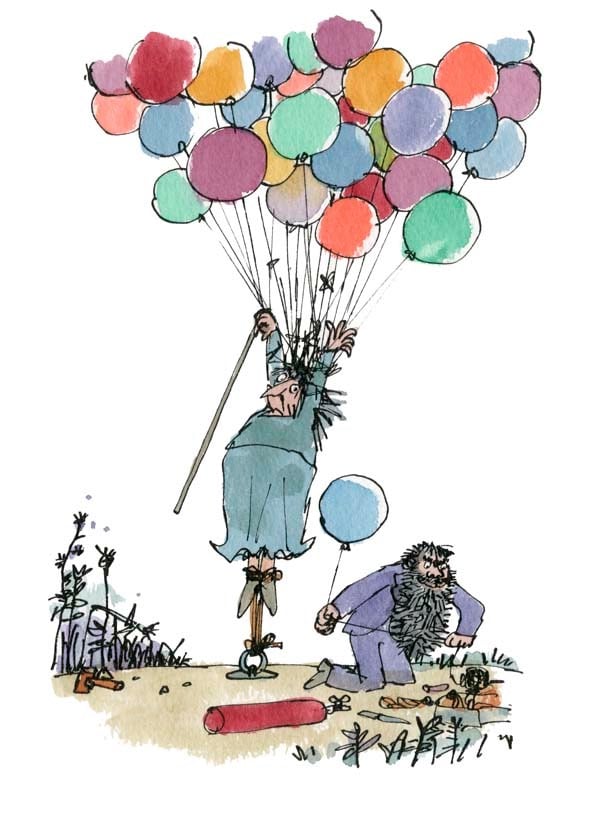
If you’ve read a book like Danny the Champion of the World or Charlie and the Chocolate Factory, you have seen the work of illustrator Quentin Blake.
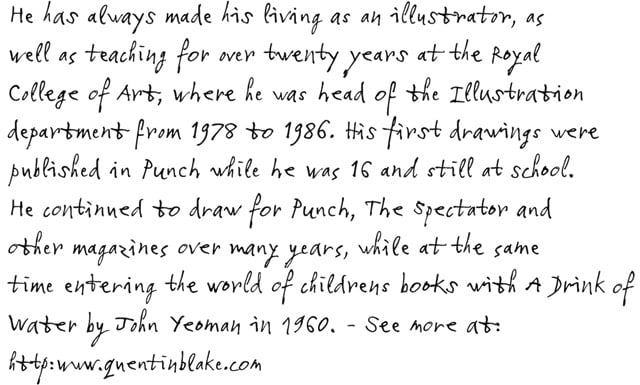
Type foundry Monotype have created a typeface from Blake’s distinctive handwriting. Each letter has four variants so the text looks more random, like actual handwriting:





Socials & More