kottke.org posts about video
Sad but expected news: Tony Zhou and Taylor Ramos have shut down their excellent video series on film, Every Frame a Painting. They wrote about their decision in the form of the script for a final episode that never got made:
(TONY) As many of you have guessed, the channel more or less ended in September 2016 with the release of the “Marvel Symphonic Universe” video. For the last year, Taylor and I have tinkered behind-the-scenes to see if there was anything else we wanted to do with this YouTube channel.
(TAYLOR) But in the past year, we’ve both started new jobs and taken on other freelance work. Things started piling up and it took all our energy to get through the work we’d agreed to do.
When we started this YouTube project, we gave ourselves one simple rule: if we ever stopped enjoying the videos, we’d also stop making them. And one day, we woke up and felt it was time.
I was a huge fan of the series and posted many episodes on kottke.org. Here are a few particular favorites:
Cheers to Tony and Taylor…you made a great thing and knew when to quit (unlike some people).
P.S. Poking around, I found a mini Every Frame a Painting that Zhou and Ramos did for Criterion about The Breaking Point, posted to YouTube back in August:
Gah, that just makes me miss it even more!
Vox and 99% Invisible take a look at the movement to remove signs and traffic lights from traffic intersections in favor of building “shared spaces”, intersections in which cars, pedestrians, and cyclists are equally free to roam.
In traditional intersections, right-of-way has essentially been outsourced to unthinking objects like stop lights and signs. Shared spaces place the responsibility of determining right-of-way back with the individual motorists, pedestrians, and cyclists. Both approaches have their pros and cons. As the video notes, accessibility is an issue with shared spaces. But in traditional traffic schemes, cars are often given too much power to harm people, in the form of speed and the implied “I have the right-of-way so get out of my way” legal authority of the green light.
While watching traffic interact in the shared spaces in the video, you realize the assumption that makes them work: that as a general rule, people do not want to harm others. Cars, being so much more dangerous than pedestrians or cyclists, could bully their way these spaces but mostly they don’t because they don’t want to menace or injure others. However, as we’ve seen in the American political sphere recently, social norms can erode and force re-evaluation of assumptions. There will always be individual bad actors — asshole drivers or those who deliberately want to harm — but what happens to shared traffic spaces if the general assumption of people not wanting to harm others breaks down? And would traffic lights and signs fix that problem?
P.S. This is off topic (or is it?!), but I was in Amsterdam last week and it was interesting to observe the hierarchy of traffic there compared with other cities. In the absence of signs or traffic lights, who has the assumed right-of-way in these places?
In NYC (especially Manhattan), cars rule the streets, followed by pedestrians and cyclists…you only need to look at the city’s policy of not prosecuting murder-by-car to understand this. In California and esp. San Francisco (at least when I lived there years ago), if a pedestrian steps out into the street, cars will usually stop, even if they’re jaywalking. This also holds for many other places in the US, especially outside of large cities…cars are generally assumed to have the right-of-way but will also stop for pedestrians. But not in Boston…the sheer insanity of the drivers there gives cars a certain authoritative wide berth, not unlike that of a tottering Jenga tower. In Amsterdam though, cyclists seem to take priority in most situations…cars and pedestrians had to be on the lookout for them whether the cyclists had the light or not. Fascinating to observe.
The New Yorker interviewed a bunch of top Scrabble players about favorite moves they’ve played…their best, worst, and most humbling. I dislike playing Scrabble1 but love watching expert practitioners talk about about their areas of expertise.
In the latest installment of the newish video series Internetting with Amanda Hess, Hess discusses The White Internet’s Love Affair with Digital Blackface. From Teen Vogue, an explanation of digital blackface by Lauren Michelle Jackson:
Adore or despise them, GIFs are integral to the social experience of the Internet. Thanks to a range of buttons, apps, and keyboards, saying “it me” without words is easier than ever. But even a casual observer of GIFing would notice that, as with much of online culture, black people appear at the center of it all. Or images of black people, at least. The Real Housewives of Atlanta, Oprah, Whitney Houston, Mariah Carey, NBA players, Tiffany Pollard, Kid Fury, and many, many other known and anonymous black likenesses dominate day-to-day feeds, even outside online black communities. Similar to the idea that “Black Vine is simply Vine,” as Jeff Ihaza determined in The Awl, black reaction GIFs have become so widespread that they’ve practically become synonymous with just reaction GIFs.
If you’ve never heard of the term before, “digital blackface” is used to describe various types of minstrel performance that become available in cyberspace. Blackface minstrelsy is a theatrical tradition dating back to the early 19th century, in which performers “blacken” themselves up with costume and behaviors to act as black caricatures. The performances put society’s most racist sensibilities on display and in turn fed them back to audiences to intensify these feelings and disperse them across culture. Many of our most beloved entertainment genres owe at least part of themselves to the minstrel stage, including vaudeville, film, and cartoons. While often associated with Jim Crow-era racism, the tenets of minstrel performance remain alive today in television, movies, music and, in its most advanced iteration, on the Internet.
AI scientist Clayton Blythe fed a video of someone walking around Times Square into an AI program that’s been trained to detect objects (aka “a state of the art object detection framework called NASNet from Google Research”) and made a video showing what the algorithm sees in realtime — cars, traffic lights, people, bicycles, trucks, etc. — along with its confidence in what it sees. Love the cheeky soundtrack…a remix of Daft Punk’s Something About Us.
See also a neural network tries to identify objects in Star Trek:TNG intro. (via prosthetic knowledge)
Update: Well, it looks like the video is offline for whatever reason. You can see some animated screengrabs at prosthetic knowledge.
Netflix has released two trailers ahead of the release of season four: one for an episode called Arkangel and the other for one called Crocodile. Arkangel, directed by Jodie Foster, seems particularly Black Mirror-ish…helicopter parenting x100 in a society where people live for hundreds of years.
Update: Here’s the trailer for a third episode, Black Museum.
Update: Trailers for two more episodes:
Eventually they might tell us when the full episodes will be available on Netflix?
Update: Finally…a premiere date (Dec 29th) and a full trailer. (thx, david)
Using a single page from Art Spiegelman’s Maus (considered by many as one of the finest graphic novels ever written), Evan Puschak considers how Spiegelman used the page (and not the individual panel) as the atomic unit of the narrative of his father surviving the Holocaust. Designing the page is the thing. In making this point, he quotes the cartoonist Seth (Gregory Gallant):
The ‘words & pictures’ that make up the comics language are often described as prose and illustration combined. A bad metaphor: poetry and graphic design seems more apt. Poetry for the rhythm and condensing; graphic design because cartooning is more about moving shapes around — designing — then it is about drawing.
For his project called Years, Bartholomäus Traubeck specially modified a record player to make piano music from the patterns of ringed growth on the cross-sections of trees.
A tree’s year rings are analysed for their strength, thickness and rate of growth. This data serves as basis for a generative process that outputs piano music. It is mapped to a scale which is again defined by the overall appearance of the wood (ranging from dark to light and from strong texture to light texture). The foundation for the music is certainly found in the defined ruleset of programming and hardware setup, but the data acquired from every tree interprets this ruleset very differently.
A digital album of recording from seven different trees (spruce, ash, oak, maple, alder, walnut, and beech) is available on Bandcamp.
At the Museum is a new video series by MoMA in NYC that offers a behind-the-scenes look at what it takes to run a world-class modern art museum. The first episode, embedded above, follows the staff as they prepare for new exhibitions, both in the museum and across the Atlantic.
As the Museum of Modern Art prepares to ship 200 masterworks by artists like Picasso, C’ezanne, Rothko and de Kooning for a special exhibition at the Louis Vuitton Foundation in Paris, other MoMA staff begin to install a new line-up of exhibitions in New York.
New videos are posted each week. (via the kid should see this)
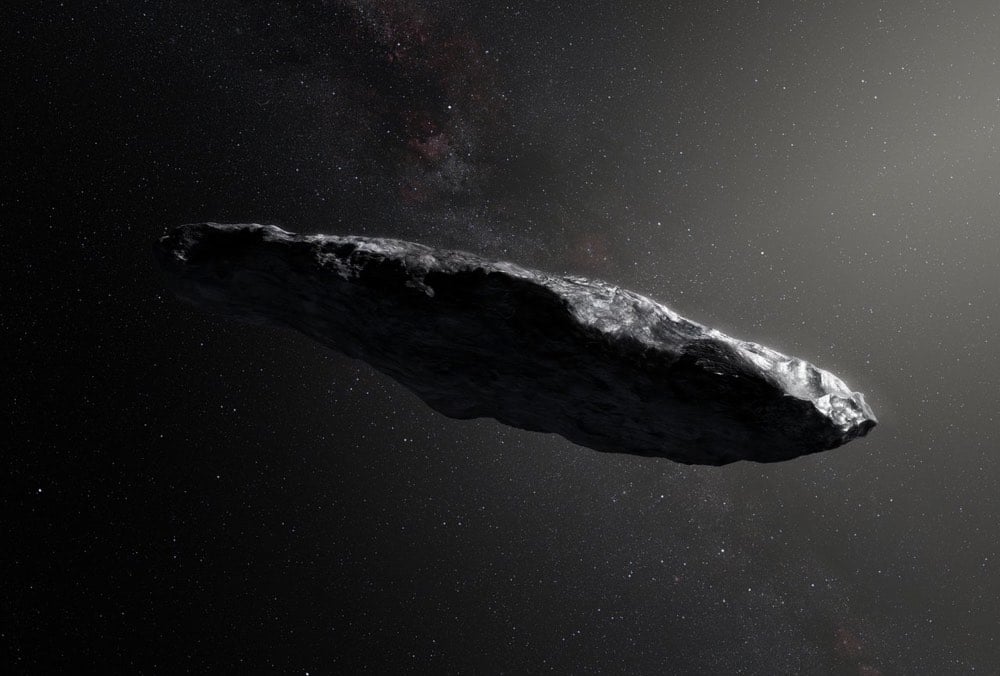
Back in October, the solar system welcomed a visitor from interstellar space…the first interstellar asteroid ever detected.
Astronomers have confirmed that an object that recently passed by our planet is from outside our Solar System — the first interstellar asteroid that’s ever been observed. And it doesn’t look like any object we’ve ever seen in our cosmic neighborhood before.
Follow-up observations, detailed today in Nature, have found that the asteroid is dark and reddish, similar to the objects in the outer Solar System. It doesn’t have any gas or dust surrounding it, like comets do, and it’s stretched long and skinny, looking a bit like an oddly shaped pen. It’s thought to be about a quarter-mile long, and about 10 times longer than it is wide. That makes it unlike any asteroids seen in our Solar System, none of which are so elongated.
Here’s a video of the asteroid’s path through the solar system:
Um, folks…that looks like a rocket. How do we know this “asteroid” isn’t actually an ancient alien ship that’s become encrusted with rock over millions of years? Or an ancient weapon gone awry? We’ve all seen the first Star Trek movie, right? (I am only a little bit kidding about this.)
Update: Scientists — or at least one scientist who has a billionaire’s ear — think that’s there’s something a little odd about Oumuamua, so they’re going to check it for radio signals. Spoiler: they’re not going to find any, but wouldn’t it be fun if they did!?
Update: They listened and did not find any radio signals coming from Oumuamua.
Update: As of October 2018, here’s what we know about Oumuamua.
A few months later, another collaboration found that ‘Oumuamua wasn’t just being pulled by the sun’s gravity. Instead, it was being slightly accelerated by an unseen force, which they argued could only be attributed to comet “outgassing” acting like a thruster. With this additional information, the case appeared to be closed. “Interstellar asteroid is really a comet,” read the headline of a press release put out by the European Space Agency.
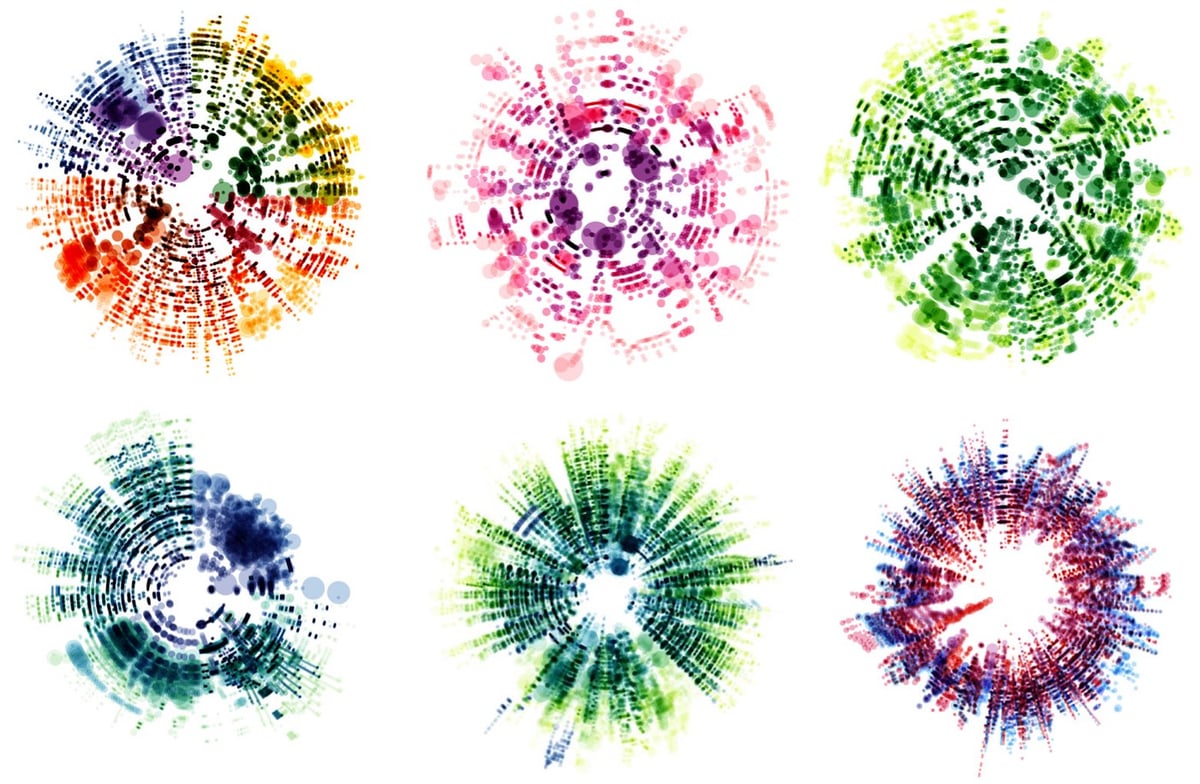
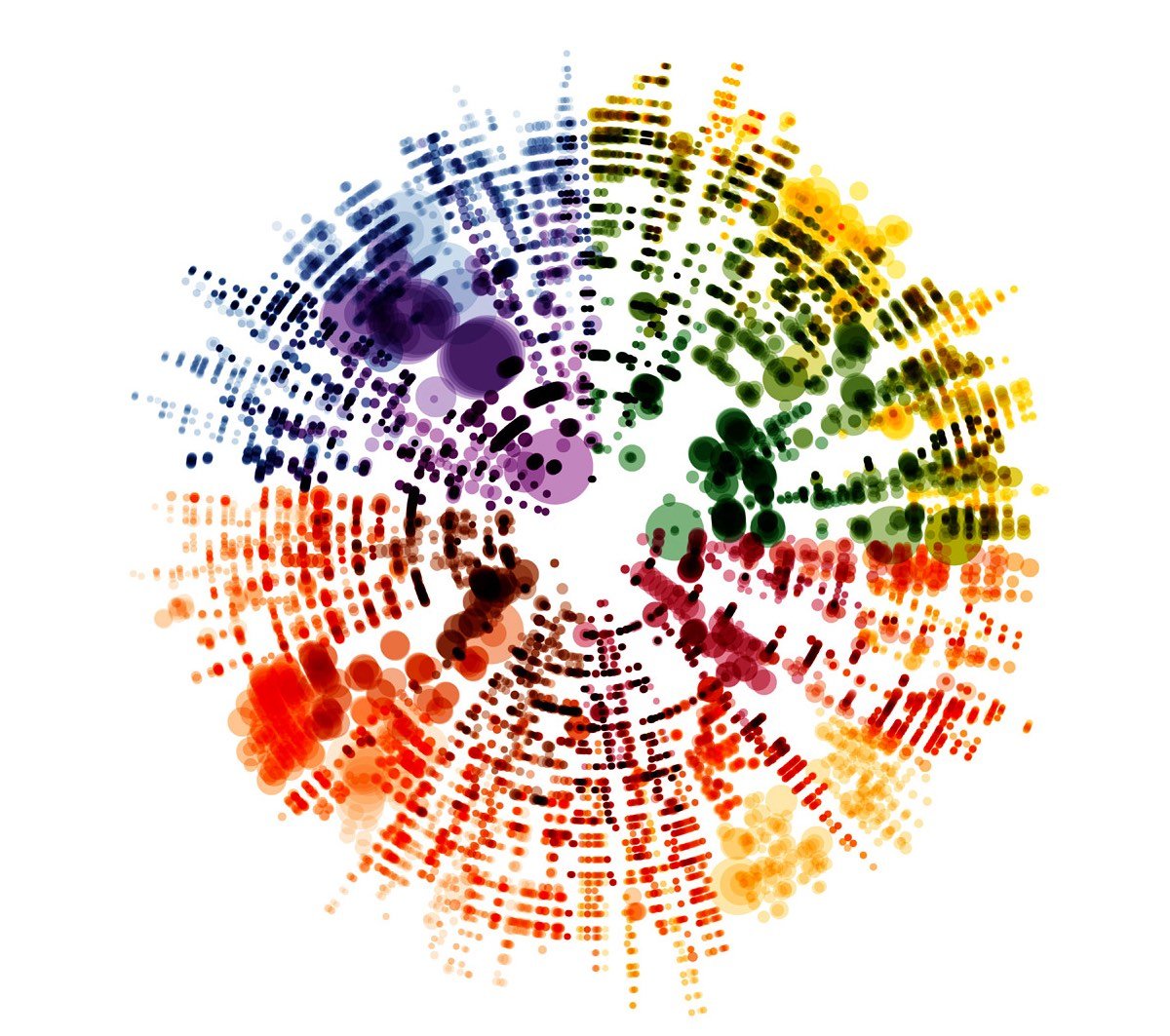
Nicholas Rougeux, who describes himself as a “designer, data geek, fractal nut”, designed a process to turn musical scores into ultra-colorful images. He outlined his process here.
Rougeux also made video versions where you can see the visualizations form as the songs play. Here’s Vivaldi’s The Four Seasons:
Posters are available.
I’m posting this mostly for my son. We were talking about this movie the other day and he remembered exactly where we were and what we were doing when I first told him Pixar was making an Incredibles sequel. Like it was the Moon landing or JFK getting shot.
I barely know how to describe this so maybe you should just watch it. Animator Ismael Sanz-Pena took a single image of a medieval cathedral and used the facade’s repeating elements to find the movement within, kind of like a zoetrope. (Ok, I guess that’s a pretty good description. I still think you should just watch it though.) See also Sanz-Pena’s earlier attempts of the same effect. (via colossal)
So, the jumping from box to box seemed cool. Hey, robot parkour! It seemed awfully agile for something that looks like it weighs quite a bit, but ok. But the casual gymnastics about 20 seconds in broke my brain. Holy. Crap.
A nice overview of emergence by Kurzgesagt. I continue to find the concept of emergence endlessly fascinating — order from disorder, complexity from simplicity, more is different. As a society, we tend to underestimate how much emergence plays a role in why things happen the way they do and are therefore often wrong-footed in our analysis and response.
For a good primer on emergence and other related phenomena, check out Steven Johnson’s Emergence: The Connected Lives of Ants, Brains, Cities, and Software.
Newer posts
Older posts


Socials & More