kottke.org posts about video
No idea if this is an April Fools thing or not, but skydiver Anders Helstrup claims that a rock whooshed past him during a wingsuit flight in 2012. And he caught the incident on video:
The relevent bit starts at about 25 seconds in. Here’s a news story and a longer version of the video report with English subtitles:
Although Helstrup is still not completely convinced that it was indeed a meteorite that flew past him, the experts are in no doubt.
“It can’t be anything else. The shape is typical of meteorites — a fresh fracture surface on one side, while the other side is rounded,” said geologist Hans Amundsen.
He explained that the meteorite had been part of a larger stone that had exploded perhaps 20 kilometres above Helstrup.
Amundsen thinks he can make out coloured patches in the stone, and believes that in that case it may be a breccia — a common type of meteorite rock.
According to the article, the search is on to find the meterorite on the ground. I poked around a bit for information on a fireball sighting over Norway on the date in question (June 17, 2012) but didn’t find anything. Smells like a hoax to me, but if it’s real, it’s the first time a post-fireball meteor has been observed and filmed while still falling.
Update: Even Phil Plait at Bad Astronomy allows this may be real.
Filmmaker IQ has a nice exploration of the history of the movie trailer. And yes, they actually used to play at the end of (i.e. “trail”) the film.
Coming into the 1960s, a new generation of star directors began to redefine the trailer - among them was the legendary Alfred Hitchcock. Instead of showing scenes from the movie, Hitchcock, who had become quite well known to audiences from his “Alfred Hitchcock Presents” TV series, cashed in on his celebrity… taking audiences on a tour using his gallows humor style in this trailer for 1960’s Pscyho.
The reemergence of Cubism in film and commercial art in the 1960s was not lost on another emerging filmmaker - Stanley Kubrick. Having experimented with fragmented cutting styles in the trailer to 1962’s Lolita, Kubrick comes back strong in 1964’s “Dr. Strangelove” with a trailer that I consider one of the most bold and brazen pieces of movie advertising ever made.
I don’t know exactly what my expectations were of how lettering is painted on city streets, but this was not it. The level of precision and artistry is surprising.
Reminds me of this video of a hand-lettering master at work.
Update: Sure, he’s using a vehicle, but this guy is pretty good at line painting as well.
It’s Saturday Sunday Night Live! Here’s Louis C.K.’s monologue from last night’s SNL; it’s 8 minutes of his trademark stand-up.
Well, I don’t even have the words to describe what this is; you just have to watch it. Preferably in fullscreen at full resolution. Takes about 30 seconds to get going but once it does………dang. Breathtaking is not a word I throw around after every TED Talk or Milky Way time lapse, but I will throw it here.
More on the hows and whys the video was made on Vimeo and the director’s site.
Errol Morris has directed a new series of Taco Bell commercials where a bunch of ordinary men named Ronald McDonald review Taco Bell’s new breakfast menu. Here’s one of the spots:
In remote areas of Vietnam where there are no bridges across rivers, people are loaded into plastic bags and swum across by men strong enough to brave the current.
(via quora)
Joe Sabia has built The Office Time Machine, which is a collection of video clips of every single cultural reference ever made in The Office, organized by year. For example, here is 1994:
Sabia built it to highlight how much artists and creators borrow from culture:
The Office is relatable (and hilarious) because it borrows so much from culture, and people get the references. Culture is society’s collected knowledge, art, and customs. It’s what surrounds us and unites us, and it allows us to collectively laugh at a joke in The Office about Ben Franklin or M. Night Shyamalan. Culture, simply put, is the seasoning in a meal.
(via waxy)
A cool short documentary about neon sign making, a dying industry in Hong Kong.
As Jonathan Hoefler notes, the letters are designed so that the designers don’t burn their hands while bending the glass over an 800°C flame.
This is a slow motion video of a hawk flying through increasingly tiny holes in a wall.
Nature, you crazy. (via @dunstan)
No matter who you are, this is pretty funny. But if you have kids, it’s very nearly transcendent.
(via @ginatrapani)
I love this video. Love love love. Chao-Lin Kuo surprises Andrei Linde and his wife with the news that gravitational waves were detected, proving Linde’s theory of an inflationary universe.
Love love love. (via @stevenstrogatz)
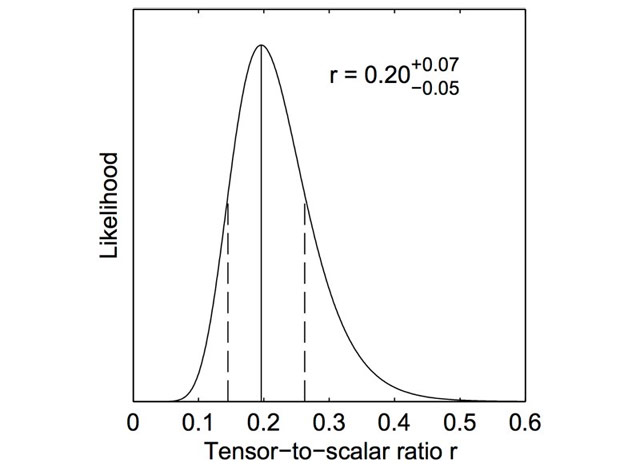
Update: Many people have asked what Kuo is saying to Linde on the doorstep. Let’s start with “5 sigma”. The statistical measure of standard deviation (represented by the Greek letter sigma) is an indication of how sure scientists are of their results. (It has a more technical meaning than that, but we’re not taking a statistics course here.) A “5 sigma” level of standard deviation indicates 99.99994% certainty of the result…or a 0.00006% chance of a statistical fluctuation. That’s a 1 in 3.5 million chance. This is the standard particle physicists use for declaring the discovery of a new particle.
The “point-2” is a bit more difficult to explain. Sean Carroll defines r as “the ratio of gravitational waves to density perturbations” as measured by the BICEP2 experiment, the telescope used to make these measurements. What BICEP2 found was an r value of 0.2:
From the brief explanation of the science behind the BICEP2 experiment:
According to the theory of Inflation, the Universe underwent a violent and rapid expansion at only 10^-35 seconds after the Big Bang, making the horizon size much larger, and allowing the space to become flat. Confirmation of Inflation would be an amazing feat in observational Cosmology. Inflation during the first moments of time produced a Cosmic Gravitational-Wave Background (CGB), which in turn imprinted a faint but unique signature in the polarization of the CMB. Since gravitational waves are by nature tensor fluctuations, the polarization signature that the CGB stamps onto the CMB has a curl component (called “B-mode” polarization). In contrast, scalar density fluctuations at the surface of last scattering only contribute a curl-free (or “E-mode”) polarization component to the CMB which was first detected by the DASI experiment at the South Pole.
The big deal with BICEP2 is the ability to accurately detect the B-mode polarization for the first time. r is the ratio between these two different types of polarization, E-mode & B-mode. Any result for r > 0 indicates the presence of B-mode polarization, which, according to the theory, was caused by gravitational waves at the time of inflation. So, that’s basically what Kuo is on about.
Update: The Atlantic’s Megan Garber spoke to Stanford’s science information officer about how the video came about.
We didn’t do any re-takes. The goal was for it to be a really natural thing. We did ask him to tell us what he was feeling and what the research means. But what you see in the video is just very off-the-cuff and raw. Part of it was, we went there not even knowing if we’d be able to use or keep anything that we did. It was just as likely that he would have been emotional in a way that he didn’t want us to share, or that his wife didn’t. So we went into it with no guarantee-we knew we’d be able to shoot, but didn’t know if we’d be able use it. So we’re thankful that they agreed to let us do that.
Finally a viral video that’s genuine and not staged or reality TV’d.
How this quad-copter shooting HD footage of a volcano erupting in Vanuatu manages to escape the flying chunks of lava is beyond me.
(via @DavidGrann)

The heath hen was once so plentiful in New England that servants bargained with employers not to be served heath hen for food more than two or three days a week. Due to over-hunting, the heath hen went extinct in 1932. But recently, a film of the bird made circa 1918 was discovered and digitized. The Boston Globe has a short clip of the film.
“I had heard about this film through various channels off and on through the years. It had gotten to the point where it was almost apocryphal in my mind” said Petersen, director of the Massachusetts Important Bird Areas program for Mass Audubon. “Nobody knew where it was, nobody had ever seen it, but I was aware it existed. It was like the holy grail.”
No one seems to quite remember the date, but some years ago two canisters containing brittle, aging film that was at risk of spontaneous combustion were found stored at the state’s Division of Fisheries and Wildlife. Aging tape with the words “heath hen” was its only label. One canister was sent off to the Smithsonian Institution, recalled Ellie Horwitz, who discovered the film sometime in the middle of her 34-year tenure at the agency. The other canister presented a dilemma because the film was in such terrible condition it might disintegrate.
“It was iffy whether the film could be viewed. And if it could be viewed, chances were we could view it one time, and the question is what are you going to do in that one time,” said Horwitz, who retired in 2011. “We had one shot at it; we thought the thing to do was to digitize it.”
For the show’s 10th anniversary, a video essay about Deadwood, perhaps the best three-season show that’ll ever be. Written and produced by Matt Zoller Seitz for RogerEbert.com.
Deadwood the series is a whole heck of a lot of things, in no particular order. And it’s that “in no particular order” part that makes it so rich.
(via @djacobs)
What the what?! Hunter S. Thompson was in an Apple Macintosh commercial? Check it out:
)
(via @brillhart)
Tatia Pilieva asked 20 strangers to kiss for the first time and filmed it. The result is surprisingly sweet.
I had forgotten the Coens were turning Fargo into a FX TV series. But time has ground onward steadily and lo, the series is set to premiere in April. Here are a whole set of teaser trailers:
Billy Bob Thornton, Martin Freeman, Colin Hanks, Bob Odenkirk, Oliver Platt? Could be good. (via devour)
If you missed it last night as I did, the new version of Cosmos is now available on Hulu (probably US-only unless you’re clever).
The reviews are good so far.
A master chef from a Hokkaido sushi restaurant shows how to make dashimaki tamago, a Japanese rolled omelette.
Watching people who are good at what they do never gets old. (via swiss miss)
If you’re reading this site, you’ll probably like watching Charlie Rose interview Bill Murray for nearly an hour. The whole thing is available on Hulu (US only):
The video is recent too: Feb 9, 2014. A clip is available on YouTube…check out that leather vest!
And from a different interview with Murray, we learn that everyone has been drinking champagne incorrectly. Here’s the Murray method:
I learned how to drink champagne a while ago. But the way I like to drink champagne is I like to make what we call a Montana Cooler, where you buy a case of champagne and you take all the bottles out, and you take all the cardboard out, and you put a garbage bag inside of it, then you put all the bottles back in and then you cover it with ice, and then you wrap it up and you close it. And that will keep it all cold for a weekend and you can drink every single bottle. And the way I like to drink it in a big pint glass with ice. I fill it with ice and I pour the champagne in it, because champagne can never be too cold. And the problem people have with champagne is they drink it and they crash with it, because the sugar content is so high and you get really dehydrated. But if you can get the ice in it, you can drink it supremely cold and at the same time you’re getting the melting ice, so it’s like a hydration level, and you can stay at this great level for a whole weekend. You don’t want to crash. You want to keep that buzz, that bling, that smile.
Buzz on, you crazy diamond!
A beautifully shot short film about mountains, how they form, how they age, and how they die.
Ok quiet down, we’re going to science right now. (That’s right, I verbed “science”.) If you take a long chain of beads, put them in a jar, and then throw one end of the bead chain out, the rest of the beads will follow *and* this bead fountain will magically rise up into the air over the lip of the glass.
As the guy’s face in the video shows, this is deeply perplexing. For an explanation, slow motion video, and a demonstration of a preposterously high chain fountain, check this video from the NY Times out:
The fountain, said Dr. Biggins, which he had never seen before the video, was “surprisingly complicated.” The chain was moving faster than gravity would account for, and they realized that something had to be pushing the chain up from the container in which it was held.
A key to understanding the phenomenon, Dr. Biggins said, is that mathematically, a chain can be thought of as a series of connected rods.
When you pick up one end of a rod, he said, two things happen. One end goes up, and the other end goes down, or tries to. But if the downward force is stopped by the pile of chain beneath it, there is a kind of kickback, and the rod, or link, is pushed upward. That is what makes the chain rise.
Superb short documentary from Grantland about a perfect 18-hole game of mini golf:
(via @torrez)
It’s only around 30 seconds long, but this video showing a standard web maps interface paired with satellite video is pretty mindblowing:
This quick shot by Skybox’s SkySat-1 shows multiple planes landing at Beijing Capital International Airport (PEK) airport in Beijing on December 30, 2013. You can easily see a large plane landing on the runway at right. Using the video’s timestamp and public flight logs, Bruno identified this plane as Air China Limited flight 1310, a wide-body Airbus 330 flying from Guangzhou to Beijing. Operating as a codeshare, that flight was also listed as Shenzhen Airlines 1310, United Airlines 7564, SAS 9510, Austrian 8010 and Lufthansa 7283.
I remember when satellite photography first became available in online maps; this feels similarly jawdropping. Gonna be more difficult to stitch video together into seamless interfaces than still images, but once it happens, it’ll prove quite useful.
Jesse Hill made a music video for Beyonce’s Drunk in Love entirely out of emoji. Fantastic work.
Fist Eggplant! Poo! Surfbort! Oh man, that was fun.
In his own words, Wes Anderson explains different aspects of his visual style.
Nicely edited together by Nelson Carvajal at Way Too Indie.
From The Avant/Garde Diaries comes a brief lesson in Japanese sword fighting from master kendo sensei Shozo Kato.
Western beauty is radiance, majesty, grandness and broadness. In comparison, eastern beauty is desolateness. Humility. Hidden beauty.
Somehow — science? magic? pelican snacks? — someone found a way to affix a GoPro camera to a pelican’s beak and the view of him flying around a lake in Tanzania is pretty awesome.
(via devour)
Nice short video tour of the U.S. Naval Observatory with Dr. Demetrios Matsakis, Chief Scientist for USNO’s Time Services.
I refer to my clocks as my babies…and that I must take care of them.
Newer posts
Older posts


Socials & More