kottke.org posts about video
The sheng is a free-reed wind instrument dating back to 1100 BCE in China. Using a modern sheng, Li-Jin Lee makes the ancient instrument sound remarkably like Super Mario Bros., including coin and power-up sounds.
And I know the Olympics are over and good riddance and all that, but this Mario Kart speedskating bit is great. Baby Park was one of my favorite tracks on Double Dash.
This Tumblr is collecting instances of experimental music on children’s television shows. Some personal favorites are Al Jarnow’s Cosmic Clock and Philip Glass on Sesame Street. (via @youngna)
If you play carefully by not stomping enemies, not collecting coins, not eating mushrooms or flowers, and hopping on the flagpole at the very last second, you can rescue the princess in Super Mario Bros with only 500 points.
One bit is surprisingly tricky:
How tough is that jump in 8-1? Well, the timing of the liftoff, the duration of holding the jump button, and the timing of the wall jump are all frame perfect. NES games run at 60 frames per second, which means all the necessary inputs need to be timed within 1/60 of a second. In addition, the starting position before running I used not only has to be on the right pixel, but also the x sub-pixel has to fall within a certain range (technical stuff blah blah blah). In short, it’s a pretty annoying jump.
When I was a kid, I left my NES on for three straight days to flip the score in SMB, using the 1UP trick and another spot in the game to get many lives and points. Scoring lower would have been a lot quicker.
In a lovely short film, Ilinca Calugareanu explores the world of 1980s black market VHS movies in Communist Romania and finds the woman who did all the dubbed dialogue.
All the dialogue on these movies was dubbed into Romanian in a husky, high-pitched woman’s voice. Throughout my childhood, these films provided a glimpse into the forbidden West, resplendent with blue jeans, Coke and skyscrapers. As Hollywood movies became ubiquitous through the black market, this voice became one of the most recognizable in Romania. Yet no one knew who she was.
The film is adapted from an upcoming feature-length documentary called Chuck Norris vs Communism. (via df)
A short video from Gizmodo about how Criterion restores a film for release on DVD/Blu-ray. Watch as the color, contrast, audio, and picture is corrected on Hitchcock’s Foreign Correspondent.
Not sure if he’s still out there or not, but Dexter Benjamin has been a bike messenger in NYC for more than 20 years, navigating his bike around the city on only one leg. He lost the leg pushing a boy out of traffic in his native Trinidad. Here’s a 2006 interview with Benjamin:
And from the NY Times in 2005, a brief profile.
He came to New York to participate in a marathon, decided to stay, and before long was leaning on a crutch and panhandling in Grand Central Terminal. He spent many nights sleeping in a shelter, and more than one dawn wondering who would stoop to steal a one-legged man’s shoe.
Another Trinidad native, Steve Alexis, eventually hired him as a messenger. “He could walk with crutches,” Mr. Alexis says. “I figure if he rides a bike, that’s even better.”
After learning to shift his weight for proper balance, Mr. Benjamin was soon darting through Manhattan streets in a triumphal blur. “I love their reaction when I pass them,” he says of others. “They’re seeing something impossible.”
(thx, porter)
I needed a good laugh this week and this news report from The Onion about how the Olympic Village in Sochi was built with the athletes’ sexual activities in mind was an LOL machine. NSFW.
Apparently Tinder is all the rage in the Olympic Village this year…those athletes need to work through the 100,000 condoms they’ve been provided.
From 1977, a video of someone snowboarding on one of the first commercially made boards:
I’m not completely sure who the rider is (probably Dimitrije Milovich), but the board is a Winterstick. A company who owns the Winterstick trademark still makes a version of the split-tail board you see in the video.

From what I can tell, Winterstick was the first modern snowboard company but was quickly eclipsed by rivals Sims and Burton, with Burton emerging in the 1990s as the growing sport’s 800 lb gorilla.
I can’t stop watching this…watch Imperial AT-AT’s attack Olympic mogul skiers on Hoth:
Those skiers are not going to make it past the first marker. (via devour)
Here’s a bit of film footage from the third-ever Winter Olympics, held in Lake Placid, NY in 1932. The ski jumping segment is amazing and terrifying.
Here’s how those Games compare to the modern day Olympics.
Nicolaus Wegner shot some gorgeous footage of thunderstorms and cloud formations in South Dakota and Wyoming during the summer of 2013.
(via devour)
Mike Judge has a new series coming to HBO in April. It’s called Silicon Valley and is about startup culture. Here’s a preview:
Snack dick.
Watch Ferrari’s F1 pit crew do a pit stop in a bit over two seconds:
I wish this were in slow motion because I’ve watched this three times now and I still cannot understand how it’s done. My favorite part is how calm they all are about it. Here’s a longer video that shows the process over and over from several points of view, including from a GoPro mounted on the chest of the wheelgun man:
Watch for the guy on the front jack pirouetting out of the way. I would love to read a long piece on how F1 pit crews train and practice. There are tantalizing bits in shorter articles, like this one from Autosport.com:
With three people per wheel, two jack operators, and a handful of mechanics fulfilling other functions, each pit crew comprises nearly 20 people.
Each is trained for a specific role and teams take their preparation as seriously as drivers’, managing crewmen’s fitness and diet.
They are drilled incessantly at both the factory and during race weekends, with hundreds of pitstop practices until the process is instinctive.
Although problems such as faulty guns are rehearsed, everyone focuses on their own job — in a two-second pitstop, there is no time to see what everyone else is doing. By the time an error has been alerted, the car has often already pulled away, as was the case at the Nurburgring.
And this one from the AP:
Teams now spend huge sums to design their own equipment and improve the fitness of their teams who also work as mechanics. McLaren is working with the English Institute of Sport to hone their 24-member team’s technique while Williams has partnered with Olympic champion Michael Johnson’s Performance Center to work on everything from diet to eye-hand coordination to core strength.
Training has also been ramped up. Most teams have rigs to practice on in the factory and pit stops are practiced as many as 70 times over a typical race weekend. Each stop is timed and videotaped for later review.
“When you had to go from 3.5 seconds down to a lower number, then you really need to be very specific and accurate on how you train because everything needs to be very synchronized to achieve that level of fast time and consistency,” said Williams’ chief race engineer Xevi Pujolar, whose team had its fastest pit stop this season in Spain after making changes to its crew but still is almost a second behind the top teams.
“There still a lot of room for improvement and we are working hard to catch up to these guys that do close to two seconds,” Pujolar said. “If you look at video of pit crew and how they move during pit stop, everything is so well coordinated. To achieve this level of coordination on every pits stop requires a lot of training.”
As well as this series about pit stops by Williams on YouTube. (via digg)
In a clip from The CBS Evening News With Walter Cronkite in 1981, a man in a hooded sweatshirt yelling about the Viet Cong threatened to jump from the 9th story of a building in Los Angeles. Out of nowhere, like a freaking superhero, appears Muhammad Ali, who manages to coax the man back into the building.
(via @DavidGrann)
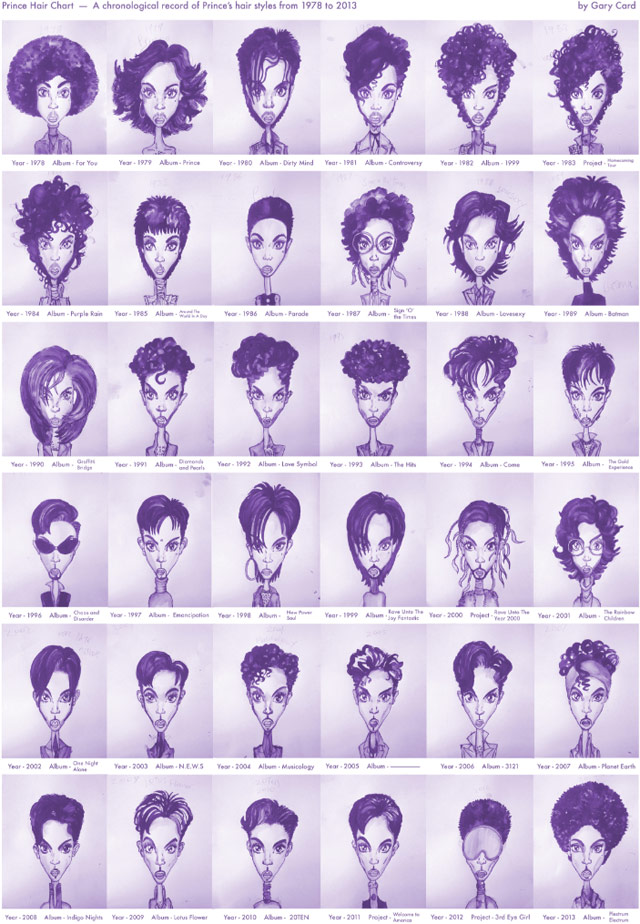
For BEAT magazine, Gary Card drew an illustration of every hairstyle worn by Prince since 1978.
A few months ago, the site featured the BMX tricks of Tim Knoll, which were some of the most unusual tricks I’d seen. (That semi trailer limbo!) Tate Roskelley’s tricks are even weirder, so much so that they seem more like an artistic statement on tricks than tricks themselves:
I think the “artist’s statement” on YouTube is spot on:
Tate’s got just about the most original perspective on BMX you can imagine. I think years ago when Jim C said “I just want to see what’s possible”, Tate took his words at face value. His riding is less about making a statement and more about asking questions. What is a bike trick? What is a street spot? The answers aren’t always pretty (I’m sure he isn’t going to start riding around with his stem bolts loose full time) but they’re always interesting and Tate is always having fun.
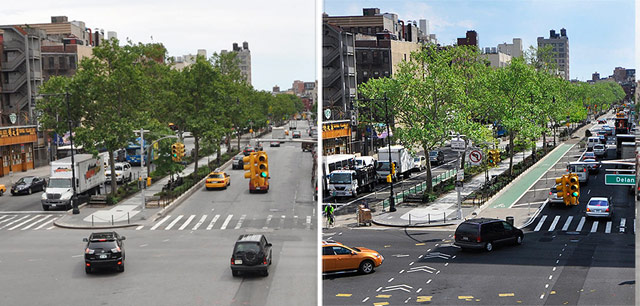
This collection of before-and-after photos of NYC’s streets shows how much the Bloomberg administration and former Transportation Commissioner Janette Sadik-Khan transformed the city’s streets.
Constructing our cities around cars is one of the biggest mistakes of the 20th century and we’re still paying for it. As Kaj Pindal cleverly depicted in his 1966 Oscar-nominated short film What On Earth!, it often seems like cars and not people are the Earth’s dominant life form.
(via @anildash)
For Howler Magazine, Sam Markham writes about Diego Maradona’s second goal against England in the 1986 World Cup quarterfinal, aka Probably The Best Goal of All Time. Markham focuses on how a pair of radio commentators — one English, the other from South America — called the goal.
Morales’s ecstatic commentary of Maradona’s second goal is itself iconic in Argentina, and his lyrical expression “Barrilete cosmico!” (Cosmic kite!) is now shorthand in Argentina and much of South America for Maradona. His narration is a frenzied mix of poetry, yelling, and sobbing that ends with a prayer: “Thank you, God, for football, for Maradona, for these tears, for this-Argentina 2, England 0.”
Even if you don’t care about soccer, you should give this a listen…the dude absolutely loses his shit:
An alternate view of the spectacular goal has recently been found. Oh, and my favorite weird thing about this goal: Lionel Messi is considered by many to be Maradona’s heir (both are small, Argentinian, and otherworldly talented) and in 2007, at the age of 19, he scored this goal against Getafe:
As you can see in the side-by-side comparison, it’s extremely similar to Maradona’s goal. Even the commentator loses it in a similar manner.
McDonald’s Canada continues their series on how their business works with a video on how Chicken McNuggets are made.
Best part of the video: the casual reveal that McNuggets come in four standard shapes: the ball, the bell, the boot, and the bow tie:

I had a McNugget over the weekend, the first one in probably more than 10 years, and it tasted and felt like chicken. Not bad for fast food. See also how McDonald’s fries are made and how McDonald’s photographs their food for advertising.
From Star Wars to Life of Pi, this is a video compilation of clips from every movie that’s won the Best Visual Effects Oscar since the introduction of the award in 1977.
(via devour)
Now this is some top notch investigative journalism. In Star Trek: Voyager, a Starfleet ship is stranded on the other side of the galaxy and the estimated travel time back to Federation space is 75 years. Early on in the show, it’s revealed the ship has only 38 photon torpedoes and “no way to replace them after they’re gone”. But they used many more than that throughout the run of the show:
This is a particularly nerdy and slow-burning example of the Bottomless Magazines trope.
In a short video from The Atlantic, science writer Philip Ball explains why Isaac Newton picked ROYGBIV (red, orange, yellow, green, blue, indigo, and violet) for the colors of the spectrum and not 3 or 6 or even 16 other possible colors.
Newton was the first to demonstrate through his famous prism experiments that color is intrinsic to light. As part of those experiments, he also divvied up the spectrum in his own idiosyncratic way, giving us ROYGBIV. Why indigo? Why violet? We don’t really know why Newton decided there were two distinct types of purple, but we do know he thought there should be seven fundamental colors.
Ball is the author of Bright Earth: Art and the Invention of Color, which looks pretty interesting. His mention in the video of the changing perception of color throughout history reminds me of my favorite segment of Radiolab, which covers that very topic.
Mario Wienerroither takes music videos, strips out all the sound, and then foleys back in sound effects based on what people are doing in the video. You’ll get the gist after about 6 seconds of this Jamiroquai video:
Great stuff. He’s also done Nirvana’s Smells Like Teen Spirit, Prodigy’s Firestarter, and Queen’s I Want to Break Free. (via @faketv)
If you haven’t been watching the NFL at all this season but are planning on tuning into the Super Bowl, this video by ESPN will prepare you by recapping the entire season in under three minutes.
If you want something more specific, try Wikipedia or SB Nation. (via devour)
The first installment was a classic, but this second video of NFL players and coaches overdubbed with alternate dialogue is pretty great as well.
(via devour)
Apple is celebrating the 30th anniversary of the Macintosh with a special subsite.
Incredible that the Mac is still around; the 90s were a dire time for Apple and it’s amazing to see the current fantastic iMacs and Macbooks that came after some epically bad mid-90s machines. Here’s Steve Jobs introducing the original Mac in 1984 (a snippet of the full introduction video):
Steven Levy writes about covering the introduction of the Mac for Rolling Stone.
First, I met the machine. From the instant the woman running the demo switched on that strange-looking contraption (inspired in part by the Cuisinart food processor), I knew the Macintosh would change millions of lives, including my own. To understand that, you must realize how much 1984 really was not like 2014. Until that point, personal computers were locked in an esoteric realm of codes and commands. They looked unfriendly, with the letters of text growing in sickly phosphorescence. Even the simplest tasks required memorizing the proper intonations, then executing several exacting steps.
But the Macintosh was friendly. It opened with a smile. Words appeared with the clarity of text on a printed page - and for the first time, ordinary people had the power to format text as professional printers did. Selecting and moving text was made dramatically easier by the then-quaint mouse accompanying the keyboard. You could draw on it. This humble shoebox-sized machine had a simplicity that instantly empowered you.
Here’s the piece Levy wrote for Rolling Stone.
If you have had any prior experience with personal computers, what you might expect to see is some sort of opaque code, called a “prompt,” consisting of phosphorescent green or white letters on a murky background. What you see with Macintosh is the Finder. On a pleasant, light background (you can later change the background to any of a number of patterns, if you like), little pictures called “icons” appear, representing choices available to you. A word-processing program might be represented by a pen, while the program that lets you draw pictures might have a paintbrush icon. A file would represent stored documents - book reports, letters, legal briefs and so forth. To see a particular file, you’d move the mouse, which would, in turn, move the cursor to the file you wanted. You’d tap a button on the mouse twice, and the contents of the file would appear on the screen: dark on light, just like a piece of paper.
Levy has also appended a never-seen-before transcript of his interview with Steve Jobs onto the Kindle version of Insanely Great, a book Levy wrote about the Mac.
Dave Winer participated on a panel of developers on launch day.
The rollout on January 24th was like a college graduation ceremony. There were the fratboys, the insiders, the football players, and developers played a role too. We praised their product, their achievement, and they showed off our work. Apple took a serious stake in the success of software on their platform. They also had strong opinions about how our software should work, which in hindsight were almost all good ideas. The idea of user interface standards were at the time controversial. Today, you’ll get no argument from me. It’s better to have one way to do things, than have two or more, no matter how much better the new ones are.
That day, I was on a panel of developers, talking to the press about the new machine. We were all gushing, all excited to be there. I still get goosebumps thinking about it today.
MacOS System 1.1 emulator. (via @gruber)
iFixit did a teardown of the 128K Macintosh.
Jason Snell interviewed several Apple execs about the 30th anniversary for MacWorld. (via df)
What’s clear when you talk to Apple’s executives is that the company believes that people don’t have to choose between a laptop, a tablet, and a smartphone. Instead, Apple believes that every one of its products has particular strengths for particular tasks, and that people should be able to switch among them with ease. This is why the Mac is still relevant, 30 years on-because sometimes a device with a keyboard and a trackpad is the best tool for the job.
“It’s not an either/or,” Schiller said. “It’s a world where you’re going to have a phone, a tablet, a computer, you don’t have to choose. And so what’s more important is how you seamlessly move between them all…. It’s not like this is a laptop person and that’s a tablet person. It doesn’t have to be that way.”
Snell previously interviewed Steve Jobs on the 20th anniversary of the Mac, which includes an essay that Jobs wrote for the very first issue of Macworld in 1984:
The Macintosh is the future of Apple Computer. And it’s being done by a bunch of people who are incredibly talented but who in most organizations would be working three levels below the impact of the decisions they’re making in the organization. It’s one of those things that you know won’t last forever. The group might stay together maybe for one more iteration of the product, and then they’ll go their separate ways. For a very special moment, all of us have come together to make this new product. We feel this may be the best thing we’ll ever do with our lives.
Here’s a look inside that first MacWorld issue.
As always, Folklore.org is an amazing source for stories about the Mac told by the folks who were there.
Susan Kare designed the icons, the interface elements, and fonts for the original Macintosh. Have a look at her Apple portfolio or buy some prints of the original Mac icons.
Stephen Fry recounts his experience with the Mac, including the little tidbit that he and Douglas Adams bought the first two Macs in Europe (as far as he knows).
I like to claim that I bought the second Macintosh computer ever sold in Europe in that January, 30 years ago. My friend and hero Douglas Adams was in the queue ahead of me. For all I know someone somewhere had bought one ten minutes earlier, but these were the first two that the only shop selling them in London had in stock on the 24th January 1984, so I’m sticking to my story.
Review of the Mac in the NY Times from 1984.
The Next Web has an interview with Daniel Kottke (no relation) and Randy Wigginton on programming the original Mac.
TNW: When you look at today’s Macs, as well as the iPhone and the iPad, do you see how it traces back to that original genesis?
Randy: It was more of a philosophy - let’s bring the theoretical into now - and the focus was on the user, not on the programmer. Before then it had always been let’s make it so programmers can do stuff and produce programs.
Here, it was all about the user, and the programmers had to work their asses off to make it easy for the user to do what they wanted. It was the principle of least surprise. We never wanted [the Macintosh] to do something that people were shocked at. These are things that we just take for granted now. The whole undo paradigm? It didn’t exist before that.
Like Daniel says, it’s definitely the case that there were academic and business places with similar technology, but they had never attempted to reach a mass market.
Daniel: I’m just struck by the parallel now, thinking about what the Mac did. The paradigm before the Mac in terms of Apple products was command-line commands in the Apple II and the Apple III. In the open source world of Linux, I’m messing around with Raspberry Pis now, and it terrifies me, because I think, “This is not ready for the consumer,” but then I think about Android, which is built on top of Linux. So the Macintosh did for the Apple II paradigm what Android has done for Linux.
A week after Jobs unveiled the Mac at the Apple shareholders meeting, he did the whole thing again at a meeting of the Boston Computer Society. Time has the recently unearthed video of the event.
Artist Dennis Hlynsky films birds in flight and then uses After Effects to make their flight paths visible, like the contrails of high-flying jets.
That’s only one of several videos…there are more at The Colossal and on Vimeo. Nice example of time merge media. (via colossal)
The landmark civil rights TV series Eyes on the Prize is available on YouTube. Here’s the first part:
I watched it a few years ago and cannot recommend it more highly.
Using nothing more than archival film footage, on-camera interviews, period music, and a narrator’s voiceover, the stories of Emmitt Till, the Montgomery bus boycott, and the desegregation of southern schools riveted me to the couch like few viewing experiences have. As compelling as the history of the civil rights movement in America is, the production of the film deserves some of the credit for its power. To hear the stories of these momentous events told by the participants themselves, without embellishment, is quite extraordinary.
That YT link likely won’t last, so check it out on DVD or at Amazon Instant Video. (via @tcarmody)
It’s amazing the amount of creativity you can pack into just 6 seconds of video. Many of these left me scratching my head as to how they were done (assuming they weren’t shot with Vine).
Rino Stefano Tagliafierro took more than 100 paintings (from the likes of Reubens, Caravaggio, Rembrandt, and Vermeer) and set them in motion to music to form a slow motion oil painted dreamland.
Lots of boobs, butts, penises, and even the occasional hint of sexual gesture in this one — the motion sometimes fills in the blanks on all of those frolicking nymph-type paintings, making them seem to modern eyes even more sexist and outdated than the static paintings. There are some definite porny moments, is what I’m saying. So yeah, probably NSFW.
And for those looking to supplement their GIF collections, this page contains links to an animated GIF for each painting represented in the video. (via digg)
Newer posts
Older posts





Socials & More