kottke.org posts about science
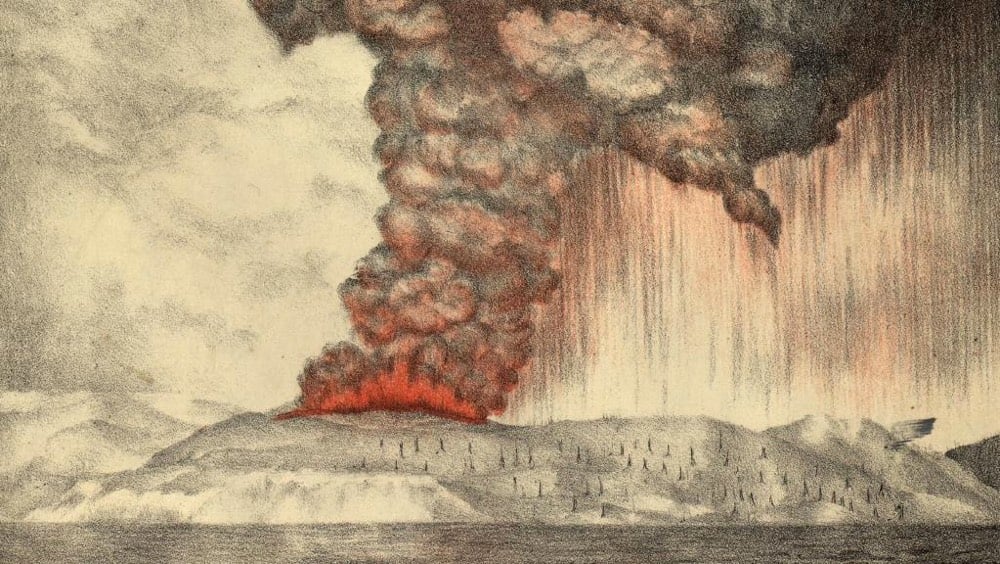
The sound made by the Krakatoa volcanic eruption in 1883 was so loud it ruptured eardrums of people 40 miles away, travelled around the world four times, and was clearly heard 3,000 miles away.
Think, for a moment, just how crazy this is. If you’re in Boston and someone tells you that they heard a sound coming from New York City, you’re probably going to give them a funny look. But Boston is a mere 200 miles from New York. What we’re talking about here is like being in Boston and clearly hearing a noise coming from Dublin, Ireland. Travelling at the speed of sound (766 miles or 1,233 kilometers per hour), it takes a noise about 4 hours to cover that distance. This is the most distant sound that has ever been heard in recorded history.
A much much smaller eruption occurred recently in Papua New Guinea. From the video, you can get a tiny sense of the sonic damage unleashed by Krakatoa:
Holy smoking Toledos indeed. On Reddit, a user details how loud a Saturn V rocket is and what the effects would be at different distances. At very close range, the sound from the Saturn V measures an incredible 220 db, loud enough to melt concrete just from the sound.
At 500 meters, 155 db you would experience painful, violent shaking in your entire body, you would feel compressed, as though deep underwater. Your vision would blur, breathing would be very difficult, your eardrums are obviously a lost cause, even with advanced active noise cancelling protection you could experience permanent damage. This is the sort of sound level aircraft mechanics sometimes experience for short periods of time. Almost twice as “loud” as putting your ear up to the exhaust of a formula 1 car. The air temperature would drop significantly, perhaps 10-25 degrees F, becoming suddenly cold because of the air being so violently stretched and moved.
Even at three miles away, the sound is loud enough to cause permanent hearing damage. But that’s nothing compared to the Krakatoa sound. The Saturn V sound is ~170 db at 100 meters away while the Krakatoa explosion was that loud 100 miles away! What happens at 170 db?
…you would be unable to breathe or likely see at all from the sound pressure, glass would shatter, fog would be generated as the water in the air dropped out of suspension in the pressure waves, your house at this distance would have a roughly 50% chance of being torn apart from sound pressure alone. Military stun grenades reach this volume for a split second… if they are placed up to your face. Survival chance from sound alone, minimal, you would certainly experience permanent deafness but probably also organ damage.
The word “loud” is inadequate to describe how loud that is. (thx, david)
Update: Sperm whales are loud! 200 decibels in water and 174 in air.
But the whale is not really as loud as the rocket, she told me. Because water is denser than air, sound in water is measured on a different decibel scale. In air, the sperm whale would still be extremely loud, but significantly less so - 174 decibels. That’s roughly equivalent to the decibel levels measured at the closest barometer, 100 miles away from the Krakatoa eruption, and is loud enough to rupture people’s ear drums. Suffice to say, you probably don’t want to spend a lot of time swimming with the sperm whales.
Every year, evolutionary biologist and professor David Barash gives his students The Talk about how evolution and religion do and do not get along.
It’s irresponsible to teach biology without evolution, and yet many students worry about reconciling their beliefs with evolutionary science. Just as many Americans don’t grasp the fact that evolution is not merely a “theory,” but the underpinning of all biological science, a substantial minority of my students are troubled to discover that their beliefs conflict with the course material.
Until recently, I had pretty much ignored such discomfort, assuming that it was their problem, not mine. Teaching biology without evolution would be like teaching chemistry without molecules, or physics without mass and energy. But instead of students’ growing more comfortable with the tension between evolution and religion over time, the opposite seems to have happened. Thus, The Talk.
This is the sort of thing Barash talks about:
The more we know of evolution, the more unavoidable is the conclusion that living things, including human beings, are produced by a natural, totally amoral process, with no indication of a benevolent, controlling creator.
(via @TomJunod)
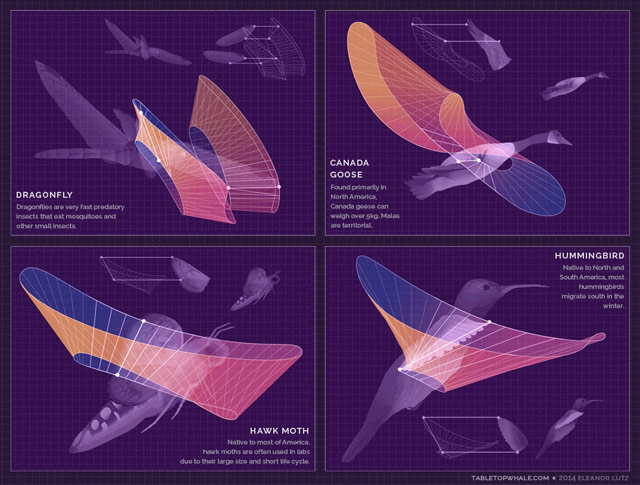
Eleanor Lutz has a degree in molecular biology, works as a designer, and loves to combine the two interests by making these wonderful information graphics on her site, Tabletop Whale. Her most recent post is an animated graphic showing how several animals (birds, bats, insects) move their wings while flying.
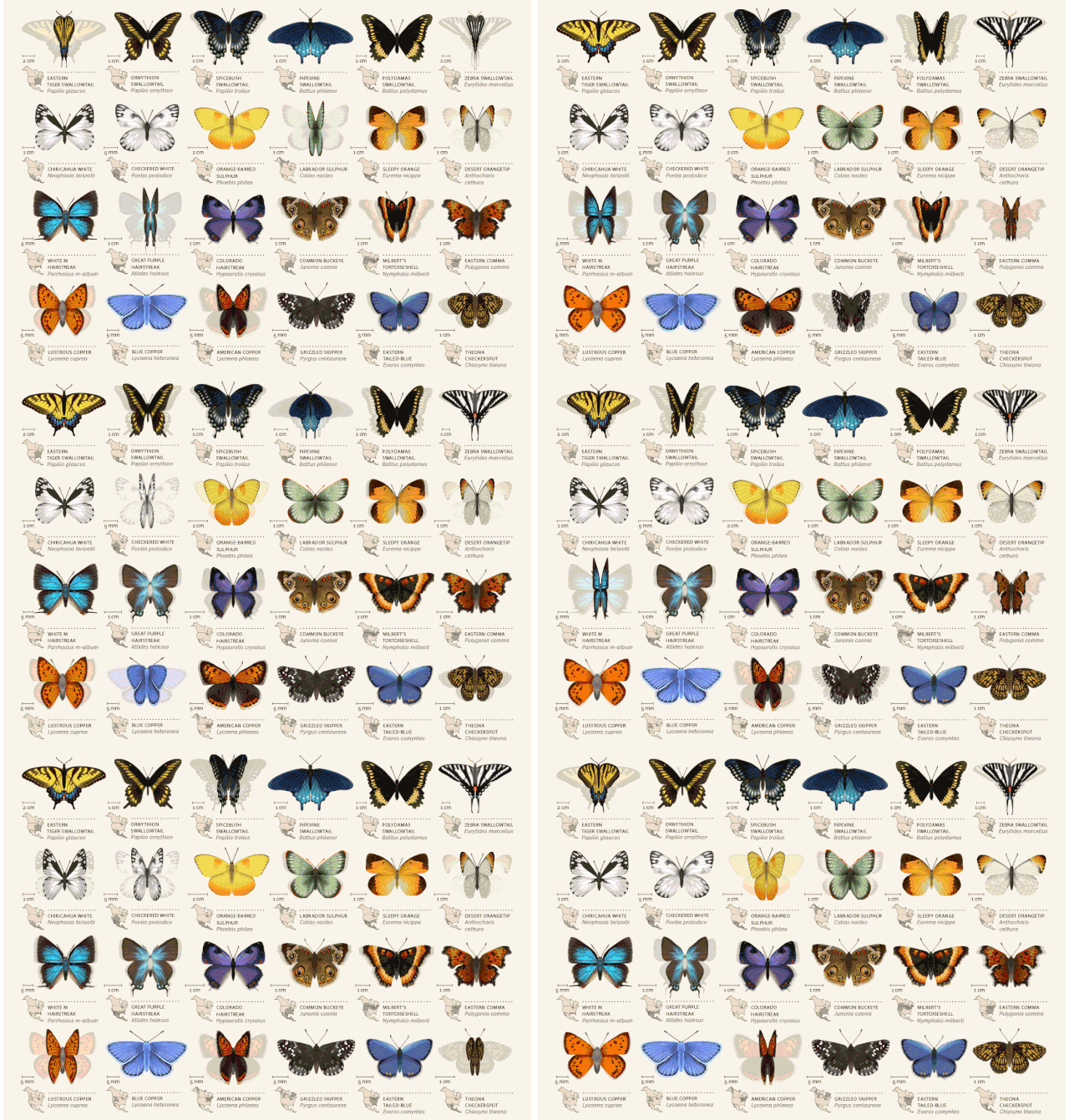
I love love love Lutz’s animated chart of North American butterflies. So playful!
There are only four posts on the site so far, but she’s done other stuff as well; this woodcut map for instance. Prints are available…I’m getting one of the butterflies for sure.
Give me even the simplest gravity simulator and I will play with it for many many minutes. Or hours. Or days. (Send help!)
This looks like a time lapse, but it’s not. It’s just a straight-up gorgeous video of the aurora borealis filmed in Yellowknife, Northwest Territories, Canada.
It is real time motion! NOT time-lapse. Brighter the Aurora, faster the movement.
(via the kid should see this)
Erik Vance on why real working archaeologists don’t care for Indiana Jones.
“Oh God,” he groans, “Don’t even go there. Indiana Jones is not an archeologist.”
It’s not surprising that academics — hell bent on taking the fun out of everything — would hate our beloved and iconic movie version of them. But Canuto is no killjoy. His ironic tone and acerbic wit seem honed by long boring days in the sun. So I bite. I quickly learn that there’s a good reason why most every archeologist on Earth hates Indy. And that they might have a point. Because Jones isn’t an archeologist at all.
“That first scene, where he’s in the temple and he’s replacing that statue with a bag of sand — that’s what looters do,” Canuto says, grinning. “[The temple builders] are using these amazing mechanisms of engineering and all he wants to do is steal the stupid gold statue.”
Makes you wonder if Jones was one of the Raiders referred to in the title of the first movie. (via @riondotnu)
As part of a course he was teaching, a biologist sent away for a genetic testing kit from 23andMe for himself and his parents. When he went looking for other relatives on the service (which is now an automatic opt-out feature), he discovered he had a half-brother his dad had not told his family about.
At first, I was thinking this is the coolest genetics story, my own personal genetics story. I wasn’t particularly upset about it initially, until the rest of the family found out. Their reaction was different. Years of repressed memories and emotions uncorked and resulted in tumultuous times that have torn my nuclear family apart. My parents divorced. No one is talking to my dad. We’re not anywhere close to being healed yet and I don’t know how long it will take to put the pieces back together.
After this discovery was made, I went back to 23andMe and talked to them. I said, “I’m not sure all your customers realize that when they participate in your family finder program, what they’re participating in what are essentially really advanced paternity tests.” People find out that their parents aren’t who they think they are. They have nearly a million people in the database. If there happens to be anyone in there you’re related to, they’ll find your match. This is a solid science.
I know a family in which one of the children is adopted and they haven’t told her. Which is crazy…she’s gonna find out eventually (through something like 23andMe or because of some medical emergency or test) and go totally berzerk.
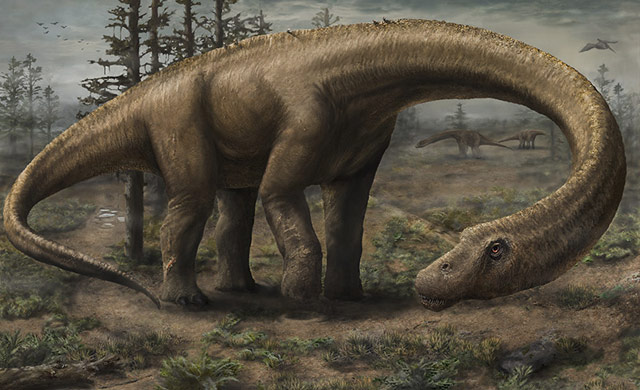
There’s a new king of the dinosaurs: Dreadnoughtus schrani. A skeleton of the species was unearthed in Argentina in 2005 and the results of the recently released analysis show this Dreadnoughtus was 85 feet long, weighed around 65 tons, and had a powerful “weaponized tail”. The kicker? It was not yet an adult and still growing when it died.
While other giants from Patagonia are known from a handful of bones, almost half of the Dreadnoughtus skeleton has been recovered. What’s more, the fossilised bones are in such good condition — even revealing where muscles attached — that the skeleton could provide unprecedented insights into the biology, movement and evolution of the group of huge plant-eating dinosaurs it belonged to, called the titanosaurian sauropods.
By comparison, an Apatosaurus (née Brontosaurus) is ~75 feet long and weighed 22 tons while a Boeing 737-900 weights around 50 tons. Here’s some more background on the Dreadnoughtus and a video showing some of the fossils:
Hmm, this is interesting. Recent studies suggest that food allergies may be caused by the absense of certain intestinal bacteria…in part due to increased use of antibiotics in very young children.
Food allergies have increased about 50% in children since 1997. There are various theories explaining why. One is that the 21st century lifestyle, which includes a diet very different from our ancestors’, lots of antibiotic use, and even a rise in cesarean section deliveries, has profoundly changed the makeup of microbes in the gut of many people in developed countries. For example, the average child in the United States has taken three courses of antibiotics by the time he or she is 2 years old, says Martin Blaser, an infectious disease specialist and microbiologist at New York University in New York City. (See here for more on the reach of microbiome research these days.)
Cathryn Nagler, an immunologist at the University of Chicago in Illinois, has spent years probing links between the immune system, intestinal bacteria, and the onset of allergies. Back in 2004, she and her colleagues reported that wiping out gut bacteria in mice led to food allergies. Since then, Nagler has continued trying to understand which bacteria offer allergy protection and how they accomplish that.

Spanning from comets in the south to the termination shock zone in the northern part of the country, The Sweden Solar System is a scale model of the solar system that spans the entire country of Sweden, the largest such model in the world.
The Sun is represented by the Ericsson Globe in Stockholm, the largest hemispherical building in the world. The inner planets can also be found in Stockholm but the outer planets are situated northward in other cities along the Baltic Sea.
Today’s brain-melter: Every Insanely Mystifying Paradox in Physics. It’s all there, from the Greisen-Zatsepin-Kuzmin limit to quantum immortality to, of course, the tachyonic antitelephone.
A tachyonic antitelephone is a hypothetical device in theoretical physics that could be used to send signals into one’s own past. Albert Einstein in 1907 presented a thought experiment of how faster-than-light signals can lead to a paradox of causality, which was described by Einstein and Arnold Sommerfeld in 1910 as a means “to telegraph into the past”.
If you emerge with your brain intact, at the very least, you’ll have lost a couple of hours to the list.
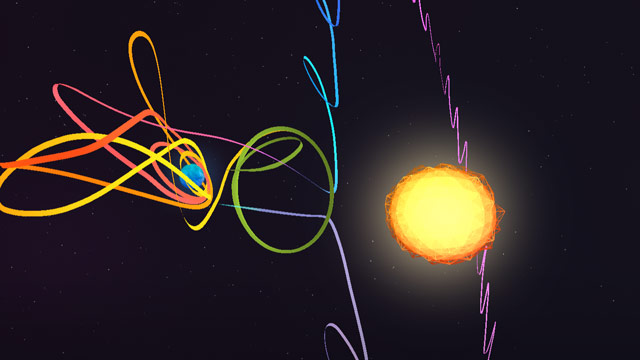
Oh man, this is great. A Spacecraft For All is an interactive video about the ISEE-3 Reboot Project, in which a group of scientists working out of an old McDonald’s crowdfunded an effort to communicate with a nearly forgotten satellite launched by NASA in 1978 to observe the Sun and chase a comet. After the intro, click on “See the Journey”…it’s well worth your time if you’re at all interested in space or science.
For instance, did you know there exists several points between the Earth and the Sun at which a satellite can orbit around, enabling spacecraft to stay more or less in the same spot for observation purposes? So cool!
The latest word on Homo floresiensis, the potential new species of hobbit-like humans discovered ten years ago in Indonesia, concerns a pair of papers which argue the single specimen found is actually a regular human with Down syndrome.
Now, the debate has reignited with two new papers published this week by a team of researchers from Penn State and other institutions. In one of those papers, they argue that the Flores skull is not a new species, but instead represents an ancient person with Down syndrome.
The researchers also point out, in the second paper, that the original report on the bones seemed to have exaggerated the skull’s diminutive size. Cranial measurements and features, along with shorter thigh bones, the team found, all correspond with modern manifestations of Down syndrome. “The difference is significant, and the revised figure falls in the range predicted for a modern human with Down syndrome from the same geographic region,” they say in a statement.
(via @daveg)
Physicist Andy Howell recently gave a talk about the science of Star Wars and wrote up a summary of it for Ain’t It Cool News. Topics covered include binary star systems, droids, the Death Star, and lightsabers:
Of course, we still don’t know how to make a lightsaber. One big problem is confining plasma (if that is even what it is), into some tube. But a bigger problem is the amount of energy required. We can actually calculate this from clues in the movies!
In Episode I, Qui-Gon jabs his lightsaber into a door, and melts part of it. That’s just basic physics! To melt something, you have to raise its temperature to the melting point, and you can calculate how much energy that takes using the specific heat capacity of a material.
(thx, greg)
MIT’s Franz-Josef Ulm has taken to analyzing the structure of cities as if they were molecular materials like glass or crystal.
With colleagues, Ulm began analyzing cities the way you’d analyze a material, looking at factors such as the arrangement of buildings, each building’s center of mass, and how they’re ordered around each other. They concluded that cities could be grouped into categories: Boston’s structure, for example, looks a lot like an “amorphous liquid.” Seattle is another liquid, and so is Los Angeles. Chicago, which was designed on a grid, looks like glass, he says; New York resembles a highly ordered crystal.
I love this. It’s like Jane Jacobs + the materials science research I did in college.
So far, Ulm says, the work has two potential applications. First, it could help predict and mitigate urban heat island effects, the fact that cities tend to be several degrees warmer than their surrounding areas-a phenomenon that has a major impact on energy use. (His research on how this relates to structure is currently undergoing peer review.) Second, he says that cities’ molecular order (or disorder) may also affect their vulnerability to the kinds of catastrophic weather events that are becoming more frequent thanks to climate change.
(via 5 intriguing things)
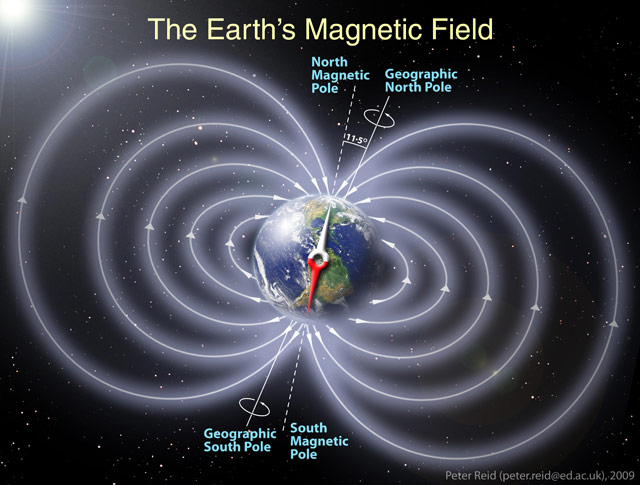
According to data collected by a European satellite array, the Earth’s magnetic field is shifting and weakening at a greater pace than previously thought. One of the reasons for the shift might be that the magnetic North and South poles are swapping positions.
Scientists already know that magnetic north shifts. Once every few hundred thousand years the magnetic poles flip so that a compass would point south instead of north. While changes in magnetic field strength are part of this normal flipping cycle, data from Swarm have shown the field is starting to weaken faster than in the past. Previously, researchers estimated the field was weakening about 5 percent per century, but the new data revealed the field is actually weakening at 5 percent per decade, or 10 times faster than thought. As such, rather than the full flip occurring in about 2,000 years, as was predicted, the new data suggest it could happen sooner.
You can read up on geomagnetic reversals on Wikipedia. A short sampling:
These periods [of polarity] are called chrons. The time spans of chrons are randomly distributed with most being between 0.1 and 1 million years with an average of 450,000 years. Most reversals are estimated to take between 1,000 and 10,000 years. The latest one, the Brunhes-Matuyama reversal, occurred 780,000 years ago. A brief complete reversal, known as the Laschamp event, occurred only 41,000 years ago during the last glacial period. That reversal lasted only about 440 years with the actual change of polarity lasting around 250 years. During this change the strength of the magnetic field dropped to 5% of its present strength.
Earlier today I asked my Twitter followers for recommendations for “really good” biographies about scientists. I gave Genius (James Gleick’s bio of Richard Feynman) and Cleopatra, A Life (not about a scientist but was super interesting and well-written) as examples of what I was looking for. You can see the responses here and I’ve pulled out a few of the most interesting ones below:
- Isaac Newton by James Gleick. Gleick wrote the aforementioned Genius and Chaos, another favorite of mine. I tried to read The Information last year after many glowing recommendations from friends but couldn’t get into it. Someone suggested Never at Rest is a superior Newton bio.
- The Man Who Loved Only Numbers by Paul Hoffman. I’ve read this biography of mathematician Paul Erdos; highly recommended.
- Galileo’s Daughter by Dava Sobel. I’ve never read anything by Sobel; I’ll have to rectify that.
- Einstein: His Life and Universe by Walter Isaacson. I enjoyed his problematic Jobs biography and I notice that he’s written one on Ben Franklin as well.
- Alan Turing: The Enigma by Andrew Hodges.
- American Prometheus by Kai Bird and Martin Sherwin. Bio of J. Robert Oppenheimer, leader of the Manhattan Project. See also: The Making of the Atomic Bomb, one of my favorite books ever.
- Everything and More by David Foster Wallace. I’ve heard Wallace was bit handwavy with the math in this one, but I still enjoyed it.
- Newton and the Counterfeiter by Thomas Levenson. Newton was a detective?
- The Philosophical Breakfast Club by Laura Snyder. Four-way bio of a group of school friends (Charles Babbage, John Herschel, William Whewell, and Richard Jones) who changed the world.
- The Reluctant Mr. Darwin by David Quammen. How Charles Darwin devised his theory of evolution and then sat on it for years is one of science’s most fascinating stories.
- T. rex and the Crater of Doom by Walter Alvarez. Not a biography of a person but of a theory: that a meteor impact 65 million years ago caused the extinction of the dinosaurs.
- Walt Disney by Neal Gabler. Disney isn’t a scientist, but when you ask for book recommendations and Steven Johnson tells you to read something, it goes on the list.
- The Man Who Knew Infinity by Robert Kanigel. Bio of brilliant Indian mathematician Srinivasa Ramanujan.
- Edge of Objectivity by Charles Gillispie. A biography of modern science published in 1966, all but out of print at this point unfortunately.
- Galileo at Work by Stillman Drake.
- The Age of Wonder by Richard Holmes.
And many more here. Thanks to everyone who suggested books.
Update: Because this came up on Twitter, some biographies specifically about women in science: The Immortal Life of Henrietta Lacks, Hedy’s Folly, On a Farther Shore, Marie Curie: A Life, A Feeling for the Organism, Rosalind Franklin: The Dark Lady of DNA, Jane Goodall: The Woman Who Redefined Man, and Radioactive.
Great post on the Fermi Paradox, aka if there are so many potential intelligent civilizations out there in the universe (possibly 10 quadrillion of them), why haven’t we heard from anyone?
Possibility 5) There’s only one instance of higher-intelligent life — a “superpredator” civilization (like humans are here on Earth) — who is far more advanced than everyone else and keeps it that way by exterminating any intelligent civilization once they get past a certain level. This would suck. The way it might work is that it’s an inefficient use of resources to exterminate all emerging intelligences, maybe because most die out on their own. But past a certain point, the super beings make their move — because to them, an emerging intelligent species becomes like a virus as it starts to grow and spread. This theory suggests that whoever was the first in the galaxy to reach intelligence won, and now no one else has a chance. This would explain the lack of activity out there because it would keep the number of super-intelligent civilizations to just one.
Update: If you prefer to watch engaging videos instead of reading text, here’s six minutes on the Fermi Paradox:
Aatish Bhatia noticed a plant in his backyard whose leaves naturally repelled water. He took a sample to a friend who had access to a high-speed camera and an electron microscope to investigate what made the leaves so hydrophobic.
But how does a leaf become superhydrophobic? The trick to this, Janine explained, is that the water isn’t really sitting on the surface. A superhydrophobic surface is a little like a bed of nails. The nails touch the water, but there are gaps in between them. So there’s fewer points of contact, which means the surface can’t tug on the water as much, and so the drop stays round.
The leaf is so water repellant that drops of water bounce right off of it:
In the New Yorker, Michael Specter writes generally about the malleability of memory and specifically about Daniela Schiller’s research on disassociating people’s memories from the feelings they have about them. Simply recalling a memory can change it, and Schiller has found evidence that process can be used to remove the feelings of stress, anxiety, and fear associated with certain memories.
Even so, Schiller entered her field at a fortunate moment. After decades of struggle, scientists had begun to tease out the complex molecular interactions that permit us to form, store, and recall many different types of memories. In 2004, the year Schiller received her doctorate in cognitive neuroscience, from Tel Aviv University, she was awarded a Fulbright fellowship and joined the laboratory of Elizabeth Phelps, at New York University. Phelps and her colleague Joseph LeDoux are among the nation’s leading investigators of the neural systems involved in learning, emotion, and memory. By coincidence, that was also the year that the film “Eternal Sunshine of the Spotless Mind” was released; it explores what happens when two people choose to have all their memories of each other erased. In real life, it’s not possible to pluck a single recollection from our brains without destroying others, and Schiller has no desire to do that. She and a growing number of her colleagues have a more ambitious goal: to find a way to rewrite our darkest memories.
“I want to disentangle painful emotion from the memory it is associated with,” she said. “Then somebody could recall a terrible trauma, like those my father obviously endured, without the terror that makes it so disabling. You would still have the memory, but not the overwhelming fear attached to it. That would be far more exciting than anything that happens in a movie.” Before coming to New York, Schiller had heard — incorrectly, as it turned out — that the idea for “Eternal Sunshine” originated in LeDoux’s lab. It seemed like science fiction and, for the most part, it was. As many neuroscientists were aware, though, the plot also contained more than a hint of truth.
The black hole at the center of the Milky Way galaxy is estimated to have a mass of 4 million Suns. The largest black hole astronomers have found so far has a mass of 18 billion solar masses, or more than 4000 times as massive as the Milky Way’s.
Around 3.5 billion light-years away, this galaxy is estimated to contain the largest black hole presently known, at 18 billion solar masses. (Although, the error bars for this one and NGC 1277’s overlap substantially.) But the most spectacular part of this galaxy — and why we’re able to learn so much about it’s central region — is because there’s a 100 million Solar mass black hole (that’s 25 times larger than the one at the Milky Way’s core) that’s orbiting the even larger one!
Also, the largest know galaxy in the Universe is IC 1101, with a mass of 100 trillion solar masses.
A group led by Dr. Robert Costanza has calculated the value of the world’s ecosystems…the group’s most recent estimate puts the yearly value at $142.7 trillion.
“I think this is a very important piece of science,” said Douglas J. McCauley of the University of California, Santa Barbara. That’s particularly high praise coming from Dr. McCauley, who has been a scathing critic of Dr. Costanza’s attempt to put price tags on ecosystem services.
“This paper reads to me like an annual financial report for Planet Earth,” Dr. McCauley said. “We learn whether the dollar value of Earth’s major assets have gone up or down.”
The group last calculated this value back in 1997 and it rose sharply over the past 17 years, even as those natural habitats are disappearing. This line from the article stunned me:
Dr. Costanza and his colleagues estimate that the world’s reefs shrank from 240,000 square miles in 1997 to 108,000 in 2011.
Coral reefs shrank by more than half over the past 17 years…I had no idea the reef situation was that bad. Jesus.
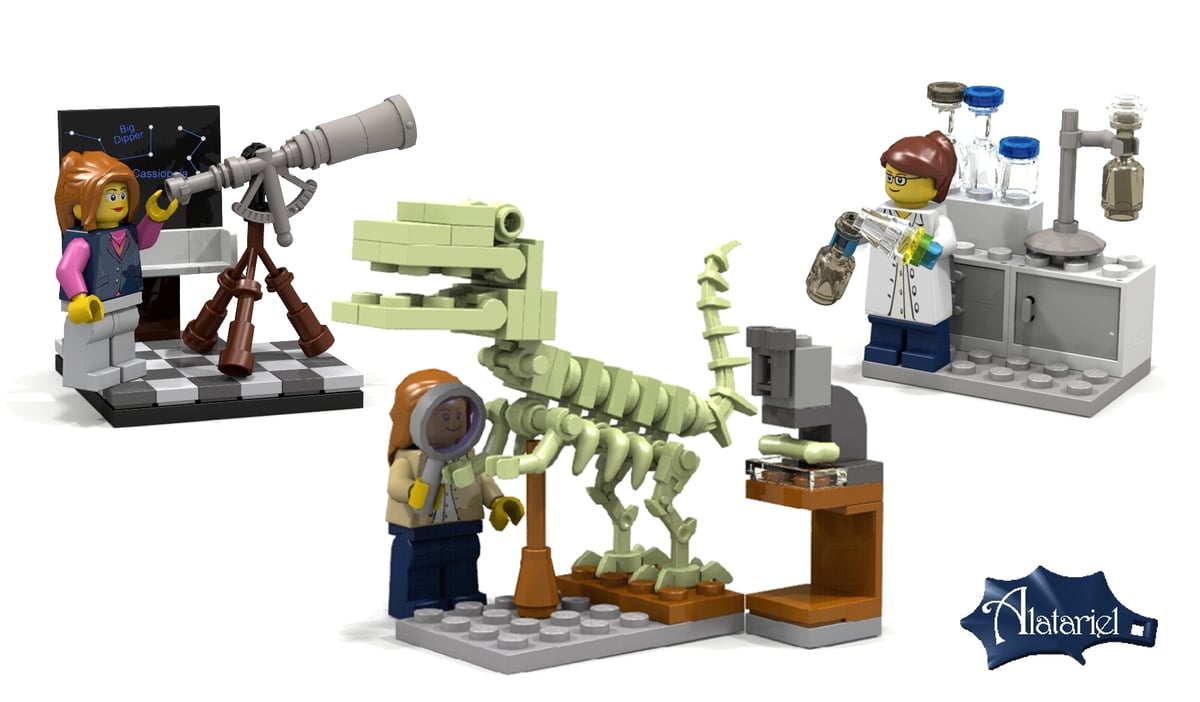
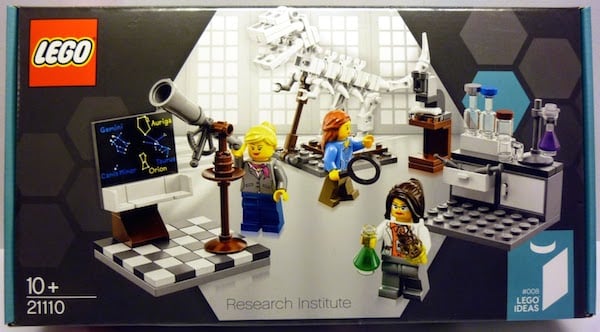
A proposal by geochemist Ellen Kooijman for a minifigure set of female scientists has won Lego’s Winter 2014 Review. The set, called “Research Institute,” is on track to be released by Lego Ideas in August 2014, more than two years after a campaign that took off with huge support from the internet.
Kooijman designed twelve figures in total, plus accessories. Lego will tweak the final designs and hasn’t announced the specific characters or total number that will be included. Kooijman’s proposed set includes an astronomer, a paleontologist, and a chemist:
Me, I’m a fan of the robotics engineer (pictured below, right, with a falconer and geologist):

Lego already has one female scientist minifigure, released just last fall (after Koojiman’s original proposal). She’s a chemist/theoretician, with the typical glasses (safety glasses! according to materials scientist Deb Chachra), pocket protector, and laboratory flasks. But scientists have all kinds of tools and look all sorts of different ways, even broader than Kooijman’s all-yellow/caucasian team with generic Lego hair. (“Ideally, Lego would use some ‘rare’ face and hair designs if they were to produce a set,” she writes.)
Besides, go back and look at the composition of some of Lego’s other sets to see if it could use more than one female scientist. Minifigure Series 1 had sixteen characters, with the two women being “Cheerleader” and “Nurse.” The “Scientist” just came out in Series 11, along with “Grandma,” [ok fine] “Pretzel Girl,” [really?] “Diner Waitress,” [ugh!] and the admittedly awesome “Lady Robot,” who loves to party. “Some day she might decide she’s ready to stop partying…but not yet!” Go ahead, be gone with it, Lady Robot.
Update: The retail version of the Lego Research Institute has arrived! It’s Kooijman’s original trio of paleontologist, astronomer, and chemist, with tweaked designs and accessories. Here’s a picture:
(Thanks, @debcha)
It is sad to see Gwyneth Paltrow promoting pseduoscience hucksters like Masaru Emoto in her very popular Goop newsletter. It begins:
I am fascinated by the growing science behind the energy of consciousness and its effects on matter. I have long had Dr. Emoto’s coffee table book on how negativity changes the structure of water, how the molecules behave differently depending on the words or music being expressed around it.
And later on in the letter, Dr. Habib Sadeghi continues:
Japanese scientist, Masaru Emoto performed some of the most fascinating experiments on the effect that words have on energy in the 1990’s. When frozen, water that’s free from all impurities will form beautiful ice crystals that look exactly like snowflakes under a microscope. Water that’s polluted, or has additives like fluoride, will freeze without forming crystals. In his experiments, Emoto poured pure water into vials labeled with negative phrases like “I hate you” or “fear.” After 24 hours, the water was frozen, and no longer crystallized under the microscope: It yielded gray, misshapen clumps instead of beautiful lace-like crystals. In contrast, Emoto placed labels that said things like “I Love You,” or “Peace” on vials of polluted water, and after 24 hours, they produced gleaming, perfectly hexagonal crystals. Emoto’s experiments proved that energy generated by positive or negative words can actually change the physical structure of an object.
Riiiight. Paltrow should stick to recipes, fashion, and workouts and leave the science to people who actually understand it lest she wander into Jenny McCarthy territory. There’s nothing wrong with asserting that thinking positively will improve your life, but connecting it with quantum physics and the like, without rigorous scientific proof, is dangerous and stupid.
Steven Johnson has been working on a six-part series for PBS called How We Got to Now. (There’s a companion book as well.) The series is due in October but the trailer dropped today:
And here’s a snippet of one of the episodes about railway time. I’m quite looking forward to this series; Johnson and I cover similar ground in our work with similar sensibilities. I’m always cribbing stuff from his writing and using his frameworks to think things through and just from the trailer, I counted at least three things I’ve covered on kottke.org in the past: Hedy Lamarr, urban sanitation, and Jacbo Riis (not to mention all sorts of stuff about time).
There are a couple of different ways you can construct a stable solar system with a maximum number of habitable worlds. One includes 36 habitable worlds in a single solar system.
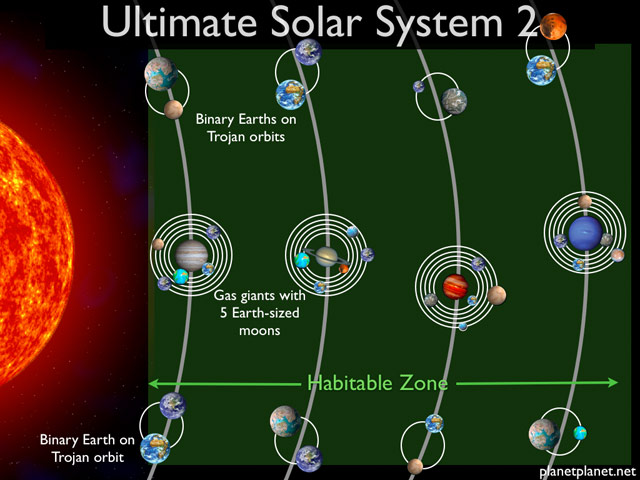
We can fit the orbits of four gas giants in the habitable zone (in 3:2 resonances). Each of those can have up to five potentially habitable moons. Plus, the orbit of each gas giant can also fit an Earth-sized planet both 60 degrees in front and 60 degrees behind the giant planet’s orbit (on Trojan orbits). Or each could be a binary Earth! What is nice about this setup is that the worlds can have any size in our chosen range. It doesn’t matter for the stability.
Let’s add it up. One gas giant per orbit. Five large moons per gas giant. Plus, two binary Earths per orbit. That makes 9 habitable worlds per orbit. We have four orbits in the habitable zone. That makes 36 habitable worlds in this system!
If there wasn’t life on Mars before, there might be now. Before NASA sent Curiosity to Mars, it was thoroughly cleaned of all traces of contaminants. But swabs of rover’s surfaces taken before it was sent to Mars have revealed 377 different strains of bacteria that potentially could have made the trip. Some of them may have even survived.
A study that identified 377 strains found that a surprising number resist extreme temperatures and damage caused by ultraviolet-C radiation, the most potentially harmful type. The results, presented today at the annual meeting of the American Society for Microbiology, are a first step towards elucidating how certain bacteria might survive decontamination and space flight.
If the Moon orbited the Earth at the same distance as the International Space Station, it might look a little something like this:
At that distance, the Moon would cover half the sky and take about five minutes to cross the sky. Of course, as Phil Plait notes, if the Moon were that close, tidal forces would result in complete chaos for everyone involved.
There would be global floods as a tidal wave kilometers high sweeps around the world every 90 minutes (due to the Moon’s closer, faster orbit), scouring clean everything in its path. The Earth itself would also be stretched up and down, so there would be apocalyptic earthquakes, not to mention huge internal heating of the Earth and subsequent volcanism. I’d think that the oceans might even boil away due to the enormous heat released from the Earth’s interior, so at least that spares you the flood… but replaces water with lava. Yay?
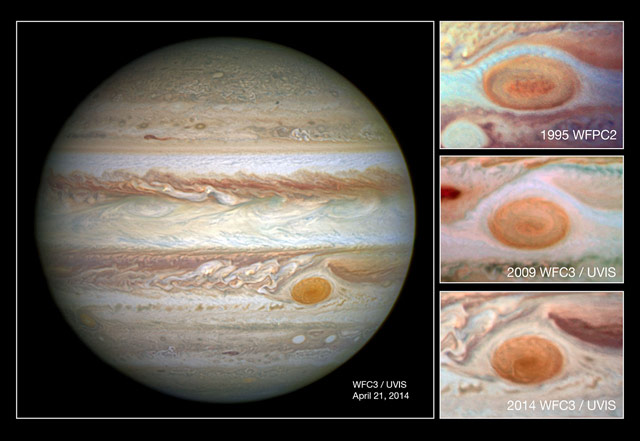
Jupiter’s Great Red Spot is becoming more of a Medium Red Spot. The gas giant’s signature beauty mark was recently measured by the Hubble as spanning 10,250 miles across its widest point, down from a high of 25,500 miles across.
Historic observations as far back as the late 1800s [2] gauged this turbulent spot to span about 41 000 kilometres at its widest point — wide enough to fit three Earths comfortably side by side. In 1979 and 1980 the NASA Voyager fly-bys measured the spot at a shrunken 23 335 kilometres across. Now, Hubble has spied this feature to be smaller than ever before.
“Recent Hubble Space Telescope observations confirm that the spot is now just under 16 500 kilometres across, the smallest diameter we’ve ever measured,” said Amy Simon of NASA’s Goddard Space Flight Center in Maryland, USA.
Amateur observations starting in 2012 revealed a noticeable increase in the spot’s shrinkage rate. The spot’s “waistline” is getting smaller by just under 1000 kilometres per year. The cause of this shrinkage is not yet known.
Clive Thompson recently saw the moons of Jupiter with his own eyes and has a moment.
I saw one huge, bright dot, with three other tiny pinpoints of light nearby, all lined up in a row (just like the image at the top of this story). Holy moses, I realized; that’s no star. That’s Jupiter! And those are the moons of Jupiter!
I’m a science journalist and a space buff, and I grew up oohing and aahing over the pictures of Jupiter sent back by various NASA space probes. But I’d never owned a telescope, and never done much stargazing other than looking up in the night unaided. In my 45 years I’d never directly observed Jupiter and its moons myself.
So I freaked out. In a good way! It was a curiously intense existential moment.
For my birthday when I was seven or eight, my dad bought me a telescope. (It was a Jason telescope; didn’t everyone have a telescope named after them?) We lived in the country in the middle of nowhere where it was nice and dark, so over the next few years, we looked at all sorts of celestial objects through that telescope. Craters on the Moon, the moons of Jupiter, Mars, and even sunspots on the Sun with the aid of some filters. But the thing that really got me, that provided me with my own version of Thompson’s “curiously intense existential moment”, was seeing the rings of Saturn through a telescope.
We had heard from PBS’s Jack Horkheimer, the Star Hustler, that Saturn and its rings would be visible and he showed pictures of what it would look like, something like this:
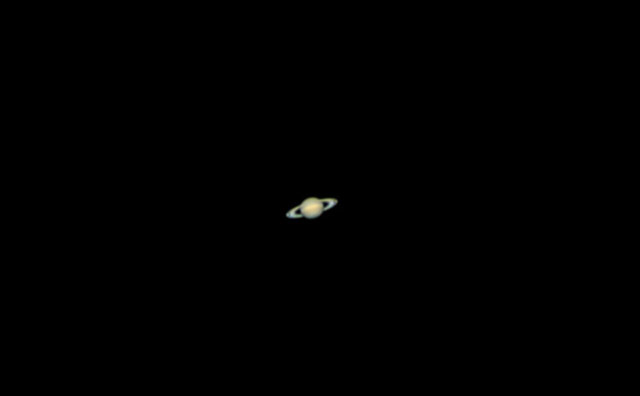
But seeing that with your own eyes through a telescope was a different thing entirely. Those tiny blurry rings, visible from millions of miles away. What a thrill! It’s one of my favorite memories.
Newer posts
Older posts



Socials & More