kottke.org posts about science
Scientists have discovered the first promising new antibiotic in 25 years. And even better, says Ed Yong, is that the antibiotic in question is “resistant to resistance”.
A team of scientists led by Kim Lewis from Northeastern University have identified a new antibiotic called teixobactin, which kills some kinds of bacteria by preventing them from building their outer coats. They used it to successfully treat antibiotic-resistant infections in mice. And more importantly, when they tried to deliberately evolve strains of bacteria that resist the drug, they failed. Teixobactin appears resistant to resistance.
Bacteria will eventually develop ways of beating teixobactin — remember Orgel — but the team are optimistic that it will take decades rather than years for this to happen. That buys us time.
…and also that the process by which teixobactin was discovered is the real breakthrough:
Teixobactin isn’t even the most promising part of its own story. That honour falls on the iChip-the tool that the team used to discover the compound. Teixobactin is a fish; the iChip is the rod. Having the rod guarantees that we’ll get more fish-and we desperately need more.
Buzzfeed’s Carolyn Kylstra asked some scientists and medical professionals about juice cleanses and while they are (mostly) harmless, they definitely don’t do any of the magical things you think they do, like flush the toxins out of your body or reset your system.
“I don’t know why someone would do a juice cleanse,” Dr. John Buse, M.D., Ph.D., chief of the division of endocrinology at the University of North Carolina at Chapel Hill, told BuzzFeed Life. “There’s very little evidence that it does anything good for you.”
And it definitely won’t “rid your body of toxins.” That really is what your liver (and your kidneys and intestines) is for. “I don’t like the marketing around juice cleanses,” Eric Ravussin, Ph.D., associate executive director for clinical science at Pennington Biomedical Research Center, told BuzzFeed Life. “That it’s going to detox and mobilize all these toxins and all that — this is pure marketing.”
Update: From the NY Times in 2009, Flush Those Toxins! Eh, Not So Fast. The last paragraph makes me angry:
Still, many people swear by these programs. Denise Whitney, 37, a registered nurse and mother of three in Traverse City, Mich., did the Master Cleanse over a seven-day period, plus six days of pre and post cleanse, which included consuming copious amounts of organic juice, fruit and vegetables. “With all the fast food, preservatives, chemicals in our food, it seems impossible that our bodies are not loaded with toxins,” Ms. Whitney said, adding that she plans to repeat it in the next few months. “I had more energy during this cleanse than I can ever remember having.”
Can we get this nurse unregistered, please? FFS. But at The Guardian, Oliver Burkeman cautions against over-debunking.
We live in the Age of Debunking: no sooner has somebody made a false or hyperbolic claim online (resulting in clicks) than someone else announces, with an air of triumph, that they’ve debunked it (resulting in clicks). I plead guilty. And often enough, debunking is a noble pursuit: the idea that we only use 10% of our brains, to pick one example, is flat wrong, and people who believe it ought to be corrected. No convincing evidence of a Benghazi conspiracy has ever been unearthed. Marie Antoinette almost certainly didn’t say “let them eat cake”.
But the internet’s enthusiasm for a vigorous debunking now frequently spills over into what you might call the pseudo-debunk. Sometimes, this involves cynically claiming you’re debunking when you’re really just disagreeing — thereby implying that your opinion is more than mere opinion; it’s “the facts”.
Update: Tara Fuller of Greatist writes I’ve Tried Almost Every Cleanse. Here’s Why I’ll Never Do One Again:
2. Eating fruit is much healthier than drinking it.
While juice cleanses may seem like an easy way to load up on vitamins and minerals, they’re often full of added sugars and devoid of the good stuff (like fiber and antioxidants). Juicing fruits does tend to preserve some vitamins, but why guzzle several hundred calories worth of fruit when you can eat one serving and actually feel full? Plus, all that juice can actually lead to type 2 diabetes-whereas eating fruit reduces the risk!
(via @fakejoshstein & @neversent & @alainabrowne)
Update: Once again, Fancy Juice Doesn’t Cleanse the Body of Toxins:
To say that drinking juice detoxifies the body isn’t quite the same as claiming leeches suck out poisons, but it’s fairly close.
The practice of cleansing has become as ubiquitous as the use of hand sanitizer. Celebrities do it. Spas offer it. Fancy food stores sell pricey bottles of juice to accomplish it, and a \$700 juicer will soon facilitate the process for those who are not satisfied with the current D.I.Y. options. But what is it that everybody is trying to remove from their bodies? Is there any science behind it?
“People are interested in this so-called detoxification, but when I ask them what they are trying to get rid of, they aren’t really sure,” said Dr. James H. Grendell, the chief of the division of gastroenterology, hepatology and nutrition at Winthrop-University Hospital in Mineola, N.Y. “I’ve yet to find someone who has specified a toxin they were hoping to be spared.”
Update: This sort of magical health thinking isn’t restricted to juice cleanses. Yvette d’Entremont writes about the sickening business of wellness for The Outline:
Health is all the stuff that you know you should do. Wellness is all the peripheral shit that someone marketed to you because it sounded almost like health. It’s modern-day snake oil, and today it either comes from extremely well-off celebrities who look healthy under 18 layers of makeup, internet charlatans who probably know they’re full of shit, and people who might not know there’s no science to back them up, but they do see your open wallet and know when business is good.
The Hubble Space Telescope was launched 25 years ago, and to start the celebration, NASA has released a pair of images that actually did make this space nerd’s jaw drop. The first is an update of a classic: a much sharper photo of the so-called Pillars of Creation:
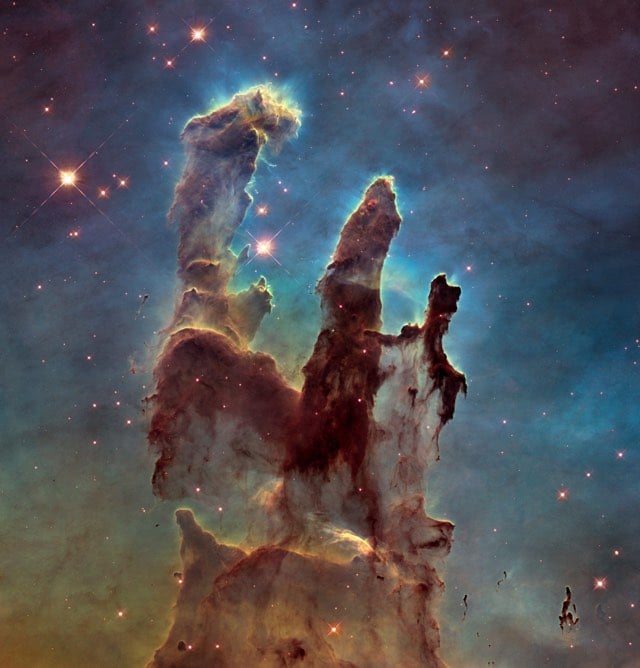
Although NASA’s Hubble Space Telescope has taken many breathtaking images of the universe, one snapshot stands out from the rest: the iconic view of the so-called “Pillars of Creation.” The jaw-dropping photo, taken in 1995, revealed never-before-seen details of three giant columns of cold gas bathed in the scorching ultraviolet light from a cluster of young, massive stars in a small region of the Eagle Nebula, or M16.
The second image isn’t so immediately amazing but is my favorite of the two. It’s a photo of half of the Andromeda galaxy, the big galaxy closest to our own in distance but also in rough size and shape. Here’s a very very scaled-down version of it:
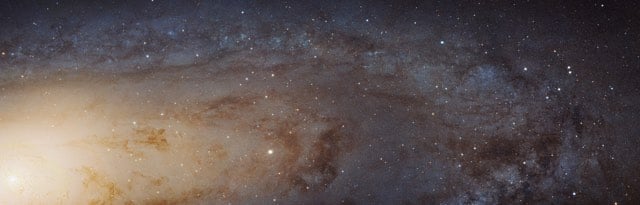
The largest NASA Hubble Space Telescope image ever assembled, this sweeping view of a portion of the Andromeda galaxy (M31) is the sharpest large composite image ever taken of our galactic neighbor. Though the galaxy is over 2 million light-years away, the Hubble telescope is powerful enough to resolve individual stars in a 61,000-light-year-long section of the galaxy’s pancake-shaped disk. It’s like photographing a beach and resolving individual grains of sand. And, there are lots of stars in this sweeping view — over 100 million, with some of them in thousands of star clusters seen embedded in the disk.
The original image is 1500 megapixels (1.5 gigapixels!), which is so big that you’d need 600 HD televisions to display the whole thing. But if you take the biggest reasonable size available for download (100 megapixels) and zoom in on it, you get this:
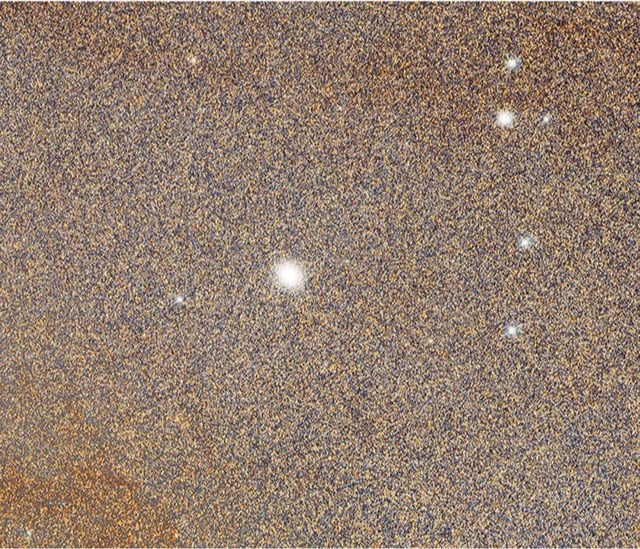
That looks like JPEG compression noise, right? Nope, each one of those dots is a star…some of the 100 million individual stars that can be seen in the full image.

That’s right, Keanu. Whoa. For an even closer look, check out this annotated close-up released by NASA:
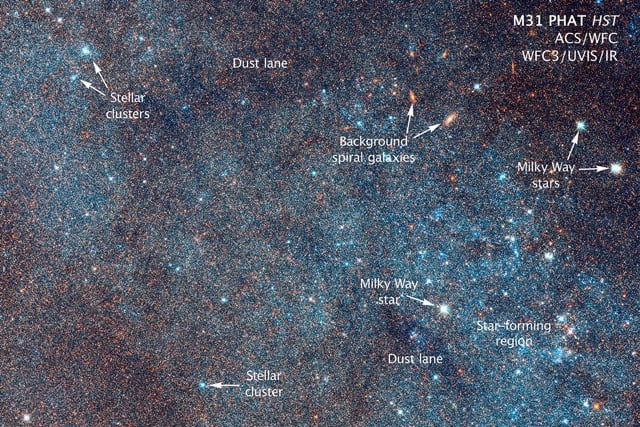
If you’re curious and feel like crashing your browser and/or Photoshop a bunch of times (I did not), the full-res Andromeda images are available here. And Phil Plait writes much more joyfully and knowledgeably about these images than I do…go take a look at his Pillars of Creation and Andromeda posts.
Update: Rob Griffiths took 50+ photos from the Hubble web site and made them into Retina iMac-sized wallpapers. (via @djacobs)
From astrophysicist Robert Simpson, a tour of the Universe from humans to the largest structure of the Universe. The piece is full of interesting little bits like:
The average female is 1.62 metres [tall] — that’s 5.4 light-nanoseconds.
If the Earth was a beach ball then all life on Earth exists within just 1mm around the surface.
Out by Pluto, the Sun itself is has dimmed to look like an other stars.
If the Sun was a blood cell then the Milky Way is the size of Europe.
See also Steven Strogatz on the Sagan Planet Walk in Ithaca, NY.
As you stroll from one to another, you can’t help noticing that the first four planets are really close together. It takes a few seconds, a few tens of steps, to walk from the Sun to Mercury and then on to Venus, Earth and Mars. By contrast, Jupiter is a full two-minute walk down the block, just past Moosewood Restaurant, waiting for someone to stop by and admire it. The remaining planets are even lonelier, each marooned in its own part of town. The whole walk, from the Sun to Pluto, is about three-quarters of a mile long and takes about 15 minutes.
My favorite detail: they added a new station to the Sagan Walk, the star nearest to our solar system. It’s in Hawaii.
As a young graduate student, Brian Greene caught the very beginning of the superstring revolution in physics. 30 years later, Greene provides an accessible overview of string theory’s current status.
While spectacularly successful at predicting the behavior of atoms and subatomic particles, the quantum laws looked askance at Einstein’s formulation of gravity. This set the stage for more than a half-century of despair as physicists valiantly struggled, but repeatedly failed, to meld general relativity and quantum mechanics, the laws of the large and small, into a single all-encompassing description.
Such was the case until December 1984, when John Schwarz, of the California Institute of Technology, and Michael Green, then at Queen Mary College, published a once-in-a-generation paper showing that string theory could overcome the mathematical antagonism between general relativity and quantum mechanics, clearing a path that seemed destined to reach the unified theory.
The idea underlying string unification is as simple as it is seductive. Since the early 20th century, nature’s fundamental constituents have been modeled as indivisible particles-the most familiar being electrons, quarks and neutrinos-that can be pictured as infinitesimal dots devoid of internal machinery. String theory challenges this by proposing that at the heart of every particle is a tiny, vibrating string-like filament. And, according to the theory, the differences between one particle and another — their masses, electric charges and, more esoterically, their spin and nuclear properties — all arise from differences in how their internal strings vibrate.
A major study conducted by the Harvard School of Public Health has found a significant link between autism and the exposure of the mother to high levels of air pollution during the third trimester of pregnancy.
Researchers focused on 1,767 children born from 1990 to 2002, including 245 diagnosed with autism. The design of the study and the results rule out many confounding measures that can create a bias, Weisskopf said. The researchers took into account socioeconomic factors that can influence exposure to pollution or play a role in whether a child is diagnosed with autism.
The fact that pollution caused problems only during pregnancy strengthened the findings, since it’s unlikely other factors would have changed markedly before or after those nine months, he said in a telephone interview.
The ultimate cause of autism remains a mystery in most cases, said Charis Eng, chairwoman of the Lerner Research Institute’s Genomic Medicine Institute at the Cleveland Clinic in Ohio. While the Harvard study isn’t definitive and the findings could be coincidental, it’s not likely given the large size and the precise results, she said in a telephone interview.
“The truth is there has to be gene and environmental interactions,” said Eng, who wasn’t involved in the study. “I suspect the fetus already had the weak autism spectrum disorder genes, and then the genes and the environment interacted.”
It would be a huge help (and I am not in any way being facetious about this) if Jenny McCarthy and all the other celebrity “vaccines cause autism” folks threw their weight behind cleaning up pollution the way they attacked vaccination. Redeem yourselves. (via @john_overholt)
There’s no blue pigment present in the wings of the morpho butterfly. So where does that shimmering brilliant blue color come from? It’s an instance of structural color, where the physical structure of the surface scatters or refracts only certain wavelengths of light…in this case, blue.
Eye color is another example of structural color in action. Eyes contain brown pigments but not blue. Blue, green, and hazel eyes are caused by Rayleigh scattering, the same phenomenon responsible for blue skies and red sunsets. Blue eyes and blue skies arise from the same optical process…that’s almost poetic. (thx, jared)
According to a recent paper, as little as 12 seconds of video is enough to identify a particular shooter’s personal “motion signature”.
Here’s a way to shake off anonymity - literally. Footage from wearable cameras contains a “motion signature” unique to you. The discovery could identify police wearing body cameras, but also let authorities single out protesters uploading footage, say.
(via @buzz)
Physics World, the magazine of the Institute of Physics, has named their 2014 Breakthrough of the Year and nine runners-up. The top spot goes to the ESA’s Rosetta mission for landing on a comet.
By landing the Philae probe on a distant comet, the Rosetta team has begun a new chapter in our understanding of how the solar system formed and evolved — and ultimately how life was able to emerge on Earth. As well as looking forward to the fascinating science that will be forthcoming from Rosetta scientists, we also acknowledge the technological tour de force of chasing a comet for 10 years and then placing an advanced laboratory on its surface.
The other nine achievements, which you can click through to read about, are:
Quasar shines a bright light on cosmic web
Neutrinos spotted from Sun’s main nuclear reaction
Laser fusion passes milestone
Electrons’ magnetic interactions isolated at long last
Disorder sharpens optical-fibre images
Data stored in magnetic holograms
Lasers ignite ‘supernovae’ in the lab
Quantum data are compressed for the first time
Physicists sound-out acoustic tractor beam
From Quora, an answer to the question “If we pour water on the sun with a bucket as big as the sun, will the sun be extinguished?”
The probable answer is “no.” The Sun involves a special type of fire that is able to “burn” water, and so it will just get hotter, and six times brighter.
Water is 89% oxygen BY MASS. And the Sun’s overall density is 1.4 times that of water. So if you have a volume of water the VOLUME of the Sun, it will have 1/1.4 = 0.71 times the mass of the Sun, and this mass will be .71*.89 = 63% of a solar mass of oxygen and 8% of a solar mass of hydrogen. The Sun itself is 0.74 solar masses of hydrogen and 0.24 solar masses of helium.
So you end up with a 1.7 solar mass star with composition 48% hydrogen, 37% oxygen, and 14% helium (with 1% heavier elements).
Now, will such a star burn? Yes, but not with the type of proton-proton fusion the Sun uses. A star 1.7 times the mass of the Sun will heat up and burn almost entirely by the CNO fusion cycle, after making some carbon and nitrogen to go along with all the oxygen you’ve started with. So with CNO fusion and that mass you get a type F0 star with about 1.3 times the radius and 6 times the luminosity of the present Sun, and a temperature somewhat hotter than the Sun (7200 K vs. the Sun’s 5800 K). It will be bluish-white, with more UV. That, along with that 6 times heat input, will cause the Earth’s biosphere to be fried, and oceans to probably boil.
Well, we probably shouldn’t do that then. (via gizmodo)
Whilst roving about Mars, Curiosity has slowly but surely racked up evidence for a past Mars that was warm, wet, and possibly habitable.
John P. Grotzinger of Caltech, the project scientist for the mission, reported at a news conference on Monday that the rover’s yearlong trek to Mount Sharp provided strong new evidence that Gale Crater had large lakes, rivers and deltas, on and off, for millions to tens of millions of years. The geology shows that even when the surface water dried up, plenty of water would have remained underground, he said.
Moreover, the team concluded, numerous deltalike and lakelike formations detected by orbiting satellites are almost certainly the dried remains of substantial ancient lakes and deltas. None of this proves that life existed on the planet, but the case for an early Mars that was ripe and ready for life has grown stronger.
“As a science team, Mars is looking very attractive to us as a habitable planet,” Dr. Grotzinger said in an interview. “Not just sections of Gale Crater and not just a handful of locations, but at different times around the globe.”
See also the interactive 28 Months on Mars.
Update: And right on cue, Curiosity has recorded a two-month-long methane burst on Mars. One explanation for the methane is that it’s a waste product of living organisms.
The presence of methane is significant because the gas cannot exist for long. Calculations indicate that sunlight and chemical reactions in the Martian atmosphere would break up the molecules within a few hundred years, so any methane there now must have been created recently.
It could have been created by a geological process known as serpentinization, which requires both heat and liquid water. Or it could be a product of life in the form of microbes known as methanogens, which release methane as a waste product.
Even if the explanation for the methane turns out to be geological, the hydrothermal systems would still be prime locations to search for signs of life.
Update: And now Curiosity has found “biologically useful nitrogen” on Mars.
There is no evidence to suggest that the fixed nitrogen molecules found by the team were created by life. The surface of Mars is inhospitable for known forms of life. Instead, the team thinks the nitrates are ancient, and likely came from non-biological processes like meteorite impacts and lightning in Mars’ distant past.
Features resembling dry riverbeds and the discovery of minerals that form only in the presence of liquid water suggest that Mars was more hospitable in the remote past. The Curiosity team has found evidence that other ingredients needed for life, such as liquid water and organic matter, were present on Mars at the Curiosity site in Gale Crater billions of years ago.
“Finding a biochemically accessible form of nitrogen is more support for the ancient Martian environment at Gale Crater being habitable,” said Jennifer Stern of NASA’s Goddard Space Flight Center in Greenbelt, Maryland.
Update: The analysis of a year of weather and soil data collected by Curiosity indicates that a small amount of liquid water could exist below the surface of Mars.
Martian weather and soil conditions that NASA’s Curiosity rover has measured, together with a type of salt found in Martian soil, could put liquid brine in the soil at night.
Perchlorate identified in Martian soil by the Curiosity mission, and previously by NASA’s Phoenix Mars Lander mission, has properties of absorbing water vapor from the atmosphere and lowering the freezing temperature of water. This has been proposed for years as a mechanism for possible existence of transient liquid brines at higher latitudes on modern Mars, despite the Red Planet’s cold and dry conditions.
New calculations were based on more than a full Mars year of temperature and humidity measurements by Curiosity. They indicate that conditions at the rover’s near-equatorial location were favorable for small quantities of brine to form during some nights throughout the year, drying out again after sunrise. Conditions should be even more favorable at higher latitudes, where colder temperatures and more water vapor can result in higher relative humidity more often.
The Guardian and other media outlets have translated this news into Nasa’s Curiosity rover finds water below surface of Mars even though NASA’s release clearly states “we have not detected brines”. Come on, guys.
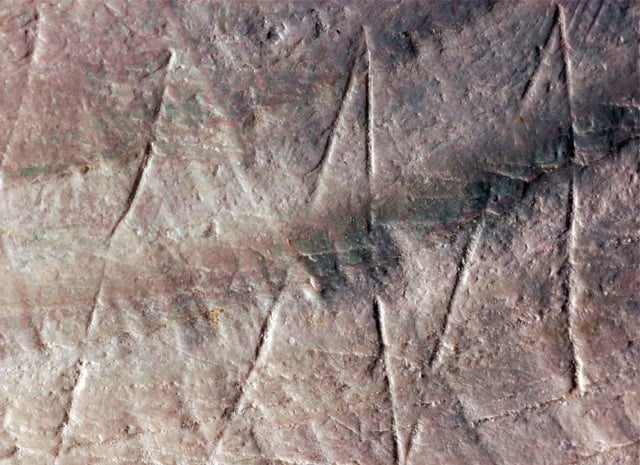
A shell found in the 1890s was recently found to have what scientists are calling the world’s oldest “abstract marking”, a 500,000-year-old etching made by Homo erectus, an extinct ancestor of modern humans.
Close inspection under the microscope suggested that the engraving was intentional. The weathering patterns of the grooves, each of which is about 1 centimetre long, show signs of significant ageing, and there are no gaps between turns, indicating that the maker paid attention to detail. He or she probably made the engraving on a fresh shell, and the newly made etching would have resembled white lines on a dark canvas, Joordens’ team notes. Sand grains still embedded in the shell were dated to around 500,000 years ago.
It turns out if you break some kinds of slow-growing corals into tiny pieces, these microfragments grow much much faster than usual, even 25-50 times faster.
“Part of the coral had grown over the back side and had attached to the bottom of the aquarium,” he said. When he grabbed it, “it broke off and left two or three polyps behind. I thought I just killed those. But oh, well, I moved the puck over.”
A week later he happened to glance at the abandoned polyps — the individual hydra-shaped, genetically identical organisms that make up a coral colony — on the bottom of the aquarium. “I noticed that those one to three polyps were now five to seven polyps,” he said. “They not only had lived — they had grown and had doubled in size.”
It was, he said, “my eureka mistake.” He cut a few more polyps from the original colony and placed them on other pucks. “And they grew like crazy. The coral seems to want to repair itself quickly and grow back over its lost ground before something else takes its territory.”
Both this and the article about the quickly regenerating corals I posted last month seem to hinge on a realization scientists have had recently about coral: what matters most is the surface area, not the volume. You look at a massive brain coral and you think the whole thing is the organism, but most of it is just a base for the thin layer of stuff coating it that actually matters.
A new analysis of the genomes of two extinct human species (Neanderthals and Denisovans) shows more clearly that they interbred with our species of human, contributing 2-4% of our modern genomes in some cases.
“What it begins to suggest is that we’re looking at a Lord of the Rings-type world — that there were many hominid populations,” says Mark Thomas, an evolutionary geneticist at University College London who was at the meeting but was not involved in the work.
But, more interestingly, the analysis also detected the Denisovans also bred with an as-yet-unknown species of humans.
The Denisovan genome indicates that the population got around: Reich said at the meeting that as well as interbreeding with the ancestors of Oceanians, they also bred with Neanderthals and the ancestors of modern humans in China and other parts of East Asia. Most surprisingly, Reich said, the genomes indicate that Denisovans interbred with yet another extinct population of archaic humans that lived in Asia more than 30,000 years ago — one that is neither human nor Neanderthal.
Is this the first time a new human species has been discovered through DNA evidence alone?
Google Research built an interactive periodic table of the elements where you can see the relative amounts of the elements as found in the human body, in the sea, and, most interestingly, by the number of mentions in books.
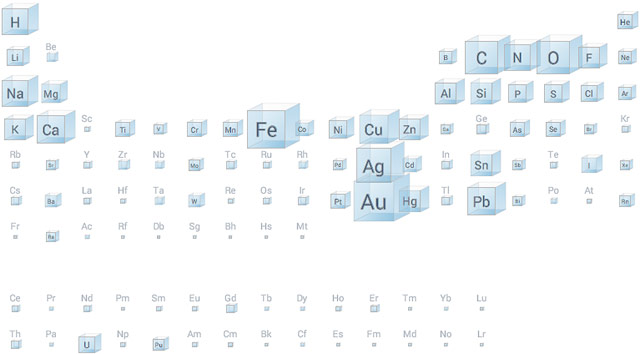
If you’ve ever wondered why the periodic table is shaped the way it is, click on “electrons” under “Shape” and pay attention to the number of electrons in the outer shells in each column of elements. Amazingly, when Dmitri Mendeleev and German chemist Julius Meyer published the first periodic tables in 1869/1870, the elements were organized only by atomic weights and chemical properties; they didn’t know what an electron was and certainly weren’t aware of quantum shells of electrons. (via @djacobs)
Photographer Ernie Button photographs the dried remains of single malt scotch whiskies, which end up looking like desolate landscapes on distant worlds.
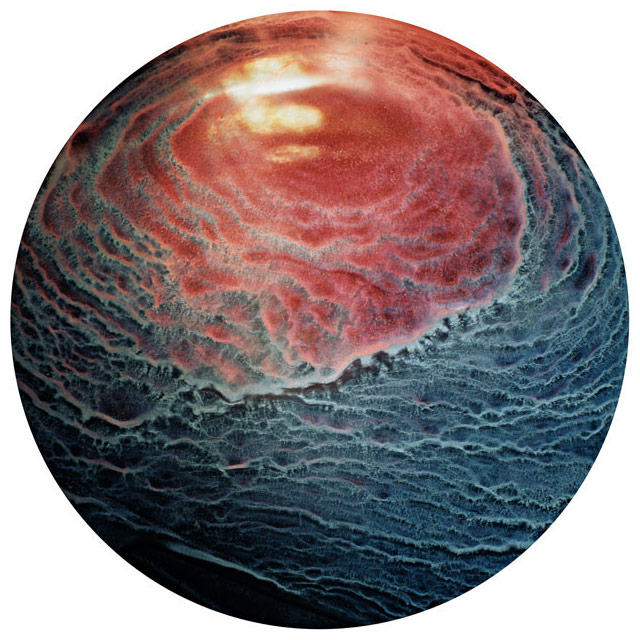
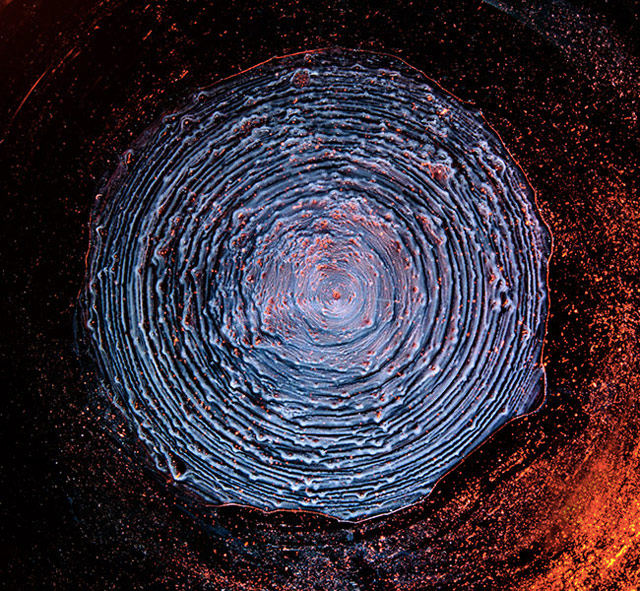
Curious as to how these patterns were formed by some kinds of whiskey but not others, Button reached out to an engineering professor at Princeton.
Dr. Stone’s group found that the key difference in whisky is that unlike coffee, it consists of two liquids — water and ethyl alcohol. The alcohol evaporates more quickly, and as the fraction of water increases, the surface tension of the droplet changes, an effect first noticed in the 19th century by an Italian scientist, Carlo Marangoni. That, in turn, generates complex flows that contribute to the patterns Mr. Button photographed.
“Here, they actually looked at what happens when you change the fluids that are drying,” said Dr. Yunker, who is soon heading to the Georgia Institute of Technology as a physics professor, “and they found some very neat effects.” (That would be neat in the usual sense of “cool and intriguing” and not as in “I’ll have my whisky neat.”)
(via @pomeranian99)
Now this is an ambitious Kickstarter project: Lunar Mission One wants to send an unmanned probe to an unexplored area of the Moon, land on the surface, drill a hole at least 20 meters in depth to analyze geological composition of the Moon, and then drop a time capsule in the hole that will last 1 billion years. That’s. Insane.
We’re going to use pioneering technology to drill down to a depth of at least 20m — 10 times deeper than has ever been drilled before — and potentially as deep as 100m. By doing this, we will access lunar rock dating back up to 4.5 billion years to discover the geological composition of the Moon, the ancient relationship it shares with our planet and the effects of asteroid bombardment. Ultimately, the project will improve scientific understanding of the early solar system, the formation of our planet and the Moon, and the conditions that initiated life on Earth.
The Rosetta mission has opened the way for a new era of pioneering space exploration and demonstrates the public appetite to engage with the secrets of the solar system. We want this to be a truly international mission that everyone everywhere can get involved in, so we are using Kickstarter to finance the next phase of development. This is your chance to be part of Lunar Mission One and to reserve your place in space. Your pledge will reserve you a digital memory box that will be buried in the moon during the mission as part of a 21st Century time capsule.
This is a great way to think about how big the planets of our solar system are: in terms of fruits.
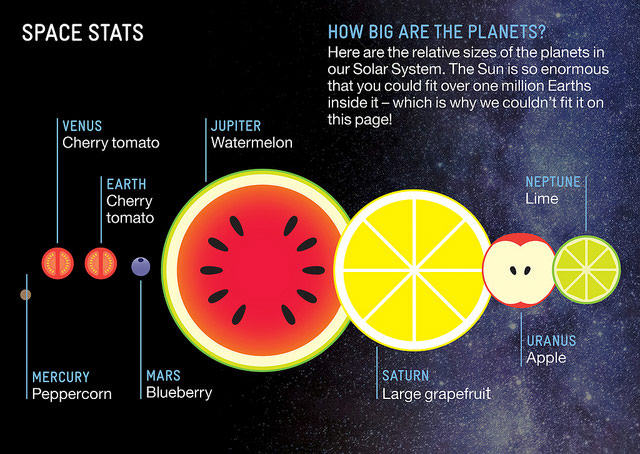
(via boing boing)
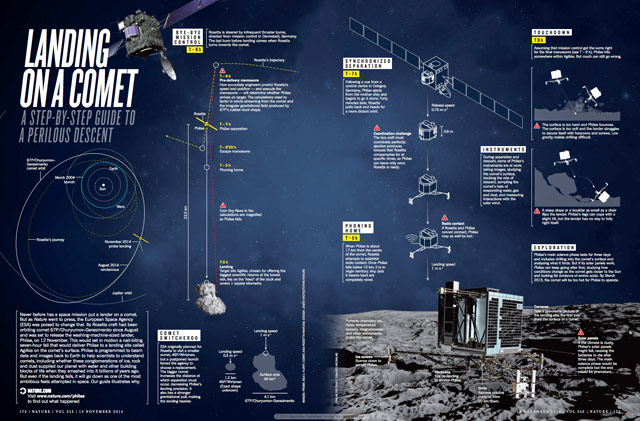
A European Space Agency landing craft the size of a washing machine is scheduled to land on a comet tomorrow, November 12, 2014. How cool is that?
Never before has a space mission put a lander on a comet. But the European Space Agency (ESA) plans to change that. Its Rosetta craft has been orbiting comet 67P/Churyumov-Gerasimenko since August and is set to release the washing-machine-sized lander, Philae, on 12 November. This would set in motion a nail-biting seven-hour fall designed to deliver Philae to a landing site called Agilkia on the comet’s surface. Philae is programmed to beam data and images back to Earth to help scientists to understand comets, including whether these conglomerations of ice, rock and dust supplied our planet with water and other building blocks of life when they smashed into it billions of years ago.
You can watch the landing live (or here too)…touch down on the comet’s surface is scheduled for 11:03 AM EST. Here’s a full rundown of the events on landing day. Good luck, Philae!
Update: Randall Munroe of XKCD is live drawing the landing.
Kip Thorne is a theoretical physicist who did some of the first serious work on the possibility of travel through wormholes. Several years ago, he resigned as the Feynman Professor of Theoretical Physics from Caltech in part to make movies. To that end, Thorne acted as Christopher Nolan’s science advisor for Interstellar. As a companion to the movie, Thorne wrote a book called The Science of Interstellar.
Yet in The Science of Interstellar, Kip Thorne, the physicist who assisted Nolan on the scientific aspects of Interstellar, shows us that the movie’s jaw-dropping events and stunning, never-before-attempted visuals are grounded in real science. Thorne shares his experiences working as the science adviser on the film and then moves on to the science itself. In chapters on wormholes, black holes, interstellar travel, and much more, Thorne’s scientific insights — many of them triggered during the actual scripting and shooting of Interstellar — describe the physical laws that govern our universe and the truly astounding phenomena that those laws make possible.
Wired has a piece on how Thorne and Nolan worked together on the film. Phil Plait was unimpressed with some of the science in the movie, although he retracted some of his criticism. If you’re confused by the science or plot, Slate has a FAQ.
Update: Well, well, the internet’s resident Science Movie Curmudgeon Neil deGrasse Tyson actually liked the depiction of science in Interstellar. In particular: “Of the leading characters (all of whom are scientists or engineers) half are women. Just an FYI.” (via @thoughtbrain)
Update: What’s wrong with “What’s Wrong with the Science of Movies About Science?” pieces? Plenty says Matt Singer.
But a movie is not its marketing; regardless of what ‘Interstellar”s marketing said, the film itself makes no such assertions about its scientific accuracy. It doesn’t open with a disclaimer informing viewers that it’s based on true science; in fact, it doesn’t open with any sort of disclaimer at all. Nolan never tells us exactly where or when ‘Interstellar’ is set. It seems like the movie takes place on our Earth in the relatively near future, but that’s just a guess. Maybe ‘Interstellar’ is set a million years after our current civilization ended. Or maybe it’s set in an alternate dimension, where the rules of physics as Phil Plait knows them don’t strictly apply.
Or maybe ‘Interstellar’ really is set on our Earth 50 years in the future, and it doesn’t matter anyway because ‘Interstellar’ is a work of fiction. It’s particularly strange to see people holding ‘Interstellar’ up to a high standard of scientific accuracy because the movie is pretty clearly a work of stylized, speculative sci-fi right from the start.
(via @khoi)
This is a time lapse of the surface of the Sun, constructed of more than 17,000 images taken by the Solar Dynamics Observatory from Oct 14 to Oct 30, 2014. The bright area that starts on the far right is sunspot AR 12192, the largest observed sunspot since 1990.
The sunspot is about 80,000 miles across (as wide as 10 Earths) and it’s visible from Earth with the naked eye. Best viewed as large as possible…I bet this looks amazing on the new retina iMac. (via @pageman)
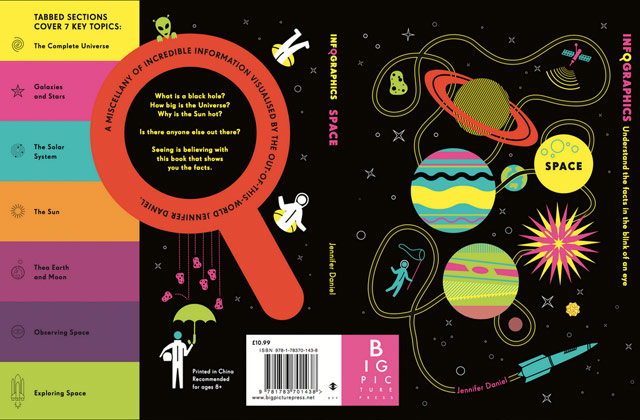
A children’s book about space featuring information graphics illustrated by the completely awesome Jennifer Daniel!?
The third in a visually stunning series of information graphics that shows just how interesting and humorous scientific information can be. Complex facts about space are reinterpreted as stylish infographics that astonish, amuse, and inform.
INSTANT PURCHASE. February 2015 cannot come fast enough.
In 2013, a group of researchers published a paper called Collective Motion of Moshers at Heavy Metal Concerts. The paper’s abstract reads:
Human collective behavior can vary from calm to panicked depending on social context. Using videos publicly available online, we study the highly energized collective motion of attendees at heavy metal concerts. We find these extreme social gatherings generate similarly extreme behaviors: a disordered gas-like state called a mosh pit and an ordered vortex-like state called a circle pit. Both phenomena are reproduced in flocking simulations demonstrating that human collective behavior is consistent with the predictions of simplified models.
The authors built an interactive mosh pit simulation based on their simplified models. You can try it out right here:
(via @nickrichter)
If you believe in gravity, then you know that if you remove air resistance, a bowling ball and a feather will fall at the same rate. But seeing it actually happen, in the world’s largest vacuum chamber (122 feet high, 100 feet in diameter), is still a bit shocking.
In the late 1500s, Galileo was the first to show that the acceleration due to the Earth’s gravity was independent of mass with his experiment at the Leaning Tower of Pisa, but that pesky air resistance caused some problems. At the end of the Apollo 15 mission, astronaut David Scott dropped a hammer and a feather in the vacuum on the surface of the Moon:
Science!
In a rare bit of good news about climate change, it appears that some types of coral have the ability to recover more quickly from trauma caused by rising ocean temperatures (archive).
At Palau in the western Pacific, a survey completed just three years after the 1998 bleaching event showed more coral had recovered on reefs within protected bays and on deep slopes.
Scientists suggest this is because heat and light serve as a double-whammy to coral health and corals that hang out in shady zones will escape the scorching combination, upping the chances that remnants will survive.
Seven years after the bleaching event, some reefs had regained nearly 40 per cent of their corals, with two species of plate-like acroporid coral, A. digitifera and A. hyacinthus, particularly prevalent. “We sampled plating coral colonies there a few years ago and found them to be pool-table size,” says Stephen Palumbi, Director of Stanford University’s Hopkins Marine Station, in Pacific Grove, California, US.

Today’s Google Doodle honors Jonas Salk on what would have been his 100th birthday. Salk developed the first successful polio vaccine in 1955 and was hailed as a hero for it.
On April 12, 1955, Dr. Thomas Francis, Jr., of the University of Michigan, the monitor of the test results, “declared the vaccine to be safe and effective.” The announcement was made at the University of Michigan, exactly 10 years to the day after the death of President Roosevelt. Five hundred people, including 150 press, radio, and television reporters, filled the room; 16 television and newsreel cameras stood on a long platform at the back; and 54,000 physicians, sitting in movie theaters across the country, watched the broadcast on closed-circuit television. Eli Lilly and Company paid $250,000 to broadcast the event. Americans turned on their radios to hear the details, department stores set up loudspeakers, and judges suspended trials so that everyone in the courtroom could hear. Europeans listened on the Voice of America. Paul Offit writes about the event:
“The presentation was numbing, but the results were clear: the vaccine worked. Inside the auditorium Americans tearfully and joyfully embraced the results. By the time Thomas Francis stepped down from the podium, church bells were ringing across the country, factories were observing moments of silence, synagogues and churches were holding prayer meetings, and parents and teachers were weeping. One shopkeeper painted a sign on his window: Thank you, Dr. Salk. ‘It was as if a war had ended’, one observer recalled.”
Because of Salk’s vaccine and subsequent vaccines, the US has been polio-free since 1979.
Lockheed Martin is in the process of developing a compact fusion reactor they say could revolutionize the world’s energy industry.
Dubbed the compact fusion reactor (CFR), the device is conceptually safer, cleaner and more powerful than much larger, current nuclear systems that rely on fission, the process of splitting atoms to release energy. Crucially, by being “compact,” Lockheed believes its scalable concept will also be small and practical enough for applications ranging from interplanetary spacecraft and commercial ships to city power stations. It may even revive the concept of large, nuclear-powered aircraft that virtually never require refueling-ideas of which were largely abandoned more than 50 years ago because of the dangers and complexities involved with nuclear fission reactors.
The key difference in Lockheed’s approach seems to be the configuration of the magnetic field containing the reaction:
The CFR will avoid these issues by tackling plasma confinement in a radically different way. Instead of constraining the plasma within tubular rings, a series of superconducting coils will generate a new magnetic-field geometry in which the plasma is held within the broader confines of the entire reaction chamber. Superconducting magnets within the coils will generate a magnetic field around the outer border of the chamber. “So for us, instead of a bike tire expanding into air, we have something more like a tube that expands into an ever-stronger wall,” McGuire says. The system is therefore regulated by a self-tuning feedback mechanism, whereby the farther out the plasma goes, the stronger the magnetic field pushes back to contain it. The CFR is expected to have a beta limit ratio of one. “We should be able to go to 100% or beyond,” he adds.
Charles Seife, who wrote a book about the history of fusion, is skeptical of Lockheed’s claims.
This week, Lockheed Martin supposedly managed to achieve a “breakthrough” in nuclear fusion that has gotten a lot of media attention. As Charles Seife points out, it did so “without having built a prototype device that, you know, fuses things on an appreciable scale. It’s a stunning assertion, even by fusion-research standards. But a quick look at the defense contractor’s ambitious plan-a working reactor in five years-already shows the dream fraying around the edges. A year and a half ago, the company promised that fusion was four years away, meaning that the schedule is already slipping. Negative one years of progress in 20 months is, sadly, business as usual for fusion. At this rate, it’ll take Lockheed Martin at least a decade before the natural endpoint: desperately spinning victory out of an underwhelming result generated by a machine whose performance comes nowhere near predictions-and which brings us no closer to actually generating energy from a fusion reaction.”
This is fun…Aatish Bhatia maps out the forces and motions involved in doing an ollie on a skateboard.
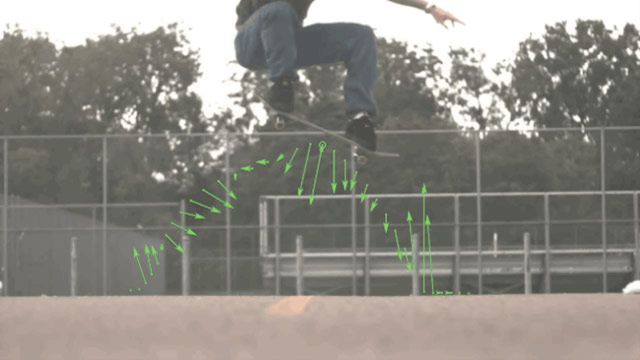
It’s a neat piece of science art, and it also tells us something interesting. The arrows show us that the force on the skateboard is constantly changing, both in magnitude as well as in direction. Now the force of gravity obviously isn’t changing, so the reason that these force arrows are shrinking and growing and tumbling around is that the skater is changing how their feet pushes and pulls against the board. By applying a variable force that changes both in strength and direction, they’re steering the board.
Gorgeous videos of chemical reactions (precipitation, bubbling, crystallization, etc.). I think the metal displacement reaction video is my favorite:
(via hn)
Newer posts
Older posts

Socials & More