kottke.org posts about science
For the first time, scientists have created a living cell with DNA containing more than just the familiar A, T, C, and G units.
Hailed as a breakthrough by other scientists, the work is a step towards the synthesis of cells able to churn out drugs and other useful molecules. It also raises the possibility that cells could one day be engineered without any of the four DNA bases used by all organisms on Earth.
“What we have now is a living cell that literally stores increased genetic information,” says Floyd Romesberg, a chemical biologist at the Scripps Research Institute in La Jolla, California, who led the 15-year effort.
So instead of just using the GATTACA alphabet, scientists may eventually gain the use of an alphabet containing dozens or even hundreds or thousands of different letters. Potentially powerful stuff.
How to Build a Time Machine is a documentary about two men on separate quests to build their own time machines. Here’s a teaser trailer:
Ronald Mallett’s reason for his search for a way to travel through time is quite poignant…he shared his story in a book and on an episode of This American Life back in 2007. (via ★interesting)
According to the National Climate Assessment, climate change has already affected the US in significant ways. This map from the NY Times shows the change in temperatures from around the country, specifically the “1991-2012 average temperature compared with 1901-1960 average”.
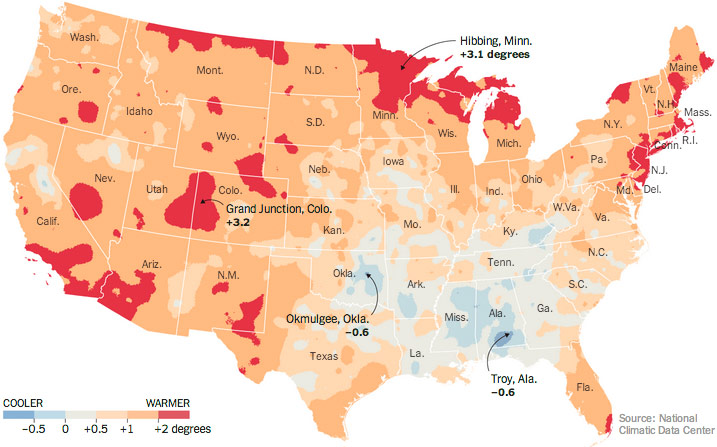
Among the report’s findings? As I’ve noted before, weather is getting weirder and more bursty, not just hotter.
One of the report’s most striking findings concerned the rising frequency of torrential rains. Scientists have expected this effect for decades because more water is evaporating from a warming ocean surface, and the warmer atmosphere is able to hold the excess vapor, which then falls as rain or snow. But even the leading experts have been surprised by the scope of the change.
The report found that the eastern half of the country is receiving more precipitation in general. And over the past half-century, the proportion of precipitation that is falling in very heavy rain events has jumped by 71 percent in the Northeast, by 37 percent in the Midwest and by 27 percent in the South, the report found.
Nonlinear systems, man.
The elements located in the upper reaches of the periodic table are notable for their short half-lives, the amount of time during which half the mass of an element will decay into lighter elements (and other stuff). For instance, the longest lived isotope of fermium (#100) has a half-life of just over 100 days. More typical is bohrium (#107)…its half-life is only 61 seconds. The elements with the highest numbers have half-lives measured in milliseconds…the half-life of ununoctium (#118) is only 0.89 milliseconds.
So why do chemists and physicists keep looking for heavier and heavier elements if they are increasingly short-lived (and therefore not that useful)? Because they suspect some heavier elements will be relatively stable. Let’s take a journey to the picturesque island of stability.
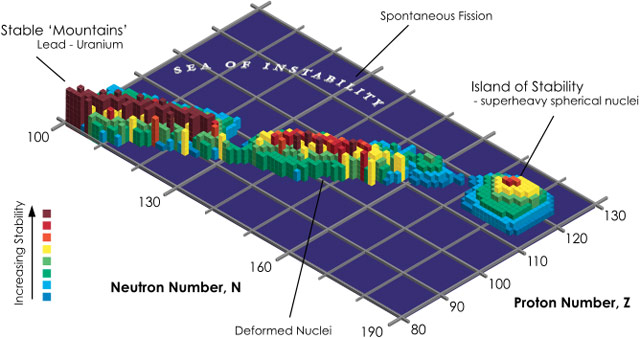
In nuclear physics, the island of stability is a set of as-yet undiscovered heavier isotopes of transuranium elements which are theorized to be much more stable than some of those closer in atomic number to uranium. Specifically, they are expected to have radioactive decay half-lives of minutes or days, with “some optimists” expecting half-lives of millions of years.
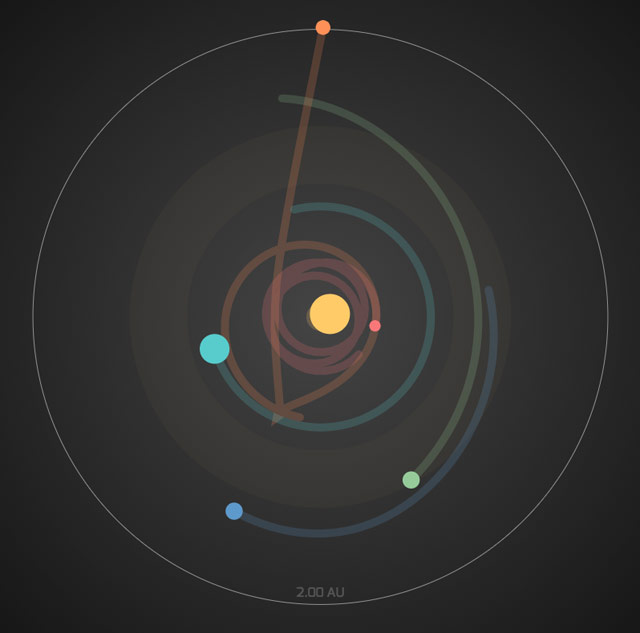
Super Planet Crash is half game, half planetary simulator in which you try to cram as much orbital mass into your solar system without making any of your planets zing off beyond the Kuiper belt. You get bonus points for crowding planets together and locating planets in the star’s habitability zone. Warning: I got lost in this for at least an hour the other day.
Ruh-roh. Remember the news last month about the detection of gravitational waves would have allowed scientists to see all the way back to the Big Bang? Well, that result may be in jeopardy. The problem? Dust on the lens. Well, not on the lens exactly:
An imprint left on ancient cosmic light that was attributed to ripples in spacetime — and hailed by some as the discovery of the century — may have been caused by ashes from an exploding star.
In the most extreme scenario, the finding could suggest that what looked like a groundbreaking result was only a false alarm. Another possibility is that the stellar ashes could help bring the result in line with other cosmic observations. We should know which it is later this year, when researchers report new results from the European Space Agency’s Planck satellite.
You may also remember the video of physicist Andrei Linde being told about the result, which seemed to confirm a theory that had been his life’s work. I don’t think I want to see the video of Linde being told of this stellar ashes business. Although Linde is more than aware that this is how science works…you have to go where observation takes you. (via @daveg)
The US Navy is working on technology to convert seawater into fuel to power unmodified combustion engines. They recently tested the fuel (successfully!) in a replica P-51 and hope to make it commerically viable.
Navy researchers at the U.S. Naval Research Laboratory (NRL), Materials Science and Technology Division, demonstrated proof-of-concept of novel NRL technologies developed for the recovery of carbon dioxide (CO2) and hydrogen (H2) from seawater and conversion to a liquid hydrocarbon fuel.
Fueled by a liquid hydrocarbon — a component of NRL’s novel gas-to-liquid (GTL) process that uses CO2 and H2 as feedstock — the research team demonstrated sustained flight of a radio-controlled (RC) P-51 replica of the legendary Red Tail Squadron, powered by an off-the-shelf (OTS) and unmodified two-stroke internal combustion engine.
Using an innovative and proprietary NRL electrolytic cation exchange module (E-CEM), both dissolved and bound CO2 are removed from seawater at 92 percent efficiency by re-equilibrating carbonate and bicarbonate to CO2 and simultaneously producing H2. The gases are then converted to liquid hydrocarbons by a metal catalyst in a reactor system.
“In close collaboration with the Office of Naval Research P38 Naval Reserve program, NRL has developed a game-changing technology for extracting, simultaneously, CO2 and H2 from seawater,” said Dr. Heather Willauer, NRL research chemist. “This is the first time technology of this nature has been demonstrated with the potential for transition, from the laboratory, to full-scale commercial implementation.”
Discover has more, in slightly more accessible language.
After many days of analysis by scientists and internet sleuths alike, it’s likely that the thing pictured whizzing by the skydiver in this video is not a meteorite but a plain old rock that got packed in with his parachute. Phil Plait reports:
I actually became convinced last night, when BA Tweep Helge Bjorkhaug sent me a link to a slowed-down version of the video. Immediately before the rock flies past, I saw a second piece of debris just to the right of the skydiver’s parachute strap. It was in several frames, and clearly real.
So yeah, bummer, not a meteorite. But as Plait notes, that’s how science works.
That’s how you get to the truth, folks. Open inquiry, honest investigation, and acceptance of the line of evidence no matter where it leads.
Researchers at Stanford have observed that foraging harvester ants act like TCP/IP packets, so much so that they’re calling the ants’ behavior “the anternet”.
Transmission Control Protocol, or TCP, is an algorithm that manages data congestion on the Internet, and as such was integral in allowing the early web to scale up from a few dozen nodes to the billions in use today. Here’s how it works: As a source, A, transfers a file to a destination, B, the file is broken into numbered packets. When B receives each packet, it sends an acknowledgment, or an ack, to A, that the packet arrived.
This feedback loop allows TCP to run congestion avoidance: If acks return at a slower rate than the data was sent out, that indicates that there is little bandwidth available, and the source throttles data transmission down accordingly. If acks return quickly, the source boosts its transmission speed. The process determines how much bandwidth is available and throttles data transmission accordingly.
It turns out that harvester ants (Pogonomyrmex barbatus) behave nearly the same way when searching for food. Gordon has found that the rate at which harvester ants — which forage for seeds as individuals — leave the nest to search for food corresponds to food availability.
A forager won’t return to the nest until it finds food. If seeds are plentiful, foragers return faster, and more ants leave the nest to forage. If, however, ants begin returning empty handed, the search is slowed, and perhaps called off.
(via wordspy)
The reboot of Cosmos has been solid but not spectacular so far, but the second episode contains as solid and clear an explanation of evolution as I’ve ever seen.
Even if evolution clashes with your world view, this is worth watching if only to understand what you’re aligned against (per Bret Victor’s advice). The third episode airs on Fox tonight and is about the creation of the scientific method.
I love this video. Love love love. Chao-Lin Kuo surprises Andrei Linde and his wife with the news that gravitational waves were detected, proving Linde’s theory of an inflationary universe.
Love love love. (via @stevenstrogatz)
Update: Many people have asked what Kuo is saying to Linde on the doorstep. Let’s start with “5 sigma”. The statistical measure of standard deviation (represented by the Greek letter sigma) is an indication of how sure scientists are of their results. (It has a more technical meaning than that, but we’re not taking a statistics course here.) A “5 sigma” level of standard deviation indicates 99.99994% certainty of the result…or a 0.00006% chance of a statistical fluctuation. That’s a 1 in 3.5 million chance. This is the standard particle physicists use for declaring the discovery of a new particle.
The “point-2” is a bit more difficult to explain. Sean Carroll defines r as “the ratio of gravitational waves to density perturbations” as measured by the BICEP2 experiment, the telescope used to make these measurements. What BICEP2 found was an r value of 0.2:
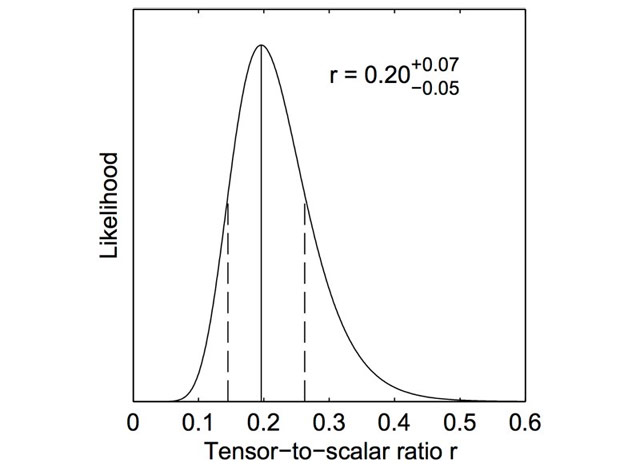
From the brief explanation of the science behind the BICEP2 experiment:
According to the theory of Inflation, the Universe underwent a violent and rapid expansion at only 10^-35 seconds after the Big Bang, making the horizon size much larger, and allowing the space to become flat. Confirmation of Inflation would be an amazing feat in observational Cosmology. Inflation during the first moments of time produced a Cosmic Gravitational-Wave Background (CGB), which in turn imprinted a faint but unique signature in the polarization of the CMB. Since gravitational waves are by nature tensor fluctuations, the polarization signature that the CGB stamps onto the CMB has a curl component (called “B-mode” polarization). In contrast, scalar density fluctuations at the surface of last scattering only contribute a curl-free (or “E-mode”) polarization component to the CMB which was first detected by the DASI experiment at the South Pole.
The big deal with BICEP2 is the ability to accurately detect the B-mode polarization for the first time. r is the ratio between these two different types of polarization, E-mode & B-mode. Any result for r > 0 indicates the presence of B-mode polarization, which, according to the theory, was caused by gravitational waves at the time of inflation. So, that’s basically what Kuo is on about.
Update: The Atlantic’s Megan Garber spoke to Stanford’s science information officer about how the video came about.
We didn’t do any re-takes. The goal was for it to be a really natural thing. We did ask him to tell us what he was feeling and what the research means. But what you see in the video is just very off-the-cuff and raw. Part of it was, we went there not even knowing if we’d be able to use or keep anything that we did. It was just as likely that he would have been emotional in a way that he didn’t want us to share, or that his wife didn’t. So we went into it with no guarantee-we knew we’d be able to shoot, but didn’t know if we’d be able use it. So we’re thankful that they agreed to let us do that.
Finally a viral video that’s genuine and not staged or reality TV’d.
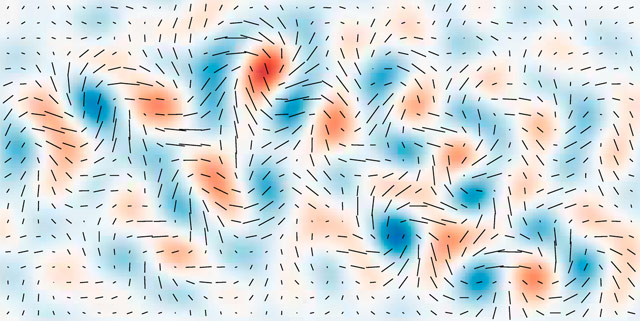
This is huge: physicists have detected gravitational waves that harken back to the beginning of the universe, when it was “a trillionth of a trillionth of a trillionth of a second old”. The discovery goes a long way toward proving the inflation theory of how the universe formed.
Reaching back across 13.8 billion years to the first sliver of cosmic time with telescopes at the South Pole, a team of astronomers led by John M. Kovac of the Harvard-Smithsonian Center for Astrophysics detected ripples in the fabric of space-time — so-called gravitational waves — the signature of a universe being wrenched violently apart when it was roughly a trillionth of a trillionth of a trillionth of a second old. They are the long-sought smoking-gun evidence of inflation, proof, Dr. Kovac and his colleagues say, that Dr. Guth was correct.
Inflation has been the workhorse of cosmology for 35 years, though many, including Dr. Guth, wondered whether it could ever be proved.
If corroborated, Dr. Kovac’s work will stand as a landmark in science comparable to the recent discovery of dark energy pushing the universe apart, or of the Big Bang itself. It would open vast realms of time and space and energy to science and speculation.
Confirming inflation would mean that the universe we see, extending 14 billion light-years in space with its hundreds of billions of galaxies, is only an infinitesimal patch in a larger cosmos whose extent, architecture and fate are unknowable. Moreover, beyond our own universe there might be an endless number of other universes bubbling into frothy eternity, like a pot of pasta water boiling over.
If the results are confirmed, Guth will undoubtably win the Nobel in Physics for this soon. Phil Plait at Bad Astronomy has more on the discovery.
Update: This video of Chao-Lin Kuo (one of the principle investigators on this experiment) telling physicist Andrei Linde (a leading inflation theorist) about the result is just outstanding.
Update: Upon further review, it turns out the evidence for the gravitational waves is inconclusive. The problem? Dust on the lens, basically:
The problem comes in when the astronomers looked at things that might mimic the signal they were looking for. For example, dust (long, complex carbon-molecules that are much like fireplace soot) floating in space can look very much like the signal BICEP2 was seeking. The astronomers knew this, and used data from the ESA mission Planck to investigate it. Planck measured the amount of dust lying along the direction BICEP2 was looking, and the astronomers concluded the amount of dust in their line-of-sight was low. The signal they saw, therefore, must be from inflation.
And here’s the bummer part: They were using preliminary Planck data. When better data from Planck were released, the astronomers used that, and found that the amount of galactic dust in their view was much higher than they previously thought. That weakens their case considerably.
I don’t want to see the video of someone telling Linde “whoops!”
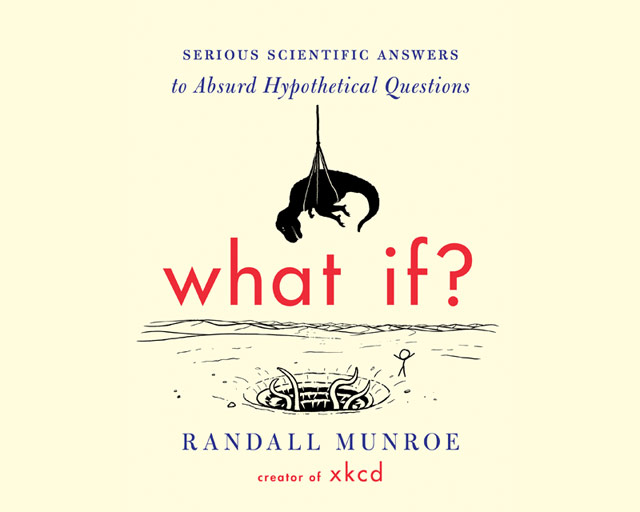
Fantastic…Randall Munroe is turning his What If? web series into a book. Munroe explains:
As I’ve sifted through the letters submitted to What If every week, I’ve occasionally set aside particularly neat questions that I wanted to spend a little more time on. This book features my answers to those questions, along with revised and updated versions of some of my favorite articles from the site. (I’m also including my personal list of the weirdest questions people have submitted.)
Update: What If? the book is now out. Phil Plait has a rave review.
Look, I answer questions for a living, too, and Randall is really, really good at this. He finds weird little scientific ways to answer the questions, but it’s his extrapolations that kill me. I laughed a lot reading this book. Even better: I learned stuff reading this book. And you will too.
Last year (spoilers!), CERN confirmed the discovery of the Higgs boson. Physicist-turned-filmmaker Mark Levinson has made a film about the search for the so-called God Particle. Particle Fever follows a group of scientists through the process of discovery and the construction of the mega-machine that discovered the Higgs, the Large Hadron Collider. Here’s a trailer:
Two additional data points: the movie is holding a 95% rating on Rotten Tomatoes and legendary sound designer and editor Walter Murch edited the film. Particle Fever is showing at Film Forum in New York until March 20. (thx, james)

The heath hen was once so plentiful in New England that servants bargained with employers not to be served heath hen for food more than two or three days a week. Due to over-hunting, the heath hen went extinct in 1932. But recently, a film of the bird made circa 1918 was discovered and digitized. The Boston Globe has a short clip of the film.
“I had heard about this film through various channels off and on through the years. It had gotten to the point where it was almost apocryphal in my mind” said Petersen, director of the Massachusetts Important Bird Areas program for Mass Audubon. “Nobody knew where it was, nobody had ever seen it, but I was aware it existed. It was like the holy grail.”
No one seems to quite remember the date, but some years ago two canisters containing brittle, aging film that was at risk of spontaneous combustion were found stored at the state’s Division of Fisheries and Wildlife. Aging tape with the words “heath hen” was its only label. One canister was sent off to the Smithsonian Institution, recalled Ellie Horwitz, who discovered the film sometime in the middle of her 34-year tenure at the agency. The other canister presented a dilemma because the film was in such terrible condition it might disintegrate.
“It was iffy whether the film could be viewed. And if it could be viewed, chances were we could view it one time, and the question is what are you going to do in that one time,” said Horwitz, who retired in 2011. “We had one shot at it; we thought the thing to do was to digitize it.”
Ok quiet down, we’re going to science right now. (That’s right, I verbed “science”.) If you take a long chain of beads, put them in a jar, and then throw one end of the bead chain out, the rest of the beads will follow *and* this bead fountain will magically rise up into the air over the lip of the glass.
As the guy’s face in the video shows, this is deeply perplexing. For an explanation, slow motion video, and a demonstration of a preposterously high chain fountain, check this video from the NY Times out:
The fountain, said Dr. Biggins, which he had never seen before the video, was “surprisingly complicated.” The chain was moving faster than gravity would account for, and they realized that something had to be pushing the chain up from the container in which it was held.
A key to understanding the phenomenon, Dr. Biggins said, is that mathematically, a chain can be thought of as a series of connected rods.
When you pick up one end of a rod, he said, two things happen. One end goes up, and the other end goes down, or tries to. But if the downward force is stopped by the pile of chain beneath it, there is a kind of kickback, and the rod, or link, is pushed upward. That is what makes the chain rise.
A group of marine biologists that has been recently studying mesopelagic fish (“fish that live between 100 and 1000m below the surface”) believes that 95% of fish biomass is unknown to humans. Marine dark matter. The problem lies with how fish have traditionally been counted and the enhanced visual and pressure senses of these fish.
He says most mesopelagic species tend to feed near the surface at night, and move to deeper layers in the daytime to avoid birds.
They have large eyes to see in the dim light, and also enhanced pressure-sensitivity.
“They are able to detect nets from at least five metres and avoid them,” he says.
“Because the fish are very skilled at avoiding nets, every previous attempt to quantify them in terms of biomass that fishing nets have delivered are very low estimates.
“So instead of different nets what we used were acoustics… sonar and echo sounders.”
A not-so-difficult prediction to make is that humans will find a way to catch these wary creatures, we’ll eat most of them, and then we’ll be back to where we are now: the world’s oceans running low on fish. (via @daveg)
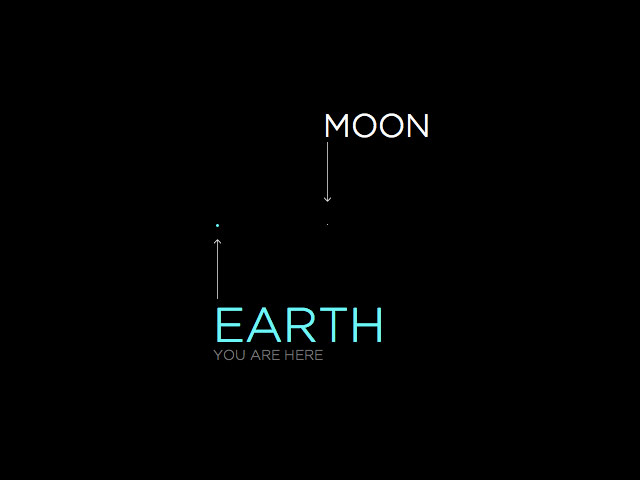
Nice visualization of the solar system; the Moon is one pixel across and everything else is scaled to that, including the distances between planets. Get ready to scroll. A lot.
It would be neat to do this with a plutonium atom or something. Related: typographically speaking, what’s the point size of the Moon?
Raffi Khatchadourian’s long piece on the construction of the International Thermonuclear Experimental Reactor (ITER) is at once fascinating (for science reasons) and depressing (for political/bureaucratic reasons). Fusion reactors hold incredible promise:
But if it is truly possible to bottle up a star, and to do so economically, the technology could solve the world’s energy problems for the next thirty million years, and help save the planet from environmental catastrophe. Hydrogen, a primordial element, is the most abundant atom in the universe, a potential fuel that poses little risk of scarcity. Eventually, physicists hope, commercial reactors modelled on iter will be built, too-generating terawatts of power with no carbon, virtually no pollution, and scant radioactive waste. The reactor would run on no more than seawater and lithium. It would never melt down. It would realize a yearning, as old as the story of Prometheus, to bring the light of the heavens to Earth, and bend it to humanity’s will. iter, in Latin, means “the way.”
But ITER is a collaborative effort between 35 different countries, which means the project is political, slow, and expensive.
For the machine’s creators, this process-sparking and controlling a self-sustaining synthetic star-will be the culmination of decades of preparation, billions of dollars’ worth of investment, and immeasurable ingenuity, misdirection, recalibration, infighting, heartache, and ridicule. Few engineering feats can compare, in scale, in technical complexity, in ambition or hubris. Even the iter organization, a makeshift scientific United Nations, assembled eight years ago to construct the machine, is unprecedented. Thirty-five countries, representing more than half the world’s population, are invested in the project, which is so complex to finance that it requires its own currency: the iter Unit of Account.
No one knows iter’s true cost, which may be incalculable, but estimates have been rising steadily, and a conservative figure rests at twenty billion dollars — a sum that makes iter the most expensive scientific instrument on Earth.
I wonder what the project would look like if, say, Google or Apple were to take the reins instead. In that context, it’s only $20 billion to build a tiny Sun on the Earth. Facebook just paid $19 billion for WhatsApp, Apple has a whopping $158.8 billion in cash, and Google & Microsoft both have more than $50 billion in cash. Google in particular, which is making a self-driving car and has been buying up robots by the company-full recently, might want their own tiny star.
But back to reality, the circumstances of ITER’s international construction consortium reminded me of the building of The Machine in Carl Sagan’s Contact. In the book, the countries of the world work together to make a machine of unknown function from plans beamed to them from an alien intelligence, which results in the development of several new lucrative life-enhancing technologies and generally unites humanity. In Sagan’s view, that’s the power of science. Hopefully the ITER can work through its difficulties to achieve something similar.
Richard Lenski and his team of researchers utilize a clever technique to observe and study evolution of bacteria in realtime. Periodically freezing a sample of the bacteria every few generations allows them to go back in time to study particular traits and to pinpoint when differences occur.
After 30,000 generations, researchers noticed something strange. One population had evolved the ability to use a different carbon-based molecule in the solution, called citrate, as a power source.
Researchers wondered whether it was the result of a rare, single mutation, or a more complex change involving a series of mutations over generations. To find out, one of Lenski’s postdocs, Zachary Blount, took some of the frozen cells and grew them in a culture lacking glucose, with citrate as the only potential food source.
After testing 10 trillion ancestral cells from early generations, he got no growth. But when he tested cells from the 20,000th generation on, he began to get results, eventually finding 19 mutants that could use citrate as a power source. The results showed that the citrate-eating mutation was most likely not the result of a single mutation, but one enabled by multiple changes over 20,000 generations.
According to an article in The Journal of the American Medical Association, the obesity rate of American 2- to 5-year-old children has dropped from 14% in 2004 to 8% in 2012.
Children now consume fewer calories from sugary beverages than they did in 1999. More women are breast-feeding, which can lead to a healthier range of weight gain for young children. Federal researchers have also chronicled a drop in overall calories for children in the past decade, down by 7 percent for boys and 4 percent for girls, but health experts said those declines were too small to make much difference.
Barry M. Popkin, a researcher at the University of North Carolina at Chapel Hill who has tracked American food purchases in a large data project, said families with children had been buying lower-calorie foods over the past decade, a pattern he said was unrelated to the economic downturn.
He credited those habits, and changes in the federally funded Special Supplemental Nutrition Program for Women, Infants and Children, for the decline in obesity among young children. The program, which subsidizes food for low-income women, reduced funding for fruit juices, cheese and eggs and increased it for whole fruits and vegetables.
Kevin Drum calls the drop “baffling”.
NASA announced the discovery of 719 new planets today. That brings the tally of known planets in our universe to almost 1800. 20 years ago, that number was not more than 15 (including the nine planets orbiting the Sun). Here’s a rough timeline of the dramatically increasing pace of planetary discovery:
4.54 billion BCE-1700: 6
1700-1799: 1
1800-1899: 1
1900-1950: 1
1951-1990: 1
1991-2000: 49
2001-2005: 131
2006-2010: 355
2006: -1 [for Pluto :( ]
2011-2014: 1243
Last year, Jonathan Corum made an infographic of the sizes and orbits of the 190 confirmed planets discovered at that point by the Kepler mission. I hope the Times updates it with this recent batch.
Huzzah! Long unavailable (or at least not widely available), Errol Morris’ documentary film on Stephen Hawking and his work, A Brief History of Time, is now available for rent or purchase on iTunes. Or if you can wait a little bit, there’s a Criterion Blu-ray edition coming out in mid-March. Bonus: score by Philip Glass!
And if you want a sense of how weird, and how fraught, the relationship between science, politics, and commerce is in our modern world, then there’s really no better place to go.
In The Daily Beast Michael Schulson provides a alternate view on Whole Foods: America’s Temple of Pseudoscience. (The first time I read this, I nearly spit out my probiotic-infused kombucha, kale, quinoa, coconut water shake.)
Related to my post on the frequency of humanity is this post on XKCD on the various frequencies of events, from human births to dog bites to stolen bicycles.
There are too many camels in the Bible. Evidence suggests they were domesticated in Israel centuries after the events in Genesis took place.
Camels probably had little or no role in the lives of such early Jewish patriarchs as Abraham, Jacob and Joseph, who lived in the first half of the second millennium B.C., and yet stories about them mention these domesticated pack animals more than 20 times. Genesis 24, for example, tells of Abraham’s servant going by camel on a mission to find a wife for Isaac.
These anachronisms are telling evidence that the Bible was written or edited long after the events it narrates and is not always reliable as verifiable history. These camel stories “do not encapsulate memories from the second millennium,” said Noam Mizrahi, an Israeli biblical scholar, “but should be viewed as back-projections from a much later period.”
Dr. Mizrahi likened the practice to a historical account of medieval events that veers off to a description of “how people in the Middle Ages used semitrailers in order to transport goods from one European kingdom to another.”
Update: Added “in Israel” to clarify the camel domestication timeline…they were domesticated much earlier in the Arabian Peninsula.
Archaeologists have established that camels were probably domesticated in the Arabian Peninsula for use as pack animals sometime towards the end of the 2nd millennium BCE. In the southern Levant, where Israel is located, the oldest known domesticated camel bones are from the Aravah Valley, which runs along the Israeli-Jordanian border from the Dead Sea to the Red Sea and was an ancient center of copper production. At a 2009 dig, Dr. Ben-Yosef dated an Aravah Valley copper smelting camp where the domesticated camel bones were found to the 11th to 9th century BCE.
(via @arbesman)
About 250 million years ago, Earth suffered its fifth (and worst) mass extinction event. Nearly seventy percent of land species disappeared. And they got off easy compared to marine species. Are we headed for another mass extinction on Earth? I’m not ready to break that news. But something unusual is definitely going on and extinction rates seem to be speeding up. Here’s an interesting chat with Elizabeth Kolbert, author of The Sixth Extinction.
The worst mass extinction of all time came about 250 million years ago [the Permian-Triassic extinction event]. There’s a pretty good consensus there that this was caused by a huge volcanic event that went on for a long time and released a lot of carbon-dioxide into the atmosphere. That is pretty ominous considering that we are releasing a lot of CO2 into the atmosphere and people increasingly are drawing parallels between the two events.
What would happen if a tiny black hole the size of a marble were placed at the center of the Earth? Rest assured, the Earth won’t completely be swallowed up by the black hole but that’s really the only good news to offer.
First of all, not all of the Earth would simply be sucked into the black hole. When the matter near the black hole begins to fall into the black hole, it will be compressed to a very high density that will cause it to be heated to very high temperatures. These high temperatures will cause gamma rays, X-rays, and other radiation to heat up the other matter falling in to the black hole. The net effect will be that there will be a strong outward pressure on the outer layers of the Earth that will first slow down their fall and will eventually ionize and push the outer layers away from the black hole. So some inner portion of the core will fall into the black hole, but the outer layers, including the crust and all of us, would be vaporized to a high temperature plasma and blown into space.
This would be a gigantic explosion — a significant fraction of the rest of the mass of the Earth matter that actually fell into the black hole will be converted into energy.
FYI, that marble-sized black hole would have about the same mass as the Earth. Not that they exist, mind you. Maybe, maybe not. Blackish holes? Dark grey holes? Anyway, really heavy.
This is nutty…by chance, a group of archaeologists found what are believed to be the oldest known human footprints outside of Africa on a beach in England. The footprints are an estimated 800,000 years old and are now completely gone. The tide that uncovered them washed them away in less than a month.
The footprints have been described as “one of the most important discoveries, if not the most important discovery that has been made on [Britain’s] shores,” by Dr Nick Ashton of the British Museum.
“It will rewrite our understanding of the early human occupation of Britain and indeed of Europe,” he told BBC News.
The markings were first indentified in May last year during a low tide. Rough seas had eroded the sandy beach to reveal a series of elongated hollows.
The other day, Bill Nye debated Ken Ham about evolution and creationism. At the event, Matt Stopera asked self-identifying creationists to write question/notes to those who “believe” in evolution. Here’s one:
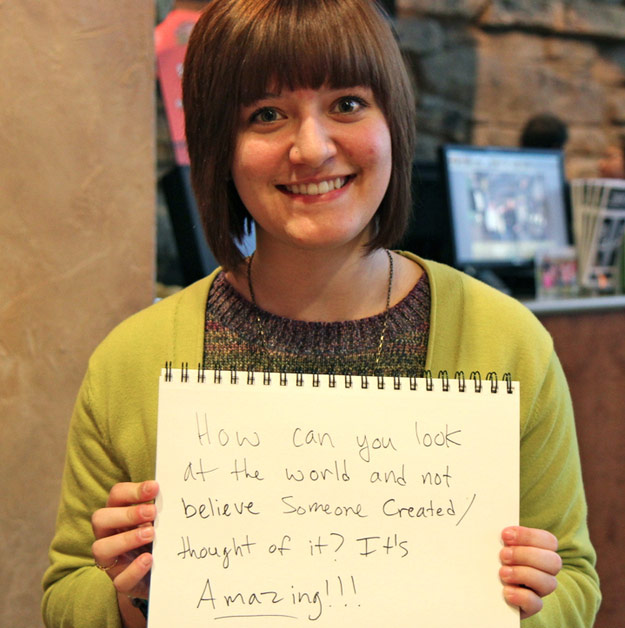
Phil Plait of Bad Astronomy responded to each of the 22 notes/questions from the creationists. Here’s his answer to the comment above:
I agree; it is amazing! I’ve written about this many times. But we know that complexity can arise naturally through the laws of physics. It doesn’t take very complex rules to create huge diversity. Look at poker; a simple set of rules creates a game that has so many combinations it’s essentially infinite to human experience. We can figure out the rules of nature by studying the way processes follow them, and deduce what’s going on behind the scenes. And whenever we do, we see science.
This makes me think of Richard Feynman’s ode to the scientific beauty of a flower:
I have a friend who’s an artist and has sometimes taken a view which I don’t agree with very well. He’ll hold up a flower and say “look how beautiful it is,” and I’ll agree. Then he says “I as an artist can see how beautiful this is but you as a scientist take this all apart and it becomes a dull thing,” and I think that he’s kind of nutty. First of all, the beauty that he sees is available to other people and to me too, I believe. Although I may not be quite as refined aesthetically as he is … I can appreciate the beauty of a flower. At the same time, I see much more about the flower than he sees. I could imagine the cells in there, the complicated actions inside, which also have a beauty. I mean it’s not just beauty at this dimension, at one centimeter; there’s also beauty at smaller dimensions, the inner structure, also the processes. The fact that the colors in the flower evolved in order to attract insects to pollinate it is interesting; it means that insects can see the color. It adds a question: does this aesthetic sense also exist in the lower forms? Why is it aesthetic? All kinds of interesting questions which the science knowledge only adds to the excitement, the mystery and the awe of a flower. It only adds. I don’t understand how it subtracts.
Newer posts
Older posts






Socials & More