According to Spike Jonze, there might not be an official release of the soundtrack for Her (performed by Arcade Fire), but the whole thing is somehow currently on the internet for your listening pleasure:
Update: Win Butler of Arcade Fire now says the Her soundtrack will be released in some form eventually.
Because the film is a period piece, The Godfather actually presents a fascinating record of what 1940s-era New York City locations still existed in the early-1970s. Sadly, many of them are now gone. What still remains? Let’s take a closer look.
This oral history of Swingers over at Grantland got a little long for me (but if you’re a fan, you should definitely read the whole thing), but there are good bits throughout. I particularly liked this part:
Ludwig: Our biggest cost was getting film. Film comes in 1,000-foot loads and 400-foot loads. On a big movie, they’ll throw away the end of the film, like the last hundred feet or so.
Liman: We shot most of the movie with these 100-foot short ends. It’s a minute of film. Which also meant the actors could get through 60 seconds of a scene and I’d have to call reload.
Wurmfeld: I cultivated a lot of relationships with the people around town selling short ends.
LaLoggia: I called this place in L.A. that does recycled, re-canned short ends and I just begged for the cheapest price we could get. (Many of the short ends came from the movie Twister.)
Liman: The problem with shooting on short ends, though, is that it takes four minutes to reload a conventional camera. I thought to myself: We’ll never get through the movie if we shoot a minute, spend four minutes reloading, shoot a minute, spend four minutes reloading. You’ll never get any kind of rhythm going. So I decided I would shoot the movie with this documentary 35-millimeter film camera that was not designed to shoot dialogue because it sounds like a sewing machine.
Ludwig: The camera was much louder than a regular camera that you’d use for a feature film. But it’s easy to load and very compact. I think it was developed so Godard could have a camera that would fit into his bicycle basket.
Liman: To absorb the sound, I would take my down jacket and put it over the camera and then take the two arms and tie them together underneath the lens. And then my comforter would just get wrapped around the whole thing once. Jon would describe it like he was acting in front of a big, fluffy snowball. But I really think that as insane as that setup was, it created a really safe environment for the actors. Vince really did some extraordinary things, like the scene where he’s supposed to be drunk and he jumps up on the table. You know, he had to do that in front of a lot of people and I feel like they looked at me and they were like, Doug is clearly not being self-conscious.
Favreau: There was never enough time and never enough film.
Liman: Every day we’d panic because I was shooting more film than I thought I was gonna shoot and we didn’t have enough film and we didn’t have any money.
LaLoggia: I used to hide film in the trunk of my car because Doug could not help himself. He just wanted to shoot, shoot, shoot, so we would lie to him and say that we were out of film.
Whenever we needed money, we’d rob the airport. To us, it was better than Citibank.
So said Ray Liotta as Henry Hill in GoodFellas. Now, more than twenty-five years after the Lufthansa heist that was fictionalized in Martin Scorsese’s movie, the FBI has arrested five mobsters in connection with that crime and a list of other jobs that “reads like a greatest hits collection of the Mafia: armored truck heists, murder, attempted murder, extortion and bookmaking.”
Well lookie here, a restored full-length version of Stanley Kubrick’s very first film, 1953’s Fear and Desire, has popped up on YouTube:
Kubrick famously disliked his first film. From a 1994 episode of All Things Considered:
D’Arcy: But Stanley Kubrick hates the film and to keep it off the screen he threatened Film Forum with copyright violations, even though Fear and Desire is in the public domain. Through a Warner Brothers’ publicist, Kubrick called his first feature ‘a bumbling amateur film exercise’.
Goldstein: Kubrick had Warner Brothers send a letter out to all the press in town saying that the picture was boring and pretentious and of course, that only drew more attention to it. So it now, now it really is a must see, because now it’s the picture Kubrick wants to suppress. So that makes it even sexier as a box office attraction. So I think he’s increased our attendance four-fold.
Hoop Dreams is a tremendous documentary that will be re-screened at Sundance this year, two decades after its initial release. Here’s an oral history of the making of the film.
Basketball fanatics Steve James, Frederick Marx, and Peter Gilbert originally set out to make Hoop Dreams as a half-hour doc for PBS that would focus on the culture surrounding streetball. But as quickly as they got on the blacktop, they left it. The dreams of their subjects, Arthur Agee and William Gates, were too grand for just the playground, and instantly, the filmmakers were immersed in the young men’s lives, showcasing both the good and bad.
Twenty years after the film premiered at Sundance and was awarded the festival’s Audience Award, it’s grown into an iconic work. Its snub in the Best Documentary category at the 67th Academy Awards in 1995 led to changes in the voting process. NBA players treat the movie as their own life story. It’s been added to the Library Of Congress’ National Film Registry. And when looking back on the film’s 15th anniversary, Roger Ebert declared it “the great American documentary.”
This is wonderful: an hour-long PBS documentary from 1981 on the making of Raiders of the Lost Ark. Lots of behind the scenes footage, interviews with Spielberg, Lucas, Ford, etc.
I love how delighted Spielberg is after the idol exchange scene.
No one uses slow motion more consistently than Wes Anderson; all his films except Fantastic Mr. Fox use the technique. Here are all the slow-mo scenes from his films strung together:
Currently out in theaters is The Secret Life of Walter Mitty, starring Ben Stiller and Kristen Wiig. The film is based on a short story of the same name by James Thurber, first published in the New Yorker in 1939 and available to read for free on their website.
“We’re going through!” The Commander’s voice was like thin ice breaking. He wore his full-dress uniform, with the heavily braided white cap pulled down rakishly over one cold gray eye. “We can’t make it, sir. It’s spoiling for a hurricane, if you ask me.” “I’m not asking you, Lieutenant Berg,” said the Commander. “Throw on the power lights! Rev her up to 8,500! We’re going through!” The pounding of the cylinders increased: ta-pocketa-pocketa-pocketa-pocketa-pocketa. The Commander stared at the ice forming on the pilot window. He walked over and twisted a row of complicated dials. “Switch on No. 8 auxiliary!” he shouted. “Switch on No. 8 auxiliary!” repeated Lieutenant Berg. “Full strength in No. 3 turret!” shouted the Commander. “Full strength in No. 3 turret!” The crew, bending to their various tasks in the huge, hurtling eight-engined Navy hydroplane, looked at each other and grinned. “The Old Man’ll get us through,” they said to one another. “The Old Man ain’t afraid of Hell!” …
12 O’Clock Boys is a documentary about an Baltimore dirt-bike gang.
Pug, a wisecracking 13 year old living on a dangerous Westside block, has one goal in mind: to join The Twelve O’Clock Boys; the notorious urban dirt-bike gang of Baltimore. Converging from all parts of the inner city, they invade the streets and clash with police, who are forbidden to chase the bikes for fear of endangering the public. When Pug’s older brother dies suddenly, he looks to the pack for mentorship, spurred by their dangerous lifestyle.
Story finds Lipsky accompanying Wallace across the country on a book tour promoting “Infinite Jest,” just as Wallace starts to become famous. Along the way, jealousy and competition bubbles up between the two writers as they discuss women, depression and the pros and cons of fame.
Reaction from the DFW fan club abut Segel playing DFW has been tepid, to say the least.
Using a black & white workprint of The Dark Crystal that Jim Henson and Frank Oz wanted to release, YouTube user scoodidabop made a full-length director’s cut of the film. It’s a bit rough in spots, but the original vision is all there.
Production was supposed to have begun on a Dark Crystal sequel, but according to the Muppet Wiki, the project has been shelved.
In a masterfully edited video, David Ehrlich presents his 25 favorite films of 2013.
Fantastic. This video makes me want to stop what I’m doing and watch movies for a week. It’s a good year for it apparently…both Tyler Cowen and Bruce Handy argue that 2013 is an exceptional year for movies. I’m still fond of 1999… (via @brillhart)
But one of the most unusual things about Katniss isn’t the way she defies typical gender roles for heroines, but the way Peeta, her arena partner and one of her two love interests, defies typical Hollywood versions of gender roles for boyfriends.
Consider the evidence: Peeta’s family runs a bakery. He can literally bake a cherry pie, as the old song says.
He is physically tough, but markedly less so than she is. He’s got a good firm spine, but he lacks her disconnected approach to killing. Over and over, she finds herself screaming “PEETA!”, not calling for help but going to help, and then running, because he’s gone and done some damn fool thing like gotten himself electrocuted.
Mimi Schippers, riffing on Holmes’ piece, argues that Katniss is such an interesting character because she’s not tied to a particular gender…she’s the “movie boyfriend” with Peeta and the “movie girlfriend” with Gale.
Forcing Katniss to choose is forcing Katniss into monogamy, and as I suggested above, into doing gender to complement her partner. Victoria Robinson points out in her article, “My Baby Just Cares for Me,” that monogamy compels women to invest too much time, energy, and resources into an individual man and limits their autonomy and relationships with others. What Robinson doesn’t talk about is how it also limits women’s range of how they might do gender in relationship to others.
It also limits men’s range of doing gender in relationships. Wouldn’t it be nice if Peeta and Gale never felt the pressure to be something they are not? Imagine how Peeta’s and Gale’s masculinities would have to be reconfigured to accommodate and accept each other?
Maybe this is why the end of Catching Fire (minor spoilers!) — Katniss as the cliched irrational hysterical woman who can’t be trusted with information — felt so out of place compared to her gender fluidity throughout the rest of the movie.
In a recent interview, the Coen brothers revealed that their next movie will be “a sandal movie” set in ancient Rome.
Right now, the brothers are plainly excited about what they’re writing, which they proudly explain, is set in ancient Rome. It’s the allure of the unexpected, all over again.
“It’s like: Would you ever do a sandal movie?” laughs Joel. “It’s big,” says Ethan, grinning. “We’re interested in the big questions. And we don’t (expletive) around with subtext. This one especially.”
Though their movies usually revel in the absurdity of life’s predicaments, Ethan promises this film has answers: “It’s not like our piddly ‘A Serious Man.’” Chimes Joel: “That was a cop-out. We just totally chickened out on that one.”
LIFE ITSELF, the first ever feature-length documentary on the life of Roger Ebert, covers the prolific critic’s life journey from his days at the University of Illinois, to his move to Chicago where he became the first film critic ever to win the Pulitzer Prize, then to television where he and Gene Siskel became iconic stars, and finally to what Roger referred to as “his third act”; how he overcame disabilities wrought by cancer to became a major voice on the internet and through social media.
Director Steve James (HOOP DREAMS) has conducted interviews with over two dozen people, including lifelong friends, professional colleagues, the first ever interview with Gene Siskel’s wife, and filmmakers Errol Morris, Werner Herzog, Ramin Bahrani, Gregory Nava, Ava DuVernay, and Martin Scorsese, who is one of the executive producers along with Steven Zaillian.
[Mild spoilers] During the production of Gravity, Jonas Cuaron (co-writer of the screenplay and Alfonso Cuaron’s son) shot a short film that shows the other side of the conversation that Sandra Bullock’s character had while in the Soyuz capsule. In the film, an Inuit fisherman struggles to communicate with the distressed voice on the other end of his radio.
The short was filmed “guerrilla style” on location on a budget of about $100,000 — most of which went toward the 10-person crew’s travel costs — and Cuaron completed it in time to meld the dialogue into Gravity’s final sound mix. The result is a seamless conversation between Aningaaq and Ryan, stranded 200 miles above him, the twin stories of isolated human survival providing thematic cohesion. Still, Jonas says he was careful “to make it a piece that could stand on its own.” Should both get Oscar noms, an interesting dynamic would emerge: Two films potentially could win for representing different sides of one conversation, to say nothing of having come from father and son.
Darren Aronofsky (Requiem for a Dream, The Wrestler, Black Swan) has made a movie called Noah, about Noah’s ark. It stars Russell Crowe, Jennifer Connelly, Emma Watson, and Anthony Hopkins. Here’s the trailer:
Spoiler: Noah survives and lives to the age of 950. More spoilers in Genesis Chapter 6. (via devour)
Esquire has Tom Junod writing profiles of the most famous men in Hollywood: Leonard DiCaprio, Matt Damon, and Brad Pitt. This month, Junod tackles George Clooney, who despite not having a big box office hit until Gravity, is right up there with Pitt, Cruise, and Hanks in pure wattage of stardom.
He has other houses. He has one, famously, on Lake Como, in Italy, and he has built another in Cabo. In this, he is not so much of a throwback-after all, Leonardo DiCaprio has a house in Cabo. Indeed, Clooney and DiCaprio once ran into each other in Cabo and struck up a conversation based on their common interest in basketball. They each have ongoing games, and their ongoing games have attained a celebrity of their own. Clooney suggested they might play someday. DiCaprio said sure, but felt compelled to add, “You know, we’re pretty serious.”
They played at a neighborhood court. “You know, I can play,” Clooney says in his living room. “I’m not great, by any means, but I played high school basketball, and I know I can play. I also know that you don’t talk shit unless you can play. And the thing about playing Leo is you have all these guys talking shit. We get there, and there’s this guy, Danny A I think his name is. Danny A is this club kid from New York. And he comes up to me and says, ‘We played once at Chelsea Piers. I kicked your ass.’ I said, ‘I’ve only played at Chelsea Piers once in my life and ran the table. So if we played, you didn’t kick anybody’s ass.’ And so then we’re watching them warm up, and they’re doing this weave around the court, and one of the guys I play with says, ‘You know we’re going to kill these guys, right?’ Because they can’t play at all. We’re all like fifty years old, and we beat them three straight: 11-0, 11-0, 11-0. And the discrepancy between their game and how they talked about their game made me think of how important it is to have someone in your life to tell you what’s what. I’m not sure if Leo has someone like that.”
Earlier this year, Hogwarts School of Witchcraft and Wizardry was subjected to a review by the Board of Education and was found wanting in several areas.
Pupils at Hogwarts have access to a reasonably wide range of esoteric qualifications, suited to its key demographic. As an independent school, it does not have to follow the National Curriculum closely; however, it is disappointing to note that basic requirements such as English, Mathematics and Religious Education are all lacking or entirely missing from the school’s syllabus. This has had adverse effects on all students, many of whom have never even been taught basic KS1 or 2 literacy. A few students have attended state or independent primary schools, and these students typically perform very well in contrast to their peers.
The majority of students appear to be under-performing, with most pupils struggling in all their lessons, most of which appear to be set at too challenging a level. One particular class, which seemed to be based on A-Level chemistry, proved too difficult for even the most proficient students. Only one pupil managed to complete the lesson objectives, mainly thanks to his use of an annotated text book.
Some Hollywood people are making a Lego movie called The Lego Movie. Batman’s in it and the plot is from The Matrix. I can’t decide if it looks horrible or amazing.
An ordinary guy named Emmet (Chris Pratt) is mistaken as being the Master Builder, the one who can save the Lego universe. With the aid of an old mystic named Vitruvius (Morgan Freeman), a tough young lady named Wyldstyle (Elizabeth Banks), and Batman (Will Arnett), Emmet will fight to defeat the evil tyrant Lord Business (Will Ferrell) who is bent on destroying the Lego universe by gluing it together.
The Wikipedia page notes The Lego Movie Video Game will be released in conjunction with the movie. Which, if you’re following along, is a video game based on a movie based on stacking toys & figures containing characters based on other movies that are based on comic books. I can’t wait for The Lego Movie Videogame Comic Book Movie that comes out in 2019.
In this 7-minute interview, Alfred Hitchcock explains his editing/cutting technique.
The full interview from which this is taken, which is “part interview, part master class in the craft of telling stories on film”, is available on YouTube: part 1 and part 2.
Speaking of Wes Anderson, Matt Zoller Seitz has finished his video essay series on Anderson’s movies. You can find the entire collection of videos on Vimeo and transcripts and notes are on Seitz’s blog. Here are the final two to get you going:
And if that’s not enough for you, here’s the book that the videos are based on.
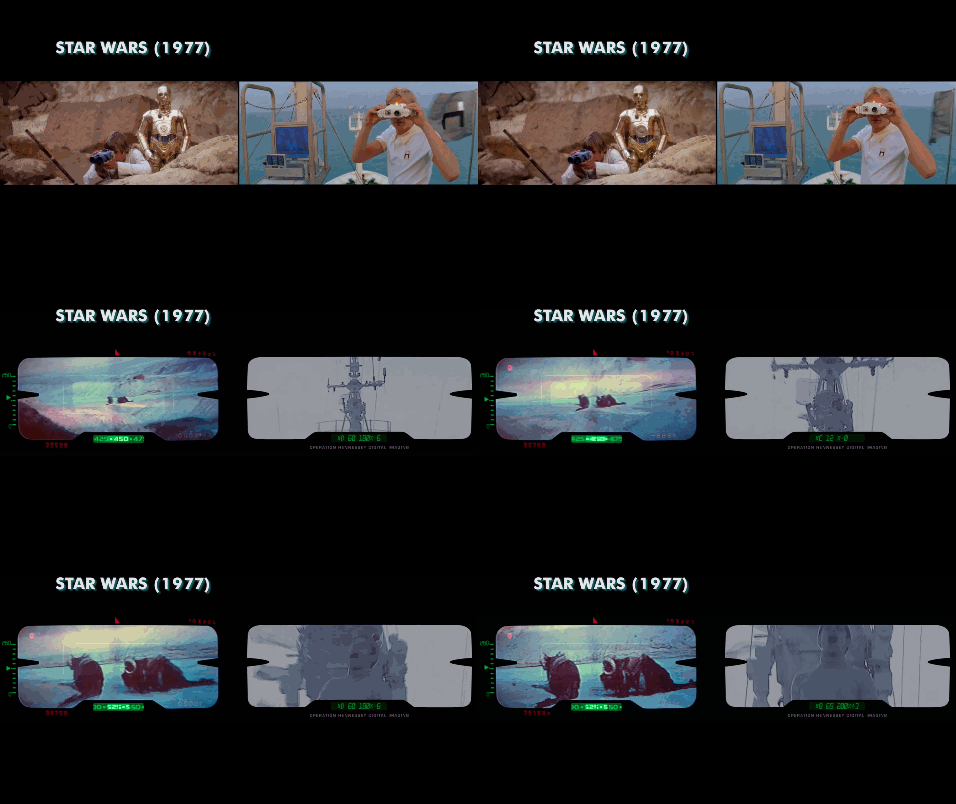
Nestled in the midst of Matt Zoller Seitz’s video essay on Wes Anderson’s The Life Aquatic with Steve Zissou is this bombshell: the movie contains a Star Wars reference no one seems to have noticed. Seitz synced the scenes for us:
There have to be others, right? Many of Anderson’s films end with all of the characters gathered together like at the medals ceremony in Episode IV…someone even synced up the end of the movie with the closing credits music from Zissou and it works really well:
Note: If you are a member and tried to log in, it didn't work, and now you're stuck in a neverending login loop of death, try disabling any ad blockers or extensions. Or try logging out and then back in. Still having trouble? Email me!






Socials & More