kottke.org posts about movies
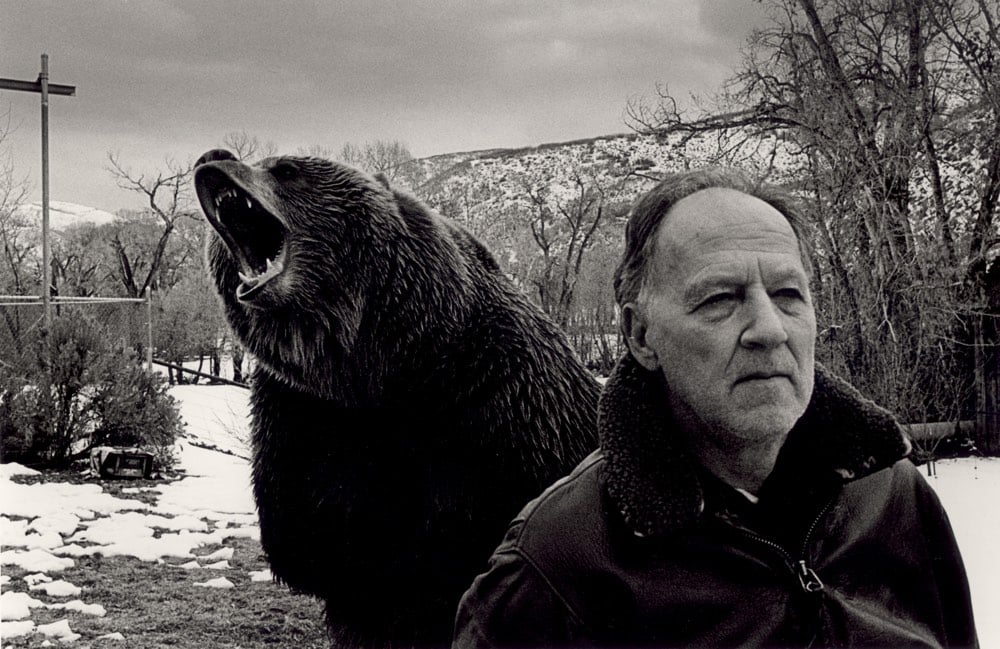
Paul Cronin’s book of conversations with filmmaker Werner Herzog is called Werner Herzog - A Guide for the Perplexed. On the back cover of the book, Herzog offers a list of advice for filmmakers that doubles as general purpose life advice.
1. Always take the initiative.
2. There is nothing wrong with spending a night in jail if it means getting the shot you need.
3. Send out all your dogs and one might return with prey.
4. Never wallow in your troubles; despair must be kept private and brief.
5. Learn to live with your mistakes.
6. Expand your knowledge and understanding of music and literature, old and modern.
7. That roll of unexposed celluloid you have in your hand might be the last in existence, so do something impressive with it.
8. There is never an excuse not to finish a film.
9. Carry bolt cutters everywhere.
10. Thwart institutional cowardice.
11. Ask for forgiveness, not permission.
12. Take your fate into your own hands.
13. Learn to read the inner essence of a landscape.
14. Ignite the fire within and explore unknown territory.
15. Walk straight ahead, never detour.
16. Manoeuvre and mislead, but always deliver.
17. Don’t be fearful of rejection.
18. Develop your own voice.
19. Day one is the point of no return.
20. A badge of honor is to fail a film theory class.
21. Chance is the lifeblood of cinema.
22. Guerrilla tactics are best.
23. Take revenge if need be.
24. Get used to the bear behind you.
I bet this is some of the stuff you learn at Herzog’s Rogue Film School:
The Rogue Film School is not for the faint-hearted; it is for those who have travelled on foot, who have worked as bouncers in sex clubs or as wardens in a lunatic asylum, for those who are willing to learn about lockpicking or forging shooting permits in countries not favoring their projects. In short: for those who have a sense of poetry. For those who are pilgrims. For those who can tell a story to four year old children and hold their attention. For those who have a fire burning within. For those who have a dream.
So. Steven Soderbergh has cut his own version of Stanley Kubrick’s 2001: A Space Odyssey. Like, !!!1
I haven’t had a chance to watch this yet, so I don’t know what’s different about it aside from the shorter runtime of 1h50m. If someone watches it and wants to report in about the differences, let me know. Soderbergh also guessed that Kubrick would have liked shooting on digital:
let me also say i believe SK would have embraced the current crop of digital cameras, because from a visual standpoint, he was obsessed with two things: absolute fidelity to reality-based light sources, and image stabilization. regarding the former, the increased sensitivity without resolution loss allows us to really capture the world as it is, and regarding the latter, post-2001 SK generally shot matte perf film (normally reserved for effects shots, because of its added steadiness) all day, every day, something which digital capture makes moot. pile on things like never being distracted by weaving, splices, dirt, scratches, bad lab matches during changeovers, changeovers themselves, bad framing and focus exacerbated by projector vibration, and you can see why i think he might dig digital.
See also Soderbergh’s B&W edit of Raiders of the Lost Ark. (via @fengypants)
Update: Reader and 2001 fan Dan Norquist watched Soderbergh’s edit and reported back via email:
I love everything Soderbergh does and I love the fact that he cut this film. It’s fun to see it in a more concise form. Really, there’s no choppy edits or anything that doesn’t make sense (except the whole movie of course!). I did miss some of my favorite parts. I love when the father is talking to his daughter on the video phone. Also, if you weren’t around in 1968 it’s really hard to describe how scary the Cold War was. There was always this thing hanging over our heads, that the Russians really had the means to destroy us with nuclear weapons. So you really need the full scene where the American meets the Russians (Soviets). The forced, unnatural politeness is so brilliant and helped to give the film context in its time.
All the important stuff is there — the apes, the monolith, HAL turning evil, astronaut spinning away, the speeding light show (shortened?), old man pointing at space child — and it’s all recut by a master.
Finally, there is something about the full length of the original film that is part of its strength as a piece of art. There is no hurry, no cut to the chase. It’s almost as if you have to go through the entire journey before you can earn the bubble baby at the end.
No surprise that he tightened it up into something less Kubrickian and more Soderberghish. Dan closed his email by saying he would recommend it to fans of the original. (thx, dan)
Update: I’ve seen some comments on Twitter and elsewhere about the legality of Soderbergh posting the 2001 and Raiders edits. The videos are hosted on Vimeo, but are private and can’t be embedded on any site other than Soderbergh’s. But any enterprising person can easily figure out how to download either video. The Raiders video has been up since September, which means either that Paramount doesn’t care (most likely in my mind) or their lawyers somehow haven’t caught wind of it, even though it was all over the internet a few months ago (less likely). We’ll see if whoever owns the rights to 2001 (Time Warner?) feels similarly.
An interesting wrinkle here is that Soderbergh has been outspoken about copyright piracy and the Internet. From a 2009 NY Times article about a proposed French anti-piracy law:
In the United States, a Congressional committee this week began studying the issue. In a hearing Monday before the Foreign Affairs Committee of the House of Representatives, Steven Soderbergh, the film director, cited the French initiative in asking lawmakers to deputize the American film industry to pursue copyright pirates.
Deputizing the film industry to police piracy sounds a little too much like putting the fox in charge of the henhouse. I wonder if Soderbergh feels like these edits are legal to post publicly, if they are fair use for example. Or rather if he feels it’s not but he can get away with it because he is who he is. (thx, @bc_butler)
Update: Soderbergh has removed his cut of 2001 from his site “AT THE REQUEST OF WARNER BROS. AND THE STANLEY KUBRICK ESTATE”. So, that answers that question. (via @fengypants)
In his piece on Back to the Future trilogy, Tim Carmody focuses not on the 2015 future of the movies (hoverboards, self-drying jackets, Mr. Fusion) but on what the movies can tell us about technology in the 1980s. This riff on Back to the Future’s cassette tape method of time travel is quite clever:
I sometimes call this “the cassette era,” and sure enough, cassettes are everywhere. Marty has a Walkman, a camcorder, and an audition tape for his band; the Pinheads have recorded a demo even though they’ve never played in front of an audience.
As a material support for a medium, the cassette has certain advantages and disadvantages. It’s more portable and sturdy than reels or records, and it requires less user interaction or expertise. It requires very fine interactions of miniaturized technology, both mechanical and electronic, in the form of transistors, reading heads, and so forth. Magnetic tape can actually record information as digital or analog, so it’s curiously agnostic in that respect.
Cassettes can also be easily rewound or fast forward. It’s easy to synchronize and dub the contents of one cassette onto another. And users can easily erase or rerecord information over the same tape.
This has clear implications for how we think - and especially, how our predecessors thirty years ago thought-about time travel. It is no accident that many important time travel films, including the Terminator franchise, Bill & Ted’s Excellent Adventure, and yes, the Back to the Future movies, appear at this time. In all three cases, time travel is accomplished with a technological mechanism that allows its users precise control of where they arrive in the timestream. (In earlier time travel stories, travellers slide down a river or awake from a dream, but in the 1980s, the H.G. Wells/Doctor Who conception of time travel through a technological device pretty definitively wins out.) And in all three cases, the goal of time travel is to save and/or rewrite events within a specific person’s lifetime, without which a future timeline will cease to exist.
Here’s Matthew McConaughey doing a proto-Wooderson for his Dazed and Confused audition.
(via devour)
Nice four-minute video about how the creators of The Lego Movie used CGI to make the movie look like it was 100% constructed with real Lego bricks with fingerprints and everything and animated in stop motion.
I’ve watched it twice with my kids, and The Lego Movie was way better than it had any right to be. They so easily could have bollocksed the whole thing up. Maybe the secret is Chris Pratt? Guardians of the Galaxy was better than it should have been as well. I’m bearish on Jurassic World, but come on Indy! (via devour)
After he died, a book containing legendary movie director Akira Kurosawa’s 100 favorite films was published. The list was made by his daughter, arranged chronologically, and limited to one film per director. His daughter describes the selection process:
The principle of the choice is: one film for one director, entry of the unforgettable films about which I and my father had a lovely talk, and of some ideas on cinema that he had cherished but did not express in public.
Some of Kurosawa’s choices: My Neighbor Totoro for Miyazaki, The King of Comedy for Scorsese (?), Annie Hall for Woody Allen, Fitzcarraldo for Herzog, Barry Lyndon for Kubrick (??), and The Birds for Hitchcock. No Orson Welles, Coens, David Lynch, or Malick.
Robert Yeoman has been the cinematographer for all of Wes Anderson’s movies, save for the stop-motion The Fantastic Mr. Fox. Kyle Buchanan at Vulture talked to Yeoman about how he shot nine iconic scenes from Anderson’s films. Of the one-take shot near the end of The Royal Tenenbaums:
We had to triple up on scenes from The Royal Tenenbaums just so we could include this subtly marvelous shot from the finale of the film, where the camera drifts from character to character in the aftermath of an accident. “There were a lot of moving parts, and it was very difficult - Wes was determined to get it in one take and didn’t want to make a cut, so we did, I think, about 20 takes of it,” says Yeoman, who mounted a crane arm to a dolly for fluid movement. “The tough part is that it ends with a very emotional moment between Gene Hackman and Ben Stiller, and this scene was so difficult technically - things didn’t always happen when we wanted them to happen, and we’d have to cut - that it’s a testament to Gene and Ben that they were able to hang in there and really deliver on take 20.” What was going wrong before then? “I don’t want to name names, but there was one actor about two thirds of the way through it who kept blowing his lines, and we’d have to start over again,” says Yeoman. “That was a little frustrating, especially because Gene and Ben were waiting there, getting themselves to a certain place emotionally. I felt bad for them, but that’s just part of making films.”
(thx, greg)
Once again, Steven Soderbergh kept track of every book, TV show, movie, play, and short story he read or watched in 2014. A sampling: Girls, True Detective, Gone Girl, 2001 (3 times), Dr. Strangelove, Olive Kitteridge, My Struggle: Book One, Boardwalk Empire, and his black & white version of Raiders of the Lost Ark (twice).
Here are his lists for 2013 (House of Cards, Koyaanisqatsi), 2012 (This is Spinal Tap, The Lady in the Lake), 2011 (Cave of Forgotten Dreams, Senna), 2010 (Mad Men, Where Good Ideas Come From), and 2009 (Breaking Bad, Slap Shot). (via @khoi)
From Mike Hale in the NY Times, a short appreciation of Hayao Miyazaki, among the best filmmakers of his generation.
Even at its high end, in the works of the Pixar studio or the director Henry Selick, the American children’s movie (a category that these days is pretty much congruent with the animated feature film) approaches its young viewers in a different and less rewarding way. There is always a sense of the filmmakers looking across a divide at their audience, trying with various degrees of grace or desperation to create an entertainment for them, to figure out what will keep those allegedly hyperdistracted children from losing interest.
Mr. Miyazaki cares deeply about that young audience, but you get the feeling that he doesn’t waste any time trying to guess what it wants. Like other great directors of films for and about children — Carroll Ballard (“The Black Stallion”) Steven Spielberg (“E.T.”), Alfonso Cuaron (“A Little Princess” and “Harry Potter and the Prisoner of Azkaban”) — he inhabits the child’s point of view and directly communicates her joys, her trepidations and, perhaps most important, her endless curiosity.
From the excellent Art of the Title (which had a great year), the top 10 title sequences of 2014. So awesome to see Halt and Catch Fire take the top spot. And Too Many Cooks!
The end credits for The Boxtrolls, a stop motion animation film by Laika, is a clever time lapse sequence showing the work that goes into moving the characters. You can tell how long it takes by how often the animator’s outfit changes.
Christopher Jobson of Colossal writes:
I first saw Boxtrolls in the theater last September with my son, and this single scene caused a more vocal response from the audience than any other moment in the entire movie. People were literally gasping, myself included.
The Boxtrolls is already available for purchase on Amazon…might have to watch this with the kids soon.
Hiro teaching Baymax how to fist bump in Big Hero 6.
Update: Jason Porath smartly speculates that Big Hero 6’s fist bump scene was a social media snack sized moment inserted into the movie for marketing purposes, which is part of a larger industry trend.
I don’t have a good word to describe this phenomenon, so I’m going to term it “hashgags.” This is a joke in an animated movie, usually input at the behest of marketing forces, that is used to sell the movie. It’s usually inserted late into production and test screened to within an inch of its life. Some are used repeatedly, some are one-offs that do well with trailers. And it is crippling the entire industry.
From Every Frame a Painting, an appreciation of Jackie Chan and his particular and excellent brand of action comedy.
I love old Jackie Chan movies. When I lived in Minneapolis, a theater there showed them on Saturday nights, late. Drunken Master II is a particular favorite…the final fight scene is AMAZING. The part about how the camera never moves and shoots wide-angle during his scenes is why action in contemporary Hollywood films leaves me yawning.

When I first saw it during the magical movie year of 1999, Hayao Miyazaki’s Princess Mononoke completely blew me away. Now that it’s (finally!) out on Blu-ray1, I can’t wait to see it again. Bonus: the ability to watch in the original Japanese with English subtitles.
From Mallory Ortberg, some reviews of children’s movies penned by objectivist Ayn Rand.
“Mary Poppins”
A woman takes a job with a wealthy family without asking for money in exchange for her services. An absurd premise. Later, her employer leaves a lucrative career in banking in order to play a children’s game. -No stars.
During the production of 2001: A Space Odyssey, Stanley Kubrick commissioned well-known film score composer Alex North to do the score for the film. North had previously done scores for A Streetcar Named Desire, Spartacus, Cleopatra, and Who’s Afraid of Virginia Woolf? and later received an honorary Oscar for his lifetime of work. As production progressed, Kubrick began to feel that the temporary music he used to edit the film was more appropriate. From an interview with Kubrick by Michel Ciment:
However good our best film composers may be, they are not a Beethoven, a Mozart or a Brahms. Why use music which is less good when there is such a multitude of great orchestral music available from the past and from our own time? When you’re editing a film, it’s very helpful to be able to try out different pieces of music to see how they work with the scene. This is not at all an uncommon practice. Well, with a little more care and thought, these temporary music tracks can become the final score. When I had completed the editing of 2001: A Space Odyssey, I had laid in temporary music tracks for almost all of the music which was eventually used in the film. Then, in the normal way, I engaged the services of a distinguished film composer to write the score. Although he and I went over the picture very carefully, and he listened to these temporary tracks (Strauss, Ligeti, Khatchaturian) and agreed that they worked fine and would serve as a guide to the musical objectives of each sequence he, nevertheless, wrote and recorded a score which could not have been more alien to the music we had listened to, and much more serious than that, a score which, in my opinion, was completely inadequate for the film.
And so the temporary music became the iconic score we know today. For comparison, the embedded video shows how North’s original score would have sounded over the opening credits and initial scene.
Selections from North’s original score were later released publicly. Here’s a 38-minute album on Spotify:
Kubrick was absolutely right to ditch North’s score…it’s perfectly fine music but totally wrong for the movie, not to mention it sounds totally dated today. The classical score gives the film a timeless quality, adding to the film’s appeal and reputation more than 45 years later. (via @UnlikelyWorlds)
Update: Two additional facets to this story. North first learned that Kubrick ditched his score at the NYC premiere of the film; he was reportedly (and understandably) “devastated”. And even when Kubrick was artistically satisfied with the music he chose, negotiations to procure the rights weren’t necessarily smooth.
2) Kubrick’s associates did obtain licenses from Ligeti’s publishers and from record and radio companies, although they were not forthcoming about the pivotal role assigned to the music in the film; 3) Ligeti learned about the use of his music not from his publishers but from members of the Bavarian Radio Chorus; 4) he attended a showing of the film with stopwatch in hand, furiously scribbling down timings — thirty-two minutes in all;
Kubrick was undoubtably of the “shoot first, ask questions later” school of negotiation. (via @timrosenberg)
The Kingdom of Dreams and Madness is a documentary which presents a year in the life of Studio Ghibli and its famed director, Hayao Miyazaki. The year in question was a particularly interesting one during which Miyazaki announced his retirement. The trailer:
Granted near-unfettered access to the notoriously insular Studio Ghibli, director Mami Sunada follows the three men who are the lifeblood of Ghibli — the eminent director Hayao Miyazaki, the producer Toshio Suzuki, and the elusive and influential “other director” Isao Takahata — over the course of a year as the studio rushes to complete two films, Miyazaki’s The Wind Rises and Takahata’s The Tale of The Princess Kaguya. The result is a rare “fly on the wall” glimpse of the inner workings of one of the world’s most celebrated animation studios, and an insight into the dreams, passion and singular dedication of these remarkable creators.
(via @garymross)
Update: The Kingdom of Dreams and Madness is now available for rent/buy on Amazon and iTunes.
Somehow I didn’t know that Zoolander (which Terrence Malick and I both love and Roger Ebert hated) began as a short clip Ben Stiller did for the 1996 VH1 Fashion Awards.
(via the dissolve)
The soundtrack for PT Anderson’s Inherent Vice is now on Spotify, well all except for one song. The album is even more partially on Rdio. For the whole thing, you’ll have to head to Amazon.
The fifth track, Spooks, is a variation of a Radiohead song that’s never been officially released. (via @naserca)
Legal scholar Cass Sunstein presents his annual list of the movies that best showcased behavioral economics for 2014.
Best actor: In 1986, behavioral scientists Daniel Kahneman and Dale Miller developed “norm theory,” which suggests that humans engage in a lot of counterfactual thinking: We evaluate our experiences by asking about what might have happened instead. If you miss a train by two minutes, you’re likely to be more upset than if you miss it by an hour, and if you finish second in some competition, you might well be less happy than if you had come in third.
“Edge of Tomorrow” spends every one of its 113 minutes on norm theory. It’s all about counterfactuals — how small differences in people’s actions produce big changes, at least for those privileged to relive life again (and again, and again). Tom Cruise doesn’t get many awards these days, or a lot of respect, and we’re a bit terrified to say this — but imagine how terrible we’d feel if we didn’t: The Top Gun wins the Becon.
(via @tylercowen)
Finally, courtesy of the Auralnauts, we get the Terminator trailer that we deserve. Time travel is hilarious.
I wish we could send you back with pants, but the technology just isn’t there yet. So as soon as you hit the ground, you’re going to want to find some pants. I know you can do it…because you already did it.
Like the old wives’ tale says, if you want to fix the future, just keep sending Terminators back in time. (via @mouser_nerdbot)
Adrian Curry selects his favorites for the best movie posters of 2014. This one, for Gabe Polsky’s Red Army, caught my eye:
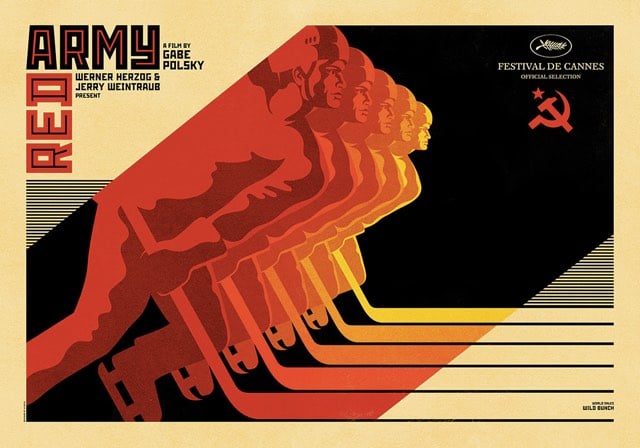
See also the best poster lists from Empire, Entertainment Weekly, and Indiewire. (via subtraction)
Woo! New Terrence Malick film! Knight of Cups stars Christian Bale, Cate Blanchett, and Natalie Portman with cinematography by Emmanuel Lubezki, who also did Children of Men, Gravity, Birdman, and Malick’s The Tree of Life. Here’s the trailer:
The Tree of Life *wrecked* me.
Every once in awhile on the site, I’ll use the phrase “in my wheelhouse”, meaning something that is particularly interesting to me. Well, Grantland’s long oral history of the making of Boogie Nights is so in my wheelhouse that I might be the captain.
When [Anderson] set out to film Boogie Nights, it was with a resolve bordering on arrogance. Compromise wasn’t part of the plan. Still, after an intense production and postproduction period — one in which the director had to manage a cranky, confused Burt Reynolds and an untested, rapping underwear model named Mark Wahlberg — Anderson was forced once again to fight studio heads for his cut of the film.
But Anderson’s vision prevailed this time. Nearly 20 years later, Boogie Nights endures. For its beautiful portrait of nontraditional families; for Reynolds and Wahlberg, the surrogate father and son, who were never better; for Philip Seymour Hoffman, squeezing into character and breaking hearts; for its prodigy director sticking to his guns and nailing it; for John C. Reilly’s hot-tub poetry; for Roller Girl. Is everybody ready? This is the making and near unmaking of Boogie Nights.
Man, I love that movie. But think on this: Leonardo DiCaprio as Dirk Diggler, Drew Barrymore as Roller Girl, and Bill Murray as Jack Horner.
A tribute to outer space in movies, featuring clips from Gravity, The Fountain, Alien, Star Wars, Solaris, Sunshine, Guardians of the Galaxy, and more.
Music is from Hans Zimmer’s soundtrack for Interstellar, which I was initially lukewarm on but have been listening to consistently over the past week or so. (via devour)
SWAPI is a new web service will use a RESTful interface to return JSON about the “Planets, Spaceships, Vehicles, People, Films and Species” from all six of the Star Wars movies. This API would be really useful if Disney would have done as Matt Webb suggested and turned Star Wars into a genre rather than a franchise.
Imagine, imagine if Disney had said: Star Wars isn’t a franchise, it’s a genre.
The legendary galaxy, a long time ago, far far away, is well understood: What’s true is what’s in the Holocron continuity database.
Open the Holocron. Show everyone what’s in it. Let it become history.
Then let anyone make movies and books that share the Star Wars world. Not like all those other franchises that argue about what’s canon and what’s not… rise above it, become a new shared set of conventions, formulas, history and myth, just like the western but for the 21st century.
My friend David suggested something similar with Harry Potter a few years ago…open it up and let any director take a shot at making Potter movies. Open source franchises.
Worth a listen: a 30-minute BBC Radio show on 2001: A Space Odyssey.
Francine journeys through time and space to uncover the mysteries of this 1968 classic. Searching for the mind of H.A.L. and lost alien worlds among the delights of the Stanley Kubrick Archive at London’s University of the Arts. Joining Francine on her voyage of discovery are 2001 chronicler Piers Bizony, former urbane spaceman Keir Dullea and the woman who built the moon! Other voices include production designer Harry Lange, make-up genius Stuart Freeborn, editor Ray Lovejoy, all now so much stardust, as well as those of lead ape ‘Moonwatcher’ (Dan Richter) & Stargate deviser Douglas Trumbull.
From the August 4, 1926 issue of The New Republic, here’s an essay about film by author Virginia Woolf, published the year before the release of the first talkie.
People say that the savage no longer exists in us, that we are at the fag-end of civilization, that everything has been said already, and that it is too late to be ambitious. But these philosophers have presumably forgotten the movies. They have never seen the savages of the twentieth century watching the pictures. They have never sat themselves in front of the screen and thought how, for all the clothes on their backs and the carpets at their feet, no great distance separates them from those bright-eyed, naked men who knocked two bars of iron together and heard in that clangor a foretaste of the music of Mozart.
The bars in this case, of course, are so highly wrought and so covered over with accretions of alien matter that it is extremely difficult to hear anything distinctly. All is hubble-bubble, swarm and chaos. We are peering over the edge of a cauldron in which fragments of all shapes and savors seem to simmer; now and again some vast form heaves itself up, and seems about to haul itself out of chaos. Yet, at first sight, the art of the cinema seems simple, even stupid. There is the King shaking hands with a football team; there is Sir Thomas Lipton’s yacht; there is Jack Horner winning the Grand National. The eye licks it all up instantaneously, and the brain, agreeably titillated, settles down to watch things happening without bestirring itself to think.
I am still very much looking forward to the Shaun the Sheep movie, but the first official trailer is not inspiring much confidence:
Yeesh. That makes it look like The Smurfs movie or something. Movie company marketing departments don’t seem to know what to do with quirky stuff like Shaun or Wallace & Gromit. Has an Aardman movie ever had a good trailer? (via digg)
Newer posts
Older posts






Socials & More