



Weezer’s “Teal Album” is a collection of covers of songs like Africa, Billie Jean, and No Scrubs

Advertise here with Carbon Ads
This site is made possible by member support. 💞
Big thanks to Arcustech for hosting the site and offering amazing tech support.
When you buy through links on kottke.org, I may earn an affiliate commission. Thanks for supporting the site!
kottke.org. home of fine hypertext products since 1998.
Beloved by 86.47% of the web.
Entries for January 2019
How the Relentless Robert Caro “Turns Every Page” in Pursuit of Powerful Prey
Since 1976, Robert Caro has been writing a multi-volume biography of former US President Lyndon B. Johnson — the first volume is called The Path to Power. In this absolutely fantastic piece he wrote for the latest issue of the New Yorker, Caro details some of his thoughts and strategies about writing and research that have served him well as he’s pursued the topic of power for more than 50 years. Here he writes about what his editor told him at an early stage in his career:
He didn’t look up. After a while, I said tentatively, “Mr. Hathway.” I couldn’t get the “Alan” out. He motioned for me to sit down, and went on reading. Finally, he raised his head. “I didn’t know someone from Princeton could do digging like this,” he said. “From now on, you do investigative work.”
I responded with my usual savoir faire: “But I don’t know anything about investigative reporting.”
Alan looked at me for what I remember as a very long time. “Just remember,” he said. “Turn every page. Never assume anything. Turn every goddam page.” He turned to some other papers on his desk, and after a while I got up and left.
“Turn every goddam page.” Caro is a living national treasure and that’s as close to a superhero origin story as you’re going to get in journalism. Over and over, he applied that strategy to his later writing, first in the masterful The Power Broker and then in the pursuit of the truth about LBJ among the boxes and boxes and boxes of papers at the Johnson Library and Museum in Austin, Texas.
I had decided that among the boxes in which I would at least glance at every piece of paper would be the ones in Johnson’s general “House Papers” that contained the files from his first years in Congress, since I wanted to be able to paint a picture of what he had been like as a young legislator. And as I was doing this — reading or at least glancing at every letter and memo, turning every page — I began to get a feeling: something in those early years had changed.
For some time after Johnson’s arrival in Congress, in May, 1937, his letters to committee chairmen and other senior congressmen had been in a tone befitting a new congressman with no power — the tone of a junior beseeching a favor from a senior, or asking, perhaps, for a few minutes of his time. But there were also letters and memos in the same boxes from senior congressmen in which they were doing the beseeching, asking for a few minutes of his time. What was the reason for the change? Was there a particular time at which it had occurred?
Caro’s recounting of this tedious research is somehow thrilling, like a slow motion All the President’s Men, Spotlight, or The Post. Set aside some time to read the whole thing…it will be time well spent. I can’t wait for Caro’s Working: Researching, Interviewing, Writing to come out in April.
“We may finally know what causes Alzheimer’s – and how to stop it.” The headline is a bit sensational, but the link between gum disease and the cause of Alzheimer’s is something to keep an eye on.
Lee Unkrich is leaving Pixar after 25 years. He directed Coco, Finding Nemo, and Toy Story 3.
The Evolution of the Alphabet
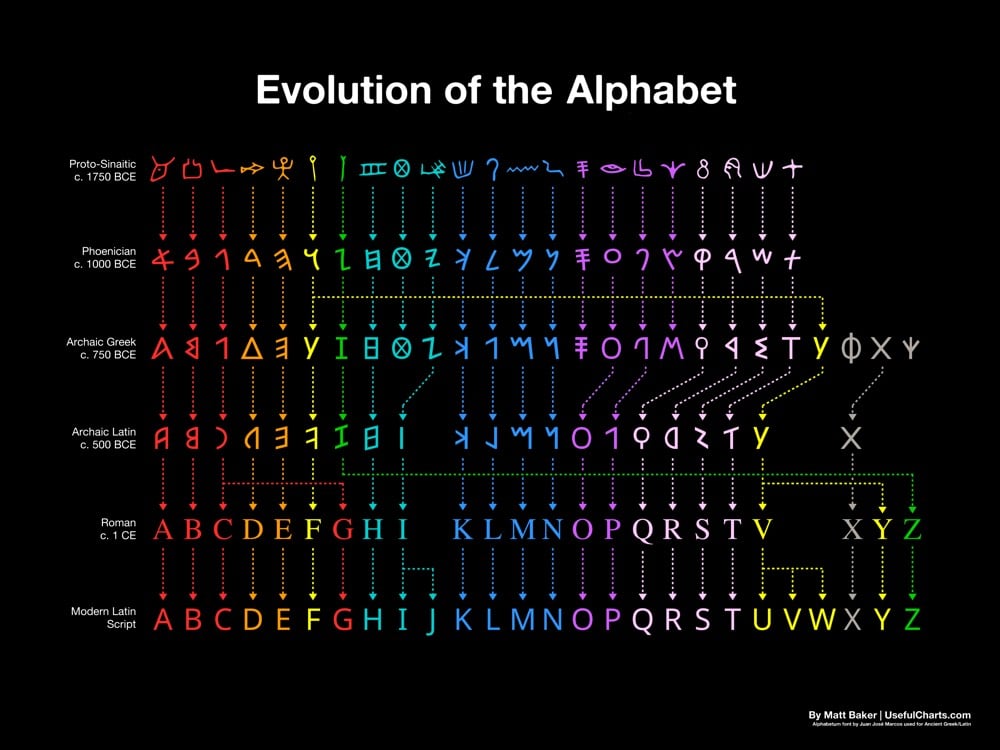
From Matt Baker of UsefulCharts, this chart traces the evolution of our familiar alphabet from its Proto-Sinaitic roots circa 1850-1550 BC. It’s tough to see how the pictographic forms of the original script evolved into our letters; aside from the T and maybe M & O, there’s little resemblance. Prints are available. (via the morning news)
Update: Baker recently did an updated version of the alphabet evolution chart.
Meet the Yamabushi Monks, Who Commune with Nature to Find Themselves
Mountain Monks is a short film by Fritz Schumann about a group of Japanese monks called the Yamabushi who regularly commune with nature to get in touch with their true selves.
The Yamabushi in northern Japan practice a once forbidden ancient religion. While their tradition is at risk of disappearing, it offers a way for those seeking a different path in Japan’s society.
Walking barefoot through rivers, meditating under waterfalls and spending the nights on mountaintops — that is the way of the Yamabushi. They walk into the forest to die and be born again.
You may remember another short film by Schumann that I posted last year about Hoshi Ryokan, a 1300-year-old family-run hotel in central Japan. (via laughing squid)
A Cyborg Artist Who Feels All of the World’s Earthquakes
Moon Rivas, a cyborg artist, has sensors implanted in her feet that vibrate whenever an earthquake is detected anywhere in the world. A dancer and choreographer, Rivas uses the randomly occurring vibrations to perform dance pieces like “Waiting for Earthquakes”. This video from Quartz gives a good overview of Rivas’ art and process (back when an implant was located in her arm instead of her feet).
CNN and Bloomberg both have recently updated reports on Rivas’ work.
Ribas then transforms that data into dance or music, often incorporating elements of spontaneity and uncertainty. For example, the movements in the dance “Waiting for Earthquakes,” in which the artist stands perfectly still until seismic activity occurs, can take many shapes.
“I’m a dancer and a choreographer, so I wanted to experience movement in a deeper way,” she explains. “Whenever there is an earthquake, I move according to the intensity of the earthquake. It’s a bit like a duet between the earth and myself. Earth is actually the choreographer of the piece and I’m just imitating the data that she gives.”
Her partner Neil Harbisson is also a cyborg. He was born colorblind but is outfitted with an antenna implanted in his head that vibrates when it detects colors. (via @boletrone)
Video: A Meteorite Hit the Moon During the Recent Eclipse!
Something incredible happened during the super blood wolf moon eclipse that took place on Sunday night: a meteorite struck the moon during the eclipse and it was captured on video, the first time this has ever happened.
Jose Maria Madiedo at the University of Huelva in Spain has confirmed that the impact is genuine. For years, he and his colleagues have been hoping to observe a meteorite impact on the moon during a lunar eclipse, but the brightness of these events can make that very difficult — lunar meteorite impacts have been filmed before, but not during an eclipse.
The 4K video of the impact above was taken by amateur astronomer Deep Sky Dude in Texas…he notes the impact happening at 10:41pm CST. I couldn’t find any confirmation on this, but the impact looks bright enough that it may have been visible with the naked eye if you were paying sufficient attention to the right area at the right time.
Phil Plait has a bunch more info on the impact. If the impact site can be accurately determined, NASA will attempt to send the Lunar Reconnaissance Orbiter to get photos of it.
Interestingly, I talked to Noah Petro, Project Scientist for LRO, and he noted that the impact may have created secondary craters, smaller ones made by debris blown out by the main impact. Those will spread out over a larger area, and are easier to spot, so it’s possible that even with a rough location known beforehand the crater can be found. Also, fresh craters look distinct from older ones — they’re brighter, and have a bright fresh splash pattern around them — so once it’s in LRO’s sights it should be relatively easy to spot.
It’s not clear how big the crater will be. I’ve seen some estimates that the rock that hit was probably no more than a dozen kilograms or so, and the crater will be probably 10 meters across. That’s small, but hopefully its freshness will make it stand out.
Universe, a Short Documentary from 1960 that Inspired Kubrick’s 2001
In 1960, the National Film Board of Canada released a short documentary called Universe. The film follows the work of astronomer Donald MacRae at an observatory in Ontario, which is accompanied a special effects-heavy tour of the solar system, galaxy, and universe: “a vast, awe-inspiring picture of the universe as it would appear to a voyager through space”. Universe was nominated for an Oscar in 1961 and also caught the eye of Stanley Kubrick, who used it as inspiration for 2001: A Space Odyssey.
“Stanley had seen the National Film Board movie Universe.” Most of the crew on 2001 were familiar with the Canadian production, made by filmmakers Colin Low and Roman Kroitor, all having seen it at the early stages of 2001’s production, it being “required watching” at the insistence of Kubrick himself, who had seen the documentary “almost 100 times”, “until the sprockets wore out,” 2001 special effects supervisor Con Pedersen remembers.
Kubrick was so taken by the depiction of the celestial objects in the film that he hired the co-director and a special effects technician from Universe to work on 2001. The narrator of Universe, Douglas Rain, also became a integral part of Kubrick’s masterpiece. After ditching the idea that 2001 would be narrated by Rain — “as more film cut together, it became apparent narration was not needed” — Kubrick chose Rain as the now-iconic voice of HAL 9000.
After finally excising the narrator altogether, he simply made Rain the voice of HAL, liking his “bland mid-Atlantic accent”. The decision was entirely Kubrick’s, who had become concerned with the character of the computer. “Kubrick was having,” Rain says, “a problem with the computer. ‘I think I made him too emotional and too human,’ he said. ‘I’m having trouble with what I’ve got in the can. Would you consider doing his voice?’ So we decided on the voice of the computer.”
But back to Universe, which is a marvelous little film (even though it asserts at one point that “it is reasonably certain” that Mars contains vegetation). I love the early sequence of the astronomer setting up his telescope — the way he walks along inside of it and then casually lifts it up into place. It’s really just a bigger version of the small reflector that I have, not any more complicated than a couple of mirrors pointed in the right direction. It’s incredible what we humans have learned about the universe simply by collecting ancient starshine with polished lenses and mirrors. (via clayton cubitt)
Craig Mod has launched a membership program to support his writing, podcasting, and walking efforts. Crucially, like @kottke’s membership program, almost nothing is disappearing behind a paywall.
Entertaining thread by @leahbroad comparing musical composers to biscuits/cookies. “8. Haydn, Jammie Dodger. The fun, family-friendly biscuit.”
AeroMexico Trolls Xenophobic Americans with “DNA Discounts” Commercial
This commercial from Mexican airline AeroMexico cleverly reminds some Americans of the melting pot nature of our nation, where even “white” folks living near the border share significant amounts of DNA with those in Mexico. According to this piece in Adweek, the ad features non-actors and their actual DNA test results.
For those wondering how legit the scenarios shown in the ad are, Agost Carreño says it’s all real and that each person featured in the video was a non-actor who did have a 23andMe DNA test done in advance of the reveal.
Update: A possible inspiration for the AeroMexico video is The DNA Journey commercial by travel search engine Momondo:
The folks in that commercial may seem a bit naive about how DNA and ancestry works, but I took the 23andMe DNA test many years ago and was also surprised to find a few significant possible geographic outliers (British/Irish, Dutch) that were not accounted for in the handed-down family genealogy. (via @rudhraigh)
The Layers of Motherhood
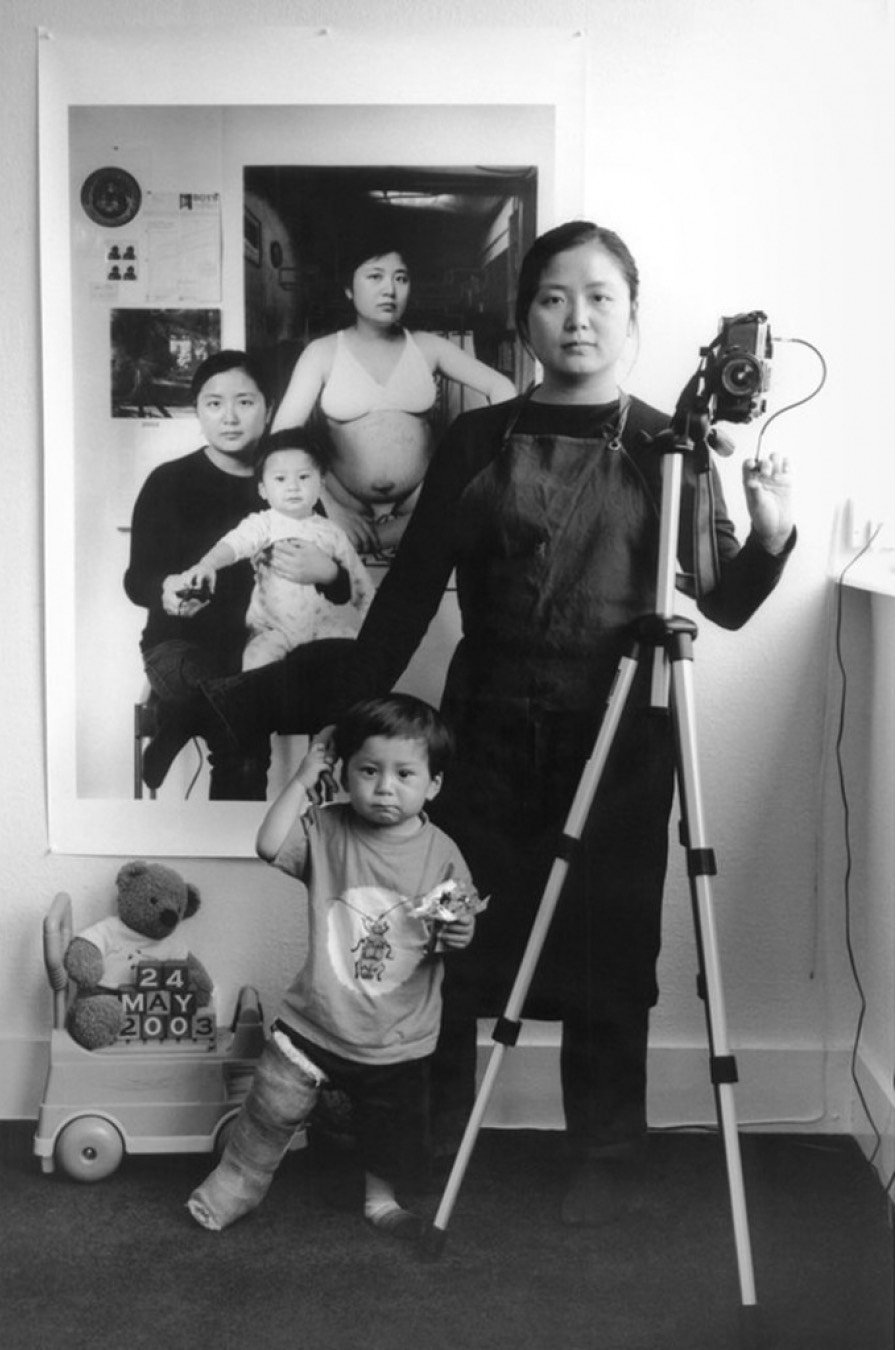
In what she calls a “time-tunnel artwork”, photographer Annie Wang has been taking a periodic photo of herself and her son over the past 18 years, each time with the previous photo in the background.
Different layers of my son and I emerge on the same surface after a lengthy accumulation of detail and texture. Different stages of my son and I are overlaid; and from the different pictures we have created dialogue with each other in this dimension upon compressed dimension. From within these dimensions will emerge a new depiction/visualization of Motherhood.
Here are two consecutive photos in the series from when her son was young.

(via swissmiss)
“I Need An Abortion — Now What?” A comprehensive guide to the laws, restrictions, and waiting periods for every US state.
A Brief History of Cheese (aka Immortal Milk)
Featuring the ideas of cheese expert Paul Kindstedt, this TED-Ed video is a quick animated look at the history of cheese and cheesemaking over the last 10000 years.
The best indication of ancient cheese-making lies in pottery fragments that migrating peoples left behind as they moved to new locations. Neolithic peoples sometimes stored cheese and butter in pottery vessels, which left embedded residues of milkfat in the pottery. Even after thousands of years, these ancient milkfat residues can be identified by sophisticated archaeochemical techniques. By following the pottery trail, it is possible to reconstruct the movement of Neolithic cheesemakers out of the Fertile Crescent into northwest Turkey, and then westwards to Europe, where cheese-making evolved into countless new varieties, and eastwards to the Eurasian steppes. With respect to Africa, it is still unclear whether cheese-making arrived from the Fertile Crescent or developed independently there.
Kindstedt is the author of Cheese and Culture: A History of Cheese and its Place in Western Civilization and is based at the University of Vermont, not too far from where I live in VT, land of plentiful hyper-local cheeses…the nearest cheese-making dairy is 1/4 mile from my house. Some of Kindstedt’s recent research uses techniques like x-ray diffractometry to study stuff like crystal formation and packing density in cheeses, which takes me back to my research days in college studying the structure of glass. What a fun thing, to discover a whole new vector into cheese appreciation! (via open culture)
Swimming with the Largest Great White Shark in the World
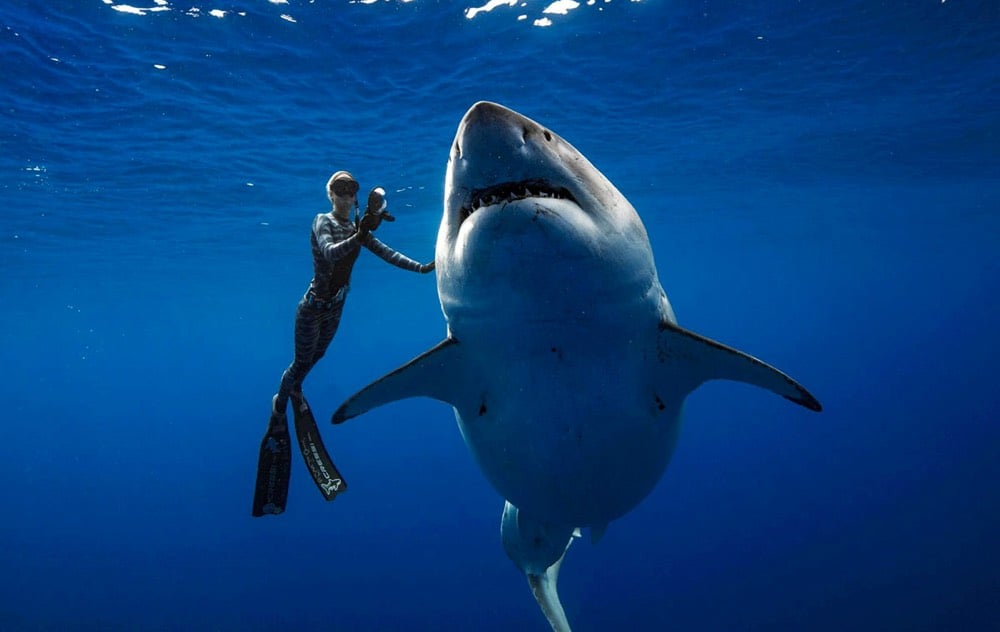
A group of divers with One Ocean Diving recently swam with Deep Blue, a great white shark that is believed to be one of largest on Earth. Deep Blue is a female white shark that’s around 50 years old and 20 feet long.

“Deep Blue came up and brushed up against the boat, maybe she’s pregnant, maybe she’s itchy?” Ramsey wrote, adding: “She swam away escorted by two rough-toothed dolphins who danced around her.”
Deep Blue is over 50 years old, and was caught on camera five years ago in a video that quickly went viral.
Ramsey said her team had been monitoring tiger sharks feeding when the legendary great white made her surprise appearance. The divers “spent the entire day with her till the sun went down,” Ramsey wrote.
Here’s a video of the group swimming with the shark. I had no idea that you could swim with great whites like that, outside of a cage. Wow.
A Delightfully Fourth-Wall-Breaking “Nancy” Comic from Olivia Jaimes
Comics fans and the internet at large have been enchanted by the new author of the classic Nancy comic, Olivia Jaimes. This comic from Sunday shows why:
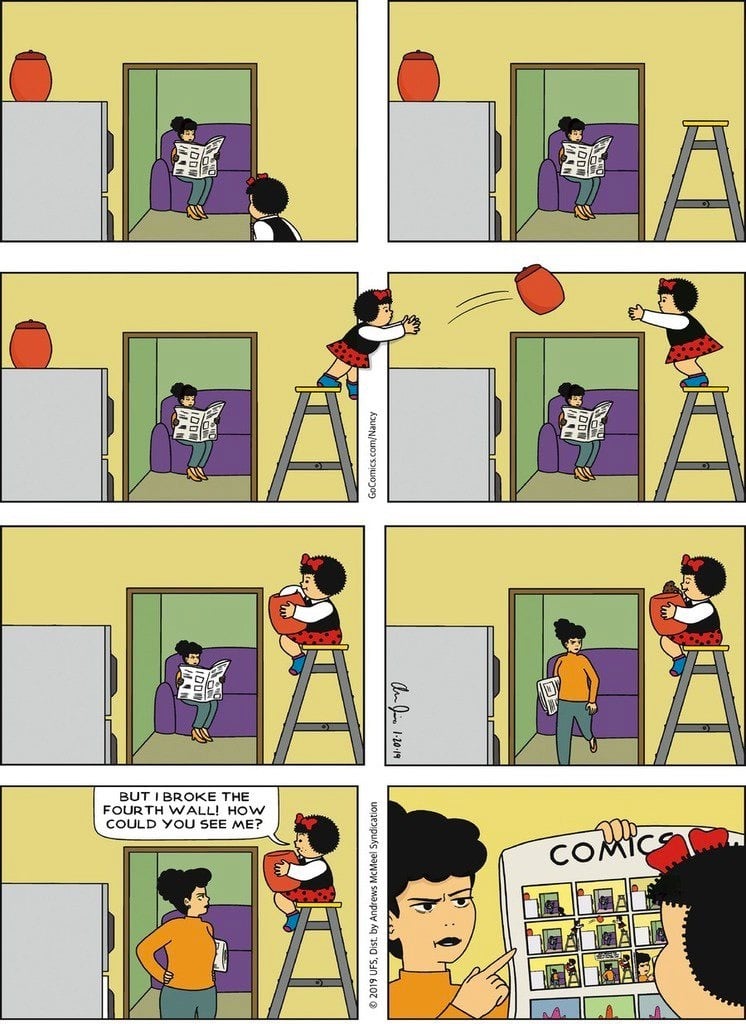
If you check out the thread for the comic on Twitter, there are several instances of comics that mess with time and space like this, but the final panel by Jaimes is particularly strong. I definitely Laughed Out Loud.
Update: Delta’s current onboard safety video takes place within the illustrated world of the seat-back safety card and contains several instances of fourth-wall breaking.
This paper proposes two techniques for detecting the glint of starshine on exoplanetary oceans (!!!!)
An experimental Ebola vaccine appears to be working to contain an outbreak in the Democratic Republic of the Congo. “Salama said the vaccine efficacy rate in the current outbreak is well above 90 percent.”
How to Fix Social Media by Injecting A Chunk of the Blogosphere
Not all hour-long podcasts are worthwhile, but I found this one by The Atlantic’s Matt Thompson and Alexis Madrigal to be pretty compelling. The subject: how to fix social media, or rather, how to create a variation on social media that allows you to properly pose the question as to whether or not it can be fixed.
For both Matt and Alexis, social media (and in particular, Twitter) is not especially usable or desirable in the form in which it presents itself. Both Matt and Alexis have shaped and truncated their Twitter experience. In Alexis’s case, this means going read-only, not posting tweets any more, and just using Twitter as an algorithmic feed reader by way of Nuzzel, catching the links his friends are discussing, and in some cases, the tweets they’re posting about those links. Matt is doing something slightly different: calling on his friends not to like to retweet his ordinary Twitter posts, but to reply to his tweets in an attempt to start a conversation.
Both Matt and Alexis are, in their own way, trying to inject something of the old spirit of the blogosphere into their social media use. In Alexis’s case, it’s the socially mediated newsreader function. In Matt’s, it’s the comment thread, the great discussions we used to have on blogs like Snarkmarket.
(Full disclosure: I was a longtime commenter on Matt and Robin Sloan’s blog Snarkmarket from 2003 to 2008, until I was elevated into a full third member of the site, where I posted pretty regularly until about 2013, when our blog, like so many others, began to wind down, replaced by both social media and professional news sites. I was also one of the early contributors to Alexis’s Tech section at The Atlantic starting in 2010, which is also held aloft as a blog standard during this podcast. So I have some skin in this game.)
Also worth reading into this discussion: Anil Dash’s 20th anniversary roundtable at Function with Bruce Ableson, Lisa Phillips, and Andrew Smales, which pretty explicitly (and usefully!) constructs the early blogosphere as the precursor to contemporary social media.
It’s easy to look at Twitter and look at Facebook, and look at the things that are happening, and how awful people are to each other, and say: the world would be better off without the internet. And I don’t believe that. I think that there’s still space where people can be good to each other.
So here’s the thing:
- The blogosphere was not always better than the contemporary social web;
- The blogosphere felt like it was getting better in a way that the contemporary social web does not.
And that turns out to make a huge difference! I mean, in general, the world was sort of a crummy place in the early 2000s. (The late 1990s were actually good.) But on the web side, especially, things in the early 2000s felt like they were getting better. Services were improving, more information was coming online, storage and computing power (both locally and in the cloud) were improving in a way that felt tangible, people were getting more connected, those connections felt more powerful and meaningful. It was the heroic phase of the web, even as it was also the time that decisions were being made that were going to foreclose on a lot of those heroic possibilities.
A lot of the efforts to reshape social media, or to walk away from it in favor of RSS feeds or something else, are really attempts to recapture those utopian elements that were active in the zeitgeist ten, fifteen, and twenty years ago. They still exercise a powerful hold over our collective imagination about what the internet is, and could be, even when they take the form of dashed hopes and stifled dreams.
I feel like I can speak to this quite personally. Ten years ago, I was just another graduate student in a humanities program stuck with a shitty job market, layered atop what were already difficult career prospects to begin with. The only thing I had going for me that the average literary modernist didn’t was that I was writing for a popular blog with two very talented young journalists who liked to think about the future of media. That pulled me in a definite direction in terms of the kinds of things I wrote about (yes, Walter Benjamin, but also Google Books), and the places where I ended up writing them (Kottke.org, The Atlantic, and eventually Wired). So instead of being an unemployable humanist, I became an underemployed journalist.
At the same time, the blogosphere, while crucial, has only offered so much velocity and so much gravity. By which I mean: it’s only propelled my career so far, and the blogs I’ve written for (Kottke notwithstanding) have only had so much ability to retain me before they’ve changed their business model, changed management, gone out of business, or been quietly abandoned. They’re little asteroids, not planets. Most of the proper publications I’ve written for, even the net-native ones, have been dense enough to hold an atmosphere.
And guess what? So have Twitter and Facebook. Just by enduring, those places have become places for lasting connections and friendships and career opportunities, in a way the blogosphere never was, at least for me. (Maybe this is partly a function of timing, but look: I was there.) And this means that, despite their toxicity, despite their shortcomings, despite all the promises that have gone unfulfilled, Twitter and Facebook have continued to matter in a way that blogs don’t.
For good or for ill, Twitter lets you take the roof off and contact people you’d otherwise never reach. The question, I think, is whether you have to tack that roof back on again in order to get the valuable newsgathering and conversation elements that people once found so compelling about the blogosphere, or whether there’s some other form of modification that can be made to build in proper protections.
The other question is whether there can be anything like a one-size-fits-all solution to the problem of social media. I suspect there isn’t, just because people are at different points on their career trajectories, which shapes their needs and wants vis-a-vis social media accordingly. Some of us are still trying to blow up, or (in some cases) remind the world what they liked about us to begin with. Others of us are just trying to do our jobs and get through the day. Many more still have little capital to trade on to begin with, and are just looking for some kind of meaningful interaction to give us a reason why we logged in in the first place. The fact that this is the largest group, for whom the tools are the least well-suited, and who were promised the most by social media’s ascendancy, is the great tragedy of the form.
Maybe we need to ask ourselves, what was it that we wanted from the blogosphere in the first place? Was it a career? Was it just a place to write and be read by somebody, anybody? Was it a community? Maybe it began as one thing and turned into another. That’s OK! But I don’t think we can treat the blogosphere as a settled thing, when it was in fact never settled at all. Just as social media remains unsettled. Its fate has not been written yet. We’re the ones who’ll have to write it.
The 1959 Project
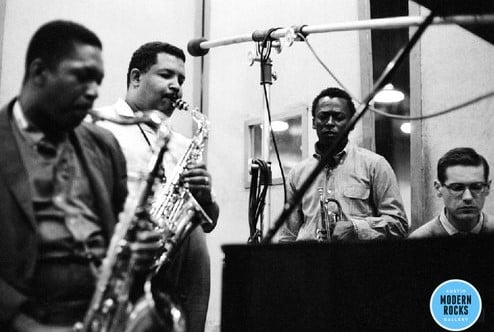
1969 is getting all the attention right now, as huge historical landmarks celebrate their 50th anniversary. But what about 1959, and all those 60th anniversaries? 1959 was particularly a landmark year for jazz, and it’s those milestones that are celebrated by an amazing blog called The 1959 Project. Helmed by Natalie Weiner, a sportswriter and history-of-jazz superfan, the premise is simple: every day, a snapshot of the world of jazz sixty years ago.
In the 2 1/2 weeks since the site’s been active, it’s already overflowing with musical goodness. I especially love this deep dive on Ahmad Jamal, an artist I didn’t know much about until my 15-year-old son, a hip-hop head, turned me on to him. There’s also plenty of Charles Mingus, John Coltrane, Max Roach, Dizzy Gillespie, Duke Ellington, Louis Armstrong, as well as vocalists like Muriel Roberts, Dakota Staton, Susan Hayward, and Lorez Alexandria.
It’s already one of the few sites that I read every day, and it only promises to get better as the year goes on.
Steven Adams is the Evolutionary Bill Laimbeer, and I Am Here For It
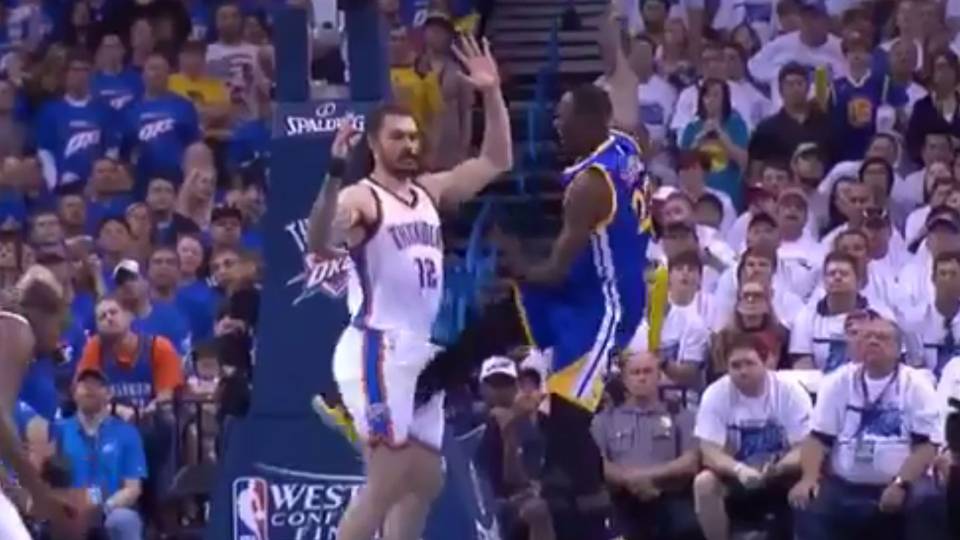
One of the best things about the contemporary NBA is that the league is overflowing with villains, great players that it’s easy to root against. It’s just as easy to love LeBron as to hate LeBron, to love or hate the Warriors, to love or hate James Harden or Kyrie Irving or John Wall. You could heat these guys’ guts, and love their entertainment value as heels at the same time.
One of the very best heels is Oklahoma City center Steven Adams, the New Zealand-born, ponytail-clad, Aquaman-resembling brute who sets screens and clears the boards for Russell Westbrook and Paul George. ESPN gave Adams a mostly sympathetic profile that at the same time made it clear why someone like Draymond Green would want to kick Adams in the nuts.
There’s no “NBA’s Strongest Man” contest where players lift Jumbotrons or heave backboards onto the upper concourse, but among peers and people around the league, Adams is widely considered the NBA’s strongman, a walking concrete wall of power and physicality.
“That guy is the strongest, most physical guy in the league,” says Wizards coach Scott Brooks, who coached Adams for two seasons in OKC.
Says teammate Jerami Grant: “He is for sure, definitely the strongest guy in the NBA.”
In a league trending toward speed, spacing, shooting and slashing, Adams is the counterpoint. Old school. A “throwback,” as San Antonio Spurs coach Gregg Popovich calls him.
Adams is a bruising, physical relic of the past, a back-to-the-basket brute who will grind possessions in the post and overpower you to get there.
“That m——-f——- is strong. Like, I’m serious,” Philadelphia 76ers star Jimmy Butler said last season. “He hit me with one screen and I thought my life was over.
“He’s from Krypton or something.”
Wait: why don’t we have strongman competitions duringthe NBA All-Star weekend or something? That would be amazing! I would rather watch that than layup drills or half of the stuff they show. I want to see Marc Gasol and Boogie Cousins throwing barrels at each other.
Gradually, Then Suddenly
Using one of my recent favorite mental models,1 Tim O’Reilly writes about some technology-related changes happening in the world where incremental advances in recent years are set to soon become pervasive.
2) The rest of the world is leapfrogging the US. The volume of mobile payments in China is $13 trillion versus the US’s $50 billion, while credit cards never took hold. Already Zipline’s on-demand drones are delivering 20% of all blood supplies in Rwanda and will be coming soon to other countries (including the US). In each case, the lack of existing infrastructure turned out to be an advantage in adopting a radically new model. Expect to see this pattern recur, as incumbents and old thinking hold back the adoption of new models.
I’ve referenced “gradually, then suddenly” in recent posts about what living in a dictatorship feels like and climate change.↩
The Case for Impeaching Donald Trump
In the cover story for the March 2019 issue of The Atlantic, Yoni Appelbaum clearly and methodically lays out the case that Congress should begin the impeachment process against Donald Trump.
The oath of office is a president’s promise to subordinate his private desires to the public interest, to serve the nation as a whole rather than any faction within it. Trump displays no evidence that he understands these obligations. To the contrary, he has routinely privileged his self-interest above the responsibilities of the presidency. He has failed to disclose or divest himself from his extensive financial interests, instead using the platform of the presidency to promote them. This has encouraged a wide array of actors, domestic and foreign, to seek to influence his decisions by funneling cash to properties such as Mar-a-Lago (the “Winter White House,” as Trump has branded it) and his hotel on Pennsylvania Avenue. Courts are now considering whether some of those payments violate the Constitution.
More troubling still, Trump has demanded that public officials put their loyalty to him ahead of their duty to the public. On his first full day in office, he ordered his press secretary to lie about the size of his inaugural crowd. He never forgave his first attorney general for failing to shut down investigations into possible collusion between the Trump campaign and Russia, and ultimately forced his resignation. “I need loyalty. I expect loyalty,” Trump told his first FBI director, and then fired him when he refused to pledge it.
Trump has evinced little respect for the rule of law, attempting to have the Department of Justice launch criminal probes into his critics and political adversaries. He has repeatedly attacked both Deputy Attorney General Rod Rosenstein and Special Counsel Robert Mueller. His efforts to mislead, impede, and shut down Mueller’s investigation have now led the special counsel to consider whether the president obstructed justice.
Appelbaum’s article has already swayed the impeachment opinions of James Fallows (“this piece…changed my mind”) and Stewart Brand. This short video is a good overview of the piece (which you should read in full anyway):
This, for me, is the critical part of Appelbaum’s argument (emphasis mine):
The fight over whether Trump should be removed from office is already raging, and distorting everything it touches. Activists are radicalizing in opposition to a president they regard as dangerous. Within the government, unelected bureaucrats who believe the president is acting unlawfully are disregarding his orders, or working to subvert his agenda. By denying the debate its proper outlet, Congress has succeeded only in intensifying its pressures. And by declining to tackle the question head-on, it has deprived itself of its primary means of reining in the chief executive.
With a newly seated Democratic majority, the House of Representatives can no longer dodge its constitutional duty. It must immediately open a formal impeachment inquiry into President Trump, and bring the debate out of the court of public opinion and into Congress, where it belongs.
Reading this, I was struck by a real sadness. What a massive waste of time the Trump presidency has been. America has urgent challenges to address on behalf of all of its citizens and they’re just not getting much consideration. Instead, we’ve given the attention of the country over to a clown and a charlatan who wants nothing more than for everyone to adore and enrich him. Meanwhile, the US government and a populace bewitched by breaking news is stuck in traffic, gawking at this continually unfolding accident. And we somehow can’t or won’t act to remove him from the most powerful job in the world, this person that not even his supporters would trust to borrow their cars or water their plants while on vacation. What a shame and what a waste.
Menendez Brothers Found Courtside on 1990 Basketball Card
About 30 years ago, the Menendez brothers of Beverly Hills murdered their parents, collected a hefty life insurance policy, and then went on an 8 month spending spree. The brothers bought cars, watches, opulent vacations, restaurants (what?!), and… courtside tickets to see the Knicks play. Incidentally, a photo of Mark Jackson from that game was used as his 1990 basketball card, and you’ll never guess who was in the background…
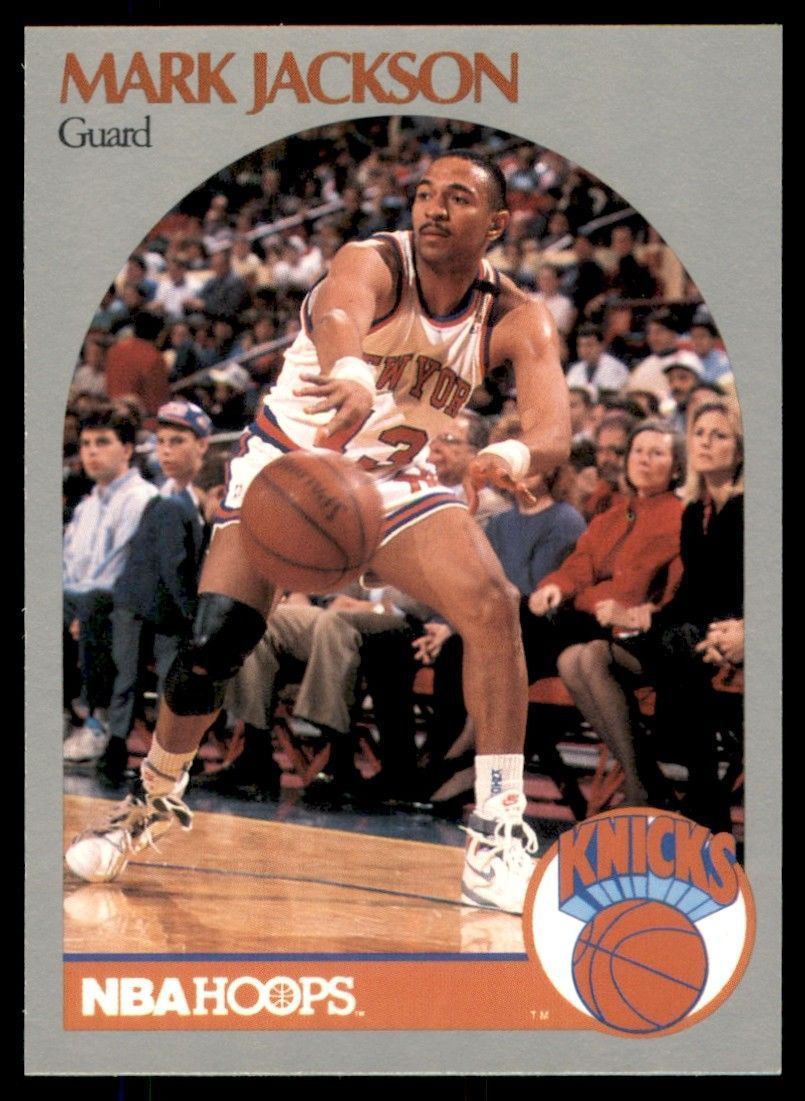
The guy who found it, Stephen Zerance, isn’t an NBA fan but a fan of true-crime. He’d read in court documents the brothers had bought the tickets and went looking for proof. When archival photo and video searches were fruitless, he thought about basketball cards. After looking on eBay, Zerance found his match and announced it this past August, 29 years after the murders. It’s some sort of real-life Time Travelers in Historic Photos bananas coincidence.
As an aside, I learned while writing this post the Menendez brothers weren’t initially considered suspects and got caught after one of the brothers admitted the murders to his psychologist, who told his mistress (the psychologist’s, not the brother’s), who told the cops. Eventually, the affair between the mistress and the psychologist ended, perhaps on account of the stress related to being an ancillary part of a high profile murder case, and likely badly as evidenced by the fact the mistress attended the Menendez trial as a witness for the defense with the intention of impugning the character of the psychologist. What a ride.
How We Talk About Racism in America is Wrong
For Vox, Jane Coaston writes about why Republicans took 15 years to act on House member Steve King’s racism. I found her point about how racism has become an insult to be wielded or avoided (depending on your perspective) rather than a useful descriptive term of behavior or views really interesting.
The way we talk about race and racism in the United States is wrong. In short, we think of “racist” as an insult rather than as an adjective. And we have narrowed down the concept of racism to an almost ludicrous extent, in effect often excusing real racism — such as that espoused by people like King — and its impact on nonwhite Americans because it is not literally wearing a hood or setting a cross alight on a lawn.
Later on in the piece, she quotes historian Ibram X. Kendi (who was a frequent guest on the excellent Seeing White podcast series) about this unhelpful shift.
“I think that the way a better part of America defines what a racist is someone who self identifies as a white nationalist or a white supremacist,” said Ibram X. Kendi, a historian at American University and author of Stamped From the Beginning: The Definitive History of Racist Ideas in America. “Someone who is in the Ku Klux Klan, someone who says the n-word, someone who engages in racial violence. Anything else, according to them, is not racist.”
We tend to define racism in a way that will not implicate our own views or ideas. “I think people define racism in a way that exonerates them. If they can narrow [the definition of racism] as much as possible to things they are not saying or doing or are about, that leaves them off the hook,” Kendi continued.
In his view, rather than “racist” being “a descriptive term with a clear-cut definition,” we have turned it into a “fixed derogatory putdown,” an insult. He told me that “by conceiving it in this way, we create a culture of denial in which everyone denies being racist but very few people know what a racist is.”
In effect, the term “racist,” which has an actual meaning, has now been turned into a schoolyard insult.
Why Is the Night Sky Dark?
I love how simple questions can reveal deep truths about how the universe works. Take “why is the night sky dark?” It’s a question a small child might ask but stumped the likes of Newton, Halley, and Kepler and wasn’t really resolved until Einstein’s theory of general relativity and the Big Bang theory rolled around. Here’s the paradox: if we live in a static infinite universe, shouldn’t the sky be unbearably bright?
Distant stars look weak, and very distant stars shine too dimly for you to see with your eyes. But when space telescopes like Hubble peer deep into the darkest spots of sky, they uncover bunches of incredibly faint galaxies. And the deeper they look, the more they find. If the universe went on forever with stars sprinkled evenly throughout — as many early stargazers assumed — the night sky would be full of so many points of light that it would never look dark.
“The fact that the stars are everywhere makes up for the fact that some of the stars are far away,” says Katie Mack, an astrophysicist at North Carolina State University. No matter which way you look, in an endless universe your line of sight would always end smack on the surface of a star, and the entire sky would always blaze with the brightness of the sun.
The answer to this paradox is that the universe is both finite & unbounded (per Einstein) and the darkness we see is the Big Bang.
The mystery of the dark sky is solved by the fact that this history has a beginning — a time before stars and galaxies. Many cosmologists think the universe started out as a very small point, and then started inflating like a balloon in an event called the Big Bang. If you look deep enough, you can see so far back in time that you get close to the Big Bang. “You just run out of stars,” Kinney says. “And you run out of stars, in the grand scheme of things, relatively quickly.”
If you’re anything like me, you just had a Little Bang go off in your brain. (via laura olin)
A Stroke Gave This Doctor the Gift of Rhyme
The brain is a fascinating organ. If you’re lucky enough to wake up after having a stroke, there’s a chance you might have some new habits or a different personality.
Some patients become hypersexual or compulsive gamblers. Others have even woken up speaking in a fake Chinese accent. “There was a famous guy in Italy who had what they called ‘Pinocchio syndrome,’” said Dr. Alice Flaherty, a joint associate professor of neurology and psychiatry at Harvard Medical School. “When he told a lie he would have a seizure. He was crippled as a businessman.”
When he was in his 50s, Beverly Hills doctor Sherman Hershfield suffered a stroke, and in the aftermath he become obsessed with poetry and start speaking in rhyme. That let to an interest in rap music and he started competing at an open mic in South Central LA as Dr. Rapp. He even befriended legendary rapper KRS-One, who shared with Hershfield an interest in how rap music and science converged in the human brain.
During the Q&A, Hershfield grabbed the mic and started to tell his story.
He explained that he was getting his language back together after a stroke by listening to rap records. “One of which was one of my songs,” KRS-One recalled.
Hershfield couldn’t stop himself.
“I started to have a stroke,” he rapped. “Went broke.”
The room fell silent.
“I started to think and speak in rhyme. I can do it all the time. And I want to get to do the rap, and I won’t take any more of this crap.”
The crowd erupted.
When Hershfield rapped about his struggles, not history lessons, he inspired the audience.
“He got a standing ovation,” recalled KRS-One. He gave the doctor his telephone number and suggested they hang out.
(thx, mike)
Massive Naturally Occurring Ice Carousel
Spinning disks of ice can form naturally in slow-moving parts of streams and rivers. What happens is a large chunk of ice gets caught in a quiet part of the river and then is spun and shaped into a circle by the nearby current.
In the video above, Tina Radel captured a particularly huge ice circle in the Presumpscot River in Westbrook, Maine…it’s about 100 yards across!
A couple of years ago, a smaller ice circle was observed in Washington and “went viral”:
The Westbrook ice circle isn’t that much smaller than the world’s largest man-made ice circle, which was fashioned in Maine last year and turned into a carousel by attaching several outboard motors to it.
Tiny Paper Crane Masterpieces
Check out these elaborate and colorfully decorated origami creations by paper artist Cristian Marianciuc.



To create these intricate artworks, Marianciuc folds traditional origami cranes and then adorns them with hand-cut paper and other materials. Some of his creations are available in his Etsy shop. (via @imperica)
Visualizing Dubious Spelling with Flow Diagrams
Colin Morris recently analyzed a corpus of comments from Reddit for misspellings by searching for words near uncertainty indicators like “(sp?)”. Among the words that provoked the most doubt were Kaepernick, comradery, adderall, Minaj, seizure, Galifianakis, loogie, and Gyllenhaal. Morris then used a Sankey diagram to visualize how people misspelled “Gyllenhaal” in different ways (with the arrow thickness denoting the frequency of each spelling):
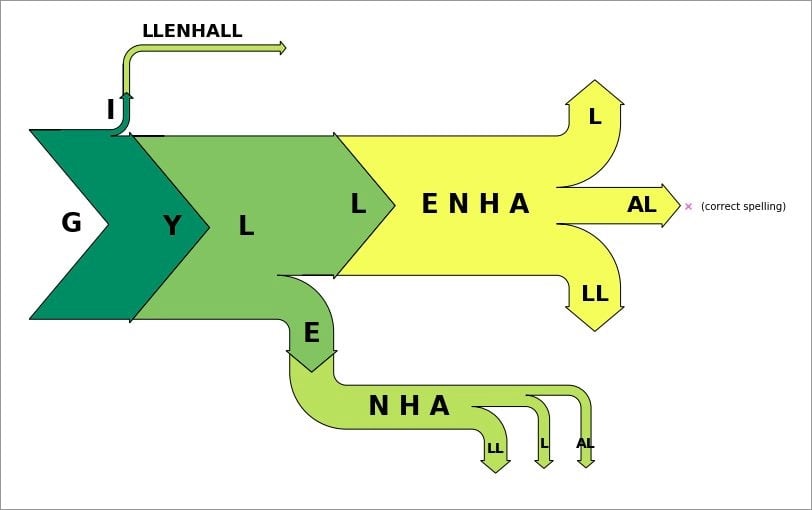
Tag yourself! (I’m probably on the yellow “LL” arrow.) Sankey diagrams are typically used in science and engineering to visualize flows of energy in and out of a system, but this is a clever adaptation to linguistics (sp?). I’d to see one of these for rhythm. (via @kellianderson)
One Film / One Shot
For more than a year now, Jon Lefkovitz has been making short videos of iconic scenes from films backed by the same musical score, a short clip of “Canis Lupus” from Alexandre Desplat’s Fantastic Mr. Fox score. Here’s Groundhog Day, 2001: A Space Odyssey, Jurassic Park (featuring a great example of the Spielberg Face), and the beautiful 2-minute shot from Big Night:
Each clip is between 30 seconds and 2 minutes 30 seconds long. Here’s the whole playlist.
Socials & More